






Abstract
The similarity between psychotic symptoms and aspects of mystical experiences is well known. It has long been recognized that there are similarities between mystical and spiritual and psychotic experiences. The content of an experience alone usually does not determine whether an individual is psychotic. The Russian composer Scriabin (1872–1915) was among the most famous artists of his time. Scriabin infused his music with mysticism, evolving a modernistic idiom through which he created a musical counterpart to the Symbolist literature of that period. In this paper, we discuss the question that arises from perusing Scriabin’s life is whether the composer was a mystic genius or whether he suffered from affective psychopathology with psychotic features.
Psychological diagnosis faces unique challenges when used to differentiate non-psychopathological religious, spiritual, and transpersonal experiences from those that might evidence psychopathology
1
(Figure 1).
Alexander Scriabin (1872–1915).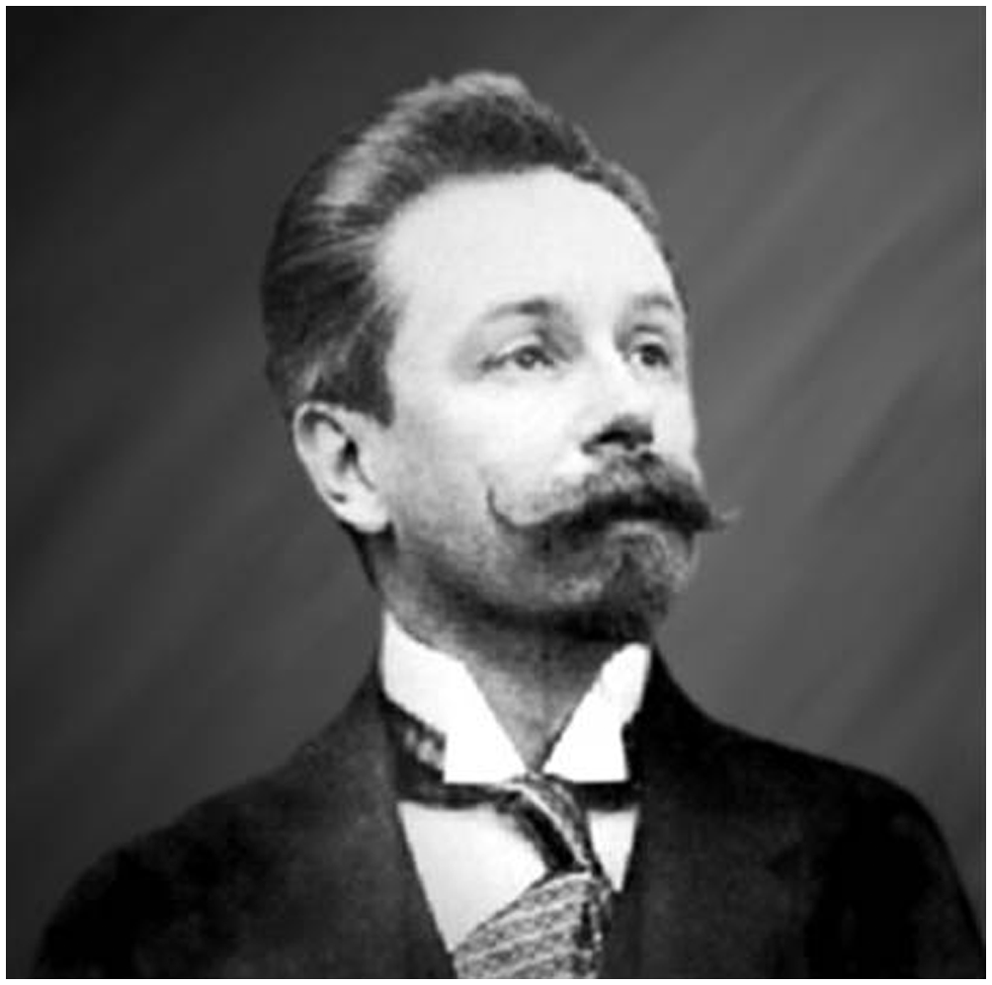
Historical background
Philosophy of music is the study of fundamental questions about the nature of music and our experience of it. Music is perhaps the art that presents the most philosophical mystery and is remained an abstract art in some sense. The Russian composer Scriabin, who was also preoccupied with mystical philosophy, was one of the most innovative and controversial of early modern composers.
The last quarter of 19th century was a most productive period of Russian music. The newly opened conservatories in Moscow and St Petersburg offered professional music education at the highest level. Russian folk music became a primary source for the younger generation of composers. Mikhail Glinka (1804–1857), the first famous Russian composer, was the first representative of the Russian nationalistic tradition, making nationalism the centre after years of influence from Western music and Western culture in general. This nationalistic trend heightened in the middle of 19th century being associated with the so-called Mighty Handful. This group included five composers and musician-innovators: Modest Mussorgsky (1839–1881), Nikolai Rimsky-Korsakov (1844–1908), Alexander Borodin (1833–1887), Caesar Cui (1835–1918) and their leader Miliy Balakirev (1837–1910) all of whom proclaimed as their aim to compose and popularize Russian national traditions in classical music.
This period also saw the foundation of the Russian Musical Society (RMS) in 1859, led by composer-pianists Anton (1829–1894) and Nikolay Rubinstein (1835–1881). The Mighty Handful were often presented as the Russian Music Society’s rival, with the Handful embracing their Russian national identity while the RMS tended to be more conservative. After the opening of the St Petersburg and Moscow conservatories, differences between two schools were clearly established. Perhaps, because St Petersburg was the cultural capital, the National Music School was established there. Moscow became the city of musical conservatism, the guardian of conservative Western traditions, remaining so until the second decade of the 20th century when new geniuses appeared. This school was built under the authority of Pyotr Ilyich Tchaikovsky (1840–1893) – the first major full-time professional composer in Russia. Though Tchaikovsky graduated from the St Petersburg conservatory, he did not continue the pure nationalistic traditions, being strongly influenced by western music.
The Russian composer Alexander Nikolaevich Scriabin was among the most famous artists of his time. Although he was never absent from the mainstream of Russian music, the outside world neglected him until recently. Today, there is worldwide resurgence of interest in his music and ideas. Scriabin did not follow old Russian national traditions. At the same time, as he neglected nationalism, he became antagonistic to conservatism. Thus, he became antipodal to both The Mighty Five and to Tchaikovsky. Scriabin belonged to the Russian Symbolists, organized against art too saturated with social motives and rather aimed toward a return to pure art mastery and the restoration of romanticism. Scriabin, a piano virtuoso, infused his music with mysticism, evolving a modernistic idiom through which he created a musical counterpart to the Symbolist literature of that period.
A history of Scriabin’s life
Scriabin was born into an aristocratic family in Moscow on 6 January 1872 according to the Gregorian calendar. The Scriabins had firm roots in the military: his father and all of his uncles had military careers.2,3
The Scriabin family has been traced back to the 13th century. Its first recorded member was described as a boyar, and Aleksandr Nikolayevich himself stressed his noble origins. Hailing from the Nizhny-Novgorod region, they moved to Moscow in the 16th century and, by the 19th century, were established as a respected military family. The composer’s grandfather, Aleksandr Ivanovich (1811–1879), is said to have run his immediate family like an army platoon. Scriabin’s father, Nikolay Aleksandrovich (1849–1914) discontinued the military service and began studying law but left his studies soon after marrying Lyubov’ Petrovna Shchetinina (1849–1873), mother of the composer. She was one of the first recognized female musicians in Russia, a pianist and composer who had studied with Theodor Leschetizky (1830–1915), knew Anton Rubinstein and drew high praise from Tchaikovsky. She gave a recital of works requiring virtuoso technique only 5 days before Scriabin was born.2,3
By the time his mother gave birth, she was ill, and 10 days afterwards, her lungs were grievously inflamed, and the infant was removed from her to prevent contagion. A wet nurse (Arina) had been hired, and she remained with family long after her milk had dried up. The infant’s paternal aunt Lyubov' Alexandrovna (his father’s unmarried sister) assumed a significant care-taking role in his life. When Scriabin was only 7 months, his mother died of tuberculosis. 2
After her death, Scriabin’s father, Nikolay, returned to his studies of the Turkish language in St Petersburg, which he had left earlier to marry Lyubov' Petrovna. Father and son had little contact, and he left the baby (nicknamed Sasha or Shurin’ka) with three females – his grandmother, his great aunt and his aunt (Lyubov’ Alexandrovna). His father finished his studies, became a diplomat and finally left for Turkey. He would later re-marry, giving Scriabin several half-brothers and sisters. His aunt Lyubov was an amateur pianist who documented Sasha’s early life up until he met his first wife. As a child, Scriabin was frequently exposed to piano playing, and anecdotal references describe him as demanding that his aunt plays for him and he even asked her to put him on her knees so that he could play on the grand piano. 3
From his earliest years, Scriabin was taken care of by his paternal grandmother and his maiden aunt who was like a mother to him. As a boy, Scriabin revealed striking musical abilities. He improvised at the piano and tried to play by ear. 4 For example, in 1877, at the age of 5, he heard a military march while soldiers were marching to battle. Immediately after returning home, Scriabin reconstructed the piece from memory. 3 His aunt was his first piano teacher.
At the age of 7, Scriabin began to construct complicated toy pianos, complete with soundboards, pedals, moveable keys and wires. He also wrote dramatic pieces that he performed with a puppet theatre of his own making. However, because of general nervousness and delicacy – he was a thin, pale child apparently – and fits of unhappiness, he was brought to see a medical specialist by his worried aunt but she was assured that nothing was wrong that could not be remedied by means of wholesome food and clean air.
Musical education
Scriabin received his first formal musical lessons from Georgy Konyus (1862–1933) for whom he began to compose as well as play. Then, Sergey Taneyev (1856–1915), an excellent pianist and head of the piano department at the Moscow Conservatory, accepted him in preparation for entrance into the Conservatory. Through Tanayev, Scriabin was guided to study piano in 1884 with the leading teacher in Moscow, the notorious Nikolai Zverev (1832–1893). 5 He was a tyrant and subject to hysteria. He sadistically punished boys for the slightest infractions, such as for a wrong note or for inattention. He beat them and threw vases at them recklessly. 2 Zverev, who became his influential piano teacher, insisted that his teenage piano pupils should live in his own house and be subject to the most disciplined of regimes. Under his guidance, Scriabin learnt not only French and German but also the manners of high society; he was exposed to great literature and how to drink vodka. Although he studied among a group of boys of similar age who included Rachmaninoff (1873–1943) and Goldenweiser (1875–1961), he soon became Zverev’s favourite.2,3
Contrary to his father’s and certainly his aunt’s wishes, Scriabin expressed a desire – encouraged by his elder cousin Mitya – to attend the Cadet Corps; he became the ‘only cadet of the Russian Army never to carry arms throughout five years of training’. 2 Scriabin dedicated a Nocturne to his teacher who attempted to dissuade his pupil from composition.
In 1882, he joined the second Moscow Cadet Corps. As a student, he made friends with the actor Leonid Limontov, although in his memoirs, Limontov recalls his reluctance to make friends with Scriabin who was the smallest and weakest among all the boys and was sometimes teased because of this. However, Scriabin won his peers’ recognition since he was generally at the top of his class in academics but was exempt from drilling due to his physique and he was given time each day to practice piano.
Later, Scriabin studied at the Moscow Conservatory with Anton Arensky (1861–1906), Sergei Taneyev (1856–1915) and Vasily Safonov (1852–1918). He became a noted pianist despite his small hands that could barely grasp a ninth. In 1886, Scriabin’s right arm was injured in a carriage accident and, although this had the undesirable effect of intensifying his aunt’s coddling, it also, as his hand strain did later, acted as a catalyst to further composition.3,5 His physician claimed that he would never recover. Scriabin then wrote his first large-scale masterpiece, the F minor sonata, as a ‘cry against God, against fate’. 3
In 1887, Scriabin started to write spiritual poems that were associated with particular musical works as well as noting down his views on religion. In 1892, he graduated with the Little Gold Medal in piano performance but did not complete a composition degree because of his strong differences in temperament and musical taste with Arensky, the composition teacher. Scriabin declined to carry out composition homework in forms that did not interest him. In the end, Arensky refused to sign Scriabin’s graduation certificate.2,3
In August 1897, Scriabin married the young pianist Vera Isakovich (1875–1920), a fellow student in the conservatorium, and went on tour in Russia and abroad, culminating in a highly successful 1898 concert in Paris. That year, he became a teacher at the Moscow Conservatory, supporting himself and his wife while attempting to establish his reputation as a composer.
The Mysterium
The Mysterium was the project that underpinned all the compositions of his last phase. The first idea for the Mysterium came to Scriabin in 1901. As Boris Schloezer (1881–1969) 4 suggested, the evaluation of his aesthetic, but also his philosophical views, depends on the status of the Mysterium. What triggered the work? Was it the crisis in his marriage? The central idea of the Mysterium was simple. 6 This original vision was not to be greatly altered over time although there were to be accretions, especially from Theosophy. 6 Scriabin left only sketches for this piece, the Mysterium, although a preliminary part called L'acte préalable (Preparatory Action) was eventually made into a performable version by Alexander Nemtin (1936–1999). 7 The Mysterium was, psychologically speaking, a world Scriabin’s genius created to sustain its own evolution. 5 To paraphrase Scriabin’s close friend, the symbolist, poet and philosopher Vyacheslav Ivanov (1866–1949), Scriabin’s music and therefore also its logical culmination in the Mysterium would not have wanted to be and could not have been ‘only art’. 7 Some scholars emphasized the obsessive way in which Scriabin worked on his plan.4,6
What exactly was this Mysterium? It is nearly as impossible to summarize adequately as it must have been to accomplish. Scriabin envisioned it as a kind of immense liturgical rite, lasting 7 days or perhaps longer and set against the backdrop of the Himalayas in India, during which the barrier between audience and performers would be dissolved to allow for a spiritual communion leading to an ecstatic dissolution and transfiguration of the world. All would perform and celebrate. All of the arts would be included – music, dance, theatre, poetry, visual colours; all of the senses too would be engaged – even taste and smell. 5
For a period of 5 years, Scriabin was based in Moscow, during which time the first two of his symphonies were conducted by his old teacher Safonov. By the winter of 1904, Scriabin and his wife had moved to Switzerland where work began on the composition of the Third Symphony (The Divine Poem). This piece was performed in Paris in 1905 where Scriabin was now accompanied not by his wife but by Tatiana Schlöezer (1883–1922) – a young pupil and the niece of Paul de Schlözer.2,3
Scriabin’s private life
The first time Scriabin met Tatiana was in 1898 when she was 15 years old. He found her strikingly pretty, matching his taste for very young dark women. 2 He left his wife Vera in 1905 during his stay in Switzerland. He had arranged for Tatiana to live in a neighbouring village and explained her presence for reasons of health. Vera, however, was soon informed of the real state of affairs and, shortly after she had left, Tatiana took her place in his apartment. With Tatiana Schlöezer (whom he could not marry because his first wife refused to divorce), he had two girls and a son named Julian.2,3
Scriabin may have also had some homosexual encounters. As one of his important biographers, Bowers expresses it ‘Even today within these post-Freudian latitudes, to impute homosexuality – latent, passive, or ultimately triumphed over – as it was in Scriabin’s case in my opinion, still it would be recreant to shirk a rather homosexual interpretation of Scriabin’s life. Incontrovertible proof cannot now be dredged up from the past, but so many signposts there seem to be’. 2 Of course, there was good cause to be secretive. It is important to note that in Tsarist Russia, homosexuality was subject to a 10-year sentence of imprisonment and exile. Another question is was Scriabin’s sexuality shaped by his all female upbringing and absence of a father figure? 6 Scriabin himself wrote ‘I drowned myself in pleasures and was put to the test by them. I have known since that the creative act is inextricably linked to the sexual act’. 2
Scriabin’s musical life
With the financial support of a wealthy sponsor, Scriabin spent several years traveling between Switzerland, Italy, France, Belgium and United States, working on more orchestral pieces, including several symphonies. He was also beginning to compose ‘poems’ for the piano, a form with which he is particularly associated.
In 1907, he settled in Paris with his family and was involved in a series of concerts organized by the impresario Sergei Diaghilev (1872–1929) who was actively promoting Russian music in the West at the time. Subsequently, he relocated to Brussels with his family.
In 1909, he returned to Russia permanently where he continued to compose, working on increasingly grandiose projects. For some time, before his death, he had planned a multi-media work to be performed in the Himalayas, a grandiose religious synthesis of all arts, which would herald the birth of a new world. It is possible to see the influence of his trip to the Himalayas in his grandiose composition, the Mysterium.
In October 1911, his financial situation improved due to income from increased numbers of concert appearances (which generally he did not enjoy doing). When the concerts subsided, he was able to write the sixth and seventh piano sonatas, the latter being among his favourite works. In 1912, he and Tatiana took a holiday in Switzerland where Scriabin continued to compose (e.g. the Etudes op.65) before returning to Moscow.2,3
In early 1913, Scriabin gave a successful series of concerts in London. That summer was spent in the province near Moscow. There he finished three more piano sonatas, numbers 8–10. At the end of the summer, he travelled alone to Switzerland where he buried the hatchet with his father and was visited, after much pestering, by Stravinsky (1882–1971). Stravinsky heard Scriabin play his late sonatas and found them ‘incomparable’; Scriabin later said that Stravinsky’s music possessed a ‘minimum of creativity’.
In early 1914, Scriabin wrote K plameni (Toward the flame) before returning to London where he was afflicted by a furuncle on his upper lip. He improved upon his earlier successes; his reception was ecstatic in most quarters. The summer was spent in a dacha near Moscow accompanied by an entourage of disciples. There he finished his last works and laboured over the text of the Predvaritel'noye deistvo (The Preliminary Action).
Disease and death
Back in Moscow, he gave a number of concerts with works from every stage of his life, ranging from the Waltz op.1 to some of the op.74 preludes. Scriabin made his last public appearance in St Petersburg on 2 April 1915. Returning to Moscow, he noticed a pimple on his upper lip reminiscent of the one that had afflicted him in London.
8
During the 4 days from 7 to 11 April, his temperature rose rapidly, and his state deteriorated progressively. On 11 April, crowds thronged the staircase of his flat – the situation had become grave. One incision was followed by others. A blood test revealed two types of microbes – streptococcus and staphylococcus, and unfortunately at that time, there were no antibiotics that could save Scriabin’s life. On 14 April 1915, at the age of 43, Scriabin died in Moscow from septicaemia.2,3,7 He was buried in the most famous cemetery in Moscow – Novodevichy. The cemetery holds the tombs of Russian authors, musicians, playwrights and poets as well as famous actors, political leaders and scientists (Figure 2).
Scriabin’s grave in the Novodevichy Cemetery in Moscow.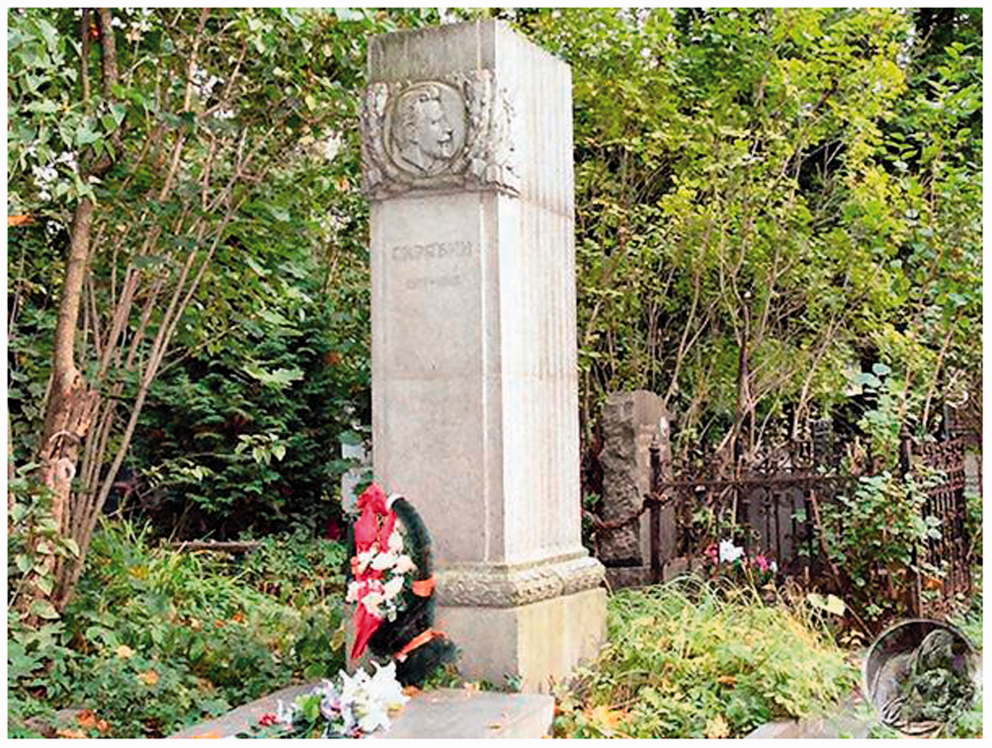
Scriabin and mysticism
Boris Schloezer, who was Scriabin’s lifelong friend and the brother of his common wife, Tatiana, was also his biographer. In Schloezer’s biography, a whole chapter is devoted to Scriabin as a Mystic 4 (pp.108–154). He writes, ‘In his childhood and early youth, Scriabin was very religious’. He underwent a religious crisis when he was 20. ‘It passed, without complications’ as Scriabin told Schloezer.
Schloezer himself tried to understand the nature of Scriabin’s mystical experiences and their relationship to his mental state. In order to do that, he prepared an introduction to mysticism.
He asks ‘What was the nature of his [Scriabin’s] mystical doctrine? We must first examine Scriabin’s personal experience, for his mysticism informed his creative work and crystallized his action which must be examined from a psychological standpoint in order to view it’s vital flow’. 4
‘Scriabin’s mystique was of a masculine and volitional, rather than a feminine or receptive, character; it was marked by a strongly pronounced pragmatism that rendered his contemplations dynamic, their power being derived from his visions’. 4
In one of Scriabin’s notebooks, dated about 1906, there are some remarkable autobiographical revelations. Here is a fragment: ‘Early childhood: Love of fairy tales, vivid imagination, religious moods. Entry into the military school at the age of ten. Unbounded faith in teachers and in the priest. Naive belief in the Old Testament. Prayers. … A very serious participation in the mystery of the Eucharist… At sixteen, a remarkable absence of self-analysis. … At twenty, an ominous hand ailment, a most decisive event of my life. Fate puts an obstacle, incurable according to the doctors, to the attainment of an ardently desired goal-brilliance, fame. The first serious failure in life. The first earnest attempt at philosophy; the beginning of self-analysis. Reluctance to admit that my ailment is incurable, and yet an obsession with somber moods. First reflections on the value of life, religion, God. Continued strong faith-in God the Father rather than Christ’.
Schloezer commented that Scriabin asserted the primacy of motion and denied the existence of the subject of the motion. ‘I remember with what satisfaction he told me, upon reading Windelband’s History of New Philosophy that Fichte also interpreted the world as a system of pure processes and recognized only acts, not substances, as valid entities’. Schloezer found Scriabin’s notebooks date from 1903 to 1905, the period during which he composed Ie Poeme divin and Ie Poeme de l'extase. From these intimate notebooks, the reader is impressed by Scriabin’s unmasked internal desires: ‘The universe represents the unconscious process of my creative work. The sensory world is a part of it, illuminated by my attention. I am nothing, I have a will to live. Through the force of my desire I create myself and my feeling for life. Life. Creative elan. All is in us, and in us only. O you, the depths of the past born in the rays of my memory. O you, the summits of the future created by my dream: you do not exist; you constantly dance and change, just as my desire, free and unique, dances and changes. I am free. I have a will to live. I yearn for the new and the unknown. I want to create, create consciously. I want to engulf everything and absorb everything in my individuality. I want to give delight to the world. I want to take the world as one takes a woman. I need the world. I am what my senses feel. I create the world by these senses. I create the infinite past, the growth of my consciousness, the desire to be myself. I create the infinite future, the repose in me, the sorrow and Joy in me. I am nothing. I am only what I create. The destiny of the universe is clear. I have a will to live. I love life. I am God. I am nothing. I want to be all. I have generated my antithesis – time, space, and plurality. This antithesis is myself; for I am only what I engender. I want to be God. I want to return to myself. The world seeks God. I seek myself. The world is a yearning for God. I am yearning for myself. I am the world. I am the search for God, for I am only what I seek. The history of human consciousness begins with my search and with my return’.
4
(Figure 3).
Scriabin’s schema of the world. Scriabin’s drawing of the World shows the centripetal–centrifugal forces whose swirling vibrations and rhythm absorb time and space. The powerful flow forms a Figure 8, and this, for Scriabin, locates God in the centre. He himself is here with the past and future placed (in space) above and below him (in time). His disembodied spirit freely rests at the still centre around the world turns.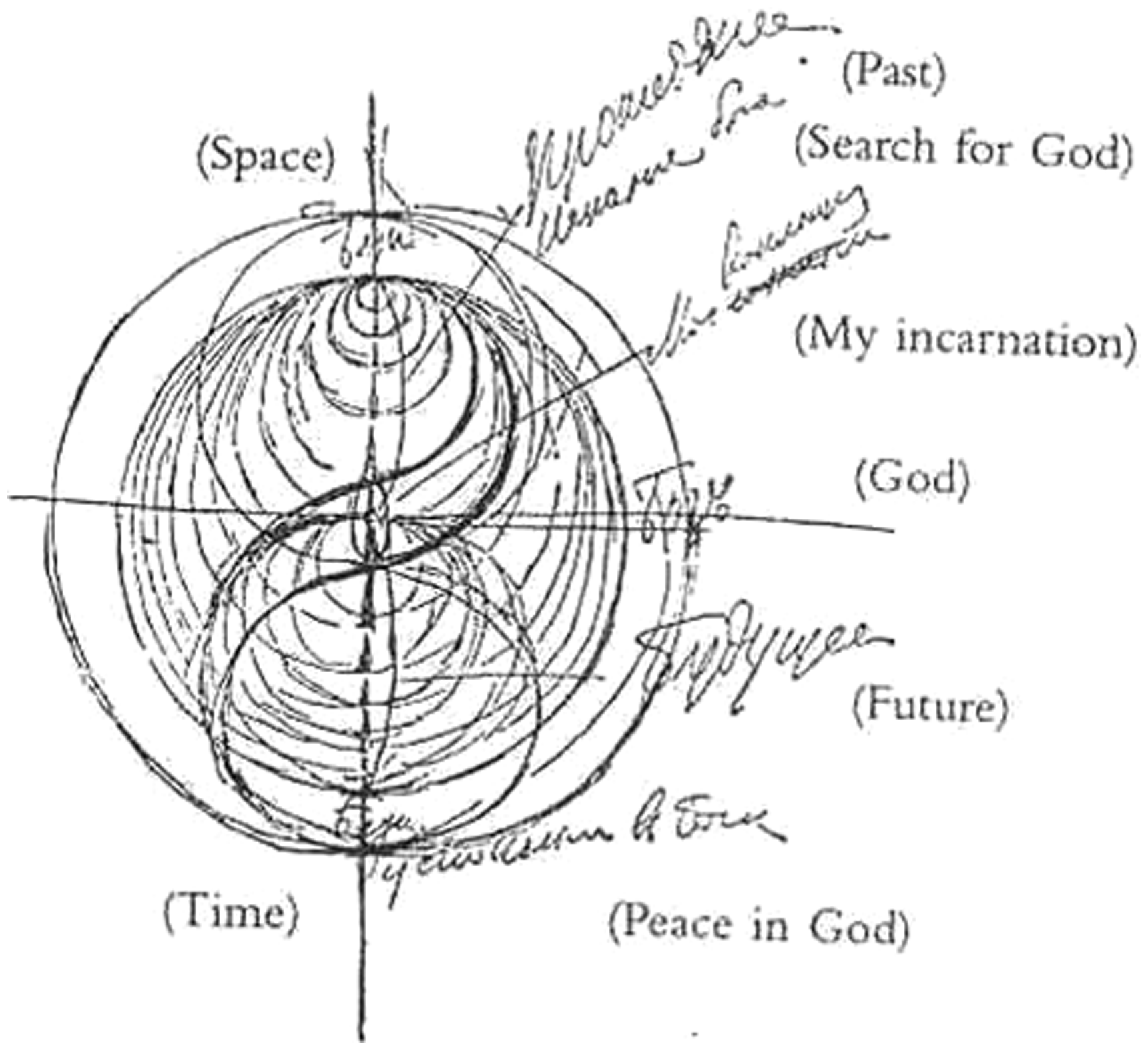
Schloezer also dwells on the phrase ‘I am nothing’, which occurs on almost every page. It was also a constant refrain during their conversations. ‘Having destroyed everything in the Spirit, Scriabin equated the Spirit with nothing. I recall his joy when this idea suddenly dawned on him. “Nothing exists!” Scriabin exclaimed. “I do not exist! But if nothing exists in reality, then everything exists if I ordain it to exist by an act of creation”’. This refrain, ‘I am nothing’, expressed Scriabin’s antisubstantialism, his postulate of the pliable nature of existence, obedient to the commands of the creator, and his feeling of boundless freedom. ‘If nothing exists’ he used to say ‘then all is possible’. Schloezer thought that these utterances betray an egocentric, state of mind. ‘The world is the product of my imagination’ Scriabin seems to declare: ‘I am divine; and nothing exists outside of me’.
Scriabin concludes with this declaration: ‘…I am an individual conscious of myself, but I am also an act defined by my relationship to the external world. But in the absolute, I am God; I am a consciousness simultaneously experiencing all other consciousnesses. I am you. I am all. I have unconsciously created the world as many times as there are living creatures. Now I have elevated myself to the level of conscious creation. The true center of the universe is the all-embracing consciousness…’
4
(pp. 124–125)
Was Scriabin a mystic or mentally ill?
Psychiatric and psychological diagnosis face unique challenges when used to differentiate non-psychopathological religious/spiritual/transpersonal experiences from those that might evidence psychopathology, particularly considering the diversity of such experiences and the value-laden assumptions inherent in most diagnostic practices. 1 This challenge become more prominent when one tries to apply psychiatric or psychological diagnostic to a historical figure. Our purpose is not to find psychopathology in famous artists but to examine the complex relationship between creativity and psychopathology and to see whether there are specific influences of psychopathology on art. 9
The question that arises from perusing Scriabin’s life is whether the composer was a mystic genius or did he suffer from affective psychopathology with psychotic features. Perhaps, both possibilities are relevant.
One of the most important biographers and researchers of Russian musicology was Leonid Sabaneyev (1881–1968). He had a special interest in Alexander Scriabin who he knew personally and admired. Sabaneyev devoted a special study to Alexander Scriabin and became an authority on this composer. He published his memoir about Scriabin a year after the composer’s death in 1916. 10
Sabaneyev adored and admired Scriabin, and no one could accuse him of being prejudiced against Scriabin. Hence we should take in earnest his description of Scriabin’s mental state as given in his memoir:
‘Scriabin’s psychosis developed gradually, from about the age of thirty-five. Actually, from the moment that he himself described his own psychosis, it began to grow stronger and take on clinical dimensions. It was undoubtedly a religious mania with strongly developed erotic aspects. His music was orgiastic through and through, and it was precisely because of this that he was attracted to exotic countries like India’. 10
Scriabin was well known as a mystic and possessed synaesthetic abilities. A serious question arises why this important critic, the biographer of Scriabin described him as ‘psychotic’, while another researcher of Scriabin’s life and works, Emanuel Garcia, vigorously rejects any possibility of mental disease. 11 In this paper, we aim to investigate and clarify this matter.
Scriabin saw himself as the messiah of some cataclysmic event, an experience of ecstasy in death, ‘the ancient dream’ as Schloezer expresses it, ‘of a universal reunion of humanity with divinity’. 4 Scriabin’s personality and his behaviour but also his music became very controversial. After his death in the 1920s, for example in England, one witnessed a backlash ‘against the burgeoning cult of Scriabinists’. This extreme expression is evident in a brief essay by Alexander Brent-Smith (1889–1950) titled ‘Some Reflections on the Work of Scriabin’.12,13 Scriabin is accused of having been ‘musically unhinged, mentally confused, illogical’. 12 and Brent-Smith calls his later music ‘monotonous and senseless noise’. 13
Sabaneyev’s observations led him to the conclusion that the composer’s Mysterium project became an ‘idea fixe’ that was rooted in some mental disorder. He wondered, ‘Could it not be that this grandiose Mysterium ultimately represents merely the material to be placed in the hands of a psychiatrist?’ 10
Scriabin was small and reportedly frail and a hypochondriac, his entire life. The likely trigger for this was his near death from measles in 1884 at the age of 12. In the same year, Scriabin’s right arm was injured in a carriage accident. In May 1893, after intensive piano practice, Scriabin suffered from recurring serious pains in his right hand. The pain spread up his arm. His whole career as a piano virtuoso was at risk. In order to restore his health, he took long vacations in the Crimea and later in Switzerland.2,3
Between the ages of 20 and 29, some of his serious biographers such as Bowers describe him as being on the verge of a nervous breakdown: ‘Scriabin was imprisoned within himself. His only escape was through music’. 2
One can certainly ask, was he a manic depressive? Was he insane? Certainly, he exhibited all kinds of obsessive and compulsive disorders. Moreover, in his history, there are some hints of affective problems. For example, when he was in Heidelberg, in 1895, he suffered from depressed mood and anxiety for which he turned to Professor Wilhelm Erb (1840–1921), a specialist in nervous disorders, the leading neuropathologist in Germany. Professor Erb gave him a lot of advice and recommended hydrotherapy in Switzerland. Sadness seems to be prevailing wind in Scriabin’s life.2,3
The similarity between psychotic symptoms and aspects of mystical experiences is discussed in the psychiatric literature.14,15 It has long been recognized that there are similarities between mystical and spiritual and psychotic experiences. 16 Both kinds of experience are ‘altered states’, and a wide variety of phenomena are common to both: for example, radical change of belief, time distortion, perception of and communication with supernatural entities, perception of meaning in events and purpose in life, social withdrawal and so on. The content of both kinds of experience has striking similarities, religious themes being common in psychotic delusions and the epistemological revelations of spiritual experiences often contrast sharply with the everyday view of reality. 17
The content of an experience alone usually does not determine whether an individual is psychotic. The psychotic person seems unaware of the fantastic nature of his claims and embellishes his account with self-aggrandizing statements. 16 The question is how to conceptualize and analyse such contents. The similarity between mystical and psychotic states is well known. 18 Both include the following features: social withdrawal, delusions, hallucinations and strange behaviour.15,19,20 Features considered specific to mystical states are often found in psychosis: noesis may be experienced at the onset of psychosis,15,21 so too ‘unio mystica’, the sense of mystical union with God prominent in Christian mysticism.22,23 However, ‘the mystical experience is transient (usually hours) and resolves completely, while psychotic states may last months or years, and will often leave residual delusions, flattening of affect or reduced social functioning’. 18
Scriabin’s circle of friends considered this alternative the ‘innocuous Mysterium’. 10 Sabaneyev assumes the new project is sort of a ‘retreat’ for Scriabin. Confessing his own limited interest in the Mysterium project, Scriabin continued to view himself in the position of the designated one, the prophet, the Messiah, the conductor to whom Fate had revealed the conditions for further evolution and the act of reunification. Involution increasingly assumed a very negative connotation in the mind of the composer. It was no longer the dispersion of golden rays emanating from an absolute source. For him, it represented everything repugnant in the material world. Most shocking in this regard are his opinions concerning Jewry in music.18,24
Considering the entire material presented here, it appears from all evidence that, in addition to a disturbed personality, Scriabin suffered from an affective disorder that could explain his mood fluctuations. The grandiosity expressed in the Himalayas project and even his mystical experiences during which he experienced himself as God the creator are rare in mystical experiences.