






Abstract
Isaak Levitan (1860–1900) was one of Russia’s most influential landscape artists. He lived a very short life, only 40 years, but left more than 1000 paintings. He suffered from mood fluctuations, and died as a result of serious heart disease. After an introduction related to the issue of creativity and mental disorders, a short biography of Levitan’s life is outlined, followed by some examples of his mood and behavior. A section on the mood’s reflection in Levitan’s professional work is followed by a description of his romantic loves and disappointments and his relationship with his contemporary Russian, the writer Anton Chekhov.
The relationship between the creative process and the artist’s mental state was described in early antiquity, and has continued to be discussed throughout history. Thus, Aristotle 1 contended that “no great genius is entirely free of madness.” Lombroso, 2 in his well-known work “The Men of Genius,” written towards the end of the nineteenth century, argued that genius is a type of degeneration, and that creative ability is intensely linked with psychopathology, the latter being inherited for the most part. 3
Increased interest has recently led to several systematic studies,4–7 in which a link between depression and artistic creativity was found. For example, according to Jamison, 38% of the writers and painters in her sample had received treatment for mood disorders. It is noteworthy that the treatment in question was invariably for depression. None of the subjects had sought help for manic or hypomanic states, although they most certainly had suffered from the latter. This is evident from the fact that a third of the group had reported pronounced fluctuations of mood, evidently cyclothymic in nature, judging by the authors’ remark that 89% of writers and painters had experienced intense creative episodes that resulted in high productivity. 8
Such studies attempt to reconstruct the life narrative of creativity and psychopathology of an individual on the basis of available evidence. The most objective and reliable sources are documents, in particular letters, diaries, memoirs of contemporaries and medical documentation. Another contribution is reflected in the artist’s works of art, which contain information concerning personal characteristics, emotional states, and creative mechanisms that can be derived from an in-depth evaluation of the works.
This process of evaluation can be compared to the art of mosaic, in that the researcher tries to put together a coherent picture of the artist’s life from disjointed, fragmentary pieces of evidence, by carefully selecting, studying and, finally, combining them together with artful precision. However, such retrospective investigation of the correlation between psychopathology and creative achievement is fraught with numerous methodological problems.
9
In spite of the fact that biographies contain a great deal of important and valuable information, they are unavoidably colored by the author’s personal taste and biases. A telling example can be found in descriptions of mood fluctuations abounding in biographies of painters, writers and composers. Periods of lowered mood, melancholy and depression, invariably accompanied by inactivity and creative stagnation, are usually described in great detail. Moreover, alternating periods of heightened mood (hypomanic states or sometimes even obvious psychoses) are often not interpreted as pathology at all, but termed “eccentricity,” “inspiration,” or “manifestations of artistic temperament”.
7
Such subjectivity in the biographer’s evaluation of the artist’s life and behavior contributes to the difficulties of retrospective psychiatric research.
Self-portrait, 1880s Levitan I.I. The Vladimirka Road, 1892, Levitan I.I. Permission of the State Tretyakov Gallery, Moscow. Levitan I.I. Golden Autumn, 1895. Permission of the State Tretyakov Gallery, Moscow.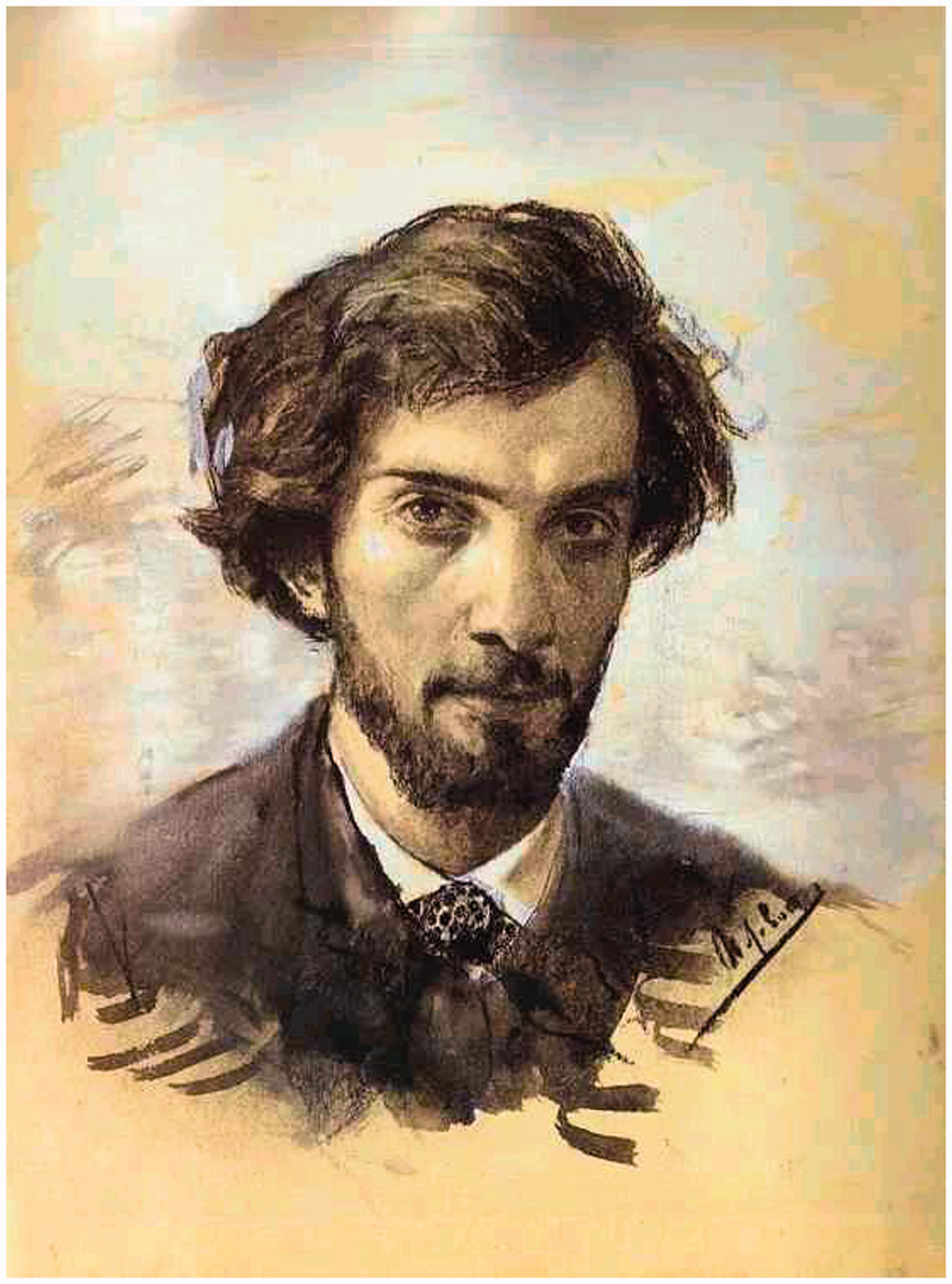


Nevertheless, the association between affective illness and artistic creativity is well known to artists themselves and is manifested in their works.7,10,11 There is an intimate connection between the artist’s inner world, his feelings of depression, despair or happiness, and his paintings. This relationship is clearly seen in the works of the Russian painter Isaak Levitan (1860–1900), who has been called the father of Russian landscape painting (Figure 1.)
It is no coincidence that Levitan’s works are usually associated with a melancholic mood. He was the founder of “the mood landscape,” in which the landscape is richly imbued with poetic associations. Levitan lived a very short life – only 40 years – but he left more than 1000 paintings. He suffered from mood fluctuations, and died as a result of serious heart disease. In February 1901, a few months after the artist’s death, an exhibit of several hundred paintings by Levitan opened in Moscow and later moved to St. Petersburg. By then, the greatness of the artist who had painted these landscapes was quite clear, as well as his important place in Russian art.
There are few documents remaining regarding Levitan's life. His personal archives including his correspondence were destroyed on his own orders shortly before his death.
Short biography
Isaak Il’ich Levitan was born on 30 August 1860, in the small remote Lithuanian village Wirballen near a small railway station Kybartay (within the limits of the Jewish Pale of Settlement) into a poor but educated Jewish family. Isaak had two sisters and brother. His mother was a housewife. His father, Elyashiv (in Russian – Ilya) Levitan, was the son of a Rabbi who had completed religious studies in a Yeshiva, and was a self-educated man. He taught German and French and later worked as a translator at a railway bridge construction site for a French building company. Isaak Levitan received his primary education at home with his father. In 1870, the Levitan family moved to Moscow, where the father earned a living as a French and German tutor in Jewish families.12,13 Isaak’s father spent a lot of his free time educating his children at home. Both of Isaak’s parents were interested in art and so, when Isaak and his brother Avel showed an interest in art, they were more than pleased to nurture their children’s love of drawing and painting.
In September 1873, Isaak Levitan entered the Moscow School of Painting, Sculpture and Architecture, where his older brother Avel had already studied for two years. After spending a year in the copying class, Isaak moved on to a naturalistic class, and soon thereafter he entered a landscape class. Levitan’s teachers were famous artists such as Vasily Perov (1834–1882), Alexei Savrasov (1830–1897), and Vasily Polenov (1844–1927).
When he was only 15 years old, in 1875 Isaak’s mother passed away, and the same year his father became seriously ill. Forced by illness to leave work on the railroad, the father could not financially maintain tutoring his four children. Fortunately, the children’s school provided some material assistance to the brothers, and in 1876 freed them from tuition fees “because of extreme poverty” and because they “had great success in the arts.” In 1877, Isaak and his father were hospitalized due to high fever. His father died, and Isaak’s health was impaired, the aftereffect of the illness being heart disease.12,13
Following the death of Isaak’s father, the children lost their financial support. Isaak had no money to pay fees for his college studies, nor even money for basic living expenses. He was requested to leave the college due to inability to pay his tuition fees, but was saved by the kindness of friends who gave him the money needed to continue his studies. Alexei Savrasov was impressed by Levitan, and brought him into his landscape painting class. In March 1877, two works of Levitan at an exhibition received awards by the press, and the 16-year-old artist was given a small silver medal and the sum of 220 rubles in order to continue his studies.12–14
In May 1879, there began massive deportations of Jews from the big cities of Russia after an assassination attempt made on Alexander II, in spite of the fact that no Jews were involved in this affair. Isaak, his brother and sisters, were forced to leave Moscow, and moved to Saltykovka, a small village near Moscow. Later that year, due to pressure on the local government officials and art lovers, Isaak Levitan was permitted to return to Moscow.
More widespread acceptance of the artist came towards the end of 1879, after Isaak included his painting Autumn Day, Sokolniki in the second students’ exhibition. This work received great reviews and the following year it was purchased by the art collector and philanthropist, Pavel Tretyakov (1832–1898), the founder of the famous Tretyakov Gallery in Moscow.
During that period, Levitan met the famous writer Anton Chekhov, with whose brother Nikolai, Isaak studied at the Moscow College of Arts. This friendship continued for many years. During the summer of the mid- and late 1880s, Levitan spent much of his time with the Chekhov family, who had a summer residence near Moscow.
In the spring of 1884, while 24 years old, Isaak left the Academy due to disagreements with some teachers and because of his non-attendance. Despite his success, the Council of the School granted him a diploma that merely entitled him to be a teacher of calligraphy. After he was diagnosed as having serious heart disease, he was advised to move to a warmer climate further to the south of the country. Thus, during late March 1886, Levitan visited the Crimea for the first time. There, he completed more than 60 sketches and paintings during two months. Upon returning to Moscow, all of them were purchased and that success brought financial stability. During the long summer months between 1887 and 1890, Levitan travelled far and wide to small towns along the Volga River. The Volga series established Levitan as the painter of “the landscape of mood,” and his style became popular with other Moscow landscape artists of the time.
In 1890, Levitan travelled to Europe visiting Germany, Switzerland, France and Italy. His reputation as an artist spread throughout Europe. His exhibits met with unreserved acclaim from both his fellow artists and the general public.
During the same year and by order of the Moscow Governor-General, the Grand Duke Sergei Alexandrovich, about 20,000 Jews were deported again from Moscow. Levitan was one of them. This event traumatized him severely. During his deportation, he lived in a place not far from the Vladimir Highway, ruefully known as the “Vladimirka.” It was a 190-kilometre road, which went from Moscow to Vladimir, Nizhny Novgorod, and then to Siberia. Siberia was the customary place of exile. In 1892, Levitan completed his painting entitled The Vladimirka Road (Figure 2). This road depicted in the painting, saw an endless movement of prisoners in shackles being marched from Moscow to the Siberian penal colonies. 15
In 1897, Levitan was elected as a member of the Imperial Academy of Arts, and in 1898 he was nominated the head of its Landscape Department. His health was deteriorating and the heart disease which had been diagnosed 10 years earlier was making his life more difficult. He suffered constant pain and had little energy. In the winter of 1899, his physicians recommended to him that he travel to Yalta in the Crimea. He spent the last year of his life at Chekhov’s home in Yalta. Levitan’s health was worsening and he spoke about his imminent death. The artist died on 22 July (August 4th) 1900, just 40 years of age. During his short life, Levitan completed over a thousand paintings, leaving about 40 unfinished paintings and 300 sketches in his workshop. Levitan never married and had no children. He was buried in the Jewish cemetery at Moscow. In April 1941, Levitan’s remains were moved to the famous Novodevichiy Cemetery, near the grave of his friend Anton Chekhov.
Mood and behavior
According to the memoirs of Levitan’s friends, during his life he suffered from depressive states that periodically changed to short-lived euphoric moods. For example, one of Chekhov’s brothers, Mikhail, wrote: “As it is known, Levitan sometimes had melancholic attacks. In such cases, he took a gun and went away for a week or two, disappearing somewhere, and he did not return for a long time, until he was happy again. Or he sat grim and silent at home, within his four walls, while no one spoke, or in the spirit of exile, hung his head, and wandered off alone.” 16 His friend the artist K. Korovin (1861–1939) noted: “Levitan often fell into melancholy and often wept. Sometimes he looked to read something that would cause suffering and sadness. He has persuaded me to read also. We will find a mood, it’s so good, so sad – the soul needs the tears … ” 17 The periods of depression usually lasted for 2–3 weeks. After that time, Levitan became cheerful, and sometimes euphoric.
Up to 1895, his depressive mood prevailed, with repeated attacks of melancholy and despair appearing very often. He expressed low self-esteem. He felt gloom and distress after his expulsion from Moscow, and felt frustration and uncertainty after he was allowed to return. Levitan was afraid that he would not be able to achieve the perfection he wanted in his painting of nature. He felt that he would not succeed in expressing his point of view and emotions in his painting. 14 “If you only knew how bad I feel in my soul. Melancholy and sadness permeate me … I do not know why, but the few days I spent with you were for me the most quiet days this summer” (letter to Chekhov). 14
During his life, Levitan attempted suicide three times. The first time it happened was in the spring of 1885, while living in the village. It was a very difficult spring for Levitan. Rebellions had occurred in Moscow. He tried to hang himself and a neighbor chanced to enter the room and saved him. A few weeks later, he tried to shoot himself. According to the memoirs of Chekhov, Levitan invited him to go hunting with him in the Vladimir province and Chekhov agreed. But, in spite of the invitation, Levitan disappeared. Chekhov wrote: “Something bad has happened with the poor man. I assume that he developed some kind of psychosis. I wanted … to go with him for a vacation … and I came to him on the appointed day of departure, but I was told that Levitan left for the Caucasus … In late April he came back from somewhere, but not from the Caucasus … he wanted to hang himself.” During the summer, Levitan rented a room near Chekhov’s summer house, but even meeting with friends could not dispel his somber mood. He had lost faith in his vocation, and he felt he had not accomplished anything and that he would not be able to use his talent. In this state, Levitan attempted to shoot himself; however, because his hand shook he missed. In 1895, he again attempt suicide. It seems that this attempt was not a result of gloomy mood but related to the deep inner conflict he felt in a simultaneous love of a mother and her daughter, and he was very confused. Even his good friends like Michael Chekhov saw this attempt as a manipulative gesture. 16
On 23 June, he sent a desperate letter to Chekhov: “For God's sake, if possible, come to visit me at least for a few days. It is very difficult for me as I never felt so bad. I would come to you, but I don’t have enough strength. Please accept my desperate request.” 14 Levitan did not write to Chekhov about his additional suicide attempt and Chekhov did not hurry to visit, hoping that the artist would cope by himself with his gloomy mood, as was often the case. According to his memoirs,“ … a week later I received an anxious letter from Turchaninova [the mother, who fell in love with him],” who wrote:“ … writing you with an important request at the physician’s insistence, to treat Isaak Il’ich. Levitan had severe melancholy that put him to the terrible state. In a moment of despair, he wanted to end his life on June 21st. Fortunately, he was saved. Now the wound is not dangerous, but he needs tender cordial and friendly care. Knowing that you are his close friend, I decided to write and request that you come immediately to attend to him. It looks like his life depends upon your arrival. You are the man who can save him and revitalize him from his indifference to life. Actually Isaak Il’ich wrote to you, but got no response.” 18
Mikhail Chekhov described the same episode: “He became involved in a very complex romantic affair, in which he had to stage a suicide. He shot himself in the head, but failed to kill himself: the bullet passed through the skin of the head, without touching the skull. Alarmed by these events, the mother, knowing that Anton Chekhov was a physician and close friend of Levitan, telegraphed the writer asking him to come immediately and treat Levitan. I do not know what happened during their meeting, but after returning he told me that he met Levitan who had a black bandage on his head.” 16
It is possible that his friends could not understand the enigmatic nature of his behavior and interpreted it as eccentric, erratic, and capricious. The suggested diagnosis of bipolar affective disease clarifies this enigma, as well as his personality factors which also may have played a part in his kind behavior. In our opinion, this pattern is in accordance with cluster B traits of Personality Disorders. 19
Mood reflection in Levitan’s painting
Naturally, Levitan’s mental state was reflected in his paintings. A characteristic of most of his works is a hushed and nearly melancholic, dreamy, pastoral landscape largely without human presence. The bleakness of his early life may well have inspired his subsequent artistic evolution. Contemporary critics viewed the wide spaces in his paintings as a form of compensation for traumatic memories of the “Pale of Settlement.” As mentioned earlier, even when he was well known as an artist, he was evicted from Moscow as an “unbaptized Jew.” 14
“I am not able to be even vaguely happy, or at ease, and I cannot understand myself, without my painting. Never before have I loved nature as I do now, or been so sensitive to it,” he wrote to Chekhov. 14 When he was elated, his happy mood was reflected in his works – he easily painted many works, and with enthusiasm. When it was impossible to go out of town, he worked at home – painting roofs and sky that he had seen from the windows of his room. 20 For example, during the summer of 1887 Levitan was in bright, high spirits. He worked a lot, painting sketches – scenic recordings for future paintings – and did not even finish one painting, since he immediately started another. 20
zHis painting Eternal Rest (1894) became a landmark in the work of Levitan. This painting combines a variety of associations of from religious themes and folk fairy tales. It marked the end of a “depressive” era, opening a new “euphoric” period (1895–1900) in his life, during which the artist painted such cheerful paintings as March (1895), Breeze. Volga (1895), Golden Autumn (1895) (Figure 3), and Spring, A Big Water (1897).
Levitan and women
Isaak Levitan was a handsome man with expressive eyes. According to contemporary sources, he was a women’s favorite and they admired him and liked him. He was aware of his charm and liked to flirt with women. Mikhail Chekhov’s memoirs describe how Levitan could not resist a female charm interest, but usually his romantic affairs were brief. He was manipulative and exhibited dramatic, theatrical gestures. From the first glance at a lady that he liked, he would leave everything and rush after her. For example, he could fall on his knees in front of a beautiful woman that he liked, without any consideration of the place or other circumstances, e.g. in the middle of a public park or in the living room of a friend, or in the presence of strangers. Few women appreciated this behavior, and some felt embarrassed or even frightened. When in a dramatic, emotional state, he could easily challenge other men to a duel. Fortunately, his friends usually intervened to prevent trouble. 16
In spite of his romantic affairs he used to complain, “Why am I so lonely? Why haven’t I even one woman in my life who could give me peace of mind or happiness? Perhaps because of their possessive nature, they desire to own me as a piece of property. But I cannot tolerate that. I can only commit myself to my peace of mind and to my muse. Anything else is vanity of vanities.” 14
Chekhov’s sister Masha liked Isaak, and he liked her in turn. She wrote in her memoirs: “I was walking one day on the way to the forest of Babkino (a village) and unexpectedly I met Levitan. We stopped and started talking” and then suddenly Levitan dramatically fell on his knees and declared his love for her. She was confused, felt embarrassed, and covered her face with her hands. She left him there without responding. 14 She told her brother Anton about this scene and he advised Masha to decline Levitan’s proposal. After this incident, Levitan never proposed marriage to any woman. 12
However, he soon became interested in another woman. Sophia was the wife of a police doctor, a friend of Chekhov. Their house was a place where intellectuals used to assemble for dinner in the evenings. According to memoirs of contemporaries, she “was an interesting woman … with black hair and dark eyes alive with a magnificent figure … she was known all over Moscow.” 21
The close relationship between Levitan and Sophia became well known after their trip to the Volga. Chekhov’s brother, Mikhail, described their relationship: “Levitan went to the Volga … and with him went Sophia, as his art pupil. They lived on the Volga for the whole summer. Among our friends and acquaintances rumors spread about their affair. It seemed that her husband was aware of the goings on and silently bore his suffering.” 16
Levitan very rarely painted portraits, and there are portraits only of those whom he loved very much. Sophia’s portrait was painted by Levitan more than once, the most famous one was from the early days of their love, in 1888. Their romance continued 7 years up to 1895.
In 1895, Levitan went together with Sophia to the lake to paint landscapes. They arrived at the village that belonged to the Petersburg Senator Ivan Turchaninov. They enjoyed staying with Turchaninov’s wife, Anna Nikolaevna, and her daughter Anna who was the same age as Sophia Petrovna. Anna was seductive and coquettish with painted eyes and lips, and dressed in elegant clothes. A hidden rivalry immediately developed between these women. Levitan enjoyed being desired by both women. He would invest attention in first one then the other woman, and then he would go off to paint sketches, leaving the rivals frustrated and anxious. Sophia realized that her opponent was going to win and she felt she had lost Levitan’s love. She tried to poison herself by scraping off the sulfur from matches, mixing it with water, and drinking this mixture. Fortunately, she was saved and Levitan took her back to Moscow and their relationship came to an end. 12
Upon Levitan’s return, Anna’s daughter felt in love with him and now there was a rivalry between daughter and mother. From time to time, the mother and daughter exchanged stinging remarks. Finally, the daughter suggested to Levitan that they run away together. Levitan became confused and paralyzed with conflict and could not decide which one to prefer. In his despair, he attempted to shoot himself.
Chekhov and Levitan
Levitan and Chekhov met towards the end of 1870s, when both were poor students. They kept in contact during the 1880s, constantly meeting in Moscow and its surroundings. They became very close in 1885, and remained best friends until Levitan’s last days. Their friendship was based on similar views of nature and life. They also shared similar views on religion, art and music. This closeness is reflected in Levitan’s letters to Chekhov, which reveal the enthusiastic and trusting, but also the nervous, vulnerable, and impulsive nature of the painter. These letters were sometimes funny and ironic, and sometimes full of gloomy melancholy. Chekhov and Levitan admired the professional works of each other.
In 1892, there arose a crisis in the close friendship between Levitan and Chekhov. The reason was the publication of Chekhov’s short story “The Grasshopper,” a novel where Chekhov used disguised figures to describe a love affair between a married woman and a painter. It was published in a well-known and very popular magazine and the readers easily identified the true hero and heroine of this narrative. Levitan was deeply offended and broke up the relationship with Chekhov. He was even, allegedly, preparing to challenge him to a duel. Their quarrel and disengagement continued up to 1895.
In January 1895, a young female writer named Kupernik went to see Levitan on her way to visiting the village where Chekhov lived. When Levitan heard where she was going, he expressed regret about his quarrel with Chekhov. She invited him to go with her to visit Chekhov. “He threw down the brush, washed his hands, and after a few hours we drove up to the house. When they met, both rushed to each other, so tightly grabbed each other’s hands, and suddenly started talking about the most ordinary things: road weather, Moscow … as if nothing had happened. The friends had found each other again. Chekhov presented the painter with his book inscribed to ‘the greatest artist from the greatest writer’.” 21
With Levitan’s death, Chekhov lost a dear friend. However, it is noteworthy that despite the fact that Chekhov knew Levitan extremely well, he did not leave any written memories about Levitan.
Concluding remarks
Isaak Levitan’s work is considered among the highest achievements of Russian culture. Its significance is usually compared with the works of Russian cultural giants such as Anton Chekhov, Pyotr Tchaikovsky, and Konstantin Stanislavsky. Levitan was one of Russia’s most influential landscape artists and the founder of what has been called the “mood landscape.”
Levitan did not view landscapes as “a beautiful combination of lines and subjects” exclusively depicting beautiful places, but rather “those intimate, deeply touching, often sad lines which are so strongly felt in our native landscape and so irresistibly affect the soul.” 22
During his life and after his death, Levitan was the subject of differing opinions. Some argued that a Jew could not capture the beauty of the Russian landscape. Yet, in his landscapes it could be said that Levitan expressed the contrast between the eternal harmony in nature, and a violation of harmony in human life. According to his first biographer Vermel, “It seems to us that one may perceive in the themes of his work a reflection of the tragic soul of a people who for thousands of years have rested on the shores of many rivers, broken harp in hand, weeping over their fate … The son of such a martyred race can feel no joy, no song, no dance. In Levitan’s works one senses that eternal melancholy, that ancient misery which the Jewish heart always carries … This melancholy, this boundless, hopeless misery Levitan introduced into the Russian landscape, which he understood and depicted in his own way.” 23 He brought a markedly individual and romantic style. The resulting effect, termed “levitanistiy” by his friend Anton Chekhov, was adopted by a new generation of Moscow landscape artists, most of whom were his students at the Moscow Art School, to which he returned in 1897, at the peak of his fame. Levitan was valued by all the painters of his time, and the personal touch he brought to traditional objective landscape painting earned him the admiration of all those inspired by Russian landscape paintings.
This article explores the connection between Levitan’s creativity and his mood swings, showing the relationship among the external events of his life, the artist’s inner world and feelings, and his paintings.