






Abstract
Background:
Growing evidence suggests that collaborative practice improves healthcare outcomes, but the precursors to collaborative behavior between nurses and physicians have not been fully explored.
Research question:
The purpose of this descriptive correlational study was to describe the professional values held by nurses and their attitudes toward physician–nurse collaboration and to explore the relationships between nurses’ characteristics (e.g. education, type of work) and professional values and their attitudes toward nurse–physician collaboration.
Research design:
This descriptive correlational study examines the relationship between nurses’ professional values (Nurses Professional Values Scale–Revised) and their attitudes toward nurse–physician collaboration (Jefferson Scale of Attitudes toward Physician–Nurse Collaboration).
Ethical considerations:
Permission to conduct the study was received from the hospital, and the Institutional Review Boards of the healthcare system and the participating university.
Participants/context:
A convenience sample of 231 registered nurses from a tertiary hospital in the United States was surveyed.
Findings:
A significant positive relationship was found between nurses’ professional values and better attitudes toward collaboration with physicians (r = .26, p < .01). Attitude toward collaboration with physicians was also positively associated with master’s or higher levels of education (F(3, 224) = 4.379, p = .005).
Discussion:
The results of this study can be helpful to nurse administrators who are responsible for developing highly collaborative healthcare teams and for nurse educators who are focused on developing professional values in future nurses.
Background
Interprofessional collaboration between nurses and physicians is crucial in promoting patient outcomes, but historically, nursing’s humanistic values, which are essential to the profession, have perpetuated and weakened nurses’ place in the healthcare hierarchy and limited nurses’ ability to collaborate effectively with physicians. 1 –8 Collaborative practice is mandated by multiple organizations, and each profession has responded in unique ways and the roles of healthcare professionals are usually seen in “parallel rather than partnership.” 8 Many factors contribute to this lack of collaboration, including differing perspectives, values, role competition, turf issues, and a physician-dominated hierarchy. 9 Thus, when attempting to practice in an interprofessional manner, conflict often arises among providers because health professions have diverse values. 10 Values are foundational to collaborative practice and should focus on the relationships between healthcare professionals. 5,11 McNair 12 defined those values as “altruism, accountability, excellence, duty, advocacy, service, honor, integrity, respect for others and ethical and moral standards” based on the work of several healthcare professions (p. 458). However, there is little known as to what degree professionals hold the values articulated in codes of ethics or how those values affect their attitudes toward interprofessional collaboration. 5,13 The purpose of this descriptive correlational study was to describe the professional values held by nurses and their attitudes toward physician–nurse collaboration and to explore the relationships between nurses’ characteristics (e.g. education, type of work) and professional values and their attitudes toward nurse–physician collaboration.
Literature review
Collaboration
Through the burgeoning research on collaboration, there are consistent findings that nurses and physicians value collaboration differently. 14,15 Nurses and physicians have unique contributions to patient care but often do not appreciate the role of the other. 16 Communication challenges exist, including perceived differences of the importance of non-medical information and the caring nature of the nursing profession. 17 Furthermore, teamwork is affected by conflict and turf issues. 16 As team members identify with each other, team outcomes are improved. 18 The strengths of the studies on collaboration include the quantitative nature of many, although they are characterized by small convenience samples and use of a variety of instruments with research designs that included few randomly controlled studies. Instruments used were generally created for each study. There is a gap in the literature concerning the precursors to collaborative behavior such as values and attitudes.
Nurses’ professional values
The literature concerning nurses’ professional values is primarily theoretical in nature. Many have called for the profession of nursing and its individual members to better articulate their values as a means of promoting professionalism and to delineate their contribution to healthcare outcomes. 2,13,19,20 Others assert that nursing needs to evaluate if the values articulated in its codes of ethics are actually held by nurses and advocate that there should be congruence between a person’s personal and professional values. 21,22 In healthcare practice, both the physician and nurse value etiquette and duty obligations, but the difference between the professions is one where the physician is focused on healing and the nurse is focused on the lived experience. 2 Congruence between personal and organizational values aids in satisfaction in healthcare workers. 23
The professional values describing nurses’ relationships to the patient are primary in the codes of ethics and in the findings of several studies. 17,21,23,24 Exceeding service expectations was a characteristic of high-performing frontline employees in a large healthcare organization in a qualitative study. 25 The American Nurses Association (ANA) Code of Ethics and its provisions for patient-centeredness were considered important by practicing nurses as well as nursing students in other descriptive studies in the United States. 26,27
The literature revealed that collaboration is perceived differently by nurses and physicians and is affected by perceptions. Values are held by nurses throughout their career from student to practitioner, but many barriers exist that prevent nurses from enacting their values. 16,17,28 The challenge remains to assess nurses’ values in a quantitative manner and forms the purpose of this study.
Conceptual framework
There are several conceptual frameworks and definitions of the core competencies necessary to promote better healthcare through collaboration. 29 –31 In the United States, the Core Competencies for Collaborative Practice were developed by Interprofessional Education Collaborative (IPEC) in 2011. 5 The IPEC comprised representative from the American Association of Colleges of Nursing (AACN), the American Association of Colleges of Osteopathic Medicine, the American Association of Colleges of Pharmacy, the American Dental Education Association, the Association of American Medical Colleges, and the Association of Schools of Public Health. The IPEC 5 defined interprofessional competencies in healthcare as “integrated enactment of knowledge, skills, and values/attitudes that define working together across the professions, with other health-care workers, and with patients, along with families and communities, as appropriate to improve health outcomes in specific care contexts” (p. 2). The competencies include (a) values and ethics for interprofessional practice, (b) roles and responsibilities, (c) interprofessional communication, and (d) teams and teamwork. Values and ethics for collaboration are defined by IPEC as mutual respect and trust which strengthen collaborative relationships among all on the healthcare team members. This framework was chosen to guide this study as it proposes a relationship between professional values and collaboration and is intended to inform both healthcare education and professional practice.
Research problem and questions
The study used a descriptive correlational design as an extensive review of published literature revealed no reports of research comparing nurses’ professional values to their attitudes toward collaboration.
2,13,20,32
It is also uncertain how strongly nurses hold the values articulated in their Code of Ethics. There is a need to explore the nature of nurses’ professional values and how they relate to attitudes toward collaboration with physicians. Thus, the research questions this study sought to answer are as follows: What are the professional values held by nurses? What are nurses’ attitudes toward collaboration with physicians? Is there a relationship between nurses’ professional values and their attitudes toward collaboration with physicians? Are there relationships between nurse’s professional values, attitudes toward collaboration with physicians, and nurses’ characteristics (e.g. education, type of work)? Is there a relationship between nurses’ attitudes toward collaboration with physicians and demographic variables?
Research design
A descriptive correlational design was used to explore the relationship between nurses’ characteristics (e.g. education, type of work), professional values, and nurses’ attitudes toward collaboration with physicians.
Participants and research context
The setting for the study was a large tertiary hospital with 600-bed level 1 trauma center located in the mid-Atlantic region of the United States. The hospital has achieved Magnet status. Of the 1776 registered nurses (RNs) employed by the hospital, a convenience sample of 231 RNs responded to the study. Licensed Practical Nurses were excluded as the ANA defines professional nurse as one with the minimum credential of RNs and preferably a baccalaureate degree in nursing. 33
Ethical considerations
Permission to conduct the study was received from the hospital, and the Institutional Review Boards of the healthcare system and the participating university.
Measurement
Nurses’ professional values
Nurses’ professional values were defined as “standards for action preferred by practitioners and the professional group” (p. 221). 34 They were measured using the Nurses Professional Values Scale–Revised (NPVS-R), which assesses professional values based on the 2001 ANA Code of Ethics. 34 NPVS-R is a revised version of the NPVS-R, which was first introduced in 2000. 28 The NPVS-R is a 26-item Likert-type instrument derived from the 2001 ANA Code of Ethics and Interpretive Statement with scores range from 1 (not important) to 5 (most important) with no reverse scoring required. The final score ranges from 26 to 130 with a high total score indicating a strong professional values orientation. Confirmatory factor analysis supported five factors: activism, trust, caring, professionalism, and justice. 33 The instrument has been used with both students and practicing nurses in several countries and has been translated into Spanish and Chinese. 35,36 The reliability (Cronbach’s alpha) of the total score for the NPVS-R in this study was .93. The reliability for the factors of the NPVS-R was .82 for caring, .87 for activism, .75 for trust, .84 for professionalism, and .73 for justice.
Nurses’ attitudes toward nurse–physician collaboration
Nurses’ attitudes toward collaboration with physicians were defined as the nurses’ way of thinking about working with physicians with shared responsibilities for patient care. This was measured through use of the Jefferson Scale of Attitudes toward Physician–Nurse Collaboration, used with permission of the author. 37 This instrument was developed on the foundation of a previous instrument. 37,38 The instrument is a 15-item, 4-point Likert-type scale with scores ranging from 15 to 60, with higher scores indicating more positive attitudes toward collaboration. Two items that form the physician dominance factor, numbers 8 and 10, are reverse scored prior to analysis so that higher scores are awarded after the recoding to those that disagree with physician dominance. Respondents who did not answer 12 items were excluded based on the scoring algorithm provided by the scale’s author. If fewer than three items were unanswered, the missing data were replaced with the mean score of the respondent. 38
Attitudes toward physician–nurse collaboration were measured along four factors: shared education, caring versus curing, nurse autonomy, and physician authority, with Cronbach’s alpha of .84. 37 The instrument has been used cross-culturally and with practitioners and students. 37 –39 The reliability (Cronbach’s alpha) of the total score of the Jefferson Scale in this sample was .88. The reliability for the factors of the Jefferson Scale was .86 for shared education and collaboration, .68 for caring versus curing, .73 for nurses’ autonomy, and .63 for physician authority.
Data analysis
Data collection occurred over a 2-week period, and data management was processed through Qualtrics and Statistical Package for the Social Sciences 20 (SPSS). Data were reviewed for accuracy, and frequencies of each variable were performed. Missing data from the Jefferson Scale of Attitudes toward Physician–Nurse Collaboration were handled according to the recommended scoring guidelines, and since no guidelines are provided for the NPVS-R, the same criteria were adopted for this instrument and the 13 respondents with missing data. The data related to the Jefferson Scale were mildly skewed and also displayed kurtosis, but once determined, the results were consistent with an organizational focus on collaboration. The researchers did not collect the names or any identifiable information from the respondents.
Findings
Sample
The demographic data are reported in Table 1. The educational levels of the participants ranged from associate degree (35.5%) to master’s degrees or higher (13.1%). A total of 42% reported being certified, and 72.1% reported experience in an interprofessional course. Work settings included inpatient (21.3%), intensive care unit (19.1%), and outpatient (20%). A total of 78% of the participants reported more than 50% of their primary work in direct patient care. Ages of the sample ranged from 20 to 69 years with a mean of 46 years (standard deviation (SD) = 1.43). Years of employment ranged from less than 1 to more than 41 with a mean of 20 (SD = 12.01). The sample was 95.5% female and 96.9% White, which is consistent with the population of nurses in the organization studied.
Sample characteristics.
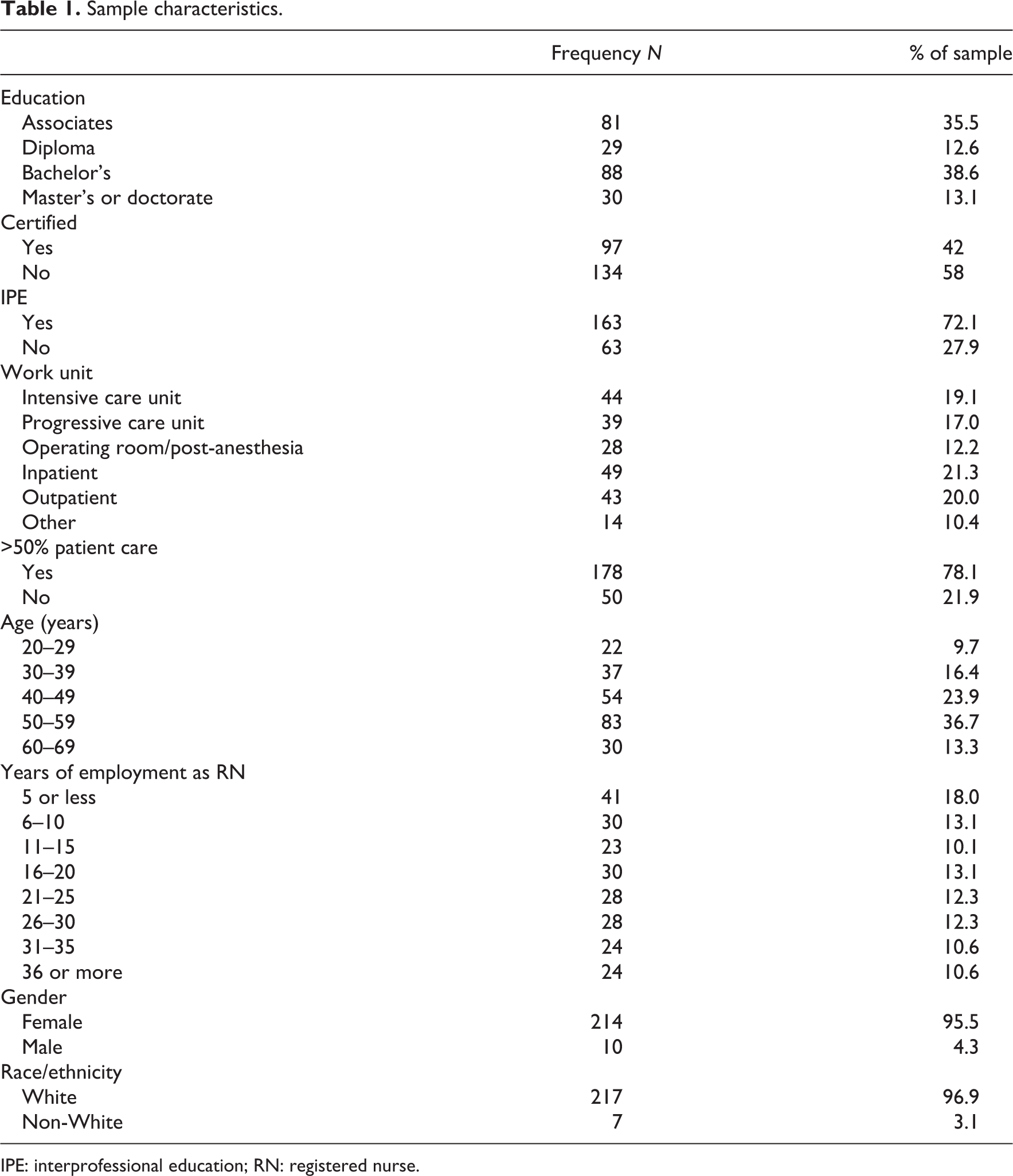
IPE: interprofessional education; RN: registered nurse.
Nurses’ professional values and attitudes
Nurses’ professional values demonstrated that a mean total score was 107.6 (SD = 12.47). The highest factors, which are an average of the items contributing to each factor, were caring with a mean of 4.43 (SD = 0.46) and trust with a mean of 4.41 (SD = 0.48). The lowest scoring factor was activism with a mean score of 3.55 (SD = 0.76). Nurses’ attitudes toward collaboration with physicians showed a total mean score of 53.41 (SD = 5.67). The highest factors, which are reported as averages of items contributing to each factor, were nurse autonomy with a mean of 3.80 (SD = 0.42) and shared education and collaboration with a mean of 3.67 (SD = 0.44). The lowest scoring factor was physician authority with a mean score of 2.85 (SD = 0.47).
Relationship between nurses’ professional values and attitudes
Several statistically significant findings were revealed regarding the relationship between nurses’ professional values and their attitudes toward collaboration with physicians. There was a significant small to moderate positive correlation between the overall strength of professional values and overall attitudes toward collaboration with physicians (r = .26, p < .01). There was also a significant small to moderate positive correlation between the overall strength of professional values and the factors shared education and collaboration (r = .21, p < .01), caring versus curing (r = .27, p < .01), and nurse autonomy (r = .23, p < .01). Likewise, there was a significant small to moderate positive correlation between overall attitudes toward collaboration with the factors physicians caring (r = .23, p < .01), activism (r = .25, p < .01), and justice (r = .24, p < .01). Small correlations were noted between overall attitudes toward collaboration with physicians and the factors trust (r = .14, p < .05) and professionalism (r = .23, p < .01). The results also revealed a significant small to moderate positive correlation between the shared education and collaboration factors from the Jefferson Scale and professional values caring (r = .21, p < .01), and a small positive correlation with activism (r = .25, p < .01), activism (r = .18, p < .01), trust (r = .15, p < .05), and justice (r = .17, p < .01). Furthermore, there was a significant small to moderate positive correlation between the caring versus curing factor from the Jefferson Scale and the factors caring (r = .24, p < .01), activism (r = .28, p < .01), professionalism (r = .21, p < .01), and justice (r = .28, p < .01). There was no significant correlation between caring versus curing and nurses value of trust.
The results also revealed a significant small to moderate positive correlation between the factors nurses’ autonomy and activism (r = .25, p < .01) and caring (r = .19, p < .01), trust (r = .14, p < .05), professionalism (r = .14, p < .05), and justice (r = .18, p < .01). The only significant correlation between the physician authority was with justice (r = .15, p < .05) (see Table 2).
Correlation of Jefferson Scale of Attitudes toward Physician–Nurse Collaboration and the NPVS-R (N = 231).
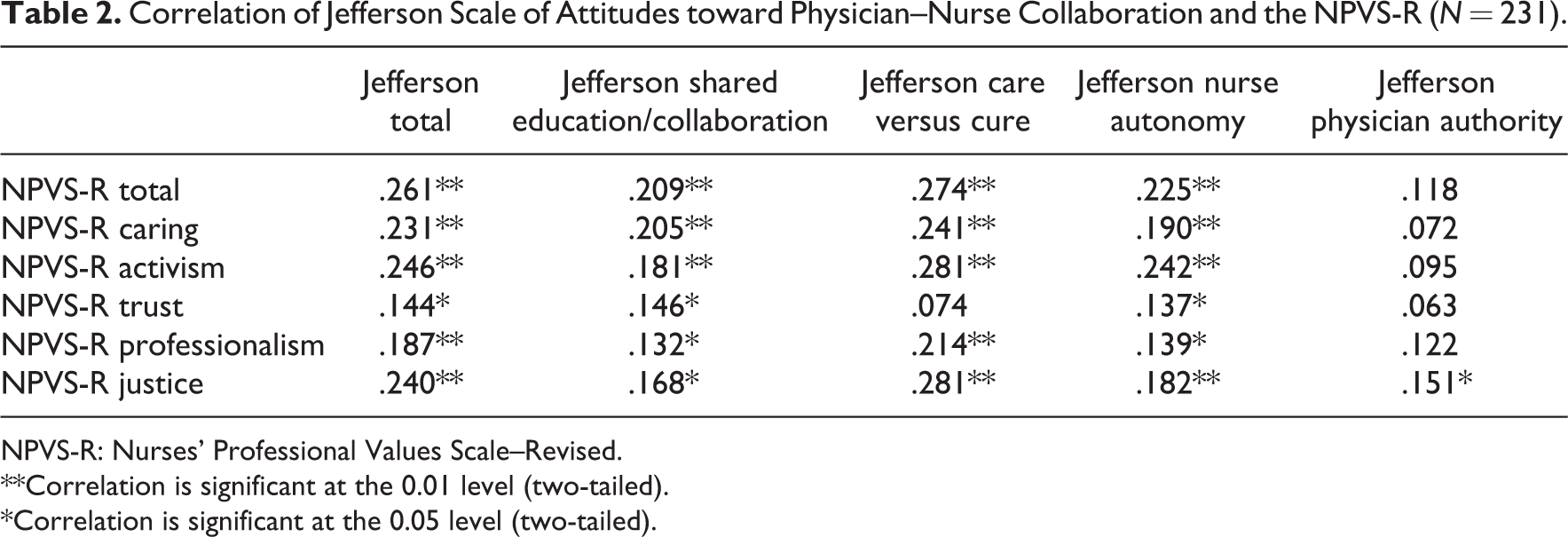
NPVS-R: Nurses’ Professional Values Scale–Revised.
**Correlation is significant at the 0.01 level (two-tailed).
*Correlation is significant at the 0.05 level (two-tailed).
Relationship between nurses’ characteristics, values, and attitudes
The relationship between nurses’ demographic characteristics and professional values demonstrated no significant relationships. However, the nurses’ attitudes toward collaboration were significantly different in those with interprofessional education experience and based on educational level. A significant weak negative correlation was found between the nurses who reported previous experience in an interprofessional education course with the total score for the total Jefferson Scale (r = −.16, p < .05), the shared education and collaboration factor (r = −.16, p < .05), and nurses’ autonomy factor (r = −.17, p < .05). There was also a weak positive correlation between the factor of physician authority and nurses who spent more than 50% of their work time in direct patient care meaning nurses in direct patient care roles viewed the physician as authoritative (r = .15, p < .05). The items for this factor were reverse scored prior to analysis so that higher scores are awarded after the recoding to those that disagree with physician dominance.
An analysis of variance showed a significant difference between nurses with a diploma and those with a Master of Science in Nursing (MSN) or higher, F(3, 224) = 4.379, p = .005. Post hoc analyses using the Scheffé post hoc criterion for significance indicated that the nurses holding an MSN or higher had mean scores significantly lower in the factor of physician authority (M = 3.22, SD = 0.74) than nurses holding diploma degrees (M = 2.53, SD = 0.78), F(3, 224) = 4.38, p < .01. This implies that nurses with diploma education and those who are spending the majority of their work in direct patient care more readily ascribe to physician authority.
Discussion
This study found that professional values held by nurses and their attitudes toward physician–nurse collaboration were related to attitudes toward collaboration. The percentage of nurses reporting experience in an interprofessional course in an academic setting is surprisingly high. This may reflect trends in the educational goals of feeder schools. The organization’s affiliate nursing school has adopted interprofessional education as a priority at all levels of education. It is reasonable that most of the respondents with less than 5 years of experience (n = 41), those diploma- and associate degree-prepared nurses who are currently pursuing baccalaureate degrees, and many of the master’s graduates (n = 27) would have experienced interprofessional education.
The nurses in our study had a high level of professional values as the scores were higher than recent reports in the literature. 40 The strongest values held by the nurses were caring and trust, while the lowest value was activism, which is also consistent with the literature. 35,36 The NPVS-R has been primarily used in nursing students, and this study contributes to the growing knowledge related to the use of the NPVS-R with practicing nurses.
Nurses’ attitudes toward collaboration with physicians
The total score for the nurses’ attitude toward collaboration with physicians was 53.41 (SD = 5.67), and this value indicates a positive attitude toward collaboration with physicians. The highest factors were nurse autonomy and shared education and collaboration with the lowest scoring factor being physician authority. It is reasonable that as nursing promotes professionalism among its nurses, there is also a related increase of nurses’ perception of autonomy. These results are comparable to other findings in the literature.14,15,28,41 Nurses’ attitudes toward collaboration have typically been measured in small samples. 38,39,41 –43 This study offers a unique description of nurses’ attitudes toward collaboration with physicians with a specific, larger nursing sample.
It is noted, however, that the sample demonstrated negative skew on the total score (−3.34), the shared education and collaboration factor (−3.34), and nurse autonomy (−4.63). This finding was not surprising as the organization where the study was conducted has made teamwork, interprofessional education, and collaboration a priority. After consultation with statistical support personnel and attempts to transform the data with no correction, it was decided that these values were acceptable. The Jefferson Scale of Attitudes toward Physician–Nurse Collaboration reported good reliability. Consistent with the previous reports, the highest scoring sub-factors were shared education/collaboration, caring versus curing, and physician authority. 37,44
Relationship between nurses’ professional values and attitudes toward collaboration with physicians
The correlations of the total score for professional values and attitudes toward collaboration with physicians approached moderate correlations (r = .26, p < .01). Of the other 29 correlations between each instrument’s total and factors, 23 demonstrated small to moderate correlations with the majority approaching moderate correlations at the p < .01 level. The non-significant findings are primarily in the relationship to physician dominance and all NPVS-R factors. These correlations may be the most important contribution to the literature from this study as there are no existing correlational studies evaluating the relationship between nurses’ professional values and attitudes toward nurse–physician collaboration.
Relationship between characteristics of nurses and their professional values
The results demonstrated no significant relationship between any demographic variable and nurses’ professional values both in the total professional value score and the scores for each factor. Similar results have been reported. 26,36 The constancy of professional values throughout the career of a nurse poses challenges for those who would seek to influence professional values through interprofessional education and other interventions. These findings suggest that promoting competence in the knowledge and skills of teamwork may be more effective than attempting to change professional values. There were few correlations between demographic variables and attitudes toward collaboration with physicians except the significant difference between diploma-prepared nurses and those who held a master’s degree or higher in the attitude toward physician authority. This may contribute to the literature, as no studies could be found that compared attitudes toward collaboration with nurse educational work level.
Another important but not altogether surprising finding was the weak negative correlation between the nurses who reported previous experience in an interprofessional education course with the total score for the Jefferson Scale shared education and collaboration and nurses’ autonomy factors. This signifies poorer attitudes toward collaboration from nurses who have experienced interprofessional education and is consistent with much of the research regarding the effects of interprofessional education. The best evidence review of 21 studies found mixed effects of interprofessional education on the attitudes of the participants and concluded that attitude is influenced by a complex number of factors and is less likely to be affected by interprofessional interventions than knowledge and skill. 45
Utility of conceptual framework
The conceptual framework for this study was the IPEC Core Competencies for Collaborative Practice which included values and ethics for interprofessional practice as the first of four essential competencies for healthcare providers and proposed a relationship between professional values and collaboration applicable to both healthcare education and professional practice. The model is supported by the findings of this study. 5 The study supports the conceptual model of IPEC by demonstrating that the values and ethics of nurses are related to attitudes regarding collaboration with physicians. 46,47
Implications for research, practice, and education
The results of this study suggest, in this setting, professional values are relatively constant throughout a nurse’s career with only minimal influence from education, maturity, or other characteristics. The challenge for education and clinical practice is to assist students and practicing nurses to become competent in collaboration even though values appear to remain constant and attitudes are mixed. The results suggest that collaborative behaviors and skills may be acquired even when the values and attitudes toward collaboration are relatively constant. Other implications for education involve the negative attitudes toward collaboration reported by nurses who had experience with interprofessional education. It has been suggested that beneficence is an ethical obligation to proceed forward with interprofessional education due to its potential to promote teamwork and patient outcomes even in the face of mixed empirical results. 48
From an administrative perspective, organizations need to adapt processes and culture to reflect nurses’ professional values as this may aid nurses in fully applying their values. 13,23 Further research should include attempts to gain better understanding of the precursors to collaborative behavior. Further understanding of the connection between nurses’ professional values and attitudes toward collaboration is warranted based on the results of this study. Additional research could include examining the effect of teaching interventions to explore the values and attitudes of nurses toward collaboration to fully determine whether professional values and attitudes are indeed stabile or can be enhanced through intervention.
Limitations
The limitations of this study are a convenience sample from one organization and a response rate of 13%. The data related to the Jefferson Scale were mildly skewed and also displayed kurtosis, as previously discussed, which was not surprising as the organization where the study was conducted has made teamwork, interprofessional education, and collaboration a priority but may affect generalizability. Replication studies are needed to confirm these findings in larger, more diverse samples, perhaps in different settings or geographical areas. An additional limitation may be the age of the Jefferson Scale of Attitudes toward Collaboration and the lack of validated instruments available to measure attitudes toward collaboration.
Conclusion
Development of highly collaborative interprofessional teams is a key concern to nurse administrators. The results of this study could be helpful to nurse administrators as they seek to select nurses who prioritize collaboration as attitudes toward physician authority vary based on the role of direct caregiver and educational level. This study could also inform nurse educators who are focused on developing professional values in future nurses. Additionally, this study is one of the first to support the conceptual model of IPEC by demonstrating that the values and ethics of nurses are indeed related to attitudes toward collaboration with physicians. 45,46 The precursors to collaborative behavior between nurses and physicians should be addressed in future replication or multifactorial studies so that interventions to enhance collaborative behavior can be developed and tested to support collaborative behaviors.
Footnotes
Conflict of interest
The authors declare that there are no conflicts of interest.
Funding
The authors declare that there was no funding for this project.
Research ethics
This study was approved by the Carilion Institutional Review Board on 2 January 2013 (no number issued) and the Case Western University Institutional Review Board on 28 January 2013 (IRB-2013-375).