







Abstract
Background:
Nurses are often faced with complex situations that made them to make ethical decisions; and to make such decisions, they need to possess the power of moral reasoning. Studies in Iran show that the majority of nursing students lack proper ethical development. Socratic teaching is a student-centered method which is strongly opposed to the lecturing method.
Objectives:
This study was conducted to evaluate the impacts of Socratic questioning on the moral reasoning of the nursing students.
Research design:
In a quasi-experimental study, Crisham’s Nursing Dilemma Test was used to evaluate the results of three groups before, immediately after, and 2 months after intervention. The data were analyzed using the SPSS statistical software (v 15).
Participants and research context:
Through random allocation, 103 nursing students were divided into three groups. In experiment group 1 (37 students), intervention consisted of Socratic questioning-based sessions on ethics and how to deal with moral dilemmas; experiment group 2 (33 students) attended a 4-h workshop; and the control group (33 students) was not subject to any interventions.
Signed informed consent forms:
This research was approved by the Ethics Committee of the University. All the participants signed written informed consents.
Findings:
There were significant differences between experiment group 1 and experiment group 2’s pre-test and post-test scores on moral reasoning (p ≤ 0.001, p ≤ 0.001), nursing principled thinking (p ≤ 0.001, p ≤ 0.001), and practical considerations (p ≤ 0.001, p ≤ 0.031).
Discussion:
Both the teaching approaches improved the subjects’ moral reasoning; however, Socratic questioning proved more effective than lecturing. Compared to other similar studies in Iran and other countries, the students had inadequate moral reasoning competence.
Conclusion:
This study confirms the need for the development of an efficient course on ethics in the nursing curriculum. Also, it appears that Socratic questioning is an effective method to teach nursing ethics and develop nursing students’ competence of moral reasoning.
Introduction
Nurses, who play an important role in healthcare, face complicated situations for which there are no clear-cut answers on a daily basis. 1,2 In fact, nurses are constantly dealing with ethical issues. 2 Nursing students experience similar conditions. 3 Among the ethical issues, violation of patients’ rights of autonomy, doctors’ and nurses’ observance of confidentiality, the opposition of patients’ families to modern treatments due to the popularity of the traditional treatments, and providing special care to rich or important patients are commonly experienced by nursing students. 3 Under such circumstances, nursing students are often faced with moral issues, 3,4 and without logical and effective solutions for their ethical concerns, they are likely to experience despair and ethical distress, 1,5 –7 which will in turn adversely affect both nurses and patients. 7,8
Effective ethical and professional nursing not only requires technical and theoretical knowledge but also the ability to make ethical decisions and act logically in complicated and uncertain situations. 9,10 Today’s students are tomorrow’s nurses who will make decisions about people’s health and lives. Accordingly, they need to acquire acceptable levels of ethical competence during their education. 11 It is essential for nursing students, like registered nurses, to be able to make ethical decisions and recognize the ethical aspect of care, which requires the skill of moral reasoning. 9
Moral reasoning is a developmental-cognitive skill that has to do with making judgments or analyzing ethical conflicts. Most studies on moral reasoning are based on Kohlberg’s work. 12 He divided the progress toward fully universalized justice into six stages of ethical development and suggested that an individual’s moral reasoning develops alongside his or her development in each stage. 2 In Kohlberg’s model, there are three levels of moral reasoning—pre-conventional, conventional, and post-conventional—with each level comprising two stages. In the pre-conventional level, individuals tend to be self-centered and act in order to satisfy themselves and receive rewards or avoid negative consequences; this level consists of punishment-obedience and self-interest orientation. In the conventional level, individuals tend to base their decisions on the accepted social rules and principles; this level consists of the stages of respect for social norms and law and order orientation. In the post-conventional level—the highest level—individuals try to orient their acts according to the established ethical principles and make humane and ethical decisions; in this level, where personality is built on conscience, there are two stages: social contract orientation and ethical principle orientation. 13
Despite the importance of moral reasoning in ethical decision-making in nursing, studies show that nursing students’ moral development is not satisfactory in Iran. 14 According to the results of studies conducted in various Iranian nursing schools, nursing students are increasingly indifferent to ethical issues in everyday nursing activities. It has been discovered that ethics are ignored in the nursing curriculum, and, consequently, the concept of professional ethics is not dealt with explicitly in any of the theoretical or clinical courses of nursing schools. 15
Educating nursing students in ethics will enhance their ability to make ethical decisions and act ethically. 16,17 However, the great challenge in nursing education is developing effective strategies to encourage students’ professional ethical virtues. 9 It appears that the traditional approaches to teaching ethics are not adequate anymore and ethics experts need to think of new ways to teach ethics to the new generation of students. The traditional approaches underline lecturing, are mostly teacher-centered, and neglect students’ active participation. 15 Studies show that the most effective methods of teaching ethics are student-centered. 5,18,19
Socratic teaching and learning stresses student-centeredness and strongly opposes lecturing. 20 Socratic questioning has been used in various types of education, 21 –24 and many studies have addressed the effectiveness of this method in teaching ethics. 25,26 Socratic questioning, which stresses reflection and reasoning, has been referred to as the most effective method of developing critical thinking. 27,28 Yet, reviews of the literature reveal that few studies have addressed the effects of teaching ethics on the development of students’ moral reasoning skills. 5,9 Moreover, previous related studies in Iran have not dealt with the effects of special education techniques on moral reasoning and have only examined the current status of adherence to ethics. Also, the Socratic method is rarely used for education in Iran. Since Socratic questioning is a thinking process which is, regardless of the topic of the lesson, transferable to all lessons and courses, 29 and in view of the fact that various studies have confirmed the effectiveness of this approach, the goal of this study is to explore the impact of Socratic questioning in teaching ethics on nursing students’ moral reasoning, and compare it to that of the traditional method of lecturing.
Methods
This quasi-experimental study—which consists of two experimental groups, a control group, a pre-test, and a post-test—evaluates the impact of teaching ethics through Socratic questioning (independent variable) on the moral reasoning (dependent variable) of nursing students who are in their sixth, seventh, and eighth terms, and compares that impact with that of the lecturing method. Since there were no similar studies available to give the researchers an idea of the sample size, the statistics counselor advised that the entire qualified nursing students be studied.
To qualify, the participants needed to have clinical experience and cognitive maturity; therefore, the researchers selected the undergraduate nursing students who were in their last terms. In total, there were 113 students studying in the second semester of the academic year 2014–2015, all of whom were asked to participate in the study. By the end, 110 students who were willing to participate filled out the informed consent form. Next, based on stratified randomization, the participants were divided into three groups: experimental 1, experimental 2, and control. The manner of stratification was thus as follows: initially, the students of each term were divided into male and female groups; then, through blocked randomization, the members of each group were put in one of the three groups.
For blocked randomization, each student was assigned a code, and the three groups were labeled A, B, and C, respectively. The letters were written in the six possible orders. Considering the number of students in each group—18 or 19—and the triple blocks, six triple blocks were randomly chosen (the names were written on pieces of paper and put in a pot) and resultant combinations were recorded and put in an envelope. Finally, each student, based on his or her choice of an envelope, was put in one of the three study groups. In each of the experimental groups, there were 37 students and in the control group, there were 36 students. By the end of the study, four students in experimental group 2 and three students in the control group were excluded as they fail to meet the criteria, which left the study with 103 participants.
Inclusion criteria were as follows: being a day student; doing one’s nursing bachelor’s degree; being in the sixth, seventh, or eighth term; being willing to participate; not having attended any classes on ethics in the past; and not having taken any courses on ethics.
Exclusion criteria were as follows: unwillingness to cooperate further, missing more than two of the classes in the study, and missing either the pre- or post-test session.
In this study, the data collection tools comprised of a demographic questionnaire and the Nursing Dilemma Test (NDT). Designed based on a review of available literature and the views of experts and the research team, the demographic questionnaire included questions about age, sex, marital status, education, average grade, domicile, experience of ethics classes, experience of ethics lessons taught alongside nursing courses, familiarity with Socratic questioning, and having at least 6 months’ experience of doing student work in a hospital.
The NDT is a customized nursing test devised by Crisham 2 based on Kohlberg’s theory in 1981 at the University of Minnesota to study 130 nurses. NDT consists of six scenarios related to nursing dilemmas: (1) newborns with anomalies, (2) forced administration of medicine, (3) patient’s request for euthanasia, (4) orientation of a new nurse, (5) medication error, and (6) care of the terminally ill. Each scenario is followed by three sections and nurses are asked to respond to three sections after each scenario.
The first section (willingness to act) asks the respondent to decide what he or she would do in that situation. The respondent’s choice will not determine his or her level of ethical maturity, but can be interpreted as right, wrong, or neutral.
In the second section, six common choices for action are offered and the respondent has to rank them in the order of importance. Each choice corresponds to one of the developmental levels in Kohlberg’s theory of moral development, and one of the choices examines the influence of organizational and official rules on the respondent decision. Based on this section, three major indexes of the respondent are determined. The first index is the respondent’s level of moral maturity based on Kohlberg’s levels: the respondent’s first choice shows his or her level of moral maturity. Thus, since each choice corresponds to a level of moral maturity, the sum of the selected choices will determine a nurse’s final level of moral reasoning. Finally, nurses’ level of moral reasoning maturity can be known at the three levels of pre-conventional (sum of levels 1 and 2), conventional (sum of levels 3 and 4), and post-conventional (sum of levels 5 and 6).
The second index is nursing principled (NP) thinking, or nursing ethical thinking, score, which is the sum of Kohlberg’s levels 5 and 6. Each scenario is scored from 3 to 11, and, since there are six scenarios, NP scores can vary from 18 to 66. It should be noted that in the case of each scenario, only two of the choices are related to NP, and nurses’ scores depend on the importance they attach to those choices. The higher the nurses rank those choices, the higher their NP scores will be.
The third index is the practical consideration (PC) score. This index is a measure of a respondent’s respect for official or organizational rules. In each scenario, one of the six choices in section 2 is related to PC. The scores for this index vary from 6 to 36. A higher NP score indicates higher moral maturity, while a higher PC score signifies greater respect for official rules in decision-making and less moral maturity.
The third section addresses a respondent’s familiarity with similar situations (F score) and are based on the Likert scale. An F score of 6–17 indicates a nurse’s familiarity with similar dilemmas, while scores between 18 and 30 indicate unfamiliarity with similar dilemmas.
The reliability and validity of the questionnaire have been verified by its author, and it has been widely used by researchers. 2,30 –32 The face and content validity of the questionnaire were verified by Zirak et al. (2012) in Iran: 33 the translated version of the questionnaire in Farsi was translated back into English and reviewed by 10 professors in the fields of sociology, medical ethics, Islamic theology, and nursing, and was subsequently revised to match the Iranian cultural and religious milieu. The reliability of the questionnaire was confirmed with a correlation coefficient of 0.95 Zirak et al. (2012).
In order to introduce the intervention, the researchers taught one group (experimental 1) ethics through Socratic questioning in group sessions; the other group (experimental 2) was taught ethics through a workshop. The control group was not exposed to any lessons on ethics. Before the intervention, all the students were given the NDT (pre-test) and their levels of moral development were evaluated. A 45-min introductory session was held for the students in experimental groups 1 and 2. The given lecture included a definition of ethics, the necessity of ethics in nursing, and ethical theories and was meant to prepare the students for active participation in the following sessions.
After a review of the available literature, the researchers decided that six sessions be held in six consecutive weeks, with each session lasting 45 min. In order to determine the number and length of the sessions more accurately, the researcher conducted a 45-min pilot session during which, based on Socratic questioning, two ethical scenarios were discussed. In order to prevent the provided information from affecting the sample, only junior M.S.N. students attended the pilot session. Finally, based on the results of the initial study and with the students’ approval, the participants attended an orientation session and six educational sessions (7 in total). The educational sessions were held twice a week in three consecutive weeks.
The sessions that experimental group 1 attended began with a few questions raised by the researcher to motivate the students to think and learn about ethical issues. Next, the students would be presented with a print of a scenario including a nursing ethical dilemma. The students had a few minutes to think about the dilemma, and then, they were asked to write down three possible measures that the main character in the situation could take to resolve the dilemma. They also had to make notes of the possible consequences. At this stage, the students would have to practice logical decision-making methods and try to consider the consequences of every possible action.
Subsequently, the researcher would start a class discussion based on the Socratic method and encourage the students to answer the raised questions and ask their own questions to enhance their understanding. Then, the students would write a reflection report of their impression of the discussion and their final decision regarding the dilemma in question. Finally, the students had to think up examples of the application of the results in real-life situations and clinical environments. The topics for the ethical dilemma scenarios were decided upon after a review of certain books, articles, and valid scientific websites.
The students in experimental group 2 were exposed to similar educational content through the conventional method of lecturing: the workshop lasted 4 h with a few brief breaks. Immediately after and 2 months after the intervention, the entire students in experimental groups 1 and 2 and the control group completed the post-test. In order to reduce errors and research bias, the questionnaires were collected and scored and the data were entered into SPSS by the co-researcher. The entire educational classes for both experimental groups were conducted by the same researcher. The students would sit in a circle so that they would have equal positions and could have more friendly interaction with each other. The students were also asked not to exchange information about the discussed educational content with students from the other groups.
For ethical reasons, the students in the control group were informed that they could register for lecture-based or Socratic questioning–based classes to learn the educational content presented to the experimental groups. Moreover, prints of the educational content were made available to the control group.
Ethical considerations
This study was approved by the research ethics committee at University of Medical Sciences. Before the study started, all the students were informed about the procedure and their rights, and they gave their informed consent to participate.
Findings
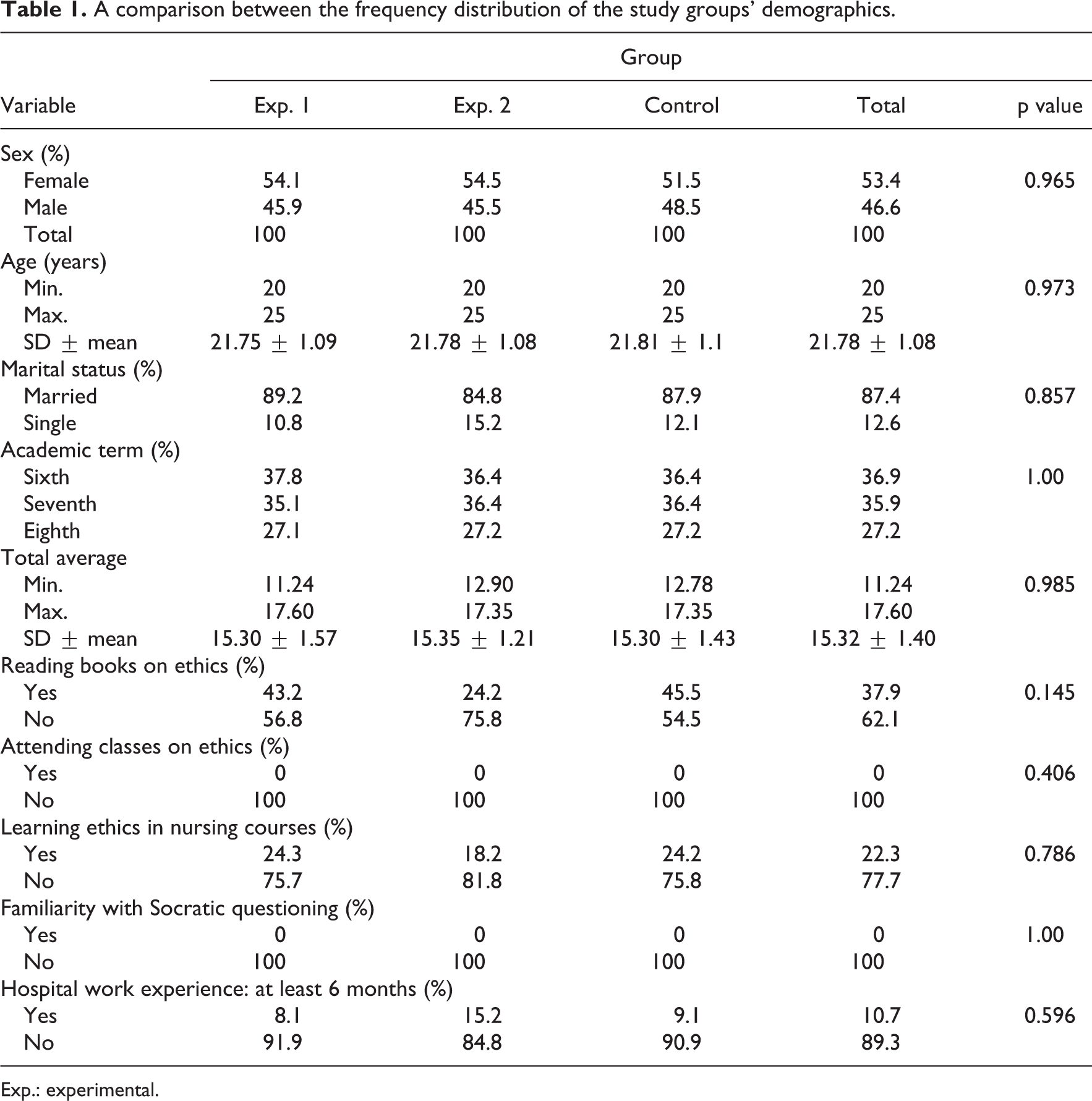
In all, 103 nursing students participated in this study: 37 students in experimental group 1, 33 students in experimental group 2, and 33 students in the control group. In total, 53.4% of the participants were female. The age range of the participants was between 20 and 25 years. Their maximum and minimum average grades were, respectively, 17.60 and 11.24, with the mean of 15.32 and standard deviation of 1.40. In terms of age, sex, average grade, and other demographic variables, there were no significant differences among the members of the three groups (Table 1).
A comparison between the frequency distribution of the study groups’ demographics.
Exp.: experimental.
Before intervention, the relationships among the indexes of NP thinking, PCs, and prior familiarity with similar situations were explored. The results showed that the only significant relationship was a negative linear relationship between NP thinking and PCs (p ≤ 0.001, r = −0.599). Also, an examination of the relationship between the factors of age, sex, and average grade with the above indexes revealed that there was a significant negative linear relationship between age and NP thinking (p = 0.001, r = −0.309).
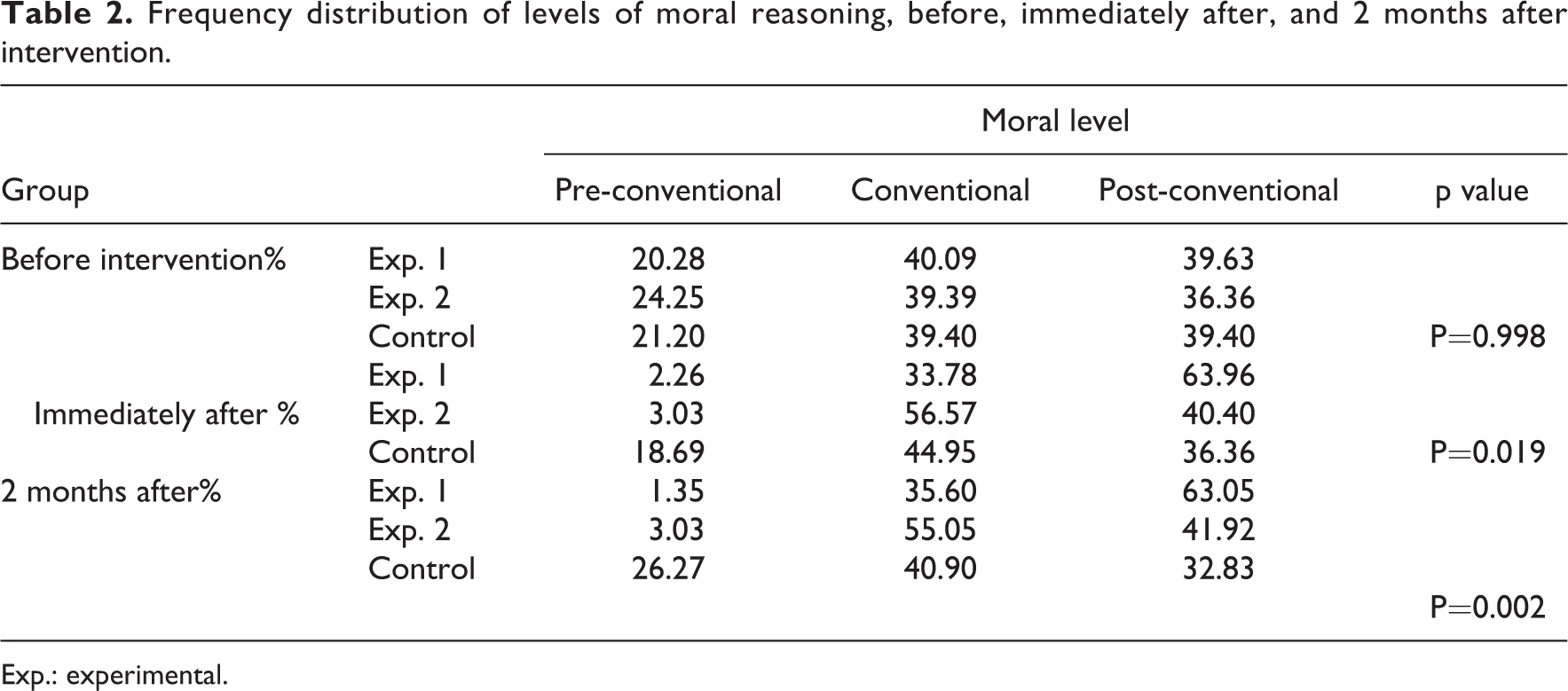
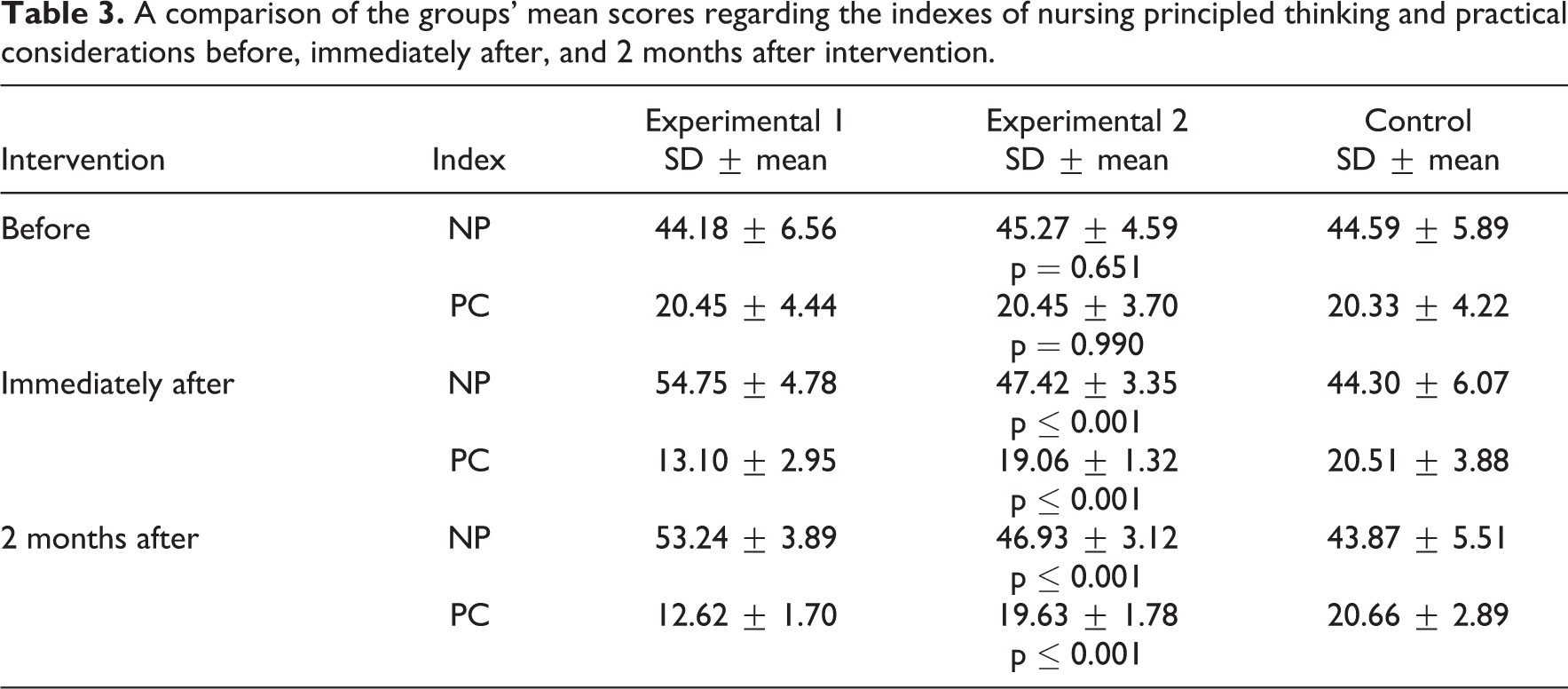
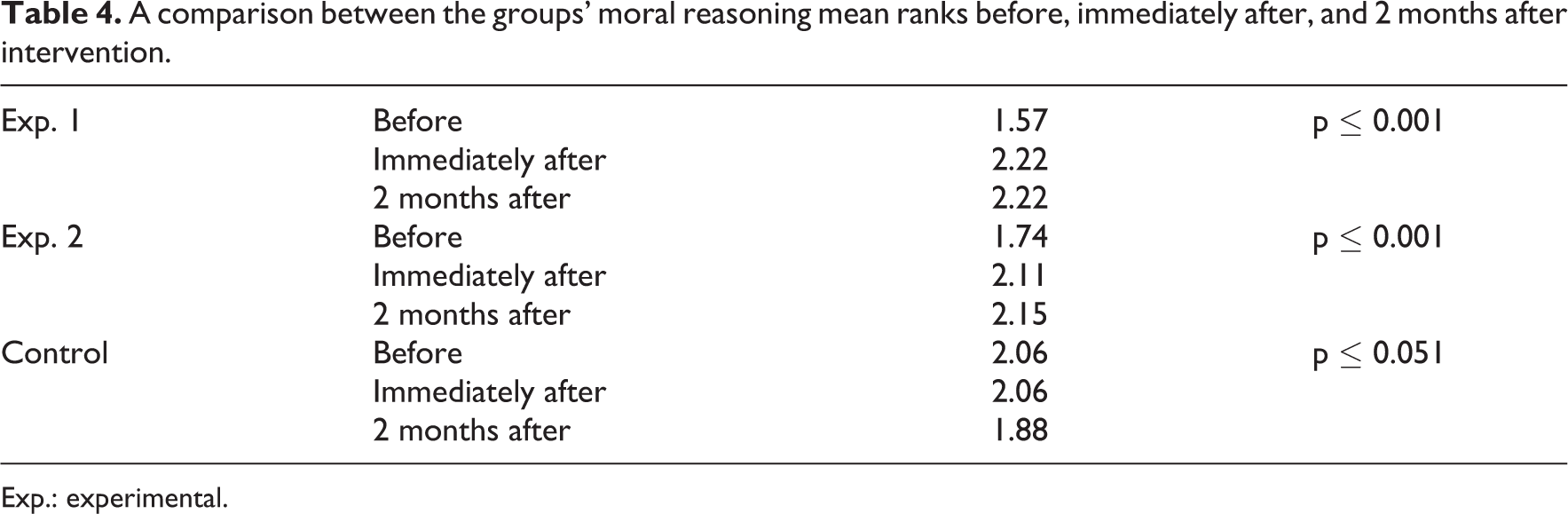
The results of the chi-square test and analysis of variance (ANOVA) obtained immediately after and 2 months after intervention showed significant differences in levels of moral reasoning, NP thinking, and PCs of experimental group 1 (Socratic questioning) and experimental group 2 (lecturing) compared to the control group (p ≤ 0.005) (Tables 2 and 3). Moreover, the results of Friedman test and repeated measure revealed significant differences in levels of moral reasoning, NP thinking, and PCs of experimental groups 1 and 2 (p ≤ 0.05). However, there were no such differences in the scores of the control group (Table 4). A comparison of the average scores of experimental groups 1 and 2, obtained immediately after and 2 months after intervention, showed that the students in experimental group 1 had achieved higher scores in the aforementioned indexes.
Frequency distribution of levels of moral reasoning, before, immediately after, and 2 months after intervention.
Exp.: experimental.
A comparison of the groups’ mean scores regarding the indexes of nursing principled thinking and practical considerations before, immediately after, and 2 months after intervention.
A comparison between the groups’ moral reasoning mean ranks before, immediately after, and 2 months after intervention.
Exp.: experimental.
Discussion
The findings of the study show that both Socratic reasoning and lecturing can enhance nursing students’ moral reasoning; however, Socratic questioning is more effective than lecturing. The results of this study are consistent with the results of similar studies of the effectiveness of active student-centered methods in teaching ethics. One reason may be the ineffectiveness of the conventional method of memorizing in preparing students for today’s ethical issues. 34
Questioning is used in many active learning approaches, such as Socratic questioning, inquiry learning, and problem-based learning, 35,36 all of which are subcategories of constructivism. 37 In view of the similarities between Socratic questioning and problem-based learning, Lin et al.’s 37 study confirms the results of this study: the researchers compared the effectiveness of problem-based learning and lecturing in teaching nursing ethics and concluded that both approaches were useful, but problem-based learning was more effective. Lin et al. 37 attribute the effectiveness of lecturing to students’ familiarity with it, the stressfulness of problem-based learning (due to its active nature and the need to comment openly), and the limited number of scenarios discussed in problem-based learning. In this study, similarly, teaching ethics through lecturing proved helpful. Since the entire students in this study were taught almost all their courses by lecturing, their familiarity with this passive method may account for its effectiveness. To avoid the nuisance parameter of limited scenarios, each experiment group in this study discussed six ethical scenarios.
Constructivism is a popular educational theory in ethics today which stresses student-centeredness. In their study of the impact of constructivist teaching methods in teaching bioethics to nursing students, Choe et al. 19 compared the effectiveness of action learning and cross examination debate in nursing students’ identification of bioethical issues, experiences of bioethical issues, and acquisition of ethical skills. The results showed that both teaching approaches had enhanced the students’ insight into bioethical issues and ethical skills; both approaches seemed to have the potential to help students improve their adaptability in clinical practice as they encountered more ethical issues and dilemmas. Choe et al. 19 conclude that the most effective approach to teaching ethics is student-centered discussions and debates, as against the teacher-centered method of lecturing, conclusion of which is consistent with the findings of this study, where Socratic questioning, by stressing the role of the student, provided for interaction between the teacher and the students and challenged the students’ beliefs and enhanced their ethical maturity.
In this study, Socratic dialogs and interaction occurred in small groups, with the students sitting in circles and having the opportunity to receive feedback and participate actively. Other similar studies stress the importance of group discussions and the active participation of students in learning ethics, which is in agreement with the findings of this study. The results of the study of Smith et al. 18 show that medical students’ identification and evaluation of ethical issues increases through practicing case analysis and feedback, and group discussion contributes to students’ learning and satisfaction. 18 In their study, Nasrabadi et al. 15 developed and applied a new approach to teaching nursing ethics in which discussions and debates surrounding ethical issues were prominent, and compared its effectiveness with that of the conventional method of lecturing; the results verified the contribution of practical ethical content alongside actual educational approaches and interaction. Likewise, Dinc and Görgülü 38 regard students’ active participation in ethics education as an important factor in effective learning. 38
Another active method for teaching ethics is applying reasoning maps which is, like Socratic questioning, based on students’ active participation in learning. A study of the effects of reasoning maps on nursing students’ ethical sensitivity and decision-making showed that the method improved the subjects’ ethical sensitivity and decision-making abilities. 39 The researcher recommends the use of the method in teaching ethics in nursing education, but advises further investigation due to limited sample size (37 students). Thus, this study was designed to include a larger sample size (103 students).
The results of this study show that there is a significant inverse relationship between nursing students’ principled thinking and PCs; however, these two indexes do not correlate with the index of students’ prior familiarity with similar situations. These results are consistent with Ham’s 32 study of principled thinking in nursing students and registered nurses. 32 Likewise, in their study of the presence of principled thinking in critical care nurses, Corley and Selig 31 did not find any significant linear relationships among NP thinking, PCs, and prior familiarity with similar situations. 31 Similarly, in their comparison of nurses’ and nursing students’ moral reasoning skills, Borhani et al. 40 found no relationship between the subjects’ moral reasoning skills and prior familiarity with similar situations. 40 However, Crisham 2 discovered a positive relationship between prior familiarity with similar situations and NP thinking: the subjects who were familiar with the ethical dilemmas referred to in Crisham’s NDT and Rest’s Defining Issues Test obtained significantly higher scores on NP thinking, which is in contrast to the findings of this study. Moreover, Crisham’s 2 study confirms the impact of formal education and experiencing similar dilemmas on higher NP thinking. Thus, nurses’ higher ethical maturity and better performance—as a result of their formal education and having experienced similar situations—show that there can be a positive relationship between prior familiarity with similar situations and NP thinking. One of the reasons for the absence of a relationship between the nursing students’ prior familiarity with similar situations and principled thinking in this study can be their lower scores on principled thinking and higher scores on PCs, which indicates that they had inadequate moral reasoning abilities (high scores on PCs show that the subject attaches great importance to organizational and official rules while making ethical decisions). Also, ignoring ethical situations by teachers, instructors, and nursing students during clinical practice and not practicing moral reasoning can be cited as another reason. Disregard for ethical issues during education may be another reason for the students’ poor moral reasoning ability: although students have encountered similar situations, they have not received any education about how to deal with them.
The results showed that there were no significant linear relationships among the participants’ genders, average grades, and indexes of principled thinking, PCs, and prior familiarity with similar situations in any of the units under study. However, there was a significant inverse relationship between age and NP thinking. Bužgová and Sikorová, 13 similarly, discovered a negative relationship between nursing students’ age and moral judgment ability: individuals who were over 30 years had less ethical maturity. 13 That finding agrees with the results of this study. However, Auvinen et al. 41 and Duckett et al. 42 did not find a relationship between nursing students’ age and gender on one hand and development of moral judgment on the other. 41,42 Likewise, Crisham 2 did not discover any significant relationships between nurses’ moral reasoning and age. Corley and Selig 31 did not find any significant relationships between age and professional experience and the indexes of principled thinking, PCs, and prior familiarity with similar situations. 31
The inverse relationship between age and principled thinking in this study shows that the students, as they got older and gained more experience at college, had a weaker moral reasoning ability. One reason may be nursing students’ experiencing more ethical dilemmas and not having received proper education about how to cope with such dilemmas. Factors related to professional environment and atmosphere can also account for this condition.
According to Auvinen et al., 41 Rest observed that nurses’ moral reasoning developed as they got older, but such development did not necessarily result in principled ethical judgment, and other factors, such as education, also played a part. Thus, the absence of a formal education in ethics and the opportunity for students to have ethical discussions with their teachers can account for the cited results.
This study has several limitations. The study was conducted on only three groups of students from the same college and, therefore, the results of the study may not apply to all nursing students. Another limitation of the study was the possibility that subjects from different study groups could exchange information with each other. To prevent that occurrence, at the end of each educational session, the researchers asked the subjects not to share the information they gained from their respective sessions with the subjects from the other groups.
Personal differences between the subjects, such as their emotional, physical, and family conditions or experiencing an unexpected incident during the time of the study, may have affected the subjects’ responses to the items in the questionnaire. However, this factor, which was outside the researchers’ control, was not related to the subjects’ cognitive and ethical maturity. The researchers used stratified random sampling to assign the subjects to the study groups to minimize the sampling error. To avoid any potential errors, all the educational sessions for experimental groups 1 and 2 were conducted by one and the same researcher. Furthermore, data were collected and entered into SPSS by a co-researcher who had not been informed about the sources of data.
The results of the study can have significant applications for nurses in the domains of clinical care, education, research, and management. The result that ethics education has a positive impact on the ethical development of nursing students 15,18,19,37 can encourage nursing administrators and policy-makers to pay more attention to the topic of ethics in nursing and reconsider their decision to ignore in nursing ethics from the curriculum. Socratic questioning can be used as an effective tool in employee training and development for nurses, especially in preparing them for coping with the ethical issues that occur in clinical environments. Since this study is the first study to use Socratic questioning for teaching nursing ethics, it is suggested that more research be conducted in this area.
Conclusion
The results of the study show that incorporating ethical content in nursing courses across the curriculum cannot produce the desired result, and nursing students have a poor moral reasoning ability. Accordingly, it is necessary that an efficient course on nursing ethics be developed and incorporated in the curriculum. Also, the findings show that modern and active techniques in teaching—Socratic questioning in particular—can prove especially helpful: in this study, Socratic questioning was found to be more effective than lecturing in teaching ethics and improving the subjects’ moral reasoning. Therefore, Socratic questioning is recommended for teaching nursing ethics.
Footnotes
Acknowledgements
This article was extracted from the M.S. thesis of the second author (L.H.). The thesis has been approved by the committee of ethics at Shiraz University of Medical Sciences, Shiraz, Iran (registration no. CT-92-6854) and recorded at the Iranian Registry of Clinical Trials under the code IRCTID: IRCT2014022516729N1. The authors would like to thank all nursing students who voluntarily participated in this study. They also gratefully acknowledge the Center for Development of Clinical Research of Namazi Hospital for statistical assistance.
Conflict of interest
The author(s) declared no potential conflicts of interest with respect to the research, authorship, and/or publication of this article.
Funding
The author(s) received no financial support for the research, authorship, and/or publication of this article.