






Abstract
Background
With the deepening trend of global aging, the issue of dignity of older adults has received widespread attention. The research on the dignity of older adults in nursing homes in China has only just begun, and it is necessary to further explore the dignity experience of older adults in nursing homes.
Research Objective
To investigate the thematic features of dignity experiences of older adults residing in nursing homes in mainland China. Furthermore, it may serve as a starting point for further research that formulates intervention strategies.
Research Design
This is a qualitative descriptive study. Twenty older adults living in one of two private nursing homes between September and November 2022 were selected as participants. For each patient, we conducted semi-structured interviews, from which we extracted and assessed information using qualitative content analysis method. SRQR reporting guidelines were used.
Ethical considerations
‘Ethical considerations' with information regarding ethical review, informed consent process and confidentiality.
Results
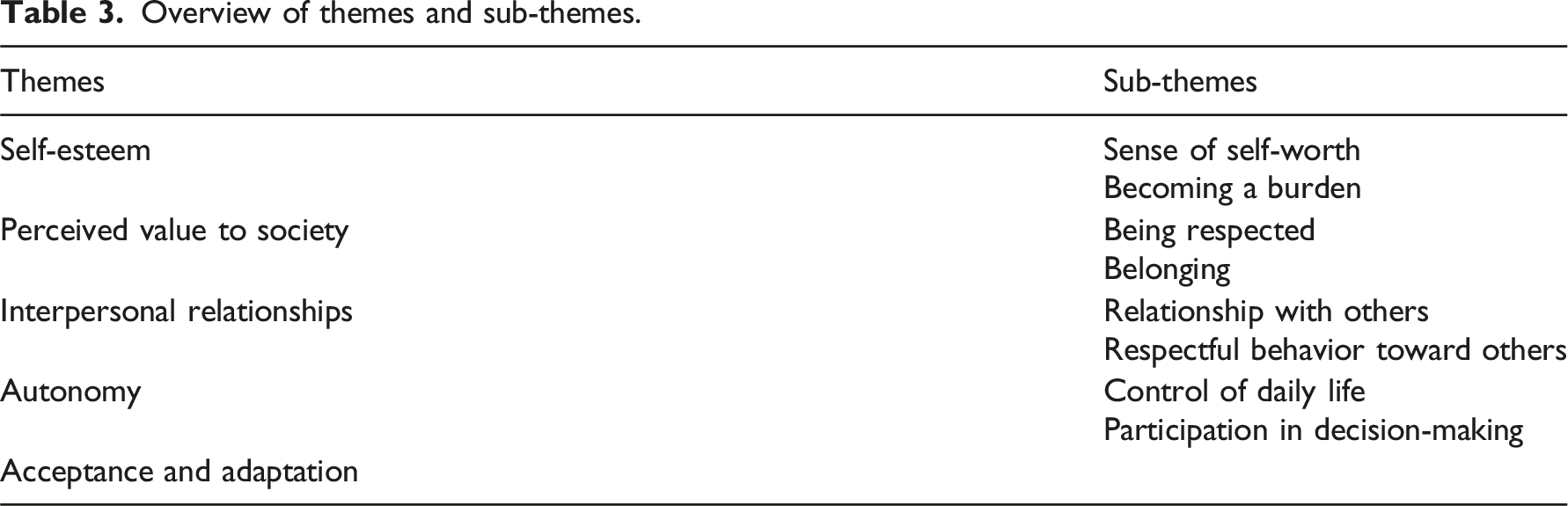
Five themes and eight subthemes emerged from the transcripts: (1) self-esteem (sense of self-worth and becoming a burden), (2) perceived value to society (being respected and belonging), (3) interpersonal relationships (relationships with others and respectful behavior toward others), (4) autonomy (control of daily life and participation in decision-making), and (5) acceptance and adaptation.
Conclusion
Dignity in older adults can be preserved by realizing self-worth, relieving the burden of self-perceived, promoting belonging, strengthening social ties, enhancing autonomy, and engaging in activities.
Introduction
The social and financial implications of an ever increasing aging population are of global concern. In China, with the increasing reduction in family size, the acceleration of aging, and the increased number of empty-nest families, the support of traditional family older adults care in older people care system has begun to decline. 1 Historically, older adults have predominantly received direct care from their relatives, but this is no longer the case. 2 Thus, the demand for institutional care services is increasing. Dignity is a crucial element of nursing, with impaired dignity leading to loss of self-worth, emotional imbalance, and poor physical and mental health.3,4 Nursing home residents face an increased risk of decline in dignity and autonomy, as not only do they face the decline of physical and cognitive function but also the unfamiliarity and isolation of the care home environment. 5 In China, institutional older adult care is at a nascent stage, compared with other developed countries, resulting in deficiencies that impact the quality of life of the residents. However, due to the combined effect of the growing aging problem and the decline in the ability of families to support their relatives, more people will choose to retire to an institution in the future. Therefore, there is widespread interest in proposals detailing how to improve the quality of care and how to maintain the dignity of older adults in nursing homes.
Background
Dignity is a multi-dimensional concept; thus, there are many definitions of dignity in current literature. 6 It is generally believed that dignity can be divided into two categories: intrinsic and attributed. 7 Intrinsic dignity, also known as absolute dignity, is inherent and inalienable to human beings. Attributed dignity, also known as extrinsic dignity, is acquired and represents the value generated or lost by a person according to their life experience and achievements. It can be passed on to others through behavior and is influenced by cultural and external factors. 8 In the field of nursing, the definition of dignity was first proposed by Shotton and Seedhouse, who believed that if an individual’s abilities are effectively utilized, they will have dignity. 9 On the contrary, when you are in a situation of discomfort, or in a situation of incompetence or extraordinary vulnerability, your dignity will decline. This is similar to Mairi’s view that dignity exists when individuals are able to control their own behavior, environment, and the way others treat them. 10 Maintaining dignity is a core concept of nursing, and failure to do so can not only lead to psychological and spiritual pain for patients but can also cause distrust and conflict between care providers and their patients, causing the patients to feel stigmatized.11,12 Nursing homes are unique environments where many older adults with complex needs will spend the remainder of their lives. Chronic diseases, disabilities, and age discrimination make older adults more likely to feel vulnerable and feel less dignified than those who are younger. 13 If the dignity of nursing home residents is not safeguarded, they may suffer from depression and even premature death. 14
Supporting older adults and ensuring their dignity during their twilight years is an important issue for both the state and family members alike. According to the literature, it can be seen that Western countries have been studying this issue for a considerable time and have taken the opportunity to discuss the implications of dignity in numerous researched fields and perspectives. As a result, they have formulated a well-established understanding of the concepts and needs involved. For example, Franklin, Nåden, Lohne, and Oosterveld-Vlug (and other academics) have conducted extensive research into the dignity of nursing home residents, including phenomenology studies from the perspectives of residents, family caregivers, and staff.15–20 However, it is worth noting that current research into the dignity of older adults in nursing homes mostly focuses on the care of dementia and end-of-life patients. This of course ignores the wider older adults’ community as a whole as they go about day-to-day life. Research into institutional elderly care in China is only a recent phenomenon. As dignity is subject to cultural restrictions, 21 therefore, historical research conducted in the West cannot be considered wholly applicable to our aging-population; thus, further investigation is needed. This study has therefore adopted a qualitative descriptive method to explore the dignity experience of older adults (from nursing home residents’ perspective) in their daily lives, but in the context of Chinese culture. The study may serve as a starting point for further research that formulates intervention strategies.
Methods
We used a qualitative and descriptive design to achieve the objectives of our study. We collected data through semi-structured interviews and reported results according to the established standards for reporting qualitative research (SRQR). 22 Qualitative descriptive research is a study method that describes the characteristics of a phenomenon as opposed to the underlying causes/mechanisms. It is based on recognizing the diversity, interactivity, and inseparable nature of human communication and shared experiences. 23 This method is applicable to nursing research and helps researchers to understand the experiences and perspectives of patients, relatives, and professionals. We used semi-structured face-to-face interviews and a content analysis to describe individually expressed, superficial, and obvious experiences. 24 Content analysis is a systematic classification and coding technique that can better understand the phenomena being studied. 25
Participants for this study were drawn from a pool of residents living in either of two private nursing homes in Shenyang, Liaoning Province, between September and November 2022, using purposive, maximum variation sampling methodology (i.e., older adults with different baseline variables). The investigator had no prior acquaintance with any of the participants. The determination of sample size was based on the principle of information saturation, that is, when there is duplication or information saturation in the interview data, and no new topics appear during analysis, sampling is stopped. 26
Participants were (1) aged≥ 60 years (China is a developing country, so setting 60 years as the minimum age for participants in the study); (2) staying in the nursing home for at least 6 months; (3) no cognitive impairment and able to communicate verbally in Chinese; (4) able to provide written informed consent. Whereas, participants were excluded if they were (1) suffering with a serious mental or physical disease; (2) unconscious, incapacitated, or unwilling to participate.
Interview guidelines.

Data analysis
After the interview, each audio file was stored on a computer in a specific file and labeled using codes P1 to P20 instead of the participants’ names. Each recording was transcribed verbatim within 24 hours of completing the interview. With the aid of another researcher, the author promptly imported the transcribed data into the software Nvivo12.0. Content analysis method was utilized by the researchers for analysis and coding. Firstly, the first author and the other investigator independently read through the documents carefully and ensured data immersion. The two analysts identified repetitive words, concepts, and phrases and then open coded the content of transcribed text manually. Subsequently, the codes were grouped into categories that reflect the dignity characteristics of older people. The codes and categories of each transcript were constant compared between the analysts, and distinctions were discussed and resolved to reach a consensus. Finally, themes and sub-themes were extracted by analyzing and interpreting these corresponding categories and codes. Data saturation was reached after coding 20 documents.
A SRQR checklist was used to guide our methodology and ensure our research was precise. The whole interview was recorded objectively without any inducement intervention. The original data were impartially analyzed by two investigators, who suspended their personal views, immersed in the text data, and read it repeatedly. Also, the first author kept writing a reflective diary throughout the research in order to fully immerse herself in the research. The transcribed text was returned to the participants for verification to ensure the stability of the results. When two analysts independently conduct data analysis and topic extraction, if there was a disagreement, the research group or a third researcher would discuss together to reach a consensus, so as to improve the credibility of the research results. Using SPSS 24.0 to analyze general demographic data.
Ethical considerations
The research protocol has been approved by the Research Ethics Committee of the author’s institution (2021-26). During the study, interviewees strictly followed the principle of informed consent and respected participants’ choice of whether or not to participate. All of the participants signed an informed consent form. All data were anonymized, encrypted, and destroyed upon completion of the study.
Results
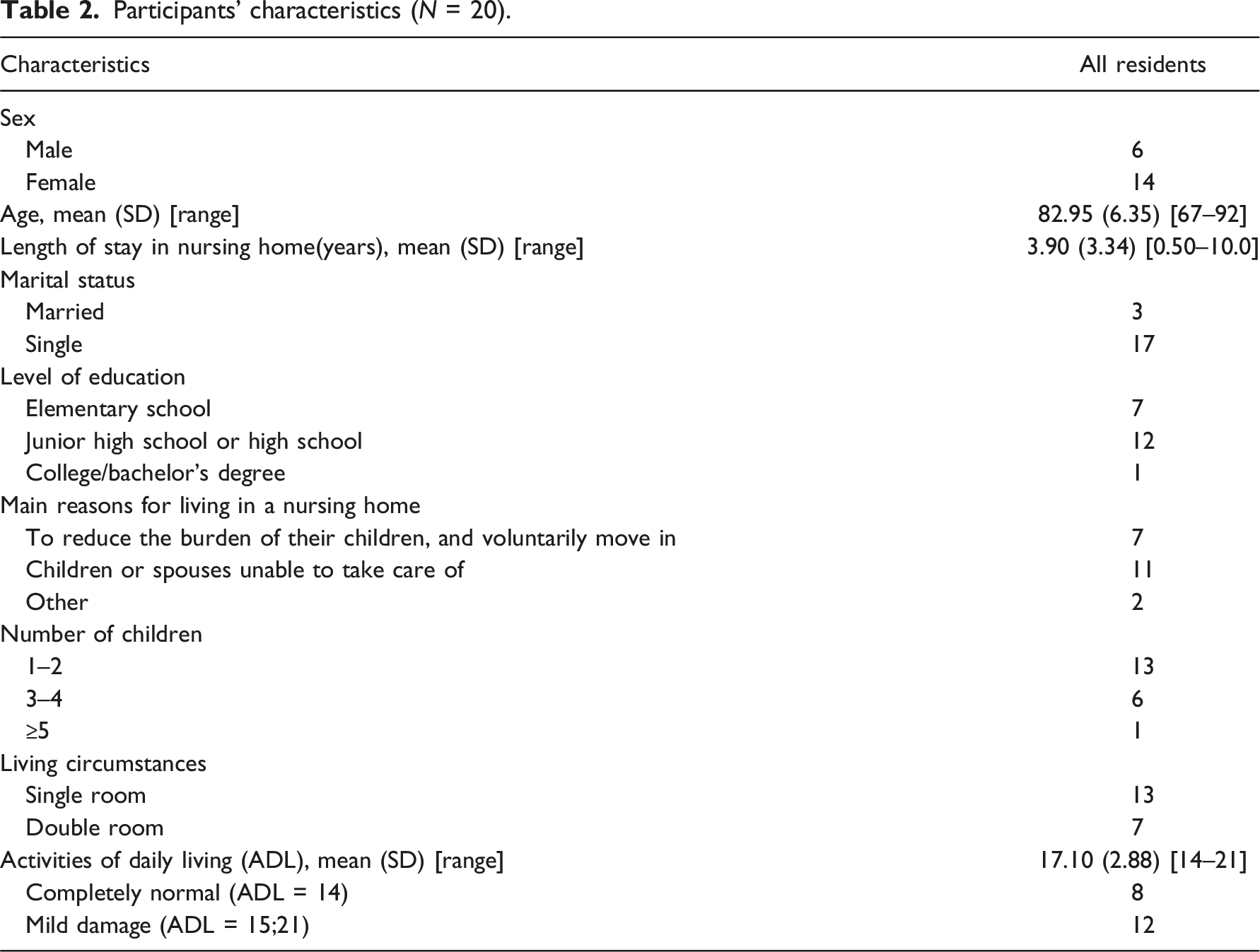
Participants’ characteristics (N = 20).
Overview of themes and sub-themes.
Theme 1. Self-esteem
Sense of self-worth
Sense of self-worth refers to an individual’s self-perceived value, which is older adults’ subjective judgment and reflection of their own value based on life experience. In this study, residents had various perspectives regarding their self-worth. Those with a positive attitude believed that the feeling of self-worth was related to a sense of accomplishment, pride, and sense of dignity. You need to be old and learn, you see these paintings are my painting. My life is very fulfilling, and among children and relatives, I am considered this (with a thumbs up), which is very dignified (P10, female, 84-year-old). I led a program to bring joy to everyone and to myself. I felt a great sense of accomplishment, worth and dignity (P2, female, 82-year-old).
The residents with a negative attitude believe that after moving into the nursing home, they need to rely on caregivers in their daily lives. They feel less confident and less useful than they used to. I’m useless, I can’t cook, I have to rely on others for everything, I’m useless (P5, female, 82-year-old). At that time, I could walk and do anything, but now I can’t do it anymore [bowing her head in contemplation] (P6, female, 85-year-old).
Becoming a burden
Becoming a burden refers to the decline in physical function of older adults as they age, making them unable to maintain or continue their previous social roles and having to rely on others. This results in transference, as they believe that they are unnecessary, causing them to be concerned for relatives who may have responsibility for their care. During the interview, most interviewees expressed their satisfaction that they had reduced their children’s burden after moving into the nursing home. Considering the interests of their children, older adults voluntarily move into the nursing home and no longer drag their children. This feeling of relief usually far outweighs their initial concerns and limited adaptation. The reason for this feeling may be related to the fact that in Chinese culture, people tend to be more family-centered and attach greater importance to interdependent relationships. My biggest concern is to liberate my children. I don’t want to hold my children back. At home, my children have to wait on me, take care of me, and cook me at least three meals, bathe me.... I’m not working now. I’m a burden (P13, female, 87-year-old).
Some respondents also felt that they could no longer contribute to society, adding a burden to society, the party, and their families.
Theme 2. Perceived value to society
Being respected
Being respected relates to older adults’ perception of being valued and participating in social interaction. Being respected can make people feel valued and recognized, thereby enhancing their dignity. In the interview, the majority of interviewees mentioned that they felt valued when they engaged in a positive relationship with their caregivers. They are considerate of older adults, attach great attention to us, understand us, respond to our needs, and can immediately take the initiative to help you (P2, female, 82-year-old). They are very polite to older adults. Generally, if you get angry or something is dissatisfaction, their attitude is very good and they will consider our feelings (P7, male, 89-year-old).
But some residents also mentioned that urgent issues they experience were ignored and left unresolved by the management, which left these elderly feeling disrespected. The food here is too expensive, and the quality is not good. I can’t even do it myself (crying), and no one cares about our feedback. I just follow others’ orders, and they don’t value us very much. It’s too difficult for me to get old, it’s too difficult... (keep crying, crying so hard) (P5, female, 82-year-old).
Belonging
Belonging refers to the emotional experience in which older adults perceive that they are accepted and recognized by the group and have a sense of identity and dependence on the nursing home. In the interview, interviewees mentioned “the feeling of home” and “feeling like being abandoned.”
The feeling of home refers to older adults enhancing interpersonal relationships through group activities, meeting the needs of love and belonging, thus experiencing the warmth of home. Most older adults mention that by establishing meaningful connections with caregivers and peers, they feel listened to, a sense of companionship and “at home.” I don’t feel homesick. I used to feel lonely at home. It’s so nice to be here. (P17, female, 79-year-old).
But some interviewees thought that their life at home was not restricted, whereas they felt constrained being institutionalized and disappointed as they lack the freedoms of home. You can go out and stroll around freely at home. But the management is quite strict here, I can’t go out and can only take a walk in the courtyard of the nursing home. I feel quite angry (P7, male, 89-year-old).
The feeling of being abandoned refers to the feeling of being abandoned by society and family after older adults are admitted to the nursing home, separated from the familiar environment, separated from relatives, and having limited interpersonal communication. The results of this study show that older adults may experience feelings of abandonment and homelessness due to reasons such as being left unattended at home and having fewer visits from their children. I sometimes look forward to my son coming to see me and talk to me, but he seems to be very busy with a business trip. My daughter-in-law is also very busy taking care of their children. They don’t have time to visit me and even make very few phone calls, as if they have forgotten about me (lowering her head in silence) (P20, female, 70-year-old).
In addition, numerous older adults also mentioned that many of their family members and friends had passed away, leaving them without a supportive social network and making them feel more unwanted, isolated, and redundant. Some older adults also mentioned that society has a misconception of older adults in nursing homes, perceiving them to be abandoned by their children, but in fact this is not usually the case. Before I came to the nursing home, I was afraid of being said to have been abandoned by the child, but I found that it wasn’t really like that. The children of the world support the parents of the world, and the caregivers are very kind to you. With filial piety in the nursing home, you will feel at ease (P1, female, 83-year-old).
Theme 3. Interpersonal relationships
Relationships with others
Relationships with others refer to the residents who establish positive interpersonal relationships with nursing staff/caregivers, peers, relatives, and/or former friends, thus promoting their dignity.
Older adults accept and trust those involved in their interaction with the caregivers. Most interviewees believe that harmonious relationships are an important part of interpersonal relationships. They treat me as an older adult and I treat them both as children, and the relationship is very harmonious. With filial piety in the nursing home, you will feel at ease (P1, female, 83-year-old).
On the contrary, if relationships are not managed well, it may bring negative emotions to older adults and affect their dignity. I had a fight with someone else, and the management and other peers appear to help me, but actually they have excluded me and kicked me out. I felt inferior, embarrassed, and have no dignity (P6, female, 85-year-old).
Establishing harmonious relationships with peers by visiting, supporting, and helping each other becomes an important part of the residents’ social network. I also get along well with my neighbors, and we always go shopping together by car. Last time we went out together, we bought the same clothes and ate at a restaurant. We were very happy that day (P10, female, 84-year-old).
Maintaining contact with family and former friends can bring emotional support and keep older people connected with their past life. My daughter often calls me and has something to discuss with me. She comes over to see me on weekends and delivers meals to me. I feel that my life is similar to before and the relationship is closer [smiling with satisfaction] (P18, male, 83-year-old).
Respectful behavior toward others
Respectful behavior refers to the actions of the residents in understanding the values of others, accepting others as they are, and making others feel valuable or recognized. Most respondents mentioned that treating others equally and not bullying them is a respectful behavior. If old people want to have dignity, first of all, they should not rely on their old age. This is very important. They should treat others equally and respect others (P17, female, 79-year-old).
Theme 4. Autonomy
Control of daily life
This refers to the individual’s control over their daily life. The findings of this study suggest that residents associate dignity with “control over daily life” and may consider dependency as a threat to their dignity. Most interviewees mentioned that they had lost the ability to cook in daily life and had to rely on others to do things they could no longer manage. This made them feel old, helpless, and a burden, resulting in them feeling embarrassed and frustrated that they cannot do what they once could. I have no choice but to go to a nursing home in my condition. I can’t go upstairs at home, no one cooks for me, and I can’t cook myself. My kids used to cook some for me before they went to work, and then I would heat it up at noon, but now I can’t heat it up either [sad look] (P19, male, 87-year-old).
However, the residents who are self-reliant feel they have control over their daily lives, which gives them a sense of pride and accomplishment. Living in a nursing home, I don’t feel inferior, I feel quite dignified. Although I have a cerebral thrombosis, I can take care of myself, do my own laundry, and take care of myself, at a slower pace (P3, male, 73-year-old).
Participation in decision-making
Participation in decision-making involves informing older adults of relevant events in detail and respecting their decision-making rights and choices. Most respondents believe that participating in decision-making makes them feel valued. At present, the management of nursing home is relatively standardized, and if there are any issues, they will discuss with us and ask our suggestions (P15, male, 86-year-old).
Some older adults also mentioned that as living in nursing homes is subject to regulations and rules, their lifestyle cannot be the same as before. Older adults feel that the decisions relating to them are no longer autocratic but dependent on the institution, for example, losing control of time, unable to make decisions on their own, and unable to choose to do what they want to do. Every night, there is a fixed time to turn off the lights, and in the morning, I have to wake up on time to have meals[... ]Sometimes I am not allowed to go out, and I cannot even come and go as I please. It is not easy to go back to the city now and I have to listen to others [nursing home staff/management], which is very uncomfortable (P18, male, 83-year-old).
Theme 5. Acceptance and adaptation
This refers to being able to accept and adapt to the status quo of living in a nursing home and having to rely on others. In this study, most respondents had adopted a positive attitude. They mentioned that it was difficult to accept their new situation when they first moved in, but they also understood that this was a reality they had to face. Over time, these older adults began to accept and adapt to their new environment, which seemed to promote the restoration of their sense of dignity. When I first came here, life was quite difficult. I was homesick, but it gets better after half a year. Adjust yourself as much as possible, learn to accept, don’t deviate, and maintain contact with the outside world (P10, female, 84-year-old).
In the interview, many older adults shared various coping strategies to maintain dignity, such as cultivating interests and hobbies; participating in meaningful collective activities; and adapting and familiarizing themselves with the environment. These positive coping strategies can enhance self-worth, increase a sense of belonging, and have significant implications for maintaining dignity. I have subscribed to two newspapers, one for the aged and one for the Daily news. I also participated in some activities, such as singing and learning to draw pictures. You see, I drew all these pictures[... ]Every day is full (P10, female, 84-year-old).
However, some of the interviewees were negative and compromise. They told that they had lived here for several years, but they could not let go, and even felt that it was not honorable to live here. I still can’t adapt. I can only comfort myself and tell myself not to leave. No one will take care of you when you go home. Just keep thinking like this[... ][eyes well up with tears] (P12, female, 67-year-old).
Discussion
Moving to a nursing home can greatly impact the lifestyle and outlook of the new resident. When older adults suddenly transition from independent living to collective living in nursing homes, where they need to rely on others, their dignity may be threatened, making them feel vulnerable.27,28 In this study, we identified five themes and eight sub-themes relating to the dignity of older adults in nursing homes.
Self-worth plays a vital role in maintaining dignity. When individuals cannot feel their own value, they will have a sense of “uselessness,” resulting in the loss of dignity. 16 In this study, when older adults begin to age and can no longer contribute to society or take care of their children/spouse and need to rely on others, they feel that they are a burden and experience a declining sense of dignity. This is similar to the results reported by Söderman and Oosterveld-Vlug, who believe that when individuals feel that they are a burden to others, their dignity is damaged and they can even lose the will to live.29,30 The root cause of this kind of psychology may be related to the absence of a social role, the decline of self-recognition, and the decrease in social belonging in the older people. In addition, the contrast between previous independent living versus institutionalization often increases frustration and affects individual dignity.
After moving to nursing home and experiencing separation from the familiar environment of their previous existence, it is natural that these older adults feel vulnerable. In this study, some older adults felt abandoned by their families and society and had no sense of belonging. This is consistent with the study of Rehnsfeldt, who believes that the sense of home is integral to dignity. 31 It is suggested that nursing homes should create a family atmosphere for residents, cultivate a sense of belonging, and make them feel at home. Creating this sense of belonging should enable older adults to undergo behavioral adaptation: considering themselves part of the collective, actively participating in collective activities, and constantly improving their self-value during the process of interaction. 32
Dignity can rely on strong interpersonal characteristics. In this study, older adults mentioned that establishing good relationships with caregivers, peers, and family members plays an important role in maintaining dignity. This may be related to the fact that a good relationship means being understood, trusted, and accepted, as well as being able to provide emotional support, which can serve as a buffer when dignity is threatened. This view is consistent with research results of Western countries.20,30 Quite often, residents are located far from relatives and have limited communication with the outside world. The people who have the most contact with them are mainly their caregivers but also residents’ companions. Older adults need to rely on these individuals for every aspect of their life here. Their attitudes and behaviors directly affect the dignity of the residents in their care.33,34 This suggests that the support of caregivers has a significant impact on the daily life and dignity experience of older adults. However, in China, the gentleness of caregivers is generally low to medium, with great variation in quality. 35 Therefore, how to further enhance the humanistic care awareness and improve the humanistic care ability of nursing staff is also an urgent need to maintain the dignity of older adults. In addition, some of older adults in the study said that although most of their relatives and friends had passed away, their happiness and sorrow were still closely related to their family. Therefore, nursing homes can strengthen communication with residents’ families, promote interaction between older adults and their children and grandchildren, help them establish emotional relationships, and rebuild supportive social networks.
In this study, the majority of older adults stated that maintaining autonomy, reducing dependence on others, and ensuring self-sufficiency in daily life were important for their dignity. These results are consistent with Heggestad and Cai.36,37 Some older adults believe that although their basic daily needs have been met, factors such as rigid institutional rules and regulations, lack of social support environment, and difficulty in adapting to nursing home life can also pose a threat to their dignity. The reason may be related to the institutionalized management, which makes older adults unable to keep their original living habits and hobbies, and have very limited opportunity to make independent decisions in daily life. It is suggested that in the future, the managers of institutions should ensure the autonomy of older adults flexibly, avoid paternalistic intervention, and comply with their wishes and values on the premise of daily management. It is worth noting that, in traditional Chinese culture, individuals have strong family ties, and individuals can be restricted by family affection and interdependence. Therefore, when faced with decision-making, older adults are often not used to making decisions in isolation but through discussion with their closest kin. They are not used to autonomously pursuing their own interests; thus it may be necessary to awaken a sense of consciousness regarding autonomy, so as to protect their dignity from violation.
Acceptance and adaptation. Studies have shown that older people, who can adapt to and accept their life in nursing homes, have a higher sense of dignity than those who cannot accept this reality. 38 In this study, the majority of older adults stated that after the transition, they could integrate into collective life, establish relationships with others, and share life experiences or events, which helped them adapt to and accept the life in a nursing home as soon as possible. Some older adults also express that they have no other choice but to compromise and passively accept, and even after living for a long time, they still cannot adapt here. These older adults have negative attitudes, prefer to be alone, and rarely participate in group activities. It is suggested that nursing staff in nursing homes should pay more attention to the psychological, spiritual, and social needs of older adults while completing their physical care. In addition, nursing homes can organize more meaningful activities, through participation, older adults can feel self-worth, form a new identity, and thus give new meaning to life.
Limitations of the study
This was the qualitative study to explore the thematic features of dignity experiences of older adults committed to nursing homes in mainland China. We collected the voices and feelings about dignity directly from participants. However, our study only interviewed residents of two nursing homes in Shenyang, so the analysis of the “dignity experience” of older adults is unlikely to be comprehensive and has certain limitations. Follow-up studies can further expand the geographic scope to ensure results are representative.
Conclusion
This study conducted in-depth interviews with 20 older adults to explore the dignity experience of older adults in their daily life in the nursing home, in the context of Chinese culture. Analysis of the response revealed five themes and eight sub-themes, including self-esteem, perceived value to society, interpersonal relationships, autonomy, and acceptance and adaptation. Nursing homes can preserve the dignity of older adults by guaranteeing their autonomy, paying attention to their inner needs and life experience, providing social support, and helping older adults to find self-worth and life meaning, thus improving the delivery of high-quality care services for older adults.
Supplemental Material
Supplemental Material - Dignity in nursing homes: A qualitative descriptive study of older adults’ experiences
Supplemental Material for Dignity in nursing homes: A qualitative descriptive study of older adults’ experiences by Yujia Liu, Yanjie Wan, Xueying Li, Li Ma, and Xiaohan Li in Nursing Ethics
Supplemental Material
Supplemental Material - Dignity in nursing homes: A qualitative descriptive study of older adults’ experiences
Supplemental Material for Dignity in nursing homes: A qualitative descriptive study of older adults’ experiences by Yujia Liu, Yanjie Wan, Xueying Li, Li Ma, and Xiaohan Li in Nursing Ethics
Footnotes
Acknowledgments
We would like to thank the older people who participated in this study and shared their stories.
Declaration of conflicting interests
The author(s) declared no potential conflicts of interest with respect to the research, authorship, and/or publication of this article.
Funding
The author(s) disclosed receipt of the following financial support for the research, authorship, and/or publication of this article: This work was supported by the youth scientific research project of education department in Liaoning Province in 2021, in China (grant number: LJKQR2021013).
Supplemental Material
Supplemental material for this article is available online.
References
Supplementary Material
Please find the following supplemental material available below.
For Open Access articles published under a Creative Commons License, all supplemental material carries the same license as the article it is associated with.
For non-Open Access articles published, all supplemental material carries a non-exclusive license, and permission requests for re-use of supplemental material or any part of supplemental material shall be sent directly to the copyright owner as specified in the copyright notice associated with the article.
