






Abstract
Environmental performance evaluation is an area of growing concern among the worldwide community. Consequently, measurements to evaluate environmental performance are of great importance. However, lack of a quantifiable model to study the environmental performance is a problem in this area. This study therefore attempts to quantify the environmental performance of supply chain of a manufacturing company, which requires evaluation of many criteria. Therefore, selection of environmental performance measures leads to a multi-criteria decision making problem. As a result, analytical hierarchy process is selected to develop the model and is solved with Expert Choice software. Finally the proposed model is applied to a case study company to identify the key areas of environmental performance of the company’s supply chain and to assess various product categories manufactured under those key areas.
Keywords
Introduction
Environmental movements are paid much attention in present agendas due to scarcity of resources, legislation, changes in the environmental patterns, natural disasters, etc. Environmental performance is an important aspect of any business for its long-term survival. Furthermore, stakeholders pressurize business organizations to increase environmental performance of their operations as it provides a basis for performance benchmarking, demonstrates compliance to regulations and increases operational efficiency. Therefore, there is a need for a comprehensive analysis of the environmental performance of the supply chain in order to keep up with the growing interest of general public on this front.
However, mechanisms for quantifying environmental performance are not fully developed. Setting targets and monitoring performance with indicators are the common practice that is applied in many business cases. Indicators are heavily used and are popular due to drawbacks of measuring directly environmental performance, such as, methodological problems, practical reasons of cost, time, and the lack of simulation models. Environmental performance indicators are commonly included in sustainability indicators too. Therefore, environmental performance indicators are defined in a way to focus on long-term effects of a policy in an area or a country.
Supply chain transforms natural resources, raw materials and components into a finished product from supplier to customer utilizing organization, people, technology, resources and information. Therefore, the impact on environment is significant in a firm’s supply chain. Products from ‘cradle to grave’ deal with environment in one way or the other during their life cycles. Consequently firm’s supply chain deals with a large number of raw materials, consumes high energy and generates lot of waste. Therefore, it is crucial for a company to optimize the use of resources and minimize waste. Consequently, evaluating environmental performance of firm’s supply chain is vital as it highly impacts on environment. However, problem would be the lack of quantifying tool to measure environmental performance and benchmarking it against other similar operations or between different products. Therefore, the objective of this research is to to develop a quantitative tool to measure the environmental performance which optimize environmental performance of complex systems and networks of the supply chain.
The article first describes environmental performance indicators and frameworks available in literature. Then it presents a decision support framework to measure environmental performance of the supply chain. Then environmental performance is modelled using MCDM model, analytical hierarchy process (AHP). Finally, an example of a case study company is presented to show the actual implementation of the model. The study would give an idea of environmental performance of various products and different areas of the supply chain.
Evaluating Environmental Performance
Environmental performance evaluation is a term used to describe a formal process of measuring, analyzing, reporting and communicating an organization’s environmental performance against criteria set by its management. Use of indicators for this purpose is an increasing trend (Putnam, 2002). Purposes of indicators are to compare environmental performance over time, highlight optimization potentials, derivate a pursuit of environmental targets, identify market changes and cost reduction potentials, evaluate environmental performance among firms, act as a communicational tool for environmental reports, act as feedback instrument for information and motivation of the workforce and provide technical support for environmental management systems (EMS) (Jasch, 2000).
Environmental performance indicators, therefore, need to possess certain qualities in order to give the desired results. They should be understandable by non-scientists, and be relevant to the environmental and social objectives of the organization and information needs of stakeholders. Further, they should be reliable, comparable across entities and against relevant benchmarks (Schaltegger et al., 1996), measurable and verifiable. Since companies modify practices from time to time, indicators should be enhanced benchmarking and monitoring. Furthermore, they should be combined with an overall evaluation of company’s operations, products and services and help in improving the decision-making process.
Niemeijer (2002) presented a review of categorization of environmental indicators that were used in business, which were mainly devoted to the descriptive analysis of the existing practices. Tsoulfas and Pappis (2008) mentioned that existence of a single set of indicators covering all aspects of company’s functions was inappropriate due to tracing only a few aspects of company’s functions and changing significance of the selected aspects from sector to sector, company to company and time to time. Moreover, they identified some problems in use of environmental performance indicators, such as, the assumptions made at the beginning of system modelling; problem of data collection, which might be a very complicated process especially when large systems were examined with varying precision; inclusion of subjective judgement in calculating indicators which would limit their value; problems with quantification of qualitative data and defining exact meaning of vague concepts.
Frameworks for Environmental Performance Evaluation
Reporting systems and certifications that are available to assess environmental impact of organizations also help in evaluating environmental performance of firm’s supply chain. Therefore, they can be used as guiding frameworks for environmental evaluation. This section provides brief overview of such reporting systems and certifications.
ISO14031 is an international standard that describes a process of measuring environmental performance based on Plan-Do-Check-Act business process improvement model. It is not a standard for certification. This tool is designed to provide management with reliable and verifiable information in an ongoing basis to determine whether organization’s environmental performance meets the criteria it has set for itself. It comes under the ISO 14000 series of standards, and intends to assist organizations to obtain ISO 14001 certification. This provides benefits to organizations irrespective of their nature and with or without the EMS in place. In applying the standard, an organization with an EMS should evaluate its performance against its environmental policy, objectives, targets and other criteria established within the management system. Organizations without an EMS may also use this to identify its environmental aspects, determine significant aspects, establish environmental performance criteria and assess its performance against the criteria (Putnam, 2002).
Global Reporting Initiative (GRI) is a framework that sets out the principles and indicators for organizations to measure and report their economic, environmental and social performance. It produces one of the most prevalent standards for sustainability reporting known as ecological footprint guidelines. Sustainability reporting is a form of value reporting by which an organization publicly communicates their economic, environmental and social performance. G3.1 is an update and completion of the so-called ‘Third Generation’ of the GRI’s Sustainability Reporting Guidelines which includes human rights, local community impacts and gender as well. In order to ensure the highest degree of technical quality, credibility and relevance, the reporting framework is developed through a consensus seeking process with participants drawn globally from business, civil society, labour and professional institutions. The environmental aspects defined in G3.1 are the materials, energy, water, biodiversity, emissions, effluents and waste, products and services, compliance, transport and overall. These aspects are structured to reflect inputs, outputs and modes of impact an organization have on environment. Energy, water and materials represent three standard types of inputs used by most organizations. These inputs result in outputs of environmental significance, which are captured under the aspects of emissions, effluents and waste. Biodiversity is also related to the concept of inputs to the extent that it can be viewed as a natural resource. However, biodiversity is also directly impacted by outputs such as pollutants. GRI guidelines are applicable to corporate businesses, public agencies, smaller enterprises, non-governmental organizations, industry groups and others (Global Reporting InitiativeTM).
Green Productivity Index (GPI) is the ratio of productivity of a system to its environmental impacts. The index is to estimate the green productivity performance of an existing product or process and comparing it with other equivalents. It is a measure of the green productivity performance of a product system throughout its entire life cycle. This can be further divided as ‘direct’ GPI to analyze the green productivity performances of direct production processes and an ‘indirect’ GPI to analyze indirect upstream processes (Gandhi and Selladurei, 2006).
Green tick sustainability certification system provides an independent, life cycle based sustainability certification of consumer products. It is an easily recognizable logo comprising a ‘Green TickTM’ inside a circle, reminiscent of a government ‘stamp of approval’, used as a sustainability label. According to European Commission’s view, sustainability labelling should be based on independent, full life cycle assessments of products. Market trials had revealed that there was measurable consumer support for independent sustainability labelling and significant commercial benefits for companies whose products qualified for sustainability labelling (Harris, 2007).
Quantitative Pollution Management (QPM) was developed by Jones and Cresser (2005) to derive quantifiable indication of overall environmental performance of an organization. Weightings that should be allocated for the individual and combined categories in achieving the indicator of pollution performance were also established. A methodology was established to derive a QPM indicator that provides a numeric variable, by using numerical values that had been obtained from a set of linguistic values evaluated against determinations of prescribed events. These unique QPM indicators assist in promoting a sustainable management strategy with preventative approaches to pollution and enable consumers to make a purchase decision taking into account environmental concerns.
Moreover, researchers had developed their own methods to analyze environmental performance of supply chains. Tsoulfas and Pappis (2006) discussed six environmental principles groups covering the areas from which the environment was affected. This includes product and process design, packaging, transportation and collection, recycling and disposal, greening internal and external business environment and other management issues. These are applicable to entire supply chain and directly relate to the material flow. As a result, evaluation of environmental performance should cover all these areas.
Environmental performance frameworks discussed here can be used to assess the environmental performance of a firm’s supply chain. Any such framework needs to be adapted to the context according to the nature of the business and appropriate indicators should be developed accordingly.
Applicability of Multi-criteria Decision Making Method to Analyze Environmental Performance
According to the discussion in previous section, evaluating environmental performance includes comparing various parameters of different nature. Therefore it requires a mechanism to assess these aspects properly. Multi-criteria Decision Making (MCDM) is an approach which facilitates this purpose by supporting decision makers facing numerous and conflicting evaluations. It highlights conflicts and derives a way to arrive at a compromise in a transparent process. Unlike the methods that assume availability of measurements, measurements in MCDM are derived or interpreted subjectively based on the strength of various preferences of indicators. Preferences differ from decision maker to decision maker, so the outcome depends on the decision maker and the goals and preferences. Following aspects are considered in MCDM:
There is no solution optimizing all the criteria at the same time and, therefore, the decision maker has to find compromise solutions. The relations of preference and indifference are not enough in this approach because when an action is better than another one for some criteria, it is usually worse for other ones, so that many pairs of actions remain incomparable with respect to dominance relation.
Several supply chain management issues have been dealt with MCDM approach. Therefore, it can be applied to develop a tool to measure environmental performance of supply chain as well.
Analytical hierarchy process is one such MCDM methodology. It is an approach to solve complex problems of multi-criteria decision nature designed by Professor Thomas L. Saaty and his associates. This is a structured technique for dealing with complex decisions which involve comparison of decision elements which are difficult to quantify. It decomposes a complex multi-criteria decision problem into a hierarchy and prioritizes the hierarchy and consistency of the judgemental data provided by the group of decision makers. It has been extensively used as a basis for environmental issues. It helps decision makers to find the one that best suits their needs and their understanding of the problem rather than prescribing a ‘correct’ decision. Therefore, it is a good way of analyzing a complex problem with many variables. Refer Appendix for AHP methodology.
Developing an AHP Model for Environmental Performance Evaluation
This section describes how to develop an AHP model to evaluate environmental performance of a supply chain. The objective is to establish environmental performance of a company’s supply chain. Then hierarchical structure is established by breaking the environmental performance evaluation problem into a hierarchy of interrelated elements, including goal, criteria, sub-criteria and alternatives. This model hierarchy is shown in Figure 1.
AHP Model
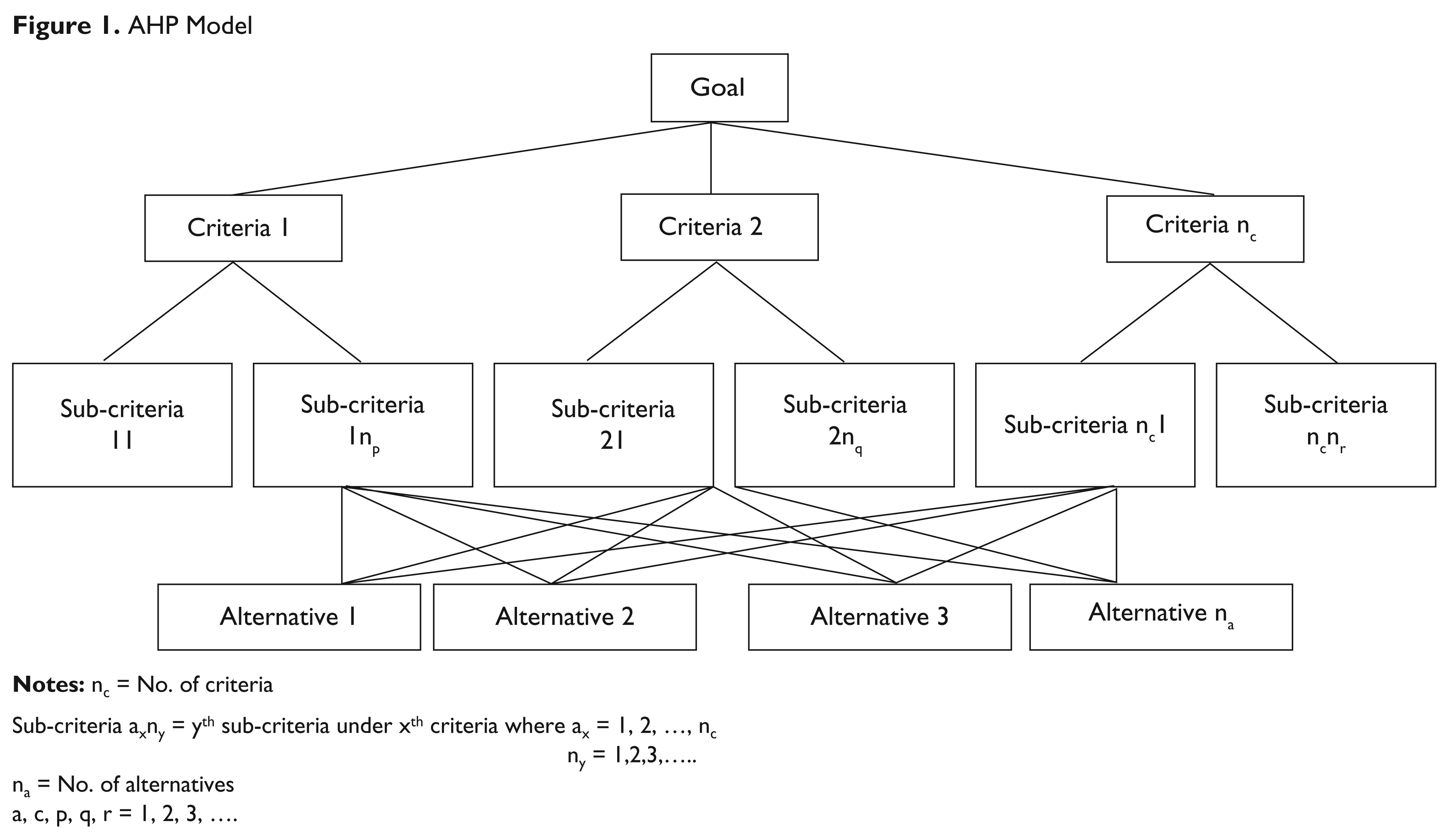
According to the previous discussion, environmental performance can be evaluated with many criteria that make an impact on the environment. Criteria and sub-criteria were defined from the available models. The model developed by Tsoulfas and Pappis (2006) was selected to derive main criteria. Product and process design, packaging, transportation and collection, recycling and disposal, greening internal and external business environment and other management issues were, therefore, considered as the main criteria. Sub-criteria which represent how each criteria influence on environment were selected from the environmental aspects defined in G3.1. Therefore, materials, energy, water, biodiversity, emissions, effluents and waste, products and services, compliance, transport and overall were selected as sub-criteria. Out of this set, relevant sub-criteria were chosen to represent respective main criteria. Therefore not all sub-criteria were fallen into all the main criteria. Various product lines of the company can be evaluated based on these multiple criteria. Therefore, product categories available in the supply chain represent the alternatives to the model. The basic element of the proposed model can be summarized as follows.
Application of AHP Model to Evaluate Environmental Performance of the Case Study Company
The foregoing model was implemented in a case company. The selected company is a well-established company operating in fast moving consumer goods industry in Sri Lanka which offers products in homecare, personal care, food and beverages. Environmental performance is one of the key considerations of this company and therefore collects data to measure environmental performance.
Product and process design, packaging, transportation and collection, recycling and disposal and other management issues were identified as the criteria for environmental performance evaluation of the company’s supply chain. However, this study was limited to product and process design, packaging, transportation and collection, and recycling and disposal due to availability of data.
Relevant sub-criteria for each criterion were identified from the list of sub-criteria. The results are shown.
Indicators to measure environmental performance of sub-criteria under each main criterion were defined. Finally 20 indicators were developed to represent the foregoing sub-criteria under each criterion.
Product categories that have major environmental impact were considered for the study and environmental performance framework was developed accordingly. Therefore, the study covered soap, powder, toothpaste, liquid and spread product categories. The proposed AHP model for the case study company is shown in Figure 2.
Hierarchical Structure Required to Evaluate the Environmental Performance of the Supply Chain
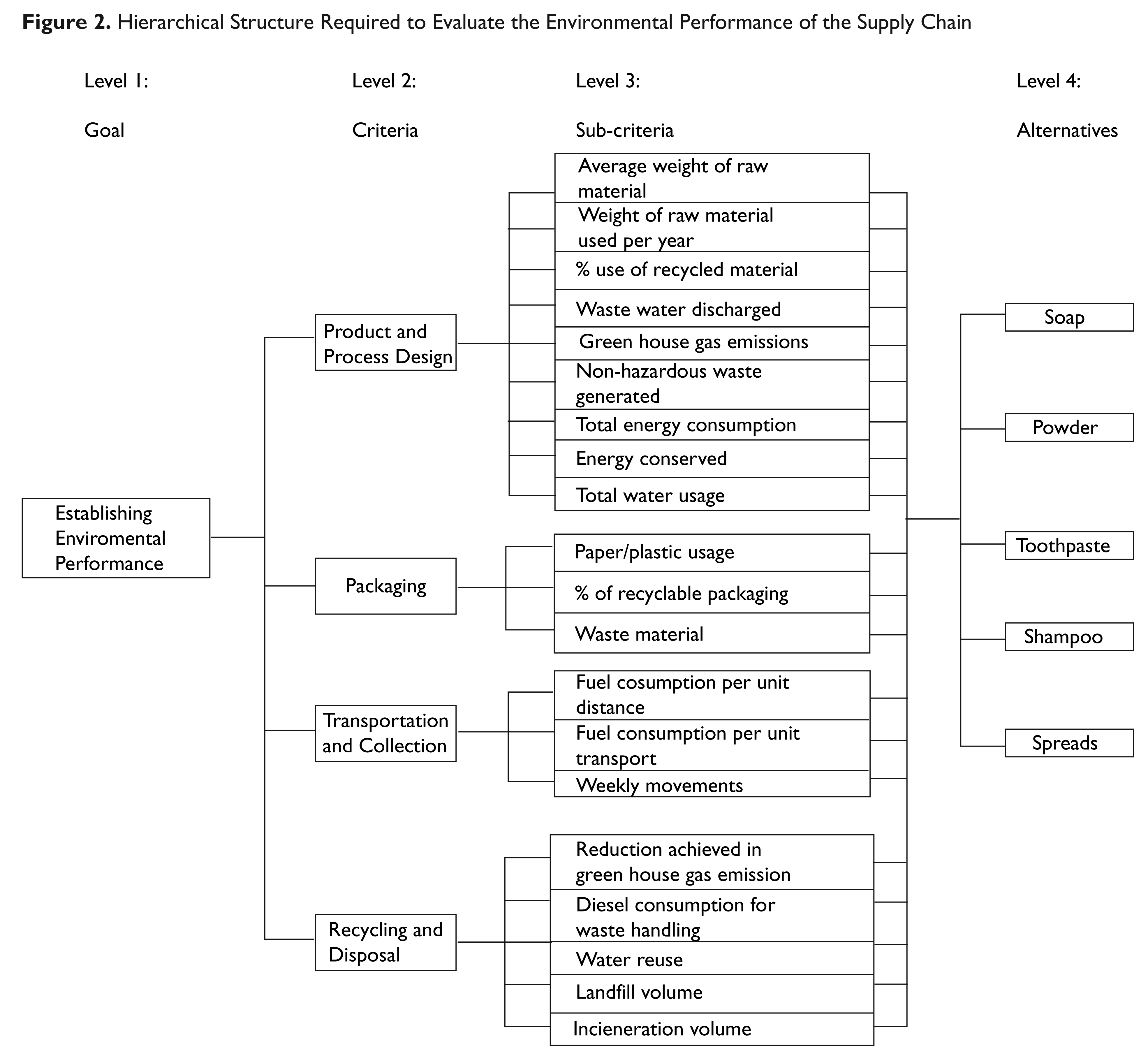
Environmental performances of the product lines were evaluated under the criteria discussed in the foregoing section. Data was obtained from the existing records and by interviewing the responsible people such as plant managers.
Once all the criteria and sub-criteria for the AHP model were determined, managers were asked to pair-wise compare the criteria and sub-criteria. Pair-wise comparison was done using a scale of 1 to 9 as explained in Appendix to establish priorities among all the criteria. One fundamental assumption made for the study was that the priorities established for criteria as above were valid for each of the alternative product categories. Then priorities of the sub-criteria within main criteria were established using a similar process as described earlier. Alternative product categories were compared against each of the sub-criteria. Pair-wise comparison matrixes were developed. They are shown in Table 1.
Pair-wise Comparison Matrixes
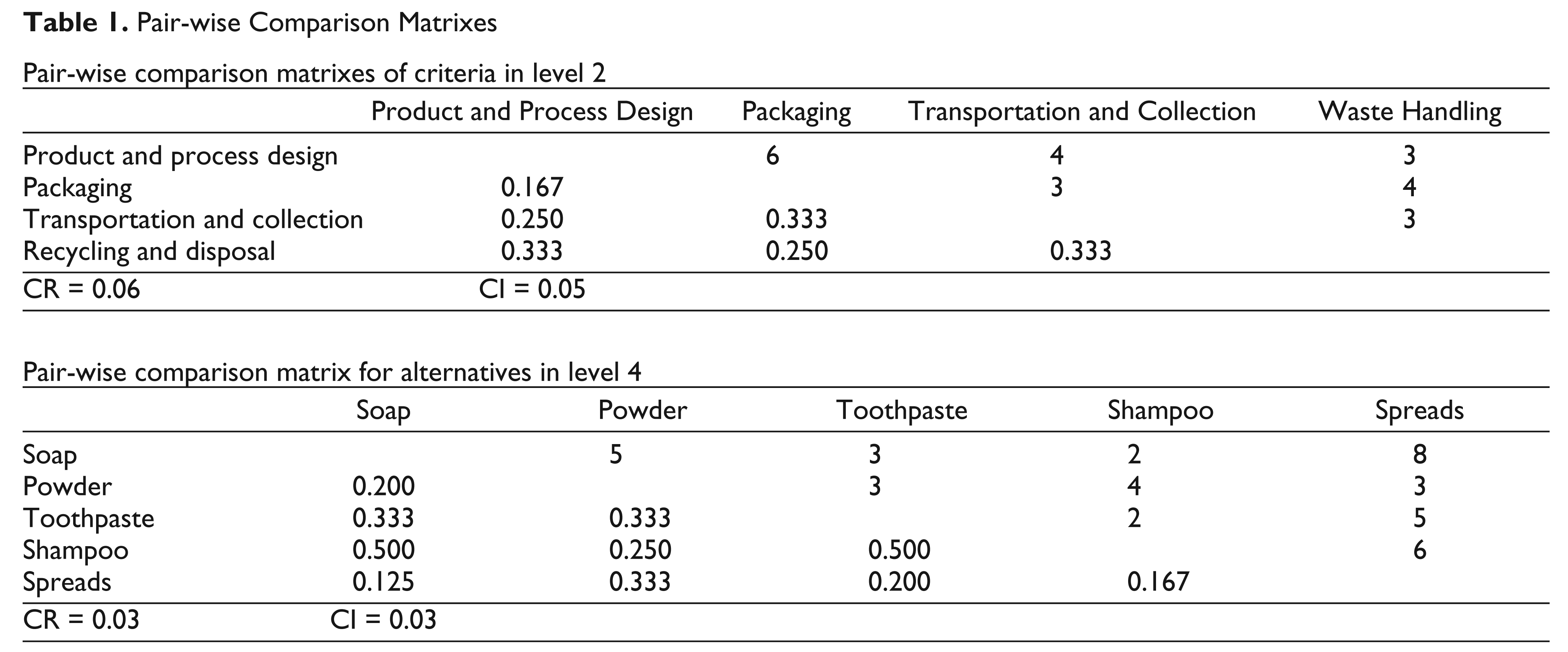
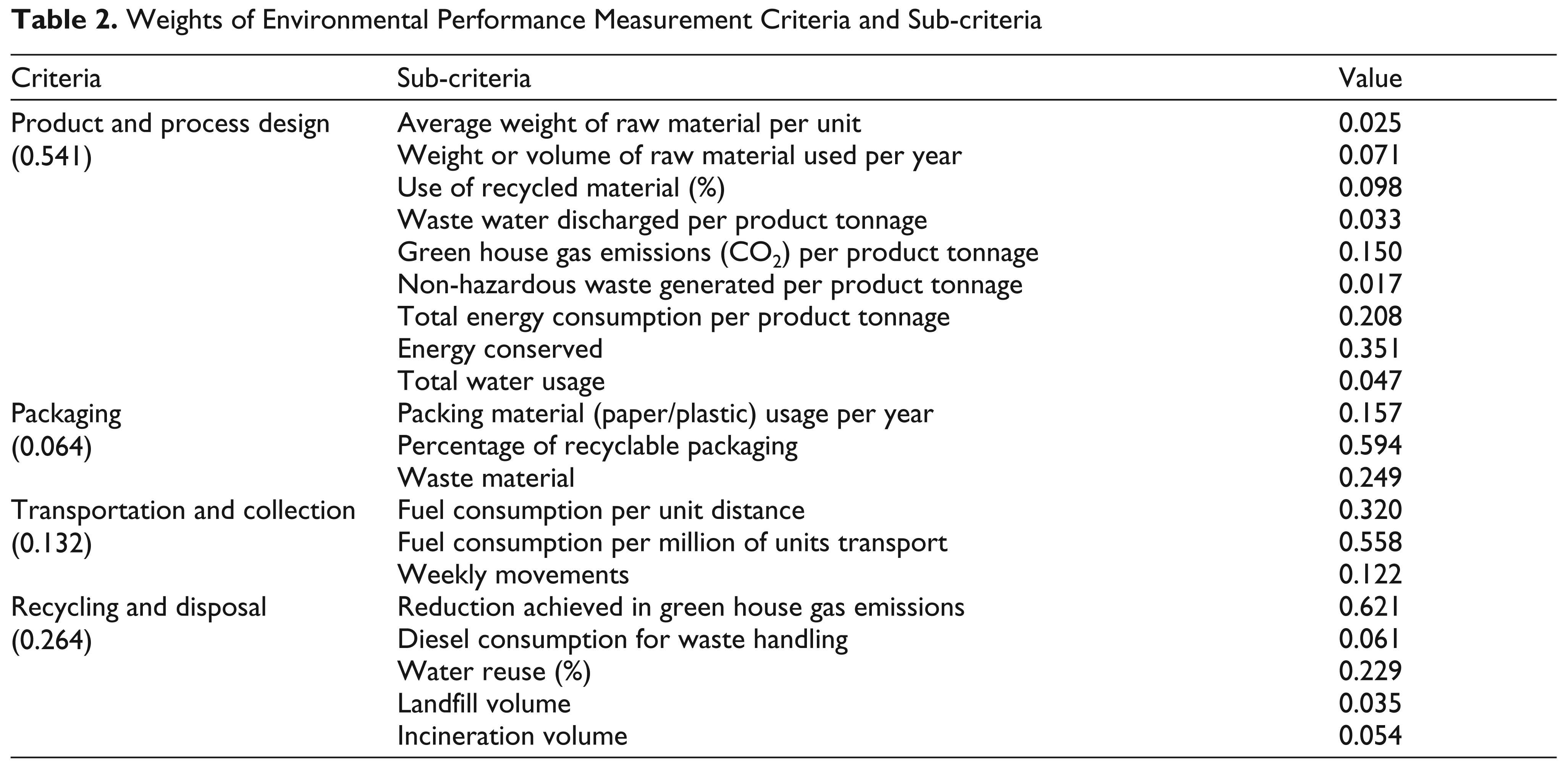
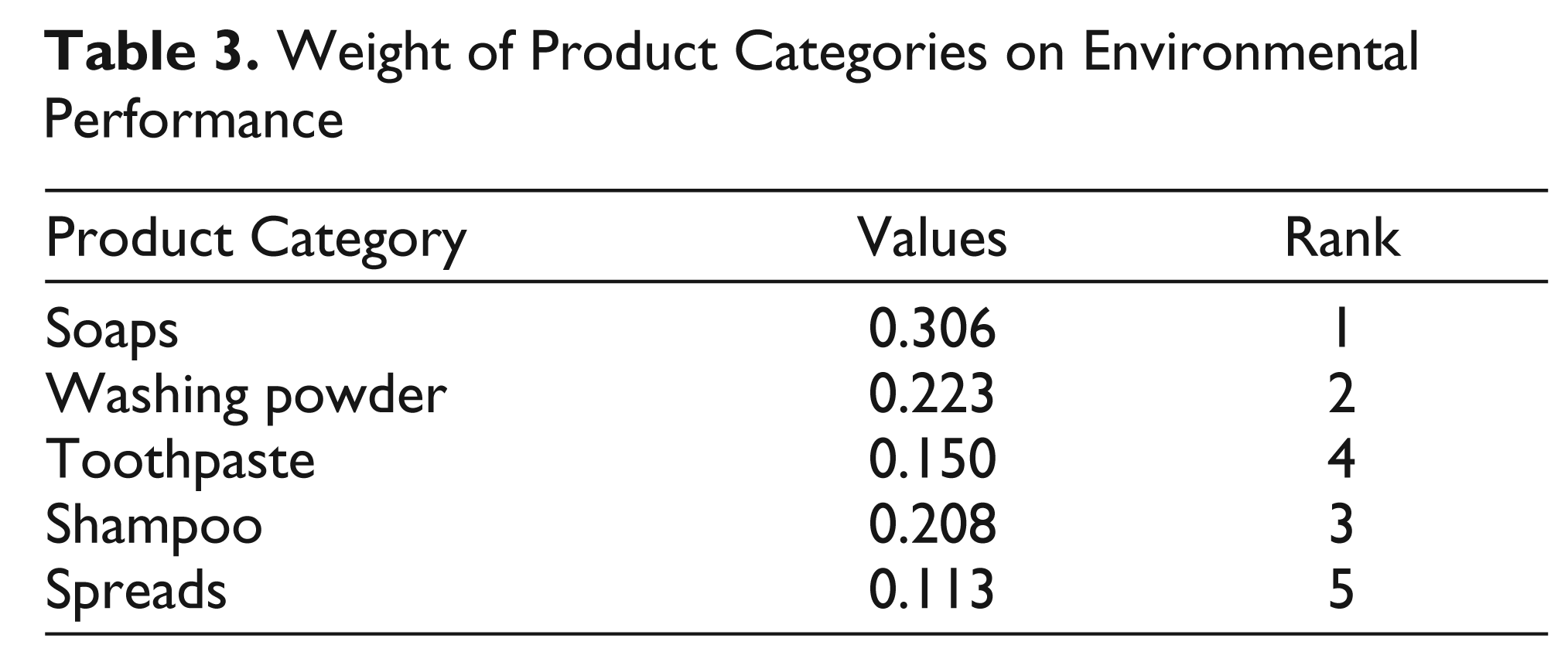
Expert Choice software was used to solve the AHP model. All pair-wise comparisons were fed into the software to get the relative weight of criteria (results are shown in Table 2), weights of sub-criteria under each criterion (results are shown in Table 2) and final rank of alternative products on environmental performance (results are shown in Table 3).
Weights of Environmental Performance Measurement Criteria and Sub-criteria
Weight of Product Categories on Environmental Performance
Inconsistency of pair-wise comparison matrix was checked by the software using the consistency ratio. The values less than 0.1 indicate the consistency of the pair-wise matrix. The results revealed that all pair-wise matrixes were consistent. Therefore, all 20 environmental performance measurements representing sub-criteria were selected for the study.
Discussion
According to Table 2, respective weights of the four environmental evaluative criteria are product and process design (0.541), recycling and disposal (0.264), transportation and collection (0.132) and packaging (0.064). The decision on environmental performance is dominated by design of the products and processes. Therefore, it is the major consideration in improving environmental performance of company’s supply chain. Recycling and disposal, transportation and collection, and packaging are the descending order of importance in developing environmental performance.
According to Table 2, weights obtained for the nine sub-criteria of product and process design are energy conserved (0.351), total energy consumption (0.208), green house gas emission (0.150), use of recycled material (0.098), weight or volume of raw material usage per year (0.071), total water usage (0.047), waste water discharged (0.033), average weight of raw material per unit (0.025) and non-hazardous waste generated (0.017). The company is highly concerned about energy and material usage, their secondary usage, and green house gas emissions when designing products and processes. However, the company should pay more attention in areas, such as, water usage, waste water discharged and non-hazardous waste generated when designing products in order to perform better on environment.
Percentage of packaging that can be recycled is the most important aspect that impact on environment in packaging whereas waste and packing material usage are in the descending order of importance of other aspects. Fuel consumption per unit transport is the most important criteria under transportation and collection whereas fuel consumption per unit distance is the second most important and weekly movements are the least important sub-criteria in the category. Green house gas emission is the most important consideration under waste with an importance of 0.621. Weights of other sub-criteria are water reuse (0.229), reduction achieved in diesel consumption for recycling and disposal (0.061), incineration (0.054) and landfill (0.035).
The overall scores of each product category in Table 3, also called the relative weights, demonstrate the priority with which each product is selected on environmental performance. Priorities are as follows: soap (0.306), washing powder (0.223), toothpaste (0.150), shampoo (0.208) and spreads (0.113). Therefore, soap has the best environmental performance in supply chain whereas washing powder, shampoo, toothpaste and spreads show the descending order of environmental performance. Nature of product and production process affects the environmental performance. The high level of environmental performance of soap may be the result of the energy saving achieved by changing its manufacturing technology and green house gas saving. Moderate performance in shampoo is a result of less material and energy consumption per unit. This is possible due to small size of units produced as sachets. Spreads performs least on environment due to high energy intensive nature of its manufacturing process. Both shampoo and spreads generate high waste during the production. The company should pay special attention to the product categories which have low environmental performance such as spread.
Conclusion and Recommendation
Environmental performance is a major consideration in many companies. Therefore, a proper evaluation system to monitor environmental performance of operations is a requisite of a company. Use of indicators is the most commonly used evaluation method although a number of frameworks exist that provides guidelines for environmental performance.
Entire supply chain of the company impacts on environmental performance. Not all companies are similar and various products are manufactured in a company. As a result, developing appropriate environmental performance measurements to evaluate a firm’s supply chain becomes complex. This involves evaluating environmental performance in many criteria. Therefore, the decision-making problem becomes multi-dimensional.
In this study, an AHP model was developed to evaluate environmental performance of the supply chain. The model can reveal the importance of each evaluating criteria on environmental performance and the importance of each sub-criterion on each criterion. Further, it has the capability of analyzing details of alternative product categories with respect to each criterion. The model gives the decision maker proper flexibility in seeing the consequences due to changes in each and every variable that evaluates environmental performance with respect to others. Finally the model was implemented on a case company that considers only five environmental aspects proposed by Tsoulfas and Pappis (2006) and only few categories mentioned in G3.1 as the sub-criteria. The management can optimize the environmental performance of the supply chain starting from the weakly performing product categories.
Environmental performance indicators, such as, environmental incidents reported, environmental trainings conducted for employees and impact on the biodiversity of the vicinity, were not covered in this study. Therefore, there is a room for improvement of the model developed considering those missing aspects. Furthermore, the study can be extended to cover remaining product categories of the case company.