







Abstract
Background
International students frequently look for programmes that are not offered in their home countries in order to pursue high-quality education, cultural exposure, professional prospects and personal development while studying abroad. Understanding attachment styles enables people to better comprehend local norms and values, facilitating easier social interactions and minimising misunderstandings, even though adjusting to the host country might be difficult.
Purpose
The present study aimed to explore the relationship between attachment styles and sociocultural adaptation among international students in the host country. The study’s specific goal was to comprehend how different attachment styles affect international students’ adjustment to new cultural customs, social norms and values.
Methods
The study included 240 international students (male = 120 and female = 120) enrolled in various universities and educational institutions in Varanasi City, Uttar Pradesh, through purposive sampling. Participants were selected between the ages of 19 and 35 years. The Attachment Style Questionnaire (ASQ) and Revised Sociocultural Adaptation Scale (SCAS-R) were used in data collection.
Results
The findings show that secure attachment style increased sociocultural adaptation, whereas insecure attachment styles decreased it among international students in the host country. A secure attachment style offers consolation, confidence and strong social bonds, all of which significantly enhance international students’ sociocultural adaptation in India.
Conclusion
Social integration of international students may be greatly aided by planning inclusive cultural activities that promote engagement, lower social barriers and create a friendly atmosphere. Educational institutions may foster cross-cultural understanding and improve the overall campus experience for both domestic and international students by giving priority to such efforts.
Introduction
Globalisation has increased mobility and interconnectedness among people and countries worldwide. One area where this is particularly evident is international education, where more and more students are choosing to study abroad. There are a variety of factors driving this trend, including the desire to gain an international perspective, the opportunity to learn a new language or culture and the potential for increased career opportunities. Many universities and colleges around the world have responded by offering a range of programmes and services to support international students, including language courses, cultural exchange programmes and assistance with visa and immigration issues. 1
India is home to over 47,000 international students from more than 160 countries. The number of international students in India has been increasing steadily over the years, as the country has emerged as a popular destination for higher education. International students in India are attracted to the country’s rich cultural heritage, diverse academic programmes and affordable tuition fees. Some of the popular fields of study for international students in India include engineering, medicine, management and information technology. 2
There are several universities and educational institutions in India that offer quality education to international students, such as Indian Institutes of Technology (IITs), Indian Institutes of Management (IIMs), Jawaharlal Nehru University (JNU) and Banaras Hindu University (BHU). The Indian government has also taken several steps to attract more international students to the country. For example, the government offers scholarships and financial assistance to international students to study in India. Additionally, the government has simplified the visa process for international students, making it easier for them to study in the country. Overall, India is a welcoming destination for international students, offering high-quality education, diverse cultural experiences and affordable fees.
Studying abroad may not be easy, as international students face a variety of challenges in a new country. These challenges include adjusting to a new culture, learning a new language, forming attachments to people and adapting to sociocultural norms.1, 3, 4 However, studying abroad can also be a rewarding and transformative experience that helps students to develop new skills, broaden their perspectives and make lifelong connections.
Attachment Styles and Sociocultural Adaptation
Attachment style is the way in which adults form and maintain relationships with others. Attachment style is based on an individual’s early experiences with their primary caregiver(s) and how they were cared for and nurtured during their childhood.5, 6 Attachment theory is based on the behaviour of infants and young children in response to separation from their primary caregiver. It is a psychological framework that describes how individuals form emotional bonds and attachments with others. Individuals develop a specific attachment style based on their early experiences with their primary caregiver.7, 8 Attachment styles are known by various names; however, according to Bartholomew and Horowitz, 9 they mentioned four types of adult attachment style: first is secure attachment style, which is also known as autonomous (F), and the remaining three are insecure attachment styles, namely fearful/unresolved (U), preoccupied (E) and dismissing (Ds). Secure attachment style is associated with a strong sense of self-worth and the ability to maintain supportive connections. In contrast, insecure attachment styles are linked to feelings of incompetence and difficulties in establishing supportive connections. 10
Individuals with a secure attachment style tend to have a positive self-view and a favourable view of others. They are comfortable with intimacy and seek out close relationships with others.9, 11 Moreover, people with fearful attachment style may have experienced trauma, neglect or abuse in their early years, which has led them to feel insecure and fearful of relationships. As a result, they may have difficulty trusting others and may feel both drawn to and repelled by close relationships. Individuals with a preoccupied attachment style tend to rely heavily on their relationships for emotional fulfilment and validation, and often feel anxious or worried about their partners’ level of commitment or affection. Dismissing attachment style is a way of relating to others, characterised by avoidance of emotional intimacy and a focus on self-reliance. Individuals with a dismissive attachment style may have difficulty trusting others and may prefer to keep their emotions to themselves. 9
In the process of acculturation, people move to a new country or community with different cultural norms, values and beliefs, where they may experience a variety of challenges that can affect their ability to function and thrive in their new environment, as well as sociocultural adaptation. Sociocultural adaptation involves learning about and adapting to the new culture, as well as adjusting one’s own behaviours, attitudes and expectations to align with its norms. This can include learning the language, customs and traditions of the new culture, as well as developing new social skills and building relationships with people from different cultural backgrounds. 12
International students need to adapt socially and culturally during their transition to the host country, including language proficiency, ecological adaptation and academic performance, which are heavily influenced by the attachment styles they adopt in the host country.3, 4, 13 Successful sociocultural adaptation can lead to a greater sense of belonging and acceptance within the new community. At the same time, failure to adapt can result in feelings of isolation, loneliness and cultural stress.14, 12 Furthermore, it is an ongoing process that can take time and effort but can ultimately lead to a richer and more rewarding experience of living in a new culture.
Studies have found that, during acculturation, attachment styles are linked to sociocultural adaptation.15, 16 Recent research has shown that attachment styles are a prominent factor in the host country and may affect the adaptation process of international students.17, 18 Existing literature also suggests that attachment styles influence students’ interactions with individuals in the host country, their academic environment, their involvement in the community, and their ecological and sociocultural adaptability.16–18 This emphasises the need to examine the potential interaction between attachment styles and sociocultural adaptation.
Wang and Mallinckrodt 13 found that Chinese international students with insecure attachment styles (attachment anxiety and attachment avoidance) were more prone to problems of sociocultural adaptation in the USA. In other words, there is a positive relationship between insecure attachment and sociocultural problems as well as psychological problems. Insecure attachment styles also predicted more sociocultural adaptation issues and psychological issues among Chinese international students in the USA. Mallinckrodt and Wei 19 also suggested that highly avoidant and anxious individuals tend to see themselves as helpless when it comes to establishing new friendships or enhancing their social support network.
In a study of 172 Brazilian immigrants in the UK, Sochos and Diniz 18 found that secure and dismissing attachment styles moderated the effect of sociocultural adaptation problems on psychological distress. In contrast, prior immigration experiences on psychological distress and length of stay in the UK were moderated by preoccupied attachment style. Specifically, the study revealed that immigrants with a fearful attachment style were more inclined to seek social interaction with individuals who spoke their native language. This behaviour may be seen as a coping mechanism or a way to establish a sense of familiarity and security in an unfamiliar cultural environment. On the other hand, dismissively attached immigrants, who tend to avoid emotional closeness and dependency, were less likely to live with a spouse or partner. This finding suggests that these individuals may prefer a more independent lifestyle or may experience difficulty forming and maintaining close relationships, which could contribute to their social isolation. Sochos and Diniz 18 also noted that immigrants who were less socially and culturally stable, possibly due to facing greater cultural barriers or experiencing social isolation, were more likely to experience psychological distress. This indicates that the challenges of adapting to a new culture and a lack of a support network can significantly affect an immigrant’s sociocultural adaptation.
Polek et al. 17 conducted a study of German and Eastern European immigrants living in the Netherlands, with backgrounds in Russia, Hungary and Poland. The findings show a positive relationship between secure attachment style and sociocultural and psychological adaptation. The results also show a negative relationship between fearful attachment style and adaptation among all immigrants. Moreover, preoccupied attachment style has not been found to have any relationship with sociocultural adjustment, but it has a negative relationship with psychological adjustment. However, no relationship was found between dismissing attachment style and either psychological or sociocultural adjustment, except in the Russian sample.
Particularly in nations like the USA, the UK, Canada and Australia, Indian international students make up one of the largest numbers of students who travel throughout the world. 20 Collectivistic beliefs, deep family interdependence and emotionally intimate parent–child interactions are characteristics of Indian sociocultural environments that greatly affect attachment styles.21, 22 Despite these characteristics, Indian students often exhibit adaptive coping mechanisms based on collectivistic ideals, such as preserving close emotional bonds with family, looking for peer support from co-national or culturally similar groups, and progressively assimilating host-culture norms. 23
Furthermore, empirical research in the Indian context indicated that Indian students frequently struggle with issues including communication styles, perceived discrimination, academic expectations, and striking a balance between autonomy and family responsibilities.24, 25 Research also suggested that secure attachment is positively correlated with improved emotion regulation, interpersonal competence and adaptive coping, which are important for adapting to new sociocultural settings.6, 26 Therefore, Indian students who are securely attached handle these changes better, demonstrating greater levels of host–national engagement, cross-cultural empathy and sociocultural competency.24, 25 On the other hand, due to increased cultural distance, Indian students in Western host countries typically report delayed initial sociocultural adaptation. Nevertheless, many eventually achieve functional integration by renegotiating attachment relationships and creating bicultural identities.27, 28 This emphasises how attachment style functions as a psychological tool that interacts with sociocultural elements to affect the results of adaptation.
Research on Indian young adults revealed that exposure of individuals to culturally dissimilar environments, individuals with anxious or avoidant attachment styles may experience increased acculturative stress, social withdrawal or dependence on co-national networks, whereas individuals with secure attachment styles may exhibit greater psychological flexibility and openness in cross-cultural interactions.29, 30 These findings are in line with attachment theory, which holds that early relational schemas affect how people perceive support, deal with stress and build connections in novel sociocultural settings.
Therefore, the studies mentioned above suggest that attachment styles play a significant role in shaping international students’ sociocultural adaptation during their acculturation.
The Present Study
International students choose to study abroad for a variety of reasons, including the desire for top-notch academic programmes, exposure to other cultures, improved professional opportunities and opportunities for personal growth. A large number of international students pursue specialised programmes or courses that are not offered in their home countries. However, because they must adjust to new social norms, beliefs and practices, these students frequently face significant sociocultural adaptation challenges upon arrival in the host nation.16–19
Understanding how individual variations in emotional ties and interpersonal interactions impact the process of adapting to a new cultural setting is made easier with the help of attachment theory. Secure attachment types are often linked to increased social confidence, emotional stability and the capacity to build deep connections, all of which promote easier sociocultural transition. On the other hand, insecure attachment patterns might make it harder to adjust, which can make it harder to integrate into society and raise the possibility of miscommunication or social isolation.3, 11, 13, 18
In India, where the number of foreign students is continuously rising, it is critical to investigate how attachment styles affect sociocultural adaptation. The purpose of this study is to explore the relationship between attachment styles and sociocultural adaptation by assessing 240 international students in the age range of 19–35 years studying in various universities and higher educational institutions of Varanasi City, Uttar Pradesh. The findings are expected to inform academic institutions to create focused interventions that foster a positive atmosphere that supports international students’ effective transition and general well-being, such as inclusive cultural events and social engagement opportunities.
Based on research findings, it was hypothesised that:
Secure attachment style would be positively correlated with sociocultural adaptation among international students.
Insecure attachment styles (fearful, preoccupied and dismissing) would be negatively correlated with sociocultural adaptation among international students.
Methods
Sample
The sample consisted of 120 male and 120 female students recruited through purposive sampling. The participants’ ages ranged from 19 to 35 years. The participants belonged to different countries, namely Bangladesh, Cambodia, Cape Verde, Mauritius, Myanmar, Nepal, Sri Lanka and Tibet. They were studying at various universities and educational institutions in Varanasi City of Uttar Pradesh.
Measures
Attachment Style Questionnaire (ASQ)
Van Oudenhoven et al. 31 developed this measure to assess individuals’ attachment styles. In this measure, 22 items assess 4 attachment dimensions: secure (8 items), fearful (4 items), preoccupied (6 items) and dismissing (4 items). This scale ranges from 1 (Strongly Disagree) to 5 (Strongly Agree). Participants use this scale to express their level of agreement or disagreement with a statement or item. The secure, preoccupied, fearful and dismissing styles had internal consistencies (Cronbach’s alpha) of 0.75, 0.80, 0.79 and 0.62, respectively.
Revised Sociocultural Adaptation Scale (SCAS-R)
Wilson 32 developed this measure to assess the participants’ sociocultural adaptation. It includes 21 items that assess five dimensions of sociocultural adaptation, namely a person’s competency in interpersonal communication (7 items), academic/work performance (4 items), a person’s personal interests and community involvement (4 items), ecological adaptation (4 items), and a person’s language proficiency when residing in a foreign culture (2 items). Participants were asked to rate items on a scale ranging from not at all competent (1) to extremely competent (5). This scale was used to assess the level of agreement related to the items. The internal consistency of the interpersonal communication subscale is 0.89, the academic/work performance subscale is 0.86, the personal interests and community involvement subscale is 0.76, the ecological adaptation subscale is 0.71, the language proficiency is 0.90, and the internal consistency of the overall SCAS-R is 0.92.
Procedure of Data Collection
To ensure students had sufficient exposure to the host culture to evaluate sociocultural adaptation, a purposive sampling technique was used to select students who had been in India for at least 6 months. Before data collection, all participants provided informed consent, and the confidentiality of their responses was guaranteed. The study used the ASQ to evaluate the participants’ secure and insecure attachment styles.
The SCAS-R was used to assess a person’s adaptation to their host culture. Depending on participants’ availability, the surveys were distributed in person. The association between attachment styles and sociocultural adaptation was investigated by coding and analysing the data after collection.
Results
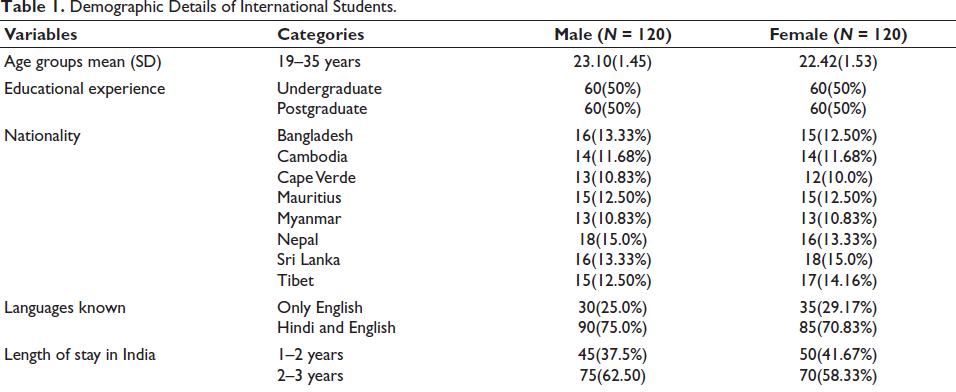
Table 1 presents the demographic characteristics of the international students included in the study (N = 240). The sample was equally distributed by gender, with 50% male participants (N = 120) and 50% female participants (N = 120).
Regarding educational experience, both male and female students were evenly represented: 50% enrolled in undergraduate programmes (males: N = 60; females: N = 60) and 50% in postgraduate programmes (males: N = 60; females: N = 60).
Regarding nationality, male students were primarily from Nepal (15.0%), Bangladesh (13.33%), Sri Lanka (13.33%), Mauritius (12.50%), Tibet (12.0%), Cambodia (11.68%), Myanmar (10.83%) and Cape Verde (10.83%). While female students were from Sri Lanka (15.00%), Tibet (14.16%), Nepal (13.33%), Bangladesh (12.50%), Mauritius (12.50%), Cambodia (11.68%), Myanmar (10.83%) and Cape Verde (10.0%), indicating a diverse international student population.
Regarding language proficiency, most participants reported knowing both Hindi and English (males: 75.0%; females: 70.83%), whereas a smaller proportion reported knowing only English (males: 25.0%; females: 29.17%).
Demographic Details of International Students.
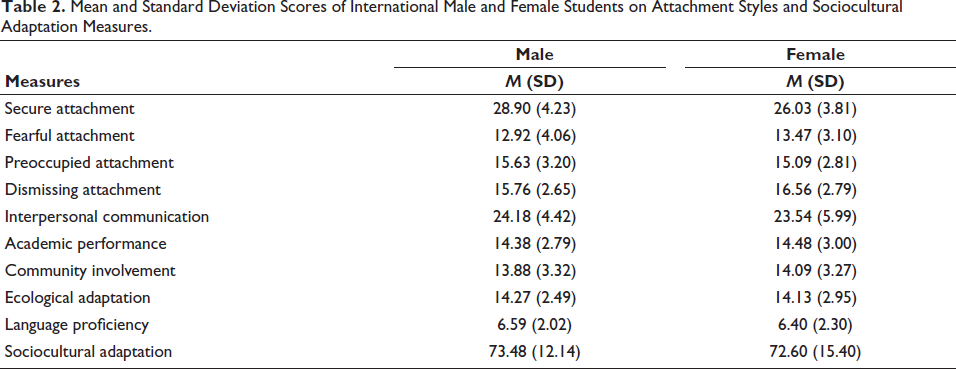
Mean scores, standard deviations and correlations were used to analyse the results. Regression analysis was used to examine the contributions of attachment styles (secure, fearful, preoccupied and dismissing) in predicting sociocultural adaptation among international students.
Mean and Standard Deviation Scores of International Male and Female Students on Attachment Styles and Sociocultural Adaptation Measures.
Coefficient of Correlation Between Attachment Styles and Sociocultural Adaptation Measure of International Male and Female Students.
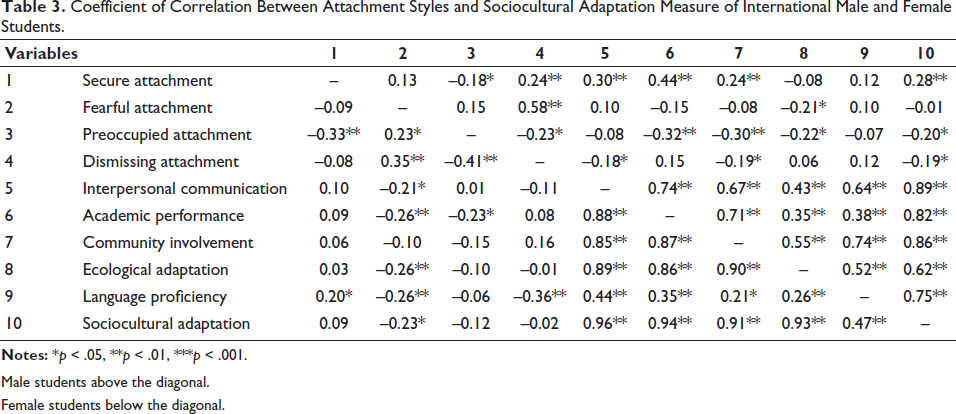
Male students above the diagonal.
Female students below the diagonal.
Pearson’s correlation analysis was used to examine the relationship between attachment styles and sociocultural adaptation of international students. The results revealed that in male students there was significant positive relationship of secure attachment with interpersonal communication (r = 0.30, p < .01), academic performance (r = 0.44, p < .01), community involvement (r = 0.24, p < .01) and sociocultural adaptation (r = 0.28, p < .01). This indicates that students with secure attachment style reported higher interpersonal communication, academic performance, more involvement in community and also more sociocultural adaptation. However, the correlation of secure attachment with ecological adaptation and language proficiency was not significant. Fearful attachment was significantly correlated with ecological adaptation (r = –0.21, p < .05), indicating that male students who applied a fearful attachment style experienced less ecological adaptation. However, the correlation between fearful attachment and interpersonal communication, academic performance, community involvement, language proficiency and sociocultural adaptation was not significant. In addition, there was significant negative correlation of preoccupied attachment with academic performance (r = –0.32, p < .01), community involvement (r = –0.30, p < .01), ecological adaptation (r = –0.22, p < .05) and sociocultural adaptation (r = –0.20, p < .05), indicating that students with preoccupied attachment style experienced lower academic performance, less involvement in community, poor ecological and sociocultural adaptation. However, the correlation between interpersonal communication and language proficiency was not significant. The score for dismissing attachment style was negatively correlated with interpersonal communication (r = –0.18, p < .05), community involvement (r = –0.19, p < .05) and sociocultural adaptation (r = –0.19, p < .05), but the correlations were not significant for academic performance, ecological adaptation and language proficiency.
Among female students, the results revealed a significant positive relationship between secure attachment and language proficiency (r = 0.20, p < .05), indicating that students with a secure attachment style reported higher language proficiency. However, the correlation was not found to be significant for interpersonal communication, academic performance, community involvement, ecological adaptation and sociocultural adaptation. Moreover, there is a significant negative correlation of fearful attachment style with interpersonal communication (r = –0.21, p < .05), academic performance (r = –0.26, p < .01), ecological adaptation (r = –0.26, p < .01), language proficiency (r = –0.26, p < .01) and sociocultural adaptation (r = –0.23, p < .05). Female students with fearful attachment style reported less interpersonal communication, academic performance, ecological adaptation, language proficiency and sociocultural adaptation. But the correlation with community involvement was not significant. Except for academic performance, no significant correlation was found between preoccupied attachment style and other dimensions of sociocultural adaptation. Preoccupied attachment style has a significant negative relationship with academic performance (r = –0.23, p < .05), indicating that female international students with preoccupied attachment style perform worse academically. In addition to dismissing attachment style, except for language proficiency, other dimensions of sociocultural adaptation were not found significant, and a significant negative correlation existed between dismissing attachment style and language proficiency (r = –0.36, p < .01). Female international students have reported less proficiency in language when they have a dismissing attachment style.
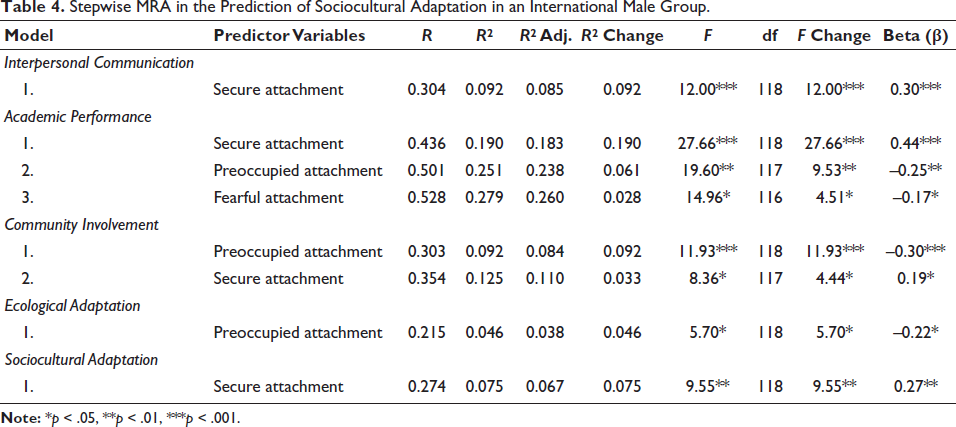
Stepwise MRA in the Prediction of Sociocultural Adaptation in an International Male Group.
Stepwise MRA in the Prediction of Sociocultural Adaptation in International Female Group.
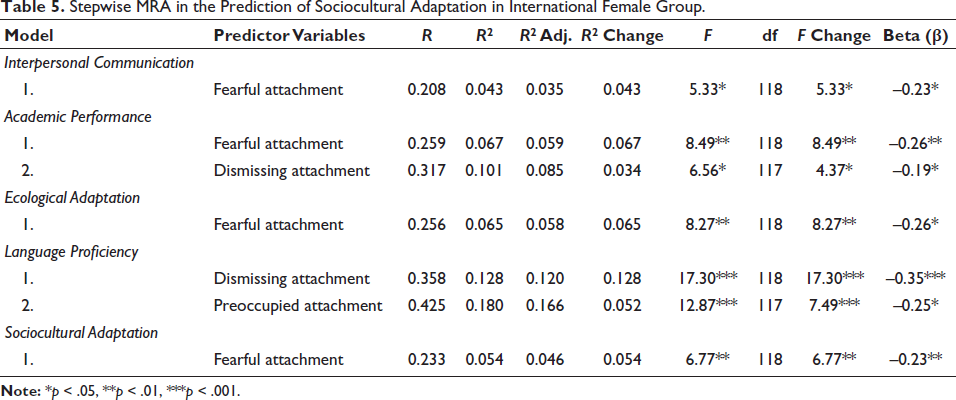
Regarding the female group, results indicated that, on the interpersonal communication measure, fearful attachment explained approximately 4% of the variance in scores (F1, 118, 5.33, p < .05), and the beta was negative (b = –0.23), indicating reduced interpersonal communication. With respect to academic performance, fearful and dismissing attachment explained approximately 10% of the variance (F2, 117, 4.37, p < .05) in the scores. Fearful attachment explained approximately 10% of the variance in the scores (F1, 118, 8.49, p < .01). The beta values for fearful attachment (b = –0.26) and dismissing attachment (b = –0.19) were negative, indicating decreased academic performance.
On the measure of ecological adaptation, fearful attachment accounted for approximately 7% of the variance (F1, 118, 8.27, p < .01), with a negative beta (b = –0.26), indicating less ecological adaptation. With respect to language proficiency, dismissing and fearful attachment together explained approximately 18% of the variance in the scores (F2, 117, 7.49, p < .001). Dismissing attachment contributed approximately 13% of the variance in the scores (F1, 118, 17.30, p < .001). The beta values for dismissing attachment (b = –0.35) and fearful attachment (b = –0.25) were negative, indicating that both attachment styles reduced language proficiency. On the measure of sociocultural adaptation, fearful attachment accounted for approximately 5% of the variance (F1, 118, 6.77, p < .01) in the scores, with a negative beta (b = –0.23), indicating reduced sociocultural adaptation.
Discussion
This study focused on understanding the relationship between attachment styles and sociocultural adaptation of international students in India. The first hypothesis stated that ‘secure attachment style would be positively correlated with sociocultural adaptation among international students’. The results revealed that international male students with a secure attachment style demonstrated greater interpersonal communication, academic performance, community involvement and sociocultural adaptation. Moreover, international female students with a secure attachment style demonstrated greater language proficiency.
The present finding is in line with Bowlby’s attachment theory. Bowlby 8 proposed that individuals with a secure attachment style have a strong foundation of trust and confidence in their relationships, allowing them to explore the world and seek support from their attachment figures when needed. This secure base provides a sense of security and comfort, which can contribute to better adjustment and adaptation in various social and cultural contexts.
Among international students, those with a secure attachment style may find it easier to establish positive relationships with peers and adapt to a new sociocultural environment. They are more likely to have developed effective coping strategies and possess a positive internal working model for themselves and others. 5 These factors can contribute to their ability to develop mental representations of their attachment figures, seek support when facing challenges and navigate the adjustment process more successfully.
It is worth noting that attachment styles are not fixed and can be influenced by factors such as early experiences and current relationships. Additionally, while a secure attachment style is generally associated with better adjustment, individuals with other attachment styles (preoccupied or dismissing) can exhibit distinct adjustment patterns that their attachment-related experiences may influence. Due to their sense of security, individuals with secure attachment style are generally more open to diverse worldviews and experiences. They are less likely to perceive others as threats and more inclined to approach interactions with trust and acceptance. This attitude allows them to engage with people from different backgrounds without feeling threatened or defensive.
Research has also indicated that securely attached individuals tend to have a more positive, open-minded approach towards others, including those from different cultures or countries. They typically have a healthy sense of self-worth and believe that they can rely on others for support and care when needed.17,18,21,22,33
The feeling of being supported and loved by others contributes to a sense of emotional stability and self-assurance in securely attached individuals. They are less likely to experience anxiety or fear in social interactions, which enables them to be more receptive to new perspectives and to welcome individuals from cultures or countries outside their own. This openness can lead to greater intercultural understanding, empathy and meaningful connections across cultural boundaries. Therefore, secure attachment provides a solid foundation for healthy relationships and a greater likelihood of embracing diversity.
The second hypothesis, which stated that ‘insecure attachment styles (fearful, preoccupied, and dismissing) would be negatively correlated with sociocultural adaptation among international students’, was supported by the present study’s findings. The results revealed that fearful attachment style reduced ecological adaptation in the male group. In contrast, it reduced interpersonal communication, academic performance, ecological adaptation, language proficiency and sociocultural adaptation in the female group. Furthermore, preoccupied attachment is associated with lower academic performance, community involvement, ecological adaptation and sociocultural adaptation in male groups. In addition, the female group’s preoccupied attachment style was associated with lower academic performance. Regarding dismissing attachment style, it only lowers language proficiency among females. On the other hand, in the male group, it reduced interpersonal communication, community involvement and sociocultural adaptation.
Recent studies have shown that insecure attachment styles are generally associated with poorer sociocultural adaptation.13,17,24,29,30,34 In the context of cross-cultural adaptation, individuals with insecure attachment styles may find it more challenging to navigate new cultural environments and establish meaningful connections. This difficulty may stem from their underlying tendencies to seek excessive reassurance and validation (preoccupied attachment) or to avoid emotional closeness and vulnerability (dismissing attachment). These attachment patterns can lead to heightened anxiety, fear of rejection, difficulties in building trust and challenges in understanding and adapting to different cultural norms and expectations.
Findings substantiated that fearfully attached individuals may hold negative beliefs about their own trustworthiness and may doubt others’ trustworthiness as well. This can make it challenging for them to form and maintain relationships. They may suppress or reject their own feelings as a means of self-protection, as individuals with a dismissing attachment style do culturally.13, 23, 30, 35 The difficulties in expressing emotions and forming connections can affect their adaptation process in various ways. Fearful attachment individuals may experience struggles with sociocultural adaptation in a new country and face increased anxiety, fear and stress.
In adapting to a new host country, individuals with a secure attachment style are more likely to approach the experience with resilience and adaptability. They are generally better equipped to handle the stressors and uncertainties associated with a new environment. Their sense of emotional security and positive self-perception allows them to seek social support, build connections with locals and engage in new experiences with less fear or anxiety.
Implications
The findings of this study contribute to understanding the attachment styles and sociocultural adaptation of international students in India. The present study highlights that secure attachment style enhances sociocultural adaptation of international students in the Indian context. When international students experience secure attachment, they feel more comfortable and confident navigating social interactions and adapting to the host country’s cultural norms. The findings of this study may provide valuable insights for universities, academic institutions and research institutions to enhance international students’ experience by creating a more supportive, friendly and welcoming atmosphere. Organising events such as festivals and cultural programmes is a powerful way for universities to foster interactions between international and national students. These events provide opportunities for students from different backgrounds to come together, celebrate their diversity and learn from one another. It provides international students with opportunities to better understand the host country’s culture, language and customs. Additionally, these events can help alleviate discomfort or hesitation in contacting members of the host country, as they provide a shared context and common ground for engagement.
One of the major implications is that, rather than relying solely on universal models, sociocultural adaptation among international students should be understood through culturally embedded attachment processes. The present study demonstrates how collectivistic ideals influence attachment, coping and adjustment in transnational environments by fusing Indian literary viewpoints with the real-life experiences of Indian international students. In order to improve the efficacy and cultural validity of support services, legislators, counsellors and student support organisations should create culturally sensitive policies and interventions that recognise the importance of family ties, relational interdependence and cultural narratives for students from Indian and other collectivistic backgrounds.
Moreover, from these interactions, international students can overcome interpersonal barriers and form more meaningful and secure attachments with their peers and acquaintances in the host country. This sense of belonging, attachment and connection can facilitate their sociocultural adaptation in the host country.
Limitations and Directions for Future Research
The present study focused on the importance of attachment styles in sociocultural adaptation in India, but it has certain limitations. One of the main limitations is that the sample is selected through purposive sampling, which may not be representative of the larger population. Future studies may consider stratified random sampling for better representation of the population.
The second limitation is that the current study used a closed-ended questionnaire, which restricted the depth of exploration into particular issues. By combining qualitative methods such as interviews, narrative analysis and case studies, future research could overcome the limitations of closed-ended questionnaires and self-report measures, providing a deeper understanding of international students’ behaviour.
The third limitation is constrained by its emphasis on international students within a single host-country setting, which restricts comparability with Indian students’ experiences in other nations. Due to differences in immigration laws, educational systems and cultural norms that were not considered, sociocultural adaptation may vary between nations. The relationship between attachment styles and adaptation results may be affected by these environmental variations. The results would be more broadly applicable in subsequent cross-cultural studies.
The findings of the present study indeed offer valuable insights into the sociocultural adaptation of international students by exploring the attachment styles. While the study’s limitations should be acknowledged, the conclusions drawn from the research can still contribute to our understanding of the experiences and challenges international students face in a new cultural context.
Footnotes
Acknowledgement
The authors would like to express their gratitude to the management of various universities and educational institutions of Varanasi City, Uttar Pradesh, for giving consent to collect the data for the present research.
Authors’ Contributions
All authors contributed to the study’s conception and design. NS, RPP and MM conducted the data collection, data sorting, analysis and duplication checks. All authors read and approved the final manuscript.
Declaration of Conflicting Interests
The authors declared no potential conflicts of interest with respect to the research, authorship and/or publication of this article.
Funding
The authors received no financial support for the research, authorship and/or publication of this article.
ICMJE Statement
The manuscript complies with ICMJE guidelines.
Informed Consent
written informed consent was taken from the participants to participate in the study. They were briefed about their voluntary participation and the confidentiality of their responses.
Statement of Ethics
This study was performed in line with the principles of the World Medical Association Declaration of Helsinki. The approval was granted by the Ethics Committee of Amity University Lucknow Campus, Uttar Pradesh.
