






Abstract
Environmental stewardship necessitates collective action from all stakeholders, yet children are often alienated. This study investigated the contribution of an environmental education programme, based on the participatory integrated planning approach, to developing stewardship competence attributes of pupils in rural Ugandan schools. Pupils (34) participated through surveys, semi-structured interviews, observations and focus group discussions. Findings indicated that pupils developed competence attributes in interrelated dimensions of environmental knowledge, connection with nature and ecological behaviour. The development of attributes was influenced by the learning environment, learning content, facilitation approach, learning activities, participatory integrated planning visioning and action-planning tools, learning activities, learning materials and facilitator capacity. Competence attributes are necessary for children’s participation in stewardship. These attributes should be developed simultaneously by exposing children to context-specific/relevant learning content, nature-based/outdoor activities and methods that stimulate reflection, participation and collaboration. Education policies should integrate environmental with formal curricula to enhance pupils’ environmental awareness and participation in stewardship.
Keywords
Introduction
Children have the potential to contribute to environmental sustainability as stewards (Graham, 2020) and as important actors in environmental stewardship (Contreras & Krasny, 2022). This potential can be cultivated through environmental education (EE), which supports the development of their (stewardship) competence attributes to engage in addressing environmental crises that include climate change and natural resource degradation (Monroe et al., 2023; UNESCO, 2016). This underlines the centrality of EE in achieving the global development agenda espoused within the Sustainable Development Goals of 2015 (Sterling, 2025; UNESCO, 2016). EE and associated education for sustainable development enhance children’s ecological literacy and motivation necessary to engage in friendly ecological behaviour (Omidvar et al., 2019; Otto & Pensini, 2017). When children learn for the environment, they gain knowledge on how to change the world and become motivated and empowered to participate in ethical practices aimed at environmental improvement and protection (Wright, 2006). This way, EE can foster a legacy of conservation-minded environmental leaders (Graham, 2020) to spearhead sustainable change (Ernst & Burcak, 2019; van de Wetering et al., 2022). Hence, EE is critical to the development of environmental stewardship (Wright, 2006) as it provides a platform for children to develop competence attributes related to ‘environmental knowledge’, ‘connection with nature’ and responsible behaviour towards nature (Schramm et al., 2022). Furthermore, EE supports children’s environmental stewardship by cultivating their environmental interest and respect, developing ethics and promoting concern for future generations (Contreras & Krasny, 2022; Wright, 2006). Environmental stewardship competences refer to capabilities that individuals and groups require to actively shape ecological and social change pathways that enhance ecosystem resilience and human well-being (Chapin et al., 2015).
Developing children’s attitudes and behaviours towards environmental sustainability at an early age appears crucial for enhancing their participation in stewardship and subsequently contributing to environmental sustainability (UNESCO, 2016; van de Wetering et al., 2022). Although children are the future environment caretakers (Graham, 2020) and agents of sustainable transformation (Sardi & Skanavis, 2023), they are often placed at the periphery of environmental sustainability efforts (Contreras & Krasny, 2022). Moreover, existing literature on stewardship in Africa is implicit regarding children’s experiences as environmental stewards. Consequently, the required stewardship competence attributes that can underpin children’s participation in the context of lower-middle income countries like Uganda are less understood. This study reflects on children’s experiences from an EE programme, founded on the participatory integrated planning (PIP) approach (Kessler et al., 2020) in primary schools in Eastern Uganda, to create a better understanding of the development of children’s stewardship competence attributes. The reflection is guided by the research question: What environmental stewardship competence attributes do children (pupils) in primary schools develop by engaging in an EE programme? These primary schools are found in the Bududa district within the Manafwa Watershed in Eastern Uganda. The watershed experiences degradation due to poor farming methods, deforestation and high population (Misanya et al., 2023). The degradation featuring frequent landslides and soil erosion has increased the watershed’s vulnerability to natural hazards (floods, waterborne diseases, extreme poverty) and affected sustainable productivity. This situation may worsen if not abated (Opedes et al., 2023).
The Manafwa Watershed Restoration and Stewardship (MWARES, 2020) project applied the PIP approach as a learning intervention to enhance stewardship among pupils in Eastern Uganda (Kessler et al., 2020). This intervention is aimed at complementing existing technical and policy-driven interventions (Akello et al., 2017). Guided by empowerment, integration and collaboration principles, the PIP approach supports stakeholders’ learning to address environmental challenges through awareness-raising and inspiring individual and collective stewardship actions (Misanya et al., 2023). The approach complements Uganda’s formal education efforts towards enhancing environmental management given that the curriculum, despite comprising environmental-related subjects (literacy, integrated science and social studies), neither fully integrates EE at all education levels nor adequately prepares teachers to teach it (Nalumenya et al., 2023). Importantly, sustainable natural resource management in Uganda requires timely and accurate information, continuous learning and integration of EE in the formal curricula (MWE-Uganda, 2014). According to UNESCO (2016), improved environmental and ecological literacy equips children to see links between specific-context issues and global environmental changes. This requires an educational process that supports learning to understand, act and transform (Schnitzler, 2019; Sterling, 2025). The PIP approach supports such a learning process through EE in schools within the Manafwa Watershed (Kessler et al., 2020).
Theoretical Framework
Competence and stewardship models in the literature lack a focus on children’s stewardship competences and their underlying related attributes. Available models focus, for example, on sustainability competences (Bianchi, 2020) and local environmental stewardship (Bennett et al., 2018). In this study, we applied the environmental competence model developed by Roczen (2011) to analyse the development of stewardship competence attributes among pupils in primary schools in a rural Ugandan context. Roczen’s model was utilized earlier to assess the development of environmental competences among children and adolescents. Moreover, the EE programme investigated in this study was developed based on the competence dimensions and attributes elaborated in Roczen’s model. The dimensions strongly connect with the focus of the EE programme being investigated. Consequently, our assessment of competence attributes among pupils is based on the following competence dimensions: ‘environmental knowledge’, ‘connection with nature’ and ‘ecological behaviour’ (Roczen, 2011).
The ‘environmental knowledge’ dimension comprises awareness of one’s physical surroundings. Without (appropriate) ‘environmental knowledge’, human actions can harm nature and its resources (Sardi & Skanavis, 2023). This dimension espoused the following competence attributes:
Systems knowledge: Being knowledgeable of the general environment and the interactions of organisms within the ecosystems, including the impacts and relationships that arise from those interactions. Action-related knowledge: Knowing about available behavioural options and solutions to environmental challenges, espousing all actions that can be undertaken to conserve and restore the degraded watershed. Effectiveness knowledge: Evaluating options and choosing appropriate alternatives to environmental challenges, including the knowledge to justify a choice and its contribution to sustainability.
The ‘connection with nature’ dimension espoused the attributes relating to how individuals connect with nature, thus feeling part of the larger (nature) whole (Mayer & Frantz, 2004) and committing to care for nature (Roczen, 2011). This dimension espoused the following competence attributes:
Identity with nature: Being able to develop a relationship with nature, exist in support of and be supported by nature (Mayer & Frantz, 2004). Appreciation for nature: Acknowledging and being grateful towards the inherent and instrumental services provided by nature (Nisbet et al., 2008). Restoration attitude: Being able to decide on what to restore and the restoration goals and methods. These decisions reflect the relational values and ethical and philosophical attitudes regarding the relationship between humans and nature (Fischer et al., 2021). Collaborative attitudes: Being open towards others, sharing with others and caring for nature (Cockburn et al., 2019; Kessler et al., 2020).
The ‘ecological behaviour’ dimension captures all behavioural outcomes from the acquired competence attributes within the ‘environmental knowledge’ and ‘connection with nature’ dimensions. These can be deliberate behaviours/actions towards/within the environment. Yet, Roczen’s model does not specify the specific competence attributes within this dimension.
Materials and Methods
Study Context
The Environmental Education Programme
The EE programme is founded on an EE guide that incorporates competence dimensions from Roczen’s model, PIP principles and various scholarly works on environmental stewardship (Cockburn et al., 2019; Kessler et al., 2020). The programme is structured for 1-year implementation, ensuring comprehensive coverage for environmental club (EC) members (pupils). After this period, pupils reflect on the programme, re-identify needs and generate insights for improvement. The programme is implemented as an extracurricular activity through ECs (MWARES, 2020). The clubs are established following school-wide sensitization on environmental issues and the PIP approach to environmental stewardship. These clubs consist of patrons (trained teachers) and volunteer pupils (club members). Together, they recruit additional pupils, elect leaders and participate in EE activities, with patrons specifically supporting pupil engagement in these initiatives. All schools’ ECs follow similar leadership structures and guiding principles as recommended by the MWARES project.
The EE programme aims at developing pupils’ stewardship competence attributes in dimensions of ‘environmental knowledge’, ‘connection with nature’ and positive ‘ecological behaviour’. The learning environment is diverse—primarily through environmental clubs within the school (classroom, compound, tree sheds) as the main place for stewardship action, but also at home (household, farm) and in natural settings such as the riverbanks. The learning content is structured around five modules: our interconnected environment, threats to our environment and livelihoods, protecting our environment—preservation and restoration, drawing our present and dreaming about our future, and planning and acting. These are complemented by content tailored to each school’s emerging needs, emphasizing collaborative relationships and local relevance. The facilitation approach blends instructive and emancipatory methods, including brainstorming, group projects, discussions, Q&A sessions, demonstrations, observations, participatory assessment comprising exercises, letter writing, exploration tables, ball tossing and peer quizzes. PIP visioning and action-planning tools support pupils in mapping their current school environment realities, envisioning desired futures and developing practical steps towards their goals. Learning activities span individual and group efforts, in school and at home. These include nature-based/outdoor activities, role-plays, music, storytelling, debates and school mapping. Termly school-wide activities such as environmental awareness marches and thematic performances further integrate ECs into the broader school and community spaces. Learning materials are locally sourced by EC members. Additionally, each school receives a PIP illustration chart to support environmental awareness and guide visioning exercises. To strengthen facilitator capacity, club patrons receive ongoing training and support from the MWARES project’s EE assistant—focusing on EC formation, material use and inclusive practices for learners with special needs.
Data Collection
We applied a case study approach (Peel, 2020) to gain in-depth knowledge of the EE programme in the schools of Bududa district. Two primary schools (Namaitsu and Bumayoka) were purposely selected for triangulation purposes as cases of schools, out of the 12 schools, that were implementing the programme. The selected schools were easy to get to (Stake, 1995) and had experience in fully implementing the programme. Within these schools, study participants (pupils) were EC members. The school administration provided verbal and written proxy consent for pupils’ participation in the study. Baseline data were collected in 2022, before EE programme implementation to establish pupils’ existing stewardship competence attributes. After a year of implementation, endline data collection was undertaken from the same participants, to assess the development of competence attributes. In both schools, we aimed for an equal number of participants (aged between 9 and 14 years from primary 4–6) from each club. The schools are described as follows:
Namaitsu School had a total of 746 pupils (20 EC members). All 20 members participated in the baseline study. By the endline, 5 of 20 members had transferred to other schools, leaving 15 members to participate in the endline study. According to the endline study, the total club membership was 40 pupils. Bumayoka School had a total of 854 pupils (25 EC members). Twenty members out of the 25 were randomly selected to participate in the baseline study. By the endline study, the total club membership was 75 although one member (who participated in the baseline study) had transferred to another school, leaving 19 members to participate in the endline study.
Data Collection Methods
The baseline assessment of competence attributes was performed through surveys, interviews, observations and focus group discussions (FGDs). Surveys provided generic insights into the development of individual pupils’ competences. Observations and interviews provided an in-depth understanding of the learning process and students’ experiences, while FGDs offered an overview of students’ collective perspectives on their development in stewardship competence. Data were collected by the first author supported by a research assistant.
Baseline data collection
Survey: A survey was conducted with 20 pupils from each EC to establish pupils’ existing competences before the implementation of the EE programme. This was guided by statements generated from the competence dimensions focusing on assessing pupils’ knowledge of their environment and the watershed (state/importance/degradation, interactions of activities and organisms, ecological challenges and solutions). Further, focus was on assessing pupils’ ‘connection with nature’ (attitudes, value of the watershed, sense of motivation, responsibility, agency towards the watershed, belief in restoration, and willingness and commitment to restore). The focus on ‘ecological behaviour’ was on pupils’ restoration actions. For each attribute, pupils were assessed along a 5-point Likert scale: strongly agree (5), agree (4), not sure (3), disagree (2) and strongly disagree (1). Semi-structured interviews: A semi-structured interview was undertaken with EC members to obtain data on the learning process, including what and how pupils were learning to care for their environment. The interview was guided by questions generated from attributes within the competence dimensions. The focus of interview questions was similar to the focus in the survey although interviews aimed to get a detailed overview of pupils’ existing attributes. Observations: Observations of training sessions were made in each school to understand the learning process (content, materials, methods). Hence, we observed the practical activities that pupils engaged in, how they learned and worked together, changes in EC membership, learning materials, the learning environment/location, willingness to care for the river, reactions/attentiveness and the shared experiences. Observation notes were written, including utterances that pupils made during the training.
Endline data collection
Survey: A second survey was undertaken with 15 and 19 pupils from the ECs of the Namaitsu and Bumayoka schools, respectively, to investigate their experiences with the EE programme for a year and how this facilitated the development of their competence attributes. The same statements and focus as in the baseline survey were used in the endline survey. Also, pupils were assessed along the same Likert scale. Semi-structured interviews: A second interview was undertaken with survey participants to investigate changes in the development of competence attributes among pupils. The same interview questions and foci used during the baseline were applied in the endline. FGDs: Two FGDs were held in each school. In Bumayoka School, one FGD had 10 members, another had 9 members, while in Namaitsu School, one FGD had 8 members, while the other had 7 members. Each FGD comprised male and female members. FGDs were held to obtain a consensus among members on what they learned about the watershed, how they felt connected to the watershed and the individual/collective actions they were taking for watershed restoration. Having engaged with the programme for a while, members were expected to be familiar with each other and therefore freely express themselves during the FGD.
Data Analysis
Data were collected in the English language although the local language (Lumasaba) was sometimes applied to enhance comprehension. All data collected in Lumasaba were translated and transcribed into English text for analysis. Survey data were collected using the ODK Collect application and exported to Excel for cleaning, analysis and presentation. Responses to the ordinal qualitative variables from the Likert scale were averaged using Excel and presented using figures. Data from interviews, FGDs and observation notes were analysed by developing a set of codes and subcodes. Thematic analysis (Peel, 2020) was applied using predefined codes based on competence dimensions and attributes defined in the environmental competence model (Roczen, 2011). These predefined codes include the three dimensions of ‘environmental knowledge’, ‘connection with nature’ and ‘ecological behaviour’ and the related attributes: (a) systems knowledge, (b) action-related knowledge, (c) effectiveness knowledge, (d) identity with nature, (e) appreciation for nature, (f), restoration attitude and (g) collaborative attitudes. Further, emerging competence attributes were considered and are presented in the ‘Results’ section. Results are presented narratively.
Results
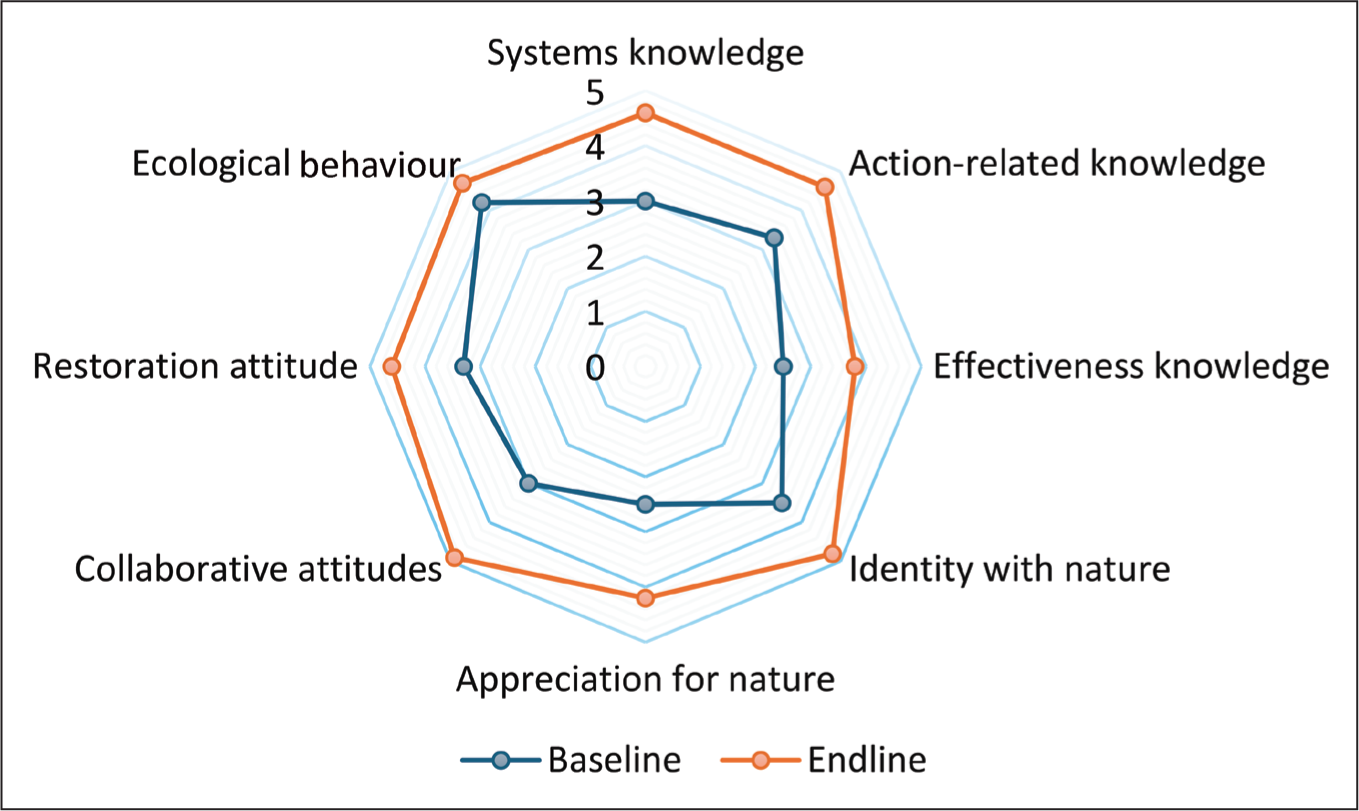
This study was guided by the research question: What environmental stewardship competence attributes do children (pupils) in primary schools develop by engaging in an EE programme? Survey results are based on a Likert scale of 1–5, whereby ‘strongly agree’ shows the highest level of development in competence attributes and ‘strongly disagree’ shows the reverse. Using a Spidergram, we present a summary of survey results (Figure 1) based on averaged responses of 34 members who participated in the baseline and endline studies. Notably, members’ competence attributes developed across the competence dimensions with lesser development in ‘ecological behaviour’.
A Spidergram Showing Progression in Pupils’ Environmental Stewardship Competence Attributes.
Environmental Knowledge Attributes
Here, pupils acquired stewardship competence attributes including systems knowledge, action-related knowledge and effectiveness knowledge as explained below.
Systems Knowledge
Pupils demonstrated progression in systems knowledge by their ability to elaborate connections between watershed degradation and human well-being and connections between causes, impacts, threats and mitigation measures for watershed degradation. For example, when interviewed about interactions of organisms and the consequences of these interactions on the watershed, P.25 said during the baseline:
I do not know what to say.
In the endline interviews, he said:
rubbish can make the river dirty and stop it from flowing well … sometimes the river must find another path or stay in one place. When the river does not flow well, it can spoil crops.
During observations and FGDs, pupils related tree planting to air quality and soil erosion control within the watershed. By the endline, a few pupils did not develop new knowledge although they became more articulate about interactions within the watershed. For example, P.01 explained the causes and impacts of watershed degradation during the endline more easily than during the baseline. Systems knowledge was supported by the learning content on the interconnected environment and learning activities (nature-based/outdoor activities—learning from the watershed, nature walks, drawing their current and desired school situations), which enabled pupils to understand relationships among environmental aspects.
Action-related Knowledge
Under this attribute, pupils developed knowledge of identifying environmental challenges, watershed restoration/conservation, monitoring and reporting. Like survey findings, interviews highlighted an increase in action-related knowledge. For instance, P.19 responded during the baseline:
I do not know how soil erosion within the watershed can be overcome.
In the endline interviews, the pupil expressed:
to control soil erosion, we can plant trees along the riverbanks … and task people to stop grazing animals near the river.
Progression in action-related knowledge was the case with most pupils as they initially did not have a comprehension of environmental challenges and alternative solutions. Action-related knowledge was facilitated by the PIP visioning and action-planning tools, which fostered environmental awareness, development of aspirations and action plans, knowledge-sharing and problem-solving skills. Further, learning activities such as music, demonstrations and role-plays in the context of the watershed developed pupils’ action-related knowledge.
Effectiveness Knowledge
Effectiveness knowledge entailed choosing environment-friendly and sustainable solutions to environmental challenges. Although survey findings indicated development in effectiveness knowledge, during interviews and FGDs, most of the pupils could not detail the environmental impact of the chosen solution. Only a few pupils emphasized that some solutions could negatively affect the watershed. For instance, P.12 initially indicated that the solution was anything that could keep the watershed in good condition. However, during the endline, he explained that tree planting is the best solution to soil erosion because trees hold soil firm, the tree canopy provides a shed and leaves enhance soil fertility. More pupils, but not all, demonstrated a progression in effectiveness knowledge, and this was attributed to learning content about our interconnected environment, which enabled pupils to identify environmental interactions and impacts of the interactions. Further, group/collaborative learning activities supported experience sharing about the consequences of human activities and solutions to environmental challenges.
Connection with Nature
In this dimension, pupils developed competence attributes such as identity with nature, appreciation for nature, collaborative attitudes and restoration attitudes as elaborated below.
Identity with Nature
This feeling of being a part of nature espoused pupils’ appreciation for the watershed’s significance, fear of nature’s impacts and role acknowledgement for watershed care. Interviews and FGDs confirmed the development of this attribute. For example, P.01 demonstrated feelings of identity during the baseline interview:
the river is part of me because we get many things from there like fish and water.
In the endline interview, he emphasized:
the watershed is part of my life, I was born here, I am growing here … if we look after the watershed, it will look after us.
The context-specific learning content supported the development of identity with nature and clarified pupils’ roles in watershed care. Outdoor and nature-based learning activities, including field walks through the watershed and learning from the riverbanks, seemed to strengthen pupils’ connection with the watershed and the motivation for restoration. Yet, outdoor learning activities were constrained by limited time, competing school activities and large numbers of club members per school.
Appreciation for Nature
From baseline interviews, most pupils perceived the value of the watershed from affordances like water provision. During the endline surveys and interviews, pupils acknowledged other benefits of the watershed, including air regulation, tourism, fertile soil, foodstuffs and habitat for aquatic life. For example, P.35 indicated the following in the baseline interview:
the watershed provides water and helps in rainfall formation
In the endline interview, she added:
the water flows very well through the hills, the sound is nice! one can be walking in the watershed while admiring the beauty between the river and the hills
Development in appreciation for nature was supported by learning content on environment and livelihoods, and outdoor learning activities. This appreciation seemed to enhance pupils’ interest and motivation to care for the watershed.
Restoration Attitude
This attribute was demonstrated by school improvement plans, which captured a vision/dream for the watershed and restoration activities, willingness and responsibility to care for the watershed (reporting culprits, mobilizing towards restoration) and enthusiasm towards generating solutions to watershed degradation. During the baseline, many pupils did not imagine the possibility of watershed restoration given the extent of degradation and the general lack of cooperation among community members. By the endline, most pupils envisioned possibilities for watershed restoration. For example, P.16 expressed during the baseline.
this river cannot be restored; the water is very dirty
In the endline interview, the pupil expressed:
the river will be restored, it will be clean, water will flow well when we all decide to care for it.
However, a few pupils insisted that the river could not be restored because of a lack of cooperation from some community members; for example, during an FGD in Bumayoka school, a pupil stated:
I don’t think this river can be restored because of some peoples’ actions … some people can stop spoiling the river this side, yet some will continue on the other side.
The development of a restoration attitude was supported by action-related knowledge, which provided restoration options; the PIP visioning and action-planning tool, which included the development of aspirations, school improvement plans and role awareness; and learning content on collaboration, which underpinned the development of collaborative attitudes.
Collaborative Attitudes
Collaborative attitudes included pupils’ expressions of knowledge and willingness to work with others towards sustainable utilization of the watershed. During the baseline, many pupils demonstrated awareness of the need to collaborate but could not detail why, with whom and how. However, by the endline, the trend had changed. From the observations in Namaitsu School, pupils were more willing to make joint school improvement/action plans and engage in restoration actions. In Bumayoka School, observations showed pupils jointly contributing ideas to the school improvement plan and planting trees around the river. During FGDs, pupils from both schools expressed interest in working with surrounding communities for watershed restoration. To further demonstrate the development of collaborative attitudes, P.24 mentioned in the baseline.
I can work with others because alone I cannot care for the watershed.
In the endline interview, he emphasized:
yes, when we work with fellow club members, we help each other, we do activities together, we can stop those who degrade the river.
Collaborative attitudes were cultivated by learning content espousing the watershed, the principle of collaboration, living sustainably with others and learning activities such as storytelling sessions, role-plays, conflict resolution and group/collaborative activities. The facilitation approach supported discussions, demonstrations and participatory assessment comprising ball tossing and peer quizzes, thereby enhancing collaborative attitudes.
Ecological Behaviour
This dimension comprised pupils’ behaviours aimed at watershed restoration, including restoration/conservation, collaborative and ethical actions. Literature review did not reveal these attributes; hence, this study illuminates them as ‘ecological behaviours’ that pupils engaged in. These behaviours were generally supported by the development of ‘environmental knowledge’ and ‘connection with nature’.
Restoration/Conservation Actions
These attributes encompassed actions pupils undertake to revive and/or maintain the watershed, including tree planting, making trenches on farms and making energy-saving stoves. Observations revealed that both schools made action plans that included activities for watershed restoration (proper waste management, propagating and planting indigenous tree species). In Bumayoka School, pupils collectively made pathways within the compound, stone bunds to control soil erosion and a tree nursery. Pupils planted these seedlings at school, around the river, and took others home. These pupils encouraged community members to plant these tree seedlings in their homes and farms. By the second interview, most pupils were engaging in proper waste disposal and tree planting. For example, although P.033 did not reveal any actions during the baseline, during the endline, she indicated making an energy-saving stove with her mother to save wood fuel and conserve forests. Restoration actions were supported by a restoration attitude and action-related knowledge. The PIP visioning and action-planning tool underpinned restoration actions based on school improvement plans. Learning activities, including brainstorming, demonstration and participatory assessment, which encouraged sharing ideas (collaborative attitudes), further underpinned restoration actions. Although most pupils started to undertake collective restoration actions by the endline, a few pupils were yet to engage in such actions owing to time constraints.
Collaborative Actions
Club members engaged in collective actions (information sharing, monitoring/reporting, cleaning, making school improvement plans) with peers, family and friends. During the baseline, a few pupils had not engaged in collaborative actions, but by the endline, they were sharing information with family, peers and neighbours. In Namaitsu School, pupils cleaned the watershed (with community members and non-club pupils). At Bumayoka School, pupils solicited tree seeds from their homes and brought them together to make a school tree nursery. Yet, they elaborated on challenges in undertaking collaborative actions. As one pupil expressed,
some people do not cooperate! … you tell them not to dump waste in the river, … they tell me that the river doesn’t belong to anyone, so why do I care so much about it.
Collaborative actions were facilitated by learning content on collaboration for stewardship, learning activities such as action planning and learning materials such as the PIP illustrative chart.
Ethical Actions
Only a few pupils demonstrated engagement in ethical actions. In both schools, FGDs revealed that pupils engaged in self-regulating behaviours (not bathing/excreting in/near the river, proper grazing, proper waste disposal) and taking responsibility (tree planting, sharing knowledge, monitoring, reporting and stopping people who dump waste in the river). During endline interviews, P.39 emphasized that he had stopped throwing rubbish carelessly and was inspiring other pupils. Devoid of any ethical actions during the baseline, P.26 emphasized taking responsibility in the endline.
as a club member, I have to share with others what I have learned and everything I now know about the watershed.
Ethical actions were fostered by learning activities like role-play, which emphasized stewardship roles of pupils as young stewards, and learning content, which supported ‘environmental knowledge’ development, identity with nature, appreciation for nature and a restoration attitude. However, there was no direct emphasis on ethics in the EE programme implementation.
Discussion
The Development of Children’s Competence Attributes
In this section, we discuss the development of pupils’ stewardship competence attributes, the interconnections therein and pedagogical features that influenced that development.
This study shows that most pupils had basic ‘environmental knowledge’ acquired through the formal curriculum, although by engaging in the EE programme, they acquired more ‘environmental knowledge’, especially systems knowledge. This knowledge makes a foundation for the systems thinking competence (Bianchi, 2020). However, this study revealed that only a few pupils developed effectiveness knowledge. ‘Environmental knowledge’ development was supported by learning content about the interconnected environment and the principle of integration (Kessler et al., 2020). Similarly, an earlier study on training a new generation of stewards (Sardi & Skanavis, 2023) reports that ‘environmental knowledge’ develops when information for environmental transformation is systematically created and exchanged (Omidvar et al., 2019; Wright, 2006) to bridge the gap between expert and non-technical audiences. This trend demonstrates that EE potentially increases environmental outcomes for stewardship, including ‘environmental knowledge’, attitudes and behaviours.
This study found that children’s willingness and curiosity to care for the environment were influenced by outdoor and nature-based learning activities. Ernst and Burcak (2019) affirm that participation in appreciative outdoor experiences can foster a lasting ‘connection with nature’. Activities such as nature play, observation and studying living organisms (Omidvar et al., 2019) promote curiosity, empathy, creative thinking, discovery and resilience, which are key problem-solving skills for environmental stewardship (Contreras & Krasny, 2022; Omidvar et al., 2019). Thus, EE is arguably more effective when delivered in nature, as such experiences strengthen emotional connections to the environment (Wright, 2006), enhance environmental outcomes and support positive ‘ecological behaviour’ (Otto & Pensini, 2017). However, this study revealed that outdoor activities were limited by time and facilitator capacity to organize meaningful experiences. Literature further highlights additional constraints, including participant characteristics, site accessibility and resource availability (Omidvar et al., 2019).
This study highlighted key environmental stewardship attributes under the ‘ecological behaviour’ dimension, namely restoration, collaboration and ethical actions, which are largely shaped by each school’s action plan. However, this dimension was the least developed owing to limited time and competing contextual priorities such as formal curriculum demands, inter-school competitions and exam preparation. Some pupils also transferred schools, thereby disrupting continuity. However, given that the bridge between learning and action is central to social transformation (Schnitzler, 2019), and that human actions are key precursors for ecological challenges, it is critical that these actions constitute important pathways for sustainable solutions (Folke et al., 2009). To foster effective actions for sustainable solutions (Hofman, 2015), it is vital to utilize outdoor and nature-based learning activities as these have the potential to cultivate pupils’ critical thinking and challenge their values (Omidvar et al., 2019). Additionally, future research should examine how social and institutional contexts influence pupils’ ecological behaviour (Bennett et al., 2018; Bhurekeni, 2022) and education policies should integrate environmental education into the formal curriculum (UNESCO, 2016), promote interdisciplinary teaching and prioritize environmental stewardship. Prioritizing environmental stewardship and active stakeholder participation in the integrated curriculum development may strengthen pupils’ agency and actions to address local and global environmental issues (Monroe et al., 2023), thereby contributing to a curriculum that strongly connects with emerging sustainability issues (Mathie & Wals, 2022). Nonetheless, behavioural outcomes are influenced by resource constraints and psychological barriers, including peer pressure and perceived ineffectiveness (van de Wetering et al., 2022).
Based on this study, only a few pupils demonstrated ethical (normative) attributes (responsibility, morality, care, commitment and sustainable values), yet these are critical to children’s stewardship (Fischer et al., 2021; Uggla & Soneryd, 2023). The development of ethical attributes was supported by action-related knowledge on children’s stewardship roles and by their ‘connection with nature’. Ethical attributes potentially enhance children’s moral responsibility, ability to sustainably utilize resources (Bhurekeni, 2022; Welchman, 2012), strengthen their ‘connection with nature’ and increase the agency for stewardship. We therefore propose ethical education as essential for cultivating such attributes. Moreover, the learning content and facilitation approach should be age-appropriate (Contreras & Krasny, 2022). This study thus recommends further research into ethics and effective strategies for fostering it.
This study found that children developed collaborative attributes through the EE programme, supported by learning content and learning activities that emphasize collaboration and learning via environmental clubs. These attributes are essential, as stewardship is increasingly viewed as inherently collaborative, bringing together diverse stakeholders through information sharing and care for nature (Cockburn et al., 2019). Collaborative attributes further promote a collective agenda grounded in individual and joint actions (Misanya et al., 2023) necessary for addressing complex ecological challenges. They create opportunities for children to learn from diverse personalities and experiences, foster peer support and appreciation, and encourage experimentation with new ideas (Schnitzler, 2019). Learning to collaborate at a young age can help children grow into inclusive, empathetic and open-minded stewards as adults.
This study found that competence attributes are interrelated and mutually reinforcing. For instance, ‘environmental knowledge’ enhanced pupils’ awareness of ecological conditions, the interdependence of environmental elements (systems knowledge) and the understanding of what to care for and how to care (action-related/effectiveness knowledge). ‘Connection with nature’ fostered the curiosity for further ‘environmental knowledge’ and supported the development of ‘ecological behaviour’. Pupils, for example, developed a sense of identity with nature and appreciation for nature, recognized the value of collective efforts (collaborative attitudes) and nurtured hope for restoration (restoration attitude). Furthermore, ‘ecological behaviour’ is shaped by both ‘environmental knowledge’ and ‘connection with nature’ (Misanya et al., 2024; Roczen et al., 2014), as evidenced by the influence of action-related knowledge, restoration attitudes and collaborative attitudes on pupils’ restoration efforts. Restoration attitudes, in turn, motivated learners to acquire further knowledge and actively participate in stewardship. Through the PIP visioning and action-planning tool, pupils saw watershed restoration as both possible and attainable. However, environmental knowledge can also trigger fear, anxiety and feelings of helplessness, potentially discouraging engagement (Schramm et al., 2022). This can be mitigated by fostering action-related knowledge and encouraging collaborative action (Moyer & Sinclair, 2020).Based on these interconnections, we suggest educational environments that simultaneously develop stewardship competence attributes. Fortunately, the PIP approach has a practical focus of engaging pupils in generating aspirations, planning, acting, experiencing, reflecting on and learning from their actions (Misanya et al., 2023). Learning takes place when an action is undertaken, and actions similarly reinforce certain forms of knowledge, thereby creating a learning loop. Consequently, stewardship knowledge and attitudes need further exploration and integration to enhance stewardship action.
The preceding discussion illuminates the core competences that children require to participate as environmental stewards and elaborates on the interconnectedness among them. Moreover, these competences align with the ESD competences such as collaboration, systems thinking, normative competence and strategic/action competences (Bianchi, 2020; Misanya et al., 2024).
This study did not compare schools which were implementing the EE programme and those which were not, nor did it assess differences between participating and non-participating pupils. Instead, it employed a baseline approach, leveraging the lack of an explicit focus on environmental stewardship in Uganda’s primary education policy documents (MoES, 2022; NEMA, 2019) to evaluate changes in stewardship competence. Hence, future research employing a comparative design could offer deeper insights into competence development in rural schools.
Educational Features Influencing Stewardship Competence Development
In this study, pupils were exposed to learning content centred on the Manafwa Watershed, including its current state, pupils’ stewardship responsibilities, individual and collective restoration actions, and the impacts of mitigation measures (effectiveness knowledge). This exposure contributed to the development of environmental literacy, an integral component of stewardship. Children need adequate environmental knowledge to make decisions regarding their personal and environmental well-being (Wright, 2006). Similarly, UNESCO (2016) underscores that EE should foster learners’ agency, problem-solving skills and core competences for improving their communities and everyday lives. This educational potential is deeply rooted in the relevance and structure of the learning content. Accordingly, the design of stewardship-oriented content should incorporate contextual elements that link knowledge to real-life experiences and cultural backgrounds, thereby cultivating a sense of place and nurturing ethical attributes among learners (Bhurekeni, 2022).
This study found that all EE facilitators were professionally trained teachers. The MWARES project further trained the patrons about the PIP methodology, and they continued to receive technical support whenever needed. However, some struggled to interpret certain concepts and implement all the learning activities, especially during outdoor activities. Yet, facilitator capacity determines the effectiveness of an EE programme (Nalumenya et al., 2023; Sardi & Skanavis, 2023). Facilitator capacity is further advocated in the literature because ecological restoration necessitates the collaboration and capacitated stakeholders (Cockburn et al., 2019). Even in resource-limited contexts, it is not material resources but the resourcefulness of the teacher that largely influences impact (Ruthanam et al., 2021) because teachers influence learning goals, determine learning activities, motivate learners and identify resources (Omidvar et al., 2019). Therefore, continuous training focused on practical, collaborative and outdoor learning approaches is essential for strengthening facilitator capacity.
It is crucial to focus on the pedagogy and learning vision while facilitating education for sustainability (Hofman, 2015). The PIP visioning and action-planning tool (Kessler et al., 2020) applied in the EE programme enabled pupils to develop school improvement plans and strategies to achieve them. By supporting participatory learning and reflection, the visioning and action-planning tool fostered pupils’ awareness of the current and dream situation and the possibilities of achieving their dreams (Schramm et al., 2022). Reflection enables children to gain a broader understanding of stewardship and the significance of their actions on nature (Contreras & Krasny, 2022). The tool enabled pupils and teachers to determine specific activities to address their schools’ environmental needs. Similarly, Uggla and Soneryd (2023) assert that education related to sustainable development should not be based on predefined learning content and learning activities but should be open to the evolving meaning of sustainable development in various contexts. Moreover, action-planning is heralded as a core sustainability competence (Hofman, 2015). Hence, we suggest the adaptation of the PIP visioning and action-planning tool to similar contexts to develop competence attributes of children and foster their participation in environmental stewardship.
The EE programme employed participatory, collaborative and practical learning activities. Collaboration was framed as essential for stewardship in rural contexts (Misanya et al., 2023), enabling pupils to support peers, share knowledge and mobilize local resources. Collaborative learning strengthened the facilitation approach and fostered synergies, reinforcing the belief that individual and collective actions could improve the watershed. Such engagement promotes interactive learning and supports shared meaning-making (Bhurekeni, 2022). EE is particularly effective when grounded in group-based and practical learning activities (van de Wetering et al., 2022), which encourage dialogue, curiosity and knowledge co-creation. This study found storytelling especially useful in helping pupils understand watershed history, as stories are a keyway people relate to their environment (Hughes & Moscardo, 2024). Demonstrations, brainstorming and practical learning activities further enhanced pupils’ confidence to participate in stewardship. Multiple learning activities thus play a vital role in fostering children’s environmental engagement.
Conclusion
This study echoes the need to engage children as stakeholders in environmental stewardship efforts given their potential. Educational design should include age-appropriate learning and stewardship activities for children in nature. Further, their potential can be nurtured by simultaneously (and contextually) cultivating their stewardship competence attributes in the dimensions of ‘environmental knowledge’, ‘connection with nature’ and ‘ecological behaviour’.
The study revealed that despite development in ‘environmental knowledge’ and ‘connection with nature’, stewardship actions are affected by one’s context (Hofman, 2015), including competing priorities. This study recommends an integration of EE especially those regarding pupils’ lifeworlds (Bhurekeni, 2022), with the formal curriculum to facilitate an integrated learning process that can contribute to meaningful stewardship outcomes among pupils.
While a generally marked trend signalled the development of competence attributes among pupils, this was not the same for all pupils. Individual learner attributes and other aspects such as the nature of learning content, facilitator capacity and learning activities impacted the process. Thus, practitioners could consider individual learner differences and apply multiple and/or appropriate learning activities to foster stewardship among children. Thus, in consideration of individual learner differences, core aspects that can enhance the development of stewardship competences among children include facilitator capacity; ethical education (Bhurekeni, 2022); collaborative learning environment, which builds synergies for action (Schnitzler, 2019); multiple learning activities; outdoor and nature-based learning activities that foster observation, reflection and learning; and relevant learning content. The use of the PIP visioning and action-planning tool cultivated pupils’ confidence, environmental attitudes, motivation and cheerfulness to act, and clarified pupils’ stewardship roles.
Footnotes
Declaration of Conflicting Interests
The authors declared no potential conflicts of interest with respect to the research, authorship and/or publication of this article.
Funding
The authors received no financial support for the research, authorship and/or publication of this article.