






Abstract

Saadat Hassan Manto (1912–1955) is widely regarded as one of the finest Urdu writers in history (Image 1). Best known for short stories penned after his arrival in Lahore in 1948, Manto’s life was spliced in two by partition—the subject of many of his most powerful and insightful fictional narratives and sketches. Versatile and prolific, Manto’s background as a radio and screenwriter in Bombay gave him considerable insight into the realities of filmmaking, which—along with a range of cultural, political, and social issues— he wrote about in newspaper commentaries as a journalist in newly independent Pakistan. Manto published “Pakistan ke Film” [Pakistani Film] some eight months after his arrival, on August 15, 1948. The essay came out in an Urdu daily from Lahore, Imroze, under the editorship of celebrated poet Faiz Ahmad Faiz. Despite its brevity and deceptively conversational tone, the text is evidence of Manto’s considerable insight into the political, social, and practical financial issues at stake when it came to the film industry’s prospects. Touching upon many of the problems that remain principal concerns of anyone preoccupied with the condition of cinema in Pakistan today (including several contributors to this volume), Manto addresses issues of religious identity and orthodoxy, lack of state funding and infrastructural frailties, private investment, marketing, distribution, and subject matter. He also confronts the daunting psychological and material supremacy of “Hindustani” cinematic power with a cool head; more than can be said for most commentators in contemporary Pakistan. More hopeful than optimistic, Manto offers no easy solutions; the specificity of Pakistan’s cultural and material dilemmas, he seems to have understood early, were quite distinct from those of India, owing to their respective industrial inheritances, market shares, and societal dynamics.
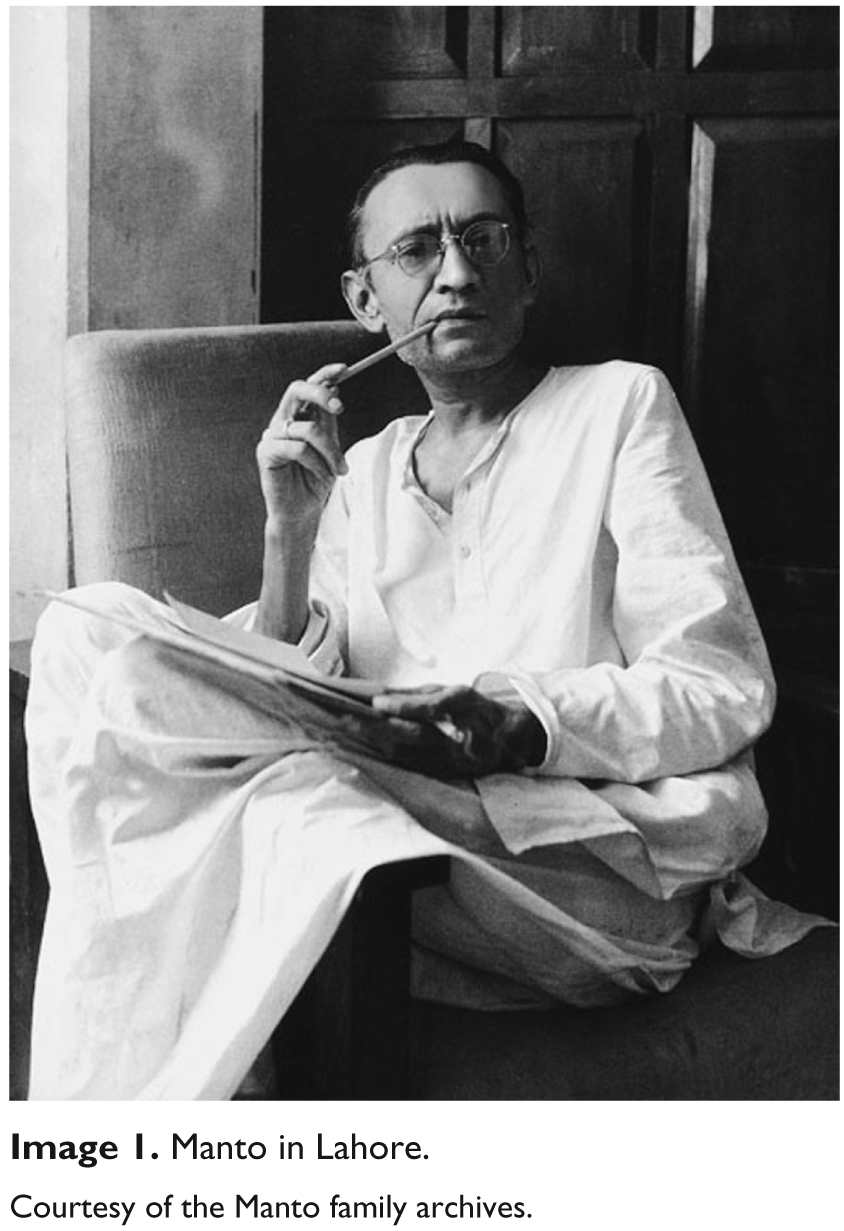
Courtesy of the Manto family archives.
Trying to imagine an authentic Pakistani film is like quenching your thirst before digging a well. 1
It has been a whole year since Pakistan came into existence, but in this time we have yet to witness the emergence of an identifiably Pakistani film production house with a stamp of its own [Why?].
Prior to partition, there was some degree of difference between Muslims and Hindus in matters of religion, but little when it came to daily life; films have to do with the latter. For this reason, [historically] all [our] films 2 have appealed to people of every religion and every creed. For commercial reasons, films that everyone would want to see were made—an approach that will remain in place for a very long time. Now partition has occurred and populations have been exchanged, but here [in Pakistan] and there [in Hindustan], the approach of filmmakers has not changed. Why would it when the issue for them is how to make a living? If somebody in Hindustan were to make an anti-Pakistan film, then obviously it would not be successful here. In exactly the same way, if anyone in Pakistan were to make a film that offends the sensibilities of Hindustanis, it goes without saying there would be little sense in trying to sell it in Hindustan—above all because the censors would not allow a film like that to be released.
Before partition, the market for Hindustani films was just Hindustan and maybe Iran and Afghanistan as well as the smaller markets of East Africa. Compared with this, the circulation of American and British films—which spans the entire world—was, and still is, vast; its size accounts for the inability of Hindi film to develop and prosper to the extent it might otherwise have. Both here [in Pakistan] and there [in Hindustan], the film industry today is even weaker for having been divided into two.
Pakistan’s share of everything is meager. The industry is practically non-existent, its future unclear. Lahore had three or four studios. One was burned in the riots. Now there is just one left—Pancholi, 3 in which a few Muslim filmmakers are currently working. It has two poorly equipped sets. What little there is has been put into working order by filmmakers who, though wringing their hands as they work, are actually making films.
It might be that in a few years, once the situation has improved, these very filmmakers who are improvising to cobble together half-baked productions will be standing on their own feet; maybe they will one day strengthen the collapsing walls of Pakistan’s film industry. But when you hear these Maulvis giving speeches wanting to impose their so-called Sharia law, one feels the very future of art is thrown into complete uncertainty. Just the other day, an elderly man seen brandishing a great big pair of scissors threatened “to cut off the pony tail of any Muslim girl I see without purdah.” 4 Will actresses too have to work in Burkas?
Contemplating the impact of so-called Sharia with this incident in mind, the future of musical concerts also appears bleak. If, God forbid, the wrong kind of religiosity begins to hold sway, then the art of music into which Muslims once breathed life will become completely extinct here [in Pakistan]. And if it does then making films is out of the question. This is the downside of things.
Nor are there many grounds for optimism when we try to look for positives. The basis of a film is its story—so what kinds of stories might be made into films? There are a great many subjects to cover here [in Pakistan], but who will make films about them? Every single one of them is linked to some vexatious matter or another. Write something about the veil and project it on screen—you can guess yourself what the reaction will be. Divorce is an equally good subject, but if we cannot make a bold film about it and instead someone makes one that plays it safe, an additional danger presents itself: it could spread the wrong message and misinform people.
Filmmakers in Hindustan do not face the number of difficulties that confront their counterparts here at every step. They can continue to make films like those made previously since these were mostly about Hindu society. Muslim filmmakers too for the most part also made these kinds of films; indeed, it became their own mode of expression. But what kind of films will they make in Pakistan? This is a question to which nobody yet has a clear answer.
If one individual is making a version of Heer Ranjha, 5 another might be making a film called Jihad, 6 and another still, Teri Yaad, a film based on Hindu society. 7 Teri Yaad might cross the border, as can Heer Ranjha (two lovers partition will not divide). But a film like Jihad will only be successful in Pakistan; distributors over there will not touch it with a barge pole. And if, God forbid, one such film were to flop completely, there is one thing you can be certain of—it will finish off whoever made it.
One reason filmmakers here do not see a clear agenda before them is that the government has not yet been able to fix one for itself. But filmmakers need to take responsibility for their own profits and losses—governmental support was never there to begin with and nor will it be in times to come. Perhaps, the reason the government does not give the plight of films much attention is because it faces many other complicated problems which need to be fixed as a priority. In addition to this, it takes a dim view of the film industry and imposes tax without thinking to do anything for its improvement. For this reason, filmmakers obviously need to put their heads together to find a pathway to their own prosperity and that of their industry.
Of these, there are several. One is to let whatever will be, be: do what you can and the people themselves will tell us which way is right and which is wrong. This path, like others, is not without its drawbacks: experimentation thrives when times are good, that is, when there is abundance—the complete opposite of the situation here. If two or three films were to fail in succession, the whole industry would go down the drain.
There is another route, and that is to make films exclusively about the Mughals. But this would require inestimable funds our filmmakers do not, at the current time, possess. Suppose somebody bites the bullet and makes one, what will become of the innovation that has been a feature of Mughal films since Pukar? 8 The filmmaker will end up having no choice but to distort history by inserting Rajput characters as rivals to the Mughals to keep the other side happy.
There are other pathways. But every single one is thorny. There [in Hindustan], films will continue to be made; here [in Pakistan], we will carry on dithering. I say this without irony: the situation is extremely unstable. Here [in Pakistan], there is the war in Kashmir; there, there is the occupation of Hyderabad. Sometimes the water gets cut off; sometimes it is allowed to flow freely. If you want to go there, you will need to get yourself a permit; cross-border trade can get halted at random. Which capitalist would possibly invest in this unpredictable and chaotic world? Who would invest their savings in making films? Everywhere, there is doubt and uncertainty; the film world is well and truly on its knees.
Should one build a studio or not? And if one does, is there a place that, in the event of war breaking out between the two domains, will remain safe and secure? Should there be Hindu characters in films? You cannot have people on this side of the border not liking it. There is no problem in having Islamic characters, but those on the other side must not get offended. Those who plan to make Islamic films, I suspect, are now wondering whether or not they can show an actress reading the Quran or praying and even now many producers have not yet been able to decide whether they will work here or there. It is not possible, at this point in time, to say what kind of films will be made in Pakistan. Nor is it possible to predict what will happen tomorrow. And we are a long way from knowing what it is about our cinema that is authentically Pakistani.
Nonetheless, our film companies over here, which are few in number, are doing all they can to survive, and their efforts to do so are impressive, because they are shooting completely in the dark. 9 If they proceed sensibly and there is at least a partial reduction in the government’s neglect, there might just be grounds for optimism; life could be breathed into a film industry which, once resuscitated, would be in a position to stand on its own two feet.