






Abstract
This paper examines the spectral nature of the genre of Malayalam soft-porn that emerged in the late 1980s but has now disappeared with rapid changes in the industry. I argue that the memory of soft-porn bleeds into the present, as if in an attempt to negotiate retroactively with the end of the celluloid era and to recoup the memory of the form that has been pronounced dead and gone by the end of 2000s. By examining the modes through which cinematic memory carries the charge of the immanent past into the contemporary moment both in terms of narrative strategies and the physical space of the cinema, I look at S.P. Theater in Trivandrum, the film Kanyaka Talkies and the installation Kuliyum Mattu Scenukalum by Priyaranjan Lal, all of which reflect the form of soft-porn as remnants of the past that haunt the present in significant ways. S.P. Theater, located in the outskirts of the city of Trivandrum, insistently maintained its status as a popular destination for soft-porn aficionados even after the form had fizzled out in the industry. On the other hand, the film Kanyaka Talkies traces the life of a fictional soft-porn theater that was converted to a Church. One of the crucial moments in the film features the installations that would later become part of Lal’s Kuliyum Mattu Scenukalum to reflect the inner contradictions in the built space of the Church/Theater. Between the fictional rendering of the soft-porn theater in the film, and its “real” variant in the form of S.P. Theater, I argue that the current cinema-scape is marked by a lingering ghostly presence of a recently deceased film form.
Introduction
Philosophers and thinkers of time (Bergson, 1911; Deleuze, 1989) have often conceptualized time as something heterogeneous, moving beyond the teleological movement of clock and calendar. Bergson, for instance, foregrounds the deeply experiential and affective nature of duration, especially the difficulties in translating and articulating it, without diluting it as a composite concept. Recent theorists of cinema such as Bliss Cua Lim have drawn from these theoretical orientations to look at cinematic time and history as something that is always haunted by this unruliness of time. In her work on the horror cinema tradition of Philippines, Lim draws on the Bergsonian notion of time as the “the continuous progress of the past which gnaws into the future and which swells as it advances” (Lim, 2009, p. 1) to argue for a form of temporal critique that can “(overturn) the presentism of the contemporary” (p. 2). While stressing the untranslatability of “immisicible time,” Lim traces the co-existence of different temporal rhythms, a strand that she argues is mostly played down in an urge to preserve the progressive and calculable logic within which homogenous empty time has been prioritized in philosophical debates on temporality. This notion of time prioritizes the concept of “unforeseeable becoming” (p. 14) over the preservation of the instantaneous present and its spatialization of time as measurable and chronological edifices. Lim foregrounds the messiness of temporality and helps locate the coexistence of the past, present, and future as a continuum that refuses the precedence of any one over the others.
Drawing from these concepts of duration and memory, my paper inspects the modalities through which the contemporary moment revisits the lingering presence of Malayalam soft-porn cinema of India that emerged in the celluloid decade of the 1980s. Like the Bergsonian past, the imagination of Malayalam soft-porn draws from and gets deflected into multiple dimensions of space and time. This ruptures the categories of past, present, and future, opening up new modalities for the co-existence of multiple temporalities. For tracking the ensemble of references that mobilize the past power of soft-porn films and its negotiation with multiple publics, I look at three sites that revisit the history of soft-porn films—the film Kanyaka Talkies (Dir. K. R. Manoj, 2013), S.P. Theater in the capital city of Trivandrum, and the installation Kuliyum Mattu Scenukalum (the shower and other scenes) by Priyaranjan Lal (created in 2013, but first exhibited separately in 2014)—all of which reflect the aura of the soft-porn moment and the memory of the era through the figure of Shakeela, the actress who is perhaps the most recognizable face of the genre. Crucially, at their height, soft-porn films were also publicized as “Shakeela films” even when she did not feature in the cast, making her actual screen presence a highly valued commodity. This relation to the on- and off-screen presence of Shakeela is exemplary, as she became a vivid temporal marker both in the narrative of Kanyaka Talkies and also in current debates on obscenity where “Shakeela” stands in as a synonym for the obscene and desirable sex siren (Mini, 2015). Between the fictional rendering of the soft-porn theater in Kanyaka Talkies, and its “real” variant in the form of S.P .Theater, I argue that Kerala’s current cinemascape is marked by the specter of soft-porn which “gnaws into the present,” like a wrinkle on the face of Malayalam film-history. “Disappearance” becomes a key conceptual node in this paper as it relates directly to the ideas of spectrality and temporality. It is not only an industrial form that has disappeared, but an entire way of being that has been brushed under the carpet of official film histories. Actors, directors, and even film scripts are hard to find today, although their association to soft-porn can never really be exorcized.
Soft-porn films had a flourishing base in the Malayalam language film industry for a brief period from the 1990s, but fizzled out in a decade’s time. The disappearance of soft-porn films in the early 2000s was accentuated by many factors including the influx of Internet, inability to sustain bonds forged on informal and non-contractual arrangements, the dwindling of theaters in the B and C circuits, and the oversaturation of the soft-porn films, among others. But even then, it remained an absent presence, enabling discussions on notions of temporality and cinematic memory, especially in invoking notions of spectrality and haunting. Some historians of Malayalam cinema have argued that there is no analytical value in reading soft-porn as a separate genre, (Radhakrishnan, 2010) as this runs the risk of predetermining the boundaries of what is possible within that cinema. 1 While I do agree that there cannot be one predetermined and fixed definition of any genre and that generic definitions are hardly fixed and coherent, to say that there is no analytical value in reading Malayalam soft-porn as a genre closes us off from seeing the possibilities within a body of films that share remarkable similarities. Instead, I suggest that in terms of narrative structures, thematic content, stylistic markers, and industrial aspects, soft-porn not only constitutes a genre in itself but also allows us a way of examining a larger imagination that cuts across media and temporalities. This offers a useful corrective to the tendency to retroactively view soft-porn only in opposition to the mainstream Malayalam cinema, which dilutes the specific industrial practices and distribution models that it gave rise to.
In the conversations I had with the soft-porn filmmakers, producers, and distributers, most of them mentioned that soft-porn as a phrase came to be used in the production circles only in the 1990s, even though many journalistic articles from the 1980s mention the term soft-porn to refer to glamor cinema made by filmmakers like K.S. Gopalakrishnan and Crossbelt Mani. 2 One can see the tension in the articulation about the real time frame of soft-porn’s origins starting from Avalude Ravukal (Her Nights, Dir. I.V. Sasi, 1978), especially because of the string of copycat productions that came out following the success of Her Nights. 3 While the circulation history of Her Nights outside the state of Kerala with the interpolation of bits could have added to its notoriety as a soft-porn film, there is no evidence to prove that they had any real impact on the production of soft-porn as an industrial practice. 4
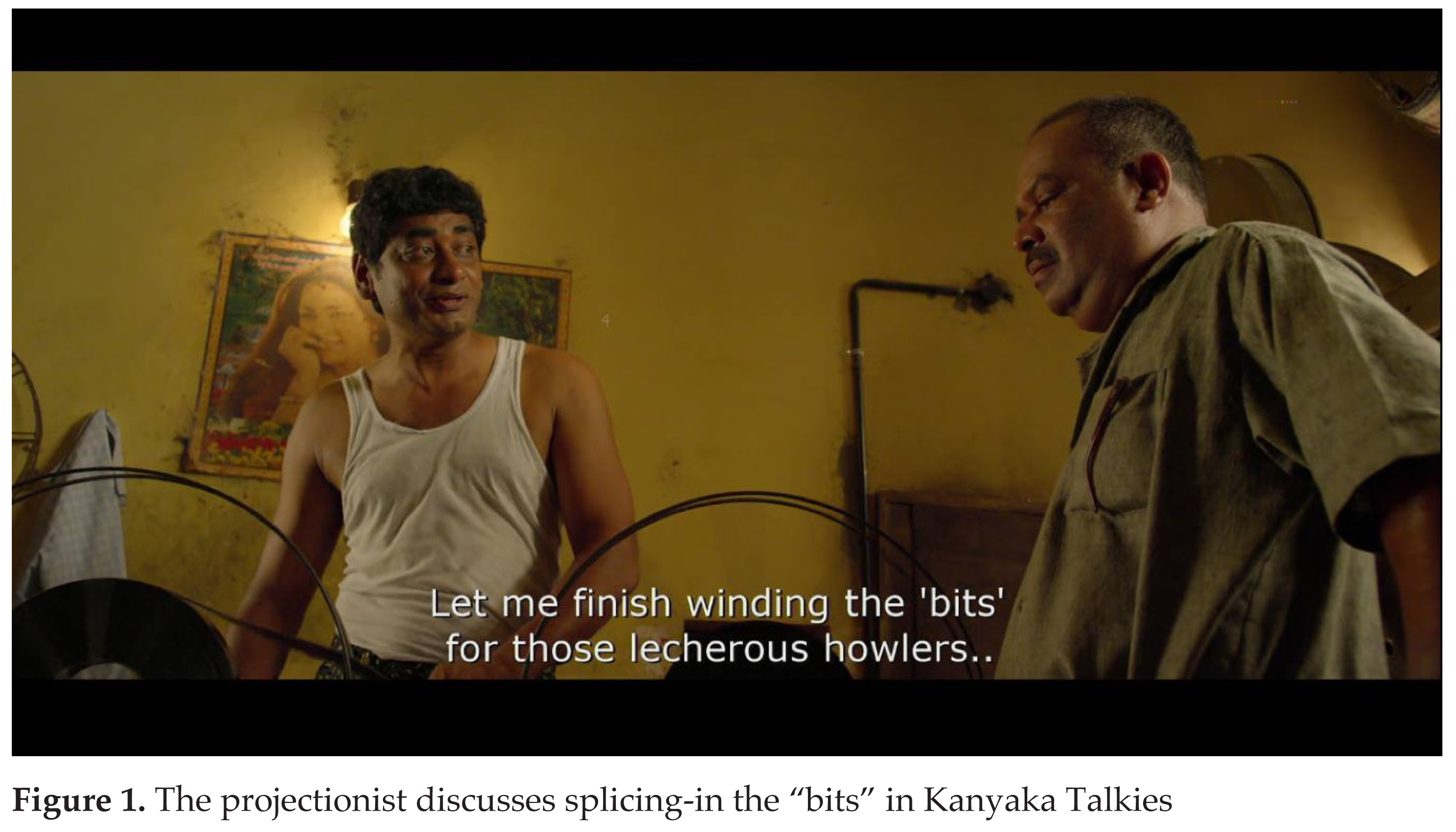
Made on low-budgets, these soft-porn films incorporated female figures in the cast of madakarani—a sexualized figure who is unabashed about her sexuality and uses her charms to her advantage. While the dominant use of the term madakarani implies a sense of fleeting sexual pleasure and voyeuristic male consumption, it can also paradoxically stand in as a useful entry point to look at the ways gendered demarcations and implacable desires enter the discursive space of the cinema. In soft-porn films, one can see improvisations of the model earlier associated with the glamor cinema, especially in the shoe-string budgets of approximately ₹20–25 lakhs, tight production schedules and identifiable features such as continuity errors and the use of stock footage. In fact, the marginal zone occupied by the soft-porn films allowed them to circumvent the certification clauses authorized by the Central Board of Film Certification (CBFC), the nodal agency in charge of film censorship in India. The resistance imbued in the process of negotiating the constraints of legality was mediated through collaborative practices that tapped into the loopholes that allowed the censorship mechanism to function in the first place. For instance, filmmakers would often employ “second writers” (randam-ezhuthukar) to generate an alternate censor-script that would be submitted to the CBFC. This specialized script would adhere to censorship regulations, even at times addressing the possible oppositions that might be raised by the committee. In some ways, these “second writers” functioned as ghost writers, but the major difference, was in the ingenious construction of alternative scripts that can be seen as variations of the one submitted to the censor board, something that my respondents referred to as “Plan B and C.” 5 The insertion of sexually explicit imagery in the form of bits or cut-pieces (locally known as thundu) during exhibition is yet another mode of conveying the presence of the uncanny that can erupt into the screen, a welcome distraction that oversteps the predictable narrative (see Figure 1). 6 Another commonly used mode of circumventing the system was to shoot significant portions of the film in locations that are far removed from the regional censor board office (initially in Chennai and later in Thiruvananthapuram) to take advantage of personal connections. 7 Some of these films also took advantage of the subsidy package offered by the government-owned Chitranjali Studios, which was meant to promote film production in Kerala, while some others made use of various shooting locations in the neighboring state of Karnataka to avail the government subsidy meant for films shot there. 8 Soft-porn films had a wide circulation, both as theatrical releases and in the form of DVDs, specially packaged for the diasporic Malayali audience based in the Middle East.
The projectionist discusses splicing-in the “bits” in Kanyaka Talkies
The emergence of soft-porn films in Kerala in the 1990s, therefore, marked a considerable shift in terms of production techniques, budgeting, themes, and distribution patterns. Even though soft-porn shared links with earlier cultural modes of sexual expression such as erotic stories (kambikathakal) and vernacular pulp fiction (painkili), as a cinematic genre it only emerged during a downturn in the box-office performance of mainstream Malayalam films. As such, it provided much needed revenue and employment to many in the film industry, by carving out an alternative terrain of film culture. The year 2001 marked the high tide of soft porn production, when out of the 89 films released, 57 were soft-porn sizzlers (Pillai, 2002). There were anxious responses from the popular press and industry about how the low-budget formula of these immensely popular films could spread low-brow taste. An article in India Today for instance declared:
Kerala is steaming, and the reasons have nothing to do with the onset of summer. Bare breasts, hairy chests and various other parts of the human anatomy are erupting like a rash across the state’s cinema screens and the audience is literally lapping it all up in lascivious delight, unmindful of censors and other sundry guardians of public morality. (Pillai, 1986)
9
By 2005, with the rise of the digital cinema, the trend of soft-porn films started to decline and the theaters which were earlier screening these films were either shut down or converted into, among other things, wedding halls. But despite this decline, the memory of soft-porn continues to bleed into the present, both in terms of narrative and the physical space of the cinema.
The Cathedral and the Tomb: Kanyaka Talkies and the Dying Spaces of Soft-porn
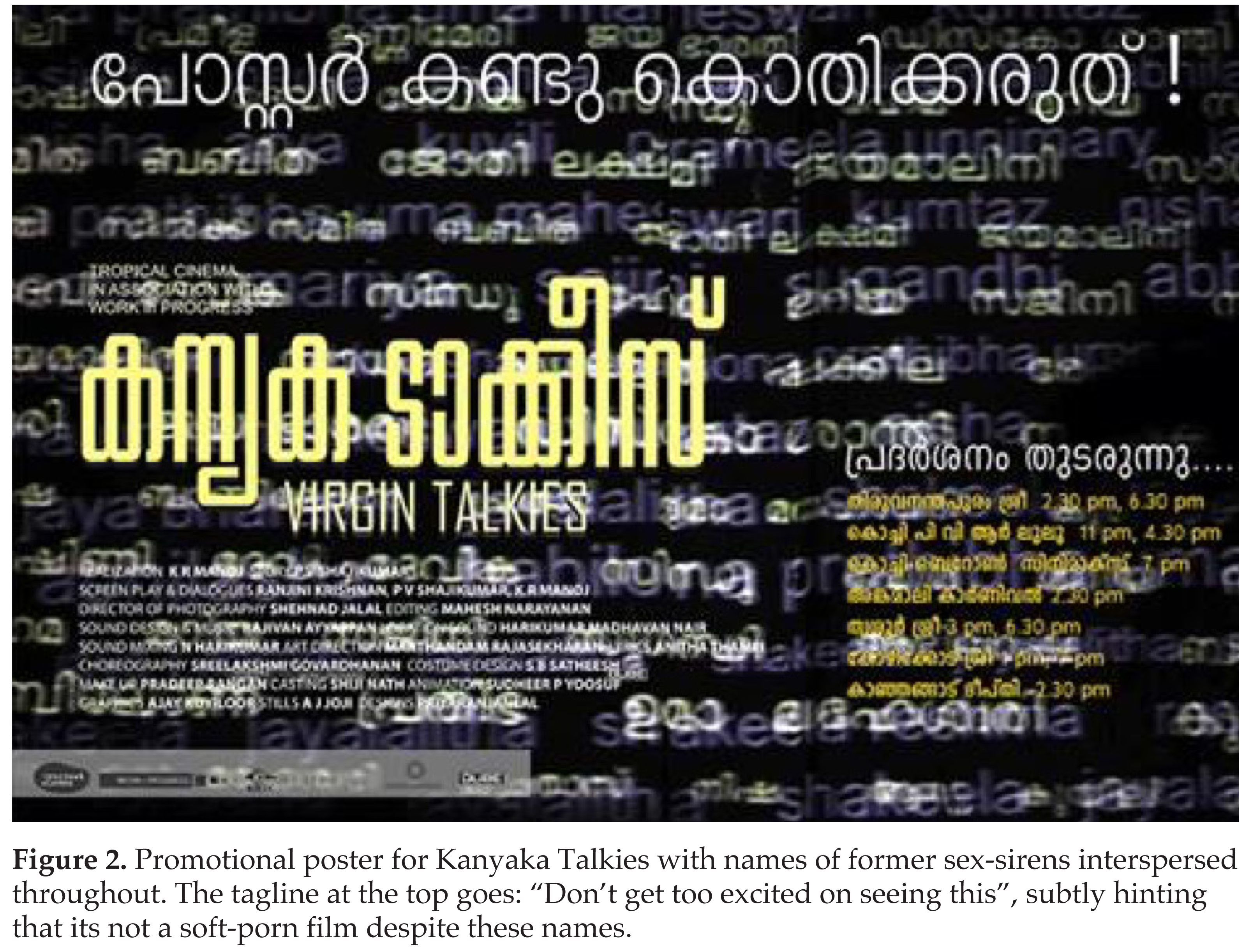
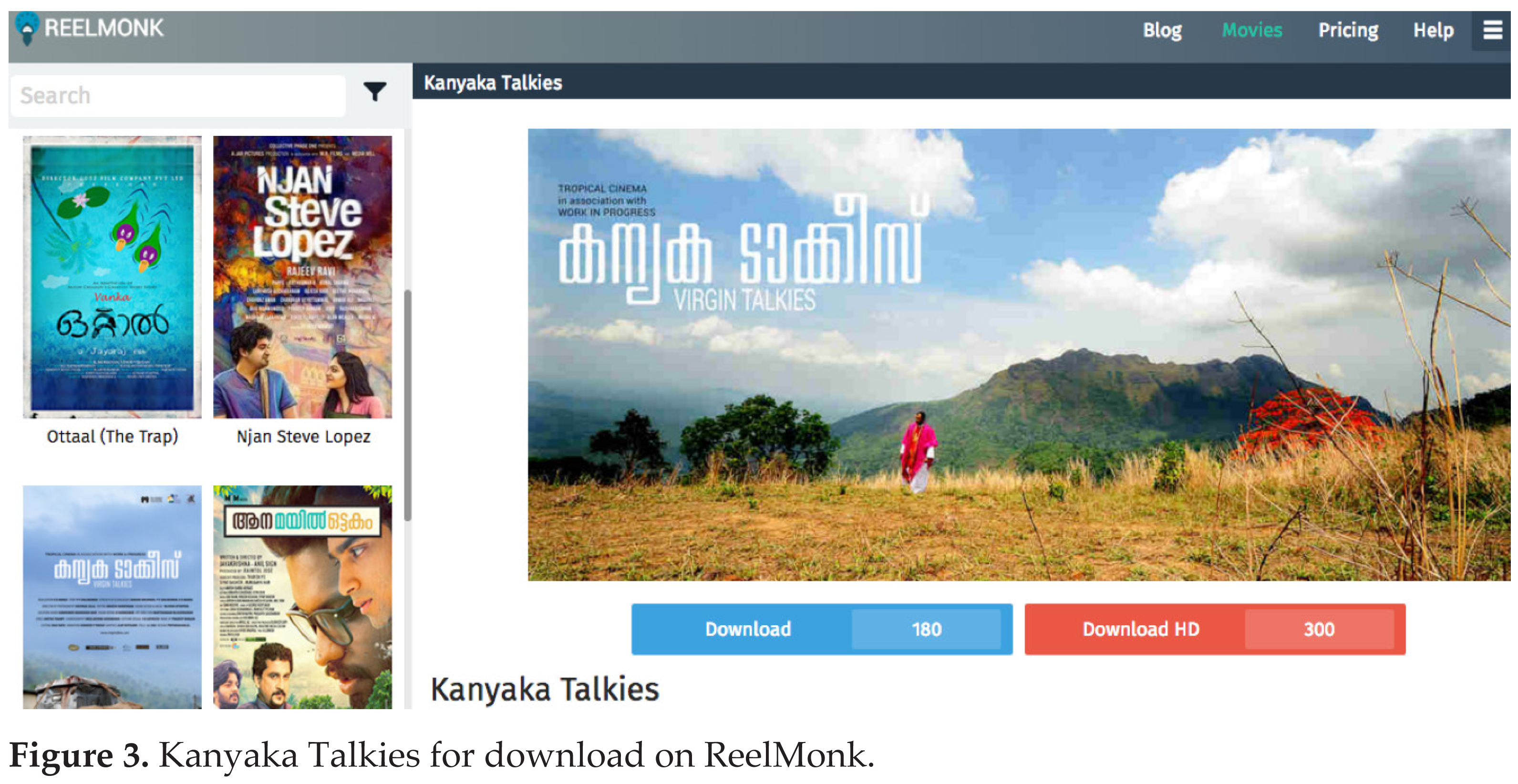
Kanyaka Talkies (2013), directed by K.R. Manoj, based on P. V. Shajikumar’s short story “18+” (originally published in Madhyamam in 2011 and then in book form in 2013) looks back at soft-porn exhibition, the cultures of its circulation and different modes of interaction that existed in the marginal space of the “B and C center” theaters (see Figure 2). 10 Similar to the critical success of Ashim Ahluwalia’s Miss Lovely (2012) that is set in the context of the B- and C-grade films produced in Bombay, Kanyaka Talkies too had a successful run in festival circuits including the 44th International Film Festival of India as the opening film to the Indian Panorama and being listed by Forbes as one of the five “Indian Films to see in 2014” (Shedde, 2013). But Kanyaka Talkies had its theatrical release only a year later in 2015, thanks to the Kerala State Film Development Corporation’s recent move to promote independent cinema following the recommendations of the Adoor Committee Report (2014) that was aimed at fortifying the state of the film industry in Kerala; the film was subsequently released in over five centers in Kerala. It also had a video-on-demand release via the cable networks Kerala Vision Movies and Asianet Talkies, while also being made available for a paid digital download via the film portal ReelMonk (see Figure 3). While the delay in theatrical release could be attributed to the difficulties involved in securing theater dates (an obstacle faced by many independent cinema makers) the significant time lapse between its debut at the IFFI in 2013 and its release in 2015, paradoxically allowed it to gather enough limelight and critical appreciation. The title Kanyaka Talkies literally translates as “Virgin Talkies” and is redolent of the varied layers of memory still alive in the avowedly “dead” soft-porn culture in Kerala. As a striking contrast to the cinema viewing experience of the “A” circuit cinema halls, this film maps the theater culture in the rural hinterland and the evocative ways the term Kanyaka, meaning “virgin”, became the catch-word among the male viewers, tapping into their deepest sexual desires and fantasies associated with the closed interiors of the theater space. The film’s focus on the conversion of the theater to a space guarded by the Church’s strict codes of morality makes it a rumination on the ways diverse beliefs and impulses, such as, religion, guilt, desire, and sin coincide within the same space, making it by turns profane and sacred in its connotations.
Promotional poster for Kanyaka Talkies with names of former sex-sirens interspersed throughout. The tagline at the top goes: “Don’t get too excited on seeing this”, subtly hinting that its not a soft-porn film despite these names.
Kanyaka Talkies for download on ReelMonk.
In the film, when the “Gulf-returned” Yakoob decides to set up Kanyaka Talkies in the remote area of Kuyyali in the 1980s, many see him as an entrepreneur who wants to invest his money in a profitable venture much like other Gulf returnees. But, soon the initial business prospects and enthusiasm give way to heavy financial setbacks and Yakoob is forced to turn to soft-porn to make up his losses. The idea of a theater being forced to turn to soft-porn to deal with financial difficulties has actual resonances. The 1990s was the time when even films starring superstars such as Mohanlal and Mamooty fared badly at the box-office, forcing many theaters to screen soft-porn films to compensate. For instance, R. Ayyappan (2001) notes that “of the 73 films released last year (2000), 21 were of the sleaze variety and most of them had covered their cost. But among the remaining 51, there were only three hits and two just- about hits.” This is also echoed in other popular reports of the time. For instance, M.G. Radhakrishnan notes that
in 1999, as many as 45 films bombed at the box office, with barely 10 reaping good profits […] with an estimated Rs 80-crore loss and an all-time low production of 60 films in the past year (1999)—a steep decline from 120 movies produced 15 years ago—there are few options for producers but to join the smut brigade.
Kanyaka Talkies’ depiction of the vicissitudes of film exhibition and strategies to deal with losses is symptomatic of the plight of many theaters across Kerala.
The reference to the past glory of the theater looms all throughout in the conversations that Yakoob shares with the villagers, especially in the projectionist’s (Saiju Kurup) musings of the good-old days when the theater catered to the leisurely festivities of the family audience. This portrayal of Yakoob as a Gulf-returned Malayali, is a reference to the nouveau-riche Gulf emigrants who invested their surplus money in soft-porn films, a phenomenon that opened up film production as an alternative mode of business enterprise to reap profits with limited investment. 11 Such financiers contributed much to the shaping of a quasi-fictitious mode of film production by hiding the identities of the financial backers. Money from the Gulf was often pumped under benami funds (i.e., funds held under a fictitious name), while hiding details and whereabouts of the investors by floating fictitious production banners.
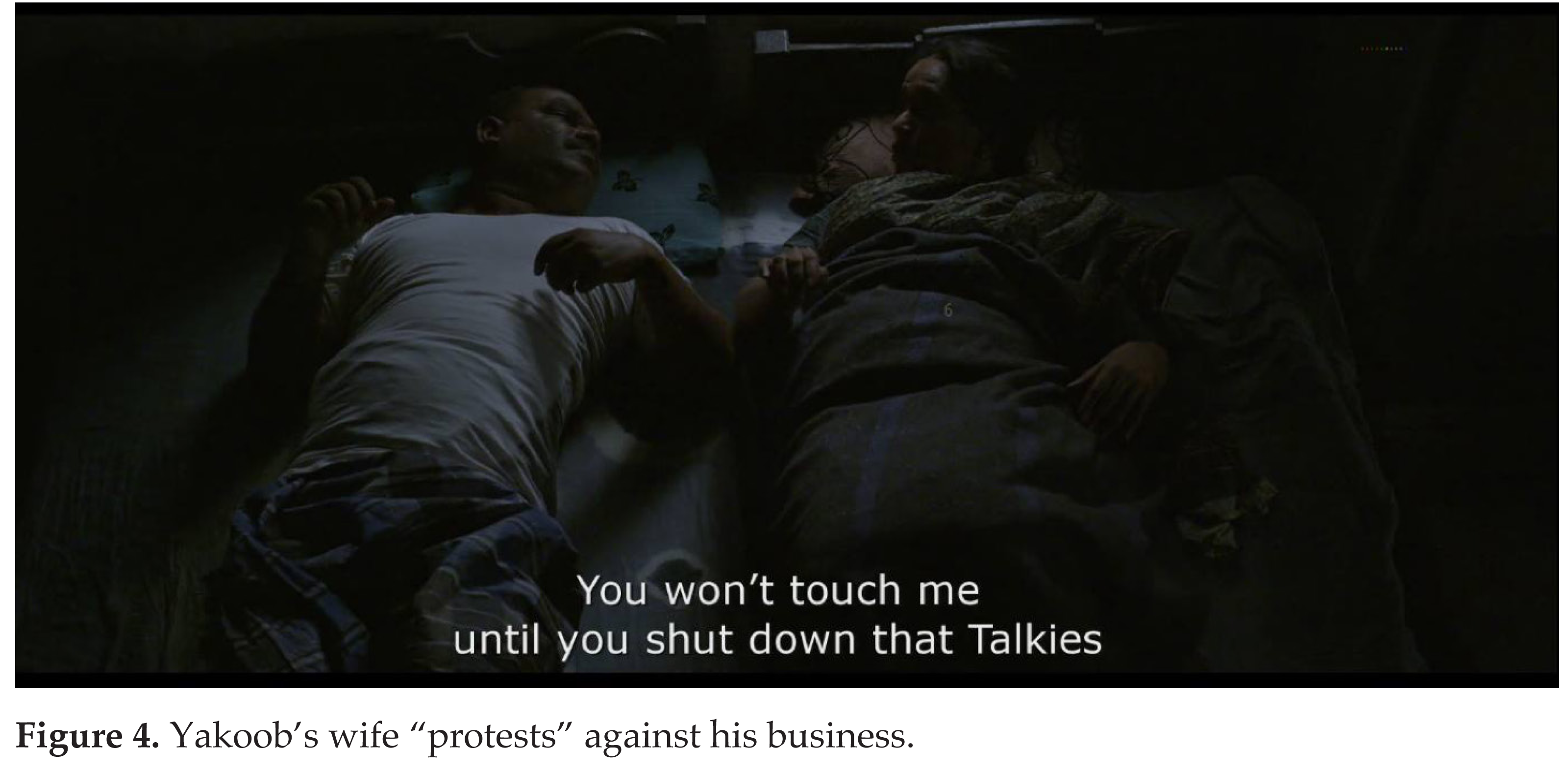
The theater “Kanyaka Talkies,” which is initially portrayed as screening “family films,” later becomes an exclusive space drawing male audiences across the age-spectrum, creating a sense of male sociality, with women looking down upon the theater as the harbinger of moral depravity. The Christian notion of guilt weighs down Yakoob’s wife and she rebels in the bedroom, only willing to resume conjugal intimacy once the theater is shut down (see Figure 4). For Yakoob’s wife, the elopement of their first daughter serves as a timely reminder to protect familial harmony. But when Yakoob refuses to consent to her plea to let go of his business, she becomes bitter, and turns to religion for solace. It is only after his second daughter elopes and his wife kills herself that the remorseful Yakoob shuts down the theater. Weighed down by guilt, he hands it over to the diocese as a last attempt to cleanse himself of sin. In this fictional logic, Yakoob’s association with soft-porn films is pitted against the tenets of religion and ethical uprightness, and his moral decay and the disintegration of his family are linked to an obsessive love for cinema. This obsession is suggested in an early part of the film, for instance, when Yakoob is confronted about showing soft-porn films by some co-passengers and retorts that the cinema business is the only thing he knows and loves. Later, after he shuts down the theater, Yakoob is still associated with cinema as a distributor. Therefore, in some ways, the tag of “soft-porn” does not deter Yakoob from the business he loves dearly, as for him it is after all, a form of cinema.
Yakoob’s wife “protests” against his business.
A crucial aspect of Kanyaka Talkies is the transmedia mode of storytelling that underlies its production and the bringing together of varied artifacts associated with the memory of soft-porn films. For instance, Shaji Kumar’s “18+”, the short story that became the inspiration for the film, drew on the changing vicissitudes of “Kanyaka Talkies,” a real theater based in the district of Kasargod that screened soft-porn films in the 1990s. 12 Even while he uses the cultural memory of the real Kanyaka Talkies, in “18+” Shaji Kumar attempts to reflect on the larger disappearance of theaters that were closed down or converted into other spaces in recent past. In fact, like in Kanyaka Talkies there were actual soft-porn theaters that were later converted to Churches, as, for instance, one located in the district of Wayanad that became another real-life reference for the film. In one of the earliest screenings of the film in 2013 at the International Film Festival of Kerala, there were viewers who shared the memory of their film viewing experiences during the discussion session, and echoed experiences similar to the one captured in the film. 13 The limited initial circulation of Kanyaka Talkies within the festival circuit and the delay in its theatrical release in many ways contributed to its framing as a fictocritical 14 account of the soft-porn era—a serious attempt at historicizing, by a filmmaker whose credentials also lent the film its cultural value. 15 In its attempt at historicizing, Kanyaka Talkies thus brings into play, an array of real references that function to link different moments when the imagination of soft-porn struck chords in the collective memory of Kerala’s public space.
This is hinted at during the opening credits of the film that intersperse the visuals of old equipment and dilapidated interiors alongside the conversation between the projectionist and the projector repairman. This provides an interesting framing device inviting the viewers to have a last glimpse of the old technology before it is dismantled for good. The concentrated gaze of the projector repair-technician as he scrutinizes the worn-out equipment is accompanied by the anxious response of the projectionist, who brushes his hands against the musty exteriors of the film canisters. This tactile gesture is imbued with the intimate feel the projectionist has toward the equipment, a gesture that is colored by the realization that change is inevitable and the obsolete technology and celluloid culture would soon give way to the digital. But, quite unexpectedly, it is not the influx of new technology that signals the demise of Kanyaka Talkies, but its conversion to a Church. Yakoob’s reconciliation to the loss of his family is expressed in his making amends by contributing to the diocese. Notwithstanding his religious faith, Yakoob emulates the course of action a true Christian would take when he is shown the right path and brought back to the fold. Yakoob treats the cinema like a mistress who he belatedly turns down to appease the rightfully wedded wife and restore peace and stability in the normative family.
In spite of Yakoob’s bid to remove the last traces of the erogenous air of soft porn by selling the film projector and other equipment to scrap dealers, and his own physical departure from Kuyyali, the shards of memory associated with soft-porn films refuse to die and their spectral presence comes to haunt the space in which it was housed. Even the priest who is assigned the task to motivate the believers to strengthen their faith is faced with the prospect of strange and inexplicable happenings. Not only does he observe the disruption of the mass by an unseen third party, moans of love making evoke repressed desires and stir doubts about the capacity of his faith to withstand sinful thoughts. While he strives to meditate and recover a steadfast sense of purpose to vanquish deviant thought and redeem sin, he becomes entangled in an existential crisis prompted by this encounter with the uncanny. When Father Michael visits a psychiatrist for therapy, a discourse of reason takes over from that of faith: in the process of talking about his disturbing thoughts, Father Michael begins to relate to Yakoob, who he has not met, but whose absence had triggered off his psychological crisis. He decides to plunge into a search mission for Yakoob, starting with a visit to the distributor whom Yakoob has been in touch with after he had left the village.
The aural environment evokes spatial memory, the theater emerging as a haunted space that brings back repressed desires to unsettle the normal scheme of things. Elements of scattered memory associated with soft-porn films resonate in a wide ensemble of stock sounds, suggesting seduction and orgasm. The soundtrack of the actresses’ voices and dialogs culled from soft-porn films creates a parallel world that collapses time as Father Michael hears them whisper from their past into his present. Interestingly, one of the acknowledgments in the final credit sequence of the film proclaims
some sound elements in this film have been created through a process of sampling of existing pieces or sound recordings/tracks and layering them with other sounds/tracks. The idea behind sampling is to create greater awareness about the marginal areas in the history of Indian cinema. (emphasis mine)
Sound thus becomes the means by which haunting takes place; the confrontation of the priest with the soundscape of soft-porn films is akin to the Deleuzian notion of crystal image that shapes time as a constant two-way mirror that splits the present into two heterogeneous directions, “one of which is launched towards the future while the other falls into the past” (Deleuze, 1989, p. 81). This oscillation between the different temporal moments the priest is confronted with, through the soundtrack is uncannily similar to what Deleuze calls “the vanishing limit between the immediate past which is already no longer and the immediate future which is not yet” (p. 81). The priest takes these aural hallucinations as an affront to his vows of celibacy, as seen, for instance, in the scene where he visits the psychiatrist in which he says that he hears “that which a priest like him should never hear.” This sonic encounter enables us to revisit the exhibition practices of soft-porn films in two ways. First, there is the logic of interruption that motivates the use of the cut-piece in soft-porn exhibition. Just as the cut-piece or thundu arrives in the cinematic experience at unprecedented moments, the priest’s aural hallucinations also start at unexpected moments and venues. But, more importantly, it is the sonic register that creates the impact—even though it is the insertion of the cut-piece that is seen as an immediate mark of identification of soft-porn films, Kanyaka Talkies refers to this only in passing and instead lays greater emphasis on the role of the soundtrack in creating the erotic landscape.
In Kanyaka Talkies this strategic restructuring of the soundscape enables the conflation of heterogeneous temporalities as the aural medium becomes the interconnection to link “the pastness of the recorded event with the presentness of the viewing” (Totaro, 1999). The importance of this soundscape is foregrounded in Kanyaka Talkies very early on where the sound assumes a dynamic character, as it is mapped onto frontal shots of viewers watching porn films in the theater. Therefore, in Kanyaka Talkies there is a displacement of the visual register of eroticism (which is perhaps the more popularly known facet of soft-porn cinema) by its distinct aural character. At the same time, this strategic use of sound also creates both a sense of temporal disjunction, and the expectation of dramatic turns in the narrative. 16
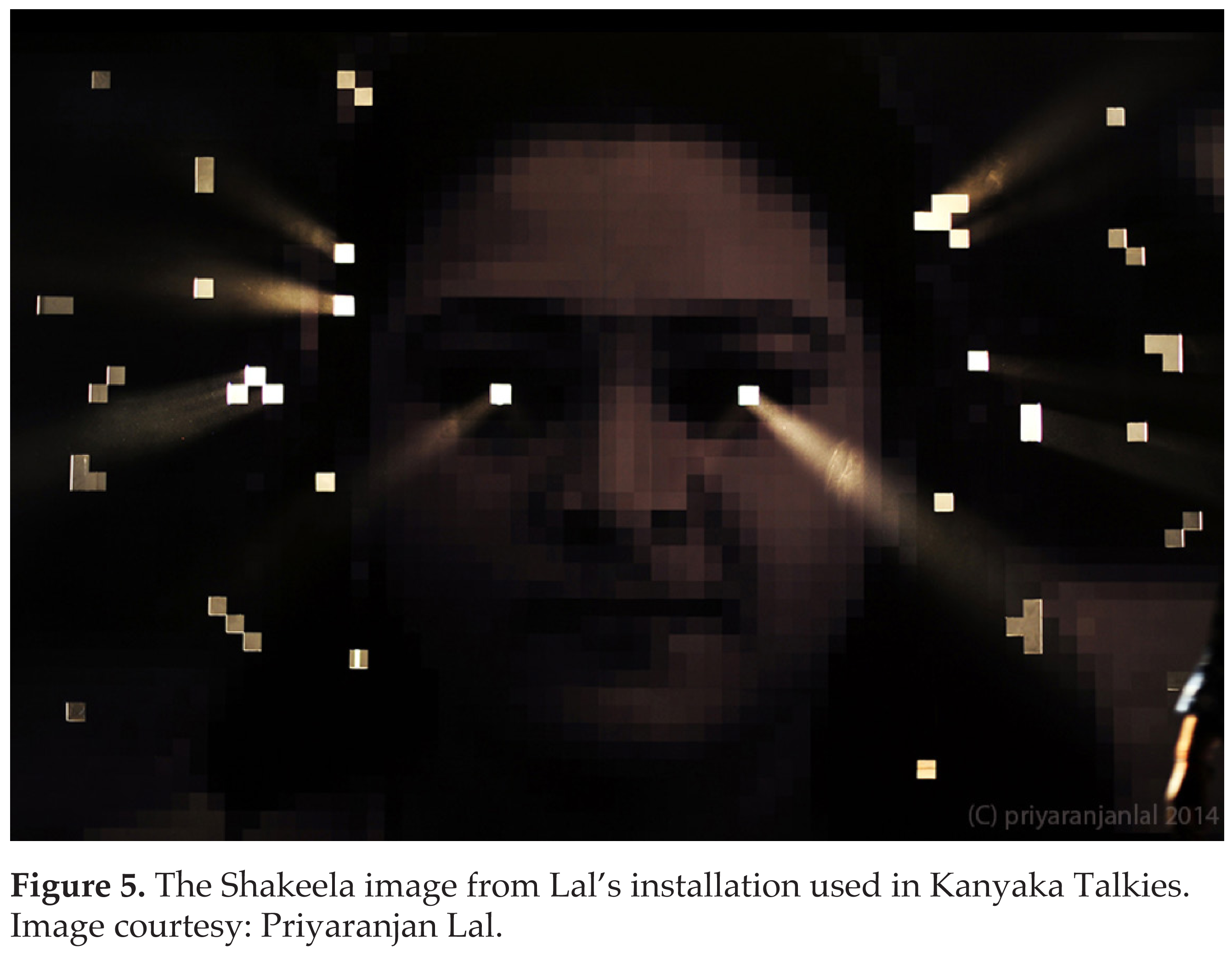
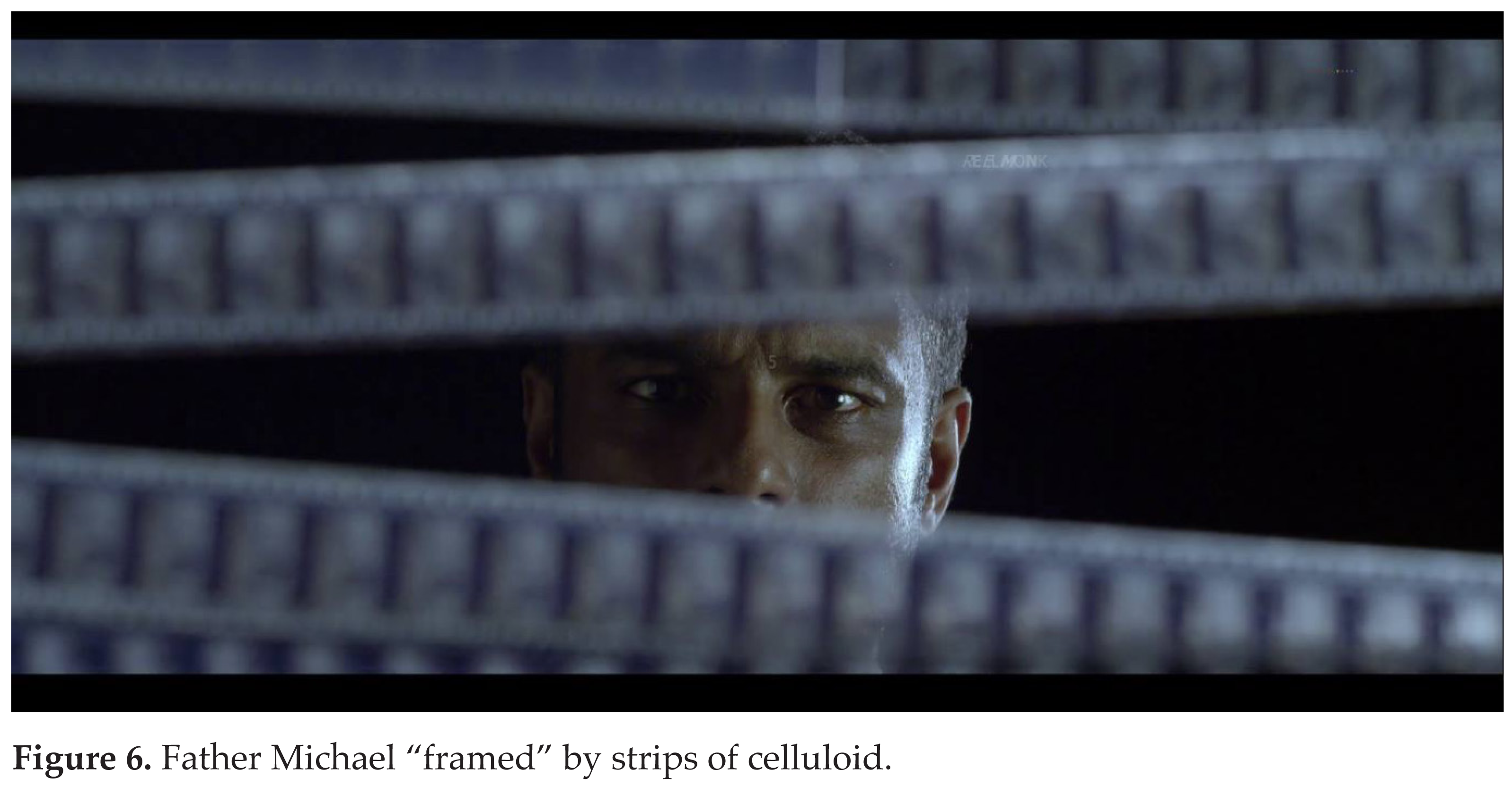
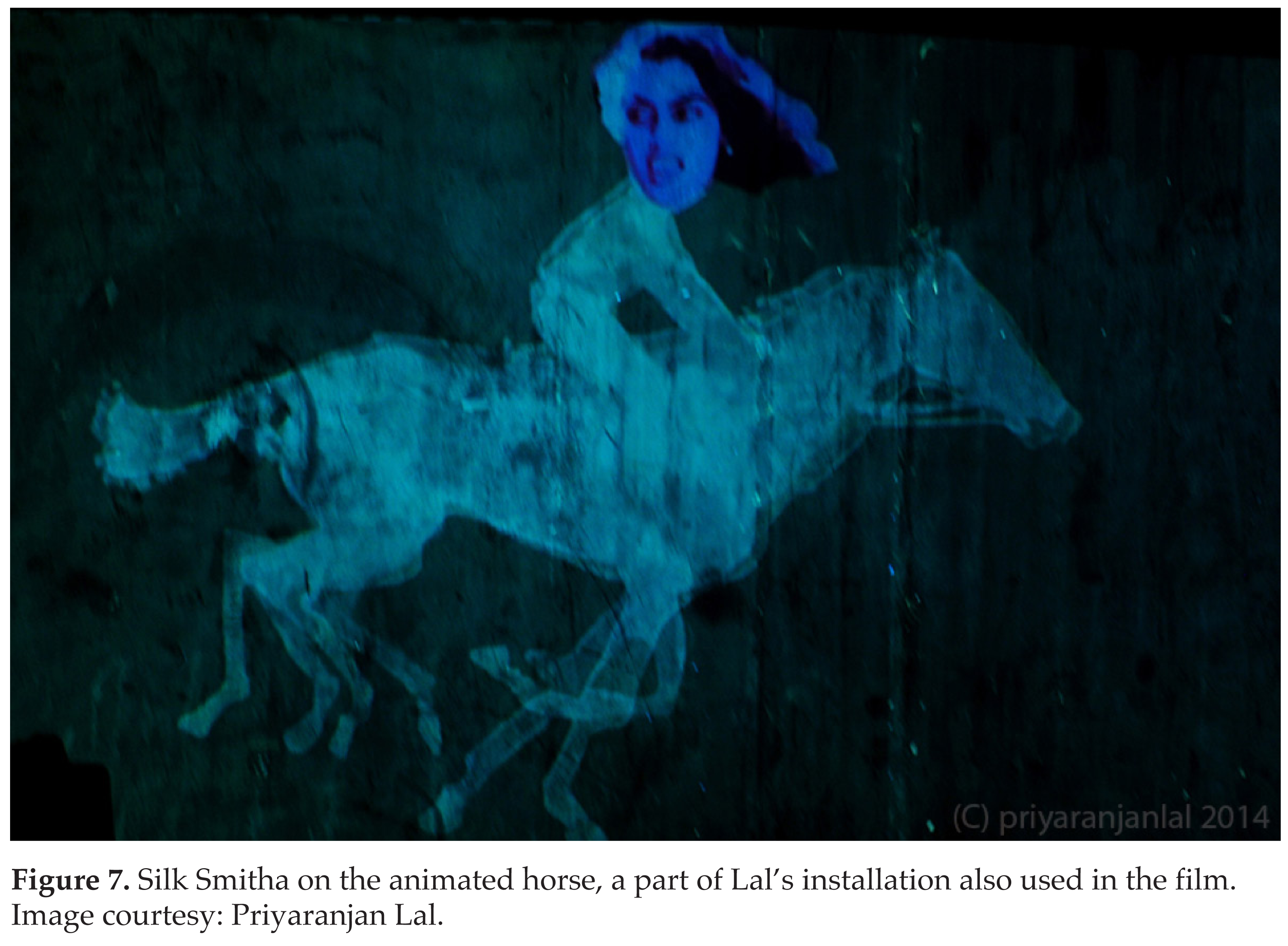
Interestingly, the projection room of the theater is retained as a warehouse even after the rest of the building is renovated to accommodate the demands of the church. This liminal space that houses the discarded stuff of the theater takes on a completely new resonance in the film. In some ways then, the warehouse takes on a quality that Anthony Vidler (1992) calls the “architectural uncanny.” For Vidler, the architectural uncanny is “a representation of a mental state of projection that precisely elides the boundaries of the real and the unreal in order to provoke a disturbing ambiguity, a slippage between waking and dreaming” (p. 11). In Kanyaka Talkies the interior of the warehouse is shown only at the end (except for the flashback scenes when it was used as a projection room), while the locked doors are shown time and again in scenes with Father Michael. The shots of the door that return Father Michael’s troubled gaze draw our attention to the space of the warehouse/projection room as a space of doubling that, in Vidlerian vein provokes a “disturbing ambiguity.” Crucially, it is through the abandoned projection room and the medium of Yakoob, rather than psychotherapy that Father Michael believes that he can achieve closure to his hallucinatory sensations. Like an exorcism ritual where the contact with the netherworld can only happen via the shaman, in this sequence, the encounter with the past is facilitated by Yakoob. It is only after Yakoob arrives that the locked doors are opened and any possibility of redemption emerges. The sequence that follows Father Michael’s entry into the projection room along with Yakoob is perhaps the most striking sequence in the whole film, featuring a monumental image of Shakeela projected on the wall (see Figure 5). This image is rendered iconic by the beams of light that are simulated as projecting out of the actress’ visage. In some ways, this almost seems to return the unilateral gaze of the audience as Shakeela seems to emerge as a demi-goddess answering the worshipper’s prayer. Father Michael’s face is also shown framed by strips of celluloid, as if to suggest that it is soft-porn cinema itself that has been haunting him all throughout (see Figure 6). This is followed by a multi-media projection of animated images where Shakeela appears with other sex sirens like Silk Smitha, Reshma, Maria, and others riding on a horse, with the faces changing as the horse gallops along (see Figure 7). 17
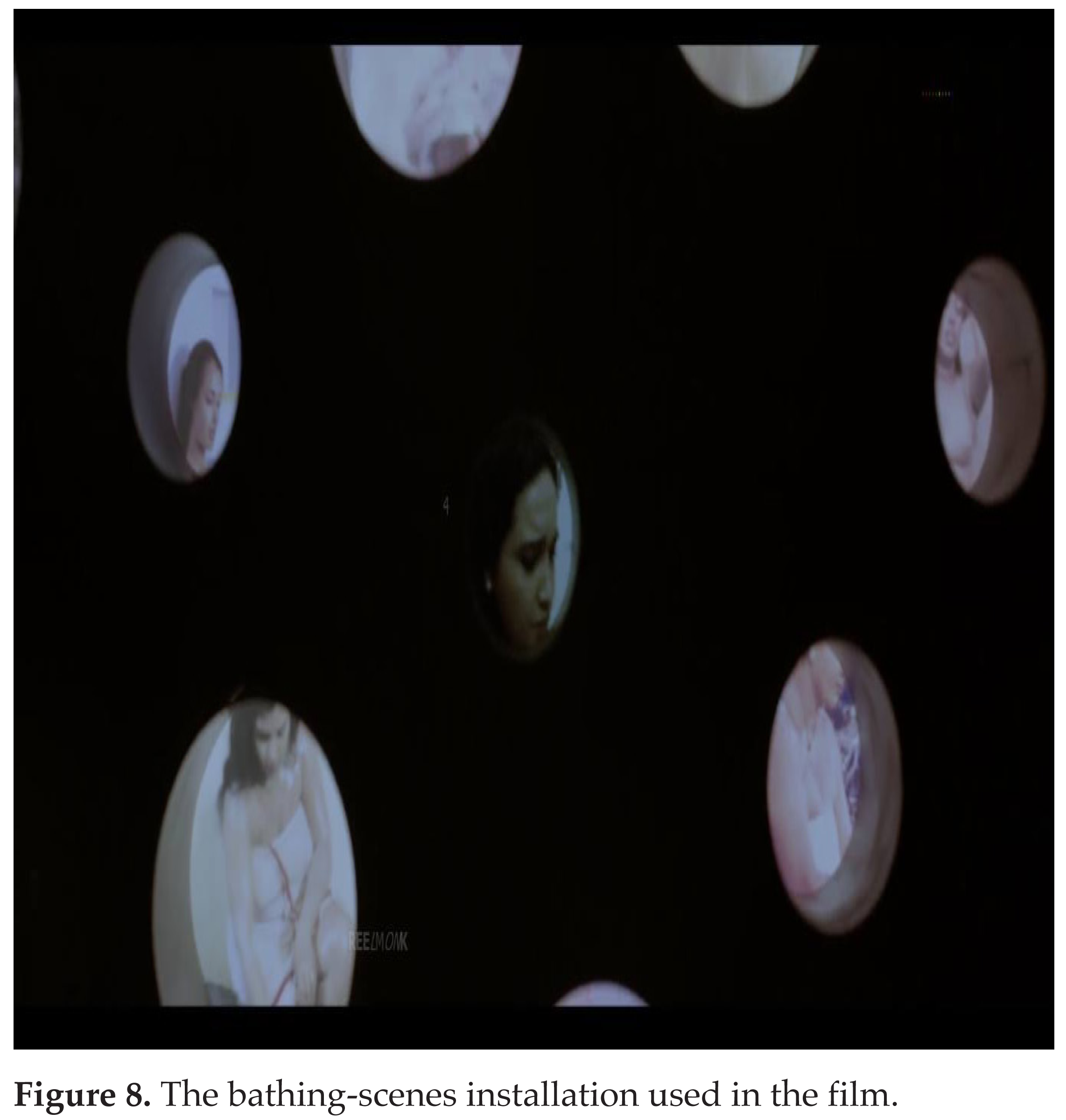
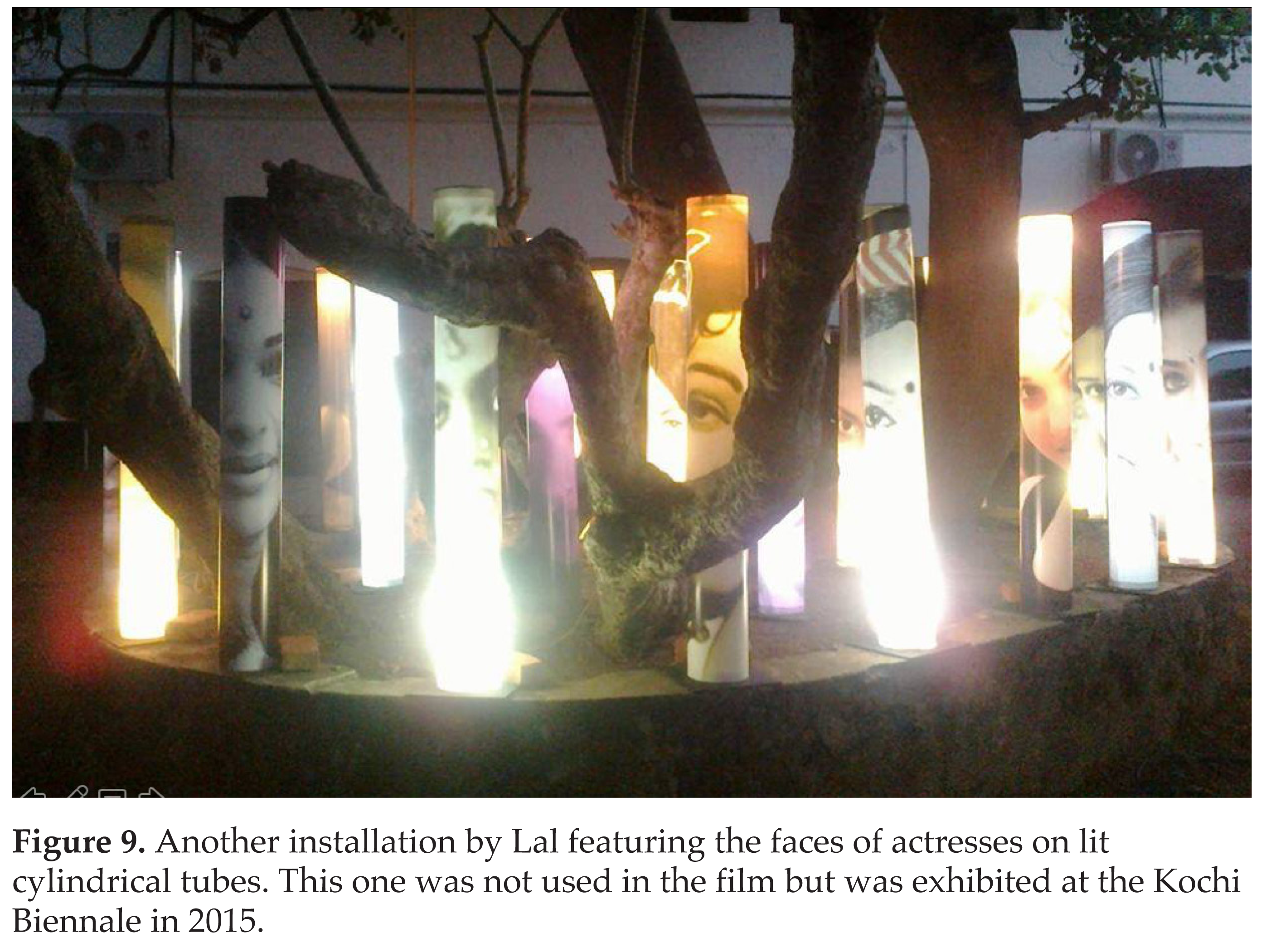
The multi-media projection that was used in this instance was commissioned for the film, but was developed as a part of a larger project by the graphic designer Priyaranjan Lal. Lal says “The installations were conceptualized as a timely intervention to counter the neat narratives which structure the history of Malayalam cinema.” 18 In fact, another installation showcases a hundred bath scenes from various soft-porn films that could be viewed through peep-holes, as if to emphasize the voyeuristic fantasy associated with these films (see Figure 8). Another installation featured the faces of several “sex-sirens” or madakarani figures from Malayalam cinema on cylindrical posts that were lit from the inside (see Figure 9). Interestingly, these actresses were not all soft-porn actresses but were mostly starlets like the actresses Jyothilekshmi and Sadhana who had short stints in the industry. Along with the animated horse imagery, the multitude of faces that pepper the installations seems to suggest a longer history of sexualized fantasies related to women actresses, of which Shakeela is only a part. These installations were crafted by Lal as a rejoinder to the centenary celebrations of Indian cinema. All the video installations were exhibited under the title Kuliyum Mattu Scenukalam (the shower and other scenes) as a part of the 100-Day Artist Cinema section curated by the film critic C.S. Venkiteswaran, at the Kochi-Muziris Biennale in January 2015. Even though the installation was publicized as being commissioned as a part of Kanyaka Talkies, only parts of it were used in the film. In this sense, Lal’s work functions as a complementary artistic conversation with the film—a facet of its fictocritical and transmedial storytelling, with some passages of Kuliyum Mattu Scenukalam punctuating Kanyaka Talkies’ narrative. Such installations and multimedia images are an interesting departure from the original short story, where the image of Shakeela or for that matter, any other specific actress is not so central to the narrative. In “18+” the priest only hears the voices of actresses and the soundtrack of soft-porn films, with no investment in the inner workings of the film industry as such.
The Shakeela image from Lal’s installation used in Kanyaka Talkies. Image courtesy: Priyaranjan Lal.
Father Michael “framed” by strips of celluloid.
Silk Smitha on the animated horse, a part of Lal’s installation also used in the film. Image courtesy: Priyaranjan Lal.
The bathing-scenes installation used in the film.
Another installation by Lal featuring the faces of actresses on lit cylindrical tubes. This one was not used in the film but was exhibited at the Kochi Biennale in 2015.
There is another significant deviation in the film in addressing the transformation of the priest after his encounter with the apparition of soft-porn. If in “18+”, the priest is shown to have realized that he is as susceptible to desires as anyone else and becomes a connoisseur of soft-porn, Kanyaka Talkies unravels the contradictory impulses that leave the priest in a state of dismay. 19 The concluding sequence of the film was rewritten more than thrice, as the scriptwriters had to keep in mind the controversies it might provoke in the Christian community, who might not appreciate the fact that priests, despite the vows of celibacy, could be susceptible to worldly desires. 20 In “18+”, the priest, introspecting on his deviance, muses that “whatever one fears, it comes to haunt you” (Kumar, 2013, p. 40) introducing a new layer of meaning to the repressed desires that manifest in his hallucinations. The slippage between the hallucinations and the moment he presently inhabits creates an eerie sense. Both in the film and the short story, hallucinatory sounds shape a new perceptual terrain for Father Michael, as dialogs from soft-porn films punctuate his thought while delivering his address at mass and while hearing confessions. 21 It is also crucial at this point to look at the affective investment which both “18+” and Kanyaka Talkies hint at in Yakoob’s return to Kuyyali which cures the priest of his incurable sleeplessness. In a seemingly magical realist twist in “18+”, P.V. Shaji compares Yakoob to Melquíades who revisits Macondo in The Hundred Years of Solitude (1967), 22 foregrounding the trope of return that conjoins the complexity of time and the repetition of history.
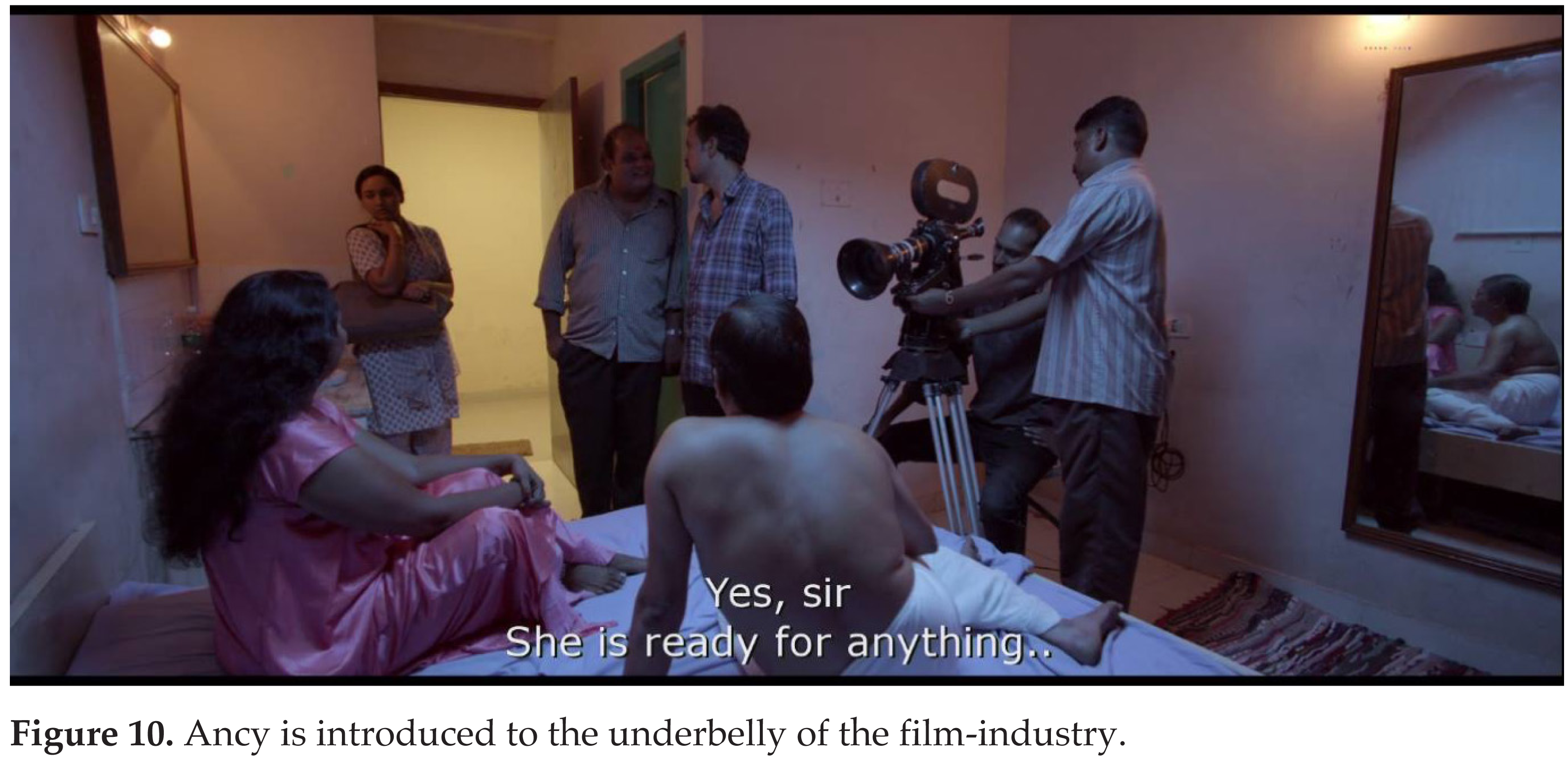
While the film has an expansive repertoire of references, it is primarily motivated by a discourse that seeks to complicate perceptions about soft-porn films. On the one hand, Kanyaka Talkies takes recourse to conventional moralist narrative strategies, incorporating the side-story of a home-nurse, Ancy who aspires to become an actress, to comment on the production aspects of soft-porn films. Ancy is duped by a production assistant who casts her in soft-porn films against her wishes and circulates erotic shots of her (see Figure 10). The film’s narrative here conforms to the understanding retailed by mainstream industry and cultural purists that soft-porn films are “low-budget” films that exploit women to reap quick profits. The film also refers to multi-media messaging service (MMS) and the ways sexually explicit material is circulated as short clips that can be easily transferred and shared over the Internet or via cell phones. While Shaji Kumar’s 18+ situates the story within the time period of 1980s, Kanyaka Talkies leaves out any mention of its periodicity, except to the fleeting shots of the posters of films released in 2013 (such as Mumbai Police, Dir. Rosshan Andreews) on the walls in the background as Ancy waits to meet her agent. The question that arises is whether the removal of the periodicity is an intended move or is it in tune with the temporal conflations that soft-porn as a form is susceptible to. Even if we account for the film maker’s discretion in not including the temporal marker, another question that this raises is with respect to the use of MMS porn in the film, a device that it mobilizes to refer to the circulation of the sex-scenes of Ancy among the young men in the locality, transferred and shared via the local mobile phone recharge shop. If we consider a hypothetical scenario that the implied suggestion in Kanyaka Talkies is still the late 1980s as in “18+”, then the reference of MMS might be anachronistic at best. The use of the term “MMS porn” to refer to amateur pornography shot with cell phone cameras and circulated online and over cellular services came into vogue only after 2004 with the Delhi Public School scandal. 23 The anachronistic incorporation of MMS porn within the narrative enables a move beyond the fixity and temporal exclusion that otherwise marks the logic of linearity, that is, of the moment of soft-porn being replaced by that of MMS. Therefore, the move to situate soft-porn alongside MMS not only unsettles the periodicity and causality that governs the historical enquiry into the industrial subterfuges that went into the making and circulation of these forms, but also render the need to work against the spatialization of time.
Ancy is introduced to the underbelly of the film-industry.
The film’s incorporation of Ancy’s victim narrative frames the history and production of soft-porn as an exploitative and non-consensual arrangement—a position espoused by cultural purists who bemoaned soft-porn to be the causal factor for the crisis Malayalam cinema faced in the 1990s. Needless to say, many of these accounts do not even attempt to consider soft-porn as an industrial form in itself or found it in any way relevant to look closely at the processes through which soft-porn films were produced, distributed, and exhibited. In stark contrast to the narratives of exploitation of the actresses involved in the films, many of my interviewees who were part of soft-porn production had a completely different take when asked whether the production shots were procured against the wish of the actors and actresses involved. Thrikunapuzha Vijaykumar, one of the film makers who had dabbled in soft-porn, said:
Even though we had access to many “intimate” shots of the actresses that could have fetched us a good price, we never sold them as “bits.” There were a few actresses whom we regularly worked with and nobody thought of breaching the trust through any kinds of exposure. After all we all worked for our livelihood and there was a clear sense of camaraderie among the cast and crew and no one wanted to compromise that.
24
While it is true that most of the accounts on soft-porn production were speculative at best, owing to the difficulties involved in tracking the personnel behind the making of these films, this relative sense of quasi-anonymity was seen as beneficial by many who worked in the industry. On the other hand, more than one of my respondents spoke of how unused shots of Shakeela were recycled for other films. 25 The recycling of unused shots subsequently marked the death knell for the industry as the same shots came to be rehashed for multiple productions. The actresses who were part of these films disappeared from the cinemascape and some of them intermittently showed up in news columns where their personal lives were compared to the story-lines of many of the films they were part of. 26 Thus, even when soft-porn films made it to video-sharing sites and sites that host pornographic material tagged as “Mallu Aunty films” or “Hot South Indian films,” there were multiple temporalities that these video clips inhabit. The insertion of the imagination of the “Mallu Aunty bits” or the “Hot South Indian bits” into the space of the digital is but a manifestation of a nostalgic impulse, for these phrases and figures belong to the weathered era of celluloid. Yet, their insertion into the digital playground testifies to the ways in which they persist as stubborn, un-erasable residues of the peak of the soft-porn era. For instance, one wonders how the word “bit” translates in the digital economy which is composed of fragments in any case and the sense of disruption that characterizes theatrical bits might not apply in the same way in case of a pornographic website that is built around distraction.
The Phantom Theater: Between the Fictional and Real
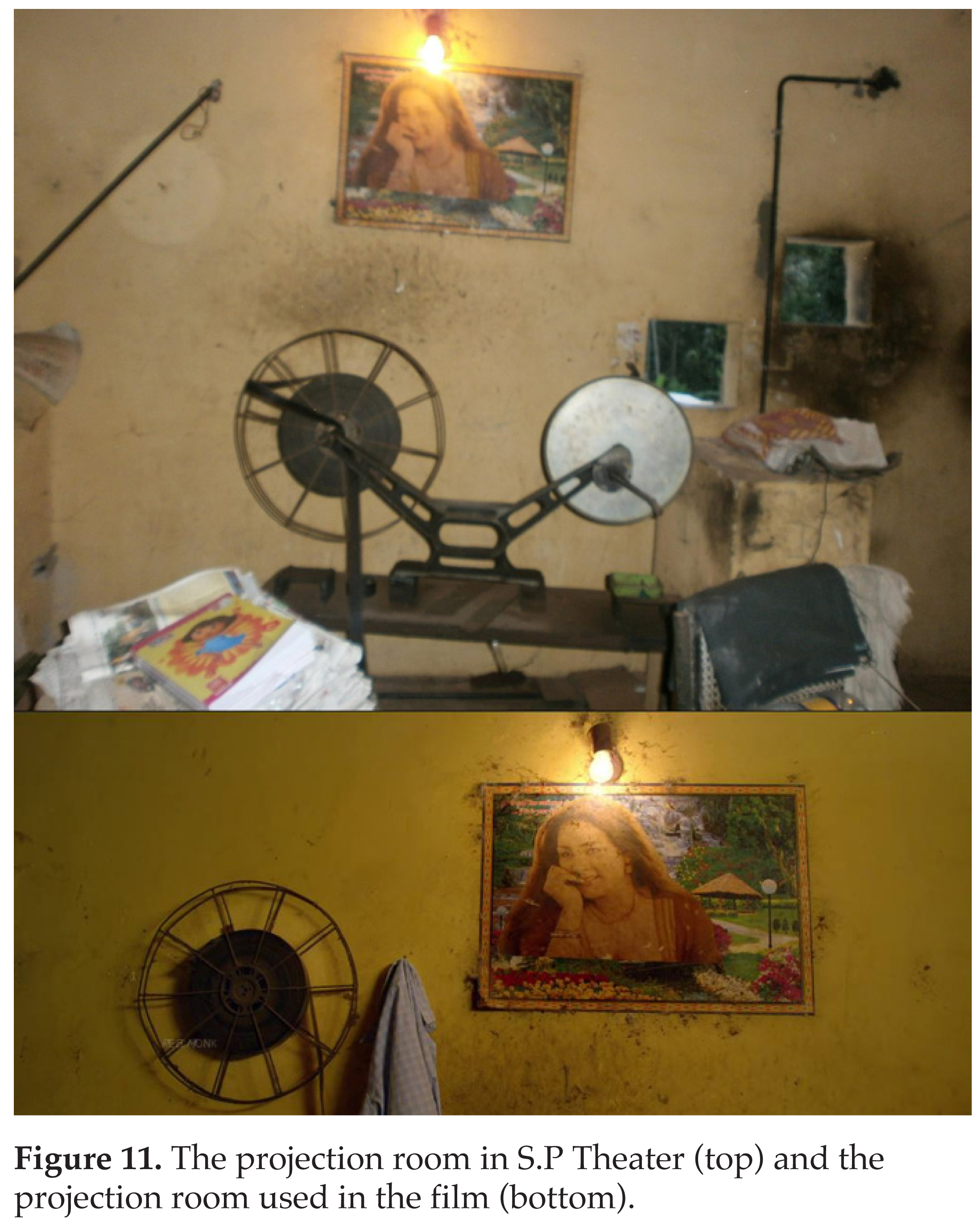
While Kanyaka Talkies provides an important segue into the discussion of the recently deceased spaces of soft-porn exhibition, the case of S.P. Theater, a theater that had a history of screening soft-porn films, perhaps offers us a close “non-fiction” equivalent. While Kanyaka Talkies sutures its account of the fate of the soft-porn theaters through references to “real” theater spaces, it is the interior of the space of S.P. Theater in the locality of Peyad in Trivandrum that stood in for the soft-porn theater in the film (see Figure 11). The film prominently uses the projection equipment and the projection room at S.P. Theater as a trace of the “real” space, even though the previous history of the theater has uncanny resemblances to the plot of Kanyaka Talkies in many ways. Even though, I had extended conversations with the director about the nitty-gritties involved in conceptualizing the film, the presence of S.P. Theater in the film was not foregrounded much. It was a passing reference by Jayesh L.R., the production executive of Kanyaka Talkies, that drew my attention to the real theater space in which the film was shot. Even though S.P. Theater finds mention in the closing credits as a shooting location, the crucial significance that the space of the theater had in the overall film was never foregrounded in publicity or otherwise. Reminiscing about the shoot at the theater, Jayesh recounts:
Except a few production people, the technicians and the cast had no clue about the history of the “real” soft-porn theater that was our shooting site. But, as the time progressed we were fascinated by the accounts from the residents nearby. Some of them even thought that the story of the film was inspired by the theatre. It was indeed true that Shakeela films were part and parcel of the film culture of Peyad, and at one point S.P. Theater was jokingly referred to as being located in Shakeela junction.The projection room in S.P Theater (top) and the projection room used in the film (bottom).
When S.P. Theater started off in 1980, it catered to family audiences. There were even instances when it doubled as a place of religious congregation. Prominent devotional films were re-released in S.P. Theater when it was started, including Snapaka Yohannan (Directed by P. Subramanyam, 1963), which was based on a Biblical tale and Swamy Ayyappan (Directed by P. Subramanyam, 1975), based on the Hindu deity Ayyappan. Both films invited religious devotees and the theater became a site of much worship and prayer. As the first theater in the locality of Peyad and with no theaters in the vicinity for the next 10 years, Gladys, the theater owner, reaped enough profits to stop renting projectors and buy his own equipment. Like the fictional “Kanyaka Talkies,” it was the crisis of the 1990s that forced Gladys to start screening soft-porn.
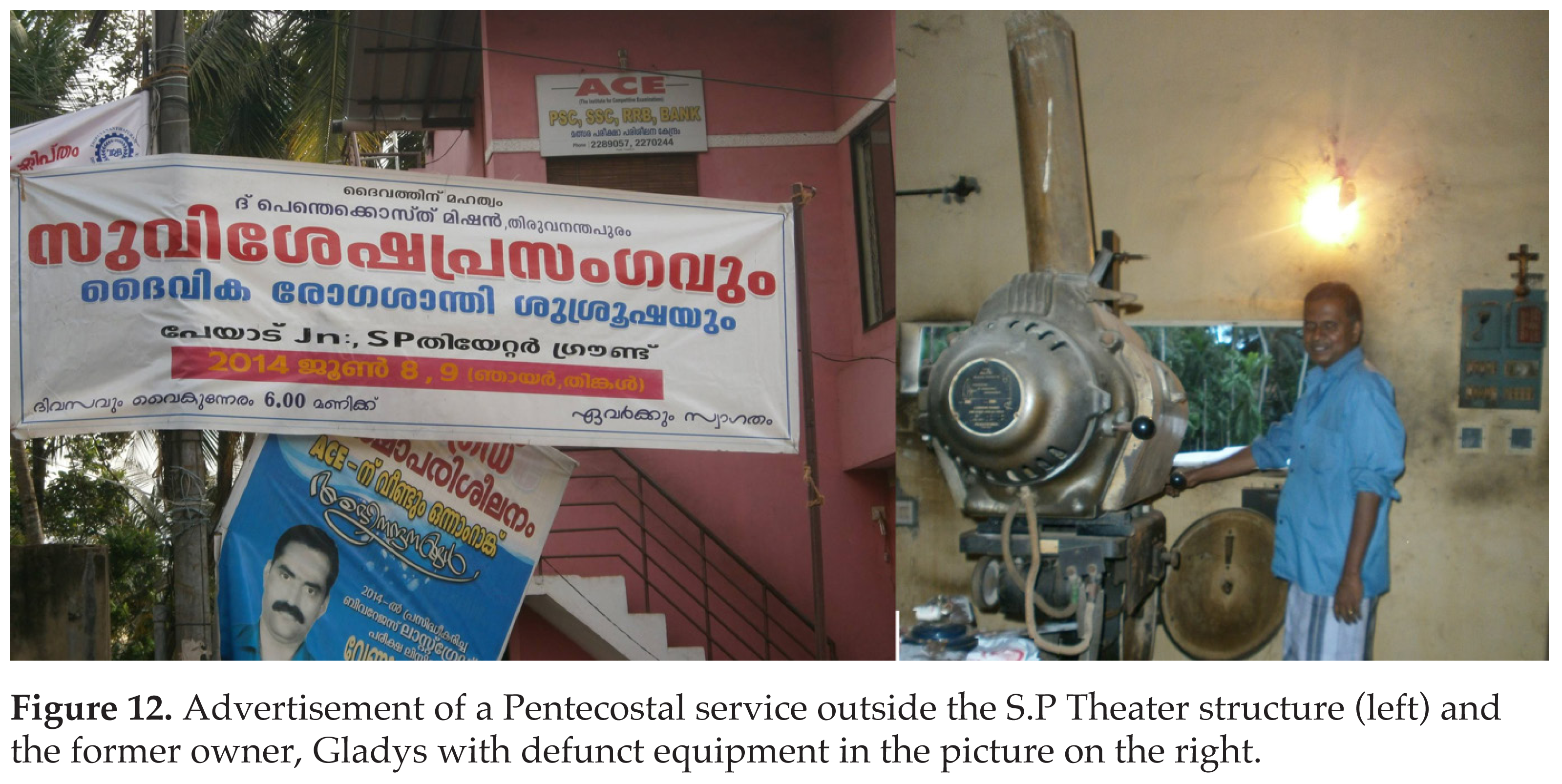
When I visited S.P. Theater in June 2014, I was surprised to see that the space had become a venue for a Pentecostal prayer service (see Figure 12). The devotees comprising men, women, and children wearing white dresses and carrying Bibles were certainly surprised to have an intruder entering the sacrosanct space. When I was asked about the purpose of my visit, I thought it to be only wise and strategic not to share with them my “not-so-pure” intentions, which involved tracking the history of a theater that had been cheekily called a “sperm bank.”
27
There is thus, a strange way in which the “real” space of S.P. Theater seemed to mirror the fate of the “fictional” theater in Kanyaka Talkies—both becoming spaces of religious congregation. It is perhaps fitting then, that the narrative of Kanyaka Talkies deals with an “exorcism” of the suppressed ghosts of the soft-porn years. If the theater in the film became a haunted space where the specters of actresses past screamed out to the living, the actual space of S.P. Theater was home to a slightly different form of haunting, as the theater closed to the public shortly after the shoot of Kanyaka Talkies, on June 18, 2013. At a time of declining popularity of soft-porn, S.P. Theater had proved to be a resilient force. While the majority of “Shakeela camps” (theaters which screened Shakeela films) either came “clean” and began to screen mainstream films or convert to marriage halls, S.P. Theater retained its tag as a “soft-porn theater” and survived for a good 10 years. The demands for upgradation to digital format wiped out the remaining B and C circuit theaters, but S.P. Theater continued to cater to regular customers until 2013 without going digital. Till it was shut, S.P. Theater remained the only theater where older soft-porn films were projected, with a large number of patrons visiting it out of sheer nostalgia. Apart from being a favorite hangout of male film-goers, it was also a part of the local hub of entertainment for many regular patrons of the theater. Many recounted the presence of a road-side tea shop which sprung up after the theater became a hot spot to cater to the crowd during the “interval,” the short break of five minutes. In fact, both the interval’s interruption of the narrative, and the splicing in of the erotic “cut-piece” were carefully calibrated to suit both the projectionist and the tea stall owner. Since most films screened at S.P. Theater were only of one and a half hour duration unlike the mainstream feature film length of two and a half hours, it was the projectionist who decided when to break for the five-minute interval. Nanukuttan, who had run the canteen for S.P. Theater for more than 20 years, narrated how he had to poke the projectionist to remind him of the “interval”:
The canteen was on the side of the exit door and diametrically opposite to the projectionist’s room. I was in one way the link between the projectionist and the audience. I waited for the jeers and hoots from the audience demanding thundu (cut-piece), some of whom would come to the canteen to whine about the repetition of the film of the same type and lack of interesting stories.
28
Advertisement of a Pentecostal service outside the S.P Theater structure (left) and the former owner, Gladys with defunct equipment in the picture on the right.
Nanukuttan’s intervention on behalf of the audience might not always translate as a fruitful one as the insertion of thundu was not after all an arbitrary exercise, but a carefully planned one. Speaking about old times, Vasu, one of the apprentices who was perceived as the cut-piece expert among the B circuit cinemas, said:
It is the projectionist who has the final say as to when and where thundu could be spliced in. He has to be good at his job, and inserting/splicing isn’t as mechanical as people might think. We try various options to achieve an effect on the viewers, sometimes really whacky ones.
29
The location of S.P. Theater in the outskirts of the city had helped Gladys get substantial returns from the sale of tickets. The theater came under B circuit classification, which meant the entertainment tax slab was much lower than the A center theaters. Balcony and front circles cost ₹10 and ₹7, respectively. Augmented by the profit-sharing arrangements forged with the distributors, the business was a lucrative one. For Gladys the day when the theater was shut down remains still fresh in his memory. He recounts:
While I knew all along that like all clandestine deals, this also has to come to an end, it was difficult to think of a day when I would wind it up for good. On June 18, 2013, when the decision was taken to wind up my business, I decided not to mourn the parting, but to make the last day of the theater an eventful one. The evening show was shown free and I invited my regular viewers to participate. I still have the last entry of the collection and the ticket stubs.
30
My encounter with Gladys was a crucial moment in my research as he was one of my few respondents who were willing to take me down the memory lane of the time when soft-porn flourished in Kerala. Methodologically, this was crucial as the veil of anonymity cast over such productions made any attempts to find the “real” personnel behind the making and distribution of these films, next to impossible. Barring a few prominent directors and some actresses such as Shakeela, Reshma, and Maria, the arena of soft-porn cinema was flooded by pseudonyms or names of “lost” or disappeared actresses. In spite of the availability of many of these films in DVD format and uploads in many media-sharing sites and even sites exclusively meant for Malayalam pornography, there is a strange way in which the details of the production, including the technicians, production banner, and even the shooting locations are hard to come by. Curiously, for a form that was so popular, references to my object of study were everywhere and nowhere at the same time: soft-porn as a form is predisposed to spectrality. But, what has been interesting in my interactions with Gladys is how we reconnected with many technicians, distributors, and exhibitors whom both of us had known at different points in time. Sharing memories and information, we found, uncannily, as in the manner of a play with shadows and mirrors, that some of Gladys’ close associates were also my respondents. It was through Gladys and the connections he had, that I could put together the last piece of the puzzle of their careers. Gladys became excited when I showed him my field diaries, in which I had sketched rough diagrams to link what appeared to be disparate connections. The recollections set in motion by my own research triggered a moment of remembrance for Gladys as he revisited his stint with soft-porn. In turn, a register of collective remembrance emerged, when Gladys invited a few people from the locality of Peyad to share their recollection of the heydays of the theater. While many of them remember how S.P. Theater was a vibrant space where local men gathered for chit-chat, others evoked their viewing experience through interesting anecdotes of the cinema’s exhibition practices. Even after the cinema’s closure, there were times when men who visited the locality of Peyad, made a stop-over at the theater to “breathe the air of the old times.” 31 Therefore, despite its metamorphosis into a prayer-hall, the built structure of S.P. Theater continues to haunt its patrons, conjuring up memories of another time, when the space was emblematic of a thriving cinematic culture.
Conclusion
When I met Gladys in the beginning, we were both ignorant of the intersecting histories that connected us. Gladys had no clue that the plot-line of Kanyaka Talkies that was shot in his theater shared close similarity to the history of many theaters of the time, including his. On seeing the photograph of Shakeela in the projection room, I initially thought that the photo was a remnant that was left hanging after the film shoot, especially since it was prominently used as a publicity material for Kanyaka Talkies. When asked whether this was part of the production design of the film, Gladys sent for his son to get a photo-album that showcased the varied phases of the theater. One of the photographs that had the same Shakeela image was taken in the 1990s, something that Gladys referred to as his “Shakeela phase.” Gladys showed me this photograph as evidence that proved that the Shakeela image was part of the theater’s topography for a long time. However, it was his use of the phrase “Shakeela phase” that struck me the most, especially as a suggestive remark on the spectrality of soft-porn. S.P. Theater no longer screens soft-porn, but the history of the theater signified in that image will be retained even when the same space will be converted to the wedding hall. 32 The physical space of S.P. Theater then itself begins to take the form of a palimpsest with multiple layers of use, motivation, and experience etched into its skin. Curiously it is not the spatialization of time that is at work here as in the homogenous notion of time, but a temporalization of space that harks back to the Bergsonian notion of a duration that gnaws into the present. In conclusion, there are perhaps two senses in which the duration of soft-porn is spectral. First, being always everywhere and nowhere, buried beneath the surface of a “respectable” film history, soft-porn cinema’s predilection to anonymity and disappearance makes it fertile ground for the release of spectral images in its afterlife. And second, as a form that is recently deceased, the residue of soft-porn culture in the contemporary haunts Malayali public culture in a sort of a phantom-porn syndrome, whose spirit is conjured up both in recent debates and controversies around obscenity (as, for instance, in the case of the recent reality TV show Malayalee House which was likened to a “Shakeela Film”) and in the discussions around the actual spaces of screening. To be sure, in both these sense, there is a specter truly haunting Malayalam film history—the specter of soft-porn cinema.