







Abstract
This article is a report and a reflection on the events and interventions in the Telugu film and media world after the 2018 #MeToo movement. It uses the conceptual frame of the “intervention” to gather together different initiatives—legal, professional and artistic—that are attempting to change the ethics and aesthetics of the film industry. It draws attention to the work of the Voice of Women (VOW) collective that is calling for systemic and concrete changes in the industry to tackle sexism and misogyny. In a different section, the article focuses on the work of actor and VOW member Jhansi, discussing, in particular, a satirical play, Tit for Tat, written and directed by her. The article concludes that the interventions being made in this particular conjuncture are without guarantees but are definitely shifting the terms of the debate even if it is slowly and slightly.
An intervention is simultaneously a political and intellectual act. It can be individual or collective. It is undertaken with intent, with consciousness of context and possible outcomes and from a specific institutional and cultural position. It is itself theorised though it may not appear to be. Interventions have expiration dates and while they can move from place to place, they are never universally applicable. They are conjunctural. Interventions do not come with guarantees.
(Jonathan Sterne, 2018, ‘What is an intervention?’)
The #MeToo Problem Continues
At the time of writing this article, a major controversy created by senior Telugu actor Sivaji’s comments about women’s dressing and decency is still generating heat and dust. It has even drawn the attention of the national media and comments, statements and counter-statements are still being issued.
In the course of his speech at a pre-release promotional event of his film, Dandora, Sivaji complimented his co-actor, Bindu Madhavi, for being decently dressed in a saree and then proceeded to warn women in the film industry that they should wear sarees or other decent clothes that cover their bodies properly if they want to be respected. He said they should not display their saamaanlu (can be translated loosely as ‘physical assets’ in English) as he gestured towards the bosom area. He proceeded to use an abusive term to describe what he thinks of women who dress in this ‘objectionable’ fashion. These comments immediately went viral in the media and provoked heated debates, criticisms and condemnations, as well as statements of support for the actor.
Media Trials and Legal Interventions
On the legal front, Sivaji was summoned by the Telangana State Women’s Commission, which took suo motu cognisance of his statements as ‘derogatory’ and that they ‘prima facie suggested an intention to defame women in society’. He appeared before the Commission and ‘apologized’ for his comments. In news reports, the Commission is quoted as stating that not only did Sivaji agree to withdraw his comments entirely, but he also promised to work towards incorporating changes in his future films as per the Women’s Commission’s suggestions. It was also reported that the panel that conducted his personal enquiry used the occasion to flag the prevalence of sexual harassment and the casting couch in the Telugu film industry and stated that public figures have a responsibility to speak out about these issues. It also advised that producers and directors should be more mindful of portrayals of women on screen. 1
However, in a press meet soon after his ‘apology’, Sivaji remarked that while he regrets the fact that he used some objectionable words, he stands by what he described as ‘well-intentioned’ and ‘sensible’ advice to female actors. Referring to an incident where the actor, Nidhhi Agarwal, was mobbed at a film promotional event in Hyderabad, he proceeded to assert that had his caution been heeded, such an incident would not have occurred. The Hyderabad police thankfully took a different view and registered a suo motu case against the management of the Mall and the organisers for not taking prior police permission and for failing to make proper security arrangements. They described the actor’s ordeal as a ‘distressing encounter with an uncontrollable crowd’. Sivaji, of course, suggested that it was her ‘indecent clothing’ that was the principal cause.
In the same statement, Sivaji also mentioned the well-known Telugu film and TV actor, Anasuya, who strongly disagreed with his views in answer to a journalist’s question. Anasuya asserted that women should have the freedom to wear the clothes they wished to wear. Soon, several social media channels used these statements to create ‘news items’ where they began circulating highly sexualised selective images of the actress. What followed was an intense online attack and abuse, mostly by men but also by some women. The sensational and concerted attack on Anasuya reduced the issue to a fight between two individuals – Sivaji, who is, after all, only giving good advice to women for their own safety, and Anasuya, who indulges in a gratuitous and hyper-sexualised display of her body in public. Familiar tropes of misogyny and patriarchal discourse were regurgitated: ‘Men are lustful by nature, they cannot help themselves; it is up to the women to keep their bodies hidden and safe’. ‘Modestly covered bodies will evoke respect, whereas display of half-naked female bodies is bound to excite and arouse men and provoke them into sexual harassment and even rape’. Supporters of individual freedom and choice are pitted against supporters of respectability, tradition and customs.
Sivajai’s comments and the events that followed reminded the public (at least some sections of it) about the long-standing, and as-yet-unresolved, issues of pervasive misogyny, gender discrimination, pay gap, normalised sexual harassment and sexual and economic exploitation of women, especially those in the lower rungs of the industry. These issues came to the fore in 2018, when the #MeToo movement gathered force in the Telugu film industry. 2 Following the sustained efforts of women fighting within the film industry and feminist activists in Hyderabad, including a PIL filed in the High Court, the Telangana government had, at that point, appointed a high-level committee to enquire into these structural issues in the film industry. After four years of work, this committee submitted its report to the government in 2022. However, the government has not yet made the report public. Following the release of the Hema Committee Report on the Malayalam film industry in August 2024, many women’s groups, including the Voice of Women (VOW) Telugu Film Industry (TFI), demanded that the Telangana government release the report on the Telugu film industry, but the government has not yet responded to this demand.
A Collective Intervention: Voice of Women in the Telugu Film Industry
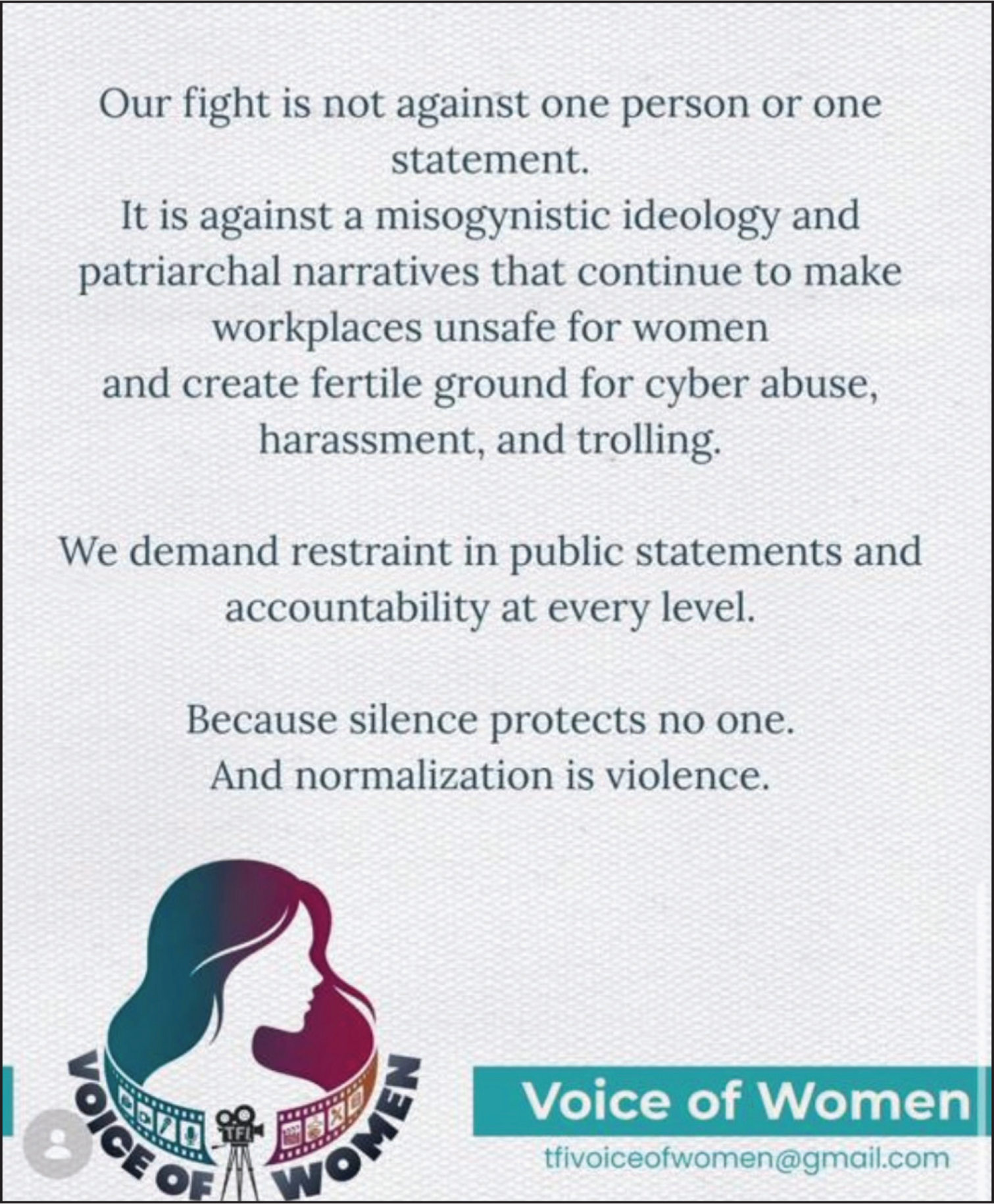
Among the many statements that were issued following Sivaji’s remarks, a prominent one was by the VOW, TFI. The group, formed in 2018, describes itself as ‘a professional network and support collective for women in the Telugu cinema and allied media’. One of their posts on Instagram states (Figure 1):
Our fight is not against one person or one statement. It is against a misogynistic ideology and patriarchal narratives that continue to make workplaces unsafe for women and create fertile ground for cyber abuse, harassment, and trolling. We demand restraint in public statements and accountability at every level. Because silence protects no one and normalization is violence.
Statement released by the Telugu Film Industry (TFI) Voice of Women group on Instagram in 2025.
In a clear and powerfully articulated open letter to the Telugu Movie Artists Association, Voice of Women presented a four-point charter calling for concrete, systemic action. The demands include:
(i) a formal code of conduct prohibiting misogynistic and sexist statements by members with defined consequences, (ii) safety protocols to ensure security and crowd control for women artists at public events, (iii) mandatory gender awareness programmes for all industry stakeholders, and (iv) a public statement affirming that women’s safety, autonomy, and dignity are non-negotiable.
The letter also argues that ‘Shaming women while ignoring harassment only normalizes control and violence. An industry that thrives on glamour and visibility cannot abdicate responsibility when the same visibility puts women at risk’.
VOW, which includes over 100 women who work in different capacities in the industry, has gradually emerged as a space for women to voice, discuss and debate various issues related to their professional lives in the film industry. Some of the prominent members of this group are Director Nandini Reddy, Producers Swapna Dutt and Supriya Yarlagadda and actors such as Jhansi Lakshmi, Samantha Ruth Prabhu, Anushka Shetty and Lakshmi Manchu. According to Jhansi, who is an active member of the group, VOW has succeeded in creating a platform where women offer professional advice and tips to each other, support each other’s ventures in film production through the sharing of information and offering different kinds of support. Jhansi added that there have been instances where VOW has helped resolve problems such as non-payment of remuneration. In addition, it supports women who come forward with complaints of sexual harassment and exploitation. The support ranges from emotional support and a sense of solidarity to legal help. Jhansi remarked that while high-profile cases of harassment and rape that lead to police arrests, like that of the choreographer Jani Master, make media headlines for a brief period (Nyayapati, 2024), the patriarchal work culture that dominates the industry and fosters and normalises such crimes can be tackled only through continuing the fight for long-term structural changes. By asserting their presence and claiming a space in positions of power within the industry, Voice of Women hopes to create an industry that allows women to work in a safe and secure environment that will help them realise their full potential.
*****
The remainder of this article will concentrate on Jhansi’s career and work, for a variety of reasons. First, it allows us to grasp some aspects about the larger context and the nature of the contested time and space that is the TFI today. Second, it shifts focus away from major media events like the Sivaji comments’ controversy, which was discussed at length in the first section. It points towards small cinema and other public media like television and theatre, in which an oppositional and critical discourse about gender has been taking shape over a long period of time.
Ethical and Professional Interventions
In 2018, Jhansi played one of the lead characters in a low-budget indie film, Mallesham, which was one of the early Telangana films made after the formation of the state in 2014. Written, directed and produced by debutant Raj Rachakonda, the film is a biopic of the weaver-innovator Chintakindi Mallesham, who won the Padmashree Award for his invention, the Lakshmi Asu machine, which reduced the manual labour of women weavers in the Pochampally region. Jhansi played the role of the mother, Lakshmi, who inspired Mallesham to invent the Asu machine.
In the wake of the #MeToo movement in the TFI, the producers of the film decided to take concrete steps to create a safe working space for women and to prevent any form of sexual harassment during its production. The entire cast and crew signed contracts with a clause that warned them against sexual misconduct. In an interview given at that time, Jhansi remarked:
It’s one thing to give verbal assurance that women will have a safe workplace and a different thing to put it in writing. As per the contract, anyone guilty of sexual misconduct will have to exit the project and compensate for the loss incurred. The contract warned against giving and receiving sexual favors. It’s a brave step.
There does not seem to be much evidence to say that this model was followed by other indie film productions, let alone medium- and big-budget Telugu films. But we do know that in the recent case of allegations of sexual abuse against Jani Master, the Telugu Film Chamber of Commerce issued a statement that the case was referred to its sexual harassment redressal panel. Further, the Internal Complaints Committee will conduct the enquiry as per the guidelines of the Prevention of Sexual Harassment Act 2013. 3
Sexual harassment cases entering the realm of the law do not guarantee conviction of the abuser, let alone any guarantee of compensation to the survivor of the abuse. There is no guarantee that justice, however one might define it, will be delivered. However, the patriarchal and hierarchical social order of the TFI is being forced to acknowledge and confront challenges to its established power structures. There seems to be a greater push towards more formal and contract-bound work cultures.
Aesthetic Interventions: Staging Tit for Tat
In October 2023, Jhansi staged a play titled Tit for Tat, which she wrote and directed, besides playing one of the characters as well. The play, which had a large cast of fourteen actors, was mostly in Telugu with substantial portions of dialogue in English and Hindi too (Figure 2). Addressing mainly a Hyderabadi audience familiar with Telugu cinema, Tit for Tat is both developing a critique of popular discourses of gender and opening a space for conversations around taboo topics. By positioning herself both as an insider to the film industry and as an outsider who has one foot in the world of television and theatre, Jhansi is able to deftly use brilliant humour and razor-sharp satire to raise questions about how women’s bodies are represented in popular culture, especially Telugu commercial cinema. With some minor changes in the script and a few changes in the cast and crew, the play was once again staged on 12 January 2025.
Poster for the play Tit for Tat written and directed by well-known actor Jhansi who is also an active member of TFI VOW. The play was staged first in 2023 and again in 2025.
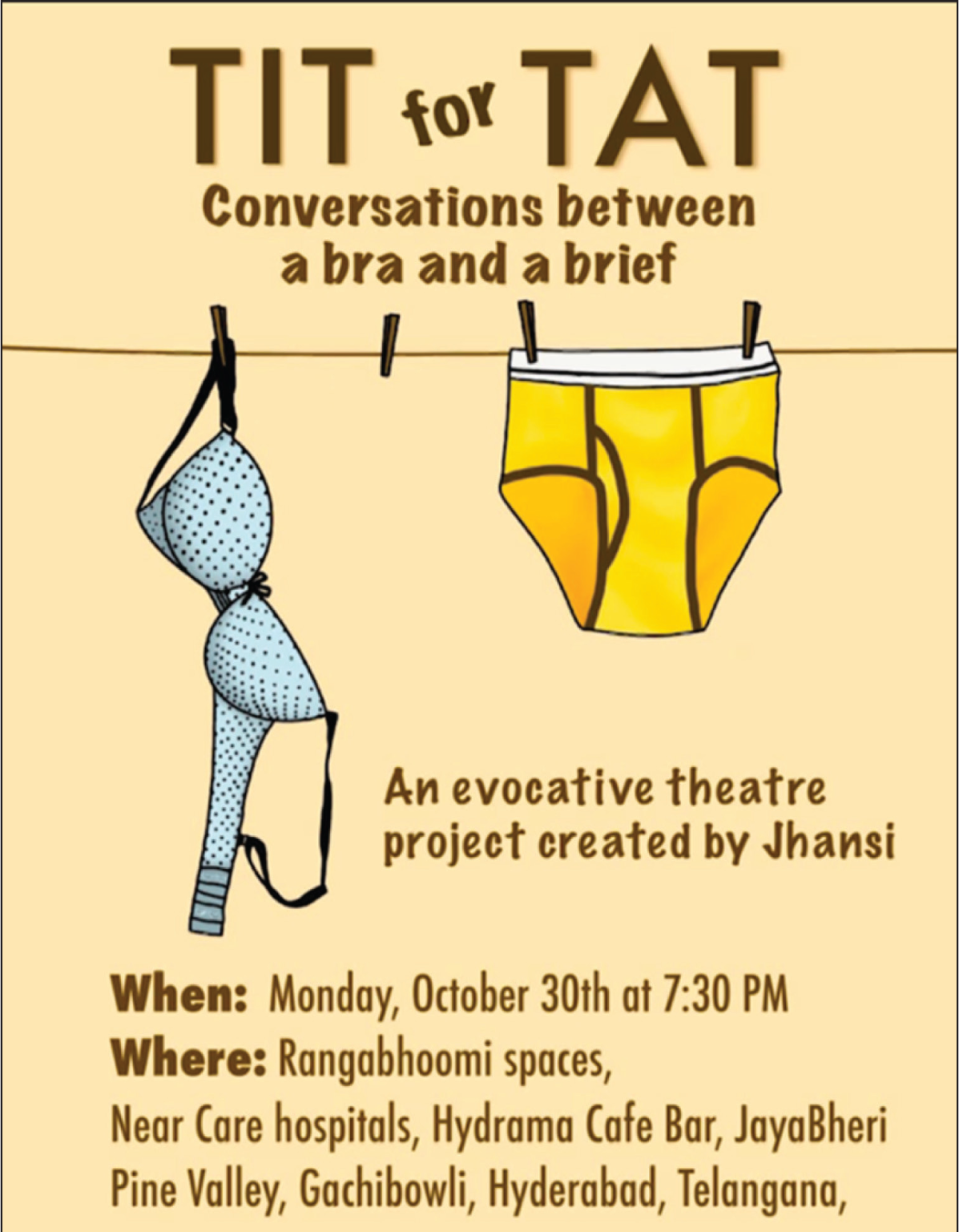
Advertised as a conversation between a bra and a brief, the play introduces two characters, one female, Tit, representing breasts, and one male, Tat, representing the penis. They begin a dialogue about their respective predicaments, given the social and cultural expectations and pressures that weigh heavily on each of them. Performing the role of sutradhars, these two characters question, criticise and challenge each other and the audience watching the play. As their dialogue progresses, they invite more characters onto the stage to serve as illustrations for the arguments they are making. A train of female and male characters makes their entry onto the stage at regular intervals to add one new voice and one more perspective to create a polyphony on stage. Among the female characters are Auntyji, a middle-aged conservative woman who wants women to uphold traditional values; Baby, a teenager who is confused and frustrated that neither her biology textbook nor the people around her are able to adequately answer all her questions about men, women, their bodies and their relationships; Mili, an urban working woman who values her freedom to dress and live as she pleases; Chinni, a big-bosomed woman who is constantly struggling to fit into society’s ideal of the perfect woman’s body; Dolly, a glamorous actress who is a popular commercial film star; Jwala, a leftist women’s rights activist who fiercely opposes exploitation and insists on freedom; and Harshini, a transwoman who has undergone gender reassignment surgeries to overcome gender dysphoria. Among the male characters are Uttam Manav, a respectable, responsible middle-class man immersed in his career and who intermittently protests that ‘not all men are misogynistic’; Tom Harry, an upper caste-class tall, fair man who believes he is a sophisticated and irresistible hero; his sidekick is Mahboob, shorter, darker and well-rounded, who worships Tom and whose only desire is to join the Bhai club and be a worthy acolyte; Indra the film director who has made a successful career of ‘selling fruits on screen’, that is, displaying fulsome female bosoms and hips (a clear reference to 1980s and 1990s commercial film director Raghavendra Rao and others like him); and finally Bro, a transman who challenges all the stereotypes about masculinity.
The play makes effective use of popular film songs to illustrate the offensive stereotypes of women and their bodies created and circulated by the film industry. As loud laughter greets the introduction of one popular song after another, there is also an uneasy acknowledgement of what was (and is) collectively enjoyed as love, romance and sexual attraction on the cinema screen. Although the play relies heavily on character types and many of these types are rendered in very broad strokes, almost caricatures, it manages to offer a different kind of entertainment – one where the theatre audience is invited to reflect on and participate in a conversation about social and cultural assumptions about gender roles, sexuality and desire.
In an interview with Sangeeta Devi Dundoo (2025), Jhansi said, ‘I look at theater as a forum for social debate. Censorship, money, and other market factors govern cinema which has primarily become a medium of entertainment. I intend to use the theater to break the silence on certain gender issues’. After the two performances, Jhansi is trying to organise more performances of the play in universities and colleges across the Telugu states. She hopes the play will be a pretext for debates and discussions among young people. However, each performance of the play demands a lot of time, energy and effort from the cast and crew, besides a substantial amount of financial expenses. And monetary support and spaces for performance are not easy to find.
*****
It must also be noted that Jhansi had a significantly long career in television as the anchor of an important women’s show called Naveena, which was aired for nearly 17 years, starting from 2006 on the popular private TV channel, TV9. Unlike many other ‘women’s’ TV shows of the time, Naveena did not promote fun or entertainment as its main goal. As the producer of the show, Shital Morjaria remarked, ‘I knew [from the very beginning] the show would have no cooking, no jewelry, and no interior design. It was to be a show on real issues’. One of the first issues taken up in the show was an investigative report about an Ayurveda doctor performing illegal sterilization procedures on women in the Medak district. Over the years, Naveena became a forum where a range of serious issues affecting women, both urban and rural, were taken up for debate and discussion. Apart from more acceptable issues like health and education, Naveena also featured controversial topics such as marital rape, queer sexuality and issues facing transgender people. 4 Although Naveena is no longer aired, it was undoubtedly an influential show that reshaped popular public discourse on questions of gender and must be acknowledged as a precursor to current critical thinking in the Telugu public domain.
*****
Following a genealogical mode, this report of recent events in the TFI is necessarily fragmentary, as it covers contemporary and still unfolding events. Therefore, the narrative presented here is necessarily tentative, non-linear and open-ended. It is a record of recent interventions of different kinds, all without guarantees but definitely trying hard to reshape the ethics and aesthetics of the film industry.
Footnotes
Acknowledgements
I am grateful to actor Jhansi for readily agreeing to meet me for a long conversation on her individual work and that of Voice of Women, TFI. I also thank her for sharing the poster for Tit for Tat used in this article. Thanks also to K. Sajaya and Vasudha Nagaraj for ongoing conversations on the #MeToo issues as well as broader issues related to gender and contemporary society. And special thanks to Juveria Asif for help with formatting this article. I have no known conflict of interest to disclose.
Declaration of Conflicting Interests
The author declared no potential conflicts of interest with respect to the research, authorship and/or publication of this article.
Funding
The author received no financial support for the research, authorship and/or publication of this article.