







Abstract
This article explores how unions self-organise in response to the shifting social and economic landscape of the present times. It takes up the case of a union in Bollywood, the Association of Cine and television Art Directors and Costume Designers (ACTADCD), to examine how it constitutes itself in process. In doing so, this article explores the history of the union and two episodes of its coming together in the recent past: the 2017 multi-union strike outside the film studio complex, Filmcity in Goregaon, Mumbai and the first Art and Costume exhibition in 2019 at The Bombay Art Society art gallery of Bandra.
Introduction
Mumbai, where Hindi cinema took shape and where much of its production, workforce and celebrity life remain concentrated, has a long history of unionism.1,2 From the time of the militant Bombay Mill Workers of the 1920s to the 1980s, from when the Left and Congress political associations facilitated unions in textile and engineering industries, Mumbai’s labour terrain has significantly shifted. As manufacturing declined, union influence shifted towards municipal and transport sectors under the Shiv Sena and later the Sena–Bharatiya Janta Party (BJP) alliance, reshaping working-class politics through regional populism and political patronage (Chandavarkar, 1998; Lele, 1995; Mhaskar, 2012). Thereafter, with the expansion of service and cultural industries, unionism itself reorganised around dispersed sites of production and new forms of political patronage (Mezzadri, 2017). The organisation of Hindi cinema’s art and costume workers arises within this changing labour landscape. 3
Bollywood unions function as craft communities that seek recognition and voice in a project-based industry. 4 Operating without the industrial infrastructure or collective frameworks available to formal sectors, they also act as brokers and contractors mediating between workers, producers and the unstable rhythms of film production. Unlike factory-based unions, Bollywood’s craft associations are not anchored in a single site of production or a shared employer. In what is conventionally imagined as an industry, where products and skills are standardised, film work thrives on continual reinvention. Here, innovation becomes the workers’ currency in an unpredictable economy of projects and deadlines. Unions are organised by craft – art directors and costume designers, sound engineers, stunt artists, background dancers, among others – and draw their strength from recognition, reputation and negotiated visibility rather than from collective bargaining alone.
Scholarship also reflects a shift in the late twentieth century, as it moves from labour-process analysis towards the study of labour movements within the field of economic sociology. It notes a crisis rather than growing unionism. Union formation, it has been argued, has increasingly become transformed into a space of reimagination because of industrial restructuring, and not because of class consolidation (Burawoy, 2008). The art and costume department of Bollywood, ACTADCD, exemplifies this shift. It operates in the gaps of typical industrial labour regulation, through regional linguistic affinities, gendered determination and aesthetic value regimes – all of these in varying social contexts, signalling how new solidarities and the politics of it are forged in conditions where classical trade union models do not obtain. 5
ACTADCD: A Bollywood Union
ACTADCD’s trajectory illustrates not the replacement of old union models but their fragmentation and recomposition under conditions of informality and brokerage. Solidarity, though, is episodic and affective rather than structural. Historically, unions emerged from the consolidation of industrial workforces, institutionalised bargaining frameworks and class-based solidarities. However, unions are not merely legal entities or historical remnants; they are processes of association, visibility and claim-making that respond to specific configurations of labour, capital and state. In this context, to ask what a union is, is also to ask how solidarity is reassembled when the shop floor is replaced by the project or the gig, the factory by freelance network and permanent employment by organised informality.
Cinema was recognised as an ‘industry’ by the Indian government in 1998. The measure was presented as an initiative to promote liberalisation, eliminate black money and enhance access to institutional credit. However, in practice, it served to further strengthen the position of established producer networks and film families, a history that cannot find elaboration here. For most workers, the change hardly meant anything. The everyday organisation of work through unofficial contracts, verbal negotiations and overlapping patronage ties continued as before.
Each film is organised as a temporary project, bringing together a changing group of technicians and craftspeople under short-term arrangements. The product itself is not standardised but assembled anew each time. Cinema, therefore, fits uneasily within the category of ‘industry’. Yet its participants continue to seek the legitimacy that such recognition offers: access to credit, visibility before the state and a language of professionalism through which they can claim place and value in the national economy. This instability also accounts for a broader postcolonial problem identified by Ashish Rajadhyaksha (2014), drawing on Chandavarkar, namely that dominant understandings of ‘industry’, derived from Western European historical trajectories, sit uneasily with non-Western economic formations, where industrialisation unfolds unevenly and without ever fully congealing. It is in this sense that Bollywood’s ‘industry’ can be seen as a process/becoming rather than a settled category. If ‘industry’ is unstable and in formation, then ‘union’ too must be understood not as a static form but a deterritorialisation, a collective asserting visibility, especially now when employment and legal protections for the same are constantly in flux.
History of ACTADCD
Established in 1975 and formally registered under the Trade Unions Act of 1926, ACTADCD functions more like a craft guild or association as opposed to a classical trade union unit, navigating the processes of unionhood through shifting socio-economic and political regimes. Craft guilds/associations need not start out as official unions. However, ACTADCD’s eventual incorporation into formal unionism illustrates how such bodies may evolve into unions over time, particularly in response to growing dysfunctionalities, shifting regimes and the need for institutional legitimacy. Opender Chanana (2011) traces the beginnings of unions in the film industry to Bengal in 1948, with the Cine Technicians Association of Bengal. Around the same time, associations emerged in Bombay and Madras, registered under the Societies Registration Act, 1860. In Bombay, this was the Association of Cine Technicians of India, and in Madras, the Association of Cine Technicians of South India. Because they were not registered under the Trade Union Act of 1926, these associations had no legal scope to settle industrial/labour disputes. Employers discouraged their staff from joining, and many technicians considered themselves ‘too emancipated’ to identify as workers (Chanana, 2011).
A turning point came with the formation of the Federation of Western India Cine Employees (FWICE) in the mid to late 1950s in Mumbai, which brought together different craft-based associations under one umbrella, including the ACTADCD. The number of craft associations within FWICE then, still debated, was considered around seven. FWICE, the mother body brought the craft associations in coalition with unions of dubbing artists, bouncers, art directors, costume designers, etc. Its origins could be traced back to a 1954 meeting at the Film Writers’ Association, with formal registration under the Trade Unions Act of 1926 occurring a few years later. While the exact year of its founding remains debated (some citing 1956, others 1958), FWICE gradually grew to include over 31 affiliated associations. Costume designers – many of them women – were only formally admitted into ACTADCD in 2014–2015, decades after the union’s formation. Prior to this, they faced exclusion from the older Cine Costume Make-up Artists and Hairdressers Union (1955), and many worked under informal arrangements, sometimes in secrecy.
However, the process of being a union continued to diverge from the traditional forms of unionism in India. Membership, wage rates and conditions of work, for example, are regulated through memorandums of understanding between unions and producers’ bodies. However, Opender Chanana (2011) argues that their early reluctance to embrace activism weakened their ability to secure rights in the long run. 6 Unlike unions in other industries, which used strikes and demonstrations to push for recognition, Bollywood unions have often shied away from aggressive mobilisation. This legacy of cautiousness, it is claimed, shaped the limited protection workers have today (Chanana, 2011). To work in the film industry, one must obtain a union card – whether as an artist, technician or craft worker. Membership fees vary by union and position. In the late 1990s, lifetime registration cost around ₹2,000, plus annual renewal. Today, fees for a lifetime range from ₹25,000 to ₹100,000, depending on one’s rank in the hierarchy. 7 While the unions cannot guarantee regular employment, they provide certain entitlements such as educational aid, script registration and financial support to families of deceased members. They also mediate disputes over wages, working hours and travel allowances and authorise promotions through internal examinations and re-registration. 8
Social Composition and Inter-union Labour Relations
While ACTADCD is the official union for art directors and costume designers, their work is deeply tied to the labour of the Film Studio Setting & Allied Mazdoor Union (FSSAMU) members – carpenters, painters, moulders and workers from other departments like lighting. Operating within the larger structure of FWICE, their working relationship is built on collaboration and hierarchy. Production designers or art directors bring the vision, often arriving with sketches and reference images, and spend time walking through sets giving instructions. FSSAMU workers are the ones who carry it out on the ground, measuring, cutting, welding, painting and adjusting as things change. The pace is fast, and deadlines are always shifting. The smooth running of a set depends on how well these two sides work together. Over the years, the lines between the leadership of these union bodies have blurred. There have been cases where individuals have held or contested leadership positions in more than one union – ACTADCD, FSSAMU and FWICE – moving between them to build influence or broker deals. These overlaps open the door to patronage networks, internal rivalries and gatekeeping. Accusations of corruption, political manipulation and mafia-esque vigilance are not uncommon, and union politics often mirror broader regional and national divides – for example, between Marathi and non-Marathi workers or between factions linked to different political parties.
Currently, senior production designers play a leading role in creative decision-making within the art and costume departments, frequently collaborating with cinematographers to shape the film’s overall visual style and atmosphere. However, many leaders of FWICE and unions such as ACTADCD and FSSAMU have considerable control over the work atmosphere through collaboration or disruption. They are frequently linked to political parties, traditionally Shiv Sena and now increasingly the BJP, influencing union activities through patronage. Most of the unions’ constitutions remain vague and unevenly implemented, leaving space for discretionary practices. This can make the working process more flexible while also making it susceptible to informal and often dubious practices.
Closely tied to the contested space occupied by stars, directors and aesthetic regimes in the process of filmmaking is the nature of labour recruitment along community, caste, class and regional lines. Despite the increasing presence of trained international design professionals such as Shivangi Singh, who worked for films like Bajrangi Bhaijaan (2015) and Margarita with a Straw (2014), the majority of the workers in the art department continue to be enrolled through informal community networks that operate along affective belonging. Maharashtrian and Oriya mistrys, 9 painters from artisanal communities, North Indian and Tamilian team of workers who do ‘loading and unloading’ 10 – these social clusters shape how teams are formed, who is promoted, how trust is managed, and how disputes are resolved. Matters of trust and survival carry weight in this informalised system, where conflict is risky in a project-based work environment. In the absence of formal hiring structures, art directors who have been in the industry for long periods tend to rely on familiar circuits. This social embeddedness ensures continuity even during unpredictable changes, and perhaps also denies easy possibilities of transformation.
Strikes and Exhibition: The Union in Process
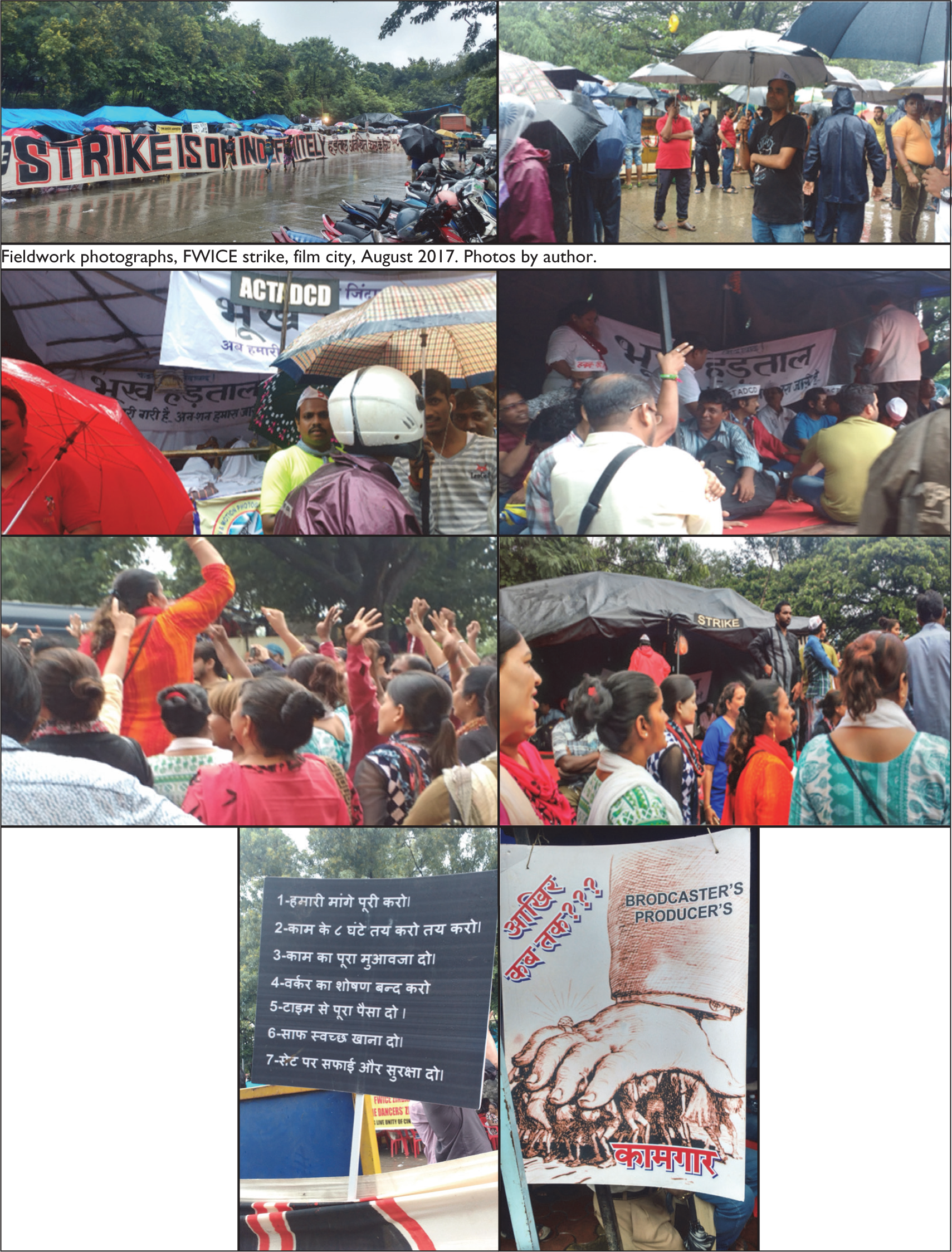
In August 2017, some of the unions under the FWICE announced a stoppage outside the film studio complex, Film City, in Goregaon of western Mumbai. ACTADCD was among them, raising grievances such as unpaid overtime, tool budgets squeezed by line producers, unsafe scaffolding of sets, poor sanitation and rest areas and irregular welfare disbursements. But there were parts of FWICE that did not participate. Within ACTADCD, senior art personnel did not always have the same stakes as the junior ones. Also, the recently incorporated costume wing made largely of women workers was still finding its footing – though they were incorporated into the union around 2014, they were only coopted into the executive committee of the union in 2017. Despite this, among the 15 art directors and 4 costume designers in the executive committee, 2 of the latter were active during and after the strike. Day 1 of the strike drew a few thousand workers to the gates. By day 3, numbers thinned markedly. Some unions like the Cine and TV Artistes’ Association (CINTA) of the actors did not join the strike; producers stayed off; few film shoots kept rolling inside the Filmcity. In interviews and in overheard conversations at the site, members voiced a pattern of mistrust. Suspicions were that certain leaders were using the stoppage to deflect attention from audits or to negotiate private commissions with producers. ‘Unions have become businesses’, one senior member of ACTADCD told me while I was there for fieldwork; others called the vigilance teams ‘daku gangs’ (gangs operating like Mafia-style bandit networks).
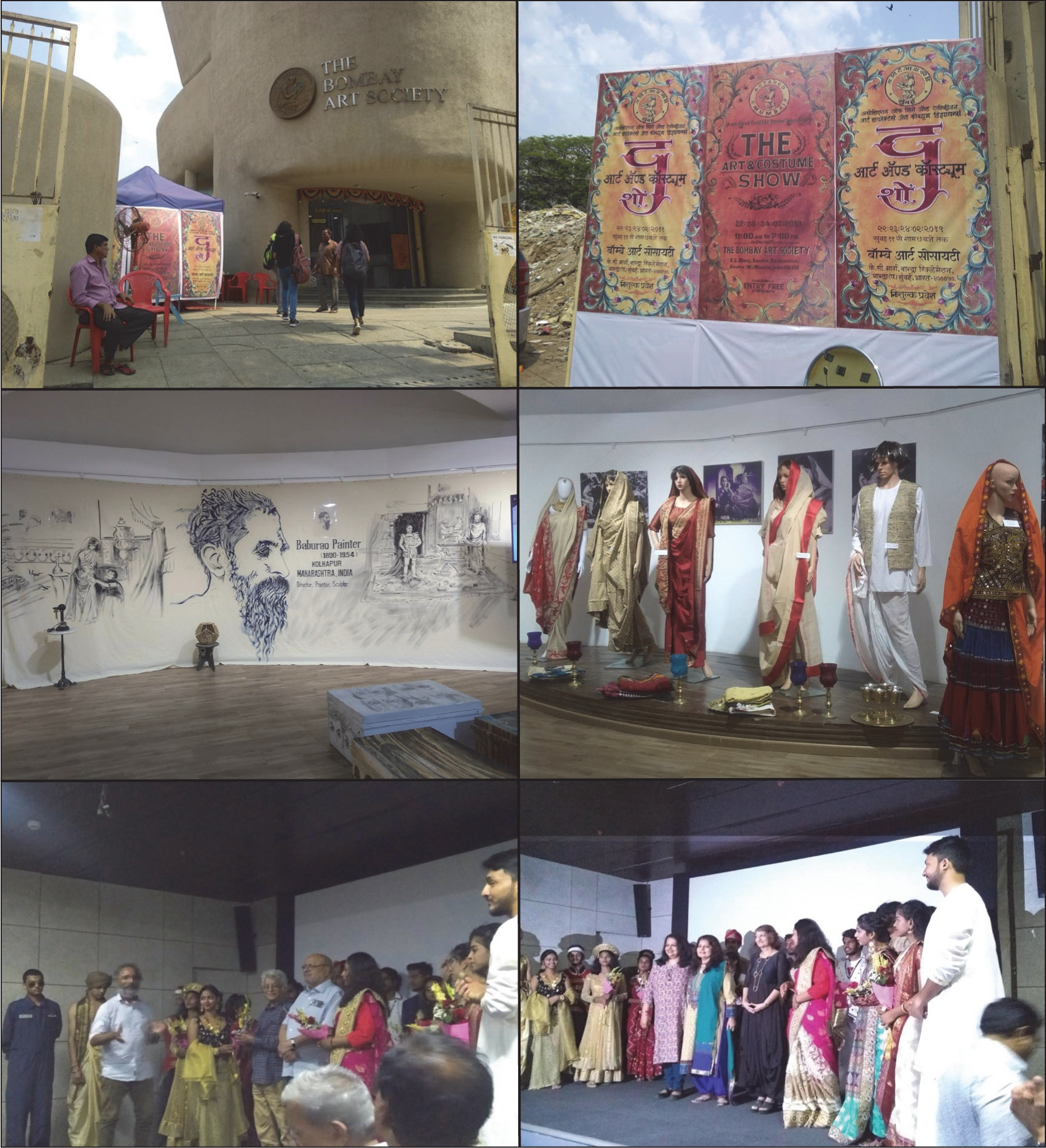
The strike was called off after 15 days, with a few promises made by the then state labour minister, Sambhaji Nilange Patil of the BJP, to intervene in helping both the workers and producers. However, nothing concrete materialised. Fieldwork conversations with union members, including those from ACTADCD, revealed a shared assessment that the conventional strategies, such as work stoppages, submitting memoranda and negotiations, were insufficient by themselves to provide leverage proportional to their profession’s value within the industry. Sukant Panigrahy, then president of ACTADCD, advocated for a ‘creative revolution’ aimed at revitalising labour politics by promoting a unique aesthetic approach. They planned for an exhibition at The Bombay Art Society gallery. The initial concept was developed in June 2018, with the plan to organise the event in the subsequent month. The imagined audience involved industry peers along with the public. They wanted to discuss working conditions and union issues in front of them. In Panigrahy’s vision, this event was to be an annual thing. For Sukant, this was ‘an initiation into getting out of a magazine on art and design in Bollywood’. He wanted to form a film art club or society which would carry this forward. However, internal disagreements, legal proceedings and bank freezes resulted in the postponement of the exhibition to February of the following year, 2019. The presence of celebrity figures such as Shyam Benegal and the president of CINTA, Sushant Singh, offered the event publicity. 11 The exhibition, however, has not yet acquired the institutional gravity to serve as an annual mode of collective assertion for the art department. In the period that followed, Panigrahy lost a substantial number of projects, a consequence that interlocutors associated with the industry’s tendency to view active union engagement as disruptive. After completing his tenure, he withdrew from frontline union work, redirecting his attention to his personal and professional life, and has not yet returned to the executive committee. However, he did tell others that this would always be his purpose, perhaps when times are more conducive (see Figures 1–3).
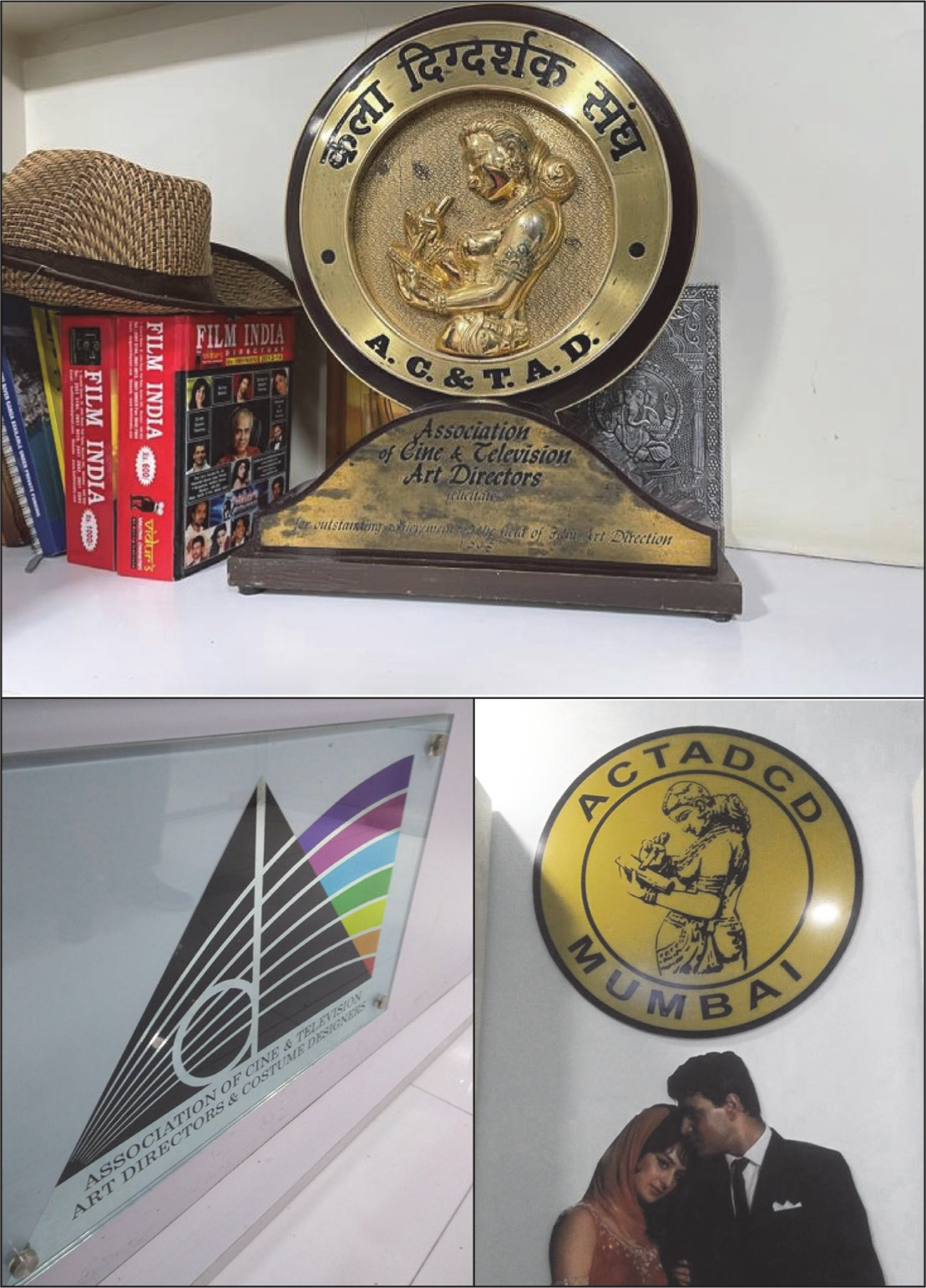
Some Pictures from the Field.
Strike, 2017 (Outside Filmcity in Goregaon, Mumbai).
Exhibition of ACTADCD, 2019 (The Bombay Art Gallery, Bandra).
In the journey of ACTADCD, we see a repeating pattern of taking initiative and then being forced to conform. Periods of high visibility, bold actions and strong demands are followed by long stretches of waiting, ultimately leading back to a patronage system shaped by factors like region, language, gender and politics. By following ACTADCD, the essay, which is a small extract from my larger doctoral work, attempted to examine unions as embedded in a politically fluid landscape: compromised and co-opted at times, yet also a site of creative assertion, affective politics and contested visibility. In Mumbai’s ‘glamour economy’, it would appear, making the union visible is itself union politics.
Footnotes
Declaration of Conflicting Interests
The author declared no potential conflicts of interest with respect to the research, authorship and/or publication of this article.
Funding
The author disclosed receipt of the following financial support for the research, authorship, and/or publication of this article: This article draws on research conducted as part of my doctoral dissertation at the Department of Humanities and Social Sciences, IIT Bombay. The doctoral research was financially supported by the University Grants Commission, Government of India, through the Junior Research Fellowship.