






Abstract
The Sustainable Development Goals (SDGs) replaced the Millennium Development Goals (MDCs) in 2015, which included several goals and targets primarily related to nutrition: to eradicate extreme poverty and hunger and to reduce child mortality and improve maternal health. In the Asia-Pacific Academic Consortium for Public Health (APACPH) member countries as a group, infant and child mortality were reduced by more than 65% between 1990 and 2015, achieving the MDG target of two-thirds reduction, although these goals were not achieved by several smaller countries. The SDGs are broader in focus than the MDGs, but include several goals that relate directly to nutrition: 2 (zero hunger—food), 3 (good health and well-being—healthy life), and 12 (responsible consumption and production—sustainability). Other SDGs that are closely related to nutrition are 4 and 5 (quality education and equality in gender—education and health for girls and mothers, which is very important for infant health) and 13 (climate action). Goal 3 is “good health and well-being,” which includes targets for child mortality, maternal mortality, and reducing chronic disease. The Global Burden of Disease Project has confirmed that the majority of risk for these targets can be attributed to nutrition-related targets. Dietary Guidelines were developed to address public health nutrition risk in the Asia Pacific region at the 48th APACPH 2016 conference and they are relevant to the achievement of the SDGs. Iron deficiency increases the risk of maternal death from haemorrhage, a cause of 300000 deaths world-wide each year. Improving diets and iron supplementation are important public health interventions in the APACPH region. Chronic disease and obesity rates in the APACPH region are now a major challenge and healthy life course nutrition is a major public health priority in answering this challenge. This article discusses the role of public health nutrition in achieving the SDGs. It also examines the role of APACPH in education and advocacy and in fulfilling the educational needs of public health students in public health nutrition.
Keywords
Introduction
The Sustainable Development Goals (SDGs) (2015-2030) are the successors to the Millennium Development Goals (MDGs) that were approved in September 2000 at the United Nations General Assembly by the 147 heads of state who had travelled to New York specifically to approve the Millennium Declaration. The MDGs were described by Professor Jeffrey Sachs as “a historic and effective method of global mobilisation to achieve a set of important social priorities worldwide.” 1 The MDGs included strategically important goals to halve the numbers in poverty, eradicate hunger, achieve universal primary school completion, and among the health goals to reduce child mortality rates by two-thirds. Specific targets were then added to the goals to assist in the monitoring process. As described by Bill Gates, the MDGs were “a type of global report card for the fight against poverty” for the 15 years from 2000 to 2015. 1
The MDGs included several goals and targets primarily related to nutrition, including “to eradicate extreme poverty and hunger, reduce child mortality and improve maternal health.” 2 In the Asia-Pacific Academic Consortium for Public Health (APACPH) member countries, infant and child mortality were reduced by more than 65% between 1990 and 2015, achieving the target of two-thirds reduction, although these goals were not achieved by several smaller countries. The target to reduce the under-five child mortality was representative of the MDG goals and the achievements of the APACPH member countries are shown in Figure 1.

Progress in under-5 mortality rate: 1960 to 2015 (deaths per 1000 live births).
With the completion of the MDGs, institutions of the UN system undertook a lengthy consultation process to develop the SDGs. The Sustainable Development Goals (SDGs), officially known as “Transforming our World: The 2030 Agenda for Sustainable Development” were approved by the General Assembly in September 2015. They comprise a set of 17 “interrelated goals” with 169 more specific targets that are applicable to countries at all stages of economic development. 3 Speaking at the 49th APACPH Conference in Incheon, South Korea in August 2017, the former Secretary General of the United Nations, Ban Ki Moon, spoke of his role in guiding the SDGs to final approval. He concluded by stating that “we all need to have a sense of ownership, and recognise these are not just collectively our SDGs, but also our individual SDGs.” 4 This was a call to all the APACPH members to take up the challenge of education, research and action to implement the SDGs. The commencement of the SDGs was followed by the beginning of the “United Nations Decade of Action on Nutrition” (2016-2025), global joint efforts to eradicate hunger and to prevent all forms of malnutrition in the world, an appropriate linkage as this article argues the SDGs are dependent on improving nutrition.5,6
The objective of this article is to review the role of public health nutrition in achieving the SDGs and the role of APACPH institutions in providing education to meet these needs.
Methods
A literature search was undertaken in the PubMed and Web of Knowledge in English. The search words used were “Sustainable Development Goals” and “nutrition” in different combinations. Additional documents were found on the World Health Organization (WHO), UNICEF, and Food and Agriculture Organization (FAO) websites.
Discussions were then undertaken at the 49th APACPH conference held in Incheon, Republic of Korea in 2017 during the Dietary Supplement Nutrition symposium. Participants reviewed the findings of the initial review.
As the article resulted from data in existing documents, ethics committee approval was not required.
The Sustainable Development Goals
The SDGs cover most of the areas of significance to human life and development that are broader than the usual boundaries of public health. But, a holistic view of health reveals that most of the goals are related to public health and require appropriate nutrition for their implementation. Because of their breadth, the SDGs have been labeled “senseless, dreamy and garbled.” 7 However, the sheer complexity of human development while maintaining a sustainable human ecology almost defies description. The Bill & Melinda Gates Foundation argued that any new goals should be specific, measurable, attainable, relevant, time bound, and easy to communicate, surely a mammoth task given the complexity of our globe. Nonetheless, they then sponsored a comprehensive review of the data available for all of the health-related targets, which has provided baseline data for future evaluation and consolidated this data into a health-related SDG indicator. 8 They identified 33 health-related indicators which were individually scaled 0 to 100 before incorporation into an overall index. The SDG Health Indicators did not directly assess risk factors. However, the group did discuss “nutrition” as an example of difficulties with some overall indicators in a discussion of 2.2.2 that “proposes a measure of malnutrition that combined prevalence of wasting and overweight among children under age 5 years.” 8 Since the distribution of growth is a continuum, there is some reasoning behind this, but it is customary to measure prevalence of undernutrition and overweight separately as the cross-sectional distribution is U-shaped. A list of the 17 SDGs and their inclusion in the SDG Index is shown in Table 1.
The Sustainable Developments Goals and Targets.
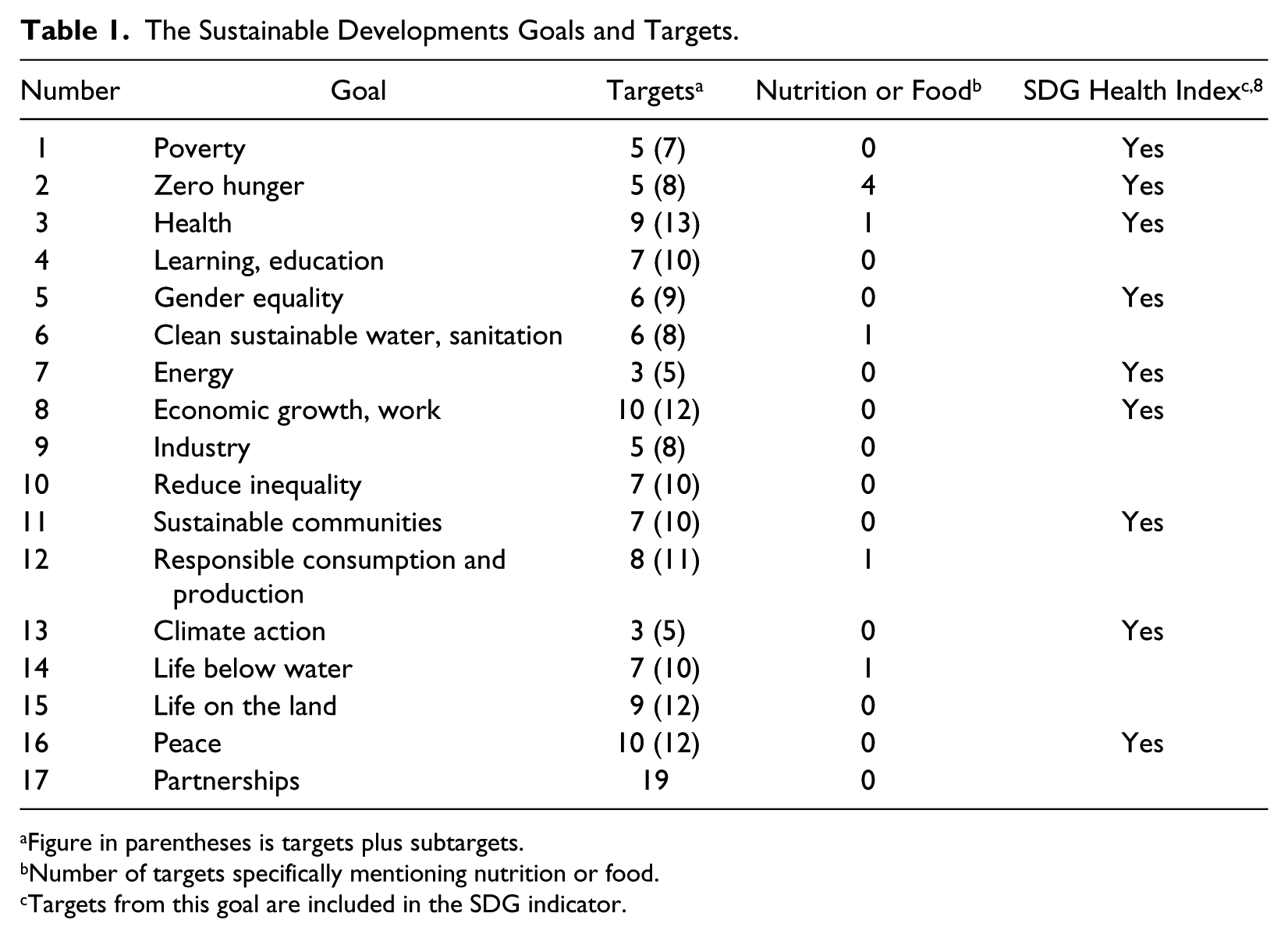
Figure in parentheses is targets plus subtargets.
Number of targets specifically mentioning nutrition or food.
Targets from this goal are included in the SDG indicator.
The MDGs have become the 17 SDGs in the context of increasing concern about climate change and the need for sustainable development and lifestyles. Many goals and targets relate to nutrition.
The SDGs are broader in focus than the MDGs, but include several goals that relate directly to nutrition: 2 (zero hunger—food), 3 (good health and well-being—healthy life), and 12 (responsible consumption and production—sustainability). Other SDGs are closely related to nutrition are 4 and 5 (quality education and equality in gender—education and health for girls and mothers, which is very important for infant health) and 13 (climate action). Goal 3 “good health and well-being” includes targets for child mortality, maternal mortality, and reducing chronic disease. The majority of risks for these targets are nutrition related. 9 For example, maternal mortality remains a significant problem with an estimated 300 000 deaths globally in 2015. 10 Hemorrhage is the cause of most of these deaths and iron deficiency is a major risk factor, and is already emphasized in public health programs. Chronic disease and obesity rates in the APACPH region are now a major challenge and life course nutrition is a major public health priority in answering this challenge. 11
The United Nations has projected that during the term of the SDGs, the world population will increase from 7.3 to 8.5 billion and life expectancy at birth from 69.1 to 70.8 years (70.3 to 71.8 years in Asia). 12 The total fertility rate in Asia will continue to decline slightly from 2.20 to 2.15. The FAO is developing a program to feed in a sustainable manner a population of around 10 billion within 50 years. 13 Food production of 8.4 billion tonnes per year will need to increase to 13.5 billion tonnes per year, from an increase in productivity (50% of the required increase) and the use of new resources. In the context of climate change and the need for sustainability, this is a major challenge. 13
For this article, each of the 17 SDGs was reviewed to ascertain their relationship to public health nutrition as part of the chain of causality (Table 2). UNICEF has developed a conceptual framework of malnutrition to assist in the upscaling of nutrition programs. 14 In Figure 2, we have shown how the MDGs can be integrated into the framework. The resultant tables were reviewed by a group of APACPH experts at the APACPH conference. Each of the goals was found to have some relationship to public health nutrition, which is not unexpected because of the key role of nutrition in human existence. The Global Burden of Diseases Study estimated that up to one-half of the disease burden in the Asia Pacific region can be attributed to inappropriate nutrition.9,15 For children, nutrition remains a major priority in continuing the trend of declining mortality rates. Breastfeeding remains the best practice for all children.16,17 The 169 SDG targets are too numerous to discuss in detail in a short review article.
The Sustainable Development Goals and Public Health Nutrition Summary Table.

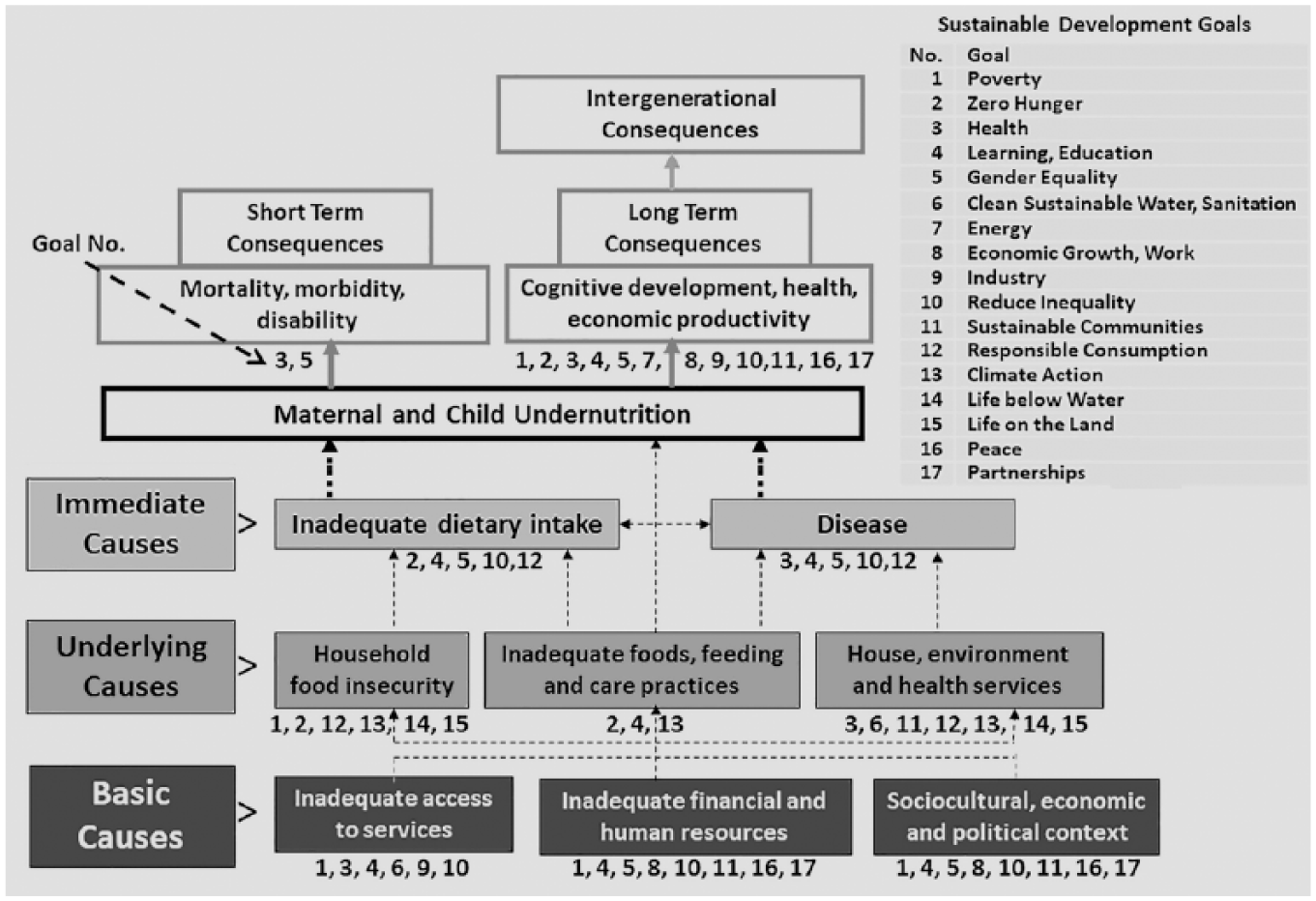
Relationship between UNICEF Conceptual Framework of Malnutrition (adapted) with the Sustainable Development Goals.
The Role of APACPH and Schools of Public Health
Public health nutrition programs will provide an important means of achieving the SDGs related to health. APACPH has an important role in education, advocacy, and research in the region to achieve the SDGs.
The APACPH members have had a longstanding commitment to achieving health and development for all with a particular interest in child health and nutrition. At the Hawaii meeting in 1987, the members passed a declaration: Be it, therefore, declared by all participants at the Conference and by all academic institutions represented, that universities of the region will act upon an abiding commitment to research, training, service, and policy development in the unmitigated support of leadership development, and the precepts and goals of Primary Health Care and Child Survival and Development in the Asia-Pacific Region and beyond. As universities, we also re-declare our resolve and commitment to leadership development for Primary Health Care and to Child Survival and Development in the support of the “Health for All” movement.
18
Education for the SDGs represents a natural progression of the programs and special interests of APACPH.
Schools of Public Health need to ensure that details of the SDGs are added to their education curricula including their MPH programs. Many schools have organized continuing education and short courses on topics that have included “Health for All” and now, these could be usefully updated to “SDGs for All.”
Research needs to be done in targeting nutrition actions and education to the cultural, geographic and developmental level of individual countries and regions. This is an important role for Schools of Public Health. A problem with the nutrition aspects of the targets is the complexity of nutrition. For example, child growth is a U-shaped risk curve, with both under- and overnutrition being at increased risk of morbidity and mortality. To reduce stunting and wasting, infants require more nutrients; but to reduce child obesity, children need less energy and require more exercise. This requires action to promote:
Target messages to small population segments rather than blanket advertising and promotion
Exclusive breastfeeding of infants to around six months and then appropriate complementary foods 15
Monitoring of growth and development by health professions
Changing perceptions of weight and growth by parents and grandparents
While much of the basic research for the SDGs has already been done, more research needs to be done on application to specific countries and cultures and the cost effectiveness of different approaches. Schools can also monitor, evaluate, and update programs where needed. These are important roles for Schools of Public Health, many of whom work in low- and middle-income countries. This has to be done in a climate of declining public health expenditure as governments spend a higher proportion of budgets on the immediate needs of hospitals, often in response to the ageing population. 19
Limitations and Threats
The threats to the SDGs include lack of funding as many of the wealthier nations become more introspective and isolated. “Untied” international aid programs that can best be used to meet local community needs are decreasing. Within the health and nutrition sector, funding is being diverted to short-term needs, particularly toward hospitals in response to increasing demands as our population ages. The SDGs contain measurable targets, but 169 is too many to monitor continuously in a useful way. Some are too aspirational to be implemented within the timeframe allowed “in setting goals for nutrition, there is always tension and debate over the level of ambition, between aspiration to drive political commitment and realism to allow concrete planning and to establish sound accountability mechanisms.” 20
Conclusion
The SDGs have considerable potential to focus global actions and aid in directions that will improve the health and well-being of all citizens. However, the goals are complex, and often made more so by their interdependency. This will require considerable effort to optimally interpret and implement them at local and region level. Schools of Public Health are based on interdisciplinary actions and are well placed to contribute to the implementation of the SDGs. Since nutrition is a risk factor in many of the problems identified in the SDGs, it is important that public health nutrition maintain a role as a core discipline within any academic public health program.
Footnotes
Authors’ Note
This article was originally presented at the 49th APACPH Conference held in Incheon, South Korea in August 2017. It was prepared in consultation with the coauthors and revised versions were circulated to the Nutrition Interest Group within APACPH for comments.
Declaration of Conflicting Interests
The author(s) declared no potential conflicts of interest with respect to the research, authorship, and/or publication of this article.
Funding
The author(s) received no financial support for the research, authorship, and/or publication of this article.