






Abstract
This conceptual article explores the tensions that climate change creates between environmental sustainability, gender equality and economic stability. It argues that these dimensions fundamentally challenge the foundations of traditional industrial relations (IR) and thus trade union strategy. By bringing union studies into dialogue with feminist political economy and eco-feminist perspectives, and drawing on scholarship and current evidence of union initiatives across the Global North and South, it proposes a union–climate–gender normative framework. This framework is structured along three interrelated continua: unions’ i) climate and ii) gender equality ambitions and iii) economic paradigms. We advocate for gender-responsive approaches that reframe productivity by considering the interdependence between paid-productive and social-reproductive labour, and call for unions to treat gender equality not as additional to but as a constitutive principle of just transition strategies.
Introduction
Trade unions’ engagement with climate change has increased, particularly in response to decarbonisation policies, industrial restructuring and associated social risks. This engagement has mostly been articulated through just transition frameworks, especially in the Global North (Stevis and Felli, 2015). Discussions have centred on carbon-intensive sectors, fossil fuel phase-out, industrial restructuring and the protection or reskilling of workers exposed to decarbonisation (Parker and Pulignano, 2026; Thomas and Pulignano, 2021).
In practice, just transition plans have often focused on compensation mechanisms, retraining programmes, regional development funds and investment in new green sectors in the EU (e.g. Akgüç et al., 2022; Crespy and Munta, 2023) and beyond. While these policies represent advances, they frequently remain anchored in productivist understandings of economic security wherein stable waged employment is treated as the primary vehicle for redistribution and social protection. Productivist growth prioritises the maximisation of output through technological innovation and efficient production, generating competition and economic value in the form of increased Gross Domestic Product (GDP), firm profitability and wages. Yet mounting evidence, including that from degrowth and no - growth advocates, suggests that such growth cannot be reconciled with sustaining life and is not necessary for ‘a good life for all’ (Schmelzer et al., 2022: 32). These tensions between environmental sustainability and economic stability confront unions with a strategic dilemma over how to defend workers’ livelihoods while engaging with the structural transformation required for decarbonisation (e.g. Hampton, 2015, 2018). Addressing climate change necessitates a shift from carbon-intensive economic expansion towards sustainable production and consumption patterns. In such a context, the traditional mechanisms of labour de-commodification (Polanyi, 1944), including collective bargaining and worker representation, may struggle to operate as they have historically.
To date, these tensions have rarely been resolved (Bembič et al., 2026), underscoring the need for unions to reconsider the economic growth paradigms that underpin their strategies. Although scholars have advanced alternatives such as post-growth (Jackson, 2021; Kallis, 2011), 1 union engagement with climate change has largely remained concentrated in carbon-intensive, male-dominated sectors (International Energy Agency, 2020). Consequently, while many unions are ‘greening’ their narratives and initiatives, this has tended to occur ‘instrumental[ly] … rather than as a transformative prioritisation of environmental concerns’ (Montesano et al., 2024: 141).
This limited shift sits uneasily with the core promise of just transition: to protect all workers. In most economies globally, women are concentrated in service-oriented sectors (education, health, retail), agriculture and garment manufacturing. This positioning renders them particularly vulnerable to climate-related job losses, food insecurity and increased unpaid care burdens, while simultaneously placing them at the forefront of adaptation processes, green service jobs and sustainable resource management (UN Women, 2024). In contexts of informal and precarious employment, climate impacts further intensify vulnerability. Women are disproportionately concentrated in some areas of such employment (e.g. street vending, home-based manufacturing – International Labour Organisation [ILO], 2024) where their engagement in dangerous, informal, or low-paid jobs exacerbates gendered poverty, health risks and exposure to violence (Parker et al., 2023).
Climate change thus obliges unions to move beyond conventional productivist assumptions to recognise the interdependence of paid and social-reproductive labour, as well as the structural and intersectional inequalities that this interdependence sustains. From a social-reproductive perspective, unpaid and under-recognised labour is not peripheral but constitutive of production and consumption, shaping both labour supply and the structural conditions for acceptable economic growth. The systematic externalisation of care thus reveals how growth regimes depend on, yet consistently undervalue, reproductive labour, thereby intensifying gendered inequalities (Pulignano et al., in press). Indeed, feminist political economy shows that capitalist growth depends on a structural divide between ‘productive’ (paid) and reproductive, care-based (largely unpaid) labour, ‘invisibilising’ the latter despite its foundational role in sustaining the economy (Bakker and Gill, 2003; Rai et al., 2014) and obscuring how crises are mediated through gendered structures of care, precarious work and informal labour (Fraser, 2014). In Nenning et al.’s (2023) taxonomy, this underscores the relevance of post-growth eco-feminist approaches which emphasise the redistribution of social-reproductive labour, expansion of universal and de-commodifying social protection systems, and provision of public and democratically governed services. However, these insights have rarely been systematically integrated into union climate strategies or their analysis. Consequently, the justice dimension of transition is often interpreted in terms of employment continuity and industrial restructuring, rather than the broader reproduction of households, communities and welfare systems.
This raises a critical question: whether integrating gender equality into union climate strategies can be achieved within reformist, productivity-led growth models, or whether it requires a gendered post-, degrowth or no-growth transformation that no longer treats nature and care labour as inexhaustible. Moreover, despite growing evidence of gendered policy approaches to climate change, and of the socially reproduced impacts of existing IR institutions and processes (Arabadjieva et al., 2023; Pulignano et al., 2024), gender and equality perspectives remain largely absent from mainstream political and academic discussions, including within IR scholarship (e.g. Flanagan and Goods, 2022; Orsatti and Dinale, 2024). This article thus asks whether unions can address these intersecting crises or risk reproducing or exacerbating existing inequalities. This question is particularly salient given that unions are widely seen as central actors in safeguarding workers from economic shocks linked to decarbonisation and structural change.
This conceptual article makes two key contributions. First, it draws on scholarship on unions in IR, feminist political economy and eco-feminism, and union documents to clarify the tensions and blind spots in current approaches. Second, it develops an analytical framework for examining union climate strategies along three interrelated dimensions: their climate ambitions; gender equality ambitions; and orientation towards growth, post-, green or no-growth models. The study thereby contributes to debates within IR by problematising productivist assumptions that underpin just transition strategies while opening a research agenda for future empirical work on labour, climate and social reproduction.
The article first critically reviews orthodox growth models and examines unions’ climate responses across selected economic and IR contexts within and beyond Europe. It then analyses the gendered character of these responses using an equality approach typology, culminating in a three-dimensional model linking union climate and gender equality ambitions and competing growth paradigms. Drawing on current literature and secondary evidence, it then develops and illustrates the conceptual framework. The concluding section discusses its implications for IR and union strategy.
Trade unions and the quest for an ecologically sustainable transition
Rethinking growth
Economic growth, traditionally measured by GDP, GDP per capita and population growth, has been the primary driver of greenhouse gas emissions over the past decade (Intergovernmental Panel on Climate Change, 2022). However, scholars have long examined not only short-term crisis management but also deeper structural transformations, highlighting an ongoing, yet uneven, transition to low-carbon economies (Jänicke and Jacob, 2009). The history of capitalist economic crises suggests that productivity-led growth is essential for stability, yet capitalism’s inherent dynamics drive it toward rapid expansion and then collapse (Barry, 2013). Recent analyses of climate change underscore the urgency of this dilemma as we approach ecological tipping points such that the effects of economic activity must drop markedly to avert disaster, irreversible processes and potential harm to future generations (e.g. Nitsche-Whitfield, 2023; Pereira et al., 2024).
A growing argument is that the pursuit of undifferentiated GDP growth will not deliver widespread well-being and social progress for people or nature. From this perspective, orthodox economic growth is an insufficient measure of an economy’s success or failure to bring societal prosperity. It does not inform us about a ‘good life beyond growth’ (Rosa and Henning, 2019), is not ecologically sustainable, and is thus undesirable on socio-economic, political and equality grounds, not least for underlining that poverty elimination can only be solved by more direct redistributive measures. This argument has driven challenges to neoclassical economics and neoliberal thinking. Indeed, the 2023 UN Climate Change Conference (Conference of the Parties, COP28) was the first COP to explicitly call upon nations to accelerate a global shift from fossil fuels in a ‘just, orderly and equitable’ manner (European Commission, 2024), highlighting the imperative of addressing climate change while ensuring fairness and inclusivity in transition processes. 2 Nevertheless, others opine that ‘(i)f the [New Collective Qualified Goal] was a test of our ability to mainstream workers into a key operational COP agreement, and thereby shape the new climate economy, then Baku was a qualified failure’ (Anderson, 2023: 79).
There are various classifications of approaches to capitalist economic growth and climate change dynamics (e.g. Koch, 2015). Nenning et al.’s (2023) taxonomy distinguishes between pro-green growth, ambivalent and post-growth approaches. Pro-green perspectives locate the roots of climate change in unsustainable growth and under-development, promoting ‘adaptive’ social protection through largely élite-driven development agendas, primarily in the Global South. Green growth ambivalent approaches, which underpin many just transition strategies, similarly identify growth as a driver of climate crisis but combine bottom-up processes of union involvement and statist, policy-led responses, mainly in the Global North. However, both remain anchored in productivist assumptions, emphasising the expansion of productive forces and the redistribution of gains from economic growth and technological progress (Schmelzer et al., 2022). By contrast, post-growth approaches – including sustainable welfare and eco-feminism – advocate universal, de-commodifying social protection, while eco-feminist perspectives further stress the redistribution of social-reproductive labour, economic democratisation, and bottom-up, internationalist forms of transformation.
However, the progress of individual nations on sustainable development varies, reflecting factors such as their differing assessments of climate crisis causes, sustainability priorities, impact levels and starting points, radical or otherwise policy approaches, regulatory and institutional maturity, resources, political will and cultural mores (Parker et al., 2023).
Trade unions, growth and climate change
Unions have traditionally operated within a capitalist economic framework, regarding growth as the foundation for employment security, wage increases and improved working conditions. However, their overall engagement with climate change has reflected differing stances. While some embrace sustainability and green transition, others uncritically support orthodox economic growth and capital accumulation, thereby prioritising the protection of male-dominated industrial jobs over environmental concerns (Kelly, 2012). Scholars note that the strongest union influence in climate debates has historically come from carbon-intensive industries such as metalworking, energy production and transport – sectors often seen as the most resistant to green policies (Uzzell and Räthzel, 2013). However, this excludes vast swathes of workers, particularly in (often feminised) service sectors which also contribute to environmental challenges but remain under-represented in union-led sustainability strategies. This exclusion largely marginalises a proper consideration of the gendered organisation of work and care (Pulignano et al., 2024; Tronto, 1993). Consequently, as indicated by Nenning et al.’s (2023) taxonomy, even progressive just transition agendas risk reproducing gender hierarchies by neglecting social reproduction and care (Fabris et al., 2025). Furthermore, many unions, particularly in Europe and North America, have become detached from broader economic and social transformations, focusing primarily on job security within existing capitalist structures rather than advocating for a systemic shift toward sustainability and equality (Barry, 2013).
At the defensive end, unions representing carbon-intensive industries remain primarily concerned with job security and economic stability, but a transformation within parts of the labour movement is underway. Some are actively integrating climate concerns into their agendas while striving to balance industrial and environmental goals. As Kalt (2022: 500) observes, ‘(u)nions are [not] [or they are no longer] glued to one side of a jobs-versus-environment divide.’ Instead, they are adopting transition strategies ranging from reactive/defensive approaches that protect the status quo, to proactive and supportive approaches that advance green and just transitions (Barca, 2024; Ciplet and Harrison, 2020).
These innovations extend to several European federal and national unions beginning to integrate post-growth economic models into their frameworks, marking a departure from their traditional stances (Fabris and Pochet, 2025). In countries such as Belgium, Italy and Spain, unions have increasingly acknowledged the limits of GDP-driven models and advocated alternative indicators centred on well-being, ecological sustainability and social justice (e.g. Spain’s Comisiones Obreras, 2022; Belgium’s Confederation of Christian Trade Unions, 2023; Italy’s Confederazione Generale Italiana del Lavoro, 2018). At the European level, the European Trade Union Confederation (ETUC) (ETUC, 2023a) has similarly called for post-GDP metrics and the integration of sustainability indicators into EU frameworks, including the European Green Deal.
This realisation within the labour movement challenges the notion of a historical antagonism between labour and environmental interests, with both workers and nature increasingly regarded as jointly threatened by globalising capital and accelerating ecological crises (Jackson, 2013). Such a turn suggests the reorientation of union strategies, priorities and assumptions about growth, work and social protection. This creates the scope for unions to act as change agents, through reformist integration within existing systems and/or more radical, post-growth strategies aimed at building a sustainable, socially just economy.
A key argument emerging from this repositioning is that economic ‘security’, not growth, should underpin union strategies, coupled with democratic representation, equality and ecological sustainability (ILO, 2004). Traditionally, union approaches to climate change have been tailored within orthodox economic growth settings, and have had a complex, evolving relationship with post-growth (e.g. prioritising just transition agendas (green growth) over (full) degrowth) amid country, sectoral, historical and ideological dynamics and the availability of allies, among other factors. Yet truly alternative approaches become necessary when orthodox growth-driven strategies fail to mitigate climate change and social inequality, and unions have spearheaded and/or supported multilateral alliances. Within unions, self-reflection, revitalisation and re-politicisation are also vital to advance a different economic model that is inclusive, equitable, sustainable and socially transformative. The potential exists for overlap between transitions from one economic paradigm to another, and thus between union change strategies. For instance, union alliance-building has typically taken place within contexts of productivity-led economic growth and formal employment. However, in such settings, this alone is not sufficient for developing a shared post-growth political economic vision (Parker et al., 2021). From a radical democracy perspective, mobilisation for societal transformation should concern not only wealth redistribution (as is customary for unions) but also recognition of other demands emerging from various groups in society relating to, for instance, the environment, gender and race.
The confluence of gender, unions and climate change: contextualised reform and/or radical potential?
Women and unions
Women 3 have long comprised a sizeable proportion of union membership. For instance, 20 years ago in the EU (then including the UK), they formed 40 per cent of members but now constitute 45 per cent (ETUC, 2023b), largely due to feminist efforts that have broadened the definition of the working class and workplace agendas (Warskett, 2001).
Within and beyond Europe, however, full gender parity in the leadership and decision-making roles of union hierarchies remains elusive, and research documents the tensions between class-based and feminist claims within labour movements (e.g. Dean, 2015; Guillaume, 2018; Warskett, 2001). 4 This is despite the gendering of union functions (including equality bargaining) being widely acknowledged for its potential to empower women and others to tackle gender inequalities in the workplace (e.g. Dean, 2015; Parker et al., 2026).
The capacity of feminists and others to influence unions varies across national and organisational contexts, resulting in women’s voices, while increasingly audible, remaining only partially integrated into union strategy. This reflects the enduring centrality of class in union mobilisation (Kirton, 2019) and the embeddedness of gender inequalities within capitalist IR systems – dimensions that have rarely been fully theorised in mainstream IR scholarship, even from labour de-commodification perspectives. This gap is striking given the scale of women’s participation in informal work, where regulatory protection and union representation are often weak or absent (Parker et al., 2023) and given that women constitute the majority of informal workers in 56 per cent of countries worldwide (ILO, 2023), particularly in the Global South where informal labour and climate vulnerability are most pronounced.
Concurrently, unions themselves may reproduce gendered hierarchies within leadership, bargaining structures and organisational cultures. Feminisation processes must therefore be understood within specific union ‘inequality regimes’: interrelated practices and meanings that sustain class, gender and racial inequalities (e.g. Milner, 2025) – as well as in relation to institutional contexts beyond unions, including care responsibilities, occupational segregation and broader economic and IR settings. Intersectional dynamics linking gender, race and class further shape the persistence of inequality within and beyond union arenas (Kirton and Healy, 2013).
Thus, union efforts to promote gender equality have ranged from ‘doing nothing’ and resistance through reforms to efforts seeking transformational change of union and wider cultural and structural arrangements (e.g. Cockburn, 1989).
Women and climate change
Some research has begun to examine how environmental change affects working women. In a comparative assessment of working women in Global North and South countries in the Asia-Pacific, for instance, it emerged that women in both regions still undertake a disproportionately high, and sometimes increasing, share of unpaid domestic work (Parker et al., 2023) even though equality in unpaid work is needed to achieve equality in paid work, societal participation and well-being (Elson, 2017). Particularly in the Global South, women are disproportionately concentrated in public services, care, retail and other services that are indirectly but significantly affected by climate change and decarbonisation policies (e.g. Pearse, 2017). They also often shoulder the burden of environmental regulatory measures because of their spatial geography, sectoral concentration and other factors (Parker et al., 2023).
Analysis also confirms, as argued above, that men tend to dominate in industries that are likely to be directly affected by relevant policy action. However, climate change affects a range of labour market sectors, including care, education, retail, hospitality and agriculture, in which women are particularly concentrated, often in low-paid and precarious jobs, and are therefore more economically vulnerable than men (Halton, 2018). Already-marginalised communities thus endure even more pressure. To illustrate, natural disasters drive relocation, disproportionately amplifying issues for working women due to the gendered division of labour. This includes an increase in their care burden and role in preserving food security; a greater threat of gender-based violence caused by moving away from more protected communal living; living in disaster contexts generally (Halton, 2018); reduced ownership; disrupted access to resources and work opportunities; and greater vulnerability to exploitation and debt traps (Parker et al., 2023).
However, analysing climate change requires more than documenting its gendered impacts; it demands theorising on how gender organises risk itself yet gender remains insufficiently integrated into risk analysis (Hemmati and Röhr, 2009). Unions, as key IR actors, frequently overlook gendered sustainability challenges, especially in informal sectors where women are overrepresented, face precarity and often migrate for work. Gendered climate vulnerabilities also remain marginal within national and international policy frameworks, partially shaped by unequal access to education and decent work (Parker et al., 2023). Addressing climate change therefore requires embedding gender as a central analytical lens to avoid reproducing structural inequalities and to advance inclusive sustainability.
Gender and union responses to climate change
Despite the growing prominence of climate change within union research and practice, systematic analysis of whether and how union climate strategies incorporate gender equality goals remains strikingly limited. Feminist and IR scholars have long criticised this omission (e.g. Mandy, 2017), highlighting the persistent failure to theorise gender as constitutive of climate vulnerability, labour market restructuring and prevailing models of productivity. Particularly, they have challenged so-called ‘gender-neutral’ climate policies, demonstrating how they often reproduce entrenched inequalities. Within growth-oriented political economies, for example, the EU Just Transition Mechanism has been assessed as centring on a male model, disproportionately benefiting the predominantly male workforce (e.g. Montúfar, 2022). Rather than unsettling the gendered foundations of production and social reproduction, such approaches risk consolidating them unless gender is treated as a structuring principle of union climate strategy. Moreover, few just transition frameworks are recognised for explicitly addressing or emphasising gender, and most unions have ‘not yet grappled with the full implications of adopting a gendered perspective’ (Samman, 2024: 12) though many have developed institutional structures and policies that focus on gender and use ‘mainstreaming’ language.
Samman and others’ empirical examples develop a limited continuum of gendered union climate change initiatives. These range from eschewing such initiatives and/or ‘doing nothing’ (e.g. engaging with the gender and climate change agenda through basic education activities/campaigns that do not differ significantly from earlier environmentally focused efforts), through adopting a just transition concept in principle and its implementation with varying degrees of focus on gender, to a rare but more comprehensive advocacy of both climate action and gender equality. However, even the most ‘ambitious’ of these efforts occurs within extant capitalism and IR.
Some feminist political economy work widens the analysis by examining the economic context of union approaches to climate change, though little of this assesses alternative economic scenarios including degrowth paradigms (Picchio, 2015). Barca (2019) centres labour within degrowth, arguing that the dominant ‘liberation from work’ framing (reducing waged production) is unrealistic and that a ‘liberation of work’ should be pursued instead. This involves workers’ control at the point of production, developed through dialogue among activists and communities (Barca et al., 2023) in which unions are not explicitly central. A related theme of feminist political economy and the sociology of work focuses on the interconnectedness between paid and unpaid labour. Climate change acts as a threat multiplier by disrupting existing economic divisions and deepening the tension between reproductive and productive work. In many Global North and South contexts including Fiji, China, New Zealand and Pakistan, environmental shocks have forced women to shoulder heavier and more precarious burdens to sustain households and buffer against risk (Parker et al., 2023).
As an often unpaid area of work, the organisation of care is ‘unjust, inequitable and a vector of inequality’ placed outside the field of capitalist productive work, despite forming the ‘basis of its reproduction and the sustenance of its existence’ (Montúfar, 2022). It ‘traps women in the sphere of the family (nuclear or collective), closing the doors to their participation, education, stability, equality, and progression in the labour market. It is also, in most countries of the Global South, family-centred, with a total absence of the state and marked colonial traits’ (Montúfar, 2022). Where gender is addressed, it is often through measures aimed at representation, inclusion in green sectors or equal access to training rather than through a structural rethinking of how work, productivity, and economic security are defined.
A deconstruction of the gendered division of labour thus urges the implementation of a relational approach (Pulignano et al., 2024) in which work and changes in its distribution can be readily explained by the changing pattern of interconnectedness among work activities, paid and unpaid (Glucksmann, 2005). This challenges traditional productivity-based understandings of labour that underpin productivity-led growth. Pivotal to this transition in gender terms is thus the redistribution of care-giving among and between all family members and the state, with implications for unions’ role in promoting this change from differing sectoral, climate and gender equality starting points.
A gender lens on climate change and unions amid the growth debate
The preceding discussion suggests that union climate strategies cannot be understood solely in sectoral or policy terms; they must also be analysed in relation to underlying assumptions about growth and economic paradigms. These strands can be combined to show the extent to which union climate strategies are structured by gendered assumptions about work, productivity and economic security. Figure 1 demonstrates the interrelated union–climate–gender dimensions in different settings within decarbonising economies, moving beyond the sectorally bounded and productivist interpretations of just transition strategies and foregrounding the structural role of social reproduction. According to the model, economic paradigms move from growth-centred productivism to an eco-social, post-growth reorientation; unions’ climate ambitions shift from defensive adaptation to structural transformation; and their gender equality ambitions evolve from gender-blindness/resistance through reform to transformative initiatives. Conjointly, these dimensions denote a reconfiguration of the growth regime itself, from one that prioritises output and externalises ecological and reproductive concerns to one in which sustainability, climate transformation and gender equality are constitutive principles of economic organisation.
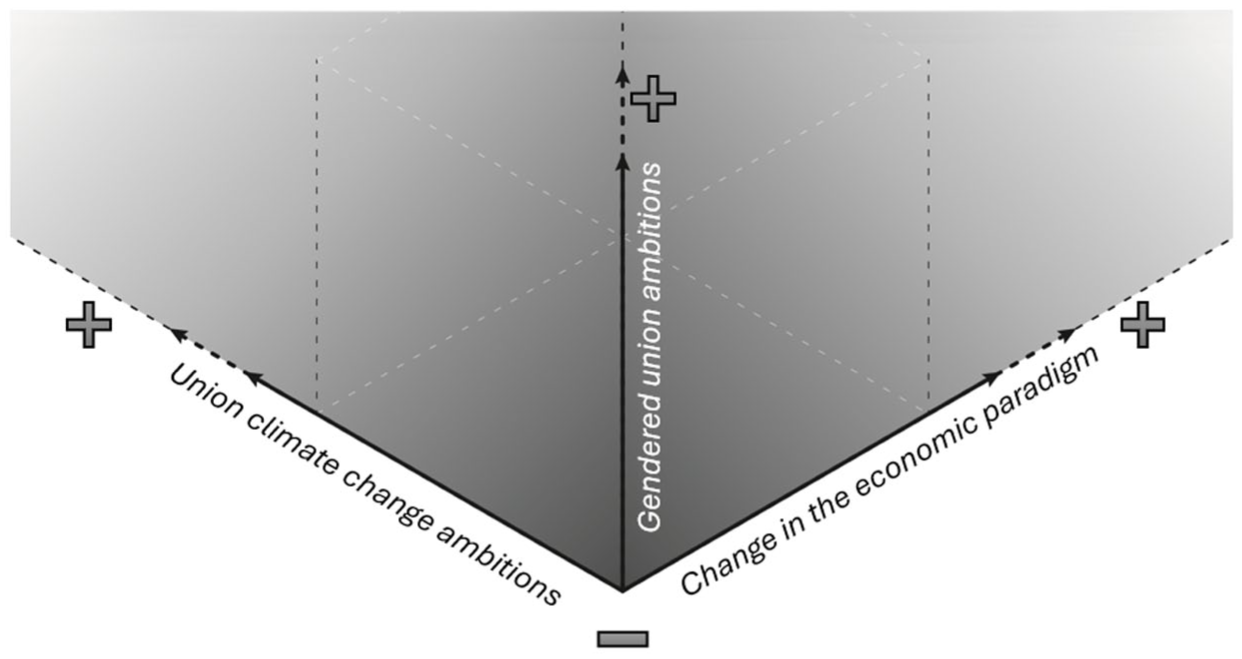
Gendering union approaches to climate change within different economic paradigms.
Each dimension thus moves from less ambitious, productivist or gender-blind/resistance strategies towards more transformative orientations (this is denoted by the ‘+’ symbol). The union climate change ambitions axis draws on existing typologies (e.g. Barca and Leonardi, 2018; Kalt, 2022; Stevis and Felli, 2015; Thomas and Doerflinger, 2020) and ranges from ‘resistance/do nothing’ strategies through reformist to radical initiatives; the second reflects increasingly ambitious gender equality approaches by unions; and the third focuses on the different economic paradigms (from productivist through degrowth, no-growth and green) in which union climate and gender endeavours are couched, extending to a consideration of the gendered divisions of labour and the politics of care (Pulignano and Domecka, 2025). Thus, varying nexus points between the three dimensions are possible, with the framework providing a heuristic tool for situating and comparing strategic positions.
Specifically, the climate ambitions axis ranges from employment protection responses within existing IR to more structural interventions in production systems and energy governance. Along the gendered union ambitions axis, positions range from resistance and gender-blind approaches to engagement with the gendered organisation of social reproduction, including care burdens and welfare restructuring. Along the economic paradigm axis, unions move from growth-centred conceptions of economic security tied to waged employment toward approaches that decouple security from continuous output growth and those which emphasise care infrastructures, public services and collective provisioning as central to resilient low-carbon societies.
Illustrations of union strategies and initiatives can be situated on the model. At the lower (-) end of the climate ambition axis, unions may prioritise employment protection within carbon-intensive sectors. The Forestry Division of the Australian Construction, Forestry, Mining and Energy Union has actively opposed climate mitigation measures, whereas the Mining and Energy Division has supported emissions reduction strategies (Goods, 2011). Similarly, Germany’s Industriegewerkschaft Bergbau, Chemie, Energie has advocated a gradual coal phase-out framed around safeguarding regional economies, stable energy supply and workers’ livelihoods (Revierwende, 2022). In these cases, economic security remains closely tied to existing industrial structures, and engagement with the gendered organisation of work is limited.
Movement (+) along this axis is visible in unions that support decarbonisation through industrial modernisation. For example, Germany’s IG Metall backs climate policies centred on technological innovation, green investment and competitiveness. Likewise, the US AFL-CIO and Canada’s UNIFOR promote reskilling and public investment in renewable sectors while remaining committed to productivist growth models. In Europe, the ETUC advances just transition within the European Green Deal framework, supporting strategic autonomy and public investment. Along the economic paradigm axis, these strategies remain closer to the growth-centred end while, along the gender axis, equality is typically addressed through mainstreaming, representation or labour market inclusion rather than through structural engagement with care and social reproduction.
Movement (+) along the gender axis is particularly evident in union strategies that explicitly frame climate change as gendered and seek to embed gender equality into transition policies (e.g. Allians för rättvis klimatomställning (Swedish Alliance for Just Transition [ARK]), 2021; Confédération française démocratique du travail [CFDT], 2023; France’s Confédération Générale du Travail [CGT], 2025; European Institute for Gender Equality [EIGE], 2024). The CGT’s (2025) position on the third National Climate Change Adaptation Plan links climate impacts to women’s health; criticises emergency/disaster planning for overlooking differences between women’s and men’s situations; and calls for better access for women to green-transition jobs in male-dominated sectors (e.g. energy, transport). Likewise, CFDT’s (2024) statement on Gender Inequalities, Climate Crisis and Ecological Transition argues that women are disproportionately affected by climate change and biodiversity loss; are key actors in the ecological transition yet under-represented in environmental decision-making; and calls for the systematic cross-integration of gender equality and environmental policies to secure women’s place in the transition. In Spain, the main confederations, Comisiones Obreras (CCOO) and Unión General de Trabajadores (UGT), acted as central social partners in the 2020–2024 Just Transition Strategy, which combines ecological transition with a specific objective of reducing labour inequalities for women through measures such as gender clauses in public calls, gender-sensitive data collection, and training and employment support for women in green sectors (EIGE, 2024). Sweden’s ARK brings together over 50 civil society organisations, including environmental NGOs, unions such as Handelsanställdas förbund (affiliated to LO Sweden), youth and human rights groups and gender equality organisations, to demand a rapid, fair green transition that protects workers, reduces inequality and orients economic activity towards human well-being within planetary boundaries, thereby situating unions within a broader, equality-oriented climate politics (ARK, 2021). Evidence from the Philippines further demonstrates the variability of climate positioning. A study of 22 unions identifies a disconnect between strong national green advocacy and weaker local climate awareness, indicating that unions can be both enabling and constraining in pursuing just transition (Velasco, 2026).
Further movement along both the climate and economic paradigm axes is visible in initiatives that more explicitly challenge growth-centred assumptions. The New Zealand Council of Trade Unions and one of its affiliates, E tū, articulate climate strategies embedded within broader social movement unionism, linking decarbonisation to inequality and democratic participation (Parker and Alakavuklar, 2023). Trade Unions for Energy Democracy (TUED), a worldwide network of unions, advances this trajectory by advocating public ownership of energy systems, a planned fossil fuel phase-out and substantial public investment guided by sustainability rather than GDP-driven growth (TUED, 2021). Its global campaign for publicly-financed climate pathways, including calls at COP29 for large-scale, debt-free climate finance for the Global South (TUED, 2024), reflects a more pronounced shift along the economic axis. Such positions indicate greater potential to decouple economic security from continuous output growth and to integrate social reproduction and care infrastructures more centrally into transition strategies.
In practice, union strategies may also cluster rather than distribute evenly along and across the three axes. For example, unions representing carbon-intensive industries may combine defensive climate positions with growth-centred economic assumptions and limited gender integration. Rarely, unions have articulated visions that integrate a transformative climate ambition with a revaluation of care and public provisioning, indicating the possibility of moving beyond productivist just transition frameworks. Moreover, union praxis may be informed by other factors (e.g. members’ perspectives on union priorities; alliance arrangements wherein unions and other parties may alter one another in the process of struggle – Mouffe and Holdengräber, 1989). And different union strategies may intertwine (e.g. reforming the regulation of employers’ procurement rules could mandate the hiring of only unionised labour, with the social partners involved in dialogue and collective bargaining to establish labour, equality, social and green clauses). However, by structuring analysis along the three continua, the framework clarifies the foci for normative and strategic shifts required for unions to advance a more inclusive and structurally transformative agenda.
Concluding discussion: ways forward?
Historically, union strategies have been embedded in a productivist model of economic growth in which workers’ livelihoods, social protection and redistributive gains were secured primarily through the defence and expansion of waged employment. Climate strategies formulated within this framework tend to prioritise preserving jobs, support industrial competitiveness and promote technological innovation to maintain employment levels.
Despite being the main architects of just transition, unions have only begun to actively engage with the demands of a gender equitable, climate-resilient future. To date, these developments tend to encompass reforms seeking to respond to one or two of the three continua explored here. Moreover, just transitions themselves, located within Nenning et al.’s (2023) green growth ambivalence approach, pitch towards changes largely informed by productivity-led growth assumptions, and are yet to recognise the uneven burdens of climate change across different forms of paid, unpaid and social-reproductive labour (e.g. Pulignano et al., 2024). Furthermore, many union strategies for just transition have treated gender as an additional, not foundational, concern, rarely addressing deeper structural links between production and social reproduction. This omission is particularly acute in the Global South where informal labour and climate vulnerability are most evident. As eco-feminist approaches to capitalist economic growth stress, this has left the redistributive potential of work under-explored, particularly in relation to social-reproductive labour and the rapidly growing care economy.
Given the urgency of climate change, it is concerning that only some unions are inching towards an economic vision couched in terms of security and a prioritisation of (gender) equality, inclusion, well-being, care and democracy. Our model, derived from a critical review of the literature and illustrations of union strategies in the Global North and South, makes a conceptual contribution by mapping union efforts to date on climate change, gender equality and economic approaches along dimensions of increasingly radical ambition, emphasising the potential for greater change within (and to) existing IR arrangements. At their most ambitious, unions will thus form an important representative and participative force in efforts that seek a re-evaluation of all forms of work (paid and unpaid) in relation to their gendered character and relationship to climate action in growth, post-growth, degrowth and no-growth economic contexts.
Our model encourages unions to inform their avenues for reflection on ways forward with the trilemma of climate crisis, gender inequality and unsustainable economic growth. More progressive avenues highlight a radical, inclusive agenda that redefines productivity and rethinks the redistributive role of work within a gendered post-growth model. This requires a relational understanding of work (e.g. Pulignano and Domecka, 2025) and eco-feminist critique of union strategies, including just transition (e.g. Guillaume, 2018). Indeed, there are persistent challenges for unions seeking synchronously to address climate change and gender equality, especially where reforms have been limited to modest adjustments within prevailing capitalist frameworks (Fougner and Kurtoğlu, 2011). Internally, these include union responses which often remain fragmented and a reflection of the differing approaches and starting points of confederations, national federations and affiliates (Galgóczi and Pochet, 2012). Diversity among working women in both formal and informal sectors adds further complexity, underscoring the need for tailored yet coordinated strategies across sectors and contexts. Moreover, differences between unions and other organisations can present obstacles (Köhler and Calleja Jiménez, 2015).
Movement along one axis of the framework presented here does not guarantee progress along the others (e.g. unions’ gender equality initiatives may remain disconnected from climate policy). Recognising such tensions allows unions to realistically assess feasible strategic possibilities. Incremental shifts (e.g. embedding gender analysis within climate bargaining, or linking green industrial policy to public service expansion) may constitute steps toward a more integrated approach but unions operate within institutional constraints, sectoral pressures and political trade-offs. Thus, reformist measures rooted in economic orthodoxy, while insufficient on their own to effect adequate change, could help to leverage subsequent moves toward broader political-economic gender-led projects; from this perspective, reform and transformational policy responses based on different growth approaches are successive rather than binary opposites.
The secondary evidence confirms that narrow productivist just transitions are unlikely to deliver fully equitable outcomes. They may also obstruct rather than lay the groundwork for more radical change. As a progressive approach within the dimensions of our model, integrating social reproduction into a post-growth climate strategy can be conceived as less an option than a vital condition for long-term sustainability and legitimacy. It underscores the concrete imperative for unions to extend their repertoire for inclusive worker representation and voice to alternative growth models. Some already advocate for different measures of socio-economic well-being that tie to ecological sustainability, equality, social justice and inclusion. Self-evaluation and revitalisation strategies are also key to progressing such an approach. Other means could involve the alignment of struggles over wages, working conditions and ecological transformation with those around time, care, reproductive labour, equality and intergenerational solidarity. Indeed, eco-social approaches emphasise that climate mitigation, welfare state restructuring and social equality are interdependent (Mandelli, 2022). As unions are unlikely to achieve transformative outcomes alone, institutional and social movement alliances could mean a reinvigorated role for the state as a stabilising force in tripartite arrangements with unions and employers; union drives to rebuild (European) social dialogue (e.g. ETUC, 2024) around a social, inclusive and ecological narrative centred on prosperity without (conventional) growth; and new, inclusive partnerships with grass-roots through international movements and institutions linked by radical and internationalist democratic aims across equality, climate and socio-economic spheres (e.g. Barca, 2019).
While unions are accumulating valuable experience in addressing the climate–gender–paradigm trilemma, there remains a practical, urgent need for more systematic mapping, implementation and evaluation of these practices. Moreover, striving for more transformative, inclusive strategies should not overshadow the considerable progress that unions have made – often under constrained political, institutional and economic conditions. Recognising these achievements is crucial, not least because they may provide a basis for ambitious interventions. However, detailed evidence is needed to bring gendered environmental concerns to the centre of labour and other agendas, while eco-feminist economic perspectives must be firmly embedded within IR and union debates to prevent future new strategies from reproducing or exacerbating existing inequalities.
Future research might also operationalise the tri-dimensional framework developed here across different political economies, examining union constellations on their climate, gender and economic axes, and how movement on one dimension interacts with constraints and opportunities on others. Such empirical work would further assess the extent to which union climate strategies reproduce productivist assumptions or contribute to more integrated transformations. Building on this, subsequent empirical work could compare union practices in different regions, including Europe and the Global South, and how they reflect the reformist or radical tendencies outlined above. These contexts differ not only in terms of political and IR systems but also in their exposure to climate vulnerability. In settings of weak welfare provision, such vulnerabilities are largely absorbed through both informal employment and intensified social-reproductive labour, with significant implications for gendered inequalities in paid and unpaid work.
Footnotes
Acknowledgements
The authors thank the anonymous reviewers for their insights which prompted some rethinking of the manuscript’s structure and argument. Appreciation goes to the Special Issue editors – Mathieu Dupuis, Julie Hagan, Mélanie Laroche, Gregor Murray and John Peters – for their support throughout the revision process and to Philippe Pochet for constructive feedback. The authors are also grateful to Aymone Lamborelle for the  illustration and to Calvin Allen for careful language review and suggestions.
Funding
The authors received no financial support for the research, authorship, and/or publication of this article.
Declaration of conflicting interests
The authors declared no potential conflicts of interest with respect to the research, authorship, and/or publication of this article.
1.
A post-growth approach prioritises well-being and sustainability over GDP growth. While related, degrowth seeks reduced production and consumption to attain sustainability while no-growth concerns a state of zero economic growth, which can be actively or accidentally achieved.
2.
Countries are charged with tripling global renewable energy production and cutting methane emissions by 2030 and achieving carbon neutrality by 2050.
3.
Gender identities go beyond the binary of male and female, referring to an individual’s internal sense of being a man, woman, both, neither, or something else (Lindqvist et al., 2021). The focus on ‘officially identified’ women here reflects the usual categories of available union statistics while recognising the existence of multiple gender identities, all of which must be meaningfully included in unions’ climate change endeavours in growth or other economic contexts.
4.
In a historical overview of the ‘ambivalent relationship’ between women and many unions, observed that feminism’s influence on the structure, practices and overall vision of unions’ role and goals across the capitalist world and in their movement towards socialism has been complex and contradictory, being shaped by socialist-feminism, working class feminism and mainstream gender politics.