






Abstract
The phasing out of the Multi-Fibre Agreement in 2005 triggered a global reorganization and relocation of the textile and garment industry. There is a rich literature on how global buyers with headquarters located in developed countries have played a dominant role in this reorganization process. The literature is less clear on how local firms have reacted or which new industrial structures are emerging in middle-income countries in response to these developments. This article examines how the textile and garment industry in Brazil is adapting to this new competitive environment. We show how large and small producers have transformed their relationships and created dynamic exchanges of roles in response to international competition, and how these new dynamic relationships are influencing the fast creation and fast destruction of value in fashion.
Introduction
The ending of international quotas in the textile and garment industries in 2005 triggered changes in previously established international industrial structures and global value chains (GVCs). This has resulted in a new competitive environment internationally, with profound impacts on industrial organization in dispersed producer locations. It has been argued that the dominance of retailers in garment value chains is shaping sector dynamics, both globally and locally, under the new competitive conditions. Buyers are able to govern GVCs by stipulating important characteristics such as fabric, style and fit (Palpacuer et al., 2005). In buyer-driven apparel chain retailers are able to standardize their requirements and formalize their subcontracting procedures, thus reducing switching costs (Bair, 2005). Several authors have claimed that the reactions of firms in countries where these changes have taken place have not been uniform (Bair and Werner, 2011). Many clusters have failed to compete, and some disappeared, while others have readjusted their operations in quite distinct ways, albeit with enormous variations across national boundaries (Amankwah-Amoah, 2015; Appelbaum, 2008; Knorringa and Nadvi, 2016; Reinecke, 2010; Tewari, 2008).
In the article, we investigate how Brazilian producers have repositioned themselves in response to these new competitive conditions. The manner in which these Brazilian firms have restructured their operations, particularly their relations with suppliers, has received little academic attention. This article investigates the responses of both formal and informal Brazilian apparel firms to the liberalization of both national and international trade, taking into account recent managerial and technological developments, as well as emerging supplier relations in these sectors, in order to analyse this on-going process of restructuring.
Our analysis shows that new forms of competition and cooperation have emerged among Brazilian firms. The higher end of Brazilian industrial textile producers, a cluster of highly competitive domestic firms, have heavily invested in new organizational and technological models. They concentrate on their core competences, externalizing fewer value-added functions, and partly become international traders. At the same time, in the apparel sector, we see the emergence of a giant and dynamic semi-informal sector alongside older and well-established producers and retailers. These firms have started to attract new Brazilian middle-class consumers and copy the products of major producers as rapidly as possible and offer them at lower prices in local street markets. This strategy has forced incumbent producers to intensify their innovation processes, improve product quality and seek legal protection for their trademarks. In other words, a virtuous cycle of innovation has been created. The main characteristics of this change in the Brazilian apparel industry can be summarized as follows: (a) major business groups in the apparel sector have partially disintegrated; (b) increasing specialization among suppliers has been coupled with complex processes of shifting supplier roles; (c) upgrading of technologies and organizational templates has been continuous; and (d) product innovation has been fast resulting in continuous creation and destruction of value.
Our article therefore relates a surprising story about innovation and upgrading in flexible textile and apparel value chains. We show that manufacturing and design in Brazil remain mutually dependent among producers in both high- and low-end contexts. Mutual exchange characterizes relationships between firms, differing from the previous conceptualization of a disintegrating value chain with a strong hierarchical dimension. In a flexible value chain, learning takes place over time among firms, obscuring who the leaders of the chains really are. The main argument is that horizontal, flexible and decentralized arrangements are more capable of dealing with volatile markets and the uncertainty in new economic conditions than hierarchical, vertically integrated organizations with specialized roles.
Global value chains
The GVC approach assumes that most transactions take place in networks, not in open markets, that firms make conscious efforts to upgrade and that their capacity to do so differs considerably (Wood, 2001). Traditionally, GVC governance has been studied by investigating the possibility to upgrade products and processes, as well as functions (Gereffi et al., 2005). The main areas of research have been the possible contributions or impediments to the upgrading of activities in firms located in less developed economies by joining a GVC (Gereffi et al., 2005; Jurowetzki et al., 2015). The main reason for this interest is that global buyers (retailers, marketers, traders) are able to exert a high degree of control over spatially dispersed value chains even when they do not own production (Gereffi et al., 2005; Humphrey and Schmitz 2000).
Humphrey and Schmitz (2000, 2002) characterized relationships with suppliers as of basically two types: buyers, as in quasi-hierarchical relationships; and network relationships between firms that cooperate because they possess complementary competences. Accordingly, international firms pursue low-cost labour locations for standard products and are able to respond to low-cost incentives and procedures to reduce switching costs, exercising a strong influence on local firms by stipulating important characteristics of the products being sold. Under these conditions, GVCs in different sectors shape the production dynamics both globally and locally. The organization of the production process is segmented into a series of individual components allocated according to the comparative advantages of different locations. The skill-intensive tasks are still carried out in developed countries, while low-skill, labour-intensive activities are outsourced to less developed countries with lower labour costs (Gereffi et al., 2005; Kaplinsky and Morris, 2001). Taplin (2014) describes this development as one of the production systems becoming disintegrated across national boundaries and argues that, more recently, technological innovations have allowed the enhanced rationalization of production systems and improved the integration of channels. Information technologies are enabling large multinational retailers to control production schedules tightly, at the extreme forcing their suppliers to relocate to less developed countries (Taplin, 2014). Recent research on GVCs has shown that many local variations can be found to the arbitraging of strategies and disintegrated production systems. As a result of the conditions and new ways of organizing production across borders, we can expect production to move away from middle-income countries, as in the case of Laguna described by Bair and Werner (2011).
Moreover, the literature also describes several examples of how different firms, locations and countries have been incorporated or excluded under new market conditions (Bair and Werner, 2011). Tewari (2008) argues that the Indian experience resembles neither the buyer-driven, large-volume export model described by Appelbaum (2008) for China, nor the regional trade regime-inspired trajectories of apparel exports in Latin America analysed by Peters (2008). Tewari (2008) claims that India’s recent export growth and competitiveness need to be understood through the history of the country’s institutional evolution and its central importance in shaping the incorporation of a protected industry into the global economy. Morris and Einhorn (2008) analyse the impact of Chinese imports on the South African clothing and textile sector and argue that its consequences are complex and multi-faceted: for some items, the standard of imported garments has improved, with knock-on effects for consumers, but it has also forced the entire domestic industry to upgrade. Reinecke (2010) analyses the experience of Chile and argues that after 45% of employment was lost as a consequence of the ending of international quotas, the quality of the remaining jobs has been poor, with clear tendencies towards precarization and informalization. In Chile, short-term flexibility strategies have helped enterprises survive, but they have also drawn the sector into a vicious circle of enterprise strategies leading to poor employment quality, which in turn has led to the blocking of more innovative enterprise strategies (Reinecke, 2010: 41).
Rutherford and Holmes (2008) argue that ‘significant accumulated financial assets and corporate strategies to sustain and increase profit rates confer on TNCs a certain “power over” suppliers in GVCs and especially small and middle size enterprises. This is not simply an essentialist argument in which such capacities unproblematically translate into given outcome’ (Rutherford and Holmes, 2008: 522). By questioning this translation, Herrigel and Zeitlin (2010) claim that this predicted international division of labour does not seem to be the dominant model for global production. In their view, in integrated architectures like machinery or the automobile industry, there is a general tendency to construct collaborative value chains. Direct production contributes to the overall value of the product and to the innovation process. This may contribute to the upgrading of products and processes over time (Distelhorst et al., 2016; Herrigel, 2010). On the other hand, products with modular architectures, such as electronics, make a clear break between design and production and treat production purely as a cost. This significantly reduces the contribution of production to the creation of value or to product innovation. Although apparel and textiles are not exactly modular products, it has generally been possible for GVCs to separate design from production and to regard production as a pure cost. Consequently, GVCs are continually in a race in the never-ending search for lower costs (Anner et al., 2012).
Leslie and Reimer (1999) claim that the complexities of economic activity have been excluded from the analysis of GVCs through their fixed territorial frameworks, where consumption is presumed to be located at the ‘core’, while production takes place on the ‘periphery’ (see also Ramamurthy, 2004). Taplin (2014) posits that we cannot dissociate changes in consumer behaviour and taste from changes in the productive sphere. Lund-Thomsen and Wad (2014) argue that the emergence of new middle-class consumers in countries such as Brazil, India and China is likely to modify the governance of GVCs. Kawamura (2005) understands the production and consumption of fashion as a system. In line with Kawamura (2005) and Taplin (2014), this article analyses both the production and the demand sides of changes in the textile and garments industry in Brazil. Therefore, we expect the emergence of new forms of industrial organization and local collaboration as a response to the new regulatory environment. We complement the analysis of recent changes in value chains (e.g. the upgrading of products, processes and functions) with the analysis of national-level rules and institutions (historical development, governance models, education and training) that strongly influence the character of industries (Hall and Soskice, 2003; Hall and Thelen, 2009; Streeck, 1991; Whitley, 1999). Our work contributes to a deeper understanding of how local firms reorganize production and learning among a diversity of producers in a middle-income country. We look into the role played by the features of the internal market, patterns of skill formation and government policies in order to explain the structure of flexible value chains and their insertion into globalized markets.
Research design
Our research investigates the Fortaleza cluster in north-east Brazil, the third largest of Brazil’s national producers, with more the 79,000 formal workers (IBGE, https://sidra.ibge.gov.br/home/ipp/brasil). During the last three decades, the local textile and garment sector in Fortaleza has prospered due to the presence of a plentiful labour force at lower costs than those that have to be met by firms in southeast Brazil. After the deregulation of the national market, which triggered a crisis in the industry, many companies decided to move from the south and southeast to the northeast of the country, particularly to Fortaleza, where salaries are lower, and there is both an abundant work force and a well-developed infrastructure to support the industry. Fortaleza has become a very complex cluster, with firms of all sizes and a rich variety of activities being represented. In recent years, the local industry has intensified its exports to other states, regions and countries. Knorringa and Nadvi (2016) argue that in Brazil major national-level policy incentives have supported cluster development in order to achieve employment creation and alleviate poverty (Knorringa and Nadvi, 2016: 68).Government policies are supporting an experimental regulatory environment in which responsible business practices are encouraged (Almeida, 2008). The Fortaleza cluster brings together very large multinational textile producers – among the largest and most modern in the world – and garment factories of various sizes. The clusters both import and export large quantities of textiles and garments. A rich variety of small producers are also concentrated in the Fortaleza metropolitan area.
During our field studies, we were highly privileged to be given the vital support of the local trade association thanks to its chairman, who has facilitated and organized visits to companies, group discussions and access to documents and associations’ reports. Thanks to this support, we were able to interview managers and owners of all sizes of firms and types of specialism. The local chairman made it possible for us to interview the president of the national trade association and his staff in São Paulo, which also contributed to our analysis.
The access we were given to firms of different sizes and levels of specialization made it possible for us to analyse the similarities and differences in their responses, thus elucidating and explaining the possible variations, and demonstrating how the same structural change can bring about different responses. The cases were chosen in order to represent different types of firm in respect of their degree of specialization, size and resources and at the different levels of the industry, thus allowing the cases to be compared.
The sample does not permit statistical generalization, as the data were gathered by concentrating on a few cases in one locality. However, the industrial cluster of Fortaleza is one of the most important textile and garment clusters in Brazil, and it is considered here as a critical case study. The information gathered at the National Trade Confederation in São Paulo revealed very similar problems and solutions among the different locations, though with some specific differences, as in the case of very specialized clusters such as that in Toritama (Almeida, 2008).
Data were collected between November 2014 and March 2016. The intention was to achieve systemic and deep knowledge of the local industry, following the tradition of research into economic sociology (Kristensen et al., 2011).
By collecting and analysing data from the different levels, we aim to fill a research gap concerning how firms in emerging markets respond to institutional changes. Data were collected from three sources: (a) semi-structured interviews; (b) written and electronic documentation furnished by the companies and associations involved; and (c) national press articles. We deploy an inductive, thematic analysis of narratives to investigate the interactions between different actors and their experiences of industrial change. We also adopt a narrative form of analysis to explore meaning-based constructs and the process-based research questions we are asking. Our narrative approach relies upon a longitudinal research design that is able to identify the temporal interrelatedness of different episodes, including not only the structural but also the temporal and spatial embeddedness of conflict situations.
We collected and double-checked our findings using multiple sources and modes of evidence. Interview informants were chosen according to guidelines for ‘purposeful sampling’ (Lincoln and Guba, 1985) using a ‘chain-sampling’ strategy. We interviewed 47 persons in 35 organizations. These interviews lasted between 20 minutes and 2 hours, and in them, we explored different domains within the industry: textile companies (N = 2), large garments (N = 3), medium-size garments (N = 12), laundries (N = 2), small garment firms (N = 14) and trade associations (N = 2). These interviews lasted between 20 minutes and 2 hours, and in them we explored different domains of the industry: textile companies, fast-fashion firms, entrepreneurs, informal firms, production managers and trade associations. Triangulation was used to double-check the findings by using multiple sources and modes of evidence, and verification was built into the data-gathering process (cf. Miles and Huberman, 1994). As Eisenhardt and Graebner (2007) point out, interviewing informants from a variety of groups and social positions reduces the possibility of our informants indulging in predisposed and convergent sense-making.
The data were categorized under nine themes: institutions, industrial relations, market conditions, change, competition, formal versus informal economies, government, trade associations and imported products. Within each theme, codes were developed inductively. For instance, under ‘industrial change’, the codes included time horizon, competition, regulations, organizational change, technological change, outsourcing, industrial relations, innovation, Chinese products, efficiency, tax and conflict, suppliers, value creation and profit. We also related codes to each other inductively, invoking the generative questions ‘who, what, where, when, why, how, and with what consequences’. Axial coding was used not only to establish the frequency with which particular perspectives are expressed, but also the strength of the relationships between the various codes, as well as which actors hold a particular perspective and in relation to what aspect of the process.
Changing macro-conditions: The ending of international quotas and the opening up of the local market
During the second half of the 20th century, the Brazilian textile and apparels industry was relatively successful in the international market while enjoying state protection of industrialized products in the domestic market as a defence against international competition. Several industrial sectors developed under the import substitution strategies (ISS) that regulated the internal market and that did not allow any powerful competition among national and international producers (Rocha, 2009). The result was a production system based on low levels of competition and quality. Taylorist principles dominated the industrial landscape, while the institutional environment favoured the emergence of large conglomerates, mainly family-owned business groups, with strong support from the state. Very few firms were financed by private banks or through the stock market.
Things started to change when tariff structures, import barriers and the process of opening up the Brazilian economy were triggered in 1989. Until then a list, called ‘Anexo C’, had existed of items that could not be imported, which covered about 55% of all industrial products. Non-tariff barriers also affected imports of capital goods, since fiscal subsidies and credit were linked to the domestic content of an investment. An effective trade liberalization program was launched in 1990 with the introduction of a 4-year schedule to bring all tariffs under 40%. This schedule was completed in 3 years, the last step being taken in July 1993. The removal of the apparatus of non-tariff barriers was sufficient to signal a complete change of direction and to cause a shock in the manufacturing sector. The first decade of the deregulation of the internal market was marked by high levels of inflation and unemployment and a misgoverned economy.
Keller (2006) argues that the Brazilian textile industry was not prepared for international competition because of the ISS that protected the industry by means of high tariff barriers and maintained its technological obsolescence. Towards the end of the Multi-Fibre Agreement (MFA) and the termination of apparel quotas, a consensus emerged that its consequences would be catastrophic for most countries except for China, which would gain access to US and European markets. Over time, unsurprisingly, Chinese exports rose by 44.95%.
Internal conditions started to change at the end of the 1990s when Brazil became an important emerging market, and a policy of redistribution was created. Brazil has made progress in income levels (moving from 15% to 24% of US income levels), while at the same time, the redistribution policy has projected 35 million people into the low middle class. Increasing the minimum salary above inflation and the emerging welfare model has also contributed to the enlargement of this new middle class, which brought to the market millions of new consumers and has significantly altered internal market conditions. There is now a large and sophisticated domestic consumer market composed of various income groups: the upper-income segment, the middle-income urban class looking for high quality and fashionable products, and the new low middle class looking for cheaper alternatives to the latter.
However, this new middle class is supported by increases in the minimum salary and welfare policies, which have led to increases in labour costs. Added to these higher production costs, for more than a decade Brazil has maintained a strong rate of exchange for its currency against the US dollar. The combined effect has been to reduce the international competitiveness of most of the country’s manufacturing industry. Trade between Brazil and China nonetheless jumped from $6.5 billion in 2003 to $77 billion by the end of 2011. Trade agreements between these two countries have made their economies more integrated and interdependent, intensifying the competition in the textiles and apparel industries.
The apparel industry was nothing exceptional in the Brazilian industrial landscape, being a labour-intensive industry that created 1.5 millions of jobs, 75% of them for women. It is the second largest industrial employer in Brazil. However, firms were large but inefficient, with long lead times, minimum production batches that were too large and defective quality control, similar to other industries in developing countries. Garments and textiles were examples of technologically backward sectors. As Posthuma and Bignami (2014) argue until recently Brazil has remained a largely self-contained ‘producer–consumer’ country dominated by national retailers, global retailers and brands accounting for a very small proportion of domestic apparel sales. The Brazilian apparel industry includes the complete range of productive activities, ‘spanning from locally-grown cotton, the production of cotton and synthetic fabric, the manufacturing stages of cut, make and trim (CMT), full package production, full package with design (otherwise known as original design manufacturing, ODM) and original brand manufacturing (OBM) to the final sale of the ready-made garment’ (Posthuma and Bignami, 2014: 350).
Facing new competitors in the national market
For the Brazilian garments and textile industries, the institutional changes that occurred with the ending of the ISS regime represented the starting point of a decade of restructuring, which culminated in the elimination of global textile quotas in 2005. During the last decade, competition from Asia has become a threat to these industries in the international and national markets alike. Currently, for both large and small firms, the cheap products imported from Asian countries cannot be produced internally at competitive prices. This demonstrates the increased importance of imports and the sustained deficit in Brazil’s trade balance. The results also demonstrate a timid increase in output for both textile and garments, as opposed to an increasing contribution from imported products. In general, there has been a small increase in revenues, but job creation is rather declining (see Table 1). The evolution in the number of firms by sector of activity can be seen in Table 2. There was a decline among all categories of firms, but small and micro-enterprises have been faced with the most severe challenges to their survival.
Textile industry and garment performance indicators from 2015 to 2017.

Source: ABIT (2018).
aBillions of units.
bMillions of tons.
cUS$ millions.
dMillions.
eMillions of units.
Textile industry and garment companies in operation by size from 2013 to 2016.
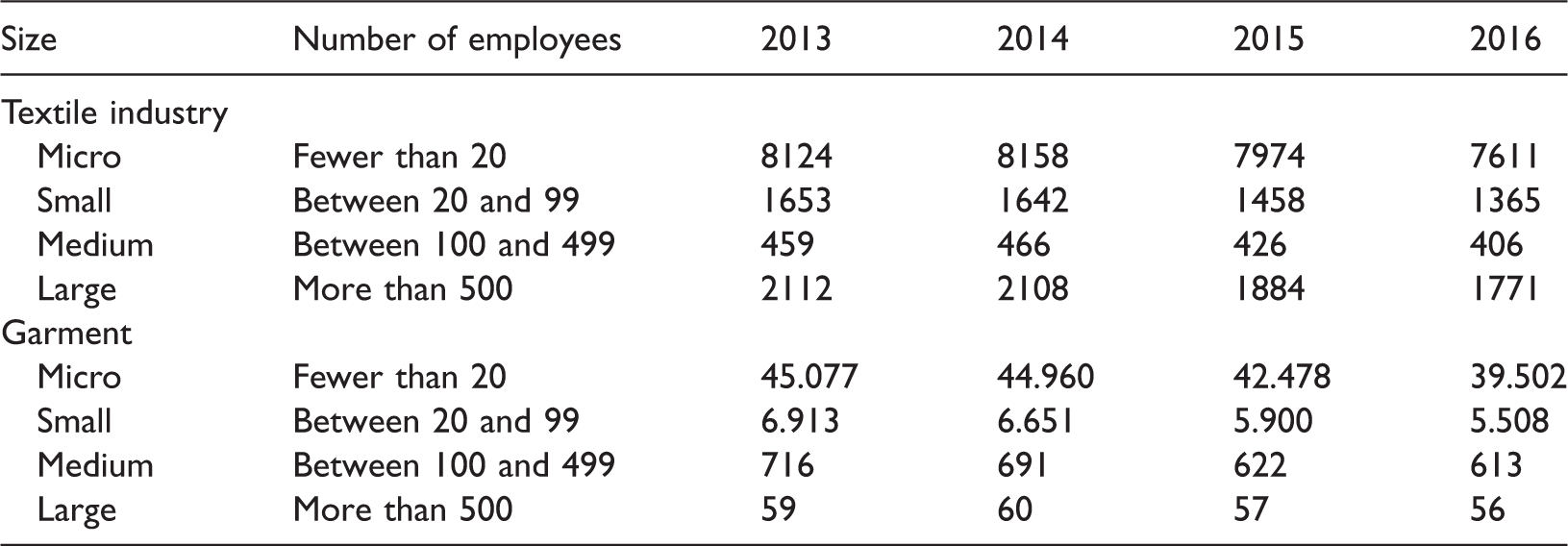
Source: ABIT (2018).
The result of a lower level of competitiveness can easily be seen in the declining shares of Brazilian products in the international and domestic markets. Asian garments can be sold in Brazil for a much lower price than Brazilian producers are able to produce at. This development is evident in the textile industry and shows the cumulative change for imports from China (see Figure 1).

Cumulative changes over time of the Brazilian garments industry (using data taking 2003 as the base year). Source: IBGE, ABIT, IEMI.
The formal and informal sectors have both been struggling with these conditions, and their answer has been to increase the share of Asian products they sell. One small entrepreneur commented as follows: Until a few years ago, we did not sell products from China. Now around 30% of our sales are composed of Chinese products, and it (the share) is growing. We are unable to produce for the price at which we sell these clothes. The difference between the price of the imported product and the national product is huge. With the imported product, we have a better margin than with our own products. An increasing percentage of our sales consists of imported garments, but we also import raw materials from different countries in order to produce our [own] clothes. You can see there (pointing to the other side of a giant room), two years ago, we had only a few employees in the international trade department. Now we have almost twenty employees only to buy products in China, and we have also established an office there. We do not produce the cheapest products anymore, the lower quality products – these now are Chinese … but we are prepared to compete with high-quality products. [With] these products we have a good share of the European market. Chinese products are not at this level, at least not yet. We have seen firms that were quite dependent on a single retailer, and this became their death sentence. When these retailers went down, they took their suppliers with them. To be highly dependent on one firm can have huge impacts on the possibilities for survival, therefore most firms are now avoiding this dependence, and even avoiding links with international firms – we do not see participation in GVCs as an option. We are not looking to become suppliers for international firms – this is not an option for us.
Functional upgrading: Increasing the competitive advantage of local firms
In the academic literature, the clothing industry has been treated as a low-capital, highly labour-intensive industry with an unsophisticated technology. This conceptualization still holds true when analysing the lower-end garment firms. However, the industry as a whole has changed rapidly and become more capital-intensive, with close links to other industries, such as chemicals and machine manufacturing. The speed of innovation in textiles, design and machinery has modified the characteristics of this industry. Fast fashion is not only related to the design of clothes, but also to the use of new fabrics and of sophisticated technologies to develop them, thus reducing production costs and improving quality. The much greater differentiation between fabrics is only made possible by heavy capital investment in technological and organizational upgrades, which depend on new organizational arrangements and supplier relations.
Originally, the Brazilian textile industry provided the major inputs into the clothing industry, and as a result, vertical and horizontal linkages were created between these two sectors, resulting in strong interdependence. More recently, the use of information technologies to exchange sales data, the adoption of standards for product labelling and new methods of material handling have strengthened this interdependence further. The idea of lean manufacturing has spread throughout Brazilian industry (Rocha, 2009), shifting the competitive advantage of suppliers from being mostly a question of the reduction of production costs to one of the costs in combination with lead time, innovation, flexibility and continuous quality improvement. The ability to create new fashions and respond to innovations quickly became central, competitive advantages. As a result, the restructuring of the industry concentrated on both technological modernization and skills upgrading. A central issue in technological modernization was to have access to a labour force capable of operating and carrying out maintenance on the new equipment, which implied a more specialized labour force than that the previously contracted companies possessed. The general manager of a large textile factory remarked: When you renew equipment, labour really needs to be more specialized. The skill levels today are of a more refined level, [and] the technological changes require a higher degree of domain knowledge for our personnel. I would say that we use SENAI [and] other training schools, but our major focus is internal training. The company provides courses [and] when purchasing equipment, we send our personnel to the equipment manufacturer. The SENAI is fundamental for us. Without it we (the local firms) would not survive or even exist. There were some proposals to discontinue the levy that supports SENAI, [which] would undermine the whole industry. I worked for fifteen years at X (a large producer and retailer). All my knowledge comes from this time, and a few years ago, my boss asked me to become one of their suppliers. It was a great opportunity, and over time I started my own independent business. I am still a supplier for X, but I also have my own trademark and am selling my own designs here (in a street market).
New trends in fashion, the upgrading of production processes and the speeding up of product creation
The industrial regime in the garments and textile industry is not only affected by the macro-structural changes that have been triggered by more liberal policies: it has also been impacted by the new fashion culture, with its emphasis on trends, copying and speed. As Tungate (2005) has argued, There may have been a time when fashion was constructed like a pyramid, with haute couture at the apex, designer ready-to-wear just below, challenger brands in the middle and a big slab of mass retail at the base. This is no longer the case today … Consumers … rather than being content to stay in their allotted sectors, scurry promiscuously from one to the other.
In the garments industry, patents for products or copyrights for a specific design are difficult to establish and sustain, any attempt being costly in terms of time and financial resources. As a result, the only way to protect one’s own market is through very rapid changes in collections, made possible only through the upgrading of production processes, coupled with fine-grained control of stocks and sales. Garment companies thrive on fast cycles: rapid prototyping, small batches combined with large variety and efficient logistics (Skov, 2002). Large Brazilian producers and retailers have reorganized their production processes in order to follow these rapid changes in fashion.
However, the logistical operations involved in bringing products from China make it difficult to follow the ever-changing demands of the fast fashion market, constituting a barrier to imported products with better quality and higher prices. At the same time, the mass production of lower quality and/or standard products such as T-shirts, uniforms and underwear has moved entirely to lower-income countries. Basic clothes are now largely imported from other developing countries since this segment is unprofitable if undertaken locally. Brazilian producers are becoming traders in basic Chinese clothing, leaving local firms to concentrate on higher value-added products at their own production sites. What I am selling here represents 20% of my production; the other 80% I produce to several other firms as … [names a few companies]. I started copying other products, but now I have my own design. It is a little bit different from the others you can encounter here, but soon, if it sells well, other firms will copy it, there is space for everyone. A simple photograph of a product or taken from the internet can easily be copied, modelled and put into production. I visit shopping malls [and], if I like a product, I take a few pictures, and one of our suppliers can easily reproduce the model.
In a very unequal society like Brazil, brands and fashions are important ways of differentiating social groups. As such, the copying of expensive products by cheaper producers destroys the value of these products for the upper classes. As the marketing manager of a famous Brazilian brand explained: Our products are very expensive, more expensive than Chanel is, and if one of our customers sees a lower-class woman using the same product she will be upset…. Being exclusive is one of our main features.
Local trademarks fight for exclusivity in order to defend their niche markets and are therefore continually creating new fashions, which small firms can copy easily. The creation of value in new fashions is continuous, but it happens almost simultaneously with the destruction of this same value by saturation. For this reason, batches must be small and the innovation continuous, with feedback from the retail stores taking place on a daily basis. Firms achieve this through a complex system of cooperation and competition in which specialized firms, which were previously internalized as part of large groups and firms, now provide services for their previous employers.
The rule of thumb among producers: Avoid dependence
As small producers do not have access to a large pool of resources, producers have learned to organize their own dynamic and flexible value chains, avoiding complete dependence on any particular customer. These flexible and short-term value chains are made possible by a continuous shifting of roles, with different specialized producers being able to sell the final products of the value chain they temporarily lead. For instance, a supplier in the middle of the value chain providing specialized services (modelling) accumulates different resources over time (network, finance, knowledge and skills) and decides to organize his or her own independent production by leading a temporary value chain. Once the season ends, the same producer can provide services to one of its previous suppliers, which now leads the value chain. In this way firms cooperatively redefine the roles they play for different products and collections. At the same time, this process exerts pressure on the large retailers, which, needing to become more flexible and reduce costs, outsource more functions, which in the medium term will contribute to the survival and growth of this new regime. As a part of this process, workers move among firms, acquiring different skills and competences, which, taken together, reinforce the capacity of the whole system.
Paradoxically, the dominant threat to formal firms, namely imitation of their products, has become their chief defence against Chinese products, which cannot be produced and transported in time to accommodate the demand for the rapid turnover of fashions. In so far as the design and marketing of a fashion are Brazilian, the Chinese producers will be kept at bay. There is a time lag of approximately 3 months between production in China and the Brazilian stores receiving their products – too long a span of time in a fashion regime that relies on the rapid copying of products.
Conclusion
This article has sought to contribute to the recent literature on the responses of firms located in different countries to the changes that have taken place during the last decade, namely the liberalization of trade and the ending of international quotas. The paper goes beyond this literature in a number of ways.
First, the paper addressed a gap in the literature, which has emphasized the links between big global retailers and local producers, with the latter being conceptualized as very weak actors, a conceptualization that victimizes the local producer. This makes it difficult to understand the self-development and active responses of local producers and their ways of engaging with the new market conditions. Secondly, the reason for this is that much of the literature has focused on GVCs and the processes of inclusion and exclusion in these chains (Bair and Werner, 2011). At the same time, this has ruled out any attempt to improve understanding of the evolution of these local markets and their potential to support the emergence of a different and more local type of value chain, one that is more flexible and that presents a lesser power differential.
However, rather than stressing opposition to this literature, we emphasize the complementarity between the GVC and the flexible value chain, stressing the need for more complementary efforts. Thus, we have argued here that our understanding of the evolution of value chains will be furthered by starting with a conceptualization of the value chain as less rigid and more dependent on local conditions and developments.
A second aim of this paper has been to document the importance of investigating the evolution of the local market in order to understand the actual structural development of the value chain. We showed that the Brazilian garment and textile industry has no dominant type of firm, being highly fragmented and presenting a dynamically flexible reorganization of its value chains. As in other cases analysed by Herrigel and Zeitlin (2010), we show that the process of the disintegration of major producers has begun to undermine the very hierarchy it was supposed to sustain. The outsourcing of some of the production of value results in learning across organizational boundaries and makes it possible for smaller firms to copy and reproduce new designs rapidly, as well as promoting the diffusion of knowledge and skills within the network of firms.
It could be expected that retailers harvested the majority of the benefits (sales increases, stock reductions, forecasting errors) produced by changes in the production system because of their size and concentration of power. The Brazilian case shows a quite different pattern in which the lower concentration of retailing firms weakens the role played by the big retailers in the local market. The strategy of producers in starting their own trademarks by organizing dynamic, flexible and short-term value chains reduced still further the ability of the big retailers to concentrate their revenues from the restructuring.
This fast-copying fashion regime is forcing firms to respond recklessly to product imitation and market variation, which involves considerable organizational flexibility. One expectation was that firms would achieve this through numerical flexibility, as in the Chilean case, combined with less complex organizational structures and arm’s-length relations with employees and business partners. However, this expectation contrasts strongly with how Brazilian firms respond to market changes. Large firms are developing long-term relationships with their employees and investing in training and new technologies. This flexibility is not achieved by a policy of continuous hire and fire, because it depends on employees being able to acquire new skills and improve work processes to meet the demand for continuous innovation. Numerical flexibility would jeopardize this strategy.
In the street markets, new relationships are constructed, and information is exchanged. A new fashion is rapidly copied, only to see its value destroyed in a few weeks. This strategy of the continuous innovation and change of collections is sought by firms of different sizes. Only very small batches can be profitable. Once the product becomes fashionable, and because it has no intellectual property rights to protect it, other firms will rapidly imitate the new fashion, whereby its value as different is rapidly destroyed. As a result, firms need to produce smaller batches and have continuous control over sales results. Products that do not sell or have been copied by several producers must be discontinued.
Our article presents three main contributions to the study of value chains. The strategies Brazilian firms follow in order to survive, upgrade and gain space in the value chain are likely to inspire governments, clusters and firms in other emerging markets. First, the flexible governance model makes it possible to avoid or at least substantially reduce dependence on GVCs, a governance model in which upgrading seems to be dependent on weakening links with powerful players. Flexible governance regimes reduce the power of the large retailers in setting prices and production standards across the value chain, immensely reducing the financial pressures on producers to continuously cut costs, and creating the possibility to invest in technological and organizational upgrade. Secondly, we show that, since upgrades of products and processes in terms of innovation capacity are central, firms still need both to innovate continuously and to copy products from other firms, this being made possible by the interdependence between firms and their changing roles in the flexible value chains. Thirdly, in terms of functional upgrading, although a firm may retain its core competences, it is not fixed in a specific role and avoids being solely connected to a single value chain or customer. For instance, a small firm that sews shirts for a large retailer may, in the context of seasonal variation, organize a short-term value chain to produce its own garment and sell it to the final consumer, perhaps having its own local store or selling it in the street market to small retailers from other cities and states as well. These shifting and flexible roles on the part of producers have contributed to better quality and a more innovative virtuous cycle among producers, a process similar to those followed by Italian and German producers (Guercini, 2004; Lane and Probert, 2004).
In recent decades, the market for basic garments in Brazil has become increasingly dominated by imports from Asian countries, mainly China, forcing local firms to move towards the higher end of the industry by intensifying their attempts to improve products and processes and speed up innovation. The result has been an increasing diversification of products of higher quality and the copying of these products at the lower end of the industry, leaving behind any attempt to compete with imported basic garments and simpler textiles from Asia.
The Brazilian example is one of industrial restructuring, with a recombination of parts and the increasing disintegration of large firms, as well as the fragmentation of local industrial chains. In the Brazilian textile and garments industry, vertical disintegration has taken place among the large producers, which have started playing new roles. Large local retailers do not dominate the domestic market, and global retailers are still incipient actors. Instead, a highly fragmented retail market is linked to a highly disintegrated industry in which many producers of different sizes are selling their products to retailers, as well as directly to the end-consumers. By combining imports with their own production, small producers are able to compete with their own customers: the retailers. Our results show that the continuous recomposition of the value chain and the permutation roles played by firms constrain the concentration of power among retailers. At the same time, we find producers starting their own retail stores, as well as big retail stores still controlling their production. Different business models exist and compete within the same market. Firms are dynamically interacting in new ways by combining a diversity of organizational forms in the same industry.
Our analysis indicates that the role of the state in regulating the textile and garment industry was more hands-off than we had expected. Future research might analyse different sectors from a comparative perspective and verify whether this now weaker state role applies to the Brazilian economy as a whole, or whether some industrial sectors are receiving stronger state support than others are. We suspect that the role of the state will prove to be more proactive and promotional (Jugend et al., 2018; Weiss, 2003) in some sectors than in others.
The main aim of the paper has been to describe the responses of the Brazilian textile and garments industry to the processes of national deregulation and to the ending of international quotas. We have shown how the changes that are occurring in Brazilian industry indicate the emergence of flexible value chains. However, we can indicate some of the reasons for the differences encountered compared to other countries. As Lund-Thomsen and Wad (2014) expected, the increasing numbers of middle-class consumers have created new markets and encouraged the pursuit of upgrading possibilities by local producers and consequently affected their resistance to being integrated into and dependent on GVCs. The consumption patterns of Brazilians have changed radically, and millions of new consumers entered the market during the golden years of Lula’s government, immensely expanding the markets for both national and international firms. However, local entrepreneurs see their integration into GVCs as inducing a racing to the bottom among producers and struggle not only to avoid participating in GVCs, but also seek to create possibilities to bypass them in export markets. The important variable which explains the existence of a flexible form of value-chain governance is that several producers gain access to consumer markets, reducing the dominance of the big players, whether national or international retailers and marketers. At the same time, the industrial actors have reorganized their relationships in a way that has made it possible for them to compete with cheaper Chinese products by upgrading production and design processes, as well as the speed of value creation and destruction. This upgrading process has been facilitated by a well-structured system of skills formation (Rocha, 2009; Weinstein, 1996) and the emergence of a myriad of fashion design schools.
Several important issues could not be dealt with in our paper. For instance, it has not investigated the new conditions of work and employment in these industries (Posthuma and Bignami, 2014). The employment strategies and conditions of work between informal and formal firms are likely to present great variation concerning how these firms follow national regulations. The regulatory agencies are likely to face difficulties in enforcing the minimal legal requirements concerning working conditions in the informal sector. National regulations protect employees in the formal sector, but not workers in the informal sector. Another issue of relevance is how firms make use of natural resources. Again, formal and informal firms are likely to diverge, since the informal firms are not registered and are likely to be out of the radar range of the authorities tasked with controlling the use of natural resources, especially water, which is an important resource in the industry (cf. Almeida, 2008; Rocha, 2017). Future research needs to address how firms deal with these important issues in the new competitive environment.
Footnotes
Declaration of Conflicting Interests
The author(s) declared no potential conflicts of interest with respect to the research, authorship, and/or publication of this article.
Funding
The author(s) received no financial support for the research, authorship, and/or publication of this article.