







Abstract
In the present study, the Career Adapt-Abilities Scale (CAAS)—which aims to measure concern, control, curiosity, and confidence as psychosocial resources for managing occupational transitions, developmental tasks, and work traumas—was translated into Turkish in order to examine the factor structure and psychometric characteristics of the scale in a Turkish sample. Data was collected from 669 high school and university students. Internal consistency estimates for the subscales and total scores ranged from good to excellent. The factor structure of the CAAS-Turkish was similar to the hierarchical four-factor model of the CAAS-International. The relationships among career adaptability, hope, and optimism were found to be as expected. These results suggested that the CAAS-Turkish is a valid and reliable scale for use in Turkish high school and university students.
Considering the trends of today's work world—globalization, multiculturalism, changing organizational forms and structures, more flexible employment patterns, changing values, and increased job insecurity (Amundson, Harris-Bowlsbey, & Niles, 2009; Biemann, Zacher, & Feldman, 2012)—human flexibility, adaptability, and life-long learning is becoming increasingly important (Savickas et al., 2009). Thus, the applicability of 20th century vocational development models is debatable (Savickas et al., 2009; Vondracek, Ferreira, & Santos, 2010). As an advancement of Super's (1957) theory of vocational development, career construction theory focuses mainly on how individuals use their vocational personality to adapt to a sequence of job changes (Savickas, 1997, 2005). According to Savickas (2005) “career construction theory focuses on neither the person nor the environment in the famous P–E symbol; instead it focuses on the dash (–), asserting that building a career is a psychosocial activity, one that synthesizes self and society” (p. 45).
One of the central components in career construction theory is career adaptability (Savickas, 2005), that is, viewed as a psychosocial construct, which refers to an individual's resources for dealing with current and expected tasks, transitions, and traumas in their occupational roles (Savickas, 1997; Savickas & Porfeli, 2012). Additionally, Savickas (2005) conceptualized career adaptability as more changeable than traits and proposed career adaptability as the attitude, competences, and behaviors that individuals use in fitting themselves to work that suits them. People who have higher levels of adaptation are more flexible and have more adaptability to cope with changing conditions (Savickas & Porfeli, 2012). Many scholars support the notion that career adaptability would be helpful to provide individuals with the necessary psychosocial resources to cope with the transition from school to work (Koen, Klehe, Van Vianen, Zikic, & Nauta, 2010; Murphy, Blustein, Bohlig, & Platt, 2010). Also, a number of longitudinal studies revealed that individuals who have high levels of career adaptability are more successful in mastering vocational transitions (Creed, Muller, & Patton, 2003; Germeijs & Verschueren, 2007; Neuenschwander & Garrett, 2008; Patton, Creed, & Muller, 2002). In this regard, the high school and university years, when students have to make decisions regarding employment and further education, are crucial with respect to the career decision-making process and adaptability.
An international research team composed of scholars from 18 countries generated an operational definition for the linguistic concept of career resources and jointly developed a measure of career adaptabilities. Then, data were collected in 13 countries to evaluate the psychometric properties of the scale. An examination of the factor structure of the scale from different countries confirmed that the scale was multidimensional and hierarchical (Savickas & Porfeli, 2012). Accordingly, the four adaptability resources are identified by the CAAS-International as concern, control, curiosity, and confidence. Concern is about having awareness and being able to plan for a vocational future. Control allows individuals to take control over the vocational future and includes beliefs regarding personal responsibility for creating one's career by using self-discipline, effort, and persistence. Curiosity is about the tendency to explore one's environment by exploring the possible-selves and alternative scenarios of the future. Confidence reflects the self-confidence to deal with vocational or career problems efficiently (Savickas & Porfeli, 2012). These psychosocial resources are viewed as self-regulation skills that can be used to cope with life challenges (Savickas, 2005).
Turkish context
Turkey has an exceptional geographic location that forms a bridge between Europe and Asia. After the Ottoman Empire, the republic of Turkey was established in 1923. It is a democratic and secular country with people who are predominantly Muslim. Today, variations in attitudes, values, and lifestyles among those in different geographic regions and groups prevent us from making a general definition of Turkish people. However, Mocan-Aydın (2000) concluded that “if we consider a continuum of collectivism versus individualism, Turkish people still seem to be close to the collectivistic end while at the same time striving for individualism” (p. 282). As a result of economic and social changes consistent with worldwide trends such as liberation and globalization, traditional values appear side by side with individualistic values (Çileli, 2000; Karakitapoğlu-Aygün & İmamoğlu, 2002).
Education in Turkey is administered by a national system. Children are required to have 12 years of education when they are between the ages of 6 and 18. At the end of the sixth, seventh, and eighth grades, each student takes the nationwide placement test (SBS) and at the end of the 8th grade, depending on the total marks of their SBS exams, students choose which high school they would like to attend (e.g. general high schools, vocational high schools, science high schools). At the end of their high school education, students are selected and placed in undergraduate programs based on a nationwide university entrance exam. In this system, students do not choose a major during their university education; they choose departments prior to their enrollment as a student at university based on their nationwide university entrance exam scores. Since higher education is viewed as crucial for future employment and opportunity, the demand for universities is constantly increasing. As a result of the discrepancy between supply and demand, only one-third of students continue on to university. The others start working or wait one more year to take the next exam. Thus, in the current education system, it is not clear to what extent students are left with the consequences of possible immature or undesirable choices for their departments. In this regard, at the high school and university level, it is particularly important to assess factors that contribute to career adaptability and relevant skills that are essential to facilitate such adaptability.
In the present study, data were collected from both high school and university students. In Turkey, high school means grades 9 through 12 and universities are higher education institutions providing a number of academic programs at the Bachelor's as well as the Master's and PhD levels. Career counseling and vocational guidance services are more common in high schools, and these services are offered by school counselors. In contrast to high schools, a majority of universities do not have any career centers or career counselors to provide advice or offer vocational guidance services. Thus, career counseling services still need to be developed both in high schools and universities.
In response to the call for further testing of the scale (Savickas & Porfeli, 2012), the present study aims to examine construct validity and psychometric properties of the CAAS-Turkish. In addition, the relationships among career adaptability, hope, and optimism are reported to provide further convergent validity evidence.
Hope and optimism
The rationale for using hope and optimism as possible correlates of adaptability is based on the notion that people have varying degrees of willingness to engage in adapting behaviors. Accordingly, dispositional characteristics may facilitate or maintain adaptation. Hope is defined as “the perceived capability to derive pathways to desired goals, and motivate oneself via agency thinking to use those pathways” (Snyder, 2002, p. 249). A substantial body of research has indicated that a high level of hope has been related to adaptive coping and adjustment in a range of stressful situations (Barnum, Snyder, Rapoff, Mani, & Thompson, 1998; Snyder, 2002; Taylor & Armor, 1996) in addition to more flexible and positive thoughts (Snyder & McCullough, 2000).
Consistent with hope, optimism, which is perceived as “a stable predisposition to believe that good rather than bad things will happen”, can be regarded as a proactive personality trait when encountering negative life events (Scheier & Carver, 1985, p. 219). Creed, Patton, and Bartrum (2002) stated that “optimism performs a self-regulatory function in determining whether an individual will initiate or maintain working toward desired goals” (p. 43). Researchers reported that greater optimism was found to be related to better personal, social, and academic adjustment (Brissette, Scheier, & Carver, 2002; Montgomery, Haemmerlie, & Ray, 2003), work happiness, job satisfaction (Youssef & Luthans, 2007), higher levels of career planning and exploration, a high level of confidence about career decisions, and having more career-related goals (Creed et al., 2002).
Even if adaptability, hope, and optimism are distinct constructs, it is anticipated that adaptability correlates to some extent with hope and optimism. Drawing on the findings of the current literature summarized here, the following hypotheses were proposed:
Hypothesis 1. Hope positively correlates with (a) overall career adaptability; (b) concern; (c) control; (d) curiosity; and (e) confidence. Hypothesis 2. Optimism positively correlates with (a) overall career adaptability; (b) concern; (c) control; (d) curiosity; and (e) confidence.
Method
Participants
The sample of the study consisted of 669 participants: 353 (144 males and 209 females) high school students from 9th (n = 61), 10th (n = 180), and 11th (n = 112) grade, with a mean age of 16.03 years (SD = .75); and 316 (125 males and 191 females) university students (62 freshmen, 48 sophomores, 118 juniors, and 88 seniors), with a mean age of 20.99 years (SD = 1.93). The total sample was composed of 269 (40.2%) male and 400 (59.8%) female students. Participants’ ages ranged from 14 to 35, with a mean of 18.38 (SD = 2.87). All participants voluntarily completed the CAAS-Turkish Form, Dispositional Hope Scale, and The Life Orientation Test. In addition, all participants of the study were Turkish and mainly from urban areas.
Measures
Career adaptability
Career adaptability was assessed by means of the Turkish version of the Career Adapt-Abilities Scale (Savickas & Porfeli, 2012). Recommended translation procedure (without back translation) by Ægisdóttir, Gerstein, and Canel-Çınarbaş (2008) was followed to generate the Turkish version of the scale. Back translation of the scale was purposefully avoided to inhibit both concept and item bias (Van de Vijver & Hambleton, 1996). As a first step, the International version of the Career Adapt-Abilities Scale was translated into Turkish (from English) by three experts (two professors of psychology and a doctoral student of English language teaching) independently. Then, these three translations were compared, and the best translation for each item was decided by the researcher, a professor of psychological counseling and guidance, a doctoral student of measurement and evaluation, and a doctoral student of Turkish language and literacy. In order to evaluate wording of the items and cultural relevancy of the Turkish version of the scale, both the Turkish and the English forms of the scale were given to three professors of psychological counseling and guidance. Afterward, some minor changes were made on the Turkish version of the scale, and this final form was administered to a small group of students (n = 59) to check the clarity and meaning of the items. Students did not offer further suggestions regarding the wording of the items. Thus, the final form of the CAAS-Turkish was constructed.
Career Adapt-Abilities Scale: Items, descriptives, and standardized loadings.
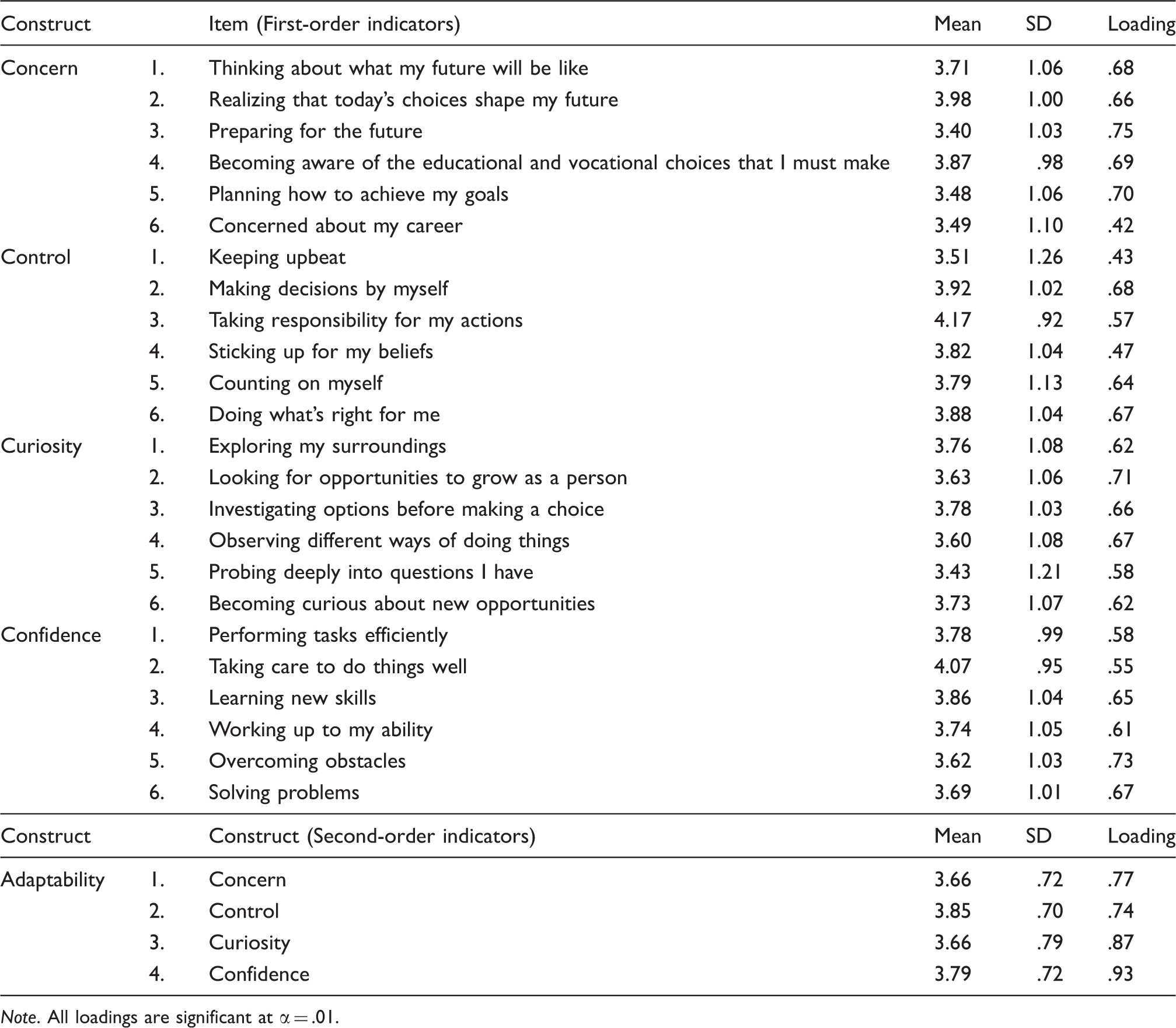
Note. All loadings are significant at α = .01.
Hope
Hope was measured by the Dispositional Hope Scale (DHS; Snyder et al., 1991), which is composed of 12 items with four filler items. DHS is a 4-point rating scale ranging between definitely false and definitely true. For the total scale, reported Cronbach alphas ranged from .74 to .84 (Snyder et al., 1991). Example items were “I energetically pursue my goals” and “There are lots of ways around any problem.” The Turkish form of the scale was administered to participants. An adaptation study of the scale translated into Turkish was carried out by Akman and Korkut (1993). The reliability of the Turkish version of the DHS was assessed by internal consistency and test–retest reliability. The reliability of DHS was assessed by internal consistency and test–retest reliability. For the entire scale, the estimated internal consistency reliability was .65. The test–retest reliability coefficient was found to be .66 within a four-week interval. Akman and Korkut (1993) and Denizli (2004) conducted separate factor analytic studies on items of the DHS among Turkish undergraduate students. Inconsistent with the original study, the Turkish version of the DHS revealed a single factor structure. The estimated internal consistency reliability was .80 in the present study.
Optimism
Optimism was measured by the Life Orientation Test-Revised (LOT-R; Scheier, Carver, & Bridges, 1994), which includes 10 items with four filler items. Participants respond by indicating their preferences on a 5-point rating scale ranging from strongly agree to strongly disagree. Example items include “In uncertain times, I usually expect the best” and “I hardly ever expect things to go my way.” Internal consistency reliability was .76 and test–retest reliability was found to be .79 in a-four week interval (Scheier & Carver, 1985). The scale was adapted into Turkish by Aydın and Tezer (1991). The internal consistency of the scale was assessed by Cronbach alpha (.72) and test–retest reliability with a four-week time interval was .77. In the current study, the reliability coefficient of the scale was .75.
Procedure
Before data collection procedures, necessary permissions to conduct the study were obtained from Samsun Provincial Directorate of the Ministry of National Education and Ondokuz Mayıs University. All data were collected during regular class hours by the researcher using a paper-and-pencil format with the permission of the teachers and course instructors. No identifying information was requested from the participants to guarantee their confidentiality and anonymity.
Results
Descriptives and correlations of the CAAS-Turkish
Reliabilities and correlations of the CAAS-Turkish, hope, and optimism.
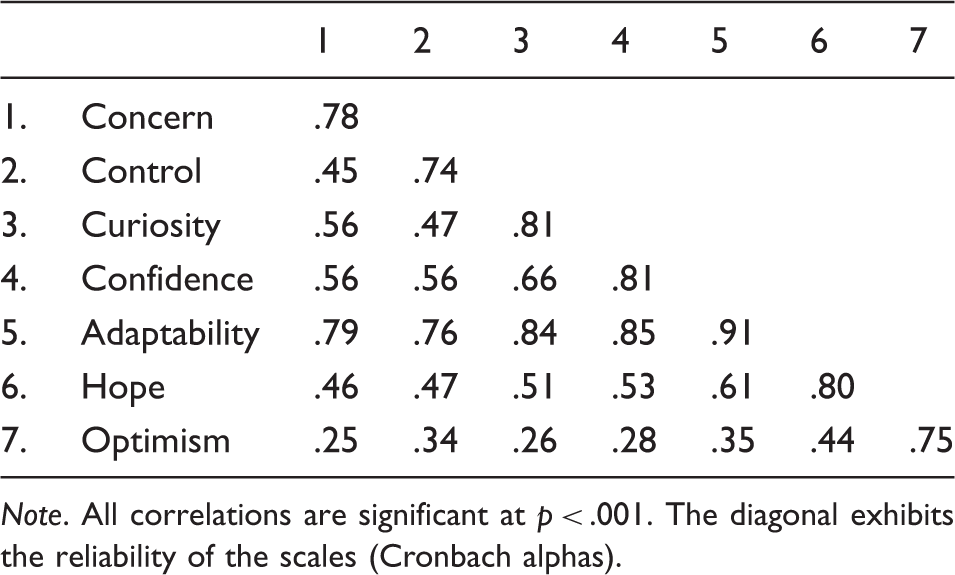
Note. All correlations are significant at p < .001. The diagonal exhibits the reliability of the scales (Cronbach alphas).
Confirmatory factor analysis
Confirmatory factor analysis (CFA) with maximum likelihood estimation (ML) was conducted to test the hierarchical four-factor model of the CAAS-International in a Turkish sample by means of AMOS 18 software (Arbuckle, 2009). The raw data were submitted to the software. Results suggested that data for the CAAS-Turkish fit the proposed model. For the Turkish sample, the fit indices were x2 = 833.063, df = 248, p < .001; x2/df = 3.36; RMSEA = .060, 90% CI = .055, .064; SRMR = .049; CFI = .90 and these results confirm previously suggested fit criteria (Hu & Bentler, 1999). The standardized loadings presented by Table 1 indicated that all items are strong indicators of the first-order constructs (concern, control, curiosity, and confidence), which in turn are strong indicators of the second-order adaptability construct.
Comparing the CAAS-Turkish hierarchical four-factor model to the model for the CAAS-International 2.0 showed that the loadings of the items on the first-order factors of adaptability were considerably similar. The most remarkable difference was for Concern#6 (“Concerned about my career”) displaying a lower loading in Turkish data. The loadings for the constructs of concern (.77) and curiosity (.87) were similar to CAAS-International (.78 and .88, respectively) and the loading of confidence (.93) was higher than on the CAAS-International (.90). The highest difference between the Turkish sample (.74) and the International sample (.86) was observed on the control.
Concurrent validity
In order to provide additional evidence for the validity of the CAAS-Turkish scores, these scores were correlated with the measures of hope and optimism. As shown in Table 2, all correlations were significant in the expected direction. It was hypothesized that hope would be positively correlated with career adaptability (Hypothesis 1a). Results of the study confirmed Hypothesis 1a; hence, significant positive correlations were found between hope and the CAAS-Turkish subscales of concern (Hypothesis 1b), control (Hypothesis 1c), curiosity (Hypothesis 1d), and confidence (Hypothesis 1e). The highest correlation coefficient was found between the hope and career adaptability total score (Hypothesis 1a). Regarding Hypothesis 2a, optimism significantly and positively correlated with the career adaptability total score and the dimensions of the CAAS-Turkish: concern (Hypothesis 2b), control (Hypothesis 2c), curiosity (Hypothesis 2d), and confidence (Hypothesis 2e).
Discussion
This study aims to examine psychometric properties of the CAAS-Turkish in a group of high school and university students. The results of the statistical analyses provided evidence that the CAAS-Turkish performs similarly to the CAAS-International with regard to factor structure and psychometric properties. The total scale and four subscales each showed good-to-excellent internal consistency estimates and a coherent multidimensional, hierarchical factor structure, consistent with the proposed theoretical model. Thus, it is possible to state that the CAAS-Turkish seems ready for use by researchers, counselors, and psychologists who want to measure adaptability resources among high school and university students.
A closer examination of the means of the subscales revealed that control was found to have the highest score among the four subscales. This may result from the structure of the Turkish education system, which is relatively centralized and determined by certain rules, because high school students know that if they want to study at a university they must get high scores on the national university entrance exam. In that situation, to shape their future, they may use self-discipline, effort, and persistence that may lead to more control. On the other hand, both curiosity and concern have the same low score. As mentioned, students were selected and placed in undergraduate programs based on national exam scores. However, the discrepancy existing between the number of potential degree candidates and the actual number of student placements in academic programs is enormous. Each year only about one-third of the candidates are placed in a university program, leaving two-thirds without higher education (Mızıkacı, 2006). Moreover, a considerable number of students who are placed into academic programs after passing the exam go on to retake the entrance exam several times to enter the academic program that they desire. For example, in 2010, 23% of the students who took the university entrance exam were retaking it even they were already currently university students (OSYM, 2010). Therefore, in order to enter one of the highly ranked universities, students and parents are extremely focused on being successful on the exam. Throughout the preparation process for the entrance exam, many students and parents seem to ignore the importance of career exploration. Likewise, senior students or graduates of universities have to take National Civil Service Personal Exam to work in government agencies, which offer stable income, specific working hours, and many holidays. If students get high scores from this exam, they can be appointed to one of the appropriate government agencies. During the preparation process, students may not give importance to searching for job alternatives that may lead to low levels of curiosity. Both high school and university students have low levels of concern that might be the result of the national exam system, because they know the exam score is the most important determinant of future possibilities rather than other personal or environmental factors. Findings of this study are related to higher mean scores on control and confidence than on concern and curiosity, which are similar to results of the studies conducted in Belgium, France, Italy, Portugal, Taiwan, and the United States.
Even if adaptability, hope, and optimism are distinct constructs, significant correlations between adaptability, hope, and optimism were found, as expected. Hope was strongly correlated with total score of career adaptability, confidence, curiosity, concern, and control. On the other hand, optimism was moderately correlated with career adaptability, control, confidence, curiosity, and concern. Correlational analyses suggested that hope was more strongly correlated with career adaptability than optimism. While optimism includes making positive forecasts of succeeding now and in the future, hope involves persevering toward goals and redirecting paths toward goals in order to succeed (Luthans, Youssef, & Avolio, 2007). Parallel to previous studies (e.g. Duffy, 2010), a significant and positive relationship between optimism and adaptability was found, which means that students who endorse a greater sense of optimism may be able to more easily handle work or career-related challenges and changes. On the other hand, hope helps people believe that they will be able to take specific steps to achieve future goals. Researchers have reported that students low in hope tend to avoid tasks that are necessary to achieve their goals (e.g. Snyder, 2002). In this study, the strong relationship found between hope and career adaptability advocates that students who feel high levels of hope might tend to perceive themselves more as adaptable in their careers.
It is crucial to integrate career adaptability in career counseling interventions to increase adaptability resources in Turkey. This is important as the younger age group has a higher share of the total population and strives to manage their careers in a competitive educational system and labor market. Specifically, a low level of career concern leads to career indifference, which includes little or no planning and pessimism about the future. In order to deal with career indifference, career interventions designed to foster a forward-looking orientation will strengthen positive attitudes toward planning, and link present activities to future outcomes to encourage planning skills. As stated previously, career control means that “individuals feel and believe that they are responsible for constructing their careers” (Savickas, 2005, p. 54). A lack of career control causes career indecision; hence, interventions such as assertiveness training and decision-making training would be beneficial. To handle low levels of career curiosity, career interventions should aim to provide information using test interpretation and occupational information. In career construction theory, confidence denotes feelings of self-efficacy concerning the individual's ability to successfully execute a course of action needed to make and implement suitable educational and vocational choices. To promote career confidence, interventions may include success acknowledgment, encouragement, anxiety reduction, and problem-solving training. To sum up, career adaptability can be enhanced by interventions including orientation exercises, decisional training, information seeking activities, and self-esteem building activities (Savickas, 1997, 2005; Savickas et al., 2009).
This study has some limitations that should be undertaken when evaluating the results of the study. Even if the sample size was relatively large enough to carry out the study, the sampling procedure did not rely on random sampling, which limits the generalizability of the findings. In conclusion, the Turkish version of the CAAS seems to have a good degree of reliability and construct validity. It would be useful for future testing of reliability and validity of the CAAS-Turkish including more diverse samples. In addition, future research is needed to consider how several personal, social, and cultural variables are associated with career adaptability in the Turkish cultural context.
Footnotes
Declaration of conflicting interests
None declared.
Funding
This research received no specific grant from any funding agency in the public, commercial, or not-for-profit sectors.