







Abstract
This contribution highlights the role of organizational context in facilitating or hindering recovery from work and introduces the concept of Organizational Climate for Recovery (OCR), defined as employees’ shared perceptions of the extent to which recovery activities are expected, supported and encouraged within the organization. This paper is a conceptual study with exploratory qualitative evidence. Description of recovery and organizational climate theories is complemented with semi-structured interviews involving 22 employees from different productive sectors. Interviews allowed to refine the construct of OCR and identify five organizational factors characterizing a recovery climate: management of workload, social support, autonomy, availability of recovery resources, and leadership support. By conceptualizing OCR, this paper contributes to the literature on employee well-being and offers practical recommendations for organizations to foster recovery-supportive climates. Future research should focus on developing measurement tools, assessing the impact of OCR, and designing interventions to enhance employee well-being and productivity.
Keywords
Introduction
Work pressures and demands on employees are becoming increasingly intense in the modern work environment. Constant connectivity and availability around the clock (Büchler et al., 2020), remote and hybrid work models blurring the boundaries between work and personal life (Carnevale & Hatak, 2020; Zappalà et al., 2024), the rise of advanced performance monitoring technologies, which increases expectations and performance pressures (Siegel et al., 2022), not to mention globalization, intensifying market competition and operations across diverse time zones and cultures (Idris et al., 2011), are elevating stress levels among employees and companies, and making work conditions more challenging.
Stress is the psycho-physiological response to demands that exceed an individual's perceived coping resources (Lazarus & Folkman, 1984). While some levels of stress may serve as a motivational force, chronic or excessive stress, common in today's fast-paced and hyperconnected work environments, may have detrimental effects on both individual well-being and organizational functioning, also leading to significant health issues. Recently, Gallup's Global Employees survey reported that 40% of workers reported feeling stressed at work in 2024, and that more than one-fifth of respondents reported negative emotions (Gallup, 2024). Taking care of stress and protect the well-being and health of workers is a priority for companies for both ethical and economic reasons (International Labour Organization, 2022; World Health Organization and International Labour Organization, 2022). Ethically, supporting workers’ health and well-being decreases individuals’ vulnerability to work and/or social exclusion and improves their economic security. Economically, healthy people mean more productive workers, but also lower risks of burnout, absenteeism, and staff turnover (Darr & Johns, 2008; Gerhardt et al., 2021; Nielsen et al., 2017). Thus, a growing number of organizations are investing in initiatives to prevent or mitigate the effects of job-related stressors on workers’ health and well-being, both at work and off time job (Karabinski et al., 2021), increasingly guided by the sustainability agenda promoted by the United Nations. In particular, Sustainable Development Goal 8 and Sustainable Development Goal 3 frame the protection of workers’ psychological and physical resources as a core component of decent work and lifelong health. From this perspective, safeguarding recovery opportunities contributes not only to individual well-being but also to sustainable career development and broader societal prosperity, echoing the call to move from decent work to decent and healthy lives within a sustainable development framework (Kenny & Di Fabio, 2024; Peiró et al., 2025).
In response to these needs, recovery from work, the process through which individuals restore physical and psychological resources depleted because of job-related stress and demands (Sonnentag et al., 2022), has gained significant attention in occupational health psychology (Sonnentag, 2018).
Strategies to recover from stress involve activities and consequent experiences that help individuals unwind and restore their physical and psychological well-being to pre-stressor level (Sonnentag et al., 2017, 2022). Recovery activities range from taking breaks during work to engaging in longer periods of rest, such as vacations, or from autonomously managing daily work schedules to practicing mindfulness, engaging in sports, or participating in social activities during non-work hours. These activities enable individuals to experience four types of recovery experiences, namely psychological detachment, relaxation, mastery, and control (Sonnentag et al., 2022; Sonnentag & Fritz, 2007), which help individuals to recharge, reduce stress, and maintain overall well-being (Bennett et al., 2018; Sonnentag, 2018; Sonnentag et al., 2017).
Research has provided important insights into predictors, such as limited time pressure and job control (Sonnentag et al., 2022; Sonnentag & Fritz, 2007), or outcomes of recovery, such as proactive behavior, proactive task performance, organizational citizenship behaviors (Binnewies et al., 2009; Huang & Tsai, 2024; Ouyang et al., 2019), or improved sleep quality (Chawla et al., 2020).
Despite extensive scholarly exploration of personal, job-related, and situational factors influencing employee recovery, minimal attention has been devoted to the role of the organizational context in facilitating or hindering recovery experiences. This highlights a critical gap in the literature: the lack of a focused conceptualization that captures how specific organizational factors can systematically enable or constrain employees’ daily recovery experiences.
Addressing this gap requires the development of a framework that considers recovery as a distinct, proactive, and context-sensitive process. In other words, to date, there has been no focused examination of employees’ perceptions of the organizational policies and practices that aim to support employees’ recovery processes. For this reason, this study introduces the concept of an Organizational Climate for Recovery (OCR) as a novel psychological construct that reflects shared employees’ perceptions and attitudes explicitly supporting or obstructing recovery activities.
To explore the OCR concept, and identify the key dimensions that may define it, this conceptual paper includes an empirical exploratory qualitative study involving 22 semi-structured interviews conducted with workers from diverse organizational contexts and countries. This investigation aims to identify the components that constitute a recovery-supportive climate, providing practical insights for conceptualizing recovery-supportive practices within organizations. In summary, this paper aims to conceptualize OCR integrating insights from literature on recovery from work, from one side, and organizational climate, from the other side. Then, it presents empirical evidence which identifies the dimensions that, we argue, compose the OCR. Subsequently, it discusses implications for research and practice. Finally, the paper acknowledges study limitations and suggests directions for future research.
Theoretical Foundations of the Organizational Climate for Recovery
Recovery from Work
Recovery from work is defined as the “unwinding and restoration processes during which a person's strain level that has increased as a reaction to a stressor or any other demand returns to its pre-stressor level” (Sonnentag et al., 2017, p. 366). This definition is mainly based on the Effort-Recovery Model and the Conservation of Resources Theory.
According to the Effort-Recovery Model (Meijman & Mulder, 1998), working requires effort that depletes resources, and subsequent recovery processes are necessary to replenish these resources and prevent strain. This theory provides an initial foundation of the importance of recovery; however, it offers limited knowledge for understanding the recovery process and moreover it focuses mainly on workload as a source of strain for workers (Zijlstra et al., 2014). The Conservation of Resources Theory (Hobfoll & Ford, 2007) goes in the direction to understand the dynamic process of recovery. This theory suggests that high-demand work consumes employees’ energy and emotional resources, and employees must invest additional resources to replenish the resources needed to return to work. Other theories, such as the Attention Restoration Theory (ART) (Ohly et al., 2016) and the Stress Recovery Theory (SRT) (Ulrich et al., 1991) highlight the mechanisms through which recovery helps mental well-being to come back to the “pre-stressor level”. ART suggests that engaging in activities that provide mental rest and stimulate fascination can restore cognitive functioning. Meanwhile, SRT posits that natural environments can have a restorative effect on individuals, helping to alleviate stress and improve employees’ well-being.
Two specific and distinct mechanisms are involved in recovery from work-related stress (Sonnentag et al., 2022): recovery activities and recovery experiences. Recovery activities refer to tangible behaviors such as physical exercise, hobbies or socializing outside of work, that require little effort are inherently enjoyable and help individuals to relax and replenish their energy. In contrast, recovery experiences, a consequence of recovery activities, pertain to the psychological processes through which individuals mentally and emotionally unwind from work. These include psychological detachment from job-related thoughts, mental relaxation, experiences of mastery through personal growth or challenging tasks, and a sense of control over how one spends his/her non-work and leisure time. Two additional dimensions discussed in the literature concern where recovery-supportive initiatives take place and how they are structured. The first refers to the distinction between external and internal recovery (de Bloom et al., 2015; Geurts & Sonnentag, 2006). External recovery occurs outside of work hours, typically in the evenings, weekends, or during vacations, and involves leisure activities that help individuals unwind. Internal recovery, by contrast, takes place during the worktime and includes activities such as coffee or lunch breaks that allow short-term detachment and recharging while still in the work context. The second dimension distinguishes between micro-breaks and work-related strategies (Fritz et al., 2011). Micro-breaks are brief, informal pauses involving activities unrelated to work—such as having a snack, stretching, or chatting with colleagues—which provide momentary relief from task demands. In contrast, work-related recovery strategies involve actively managing one's tasks to reduce stress and prevent the accumulation of strain, for instance by structuring tasks more evenly throughout the day or creating prioritized to-do lists.
Beyond these activity- and experience-based distinctions, recovery has also been examined through the lens of occupational fatigue and its prevention. In line with established research on occupational fatigue and recovery, recovery processes have been conceptualized as central mechanisms in preventing the accumulation of work-related fatigue and exhaustion. The Occupational Fatigue Exhaustion/Recovery (OFER) framework (Di Fabio, 2018; Winwood et al., 2005) distinguishes between acute fatigue, chronic work-related exhaustion, and inter-shift recovery, offering a measure that operationalizes recovery as a protective process which sustains performance and well-being.
Building on the mentioned literature, we conceptualize Organizational Climate for Recovery (OCR) not as an individual-level outcome, but as a contextual organizational condition that may enable recovery opportunities and help limit prolonged fatigue accumulation. Following the OFER approach, we underline the preventive relevance of recovery; our focus, however, is not fatigue measurement but the conceptualization of OCR as a climate-level construct that shapes the structural context and shared meanings surrounding recovery, thereby facilitating processes that are essential for employee health and sustainable performance.
Despite this theoretical scenario in which recovering from work is mainly an individual responsibility, mostly managed after work, we propose that recovery from work can also be framed as an organizationally driven and supported process. Organizational policies, when well supported and implemented by managers and supervisors, contribute to creating organizational climates that affect employees’ behaviors (Schneider et al., 2017). Thus, we argue that organizations may play a critical role in creating environments that facilitate recovery by addressing factors such as workload management, social support or employees’ autonomy that ensure that employees have the resources and opportunities to recover effectively. For this reason, we introduce organizational climate as a relevant, although understudied, asset that may influence employees’ involvement in recovery activities.
Organizational Climate and Organizational Health Climate
Organizational climate refers to the “shared perceptions of and the meaning attached to the policies, practices, and procedures employees experience and the behaviors they observe getting rewarded and that are supported and expected” (Schneider et al., 2013). Thus, this concept suggests that employees collectively perceive and interpret many distinct aspects of the work environment, such as, for instance, leadership styles, communication patterns, reward systems, interpersonal relationships, decision making or work processes and that these perceptions significantly shape employees’ attitudes and behaviors (Schneider et al., 2017).
Organizational climate develops from: (1) the common exposure of organizational members to the same structural characteristics; (2) the homogeneity of their members derived from the attraction, selection and attrition processes (Schneider, 1987); and (3) social interactions among colleagues, leading to the development of shared meanings (Glick, 1985). Although each person has personal experience of the climate in the company, the so-called “psychological climate”, organizational climate represents the aggregate set of these individual perceptions, and the more agreement there is among organizational members about the practices, policies, procedures, and behaviors that are encouraged in an organization, the stronger the organizational climate (Schneider et al., 2013).
Although research had initially described organizational climate as a generic and inclusive concept, deriving from factors describing organizational aspects, such as communication patterns, work relationships, leadership styles, autonomy and other job and group features, later Schneider (1975) proposed that organizational climate needed a focus, a target, so that, in other words, the construct should refer to a climate for something. The something of interest has concerned, for instance, climate for service (Schneider et al., 2000; Zappalà et al., 2018), climate for safety (Griffin & Curcuruto, 2016; Zohar, 2010), and even organizational processes, such as climate for diversity (Perry & Li, 2019). Focused climates, according to Schneider and colleagues (2013), are superior to molar ones both because they allow to understand specific organizational outcomes and suggest specific strategies to improve organizational functioning or employee performance.
An organizational climate close to recovery is the Organizational Health Climate (OHC), defined as employees’ shared perceptions of workplace events, practices, and procedures that reflect organizational support for health-related behaviors and norms (Zweber et al., 2015, 2016). A specific dimension of the OHC, the health climate, centers on employees’ perceptions of health-related behaviors and norms, and highlights the importance of organizational support in fostering healthier workplace practices and environments. Although previous studies underline the potential role of the OHC framework in influencing employees’ experiences and activities (Kim et al., 2022; Teetzen et al., 2023), its broad scope does not capture the organizational factors that specifically promote recovery from work. By framing organizational health and well-being as a general construct, the OHC framework treats recovery as one component among others, and conceptualizes it as an individual, reactive process that takes place after a noticeable decline in employees’ health. In contrast, we argue that recovery can be understood as a day-to-day process that can be proactively supported and embedded within organizational strategies for employee well-being. Moreover, OCR is conceptually distinct from structural job design frameworks, such as the Job Demands–Resources (JD–R) model (Bakker et al., 2023). While JD–R focuses on job demands and job resources as characteristics of work, OCR operates at the level of shared climate perceptions regarding how much organizations support, facilitate and encourage recovery from work practices. In this sense, OCR does not redefine demands or resources, but specifies the normative and organizational context within which recovery opportunities are enabled or constrained. Thus, in this study, we postulate the need to consider a specific climate for workers’ recovery activities, whether encouraged or not by the organizational context in which they are embedded.
Building upon the theoretical foundations of recovery from work and of organizational climate theory, we propose the concept of the organizational climate for recovery. This specific climate reflects the shared perceptions among employees regarding the extent to which their organization supports and encourages recovery activities. It encompasses policies, practices, procedures, and behaviors that signal to employees that their recovery from work-related stress is valued, expected, and facilitated by the organization.
Building on these theoretical foundations, the following section presents the qualitative empirical study conducted to explore how employees perceive recovery-supportive practices within organizations, with the aim of identifying the key dimensions that may characterize the organizational climate for recovery.
Empirical Investigation
To explore the concept of organizational climate for recovery, an empirical investigation was conducted to examine how organizational policies, practices and procedures are perceived and experienced by workers in different organizational contexts. The aims of the study were: 1) to identify the specific practices implemented in organizations and/or adopted by employees to support their recovery from work; 2) to analyze at what levels these practices are situated (individual, team, and organizational ones), and 3) to identify and conceptualize the key dimensions that may characterize the organizational climate for recovery as a construct. It is expected that this empirical and qualitative study provides a practical lens for conceptualizing the organizational climate for recovery and offers valuable insights into how organizations can foster this process among their employees.
Methods
Participants and Procedure
Data collection took place in 2024 and involved semi-structured interviews with 22 workers from various countries, including Italy, Bosnia Herzegovina, and Turkey. The participants represented a wide range of professional roles, such as lab technicians, marketing directors, bank employees, technical inspectors in the police force or chief foresters. Tenure in their respective roles varied significantly, ranging from 6 months to 29 years, providing a rich spectrum of experiences. Most participants worked 36–40 h per week, though some reported longer hours due to overtime or demanding responsibilities. Their work settings included collaborative team environments, small groups, and solitary roles, with a few benefiting from hybrid or remote working arrangements.
Goal of the study, interview contents and possibility to withdraw at any moment were illustrated to participants who gave their oral consent, which was audio-recorded. Interviews were conducted in a setting conducive to open discussion, ensuring participants felt comfortable sharing their thoughts. Interviews were recorded and transcribed verbatim for subsequent analysis; all direct and indirect identifiers were removed or masked. Interviews lasted between 30 and 60 min. The study consisted of minimal-risk qualitative interviews with competent adults, did not involve any intervention, deception or special – category personal data; the ethics committee of the University of the first author certified the study was conducted in accordance with the ethical principles stated in the Declaration of Helsinki and did not detect ethical issues to be concerned with.
Measures
A semi-structured interview grid that allows flexibility for follow-up inquiries, question re-ordering, or exploration of emerging themes (Rubin & Rubin, 2005), was used. The grid was intentionally anchored to two broad and complementary domains - internal recovery (occurring during work hours) and external recovery (taking place outside of work) - and further articulated across different levels of experience: individual, team, and organizational levels. This dual anchoring had a specific methodological value: it offered respondents an intuitive structure for recalling events and practices, while ensuring that the investigation captured the full multidimensionality of recovery processes.
After background information on tenure, working hours, or flexibility arrangements, questions addressed work routines, experiences of strain, strategies of detachment, and perceptions of organizational practices (see Appendix A for full list of questions). Importantly, questions were formulated as broad invitations to narrate concrete memories, situations, and reflections. The flexibility of the semi-structured design made it possible for the interviewer to re-order or expand questions depending on the flow of the conversation, encouraging depth and richness without sacrificing comparability across interviews.
Overall, the grid functioned as a scientifically robust tool for eliciting detailed and ecologically valid narratives. It enabled the systematic collection of accounts that are both personally meaningful for participants and analytically relevant for the research objectives. This design aimed to identify the variety of recovery practices across different contexts, and the underlying dimensions that might contribute to the conceptualization of the organizational climate for recovery.
Data Analysis
Aligned with the Interpretative Phenomenological Approach (IPA) (Smith, 2011), a system of content data analysis was utilized. This approach involved an iterative process of exploration of participants’ narratives (Pietkiewicz et al., 2014) in which participants’ experiences were prioritized as the foundation for interpretation. A bottom-up thematic analysis was used with coding categories arising from the data. Each interview was analyzed individually to identify unique categories, followed by a comparative analysis to examine shared and differing themes across interviews. The initial coding was carried out by the first author, who systematically examined the transcripts and generated preliminary categories. These results, together with any points of doubt or ambiguity, were then discussed in depth with the other authors to refine the coding framework, ensure interpretative consistency, and minimize individual bias. This collaborative process fostered intersubjective validation of the emerging themes, combining idiographic sensitivity with cross-case generalization, enabling the research team to progressively distill a coherent set of themes that addressed the study's aims and laid the basis for conceptualizing the key dimensions of the organizational climate for recovery.
Results
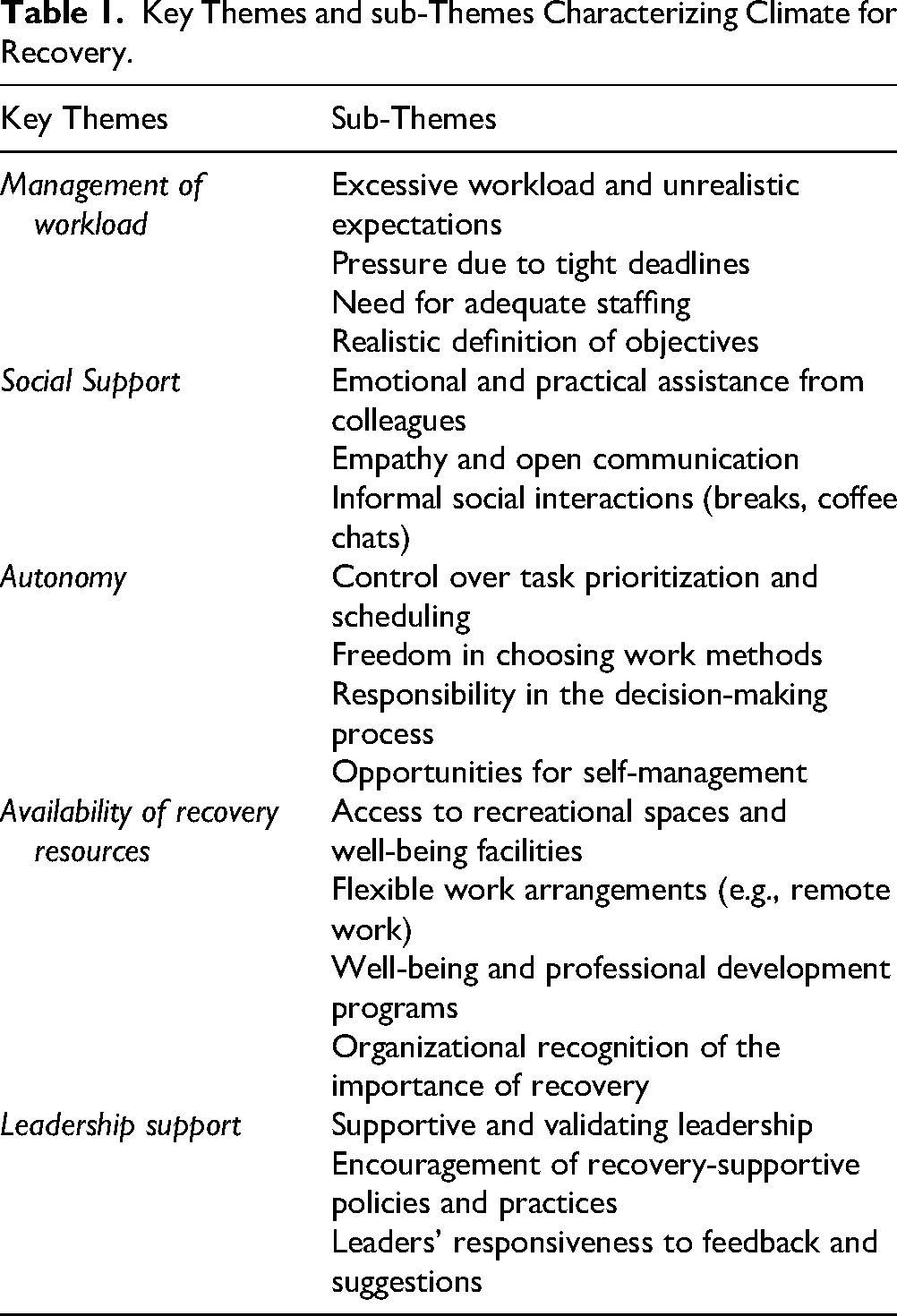
The interview investigated organizational practices and support systems that facilitate recovery from work-related stress, along with factors influencing these processes. Themes and sub-themes derived from participants’ narratives have been identified to provide a comprehensive view of organizational factors and practices that support employee recovery and the strategies that foster a climate for recovery. Table 1 reports the five themes, and respective sub-themes, that were identified as potential component of a climate for recovery, and that we describe in the next section.
Key Themes and sub-Themes Characterizing Climate for Recovery.
Dimensions of an Organizational Climate for Recovery Construct
The analysis of interviews revealed five potentially interrelated dimensions that provide an initial conceptual structure of the organizational climate for recovery construct. The first dimension, management of workload, was frequently reported as central for recovery. Participants highlighted that excessive workload, unrealistic expectations, and tight deadlines made it difficult to detach and recharge. Conversely, realistic goal setting, adequate staffing, and reasonable deadlines were seen as protective factors, for instance when managers spaced out deadlines or adjusted priorities to avoid overload.
The second dimension, social support, emphasized the role of interpersonal resources in the workplace. Emotional and practical assistance from colleagues, empathy and open communication, and informal social interactions, such as sharing a coffee break or talking through difficulties, were described as vital buffers against stress and important opportunities to restore energy.
The third dimension, autonomy, reflected employees’ need for control over their work. Having the ability to prioritize tasks, choose work methods, and participate in decision-making was perceived as empowering; examples are when employees, after an intense period or an important respected deadline, may rearrange their schedules or when may select their own approach to solving a task. Opportunities for self-management were consistently associated to improved stress regulation and recovery.
The fourth dimension, availability of recovery resources, represented a tangible indicator of organizational direct commitment to recovery. Participants mentioned access to recreational spaces, flexible work arrangements such as remote working, wellness programs, or training opportunities.
Finally, leadership support emerged as another pivotal dimension. Leaders who validated recovery needs, encouraged supportive practices, and answered employees’ requests were considered essential in shaping a recovery-supportive climate. Importantly, participants noted that leaders who modeled recovery behaviors, such as taking breaks themselves or disconnecting after hours, sent a powerful signal that recovery was legitimate and valued.
Taken together, these five dimensions — workload management, social support, autonomy, availability of recovery resources, and leadership support — provide a coherent framework for understanding how organizational contexts can foster or hinder employees’ recovery from work-related stress.
Strategies Related to Organizational Climate for Recovery
The interviews also highlighted a diverse array of strategies that employees use to recover from work-related stress. These accounts represent concrete examples of recovery processes as narrated by participants and were systematized in line with the structure of the interview grid. Specifically, strategies were distinguished between internal recovery (occurring during work hours) and external recovery (taking place outside work). Internal strategies included, for example, micro-breaks, informal conversations with colleagues, or short moments of detachment during the day, while external strategies referred to leisure activities, social interactions, and practices conducted after working hours.
This classification was consistent with the design of the data collection instrument and also analytically valuable, as it highlights how recovery is experienced both within the temporal boundaries of work and in employees’ private time. Importantly, while these strategies illustrate the range of processes through which employees attempt to manage stress and replenish resources, not all of them can be considered manifestations of an organizational climate conducive to recovery. Rather, they are empirical examples of recovery practices at the individual, social, or organizational levels, and some of them can be integrated into the climate while others remain personal routines or contextual contingencies. Table 2 summarizes these strategies through the internal/external distinction and through levels of experience (individual, group, and organizational level).
Individual, Team and Organizational Strategies Fostering Internal and External Recovery.
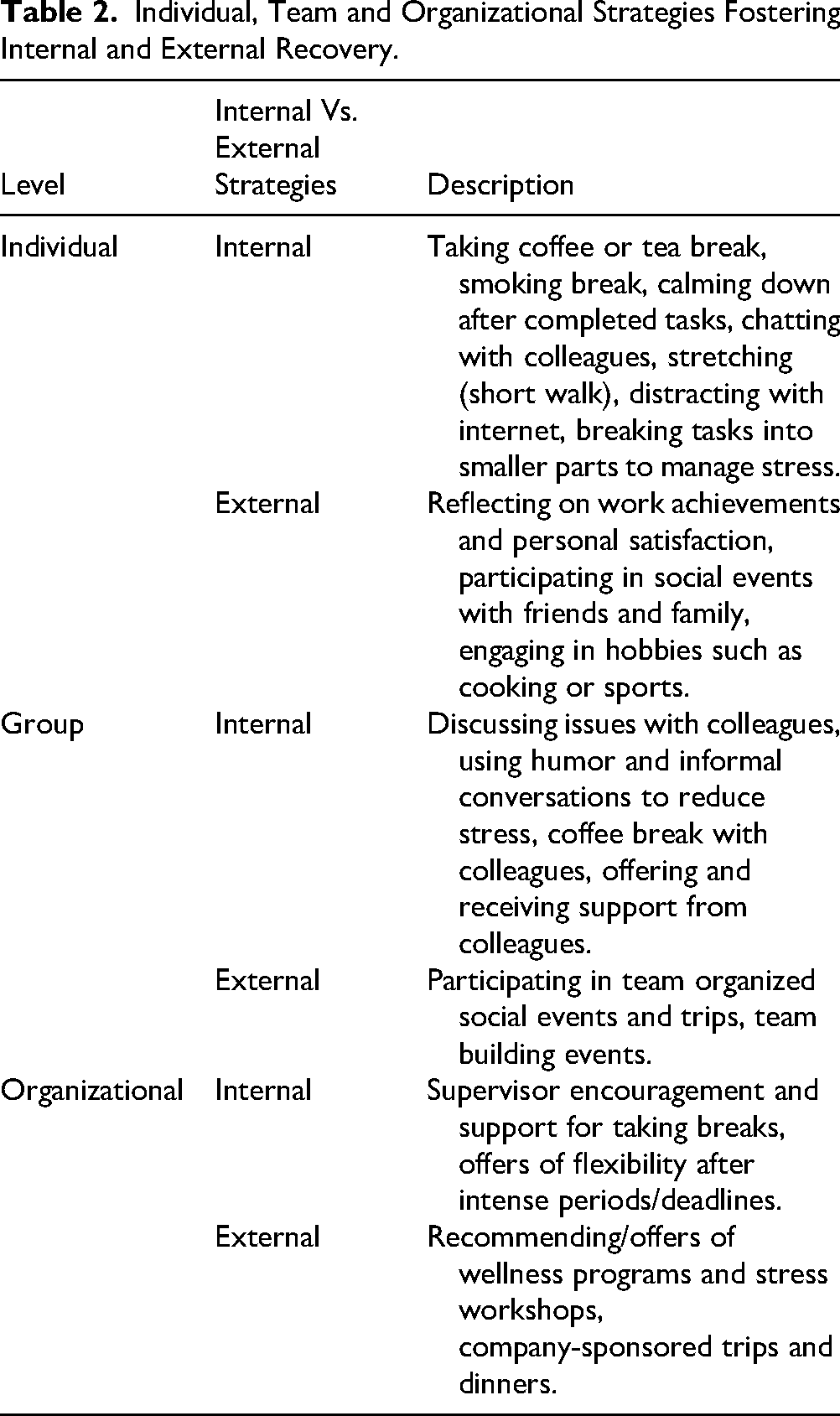
The analysis of the interviews suggests that recovery is structured across distinct contexts and levels of organizational life. Two main domains can be identified: internal recovery, which takes place during work, and external recovery, which unfolds outside working hours. Within each domain, recovery practices manifest at the individual, group, and organizational levels, offering a multidimensional picture of how employees sustain their capacity to detach and restore resources.
At the individual level, employees described strategies such as taking short breaks, stretching, listening to music, or engaging in hobbies and leisure activities after work. At the group level, practices included informal conversations, humor, or shared breaks and lunches during the day, and social gatherings or spontaneous team-building activities outside of work. At the organizational level, recovery was associated to policy signals, such as organizational measures of flexibility, or occasional company-sponsored initiatives. This structured map illustrates the breadth of processes through which employees manage recovery in daily life.
Beyond this descriptive variety, however, the analysis distills a coherent set of five interrelated dimensions that may characterize the organizational climate for recovery: workload management, social support, autonomy, availability of recovery resources, and leadership support. These dimensions capture the shared perceptions of the conditions that make recovery possible, translating dispersed accounts into an integrated framework. In this way, the internal/external distinction clarifies when (during or after work) recovery unfolds, the individual/group/organizational levels clarify where, in a social sense, it is situated, and the five dimensions clarify how recovery is perceived as enabled or constrained in everyday organizational functioning. Together, the five subdimensions offer an initial conceptual articulation of recovery not as a collection of scattered practices, but as a climate-driven process embedded in organizational life.
Discussion
Research Implications
Conceptualizing the organizational climate for recovery advances theoretical discourse by addressing critical gaps in understanding in which way workplaces shape employees’ ability to recover and restore depleted resources. Whereas much prior research framed recovery primarily as an individual responsibility, OCR shifts the focus to shared perceptions of organizational practices, policies, and procedures that collectively influence employees’ capacity to replenish physical and psychological energy. This conceptualization considers recovery not only an exclusively individual sphere but also an organizational one, offering a holistic framework for examining how systemic factors interact with personal strategies.
By integrating recovery research with the organizational climate tradition, OCR clarifies how structural norms, such as flexible scheduling, supportive leadership, or recognition of micro-breaks, intersect with psychological mechanisms of resource conservation. The conceptualization also enables multilevel analyses, showing that team-level practices and department-wide policies cascade into individual recovery experiences, thereby enriching organizational behavior theories with nuanced cross-level insights.
The specificity of OCR further refines theoretical boundaries with broader constructs such as the Organizational Health Climate. Whereas health-related climates adopt a general well-being lens, OCR captures shared perceptions specifically concerning the recovery practices that are expected, supported and encouraged in the organization (e.g., norms legitimizing pauses or after-work detachment), thereby enhancing conceptual precision. OCR is also conceptually distinct from structural job design frameworks, such as the Job Demands–Resources (JD–R) model, which focus on job characteristics (demands and resources), whereas OCR operates at the level of shared perceptions on the extent to which the organization values employees recovery and actively shapes working conditions and practices to enable or constrain recovery opportunities. From a theoretical standpoint, OCR is proposed as a contextual condition that may affect the relationship between job characteristics and recovery processes, for instance by buffering the impact of high demands or strengthening the effectiveness of individual recovery strategies. More broadly, the construct of OCR invites a reconsideration of recovery as a collective organizational responsibility, rather than solely an individual obligation. These theoretical advancements not only enrich scholarly understanding of workplace well-being but also provide actionable guidance for organizations aiming to align productivity objectives with sustainable health practices. In doing so, the construct of OCR considers recovery as a foundational component of both ethical responsibility and strategic organizational functioning.
Practical Implications
The construct of organizational climate for recovery addresses a new issue for organizations: the recognition that recovery from work-related stress is not only a matter of individual responsibility but also of shared organizational perceptions. This reframing implies that organizations can no longer rely exclusively on employees’ personal strategies to restore their resources but must create a systemic context where recovery is legitimized, supported, and rewarded.
A first practical implication concerns the diagnostic potential of OCR. In order to manage recovery-supportive climates, organizations need to reflect on their own attitude and culture towards employees’ recovery and then also monitor how employees collectively perceive practices, procedures, and behaviors related to recovery opportunities. At present, such monitoring can only be partial, as a validated measurement scale does not yet exist. The development of such an instrument will be crucial to systematically assess the climate for recovery, detect areas of strength and weakness, and evaluate the impact of organizational interventions over time. In the meantime, organizations may draw on indirect signals, such as turnover data, or employees’ feedback on workload and rest, to approximate their recovery climate.
A second implication is that OCR highlights the need for alignment between different organizational layers. Leaders play an important role in legitimizing recovery by modeling behaviors such as taking breaks, respecting boundaries, and avoiding constant connectivity, but their action is not sufficient alone. The recovery climate is co-constructed: it emerges when formal policies, managerial practices, and peer norms consistently align and become embedded in employees’ shared perception of organizational support for recovery. This means that organizations must intervene at multiple levels, ensuring that what is formally stated (e.g., flexible work policies) is mirrored in managerial behaviors and reinforced in everyday social interactions among colleagues. Finally, OCR draws attention to the need for continuous adaptation. Because recovery needs differ across roles, teams, and life stages, organizations should not consider OCR initiatives as one-off programs but as evolving processes. Feedback loops, regular assessments, and inclusive participation in shaping recovery-supportive practices are essential to maintain a climate responsive to employees’ changing conditions. By treating OCR as a collective phenomenon rather than an individual practice, organizations can prevent recovery from being sidelined as a private matter and instead embed it into the organizational fabric. This shift not only reduces the risks of burnout and turnover but also strengthens resilience, positioning recovery as a strategic resource for well-being and performance.
Study Limitations
While this study advances the conceptualization of organizational climate for recovery and offers empirical insights into its dimensions, several limitations must be acknowledged to contextualize its scope and guide future inquiry. The qualitative methodology, though instrumental in capturing rich, nuanced narratives, restricts generalizability due to the small sample of 22 participants, geographically concentrated in Italy, Bosnia and Herzegovina, and Turkey. From one side, the inclusion of diverse professional roles adds breadth to the study and to coverage of recovery strategies. However, industries with a typical stressful type of job, and thus higher barriers to recovery, such as healthcare, emergency services, or manufacturing, remain underrepresented, potentially overlooking sector-specific challenges like rigid work schedules or physical demands. Furthermore, the reliance on self-reported data introduces risks of recall bias and social desirability effects, as participants may have idealized their recovery practices or underreported stressors. The absence of triangulation with objective measures (e.g., work contract, organizational well-being policies, or interviews with employers and HR managers) limits the robustness of conclusions about how recovery climates manifest in policies, practices and behaviors that are expected and rewarded in the companies. In addition, contextual factors, such as organizational size, economic pressures, or cultural norms around work-life balance, were not explored, potentially masking how external forces shape recovery climates. For instance, multinational corporations may prioritize recovery differently than startups with informal cultures, while economic downturns might deprioritize well-being initiatives despite employee needs. The role of technology—such as always-on communication tools in hybrid work environments—in undermining or enhancing recovery climates also remains unexamined.
Importantly, the OCR concept, though theoretically grounded in recovery and organizational climate literature, lacks empirical validation through quantitative methods. Its proposed dimensions have yet to be tested for reliability or discriminant validity across broader populations, leaving their universal applicability uncertain. Additionally, the cross-sectional design precludes causal inferences on the effects of OCR on employees’ well-being outcomes, or its emergence as a byproduct of pre-existing and broader healthy workplace initiatives. Likewise, while this study distinguishes OCR from constructs like organizational health climate, it does not fully address overlaps with related frameworks, such as the Job Demands-Resources model, leaving theoretical boundaries partially undefined. Finally, while leadership support is identified as pivotal, the study does not explore how power dynamics or managerial discretion might dilute or amplify OCR's impact, such as leaders endorsing recovery policies superficially without enacting meaningful change.
These limitations, while notable, do not diminish the study's foundational contributions but rather highlight opportunities for future research to refine OCR's conceptual boundaries, validate its dimensions empirically, and adapt it to diverse organizational and cultural contexts. Addressing these gaps will strengthen OCR's utility as a framework for fostering sustainable workplace well-being.
Future Research
Building on the conceptual foundations of Organizational Climate for Recovery (OCR), future research must address several critical avenues to advance both theoretical understanding and practical application. A priority lies in investigating how OCR manifests across diverse industries and occupational contexts. For instance, sectors characterized by high emotional labor (e.g., healthcare) or physical demands (e.g., manufacturing) may encounter unique barriers to fostering recovery supportive climates, such as rigid scheduling or limited autonomy, compared to knowledge-based industries where flexible work arrangements are more feasible. Comparative studies could elucidate how industry-specific stressors, regulatory frameworks, and cultural norms shape the development and efficacy of OCR, enabling tailored interventions such as structured respite protocols in healthcare or ergonomic redesign in logistics. Concurrently, longitudinal research is essential to uncover OCR's long-term effects on employee well-being and organizational outcomes, including sustained reductions in burnout, enhanced job satisfaction, and productivity gains. Such studies could also track how shifts in organizational policies or leadership practices dynamically influence recovery climates over time, offering insights into resilience-building strategies.
Methodologically, similarly to the Multi-faceted Organizational Health Climate Assessment (MOCHA) scale (Zweber et al., 2016), a scale which measures a construct close to but distinct from OCR, namely the organizational health climate, advancing the construct of OCR necessitates the creation of a robust, multidimensional measurement tool that integrates qualitative insights (e.g., employee narratives on recovery experiences) with quantitative assessments of key OCR dimensions. Future advancements in this domain thus require the urgent development of specific and refined instruments capable of adequately capturing the organizational climate for recovery (Sonnentag et al., 2022).
Scholars should explore how recovery practices become culturally embedded within organizations. This involves investigating processes through which norms like after-work disconnection or open dialogue about recovery needs are institutionalized, as well as the role of leadership in reinforcing these norms. In other words, to better understand OCR, future research should examine how recovery practices become an integral part of an organization's functioning.
Finally, future research should also consider OCR as a component of the sustainability-oriented perspectives in career development. In line with sustainable development as an emerging paradigm for twenty-first century careers (Hartung & Di Fabio, 2024), recovery-supportive climates can be examined as organizational conditions that help sustain employees’ health, functioning, and long-term career continuity. This framing also aligns OCR with current intervention agendas in the psychology of sustainability and sustainable development in organizations (Di Fabio & Cooper, 2023), by treating recovery as a legitimate organizational target rather than solely an individual responsibility. More broadly, OCR may be positioned within the interdisciplinary sustainability science perspective, which emphasizes integrative approaches to complex societal and organizational challenges (Komiyama & Takeuchi, 2006; Sahle et al., 2025; Takeuchi et al., 2017). Empirical studies could test the relationship between OCR and sustainability-related career outcomes, such as sustainable employability and long-term career viability, and evaluate interventions aimed at embedding recovery-supportive norms and leadership practices within broader sustainable career development strategies.
Conclusion
This conceptual study with exploratory evidence has introduced the construct of organizational climate for recovery, highlighting the responsibility shared between employees and the organization in supporting recovery at work and from work. The analysis identified five dimensions (workload management, social support, autonomy, availability of recovery resources, and leadership support) that may represent emergent components of OCR. These dimensions should be considered as preliminary and exploratory, requiring further empirical validation across diverse contexts and methodological approaches. By articulating OCR as a focused climate construct, this study offers an initial conceptual framework that invites both theoretical refinement and empirical testing. Although subject to the limitations inherent in qualitative exploratory designs, the present work lays the groundwork for integrating recovery more explicitly into organizational practices and research agendas aimed at fostering healthier and more sustainable workplaces.
Footnotes

Ethical Considerations
The study consisted of minimal-risk qualitative interviews with competent adults, did not involve any intervention, deception or special – category personal data, thus no prior ethics committee review was initially sought. However, ethical approval for the study has since been obtained from the ethics committee of the University of the first author (Università della Campania “Luigi Vanvitelli”). The approval, issued on October 25th, 2025, confirms that the study adhered to the ethical principles stated in the Declaration of Helsinki and the ethics committee did not detect ethical issues to be concerned with. The study also adhered to the data protection law (GDPR), and the Italian Data Protection Authority's guidelines on the ethical management of data for research purposes.
Author Contributions
Conceptualization: SZ, FT; Data curation: FT, SD, SZ; Funding acquisition: SZ; Investigation: FT, SZ; Methodology: SZ, FT; Writing – original draft: FT; writing review & editing: SZ, SD, FT.
Author's Note
Ferdinando Toscano is now at the Department of Humanities and Social Sciences, Universitas Mercatorum, Roma, Italy.
Funding
This work was supported by the research grant PRIN 2022 PNRR “Recovery at work nowadays: a multidimensional perspective” (Prot. P20225HN8X) assigned by the Italian Ministry of Research to the second and corresponding author of this manuscript, as partner of a consortium of three Italian Departments.
Ministero dell'Università e della Ricerca, (grant number PRIN 2022 PNRR (Prot. P20225HN8X)).
Competing Interests
The authors declare that they have no known competing financial interests or personal relationships that could have appeared to influence the work reported in this paper.
Declaration of Conflicting Interests
The authors declared no potential conflicts of interest with respect to the research, authorship, and/or publication of this article.
Declaration of Generative AI Assisted Technologies in the Writing Process
During the preparation of this work the authors used ChatpGPT for the sole purpose of improving the written English. After using this tool, the authors always reviewed and edited the content as needed and take full responsibility for the content of the publication.
Data Availability Statement
The transcript of the interviews that support the findings of this study are available from the corresponding author, upon reasonable request.
Supplemental Material
Supplemental material for this article is available online.