






Abstract
Career identity is a critical developmental outcome for university students transitioning from education to employment. This study examines the relations among dispositional employability, career adaptability, job search self-efficacy, and the career identity of Australian undergraduate health science students. Participants were 1,236 first-year non-vocational health science students who completed a survey embedded within a curriculum-based career development module. Multinomial logistic regression tested if dispositional employability, career adaptability, and job search self-efficacy were significantly associated with four career identity statuses: diffused, moratorium, foreclosed, and achieved. Results demonstrated that career motivation and optimism were strongly associated with career identity. Distinct patterns emerged between trait and state optimism. Job search self-efficacy also showed meaningful associations with career identity. Career agency was particularly important for students experiencing career identity uncertainty, supporting adaptation and exploration. We advance career identity research by highlighting the importance of psychosocial resources and informing targeted career development interventions within university curricula.
Keywords
Exploration and commitment to a career identity is an important developmental milestone for university students making a transition from study to employment. An individual's career identity is particularly important in providing clarity and focus within the job search process. For students enrolled in vocationally oriented degree programs like medicine, engineering, and law, there is usually a direct pathway to a defined profession; however, for undergraduate non-specialist courses such as health science degrees, there is a wider and less defined range of occupational destinations (Julien et al., 2023; Lexis et al., 2023). Yet, many students enrolled in non-vocational undergraduate courses have limited knowledge of career pathways (Lock & Kelly, 2020). Their lack of knowledge about pathways could be a barrier to developing career identity, thus hindering transition to employment.
Therefore, there is a need for targeted initiatives to support students to develop their career identity. Employability scholars argue that career development learning should be embedded in degree programs (Healy, 2023) as iterative and assessable components supporting students to build an emerging career identity throughout the duration of their degree program (Bridgstock et al., 2019). Embedding assessed career development learning into core units has been found to foster the development of an emerging career identity (Julien et al., 2023; Lexis et al., 2023). This psychological aspect of employability may be overlooked among the multiple topics that constitute the study of employability in the higher education literature (e.g., pedagogy, policy, training and skill development; Healy et al., 2022, 2025).
We aim to extend theory about career identity (Marcia, 1966; Marcia et al., 1993) by investigating dispositional employability, career adaptability, and job search self-efficacy are associated with the career identity of undergraduate health science students. We briefly define each of those factors and summarize research evidence, before outlining the research methodology and results of this study. Finally, we discuss how educators and career practitioners can use valid and reliable measures of the factors to design career development learning modules that meet the specific needs of students, based on their current career identity status.
Career Identity Status
Career identity is a perception of oneself in relation to work and career. Career identity is integral to an individual's making sense of their past and present experiences and future aspirations. Career identity formation is a dynamic process shaped by an individual's engagement with and interpretation of their environmental experiences (Laughland-Booÿ et al., 2017; Marcia, 1966). These experiences are progressively integrated into the individual's self-concept, contributing to the development of a coherent career identity into the future. Marcia's classical developmental model of four distinct types of career identity: diffusion, moratorium, foreclosure, and achievement (Marcia, 1966; Marcia et al., 1993). Individuals classified as diffused have neither committed to a specific occupational path nor actively engaged in career exploration, resulting in an underdeveloped sense of career identity (Ahn et al., 2015). This lack of concern regarding identity formation may stem from psychological avoidance or the deferment of exploration and commitment processes (Laughland-Booÿ et al., 2017). In contrast, individuals in the moratorium status are actively exploring career options but have yet to make a definitive commitment, often experiencing an “active struggle” in navigating this transitional phase (Marcia, 1966, p. 552). Those with a foreclosed identity status have prematurely committed to a career path without prior exploration, frequently influenced by parents or other significant figures (Ahn et al., 2015). While foreclosed individuals exhibit a strong sense of commitment, they tend to resist new experiences and avoid risk-taking, thereby constraining their understanding of both the labour market and their personal vocational preferences (Luken, 2019). The achieved identity status represents the optimal developmental outcome, characterized by deliberate exploration and subsequent commitment to an occupation (Ahn et al., 2015; Marcia, 1966). Individuals who attain this status have developed insightful knowledge of themselves, their reasons for studying a particular degree, and how they can best transition into the workforce.
Individuals move through development phases as they become concerned with forming an identity and engaging in processes of career exploration. Over time, individuals will have different career identity statuses, reflective of their stage of the development process at any point in time. Individuals might not stay in the achieved status for life, as changes in the labour market, personal circumstances, or career preferences may result in an individual disconnecting from a commitment to a career identity and commencing the exploration of other career options (Meijers, 1998).
Research into the antecedents of career identity status indicates that psychosocial resources are influential, including caring and engaging adults (Chen & Solberg, 2018), career adaptability (Rudolph et al., 2017), career optimism (Ahn et al., 2015; Rhee et al., 2016; Rottinghaus et al., 2005), and the psychological contract, which has been found to mediate the relations between internship satisfaction and career identity (Feng et al., 2023). Furthermore, Petruzziello et al. (2024) found evidence that career identity is used as a resource to build other forms of employability capital and in managing tasks related to the transition from university to work.
Research into the benefits and outcomes of career identity demonstrates its contribution to students’ motivation to make decisions about their studies, internships, and pursuit of employment (Meijers et al., 2013). Higher levels of engagement in career exploration has been found to improve clarity of career identity, which in turn is related to higher levels of perceived employability and lower levels of career distress (Praskova et al., 2015). Rottinghaus et al. (2005) found that students with an achieved career identity status had higher levels of career adaptability, career optimism, and perceived knowledge compared with all other career identity statuses. Career identity is important in the re-employment of jobseekers, providing direction and focus through self-knowledge and understanding of the labour market (McArdle et al., 2007). In organizational settings, career identity has been found to moderate the relations between career adaptability with turnover intentions, career satisfaction, and career success (Haibo et al., 2018).
Dispositional Employability
Graduate employability is a significant topic of research in the higher education literature because universities emphasize graduate outcomes as an indicator of esteem and prestige (Brown et al., 2022; Healy et al., 2022). Dispositional employability is a psychosocial resource that facilitates the enactment of proactive career behaviours directed at obtaining and maintaining employment, and is conceptualized to incorporate dimensions of career identity, personal adaptability, and social and human capital (Fugate et al., 2004). Dispositional employability predicts emotions and affective commitment to organizational change (Fugate & Kinicki, 2008), job search intensity (McArdle et al., 2007; Tomas & Maslić Seršić, 2017), engagement in professional development (Torrent-Sellens et al., 2016), and perceptions of future career prospects (Cerdin et al., 2020). Aspects of dispositional employability have associations with career adaptability and job search self-efficacy in university students (Brown et al., 2024). Fugate and Kinicki (2008) proposed that individuals with high dispositional employability would exhibit several attributes. Specifically, they would be open to change or be positive about changes at work; be resilient through a sense of control over their career; be optimistic about the future and the possibilities of opportunities; be proactive in seeking out information about future career opportunities; exhibit motivation directed toward career planning and career self-management; and incorporate their work or career into their personal identity. Therefore, we expect dispositional employability to be associated with career identity status.
Career Adaptability
Career adaptability is a psychosocial resource that individuals use to respond to vocational developmental tasks, occupational transitions, and work traumas (Savickas, 2005, 2013). Career adaptability facilitates an orientation to the future, individual agency, occupational knowledge, optimism, and resilience (Rottinghaus et al., 2005, 2012, 2017). Thus, career adaptability is conceptually aligned with dispositional employability's future orientation. Career adaptability has been found to positively relate to proactive career behaviour (Spurk et al., 2020), self-perceived internal and external marketability (Spurk et al., 2016), career planning, career exploration (Rudolph et al., 2017), and self-efficacy (Matijaš & Maslić Seršić, 2021; McLennan et al., 2017). Career adaptability is considered a transactional competency that is responsive to interventions and learning experiences (Rottinghaus et al., 2017; Rudolph et al., 2017; Savickas & Porfeli, 2012). Given career adaptability's sensitivity to learning experiences (Brown et al., 2021), we expect that it would be associated with career identity status.
Job Search Self-Efficacy
Knowing what job to apply for will be based on the career exploration activities an individual undertook as part of the career identity achievement status. Job search self-efficacy (JSSE) is defined as an individual's confidence in performing job search tasks (Saks et al., 2015; Tolentino et al., 2019; Van Hooft et al., 2021). Scholars have identified dimensions of JSSE related to job search behaviours and outcomes (Brown et al., 2024; Matijaš & Maslić Seršić, 2021; Petruzziello et al., 2022; Saks et al., 2015; Van Hooft et al., 2021). JSSE has been found to be an antecedent of overall job search behaviour (Lim et al., 2016), as well as job search intensity and quality, and job search outcomes (Guan et al., 2014; Saks et al., 2015; Van Hooft et al., 2021). JSSE is developed via mastery experiences, feedback from experts, role models, and affect (Lent et al., 2017). Other research has found that employability (Berntson et al., 2008), career adaptability (Matijaš & Maslić Seršić, 2021), and psychological capital (Pajic et al., 2018) are antecedents of JSSE. Saks et al. (2015) found that environmental-and self-exploration were stronger predictors of JSSE behaviour, whereas career planning was a stronger predictor of JSSE outcomes. Thus, given JSSE's relation with career exploration behaviour, we expect it will be associated with career identity status.
The Present Study
This present study aims to examine if dispositional employability, career adaptability, and job search self-efficacy are associated with career identity status of undergraduate, non-specialist, health science students. Based on the review of the literature, we expect that:
Testing these relations will enrich Marcia's (1966) career identity theory regarding which status is associated with certain career-related behaviours. Furthermore, in the presence of significant demand for a growing the health workforce (Bates et al., 2025), these student's career exploration and development of career identity are particularly salient topics for research. Determining the correlates of their identity may be useful in supporting their transitions to employment or further study toward specialist vocational professions.
Method
Participants
In total, 1236 participants were studying a non-specialist health sciences undergraduate degree at an Australian university. There were 185 participants identifying as male (15%), 1048 female identifying (85%), and 3 non-binary participants. The high proportion of female participants is consistent with the enrolment profile of health science degrees in Australia. Participants were aged from 19 to 54 years old (Mage = 21.75), and a large majority were employed 991 (80%). In Australia it is quite common for students to hold part-time or casual employment.
Procedure
Participants were invited to complete an online career assessment tool as part of a career development module within a core unit of study in the first year of their degree. Data in this study was collected across multiple deliveries of the module from 2020 to 2024. This module, worth 10% of the unit grade, was part of a scaffolded series of modules intended to support students with career development through all years of their studies. Throughout the module, students learned about the institution's employability support program and the transferable skills and personal attributes employers seek in graduates, completed an online career assessment tool, rated their transferrable skills and personal attributes, and created a career plan. At the end of the survey, participants received a computer-generated report which contained a description of the measures in plain English and the participants’ scores on each subscale. The study was approved by the Human Research Ethics Committee of the University of Southern Queensland and endorsed by the Human Research Ethics Committee of La Trobe University where the data was collected. Participation was voluntary, and participants had the right to withdraw from the study.
Measures
The measures include the Dispositional Measure of Employability (Fugate & Kinicki, 2008), job search self-efficacy (Saks et al., 2015), and an Australian version of the Career Futures Inventory 9-item scale (McIlveen et al., 2013). The outcome measure is career identity status; that is diffused, moratorium, foreclosed, and achieved (Rottinghaus et al., 2005). The description of the measures is partially re-reported from Brown et al. (2024), which validated the use of the dispositional measure of employability with university students across several fields of education in 2020 from the same online career development tool.
Dispositional Measure of Employability (DME)
The DME (Fugate & Kinicki, 2008) is a 25-item measure which includes six subscales aligned with its theoretical foundation. In this study, five subscales were included, each containing three items, based on the confirmatory factor analysis in previous research (Brown et al., 2024): Career Motivation (e.g., “I have a specific plan for achieving my career goals”), Openness to Changes at Work (e.g., “I am able to adapt to changing circumstances at work”), Optimism at Work (e.g., “In uncertain times at work, I usually expect the best”), Work and Career Proactivity (e.g., “I stay abreast of developments in my industry”), and Work and Career Resilience (e.g., “I am optimistic about my career opportunities”). Respondents indicate their agreement with each item using a 5-point Likert-type scale (1 = strongly disagree, 5 = strongly agree). The score of each subscale is calculated by taking the mean of the items. In the present dataset, the DME subscales’ internal consistency coefficients ranged from α = .68 to α = .90.
Career Futures Inventory-9 Item (CFI-9)
The Australian version of the CFI-9 (McIlveen et al., 2013) is a short-form version of the Career Futures Inventory (Rottinghaus et al., 2005) with three subscales: Career Agency, Perceived Knowledge, and Career Optimism. The CFI-9 has been tested in research and found to be a valid measure of career adaptability (McLennan et al., 2017; Spurk et al., 2020), and includes measures of knowledge, optimism, and agency that Fugate and Kinicki (2008) anticipated would be supported by dimensions of dispositional employability. All three subscales from CFI-9 were selected for this study. Career Agency (CA) measures how an individual perceives their ability to cope with and adapt to work and career related changes (e.g., “I can adapt to change in the world of work”); Career Optimism (CO) measures individuals’ tendency to expect the best to happen (e.g., “Thinking about my career inspires me”); and Perceived Knowledge (PK) indicates how well individuals understand labour market information (e.g., “I am good at understanding job market trends”). Respondents indicate their agreement with each item using a 5-point Likert-type scale (1 = strongly disagree, 5 = strongly agree). In the present dataset, the JSSE subscales’ internal consistency coefficients ranged from α = .74 to α = .93.
Job Search Self-Efficacy (JSSE)
The original JSSE scale had two subscales: Outcomes and Behaviours (Saks et al., 2015) to measure the confidence of participants in obtaining job outcomes and engaging in career adaptive behaviours. However, other research identified three subscales (Brown et al., 2024), representing job search outcomes (e.g., “Be invited for job interviews”), active job search behaviour (e.g., “Use social networks to obtain job leads”) and passive job search behaviour (e.g., “Prepare resumes that will get you job interviews”). Respondents indicate their confidence for each statement using a 5-point Likert-type scale (1 = not at all confident, 5 = totally confident). The score of each subscale is calculated by taking the mean of the items in the subscale. In the present dataset, the JSSE subscales’ internal consistency coefficients ranged from α = .79 to α = .94.
Career Identity
There are several approaches to measuring Marcia's (1966; Marcia et al., 1993) types of identity status (cf. for a systematic literature review, Maehler & Hernández-Torrano, 2025). The categorical indicator of career identity method (Rottinghaus et al., 2005) was used as the measure in the present study. This categorical item asks participants to select one of four descriptors of career identity that best describes their current identity status. There is one descriptor for each of the diffused, moratorium, foreclosed, and achieved identity statuses (Rottinghaus et al., 2005, p. 8):
Choose the one description below that you feel best represents your career plans at this time:
I have not made a career choice at this time and I do not feel particularly concerned or worried about it. I have not made a career decision at this time and I am concerned about it. I would like to make a decision. I have chosen a career and although I have not investigated it or other career alternatives thoroughly, I think I would like it. I have investigated a number of careers and have selected one. I know quite a lot about this career, including the kinds of training or education required and the outlook for jobs in the future.
Despite the limitations of single-item measures, recent research suggests that offhand dismissals of single-item measures are not actually justified (Allen et al., 2022; Matthews et al., 2022).
Data Analysis
Multinomial logistic regression was used to determine if dispositional employability, career adaptability, and job search self-efficacy could predict career identity. First, data screening was conducted to remove aberrant responses that were completed in less than 3 min or more than 60 min. These times were selected to remove responses completed without much thought and those that were likely to have not been completed in one sitting. Participants who did not indicate a current student status were also removed, leaving 1236 responses. Descriptives statistics, correlations among variables, and a confirmatory factor analysis (CFA) were conducted to check adequacy of the data. All analyses were conducted using RStudio Version 2024.12.1 + 563 and R 4.4.2. The multinomial logistic regression was conducted using the mlogit package (Croissant, 2020).
Results
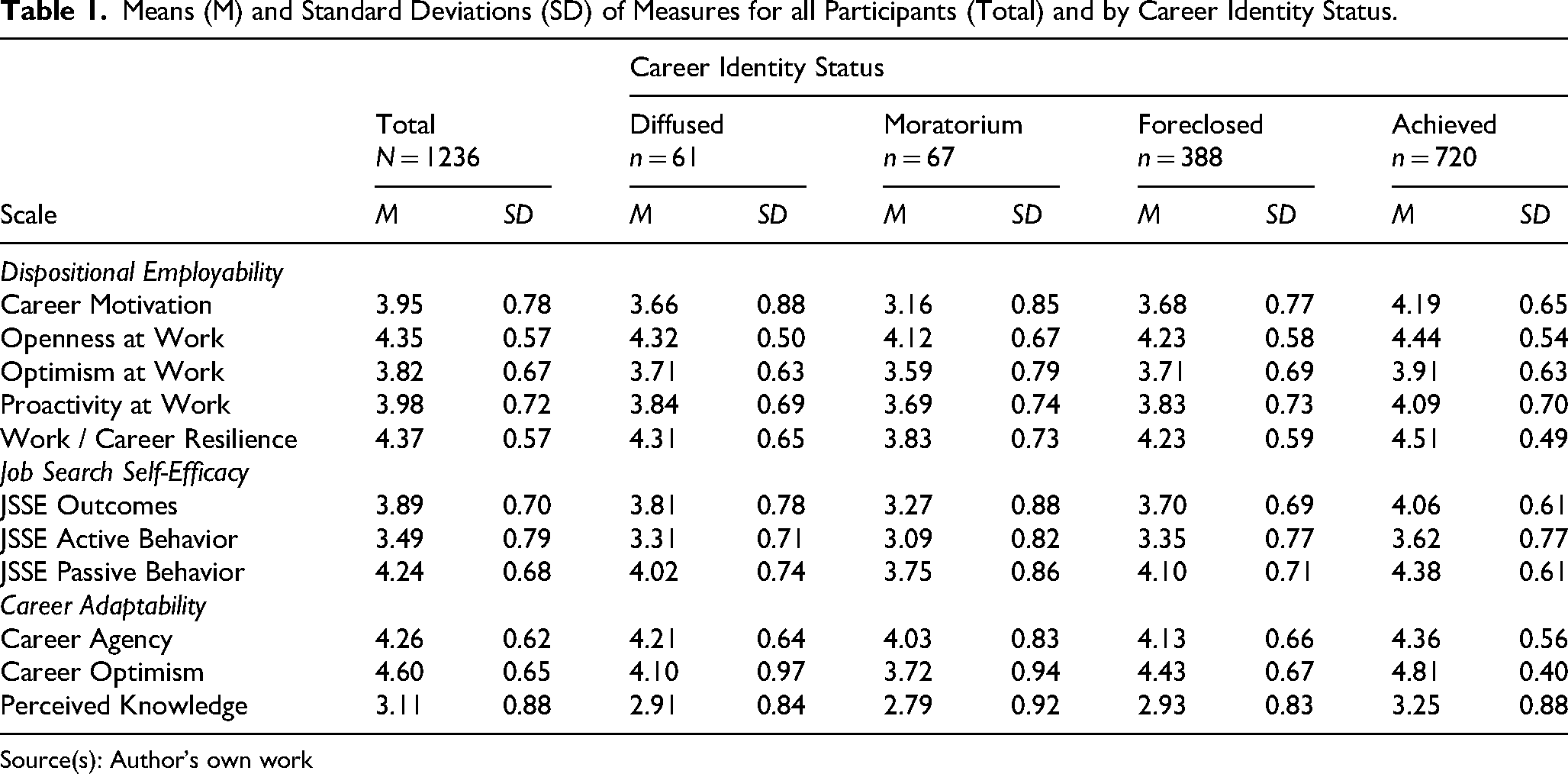
Descriptive statistics are reported in Table 1 for all participants and separately for each career identity status. More than half of the participants reported an achieved identity status (n = 720), followed by foreclosed (n = 388), moratorium (n = 67) and diffused (n = 61). The moratorium group reported the lowest mean scores against each of the subscales for dispositional employability, job search self-efficacy, and career adaptability. The achieved group had the highest mean score across each subscale. The diffused and foreclosed groups have similar mean scores across the subscales. As reported in Table 2, the correlations between subscales are in the moderate range (r = .21 to r = .62).
Means (M) and Standard Deviations (SD) of Measures for all Participants (Total) and by Career Identity Status.
Source(s): Author's own work
Correlations Between Measures, N = 1236.
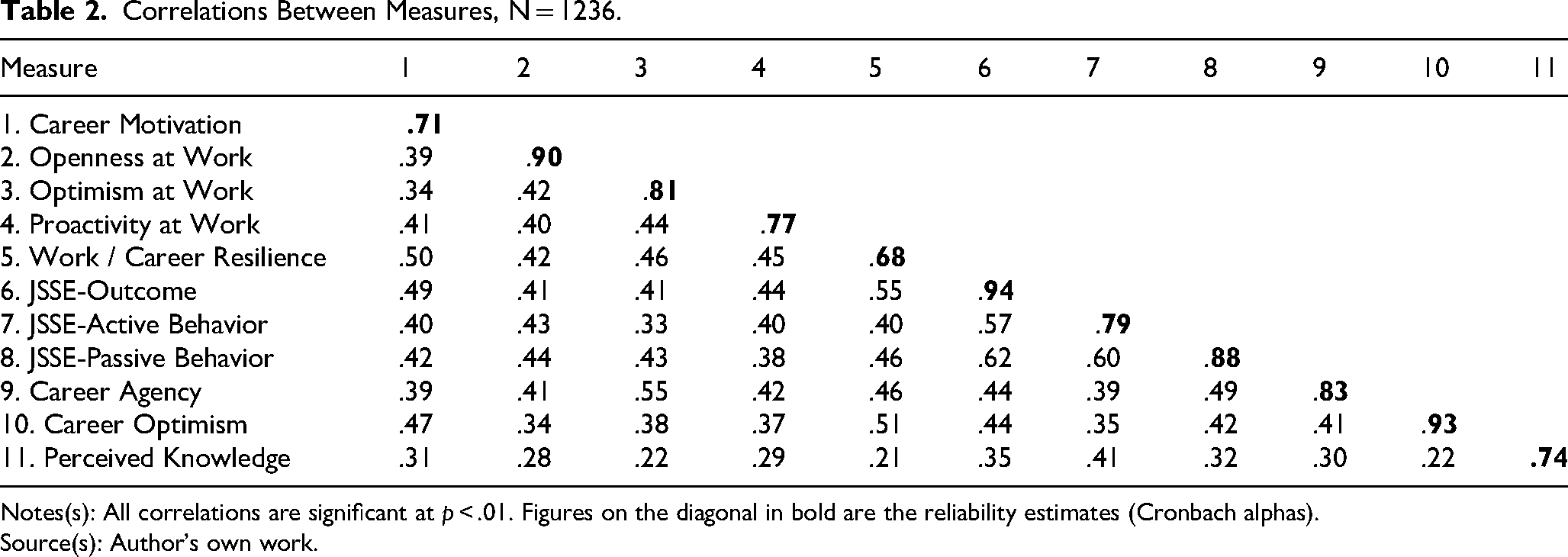
Notes(s): All correlations are significant at p < .01. Figures on the diagonal in bold are the reliability estimates (Cronbach alphas).
Source(s): Author's own work.
Confirmatory Factor Analysis
The Kaiser-Meyer-Olkin measure confirmed adequacy of the sample (KMO = .92). CFA using a maximum likelihood estimator produced a correlated factors model for dispositional employability, job search self-efficacy, and career adaptability. The model was found to be an acceptable fit to the data χ2 (764) = 2749.118, p < .001, CFI = .94, TLI = .93, RMSEA = .046, 90% CI [.044, .048], SRMR = .046.
Multinomial Logistic Regression
For the multinomial logistic regression, career identity categories were compared in reference to the fourth category: achieved identity. The analysis provides support for hypotheses 1, 2, and 3. The regression and odds ratios are reported in Table 3.
Multinomial Regression of Career Identity status with Achieved as the Reference.
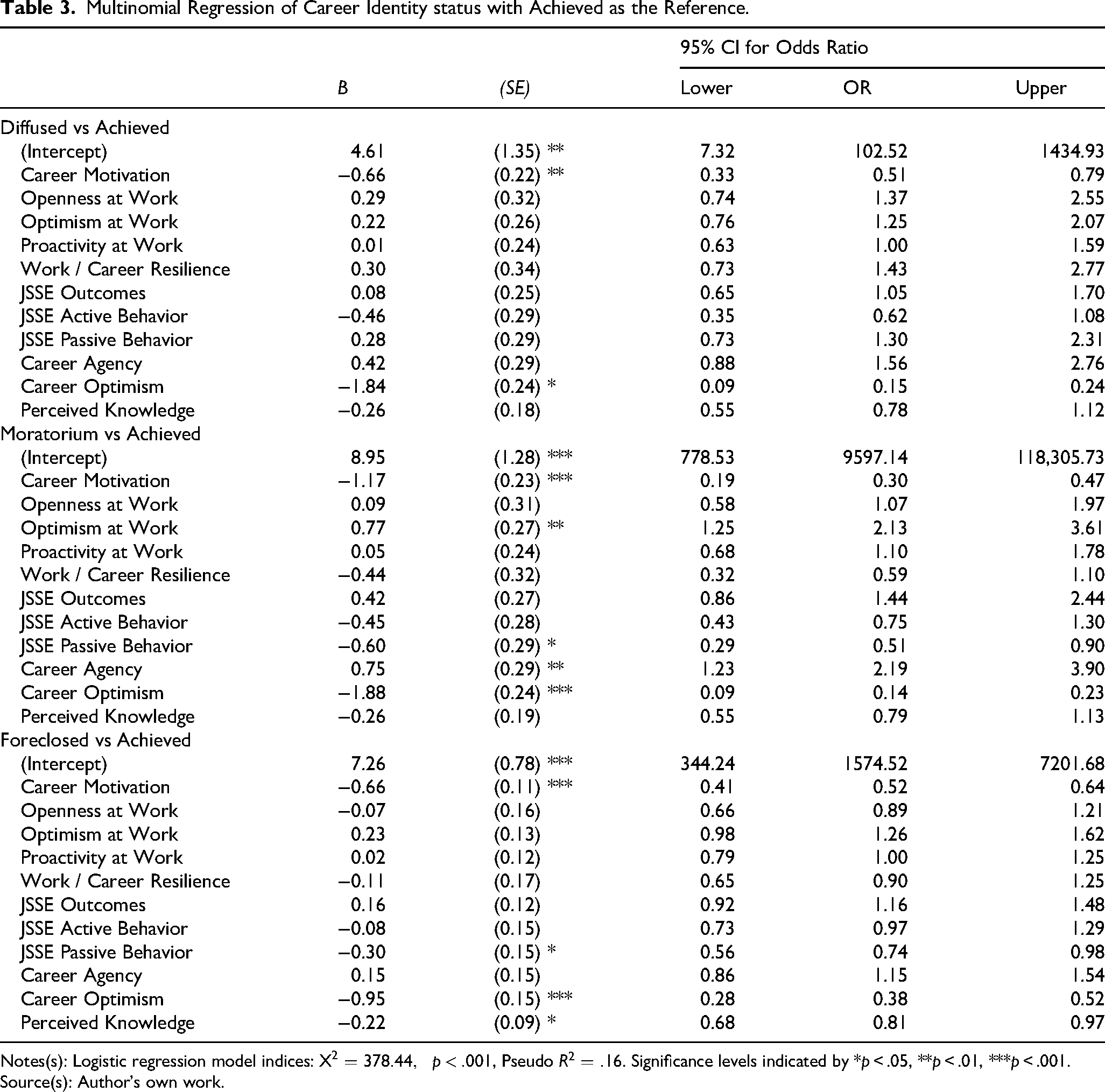
Notes(s): Logistic regression model indices:
Source(s): Author's own work.
DME Career Motivation (B = −0.66, p < .01) and CFI-9 Career Optimism (B = −1.84, p < .05) predicted membership of the diffused identity status. For DME Career Motivation, a one-unit increase was associated with a decrease in the likelihood of having a diffused career identity status (OR = .51, 95% CI [0.33, 0.79]). For CFI-9 Career Optimism, a one-unit increase was associated with a decrease in the likelihood of having a diffused career identity status (OR = .15, 95% CI [0.09, 0.24]).
Moratorium was predicted by DME Career Motivation (B = −1.17, p < .001), JSSE Outcomes (B = −0.60, p < .05), CFI-9 Career Optimism (B = −1.88, p < .001), DME Optimism at Work (B = 0.77, p < .01) and CFI-9 Career Agency (B = 0.66, p < .01). The odds ratios indicate that there is a decreased likelihood of having a moratorium career identity status for every one-unit increase for each of the following predictors: DME Career Motivation (OR = .30, 95% CI [0.33, 0.79]); JSSE Outcomes (OR = .51, 95% CI [0.29, 0.90]), and CFI-9 Career Optimism (OR = .14, 95% CI [0.09, 0.23]). However, there was an increased likelihood of a moratorium career identity status for every one-unit increase in DME Optimism at Work, (OR = 2.13, 95% CI [1.25, 3.61]) and CFI-9 Career Agency (OR = 2.19, 95% CI [1.23, 3.90]).
Foreclosed identity status was predicted by DME Career Motivation (B = −0.66, p < .001), Job Search Self-Efficacy Outcomes (B = −0.30, p < .05), CFI-9 Career Optimism (B = −0.95, p < .001) and CFI-9 Perceived Knowledge (B = −0.22, p < .05). The odds ratios indicate that for every one unit increase in each measure, there was a decreased likelihood of a foreclosed versus achieved career identity status: DME Career Motivation (OR = .52, 95% CI [0.41, 0.64]), Job Search Self-Efficacy Outcomes (OR = 0.74, 95% CI [0.56, 0.98]), CFI-9 Career Optimism (OR = .38, 95% CI [0.28, 0.52]) and CFI-9 Perceived Knowledge (OR = .81, 95% CI [0.68, 0.97]).
Discussion
This study examined how dispositional employability, career adaptability, and job search self-efficacy related to membership in Marcia's (1966) four career identity statuses. Career identity is a critical developmental milestone for university students, particularly for undergraduate non-specialist health science students who may require further graduate study to qualify for a health profession. A decision to undertake further study to qualify as a specific health professional has risks in terms of personal, time, and financial commitments and opportunity costs. The same risks are present for other exploration and decision-making about entry into other graduate professions. The findings from this study reveal four key insights into the correlates of career identity.
First, this study found that career motivation and optimism are strongly associated with career identity. Compared to those with an achieved identity status, all other identity statuses had significantly lower odds ratios for DME Career Motivation, which reflects motivation to engage in career planning and self-management behaviours (Fugate & Kinicki, 2008). Individuals with an achieved career identity status have typically explored a range of career options before committing to a particular occupation.
DME Optimism at Work also emerged as a significant correlate. Participants with a moratorium identity status were less optimistic than those in the other three identity groups. This aligns with the notion that individuals in moratorium have yet to commit to an occupation and may feel uncertain or concerned about their future. Career optimism has been identified as an important antecedent to adaptive career behaviours (Eva et al., 2020), and although few studies have directly examined its relationship with career identity, existing research supports this link. For example, Ahn et al. (2015) found that high school students with an achieved identity status were more optimistic, while Rhee et al. (2016) reported that both searching moratorium and achieved groups used optimism to support identity commitment.
These findings contribute to a growing body of literature connecting dispositional employability to psychosocial processes such as affective commitment to organizational change (Fugate & Kinicki, 2008), job search intensity (McArdle et al., 2007; Tomas & Maslić Seršić, 2017), job search self-efficacy (Brown et al., 2024), engagement in professional development (Torrent-Sellens et al., 2016), and perceptions of future career prospects (Cerdin et al., 2020).
Second, we found divergent associates between trait- and state- optimism and career identity. Interestingly, the three non-achieved identity groups had odds ratios above 1 for DME Optimism at Work, but below 1 for CFI-9 Career Optimism. This discrepancy may be due to differences in the constructs measured: DME Optimism appears to assess trait-like optimism, whereas CFI-9 captures more state-like optimism. This interpretation is consistent with the broader conceptualization of DME as a trait-based measure (Fugate & Kinicki, 2008) and the CFI as a measure of self-regulated psychosocial processes (McIlveen et al., 2013; Rottinghaus et al., 2012). Eva et al. (2020) argued that career optimism should be conceptualized as a malleable, state-like construct. Furthermore, career optimism has been shown to mediate the relationship between general optimism and career identity (Chatterjee et al., 2015), reinforcing the importance of distinguishing between these two forms of optimism in career development research.
Third, this study extends understanding of the relationship between career identity and job search self-efficacy (McArdle et al., 2007). Although participants with an achieved identity status reported the highest confidence in both passive and active job search self-efficacy, these differences were not statistically significant across identity groups. Notably, 80% of participants were employed while studying, suggesting prior experience with job seeking. However, confidence in achieving job search outcomes—such as securing an interview—was significantly lower among those with moratorium and foreclosed statuses. This may reflect the uncertainty and lack of commitment associated with moratorium status, or limited labour market knowledge among foreclosed individuals. While these groups may possess the skills to search and apply for jobs, their confidence in achieving outcomes may be undermined by their unclear or externally influenced career identities.
Fourth, career agency was significantly associated only with the moratorium identity group. This suggests that career agency may be a valuable resource for individuals experiencing a career identity crisis, helping them adapt and explore future options. Perceived knowledge, on the other hand, was a significant predictor only for the foreclosed group. These individuals scored low on perceived knowledge, consistent with Marcia's (1966) theory that foreclosed individuals often commit to a career path without significant exploration, typically influenced by parents or other role models.
Implications for Practice
Given the demonstrated effectiveness of career development learning (Milot-Lapointe & Arifoulline, 2025; Whiston et al., 2017), educators and career practitioners should consider how best to support students at different stages of career identity development. The career identity status question (Rottinghaus et al., 2005) could serve as a brief screening tool to identify students who may benefit from targeted interventions, and as a single-item measure it may be more practical to implement than longer measures of career identity (cf. Porfeli et al., 2011; Wendling & Sagas, 2022).
Students with a diffused identity status may resist career education if they perceive it as pressuring them to make premature decisions. In contrast, foreclosed students may benefit from exploring career options aligned with their current identity and building job search skills such as networking. Achieved identity students may be more interested in transition-focused opportunities, such as postgraduate study or employment preparation, including mentoring and work-integrated learning. Moratorium students, who often have more complex needs, may require additional specialist support from career development practitioners. An innovative solution to the diverse career development learning needs of students would be to design a suite of career development modules using an adaptive learning framework (Martin et al., 2020), that would enable students to choose to complete specific content based on their current career identity status and willingness to engage with career exploration and decision making.
Across all identity groups, students reported low to moderate scores on CFI-9 perceived knowledge, suggesting a general need for improved labour market awareness. Additionally, all groups scored lower on JSSE Active compared to JSSE Passive and JSSE Outcomes, indicating that proactive job search behaviours—such as networking—may be an area for development. Embedding career education that fosters exploration and builds labour market knowledge could support students in progressing toward an achieved career identity.
Limitations and Implications for Research
This study has limitations. The cross-sectional design and reliance on a single cohort of undergraduate students prohibits inferring causal relations among the variables. Longitudinal studies with independent collections of data at multiple time points would be required for such inferences The use of categorical identity indicators and anonymous completion of the measures was important to mitigate response bias (Podsakoff et al., 2024); however, it was not possible to match participants’ responses with other data sources (such as teaching evaluations and academic performance), which could have strengthened the findings. Although the sample had more females—like other universities and health fields—differences between male and female students may not be clear because the group sizes were unequal.
Career identity is dynamic and evolves over time. Longitudinal or experimental designs are needed to examine identity development (Maehler & Hernández-Torrano, 2025), particularly how career development learning supports students in achieving a stable career identity. Future research could also explore how career identity status mediates the relationship between dispositional employability and outcomes such as self-perceived employability, employment success, and engagement in career self-management behaviours.
Conclusion
This study demonstrated that dispositional employability, career adaptability, and job search self-efficacy are significant correlates of the four career identity statuses (Marcia, 1966) among undergraduate health science students. These results underscore the crucial role of these psychosocial resources in the development of career identity, particularly for students in non-specialist programs navigating diverse career pathways. Indeed, non-specialist health science students are a vital source of potential health practitioners who may enter professions via graduate qualifications. In an era of emphasis upon careers for sustainable development (Hartung & Di Fabio, 2024) and growing demand for health practitioners to meet vulnerable populations’ needs (Bates et al., 2025), the career development and emerging career identity of these students may very well serve to build health workforces to meet pressing and future demands. The implications for practice suggest that educators and career practitioners can utilize these findings to identify students at distinct stages of career identity development and tailor interventions to meet their specific needs, ultimately supporting their transition to employment or further study toward specialist qualifications.
Footnotes

Ethics Statement
The study was approved by the Human Research Ethics Committee of the University of Southern Queensland and endorsed by the Human Research Ethics Committee of La Trobe University where the data was collected.
Funding
The authors received no financial support for the research, authorship, and/or publication of this article.
Declaration of Conflicting Interests
The authors declared no potential conflicts of interest with respect to the research, authorship, and/or publication of this article.
Data Availability
Data are available to researchers upon reasonable request to the first author.
Disclosure Statement
Two authors are members of the editorial board of the Australian Journal of Career Development.