






Abstract
Objectives:
To review the ethical problems posed by the participation of psychiatrists in various forms of lay media and propose a method of resolving quandaries in this area.
Conclusions:
We review the potential ethical problems that arise when psychiatrists make contributions to the lay media, particularly when commentary and opinion reflects the views of the individual rather than the profession. The issues raised by the North American injunction known as the “Goldwater Rule” are pertinent to Australasia, particularly when media statements made by psychiatrists may seem to diminish the profession through politicisation, polemic, or bringing the profession and the field into disrepute. We propose a series of reflective questions to assist psychiatrists in Australasia to deliberate on the potential ethical problems arising from their participation in media activities. We conclude that it is for the Royal Australian and New Zealand College of Psychiatrists to formulate an approach to situations where the media activities of Fellows raise such problems.
Keywords
In 1982, the BBC launched a novel programme entitled “In the Psychiatrist’s Chair” on one of its public TV channels. The central premise was for a psychiatrist to demonstrate their craft by interviewing a public figure, revealing aspects of their inner life. Professor Anthony Clare, a distinguished British academic, was a wise choice of host. Whilst not to everyone’s taste, the series was a landmark for its time. Several derivative programs produced by a range of media outlets have not succeeded to match the standard set by Dr Clare.
Voracious 24-hour news media cycles, the evolution of rapid online news services and the growing popularity of radio and television broadcasts that are more opinion and analysis than factual news have increased demand for expert comment on a variety of social, political and cultural themes. This new type of media environment has seen psychiatrists, among many other professionals, being invited regularly to contribute their views, ostensibly in the context of their sphere of expertise in print, electronic and online settings. Beyond this, the liberty offered by social media platforms enables anyone to produce and mass distribute any content. Social media platforms that enable the rapid mass dissemination of ideas or images can and do blur professional and personal boundaries for psychiatrists. Discussion threads that enable anonymous commentary to be linked to social media or mainstream web-published items provide scope for psychiatrists to embark on, at times, ad hominem attacks on colleagues (what is frequently termed “trolling”).
The scope of psychiatrists’ contributions to the media includes, inter alia, direct commentary on mental health in current affairs, advocacy for services and contributions to discourse on public policies. On occasion, a proportion of psychiatrists have strayed into the vexed area of explicit social and political commentary. The more unfortunate instances of this have involved psychiatrists making seemingly partisan political statements and professional disputes or rivalries being played out in the media. 1
Despite the potential for such problems, the breadth and interdisciplinary nature of psychiatry places its members in a unique position among the health disciplines to make continuing contributions to public discourse. In the 1959 Rede Lecture at Cambridge University, scientist and novelist Charles Percy Snow lamented the lack of dialogue between the “two cultures” of the sciences and the humanities. Snow called for a “third culture” that enabled the two to be brought together. 2 Although this type of culture was never realised in the academic sphere, scientists bypassed the humanities altogether and initiated a direct dialogue with the lay community. 3 This manifestation of Snow’s “third culture” took the form of such television programs as those of cosmologist Carl Sagan, popular science books of palaeontologist Stephen Jay Gould, and the like. In this incarnation of the “third culture”, psychiatry has become well placed to communicate the complex interdisciplinary discourse of psychiatry. In light of the recent adoption of the CANMeds framework 4 by the Royal Australian and New Zealand College of Psychiatrists (RANZCP), this kind of activity could arguably be regarded as a core competency. Done well, psychiatrists’ contributions to the media may benefit the community by enhancing the field of psychiatry, reducing stigma and promoting the potential of mental health services. But the risk also prevails that this pursuit may be handled ineptly, harming the psychiatric profession.
The “Goldwater Rule”
Even by today’s partisan standards in US politics, then Arizona Senator Barry Goldwater was a divisive figure in the 1960s. His hawkish stance won him the Republican nomination for the 1964 election for the Presidency. Soon after, popular American magazine Fact sent a questionnaire to over 12,000 psychiatrists, asking them to express their views on Goldwater’s psychological suitability for the presidency. 5 The “poll” results together with a “sampling” of comments made by the 2417 respondents became the basis for an article on “The Unconscious of a Conservative: A Special Issue on the Mind of Barry Goldwater” written by Ralph Ginzburg in Fact’s September–October 1964 issue. Constructing an argument around Adorno’s concept of the “authoritarian personality”, 6 Ginzburg concluded that Goldwater was psychiatrically unsuited for the Presidency. Having lost the presidential election to Lyndon Johnson, Goldwater later sued the magazine. In the final ruling on the case in 1969, Goldwater was awarded USD$1 for “compensatory damages” and USD$75,000 for punitive damages. 7
In the light of this remarkable episode, the American Psychiatric Association (APA) added Rule 7.3 to its Principles of Medical Ethics with Annotations Especially Applicable to Psychiatry (Box 1). 8
The Goldwater Rule
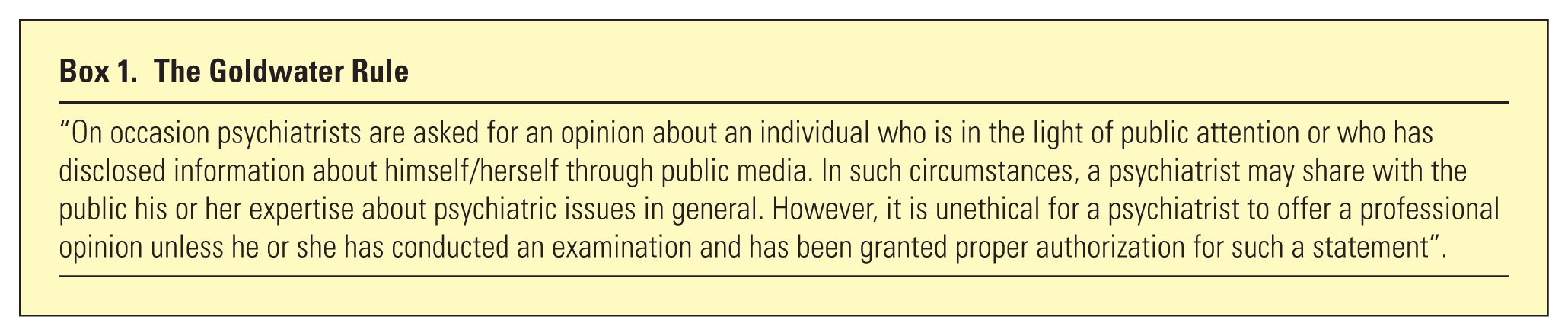
This injunction is now referred to as the “Goldwater Rule”. In essence, it sought to set the tone for psychiatrists, providing commentary in the media. As the rule remained, so did hyper-partisanship in US politics. In 1998, presumably in light of the licentious travails of the Clinton Presidency, then APA President Herbert Sacks revisited “Goldwater” appropriating the controversial term “psychobabble”. 9
The position of the Royal Australian and New Zealand College of Psychiatrists (RANZCP)
The World Medical Association recently issued a statement of guidelines for media activities by all physicians, which included injunctions pertaining to “accurate and objective delivery of scientifically proven medical information” and “not abusing mass media as a means of advertisement and maintaining professional integrity”. 10 Although the Goldwater Rule has not been enshrined in law in Australasia, several annotations of the 11th Principle of the RANZCP Code of Ethics 11 provide guidance on the matter of psychiatrists’ conduct in the media (Box 2). In turn, these annotations suggest that psychiatrists’ communications should reflect current limitations of knowledge (Annotation 5), declare the speaker’s status in providing an opinion in the public domain (Annotation 11.6), and safeguard patient confidentiality (Annotation 11.7). Annotation 11.8 is perhaps the most problematic, as it is value laden and very much subject to individual interpretation. A media appearance by a professional of any stripe is a potentially self-serving act. Whilst such activity does not usually involve promotion of clinical skill or advertisement of clinical services, such public exposure may enhance the reputation of the psychiatrist. By contrast, the issue of public denigration of colleagues requires more reflection. The term “denigration” connotes severely ad hominem or defamatory remarks that clearly have no place in any form of civil discourse. The question is begged, however, as to whether public disagreement over a particular clinical or scientific opinion, or condemnation of a clearly egregious or illegal act on the part of a colleague, represents “denigration”?
Annotations of the 11th Principle of the RANZCP Code of Ethics providing guidance about psychiatrists’ conduct in the media

A proposed approach for contributions to the media by psychiatrists in Australasia
We now propose a methodology to guide Fellows considering contributions to public discourse using the media. Our approach, derived from the philosopher John Rawls’ concept of “reflective equilibrium”, seeks to achieve a “coherentist” position in ethical deliberation. 12 Through a process of Socratic self-questioning and reflection, Fellows deliberate on any statements they may choose to make in the media, mindful of potential harms and benefits. Reflecting upon the implication of possible consequences enables psychiatrists to arrive at a decision consistent with the principles and annotations of the College’s Code of Ethics and the ramifications of the Goldwater Rule. This process is likely to be enhanced if performed in conjunction with peers. We propose the following four questions:
Question 1: Who does the contribution serve – the psychiatrist who made it, the patient, the psychiatric profession or the community?
This question covers the issue of who is the primary beneficiary of a psychiatrist’s particular contribution to the media. Even in cases of a consented discussion of the mental health of a celebrity or “high profile” patient, the question is often begged whether that psychiatrist’s reputation benefits more through being identified as the clinician involved in such a situation than any putative gains for the patient, profession or community?
By contrast, what of Fellows who, in breach of the recently promulgated Australian Border Force Act, 13 highlight the noxious effects of continuing detention on the mental health of asylum seekers? Such acts may be argued to serve the public interest, particularly if they uncover a public health problem in which the psychiatric profession has a significant interest. On the other hand, this behaviour is technically illegal and could be considered a partisan political act, albeit motivated by a perceived sense of beneficence.
Question 2: Do my actions diminish or enhance the status of the psychiatric profession?
On occasion, Australian and New Zealand psychiatrists have appeared in the media in circumstances that some Fellows have regarded as controversial, even harmful. Particularly flagrant examples have involved partisan political statements, provocative pronouncements on public policy and outright intellectual dishonesty. Beyond these, media activities that are not specific commentary on questions of mental health and illness (or related academic disciplines) can and do invite criticism not merely of the specific psychiatrist involved but often of the wider professional group.
The RANZCP and its Fellows seek to define psychiatrists as highly trained professionals who maintain rigorous standards of practice. This perception is in contrast to longstanding negative views about psychiatry in both the medical profession 14 and the community. 15 We advocate that a “rule of thumb” on this point is to ask the question, “Do my comments enhance, or detract from, the image that the RANZCP and its Fellows seek to project to the lay public?”
Question 3: Am I speaking as a member of the psychiatric profession or as a private citizen?
In making statements in the public sphere, the contributing psychiatrist assumes the status of expert, sufficient to have his or her commentary regarded as authoritative. The influence of such statements represents an exercise of power and influence. The question is begged, “What represents a safe assumption of the grounds for expertise to provide such contributions?” We have addressed this issue elsewhere, through an “onion skin” model of expertise and advocacy. 16 The model posits that there is a “core” of knowledge upon which the psychiatrist can offer authoritative commentary (Figure 1).
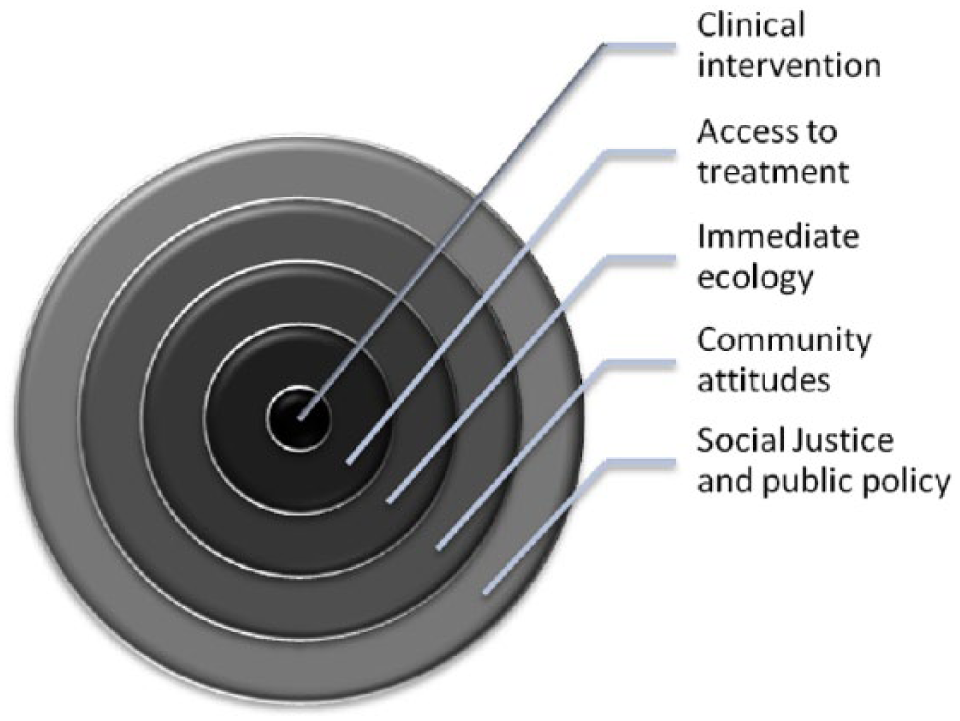
“The onion skin model of psychiatric expertise” (after Robertson and Walter, 2013). 16
The core is best defined as the diagnosis and treatment of mental illness. The subsequent “layers” cover such concerns as allocation of health resources, psychosocial determinants of illness, community attitudes and stigma in relation to mental illness and questions of broader public policy. If media contributions by psychiatrists are primarily at the core of the model, they speak with authority and their views can be privileged as expert. The further the subject matter shifts to the outer layers of the model, the less authoritative the commentary and the more it is that of a private citizen. By way of an example, consider the issue of psychiatrists commenting in the media on suicide in rural communities. In such a setting, their comments are qua member of the profession if they speak in general about the significance of mental illness in the act of suicide. If, however, a psychiatrist were to comment on an association between a spike in rural suicide and climate change policy, they should emphasise that they speak as a private citizen.
Question 4: Am I using my status and knowledge as a psychiatrist to good purpose?
This calls on the psychiatrist to consider the ethical principles of beneficence and non-maleficence. This may be achieved by interrogating several propositions, including: Are my comments likely to assist or, conversely, offend or distress any individual or group? Are they likely to diminish or add to the burden of stigma? Is my contribution liable to be understood and used as intended, or misinterpreted and misrepresented? In each of these situations, psychiatrists are well advised to apply a “double-effect” approach, 17 in which they attempt to foresee not only the potential benefits but also any possible adverse effects of purportedly well-intentioned remarks.
Conclusion
We posit that psychiatrists are well placed to provide enlightening and helpful contributions to the media. Although the Goldwater debacle occurred over half a century ago and reflected the overly partisan nature of American political discourse, the lessons garnered from that episode remain instructive in the context of Australasian psychiatrists’ involvement with the media. The RANZCP Code of Ethics offers a useful framework for applying our proposal of a reflective questioning strategy. In addition, the RANZCP needs to deal energetically with a Fellow’s media involvement that clearly contravenes relevant annotations of the code in order to protect vulnerable people entrusted to our care and the integrity of the profession as a whole.
Footnotes
Disclosure
The authors report no conflict of interest. The authors alone are responsible for the content and writing of the paper.