






Abstract
Objective
To report on the rate and causes of mortality, and associations with premature mortality among the homeless in inner city Sydney.
Method
Retrospective cohort study of 2,498 people who attended a psychiatric clinic conducted at the three main homeless hostels between 17 February 2008 and 19 May 2020. Cox’s proportional hazards regression was used to identify factors associated with mortality.
Results
A total of 324 of the 2498 (13.0%) clinic attenders were found to have died in the follow-up period, with a mean age at death of 50.7 years. Unnatural causes of death (119/324, 36.7%) included drug overdose (24.1%), suicide (6.8%) and other injuries (5.9%), at a younger age (44.4 years) than those who died from natural causes (54.4 years). There were 142 (43.8%) deaths from natural causes and 63 (19.4%) in which the cause of death was not determined.
Conclusions
The study confirms the high mortality of homeless clinic attenders in Sydney found in a study from 30 years earlier. The lower mortality among regular attenders supports the provision of accessible services to address the physical health needs of homeless people, as well as ready access to mental health and substance use services.
People who experience homelessness in high income countries are more likely to have severe mental illness, comorbid substance use and poor physical health.1,2 The high prevalence of chronic health conditions among homeless populations includes undertreated infectious diseases, metabolic disorder, respiratory conditions and cardiovascular disease.1,3,4
Studies conducted in Australia and elsewhere show that being homeless is associated with reduced access to primary and preventive health care as well as greatly reduced life expectancy.5–7 Exposure to any type of homelessness in early adult life, including rough sleeping, couch surfing and attending homeless facilities has been estimated to reduce life expectancy compared to the general population by as much as 30 years. 8 A study from the United States found standardised mortality rates (SMRs) of people experiencing various forms of homelessness ranged from 8.6 to 16.1 times greater than non-homeless comparison groups. 9 In addition to excess mortality from poor physical health, studies of mortality among the homeless report an excess of deaths from unnatural causes, including drug overdose, suicide and other traumatic injury.1,3,4
Currently there is no systematic measurement of mortality rates, life expectancy or causes of death for people experiencing homelessness in Australia. 10 A prospective study of presenters to Australian emergency departments who identified as being homeless had a life expectancy on average 12 years lower than people in stable accommodation. 11 A previous study examining a population drawn from homeless shelters in Sydney conducted nearly 30 years ago found an overall mortality at 10 years follow-up of 12%, with SMRs between 3.1 and 3.8. 5 In that study 36% died from unnatural causes, including 23% who died by suicide.
The aims of this study were to (1) provide an estimate of the rate of mortality of people attending clinics conducted in Sydney homeless shelters; (2) to report the causes of death; and (3) to report the demographic and clinical factors associated with mortality.
Method
A retrospective cohort study of 2,498 people who attended mental health clinics conducted in homeless hostels in New South Wales (NSW), Australia, linking clinic, health and criminal justice data with Registry of Births, Deaths and Marriages and Cause of Death Unit Record File mortality data.
Data sources and record linkage
Homeless clinic clients attended clinics performed at the three main homeless hostels in inner city Sydney, the Matthew Talbot Hostel run by St Vincent De Paul, the Edward Eager Lodge run by the Wesley Mission, and Foster House run by the Salvation Army from 17 February 2008 to 19 May 2020. Demographic and clinical variables collected included psychiatric diagnosis, patterns of substance use, experience of trauma as a child or adult, problem gambling, being homeless for more than a year, sleeping in the open, social security benefit, financial management orders, criminal conviction and history of psychiatric hospital admission. Deaths were identified to 30 June 2021 and where available, the cause of death was coded according to International Classification of Diseases, 10th Revision Australian-modification (ICD-10-AM).
Probabilistic record linkage was conducted by the Centre for Health Record Linkage (CHeReL). Upper and lower probability cut-offs for a link were 0.75 and 0.25, and record groups with probabilities between the cut-offs were clerically reviewed.
Clinic and linked health and mortality data were analysed using SPSS version 28 (IBM SPSS Statistics). A descriptive analysis of characteristics compared clients that were known to have died within the study period (n = 324) with those that survived. Pearson chi-square tests were used to identify significant differences. A Bonferroni-adjusted p-value <0.05 was used. A Cox’s proportional hazards regression was used to identify factors that were significantly associated with mortality. 12 A Kaplan–Meier survival plot for those who died was used to calculate time from contact to date of death for those who attended a clinic on more than 10 occasions and those who attended between one and 10 times. SMRs were calculated by dividing the observed deaths by the expected deaths. Expected deaths were based on the national age-standardised death rates. 13
Results
Comparison of demographic and clinical characteristics

aIncludes missing/unknown.
Risk factors found to be significant on multivariate Cox regression analysis

Having 10 or more clinic contacts was a significant protective factor for mortality (Hazard Ratio, or HR 0.734; 95% CI 0.554–0.971, p = 0.03). Other factors found to be protective on Cox’s regression were a diagnosis of schizophrenia or other persistent psychosis (HR 0.706, p = 0.14), cannabis use (HR 0.68, p = 0.002) and surprisingly a history of early life or recent trauma (HR 0.694, p = 0.004). Factors associated with an increased risk of death within the study period were having an acquired brain injury (HR 1.72, p < 0.001), contact with ambulatory mental health service (HR 1.91, p < 0.001), receiving the Disability Support Pension (HR 1.55, p < 0.001) and having a substance abuse disorder (HR 1.65, p < 0.001) (Table 2).
Cause of death

A Kaplan–Meier curve comparing the probability of death after the date of initial contact for those who had 10 or more contacts with a clinic (64/625), compared with those who had less than 10 contacts (260/1873) is shown in Figure 1. A Kaplan–Meier curve comparing the probability of death after the date of initial clinic contact for those with more or less than 10 clinic contacts.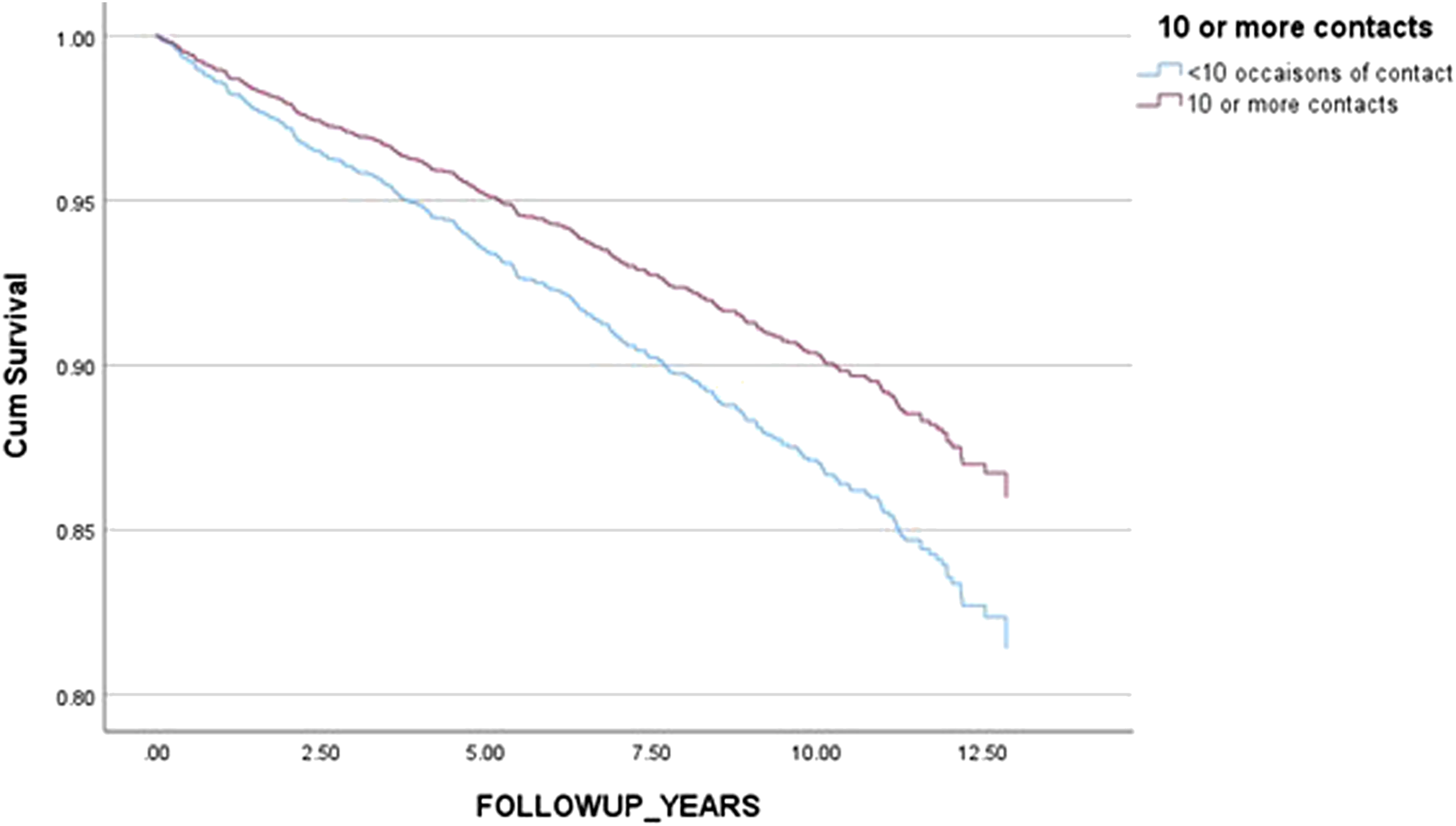
Discussion
This study found that 13% of a large sample of attenders at psychiatric clinics in homeless hostels died in a follow-up period of up to 13 years, with a high rate of death from unnatural causes, mainly overdoses of both illegal drugs and medication, and also suicide. The mean age of death was 50.7, far below the average life expectancy, and the SMR was 1.8 times the expected rate. An important finding was that being seen on more than 10 occasions at one of the clinics was associated with significantly lower mortality, whereas contact with ambulatory mental health services was associated with an increased risk of death.
The rate of death was similar to the rate reported by Babidge and colleagues of 12% in a 10 years follow-up of a cohort drawn from attendees at some of the same mental health clinics in Sydney between 1988 and 1991. 5 In the previous study most of the deaths from unnatural causes were by suicide, with comparatively fewer unintentional overdoses, but also with fewer deaths from undetermined cause than the current study, in which some of the deaths from overdose might also have been suicides. The higher proportion of deaths from unintentional overdose was surprising, as the current study was conducted during a period in which there had been a decline in the use of heroin and a greater use of stimulant drugs, and when newer antidepressants had largely replaced the prescription of tricyclic antidepressants that are more dangerous in overdose. It was notable that there had been no improvement in overall mortality in the last 30 years.
An estimated 116,000 people were identified as homeless in the 2016 national census 14 many of whom face barriers in accessing health services used by other Australians for preventive health care, such as general practitioners. 15 A previous study of health service use drawn from the same sample found people experiencing homelessness had an average of more than 13 contacts with ambulatory mental health services, presented to the ED on three occasions, and were admitted to hospital at least once. 6 However, the high use of ambulatory mental health services did not improve life expectancy, whereas regular attendance at a readily accessible nurse led primary health care service was associated with lower mortality, which supports that model of care. In the current study, the higher than expected rate of death from natural causes may reflect reduced opportunities for early identification of preventable conditions, for example, many forms of cancer, and also high rates of tobacco smoking 16 and metabolic disorder 17 in this population. The findings are consistent with the poor physical health identified in studies of homeless populations worldwide.1,4 However, there were a higher proportion of deaths from unnatural causes among the homeless than among the general psychiatric population, where excess mortality was mostly due to chronic comorbid illness. 18
Interventions aimed at reducing homelessness, improving the health of people who are homeless and reducing premature mortality overlap. Rather than a focus on individual needs, a systems framework informed by data is needed when developing programs to improve the uptake of preventive treatment, and there is an obvious need for greater integration between the mental health care, addiction treatment and housing. The lower mortality of regular clinic attenders lends some support for a model of readily accessible primary and mental health care co-located with homeless services.
The main strength of this study is the comparatively large sample and the relatively long follow-up period. However, the study has a number of limitations. There were comparatively few women, despite women making up a significant and increasing proportion of people defined as homeless. There were also a relatively high number of deaths from undetermined cause, which is likely to have been due to delays in reporting the cause of death, and also a number of overdose deaths of undetermined intent. The finding of fewer deaths among those who attended the clinics on more than 10 occasions might also have been due to a longer period of observation, rather than due to the effects of clinic interventions, whereas the higher death rate among those in ambulatory care might reflect more serious illness in those patients. Moreover, those attending the clinics might not have been representative of the homeless population as a whole.
Conclusion
This study confirms the high rate of mortality among attenders at psychiatric clinics conducted in homeless hostels, with no improvement in 30 years. The findings confirm the need for comprehensive and systems-based programs to improve access to preventive healthcare to address the causes of mortality. Contact with the mental health clinics provided an opportunity for collaborative intervention to secure housing and the integration of treatment for mental illness and substance use.
Footnotes
Acknowledgements
The authors wish to acknowledge the homeless clinic clients and wish to thank the NSW Ministry of Health for providing access to the NSW ED, ambulatory mental health contact, hospitalisation and mortality data, and the CHeReL for conducting the record linkage.
Author contributions
Logan Woodman initiated the study and prepared the first draft. Lauren Staples, Eyal Karin and Rebecca Mitchell cleaned the data and performed statistical analyses, and reviewed the draft. Nicholas Burns collected data and reviewed the manuscript. Olav Nielssen conceived the study, collected data, obtained ethical consent and prepared the final draft. All authors reviewed a near complete draft of the paper.
Disclosure
The author(s) declared the following potential conflicts of interest with respect to the research, authorship, and/or publication of this article: Professor Nielssen has received payment for participation in a Jansen advisory board. The remaining authors declare that there is no conflict of interest.
Funding
The author(s) disclosed receipt of the following financial support for the research, authorship, and/or publication of this article: The study was assisted by an investigator initiated research grant from Janssen.
Ethical approval
Ethical approval to conduct the study, which linked anonymised data therefore did not require individual patient consent, was obtained from the NSW Population Health Services Research Ethics Committee (2018HRE0301).
