







Abstract
Extant research has portrayed the effect of prior entrepreneurial experience as one that manifests uniformly across contexts. Drawing on the person-by-situation perspective, we elaborated how prior entrepreneurial experience could manifest differentially across contexts. Results from our lab experiment indicated that prior entrepreneurial experience brought an advantage in avoiding being overly “captivated” by a situationally salient role identity and missing the main goal of developing something that is both novel and commercially viable. Our research also examined the “role identity advantage” by demonstrating that compared to novice entrepreneurs, experienced entrepreneurs can better manage tensions between their chronic and situationally salient identities.
Entrepreneurship scholars have generally agreed that prior entrepreneurial experience, defined as whether an individual has previously started or owned a business (MacMillan, 1986; Ucbasaran et al., 2009), benefits new venture processes and outcomes ranging from sales performance (Delmar & Shane, 2006) and new venture success (Stuart & Abetti, 1990) to longevity of the next business opened (Lafontaine & Shaw, 2016) and overall survival rates (Brüderl et al., 1992; Dencker et al., 2009). In accounting for the benefit of prior entrepreneurial experience, past research has focused on knowledge and skill gained for venture creation and growth through learning by doing. For example, experienced entrepreneurs acquire a set of highly developed knowledge structures that can enhance their information-processing capability (Mitchell et al., 2000; Smith et al., 2009). Accordingly, experienced entrepreneurs tend to have better-integrated cognitive capacities and a richer mental framework than novice entrepreneurs, who are more prone to blind spots when thinking about and executing entrepreneurial tasks (Baron & Ensley, 2006). For instance, novice entrepreneurs adopt active coping (i.e., directly addressing a venture-relevant stressful situation) effectively, but not avoidant coping (i.e., temporarily distancing from a venture-relevant stressful situation), whereas experienced entrepreneurs tend to employ both types of coping effectively (Uy et al., 2013).
Although consensus holds that novice entrepreneurs largely exhibit worse cognition and performance than experienced entrepreneurs, there is less consensus about how novice entrepreneurs’ shortcomings are manifested. For instance, regarding entrepreneurs’ perception and pursuit of opportunities, Baron and Ensley (2006) suggested that novice entrepreneurs overemphasized novelty and underemphasized commercial viability, whereas Ucbasaran et al. (2009) found that novice entrepreneurs pursued less novel opportunities. Although these findings may seem conflicting, we suggest that they may both hold depending on the context. Indeed, most research has portrayed prior entrepreneurial experience as an individual difference factor that manifests uniformly, with less attention paid to the role of context—that is, to whether the impact of experience may manifest differently across contexts. We subscribe to Shane and Venkataraman’s (2000) perspective that “when we argue that some people and not others engage in entrepreneurial behavior, we are describing the tendency of certain people to respond to the situational cues of opportunities—not a stable characteristic that differentiates some people from others across all situations” (pp. 218–219), and propose that a person-by-situation approach can better inform the precise impact of prior entrepreneurial experience or lack thereof.
Recently, Kollmann et al. (2019) proposed a “role identity advantage” as an alternative explanation for how prior entrepreneurial experience benefits entrepreneurs, because “the interpretation of entrepreneurial roles seems to vary with entrepreneurial experience” (p. 703). Their perspective, which aligns with prior research on role identities’ importance in shaping entrepreneurial outcomes (e.g., Murnieks et al., 2012), suggests that the benefits of prior entrepreneurial experience can manifest through how entrepreneurs interpret and enact their role identities. Role identities are a key building block of entrepreneurs’ mental framework relating to how knowledge is organized, including the set of behaviors expected from a certain role (Corbett & Hmieleski, 2007). Entrepreneurs assume multiple roles, which can be classified into two broad categories: inventor and businessperson (Jain et al., 2009; Mollick, 2016). The inventor role emphasizes the novelty of a product or service (i.e., “Is it new?”), whereas the businessperson role stresses its commercial viability (i.e., “Will people buy it?”)—both of which are defining criteria of entrepreneurial creativity (Amabile, 1997; Baumol, 1993). Although both roles are critical to entrepreneurial success, it is difficult to embrace and enact both roles effectively. Studies have shown that achieving both novelty and commercial viability is challenging, because they are facilitated by different motivation and cognitive styles (Amabile, 1997; Berg, 2016; Demetry, 2017). However, the experience of enacting dual roles could help an individual integrate both roles (Berry et al., 2006). In this study, we expand Kollmanns et al.’s (2019) arguments to theorize about and examine the ways in which experienced entrepreneurs manifest a “role identity advantage” over novice entrepreneurs.
In particular, we compared how novice and experienced entrepreneurs performed in a creative business idea generation task by manipulating contextual characteristics such that a particular entrepreneurial role becomes more salient than the other on situational activation of that role identity 1 (Hong et al., 2004; Leavitt et al., 2012). During the early stage of the uncertainty-laden entrepreneurial process, the entrepreneur tends to assume different roles at different times (Bird, 1988; Clarke & Holt, 2017), such as by wearing the inventor hat for a few weeks to prepare for product launch and then putting on the businessperson hat thereafter to negotiate the best possible terms of sale. To draw causal inferences about the impact of the situationally activated or contextually salient role identity, we used a laboratory experiment to test our hypotheses. Left on their own, entrepreneurs might be influenced by either their own chronically salient role identity or a randomly salient role identity at the time of the study, thus compromising internal validity. For this reason, an experimental design is needed because experiments allow us to assess the causal impact of the precise role identity that is of theoretical interest yet difficult to capture and ascertain using field studies such as surveys (Williams et al., 2019).
In this study, we offer fresh theoretical insights for entrepreneurship research. First, we contribute to the entrepreneurial experience literature. Although prior research often attributed experienced entrepreneurs’ advantage to a superior knowledge structure in terms of prototypes (Baron & Ensley, 2006), empirical findings remain equivocal (Grégoire et al., 2010; Ucbasaran et al., 2009). Accordingly, we examine role identity as an alternative component of entrepreneurs’ knowledge structure. We theorize and find that prior entrepreneurial experience allows entrepreneurs to integrate their key roles into their knowledge structure, thus allowing them to gain an advantage by avoiding being overly “captivated” by a situationally salient role identity and missing the main goals of entrepreneurial pursuits—developing something that is both novel and commercially viable. Our study thus extends the entrepreneurial experience literature by illuminating the mechanism of a role identity advantage of entrepreneurial experience (Kollmann et al., 2019).
Second, prior research has predominantly treated entrepreneurial role identity as chronic and internal to the entrepreneur (e.g., Cardon et al., 2009; Gruber & Fauchart, 2011; Mollick, 2016; cf. Mathias & Williams, 2017). To the best of our knowledge, ours is the first empirical study to test chronic role identity and situationally salient role identity concurrently in the same model. Thus, we broaden the current conceptualization of entrepreneurial role identity to include situationally activated “working self-concept” with the aim of enhancing the predictive power of role identity in entrepreneurial processes characterized by fluctuations in task environments that call for enactment of different role identities.
Third, we integrate two separate streams of research regarding entrepreneurial action—those focusing on the individual actors (Ardichvili et al., 2003; Baron, 2008; Gaglio, 2004) and those emphasizing the situation (Mathias & Williams, 2017)—to highlight the need to take a person-by-situation interaction approach to enhancing predictions and explanations about entrepreneurial action. In doing so, we also contribute to the recent call for more experimental research in entrepreneurship (Williams et al., 2019) by suggesting and demonstrating a theoretical perspective that can benefit profoundly from an experimental method.
Theory and Hypotheses
Entrepreneurship as a Creative Endeavor
Because entrepreneurial activity involves carrying out new combinations, creativity is at the heart of the entrepreneurial process (Grégoire & Shepherd, 2012; Ward, 2004). Entrepreneurial creativity is the generation and implementation of ideas that are both novel and appropriate (Amabile, 1997). Novelty requires that an idea be original and groundbreaking, whereas appropriateness requires that it effectively addresses a need in a manner superior to existing or alternative solutions. In entrepreneurship, appropriateness primarily entails commercial viability, as extant research highlights the importance of monetization and, ultimately, profitability (Amabile, 1997; Baumol, 1993). Commercial viability indicators such as marketability and profitability are important to pursue even at the early stage of entrepreneurship (Kirzner, 1979; Schumpeter, 1934), because the potential for a new product or service to generate economic returns helps the venture obtain the cash flow needed to survive and attract investors (Mason & Stark, 2004).
Building on Amabile’s (1997) conceptualization, we regard entrepreneurial creativity as a result of generating novel and commercially viable business ideas. We followed Davidsson’s (2015) suggestion of focusing on the new venture idea and examining its novelty and commercial viability. Although entrepreneurs should pursue both novelty and commercial viability, doing so can be difficult, because novelty and commercial viability are facilitated by different motivations. For example, intrinsic motivation promotes a focus on novelty, whereas extrinsic motivation encourages an emphasis on commercial viability (Amabile, 1997). Novelty and commercial viability are also facilitated by different cognitive styles: Divergent thinking benefits novelty, whereas convergent thinking is needed for commercial viability (Berg, 2016). In addition, the goals of attaining novelty and commercial viability can compete for the entrepreneurs’ limited cognitive resources, making it challenging for them to achieve both simultaneously (Ethiraj & Levinthal, 2009).
For all these reasons, the dual goals of novelty and commercial viability make pursuing entrepreneurial creativity a complex task—one that involves a long list of relevant facts, rules, or requirements (Duncan et al., 2008). Indeed, within large organizations, such a complex task has often been performed by staff members in different roles, with inventors focusing on developing novel products and business executives focusing on promoting commercial viability (Mollick, 2012). In contrast, entrepreneurs (particularly lead founders) often must take up the complex task of achieving both goals simultaneously.
Entrepreneurial Role Identities as Situated Facets of the Self
Role identities, defined as the meanings one attributes to oneself in a role (Burke & Reitzes, 1981), form an important part of people’s self-concept. Scholars have long recognized that role identities have both stable and fluid facets (Kahn, 1990; Leavitt et al., 2012; Markus & Kunda, 1986). On the one hand, individuals can internalize a set of role identities as self-defining—that is, answering the question “Who am I?” These identities tend to be chronically accessible (Higgins et al., 1982)—they endure across varying situations—because of their importance in defining the self. This static view of identity is akin to a photographed personal portrait. On the other hand, a video portrait of the same person offers more varied views: The person is represented by a series of snapshots in different moments. Such a video portrait is analogous to the working self-concept—the self-concept activated by the social situation at a given moment (Markus & Kunda, 1986). For instance, placing participants in an office with Chinese (vs. Western) decorations makes their Chinese (vs. Western) identities salient (Friedman et al., 2012; Hong et al., 2001; LeBoeuf et al., 2010). Similarly, engineering managers’ managerial (vs. engineering) role identity became more salient when a specific context reminded them of their experience performing a managerial (vs. engineering) task (Leavitt et al., 2012). In this way, individual identities can shift in and out of the working self-concept, so that identities “may less define who the individual is than who the individual is in the moment” (Leavitt et al., 2012, p. 317). This is especially the case for individuals who wear multiple hats, for not all their identities tend to be called on in any given situation.
Considering that entrepreneurs wear multiple hats or take on multiple roles (e.g., inventor and businessperson; Jain et al., 2009; Mollick, 2016) and that the entrepreneurship process is so dynamic that it activates different role identities in different situations, prior entrepreneurship research has paid surprisingly little attention to the impact of situationally salient identities (cf. Murnieks et al., 2012). The prevalent view is that entrepreneurs’ role identities are chronic attributes that influence behaviors such as creativity, persistence, opportunity recognition, and commercialization (e.g., Cardon et al., 2013; Mollick, 2016; Wry & York, 2017) in a consistent and stable manner. In this study, we draw on the working self-concept literature to gain new insights into whether and how situationally salient role identities influence entrepreneurs’ performance.
Role Identities and Entrepreneurial Creativity
According to social role theory (Eagly, 1987; Eagly & Karau, 2002), role identities simplify information processing to enhance efficiency in implementing role-consistent tasks, because role identities function as both descriptive and injunctive norms. Descriptive norms describe what people in a certain role actually do—for example, employees’ creative role identity is positively related to creative job performance (Farmer et al., 2003). Injunctive norms prescribe the desired goals and behaviors that people in the role should perform—for example, an inventor is responsible for engaging in creative problem solving or coming up with novel ideas (Cardon et al., 2009), whereas a businessperson engages in commercial activities that contribute to venture survival and growth. The businessperson role in particular demands entrepreneurial actions that are geared toward gaining market traction and securing healthy revenue streams (Ries, 2011).
Although an entrepreneur might hold both inventor and businessperson role identities, his or her behavior depends on which role identity is activated by the social situation at a given moment. The principle of knowledge activation (Higgins, 1996) suggests that when a concept is situationally activated or made salient, it becomes temporarily stored in short-term memory as long as the concept is accessible (i.e., easily retrieved and readily usable) and applicable (i.e., relevant to the task at hand). Thus, when a concept is situationally activated, it takes priority over other chronically held but non-situationally activated concepts to influence immediate behaviors. Research has demonstrated that identity is one concept that complies with the principle of knowledge activation (e.g., Hong et al., 2001; Leavitt et al., 2012).
Integrating the principle of knowledge activation and social role theory, we expect that when a situation activates the inventor role identity, its associated norm of novelty seeking would become immediately available in an entrepreneur’s mind, in turn producing novelty-seeking behaviors to promote novelty in creative performance. By the same token, when a situation activates the businessperson role identity, its associated norm of commercial viability would become immediately available in an entrepreneur’s mind and consequently engenders behaviors that promote commercial viability in creative performance.
The principle of knowledge activation also suggests that a situationally salient feature receives selective attention relative to alternative features (Higgins, 1996), because limitations of mental resources mean that paying attention to a focal feature or fulfilling a focal goal distracts from alternative features and goals. For example, Jones et al. (1977) demonstrated that when people evaluated a behavior that can be seen as both stubborn and persistent, those who were exposed to a salient stubbornness trait in a preceding task were more likely to interpret the behavior as stubborn and ignore the alternative interpretation of persistence, and vice versa.
Following the foregoing logic, we argue that although the situationally salient role identity promotes achievement of role-consistent goals, it can also obstruct other important goals not related to the salient role identity. This exemplifies the phenomenon of missing the forest for the trees, or a blind spot where one tends to overlook other aspects of a task that are equally important as a consequence of focusing narrowly on a specific aspect of a task (Henderson & Trope, 2009). We thus predict that when the inventor role identity is situationally salient, the entrepreneur’s attention is directed primarily to novelty and less toward commercial viability, so that the commercial viability of business ideas is lower. Likewise, when the businessperson role identity is situationally salient, the entrepreneur’s attention is focused more on commercial viability and less on novelty, resulting in less novel business ideas. To summarize the preceding arguments, and as a starting point, we propose the following hypotheses:
In short, on the one hand, the principle of knowledge activation proposes that a situationally salient role identity would prompt the entrepreneur to focus on the feature of the task that corresponds with the situation, whereas on the other hand, the blind spot phenomenon suggests that the entrepreneur would tend to neglect aspects of those tasks not directly relevant to the situationally salient role identity. Taken together, the principle of knowledge activation and the blind spot phenomenon are predicting the two sides of the same coin, and their predictions are consistent, as articulated in H1a and H1b. Although these main effects of role identities are logically derived from existing theories, they are likely to be moderated by individual differences in prior entrepreneurial experience, the key focus of this research, which draws on the person-by-situation perspective, as we elaborate in the next section.
The Role Identity Advantage of Experience—A Person-by-Situation Interaction
The crux of our person-by-situation interaction hypothesis is that blind spots spurred by situational influences would be attenuated by prior entrepreneurial experience. Both novice and experienced entrepreneurs rely on knowledge structures—defined as “knowledge about a concept or type of stimulus, including its attributes and the relations among those attributes” (Fiske & Taylor, 1991, p. 98)—in their daily decision-making. However, the cognitive structures of experienced entrepreneurs are superior to those of novices, with cognitive research indicating that experience fosters the development of integrated knowledge structures (Baron & Ensley, 2006; Gitomer, 1988). That is, cognitive structures of experienced individuals tend to consist of categories of information based on a deep structure that involve richer and stronger links between concepts (Dane, 2010; Gobbo & Chi, 1986). Thus, experienced entrepreneurs tend to be capable of processing greater amounts of information in a given instance and see the big picture, which novices tend to neglect (e.g., Uy et al., 2013).
One important type of information-rich category in knowledge structures is role identity (Ashforth et al., 2000; Bem, 1981; Corbett & Hmieleski, 2007). Because identity is a primary type of mental category that people use to organize their world, it follows that prior experience of enacting multiple roles provides experienced entrepreneurs with the opportunity to develop rich and strong structural connections among their multiple identities, in contrast to novice entrepreneurs’ tendency to see role identities as disconnected (Mollick, 2016). Parallel to this theorizing, research in other domains such as multicultural identities also suggested that people’s identities tend to integrate as they gain experience enacting these identities (Berry et al., 2006). Because entrepreneurs enact both inventor and businessperson role identities while creating new ventures (Cardon et al., 2009), we expect experienced entrepreneurs to have developed a more holistic knowledge structure in which their inventor and businessperson roles are integrated. In contrast, novice entrepreneurs who lack prior entrepreneurial experience may see their two role identities as separate and disjointed.
How could a more integrated identity structure protect experienced entrepreneurs from common blind spots in specific situations? According to the spreading-activation theory in cognitive psychology, knowledge structures consist of nodes and links (Collins & Loftus, 1975). The nodes are units of knowledge or concepts in the mind, such as entrepreneurs’ concepts of the inventor and businessperson role identities. The links are paths that connect the nodes. When a node is first activated (or made salient), it spreads to activate other nodes via the links they share. This is akin to when one person in a social network hears a piece of news: His or her link (or contact) with other persons in the same network enable the news to spread. The link is a critical element in the spreading mechanism, because the likelihood and speed of spreading depends on the strength of the link or relationship: Strong links spread faster than weak ones. For example, when the concept “fire engine” is activated, it spreads to activate strongly related concepts such as “vehicle” and the color “red” but not to concepts such as “flower” and “cherry,” which are generally not strongly related to “fire engine”. Furthermore, the strength of the links depends on how often people think about or use the linked concepts together: The more often they use the linked concepts, the stronger the link becomes, and thus the faster the activation will spread.
Based on this line of reasoning, if the two role identities are closely integrated within experienced entrepreneurs’ knowledge structure, the situational activation of one identity should also activate the other. That is, when the businessperson role identity is situationally salient, it would spread to activate the inventor role identity, and vice versa, by virtue of the identities being closely linked. As a result, the situational salience of the businessperson role identity should not decrease idea novelty among experienced entrepreneurs, thus protecting them from this blind spot. In contrast, for novice entrepreneurs in whom these role identities are not yet integrated, activation of the businessperson role identity will not spread to activate the inventor role identity.
In a similar vein, when the inventor role identity is made situationally salient for experienced entrepreneurs, it should spread and activate the businessperson role identity as well. As a result, the situational salience of the inventor role identity should not decrease idea commercial viability among experienced entrepreneurs, thus attenuating the blind spot phenomenon. In contrast, for novice entrepreneurs in whom these role identities are not yet integrated, activation of the inventor role identity will not likely spread to activate the businessperson role identity. Thus, activation of inventor role identity will tend to decrease idea commercial viability among novice entrepreneurs.
Taken together, we hypothesize as follows:
The Moderating Role of Chronic Role Identities
The impact of a situationally salient role identity can also be contingent on the chronic identity, because the two identities can be either aligned or in tension. Role identities are aligned when the situationally salient role identity is also one that a person strongly identifies with chronically, such as when an entrepreneur who has a strong inventor (or businessperson) role identity is in a situation that activates an inventor (or businessperson) role identity. Conversely, role identities are in tension when the situationally salient role identity differs from one with which a person chronically identifies, such as when an entrepreneur who has a strong inventor (or businessperson) role identity is in a situation that activates a businessperson (or inventor) role identity.
According to the role identity literature, fulfillment of a role is facilitated when the situation also makes the role identity salient (Ely, 1994, 1995). That is, if the chronic role identity is aligned with the one that is situationally salient, the expectations and goals of the chronic role identity can be achieved with relative ease. Accordingly, when an entrepreneur who has a strong inventor (or businessperson) role identity is in a situation that activates an inventor (or businessperson) role identity, he or she is more likely to generate novel (or commercially viable) ideas with ease. These conducive situations facilitate performance regardless of whether one has prior entrepreneurial experience. As a result, when the chronic role identity aligns with the situationally salient role identity, idea novelty or commercial viability does not significantly differ between novice and experienced entrepreneurs.
In contrast, misalignment of the two, so that the situationally salient identity differs from the one with which a person chronically identifies, creates a tension between what the situation demands and what the person values. We expect the individual to put aside his or her chronic role identity to fulfill the demand of the situationally salient role, because the principle of knowledge activation (Higgins, 1996) suggests that the situationally salient role identity is temporarily more accessible and thus could more readily influence behavior than could an alternative role identity that is chronically important but not situationally salient. For example, an academic faculty member who is under strong pressure to obtain tenure and promotion may focus on fulfilling the researcher role identity and put less time and effort into teaching despite also identifying strongly with an educator role identity. For this reason, in such tension-ridden situations, fulfillment of the situationally salient role identity is more likely to result in a blind spot—that is, in neglecting the nonsituationally salient but chronically important role identity.
Although novice entrepreneurs will likely succumb to such a blind spot when the chronic and situationally salient identities are in tension, we contend that experienced entrepreneurs will not, for the following reason. Entrepreneurial experience repeatedly exposes entrepreneurs to similar tensions between chronic and situationally salient role identities as they put on different hats in response to situational cues (Bird, 1988; Clarke & Holt, 2017). Repeated and extended experience with such tension-ridden situations can be uncomfortable, for role theory suggests that discrepancies in role expectations produce stress and diminish self-perceptions of competence and effectiveness (Kahn et al., 1964; Matta et al., 2015). Similarly, the principle of cognitive dissonance (Festinger, 1962) suggests that setting aside one’s chronic identity to fulfill another identity demanded by the situation can cause dissonance. These role identity tensions are uncomfortable, for they threaten one’s self-consistency (Lecky, 1961); as a result, they motivate people to resolve the tensions and thereby maintain self-consistency (Aronson, 1992). The more tension people experience, the more they are motivated to resolve it (Cooper & Stone, 2000; Elliot & Devine, 1994; Festinger, 1962). Taking this line of reasoning, entrepreneurs’ repeated encounters with tension-ridden situations would motivate them to resolve the tension by learning to exert their chronic role identity while fulfilling an alternative situational identity demand, which in turn would allow them to maintain self-consistency over the long run. In short, experienced entrepreneurs’ repeated exposure to identity tensions and deliberate practice of exerting a chronically important identity over time can help them develop a behavioral tendency to exert a chronically important identity even when the situation does not facilitate it.
Accordingly, experienced entrepreneurs should be more capable than novice entrepreneurs of avoiding a blind spot in the presence of tension between the situationally salient identity and their chronically important identity. Specifically, when the businessperson identity is situationally salient while the chronic inventor identity is high (thus engendering a role identity tension), experienced entrepreneurs are less likely than novice entrepreneurs to neglect the inventor identity and thus can generate more novel ideas. Similarly, when the inventor identity is situationally salient while the chronic businessperson identity is high (tension), experienced entrepreneurs are less likely than novice entrepreneurs to overlook the businessperson identity and thus can generate more commercially viable ideas.
Accordingly, we hypothesize as follows:
Overview of Empirical Strategy
We conducted a lab experiment to test our hypotheses and examine our research question. At least two considerations justify the use of a lab experiment. First, because we hypothesized a person (prior entrepreneurial experience)-by-situation (salient role identity in the moment) interaction effect, an experiment is needed to draw causal inferences about the impact of the contextually salient role identity. Left on their own, entrepreneurs might be influenced by their own chronically salient role identity (Hogg et al., 1995; Reed, 2004) or a randomly salient role identity at the time of the study, compromising internal validity. An experimental design allows us to assess the causal impact of the precise role identity that is of theoretical interest. Capturing and untangling these effects using field studies would be difficult (Williams et al., 2019).
Because it is critical that we control for environmental factors to eliminate most, if not all, confounds, we invited the entrepreneurs into a physical lab to carry out the experiment rather than using an online approach, which may be better suited for experiments that manipulate internal characteristics such as emotion, psychological ownership, or self-efficacy (Foo, 2011; Hsu, 2013; Hsu, Simmons, Wieland, 2017). Moreover, Hsu, Simmons, Wieland (2017) recommended lab experiments as particularly suitable for unpacking the effect of boundary conditions. We followed the guidelines for conducting experiments in entrepreneurship to improve both internal and ecological validity and avoid common drawbacks (e.g., Grégoire et al., 2019; Hsu, Simmons, Wieland, 2017; Stevenson & Josefy, 2019). The following section describes our experimental design.
Method
Sample, Design, and Procedures
We recruited actual entrepreneurs who were in the process of starting a new venture to ensure external validity through sampling (Grégoire et al., 2019). Because the two role identities we manipulated have not been studied before, we looked to similar experiments that manipulated situationally salient role identities as a guide for determining our sample size. Relying on Hong et al. (2001) and Leavitt et al. (2012), we concluded that we needed to target at least 40 participants per identity manipulation, so at least 80 in total for our two identity manipulations. One hundred eight participants who identified themselves as working on their respective entrepreneurial ventures as lead founders (62% male; mean age = 24 years, aged 18–44 years) were recruited from an entrepreneurship center and a student entrepreneurship society of a public university in Singapore. Among our study participants, 40 participants were entrepreneurs who had previously started a business (the duration of their past business experience ranged from 5 months to 88 months, with a mean of 27.29 months). Seventy participants (64.80%) had a bachelor’s degree, and thirty-three (30.60%) had a master’s degree. Thirty-three participants (30.60%) had held full-time jobs in the past.
Because prior entrepreneurial experience is a characteristic not easily amenable to experimental manipulation, we measured it as a fixed individual characteristic. Entrepreneurs who have prior entrepreneurial experience could differ from novices in their baseline creative capabilities (i.e., entrepreneurs who have prior experience are likely to be more creative as a result of their startup experience), potentially influencing the dependent variable of creative performance in this experiment. To rule out this alternative explanation, we controlled for the effects of baseline creativity prior to the experimental manipulation. We administered a separate business idea generation task at the beginning of the study to measure the baseline creativity of each entrepreneur before introducing the experimental manipulation. We described the task in detail hereafter, in the Measures section.
The experiment used a between-subject (inventor vs. businessperson role identity salience) design to assess the interaction effect of prior entrepreneurial experience and situational role identity salience on creative business idea generation. We introduced the study by explaining that we sought to understand issues related to business idea generation, which required participants to perform brainstorming tasks. Participants were first asked to indicate whether they had started their own business before. Based on this information, we classified participants as being with or without prior entrepreneurial experience. We used Qualtrics to perform a random assignment for each category of entrepreneurs into one of the two experimental conditions for each experience category, to ensure that approximately equivalent numbers of experienced and novice entrepreneurs were assigned to each experimental condition. Afterward, we introduced our role identity manipulation.
Role Identity Manipulation
In designing the experimental manipulation, we first ensured construct validity using a tested and proven approach of manipulating the same construct in psychology and management research (Leavitt et al., 2012; Libby et al., 2005). This manipulation employs memory recall to activate the contextual salience of the inventor or businessperson role. This approach corresponds with the active participation method, ensuring high internal validity (Hsu, Simmons, Wieland, 2017).
We first used the following introduction to remind participants that everyone can behave like a typical inventor (businessperson) at times, explaining that we wanted to know their experience behaving like a typical inventor (businessperson) in this exercise:
In an interview with a large number of ordinary people, researchers found that almost everyone behaves like a typical inventor (businessperson) from time to time, although they are not inventors (businessperson) by profession. In this study, we want to know your experience behaving like a typical inventor (businessperson).
We then asked participants to recall and write about their experience behaving like a typical inventor (businessperson) with the following instructions. To boost the strength of the manipulation, participants also saw a panel of four colored pictures depicting the primed role in each condition (e.g., a deal-making businessperson in the businessperson condition) during the recall exercise. Moreover, participants answered four questions designed to increase the memory’s vividness (e.g., “Can you see what you were wearing?”; Leavitt et al., 2012; Libby et al., 2005). Participants were instructed to type a brief description of the memory from an observer’s visual perspective.
We bolstered ecological validity in the process of the creating the foregoing manipulation stimulus. Particularly, entrepreneurs may experience heightened inventor role identity salience when they are focusing on tasks that involve solution generation and product development. In contrast, entrepreneurs tend to experience greater businessperson role identity salience when working on a pitch to win investors, close a new sale, or so forth. Research has demonstrated that when performing tasks key to a role identity, role identity salience is temporarily boosted (Leavitt et al., 2012). Accordingly, we manipulated the contextual salience of the inventor versus businessperson role identities by making entrepreneurs recall the last time they were performing tasks key to the role identity.
Immediately following the manipulation, participants were informed that the university’s student enterprise center had been looking for creative ideas for an innovative concept to sell to students, for the purpose of helping university students perform well in job interviews. The instructions indicated that the participant’s goal was to develop a creative product or service idea that served this purpose. Because research has suggested that setting explicit goals of producing ideas that are both novel and appropriate can facilitate creativity (Shalley, 1991), to avoid anchoring participants on either novelty or appropriateness, we asked participants to develop just “creative” ideas without specifying what “creative” meant. Participants had to come up with at least three and up to six (M = 3.88, SD = 1.23) business ideas. 2 After generating at least three business ideas, participants were asked to select one idea that they thought would have the greatest potential for further development. To motivate participants, we informed them that “if your final idea is highly creative, you will be entered into a lucky draw for a $30 gift card. To qualify for the Lucky Draw, your idea must be considered very creative by the enterprise center’s product managers.” Consistent with Amabile (1996) and Berg (2014), we introduced this performance-based (extrinsic) motivator only during the validation stage of the creative process. Participants then spent at least 5 min elaborating their final idea. They were given the option of describing the details of their idea by typing into an essay box or making visual illustrations of their idea on a blank paper provided, or both.
Measures
Entrepreneurial Experience
Participants responded to two experience-related questions. First, they indicated whether they were currently running a business they had founded or cofounded. In addition, they indicated whether they had ever founded or cofounded a company, regardless of whether it was still in operation. Participants who responded “yes” to either question were considered experienced, whereas those who did not have any prior experience founding a company but were trying to start one were considered novices. This way of dichotomizing between experienced and novice (first-time) entrepreneurs is consistent with the approach used in prior studies (e.g., Baron & Ensley, 2006; Kotha & George, 2012). 3
Chronic Role Identities
We measured participants’ chronic role identities in a baseline survey administered 33 days prior to the start of the lab experiment. We measured both chronic inventor and businessperson role identities by adapting the four-item identity scale of Luhtanen and Crocker (1992). Sample items include “Being an inventor (businessperson) is an important reflection of who I am” and “Overall, being an inventor (businessperson) has very little to do with how I feel about myself” (reverse coded). Participants responded on an 8-point Likert scale. Cronbach’s alphas were .73 and .83 for the inventor and businessperson measures, respectively.
Creative Performance (Expert-Rated Novelty and Commercial Viability)
Creative performance was based on the evaluation of the final ideas rated by two expert raters with substantial experience in entrepreneurship and the domain of job interview training in accordance with the Consensual Assessment Technique (Amabile, 1996). The raters were blind to the study questions and hypotheses and rated the final ideas on the dimensions of novelty and commercial viability, using a 1–7 scale (1 = “very low,” 4 = “moderate,” 7 = “very high”). The two raters assessed the novelty of the interview aid product by answering the following question: “Based on your professional experience, to what extent do you consider this idea new or original, that is, the extent that it is unique for other products currently available or related to the domain of interview aid?” They evaluated the commercial viability of the interview aid product by answering the following question: “To what extent can the interview aid product compete effectively in the marketplace to generate attractive revenues?” In discussion with the researchers, the raters further considered the following factors when judging commercial viability: cost of business, degree of market saturation, or suitability given the consumer behavior patterns of the target market. For 7-point scales such as ours, LeBreton and Senter (2008) suggested that high interrater agreement is achieved if the average deviations of mean (ADm) are less than 1.20. ADm for the experts’ ratings was .72 and .45 for novelty and commercial viability, respectively, demonstrating adequate interrater agreement. 4 Furthermore, the intraclass correlation of the two experts’ average ratings were .76 and .73 for novelty and commercial viability, respectively, demonstrating acceptable interrater reliability. Accordingly, we averaged the two raters’ assessments of novelty and commercial viability, respectively, such that each idea had a novelty score and a commercial viability score—an approach consistent with those used in prior studies (e.g., Berg, 2014; Grant & Berry, 2011).
Baseline Creative Performance
We measured baseline creative performance as a control variable to rule out the alternative explanation that experienced entrepreneurs differ from novice entrepreneurs in terms of their baseline creative capabilities. We measured baseline creative performance at the start of the study before introducing experimental manipulations. Participants read the following instruction on the creativity task, adapted from Gielnik et al. (2012):
“You will engage in a business idea brainstorming task now, based on the following trend report. You are watching the news on TV and you hear that nowadays, skills and competencies are becoming more important than ever. There is much room for improvement in the education sector worldwide. Although it seems to be a governmental or political issue, the news reports that education is a huge new market with great business potential because people are more willing to invest on their own and their children’s education. Lifelong learning is the new trend. What business ideas come to your mind? Please list as many business ideas for new products or services as possible on the next page. The ideas may or may not be related to your current business.”
Participants generated 1–16 ideas (M = 4.93, SD = 2.54) whose creativity was rated by the same raters using the same approach described above. Again, we averaged the two raters’ assessments to derive a final score of novelty and commercial viability for each idea. We then computed the score of novelty and commercial viability for each participant by averaging scores for all ideas generated by each.
Manipulation Check
Two independent coders blind to the manipulation conditions and study hypothesis carried out manipulation check in accordance with the procedures taken by Yang et al. (2014). The coders read the manipulation prompt and coded each response for relevance independently. 5 The interrater agreement was high: Interrater disagreement occurred for only 6 of 108 (5.56%) responses. Disagreements were resolved by a discussion facilitated by the researchers; ultimately, only 4 cases were ruled irrelevant (indicating that manipulation was effective) and thus excluded from subsequent analysis. The final sample size for the analysis was 104.
Analyses and Results
We analyzed the data using moderated multiple regression. Following prior research testing the unique variance of each dimension of creativity (e.g., novelty and usefulness, Berg, 2014; see also Chua, 2013), we ran separate regression analyses for each outcome variable: idea novelty and idea commercial viability. To account for any spillover between the two dimensions of entrepreneurial creativity, we included novelty as a control when analyzing commercial viability as outcome and vice versa. We also controlled for baseline creativity as indicated by the novelty and commercial viability of the business ideas participants generated at the beginning of the experiment and the total number of ideas generated as an indicator of ideational fluency.
First, we tested the main effects of role identities as articulated in Hypothesis 1a and 1b. In testing Hypothesis 1a, we obtained a marginally statistically significant evidence (at p < .10 level of significance) that idea novelty is higher (lower) when the inventor (businessperson) role identity is situationally salient than when the businessperson (inventor) role identity is situationally salient (Hypothesis 1a), b = .26, p = .09. However, for Hypothesis 1b, we observed that there is no statistically significant evidence that idea commercial viability is higher (lower) when the businessperson (inventor) role identity is situationally salient than when the inventor (businessperson) role identity is situationally salient (Hypothesis 1b), b = .07, p = .50.
Central to our contention, we tested whether prior entrepreneurial experience is beneficial (Hypotheses 2a and 2b). In short, we needed to demonstrate that when the inventor (businessperson) role was salient, the commercial viability (novelty) of the idea was compromised among novice entrepreneurs but not among experienced entrepreneurs. To this end, we created an interaction term between entrepreneurial experience and situational role identity (both contrast-coded). Furthermore, to test Hypotheses 3a and 3b regarding the moderating role of chronic identities, we needed to demonstrate that novice entrepreneurs compromised novelty or commercial viability when mismatch occurred between situational identity and chronic identity. To this end, we created an interaction term among prior entrepreneurial experience, chronic identity, and situational role identity. We ran a moderated multiple regression analysis followed by planned contrasts using simple slopes analysis (Aiken et al., 1991; Dawson & Richter, 2006; Dawson, 2014) to test our hypotheses. All control variables were first entered into the regression, followed by independent variables and finally their respective two-way and three-way interaction terms. All continuous variables were mean-centered. Tolerance and variance inflation statistics indicated that multicollinearity did not unduly influence our results.
Table 1 presents the descriptive statistics. Table 2 reports the results of the moderated multiple regression analysis.
Means, Standard Deviations, and Correlations.
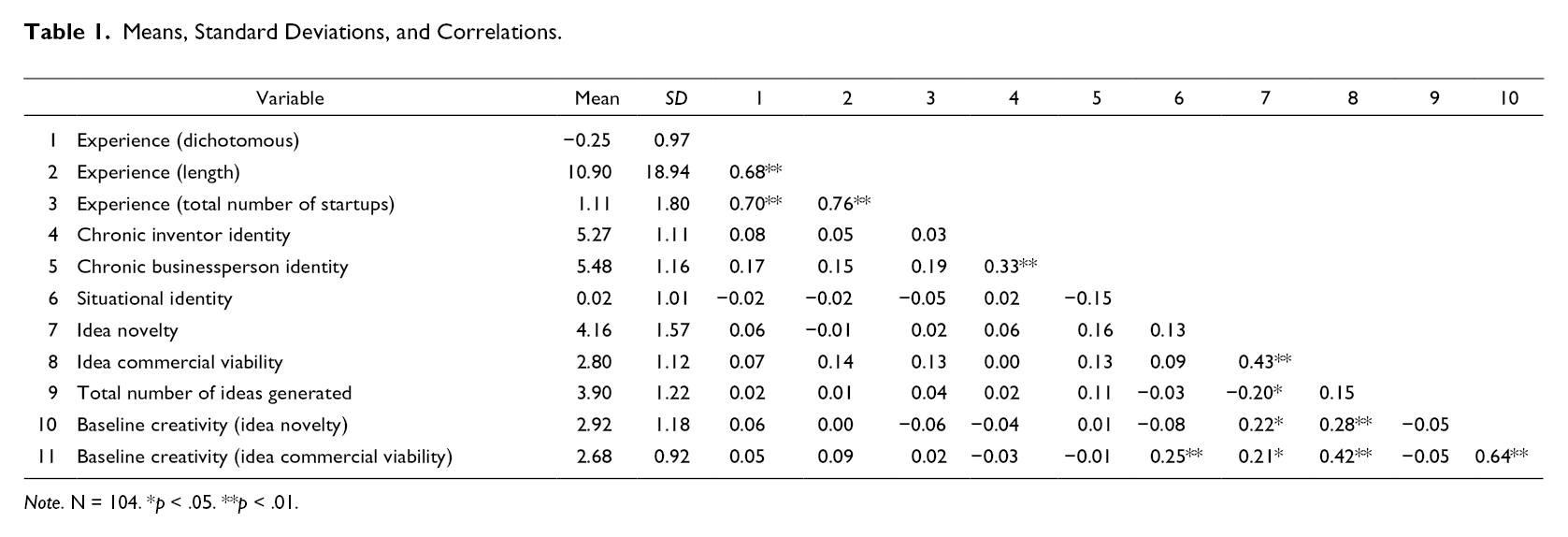
Note. N = 104. *p < .05. **p < .01.
Regression Results.
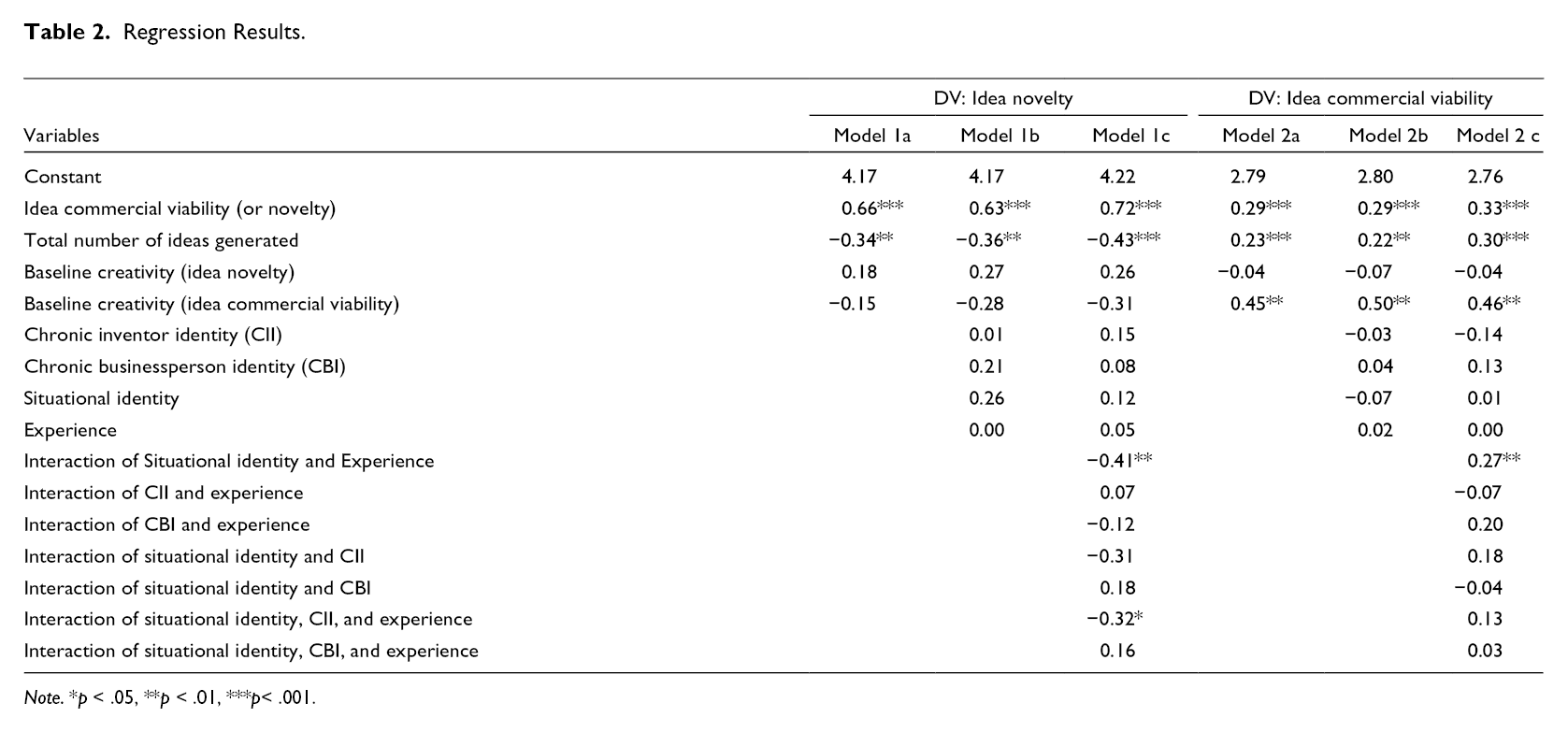
Note. *p < .05, **p < .01, ***p< .001.
We observed statistically significant evidence of an interaction effect, such that prior entrepreneurial experience moderated the effect of situationally salient role identity on novelty, Model 1c, b = –.41, p = .007. To interpret the nature of this interaction and test Hypotheses 2a and 2b, we carried out a planned contrast by conducting simple slopes analysis (Dawson, 2014).
Figure 1a 6 illustrates the effect of situational identities (inventor vs. businessperson) on novelty for novice versus experienced entrepreneurs. Specifically, planned contrast between the two experiment conditions (situationally salient businessperson vs. inventor identities) for novice entrepreneurs showed statistically significant evidence for a difference (b = –.63, p = .002) such that they produced less novel business ideas when the businessperson role identity was situationally salient than when the inventor role identity was situationally salient (first and second bars from the left in Figure 1a). Specifically, a change of the situationally salient identity from inventor to businessperson was associated with a decrease in business idea novelty by .63 out of a 7-point scoring scale—a 9% decrease. In contrast, the novelty level of the ideas generated by experienced entrepreneurs was no worse in the businessperson condition than in the inventor condition (third and fourth bars from the left; b = .17, p = .43). Thus, Hypothesis 2a is supported.
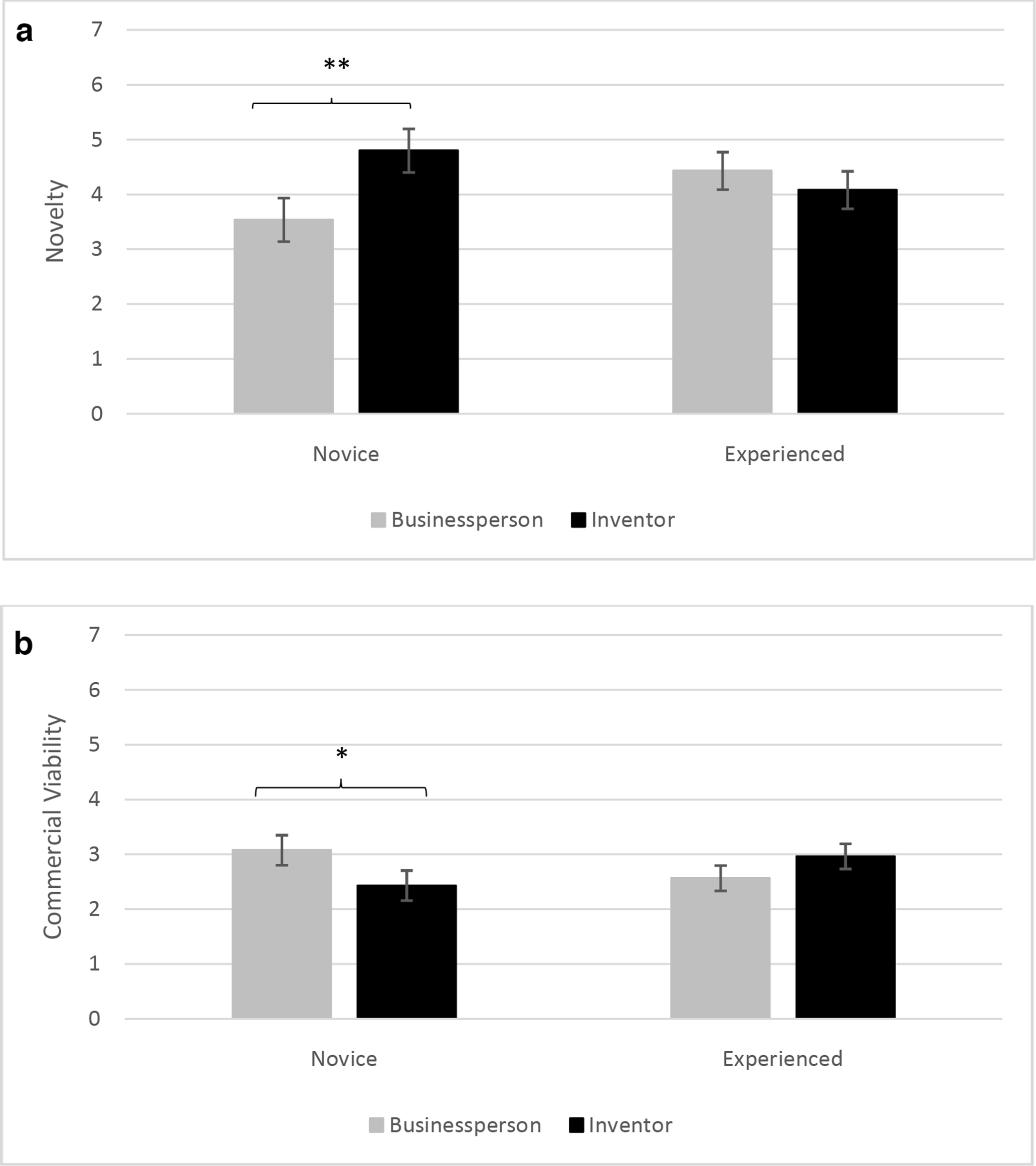
Interaction between role identity and entrepreneurial experience on predicted business idea (a) novelty and (b) commercial viability.
We also observed statistically significant evidence for an interaction effect, such that prior entrepreneurial experience moderates the effect of situationally salient role identity on commercial viability, Model 2c, b = .27, p = .009. Figure 1b illustrates the effect of situational identities (inventor vs. businessperson) on commercial viability for novice versus experienced entrepreneurs. Specifically, planned contrast between the two experiment conditions (situationally salient businessperson vs. inventor identities) for novice entrepreneurs showed statistically significant evidence for a difference (b = –.32, p = .02) such that they produced less commercially viable business ideas when the inventor role identity was situationally salient than when the businessperson role identity was situationally salient (first and second bars from the left in Figure 1b). Specifically, a change of the situationally salient identity from businessperson to inventor was associated with a decrease in business idea commercial viability by .32. Given the 7-point scoring scale in our study, this translates into a 4.57% decrease. In contrast, the commercial viability level of the ideas generated by experienced entrepreneurs was no worse in the inventor condition than in the businessperson condition (third and fourth bars from the left; b = .20, p = .18). Thus, Hypothesis 2b is supported.
To test Hypotheses 3a and 3b, we needed to inspect the relationship between situational role identity and prior entrepreneurial experience (a 2 × 2 interaction) at the high (but not low) level of a chronic role identity, because the role identity tension of interest in this research occurs when a situationally salient role identity differs from a strong chronic role identity 7 (Cohen et al., 2003). To this end, we conducted the following two sets of planned contrasts via simple slope analysis (Dawson & Richter, 2006) to test Hypotheses 3a (for novelty) and 3b (for commercial viability). Each set of contrast is also plotted in Figure 2. 8
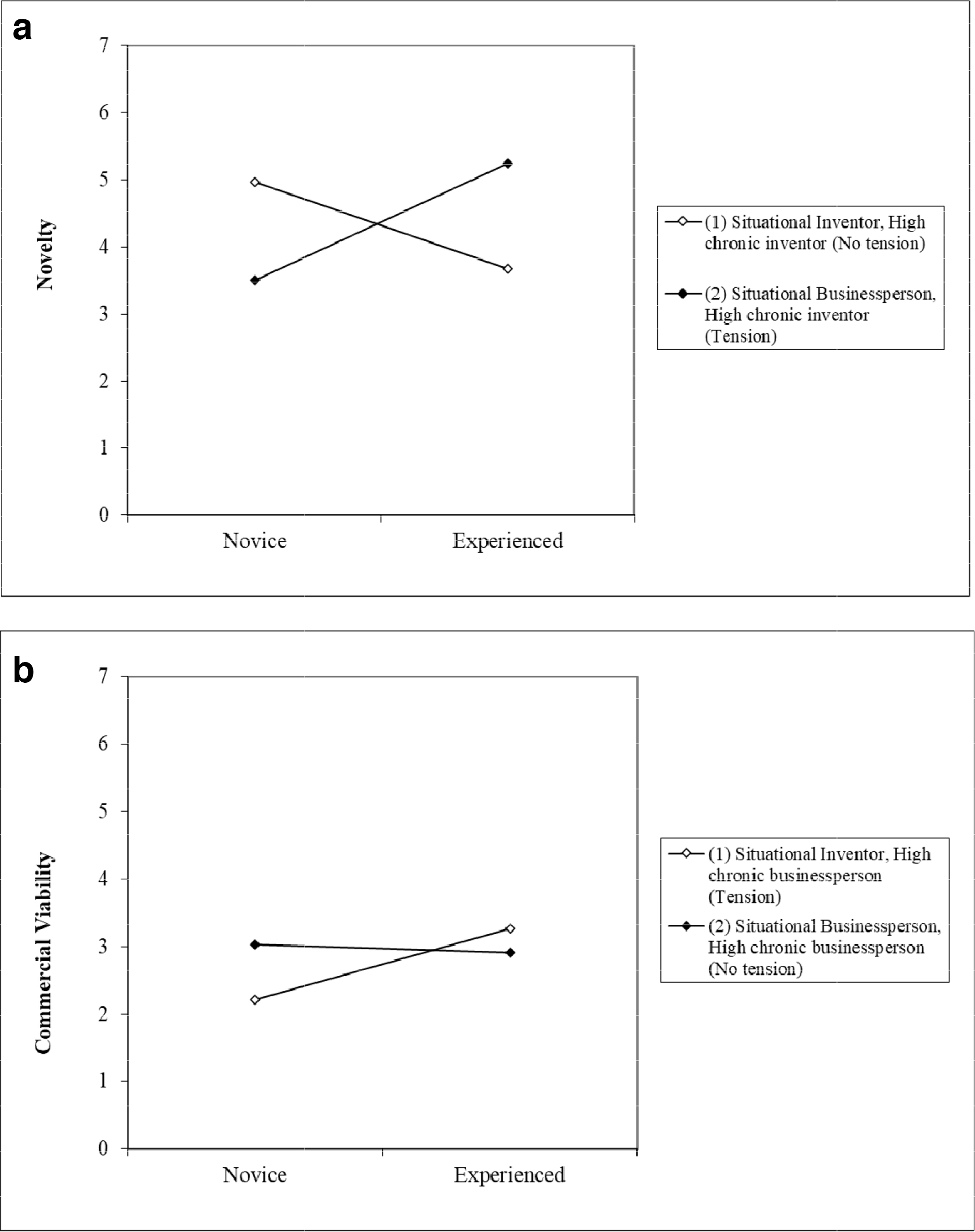
Planned contrast between novice and experienced entrepreneurs in the presence versus absence of chronic-situational identity tension on predicted (a) novelty and (b) commercial viability.
The simple slope test for novelty as the dependent variable showed statistically significant evidence of a positive difference between experienced and novice entrepreneurs who have high chronic inventor identity while the businessperson identity is situationally salient (tension), b = .89, p = .03. In short, experienced entrepreneurs’ business ideas were .89 more novel (or a 12.71% advantage on a 7-point scoring scale) than novice entrepreneurs’ when there was tension between chronic role identity and situationally salient identity. There was statistically significant evidence that the coefficient between experienced and novice entrepreneurs with high chronic inventor identity when the inventor identity is situationally salient (no tension) was negative (b = –.66, p = .01), suggesting that experienced entrepreneurs’ business ideas were .66 less novel (or a 9.43% disadvantage on a 7-point scoring scale) than novice entrepreneurs’ when there was no tension between chronic role identity and situationally salient identity. Results of the slope difference test revealed statistically significant evidence of a positive difference between these two slopes (b = 1.55, p = .002). These results support Hypothesis 3a, which states that when the situationally salient identity does not match the chronic identity, novice entrepreneurs neglect their chronic identity more than experienced entrepreneurs do. Although we did not expect idea novelty to differ between experienced and novice entrepreneurs with high chronic inventor identity when the same identity was also situationally salient (i.e., no tension), the slope test result suggests that novice entrepreneurs generated more novel ideas in this case. This finding which we did not explicitly hypothesize does suggest that novice entrepreneurs may be better at assimilating to a situationally salient inventor role identity and thus produce more novel ideas. Novice entrepreneurs’ ability to assimilate to a situationally salient identity can be an advantage if the situationally salient role is the most critical element for attaining success. Future research is needed to verify the robustness of this finding. That said, for commercial viability, we did not find a statistically significant evidence for the difference between novice and experienced entrepreneurs, perhaps because commercial viability is a more complex outcome that involves several moving parts, including market, industry, and competition (Teece, 2010).
We applied an identical approach to test Hypothesis 3b (commercial viability as the dependent variable; see Figure 2b). The simple slopes test showed statistically significant evidence for a positive coefficient between experienced and novice entrepreneurs who have high chronic businessperson identity while the inventor identity is situationally salient (tension), b = .54, p = .01. In short, experienced entrepreneurs’ business ideas were .54 (or a 7.71% advantage on a 7-point scoring scale) more commercially viable than those of novice entrepreneurs when there was tension between chronic role identity and situationally salient identity. There was no statistically significant evidence of a difference in the coefficient between experienced and novice entrepreneurs with high chronic businessperson identity when the businessperson identity was also situationally salient (no tension), b = –.06, p = .76. Results of the slope difference test revealed a statistically significant evidence for a positive difference between these two slopes (b = .60, p = .05). These results support Hypothesis 3b, demonstrating that experienced entrepreneurs generate more commercially viable ideas than novice entrepreneurs when the chronic businessperson identity is high while the inventor identity is situationally salient (tension) but not when the chronic businessperson identity is high while the businessperson identity is situationally salient (no tension).
Discussion
Implications for Research on Entrepreneurial Experience
Research on entrepreneurial experience has often attributed experienced entrepreneurs’ advantage to their superior knowledge structure. Existing theories about entrepreneurial experience predominantly focus on knowledge structure in terms of cognitive script and prototypes (e.g., Baron & Ensley, 2006; Mitchell et al., 2000). We add to the existing conceptualization of entrepreneurial knowledge structure by proposing role identity as an alternative component in entrepreneurs’ knowledge structure. To this end, we theorize that experienced entrepreneurs’ superior knowledge structure is exemplified by better integrated role structures with respect to inventor and businessperson roles. In doing so, we advance the conceptualization of the role identity advantage of entrepreneurial experience (Kollmann et al., 2019) by illuminating what this advantage involves and why it results in better performance. Clarifying the role identity advantage is important because role identities influence a wide range of entrepreneurial behaviors (Cardon et al., 2013; Jain et al., 2009; Mollick, 2016). Our study offers compelling evidence that by virtue of their highly integrated role structures, entrepreneurs tend to benefit from prior entrepreneurial experience as manifested in how they performed in entrepreneurial creativity tasks. Specifically, novice entrepreneurs exhibited the blind spot of narrowly focusing on one aspect of the task that was consistent with a situationally salient role identity while overlooking the other aspect. Conversely, experienced entrepreneurs did not exhibit such a deficiency.
Although our theory builds on the argument of knowledge structure, we did not find evidence, as Baron and Ensley (2006) did, that novice entrepreneurs exhibit an opportunity prototype that biases for novelty and against commercial viability. Instead, and in support of a “role identity advantage” view, our results show that novice entrepreneurs overlooked novelty and commercial viability, depending on which role identity is situationally salient. Specifically, when the inventor role identity was situationally salient relative to the businessperson role identity, novice entrepreneurs tended to neglect their businessperson role identity and generated less commercially viable business ideas. To the contrary, when the businessperson role identity was situationally salient relative to the inventor role identity, novice entrepreneurs tended to neglect their inventor role identity and generated less novel business ideas.
Our study also departs from the predominant assumption that the impact of experience is uniform across situations and from the empirical approach that compares novice entrepreneurs with the experienced ones at a single time point or context to demonstrate the advantage of entrepreneurial experience. We did not find support for an experience main effect: Experienced entrepreneurs did not produce business ideas that were either more novel or more commercially viable than novice entrepreneurs. Instead, our study revealed that the benefit of prior entrepreneurial experience can be better viewed by comparing performance differences between situations that facilitate or hinder a performance goal. Specifically, novice entrepreneurs generated less novel (or commercially viable) opportunities when the situation did not facilitate novelty (or commercial viability) than when it did, whereas experienced entrepreneurs were more likely to produce consistent performance regardless of whether the situation was conducive or hindering. These findings, which could not have been uncovered from employing the traditional approach of comparing novice and experienced entrepreneurs at a single time or in a single context, help in resolving the apparent contradiction between Baron and Ensley (2006), who found that novice entrepreneurs overemphasized novelty and deemphasized commercial viability, and Ucbasaran et al. (2009), who found that novice entrepreneurs exploited less novel opportunities. Our study reconciles the two seemingly disparate conclusions from past research by showing that whether novice entrepreneurs neglected novelty or commercial viability depended on the situationally salient role they were enacting.
Future research could extend our research by investigating the dynamic development of role identity advantage over the course of an entrepreneurial experience. It is possible that some people could develop the role identity advantage more easily than others. Mollick (2016) found that some innovators in the open-source software (OSS) community had difficulty identifying with a businessperson role in addition to their inventor or innovator role due to a perceived identity conflict. Consequently, the lack of identification with the businessperson role prevented OSS innovators from commercializing their product via entrepreneurship even though their products had commercial potential. In their interview study with academic entrepreneurs, Jain et al. (2009) similarly noted that academic entrepreneurs experience conflicting pressures that originated from the differing norms of their inventor and businessperson roles. They further found that in an attempt to reduce the tension, these academic entrepreneurs often engaged in role delegation—having other individuals play the role of a businessperson—so that they could focus on their primary role of inventor. These findings raise the question of whether it is more difficult for people who start with a strong inventor role identity to eventually incorporate the business role into their overall role schema, perhaps because for some individuals venture-relevant roles are organized in a hierarchical manner (Stryker, 1968), so that “I am first an inventor and then a businessperson trying to commercialize my invention.” It would also be useful to examine whether these same individuals would benefit more from having an entrepreneurial experience because they might encounter more setbacks and failure early on, promoting the learning needed to develop and integrate a businessperson role schema. Future research could dive deeper by examining these mechanisms.
Implications for Entrepreneurship and Role Identity
Prior research has almost exclusively treated entrepreneurial role identity as chronic and internal to the entrepreneur (i.e., answering the question “Who am I?”; e.g., Cardon et al., 2009, 2013; cf. Mathias & Williams, 2017). However, we have demonstrated that situationally salient role identities can also play a powerful role in influencing entrepreneurial behavior. By testing both chronic role identity and situationally salient role identity in the same model, we showed that in conjunction with prior entrepreneurial experience, the latter overshadows the former in influencing immediate behavior and performance. 9 Broadening from the dominant view of “who I am” to a situationally activated “working self-concept” view of entrepreneurial role identity can potentially enhance the predictive power of role identity in entrepreneurship research, because entrepreneurial processes are characterized by uncertainty (McMullen & Shepherd, 2006)—marked by frequent unknowable changes to task environments—that calls for enactment of different role identities in different situations. Although new research suggests that entrepreneurs’ role identities change over an extended period (Lex et al., 2020), a key implication of a situational “working self-concept” view of entrepreneurs’ role identities is that role identities enacted in the course of new venture creation can change from situation to situation. Recognizing that role identities can change instantaneously, not only through extended periods, can also hold important implications for research methods for entrepreneurial identity. The previous conceptualization of entrepreneurial identity as a relatively stable individual difference saw it as most suited for between-person analysis or within-person longitudinal change. By highlighting the situational facet of entrepreneurial identities, we recognize that entrepreneurial identities could fluctuate momentarily. Accordingly, future research could extend our study with a view to capturing within-person fluctuations of identity salience so as to account for changes in individuals’ entrepreneurial cognition and behavior. The experience sampling method (Uy et al., 2010) and conjoint analysis (Shepherd & Zacharakis, 1999) might be useful.
Furthermore, our finding that chronic identity and situationally salient identity can have an interaction effect demonstrates that these two facets of entrepreneurs’ role identities should be examined concurrently to explore novel intricate relationships that have been previous neglected. Indeed, early work on identity theory has contended that “particularly useful, then, are analyses containing both salience and centrality” (Stryker & Serpe, 1994). Our study represents an initial step along such a line of research; scholars can enhance our research model to examine how chronic identities interact with changing situational identity salience to influence other outcomes relevant to entrepreneurship.
Finally, extant research on entrepreneurial role identity has focused primarily on its main effect. By contrast, we introduced prior entrepreneurial experience as a contingency factor to expand the current focus on the main effect of identities on entrepreneurs’ behavior (e.g., Gruber & Fauchart, 2011; Jain et al., 2009; Mathias & Williams, 2017; Mollick, 2016; Murnieks et al., 2012, 2020). We did not find a main effect (either chronic or situationally salient) of role identity in our study, perhaps because, at least for entrepreneurial idea generation, the influence of role identity differs drastically between experienced and novice entrepreneurs: Experienced entrepreneurs tend not to enact a role identity strongly just because it is situationally activated, but they also tend not to neglect a role identity that is not situationally salient. In short, they balance key entrepreneurial role identities and maintain an overview of both, even when only one is situationally salient. Thus, although role identity directly affects the ways in which novice entrepreneurs generate business ideas, the main effect (i.e., average between the two groups) did not emerge when both groups are examined together. Examining additional boundary conditions that moderate the effect of entrepreneurial role identities is an important way to challenge dominant assumptions about role identity and thus, gain new knowledge about the mechanism through which role identity plays a role in entrepreneurial cognition, motivation, and behavior. Echoing prior literature (Leavitt et al., 2012; Mathias & Williams, 2017), we found that novice entrepreneurs assimilated into the situationally salient role identity (to the point that they neglected a similarly important but nonsituationally salient role identity). In a departure from prior research, however, we also found that experienced entrepreneurs were able to fulfill the goals of an important but nonsituationally salient role identity. We hope to broaden future discourse from its current focus on how entrepreneurial role identity is deliberately acquired, developed, managed, or abandoned (Demetry, 2017; Jain et al., 2009; Mathias & Williams, 2018), allowing examination of how individuals can be “nudged” into enacting new or important role identities. Such an approach can be particularly fruitful for individuals who struggle with or resist certain roles (Jain et al., 2009; Mathias & Williams, 2018).
Other relevant role identities that could interact with prior entrepreneurial experience to influence other entrepreneurial behaviors could also be considered in future research, such as the social entrepreneurship domain. As social entrepreneurs strive to develop opportunities “in ways that integrate social and financial aims” (Wry & York, 2017), could a situationally salient philanthropist identity bias a novice social entrepreneur against commercial viability? Would having prior experience with starting social enterprises help mitigate this bias? It would be meaningful to examine whether our findings would also apply to this and other contexts.
Implications for Entrepreneurial Action
Entrepreneurial action concerns the introduction of novel products or services to create commercial value. Thus, the genesis of entrepreneurship is in the nexus of entrepreneurial individuals and opportunities. To date, research on entrepreneurial action has focused heavily on individual actors: how and why some individuals discover and pursue entrepreneurial opportunities but others do not. In particular, a central theme focuses on the established notion that individual differences internal to entrepreneurs, such as affect (Baron, 2008), thinking styles (Gaglio, 2004), and entrepreneurial alertness (Ardichvili et al., 2003), drive entrepreneurial action.
More recently, Mathias and Williams (2017) highlighted the situation as a missing piece in the studies of entrepreneurial actions, asserting that “the entrepreneur–opportunity nexus is about understanding not only who the entrepreneur is or what the entrepreneur does but also the situation in which the entrepreneur thinks and acts” (p. 21). While acknowledging that both views contributed to significant advancement of entrepreneurship theories, we argue that it may not always be enough to separately consider the actor and the situation. Instead, we demonstrate that the two factors jointly, through the person-by-situation interaction approach, shape entrepreneurial action. The person-situation interaction approach echoes Shane and Venkataraman (2000) notion of entrepreneurial action as “the tendency of certain people to respond to the situational cues of opportunities” (pp. 218–219), which has been largely neglected in subsequent theorizing and empirical testing (cf. Dimov, 2007; Grégoire & Shepherd, 2012; Hmieleski & Baron, 2008).
A person-by-situation interaction view of entrepreneurial action also holds important methodological implications for future research. Our study, which involves real entrepreneurs participating in an active role-playing manipulation (Hsu, Simmons, Wieland, 2017) in the lab, demonstrates that experiments can be especially suited for studying a person-by-situation interaction effect on entrepreneurial action, for two reasons: First, in an experiment, researchers can systematically vary multiple situational cues or characteristics to compare both their direct effects and their interaction effect with individual differences on entrepreneurial actions. Second, experiments allow researchers to causally control the situational or contextual factors of interest and thus enhance internal validity (Grégoire et al., 2019; Stevenson & Josefy, 2019; Williams et al., 2019). A lab experiment that involves real entrepreneurs can simultaneously achieve high internal and ecological validity. Thus, we respond to the call of Williams et al. (2019) for more experimental research in entrepreneurship by suggesting a fruitful theoretical perspective that can particularly benefit from an experimental method.
Limitation and Future Directions
We acknowledge several limitations and discuss their implications for future research. First, although we deliberately chose to focus on entrepreneurs’ key role identities as inventors and businesspersons for reasons of parsimony and relevance, we acknowledge that entrepreneurs could assume other roles (Bird, 1988; Cardon et al., 2009; Clarke & Holt, 2017). The contextual salience of the inventor or businessperson role could influence entrepreneurs’ ability to fulfill other roles, or the contextual salience of entrepreneurs’ other roles could influence their creative performance on the novelty and commercial viability dimensions, which we did not examine. Although testing these possibilities was not within the scope of our purpose, future research could extend the current discussion by empirically examining whether the “role identity advantage” of prior entrepreneurial experience proposed in this study applies to other roles.
Second, although we have demonstrated the positive impact of better-integrated role identities, future research can offer a more balanced view by exploring potential downsides. For instance, although our study demonstrated that experienced entrepreneurs were less likely to neglect a nonsalient role, it is possible that more highly integrated role identities might compromise task efficiency through indecision, with multiple role demands increasing the time and cognitive sources required to consider alternatives (Hanek, 2016). Future research is needed to explore such possibilities.
Practical Implications
Our findings that novice entrepreneurs tend to experience the blind spot of fulfilling one objective at the expense of another, particularly in the presence of a contextually salient role identity, are consistent with the field observation that entrepreneurs commonly build novel products that nobody wants (and that thus lack commercial viability; Walker, 2019). Our findings suggest that prior entrepreneurial experience might help entrepreneurs avoid such a pitfall. Two practical implications may ensue. First, because prior entrepreneurial experience is instrumental for entrepreneurs to integrate their various roles, novice founders might need to team up with cofounders and other business partners who have prior entrepreneurial experience or might need to have an experienced mentor. In this way, an experienced entrepreneur or mentor can maintain the “big picture” for the team and help the novice entrepreneur avoid the inherent blind spot.
Second, novice entrepreneurs are prone to be affected by the blind spot when the current situation focuses their attention on one of their role identities but not on others. Such situations may be ubiquitous in entrepreneurial pursuits. For example, when pursuing a technological breakthrough or when working on an imminent product launch, the main task at hand can make entrepreneurs’ inventor role identity particularly salient. By contrast, when trying hard to raise fund or achieve positive cash flow, entrepreneurs’ businessperson role identity may be particularly salient. Our findings showed that during these times, when one role is more salient than another, novice entrepreneurs tend to suffer from the blind spot of focusing on the contextually salient role but neglecting the other. Business mentors and advisors should pay attention to such situations so that they can guide novice entrepreneurs at such times.
Supplemental Material
Supplementary Material 1 - Supplemental material for Missing the Forest for the Trees: Prior Entrepreneurial Experience, Role Identity, and Entrepreneurial Creativity
Supplemental material, Supplementary Material 1, for Missing the Forest for the Trees: Prior Entrepreneurial Experience, Role Identity, and Entrepreneurial Creativity by Siran Zhan, Marilyn A. Uy and Ying-yi Hong in Entrepreneurship Theory and Practice
Footnotes
Acknowledgements
We would like to thank Melissa Cardon, Denis Gregoire, Dean Shepherd, Deniz Ucbasaran, and Dave Williams, for their invaluable feedback and suggestions in the earlier versions of the manuscript.
Declaration of Conflicting Interests
The author(s) declared no potential conflicts of interest with respect to the research, authorship, and/or publication of this article.
Funding
The author(s) disclosed receipt of the following financial support for the research, authorship, and/or publication of this article: This study was partially supported by the Singapore Ministry of Education Research Grant (MOE Tier 1 RG 60/15) provided via Nanyang Technological University to Marilyn A. Uy.

Supplemental Material
Supplemental material for this article is available online.
Notes
Author Biographies
References
Supplementary Material
Please find the following supplemental material available below.
For Open Access articles published under a Creative Commons License, all supplemental material carries the same license as the article it is associated with.
For non-Open Access articles published, all supplemental material carries a non-exclusive license, and permission requests for re-use of supplemental material or any part of supplemental material shall be sent directly to the copyright owner as specified in the copyright notice associated with the article.
