






Abstract
This study develops an integrated resource orchestration framework to examine how internal resource configurations shape entrepreneurial resilience in new ventures under crisis conditions. Specifically, we focus on bundles of social and technological resource slack and constraints and conceptualize entrepreneurial resilience as comprising two dimensions: stability (severity of loss) and flexibility (time to recovery). We argue that stability is primarily driven by a resource compensation logic, whereas flexibility is driven by a crisis-induced resource reconfiguration logic. Extending resource orchestration theory (ROT), we conceptualize entrepreneurial teams as the central actors of resource orchestration and introduce entrepreneurial team task-related faultlines (ETTF) as a key structural mechanism shaping how effectively resources are mobilized under disruption. Using a sample of 345 Chinese listed new ventures, we find that dual resource slack reduces severity of loss but slows recovery, whereas among constrained bundles, social resource slack combined with technological constraints enables both lower loss and faster recovery. Response surface analyses further show that greater misalignment between social and technological resources increases loss severity but shortens recovery time. In addition, ETTF moderates the effects of resource bundles on resilience outcomes by strengthening both compensatory coordination and reconfiguration capacity. This study advances ROT by showing that internal resource configurations shape entrepreneurial resilience through both bundle composition and misalignment, contingent on team structural conditions.
Keywords
Introduction
Resource orchestration theory (ROT) suggests that entrepreneurial outcomes depend not only on what resources firms possess but also on how they are structured, bundled, and leveraged to build capabilities (Sirmon et al., 2011). Prior ROT research has substantially elaborated these processes across diverse contexts (Amit & Han, 2017; Baert et al., 2016; Carnes et al., 2017; Chadwick et al., 2015; Chirico et al., 2025), emphasizing the importance of aligning resources with appropriate leveraging strategies (Carnes et al., 2022; Sirmon & Hitt, 2009; Symeonidou & Nicolaou, 2018). Yet, less attention has been paid to how distinct internal resource configurations jointly shape capability development in entrepreneurial ventures under crisis conditions. This gap matters because the value of a focal resource often depends on the presence, absence, or deployment of another resource within the same venture (Paeleman & Vanacker, 2015). Such bundle-level dynamics may create complementarity and compensation but also trade-offs that cannot be understood through single-resource analysis alone. This issue is especially important for new ventures, which face liabilities of newness and are particularly vulnerable to disruption (Batjargal et al., 2023). In such settings, the consequences of resource orchestration are often reflected in entrepreneurial resilience (Conz et al., 2023). To explain how internal resource bundles shape entrepreneurial resilience under crisis, we develop a three-theory framework integrating ROT with the entrepreneurial team perspective and the faultlines perspective.
In this study, we conceptualize entrepreneurial resilience as an organizational-level capability with two distinct dimensions: stability, reflected in the severity of loss during disruption, and flexibility, reflected in the time required to recover after disruption. These two dimensions are grounded in prior resilience research and capture different crisis demands (DesJardine et al., 2019). Prior research on resource complementarity suggests that the value of resource combinations is task dependent rather than fixed in the abstract (Furlotti & Soda, 2018; Soda & Furlotti, 2017). Following this reasoning, we argue that stability and flexibility should not be assumed to rest on the same underlying resource logic. Stability is more closely associated with a resource compensation logic, because containing loss depends on whether one resource domain can buffer and reinforce another in sustaining continuity (Ennen & Richter, 2010; George, 2005; J. Tan, 2003). By contrast, flexibility is more closely associated with a crisis-induced resource reconfiguration logic, because rapid recovery depends on whether ventures can identify bottlenecks, realign available resources, and recombine them into workable new action paths under disruption (Attah-Boakye et al., 2023; Colombo et al., 2021).
Explaining these effects requires more than a resource-based account alone. In new ventures, resource orchestration is typically undertaken by an entrepreneurial team whose members jointly interpret threats, mobilize stakeholders, and decide how scarce resources should be deployed (Jin et al., 2017; Sirmon et al., 2011). Yet entrepreneurial teams are not internally homogeneous (Ndofor et al., 2015). Their effectiveness depends not only on who composes the team but also on how task-relevant differences among members are structured (Lau & Murnighan, 1998; Rico et al., 2012). Here the faultlines perspective becomes essential. Building on these two perspectives, we conceptualize entrepreneurial team task-related faultlines (ETTF) as a team-level structural condition that captures how subgroup differentiation around task-relevant attributes shapes a team’s capacity to orchestrate resources under disruption. On this basis, we examine how bundles of social and technological resources shape the stability and flexibility of entrepreneurial resilience under crisis, how greater misalignment between these two resource domains influences resilience, and how ETTF conditions these relationships. Accordingly, we ask: How do bundles of social and technological resource slack and constraints, including their misalignment, influence the stability and flexibility of entrepreneurial resilience? And how does ETTF condition these relationships?
This study makes three contributions. First, we contribute to ROT by explicitly integrating entrepreneurial team and faultline perspectives into ROT (Amit & Han, 2017; Sirmon et al., 2011) and advancing a three-theory framework explaining how internal resource bundles shape entrepreneurial resilience under crisis conditions. In doing so, we show that bundle composition and misalignment have distinct implications for resilience and that these effects differ across stability and flexibility because they rest on resource compensation and crisis-induced reconfiguration, respectively. Second, we contribute to entrepreneurial team (Harper, 2008; West, 2007) and faultline research (Lau & Murnighan, 1998; Thatcher et al., 2024) by conceptualizing ETTF as an integrated construct that links these two previously separate literatures. We show that ETTF matters because it shapes how teams allocate attention, search for alternatives, integrate differentiated expertise, and coordinate responses under disruption, thereby helping explain why similar resource bundle conditions may produce different resilience outcomes. Third, we offer an empirical contribution to resilience research in entrepreneurship (Anwar et al., 2023; Williams et al., 2017) by revealing how different resource configurations generate contrasting resilience outcomes. We show that resource slack is double-edged, enhancing stability but slowing recovery. By highlighting this trade-off, we contribute directly to a more nuanced understanding of how new ventures withstand and recover from disruption.
Theory and Hypotheses
ROT and Entrepreneurial Resilience in Crisis Contexts
Strategic entrepreneurship research has long emphasized that firms create value by exploring entrepreneurial opportunities while exploiting existing advantages (Hitt et al., 2001), and that doing so depends not only on what resources they possess but also on how those resources are deployed and combined (Baert et al., 2016; Sirmon et al., 2011). ROT extends this insight by shifting attention from resources as static stocks to the managerial actions through which they are structured, bundled, and leveraged to create capabilities and value (Sirmon et al., 2007, 2011). Prior research has further refined these processes across diverse settings (Amit & Han, 2017; Baert et al., 2016; Chadwick et al., 2015; Chirico et al., 2025). However, this literature has paid less attention to how new ventures orchestrate distinct internal resource bundles to build capabilities critical for coping with crises.
This gap is important because crisis conditions place unusual demands on new ventures (Anwar et al., 2023). In this study, we define entrepreneurial resilience as an organizational-level capability, namely, a venture’s capacity to maintain stability while remaining flexible in the face of environmental disturbances, rather than as an individual or team-level psychological attribute (Ahmed et al., 2022; Preller et al., 2023). For new ventures, developing such resilience is especially challenging because they are often constrained by the liabilities of smallness and relatively weak margins for error (J. Freeman et al., 1983; Thornhill & Amit, 2003). Although interfirm collaboration can provide access to external resources and knowledge (Katila et al., 2022; Wiklund & Shepherd, 2009), crises often make such ties less reliable, more fragile, or temporarily inaccessible (Batjargal et al., 2023; Williams et al., 2017). Under such conditions, the ability to organize internal resources becomes especially consequential. We therefore draw on ROT to explain how internal resource bundles are configured and deployed under constraints, and how complementarities, compensation, and trade-offs across resource domains shape entrepreneurial resilience under crisis.
The Entrepreneurial Team Perspective and the Faultlines Perspective: The Actor and Team Structure of Resource Orchestration
To understand how internal resource bundles shape entrepreneurial resilience in new ventures, it is necessary to clarify who enacts resource orchestration and how this process is internally structured (Harper, 2008; Ndofor et al., 2015). In new ventures, resource orchestration is rarely enacted by a single founder. Rather, it is typically undertaken by an entrepreneurial team (West, 2007). Resource orchestration therefore needs to be located in the entrepreneurial team context.
The entrepreneurial team perspective emphasizes that entrepreneurial action is inherently collective (Harper, 2008; West, 2007). New ventures are often founded and developed by teams whose members bring heterogeneous knowledge, functional backgrounds, industry experience, and cognitive styles (Jin et al., 2017). Entrepreneurial teams jointly identify opportunities and threats, mobilize stakeholders, allocate scarce resources, and make strategic decisions (West, 2007). They should therefore not be treated merely as collections of individual attributes, but as the immediate actors through which resource orchestration occurs (Ndofor et al., 2015). Team members’ heterogeneous expertise and experience influence how environmental shocks are interpreted, which bottlenecks are prioritized, and which resources are preserved, recombined, or leveraged (Motley et al., 2023). In this sense, the entrepreneurial team perspective specifies who performs resource orchestration.
However, entrepreneurial team literature has paid less attention to how task-relevant differences within the team are structurally organized. The faultlines perspective addresses this issue. Faultlines emerge when multiple member attributes align to create potential subgroup boundaries within the team (Lau & Murnighan, 1998; Meyer & Glenz, 2013). Task-related faultlines are particularly relevant in entrepreneurial settings because they arise from the alignment of work-relevant attributes such as functional background, expertise, or tenure (Cooper et al., 2014; Richard et al., 2019). Unlike relationship-related faultlines, which are more likely to activate identity-based divisions and relational conflict, task-related faultlines primarily shape how knowledge bases, attention patterns, and problem-solving responsibilities are distributed within the team (Richard et al., 2019). In this sense, the faultlines perspective specifies how differences within the entrepreneurial team are organized and become consequential for resource orchestration.
These two perspectives are therefore not substitutes, but complements. The entrepreneurial team perspective identifies the collective actor through which resource orchestration occurs (West, 2007), whereas the faultlines perspective explains how differences inside that collective actor are structured (Chung et al., 2015; Ndofor et al., 2015). Integrating them allows us to conceptualize ETTF as the structural manifestation of task-relevant differences within entrepreneurial teams. ETTF captures not merely the presence of heterogeneity, but the way such heterogeneity is aligned and organized within the team. In this sense, ETTF shapes how entrepreneurial teams allocate attention, integrate specialized knowledge, and coordinate resource-related responses under disruption. This helps explain why entrepreneurial teams face similar resource bundles and crisis conditions may nevertheless differ in how effectively they orchestrate resources.
An Integrative Theoretical Framework Linking Resource Bundles, Entrepreneurial Resilience, and ETTF
Building on the foregoing discussion, this study develops a three-theory integration that combines ROT, the entrepreneurial team perspective, and the faultlines perspective to explain entrepreneurial resilience in new ventures under crisis conditions. Each perspective plays a distinct but connected role. ROT explains why resource configurations matter for resilience (Sirmon et al., 2011); the entrepreneurial team perspective specifies who enacts resource orchestration (Harper, 2008; West, 2007); and the faultlines perspective explains how the internal structure of the entrepreneurial team shapes that process (Chung et al., 2015; Richard et al., 2019). Taken together, these perspectives provide the basis for explaining how internal resource conditions are translated into resilience outcomes through entrepreneurial teams.
Within this framework, we focus on two resource domains that are especially consequential for new ventures and that perform distinct yet interdependent functions: social resources and technological resources. Social resources refer to the venture’s relationships with key stakeholders, such as partners, investors, government agencies, suppliers, and customers, and primarily provide external access, legitimacy, and complementary assets (Batjargal, 2003; Florin et al., 2003; Grichnik et al., 2014; J. Tan et al., 2015). Technological resources refer to knowledge stocks, patents, and R&D capabilities, and primarily provide the capability base for continuity, alternative technical pathways, and adaptive change (Bianchi et al., 2014). These two resource domains may each exist under conditions of slack or constraint; more importantly, they do not operate in isolation but form bundles whose internal interplay affects venture responses to shocks (Paeleman & Vanacker, 2015). We therefore conceptualize a two-by-two matrix of resource bundles, which combines slack and constraints in social and technological resources into four representative bundle types (see Figure 1).
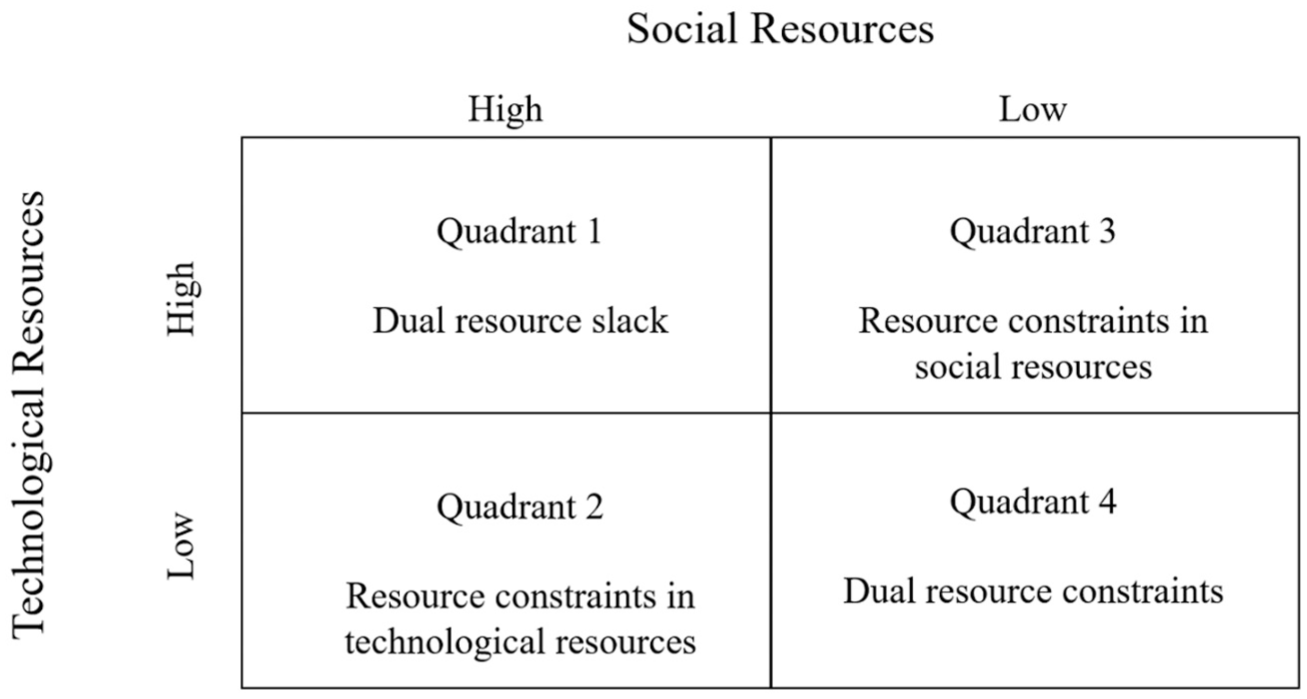
Bundles of social and technological resource slack/constraints.
Their combination yields four representative bundle types: dual slack (Quadrant 1), social resource slack with technological resource constraint (Quadrant 2), technological resource slack with social resource constraint (Quadrant 3), and dual constraint (Quadrant 4).
Bundles of Resource Slack/Constraints and Entrepreneurial Resilience
We now develop hypotheses on how social and technological resource slack/constraints shape entrepreneurial resilience. Given that stability and flexibility correspond to distinct crisis tasks (DesJardine et al., 2019), we propose that stability is primarily driven by a resource compensation logic (Ennen & Richter, 2010; George, 2005; J. Tan, 2003), while flexibility is driven by a crisis-induced resource reconfiguration logic (Attah-Boakye et al., 2023; Colombo et al., 2021).
Resource Bundles and Stability
With respect to stability, the key issue is whether a venture can continue meeting the minimum requirements of ongoing operation under disruption (DesJardine et al., 2019). Stability is therefore primarily governed by a resource compensation logic, under which one resource domain offsets shortfalls in another and prevents disruption from escalating into severe loss (Ennen & Richter, 2010; Paeleman & Vanacker, 2015). Under this logic, the value of resource bundles lies not simply in resource abundance, but in whether social and technological resources can jointly cover the critical requirements of continuity (Lengnick-Hall et al., 2011). Accordingly, stability should be highest when the two resource domains provide the strongest mutual compensation and lowest when neither can compensate for the other.
From this perspective, dual resource slack (Quadrant 1) provides the most advantageous basis for minimizing the severity of loss during disruption. When both social and technological resources are slack, each domain can compensate for pressures arising in the other. Social resource slack helps maintain access to external support, coordination, legitimacy, and complementary assets (Batjargal et al., 2013; Gil et al., 2022; Li et al., 2023), whereas technological resource slack helps maintain operational continuity, technical reserves, and alternative solution paths (Haase & Eberl, 2019; Parida & Örtqvist, 2015). Their joint value therefore lies in mutual compensation: social slack helps mobilize the support and legitimacy needed to activate technological reserves (Zimmerman & Zeitz, 2002), whereas technological slack gives operational content to the support mobilized through social ties (Lee et al., 2001). Entrepreneurial teams can therefore combine external support and internal technical continuity into an integrated buffering system (George, 2005; J. Tan, 2003). For this reason, ventures with dual slack should exhibit the lowest severity of loss.
By contrast, when both social and technological resources are constrained (Quadrant 4), neither domain can adequately compensate for the weakness of the other. Lacking both external support and internal continuity reserves, such ventures are less able to preserve routines (Haase & Eberl, 2019; D. Tan & Tan, 2017), sustain legitimacy (Zimmerman & Zeitz, 2002), or build credible buffers (George, 2005). Dual constraint is therefore the least favorable condition for stability.
When only one resource domain is constrained, the unconstrained domain can still provide partial compensation. However, the two single-constraint bundles are not equally effective because the compensatory roles of social and technological resources are asymmetric in the short run (Bianchi et al., 2014; Mesquita et al., 2008; Ozanne et al., 2022). We expect ventures with social resource slack and technological resource constraint (Quadrant 2) to outperform those with technological resource slack and social resource constraint (Quadrant 3). Social resources are more immediately deployable during crisis: they can be mobilized quickly to ease cash-flow pressure, secure supplier flexibility, gain stakeholder patience, and access external support (DesJardine et al., 2019; Mesquita et al., 2008). Technological slack, by contrast, is often more specific and less fungible in the short run (Danneels, 2007). Although patents, R&D, and technical know-how may be valuable, they usually require complementary relationships, validation channels, and external cooperation before they can be converted into crisis response (Tripsas, 1997). Thus, social slack can still compensate for technological constraint, whereas technological slack is more likely to remain underutilized when social resources are constrained.
Resource Bundles and Flexibility
With respect to flexibility, the key issue is whether a venture can restore a viable course of action after disruption (DesJardine et al., 2019). Flexibility is therefore primarily governed by a crisis-induced resource reconfiguration logic, under which resource conditions push entrepreneurial teams to identify bottlenecks, break from inherited deployment patterns, and recombine available resources into new workable arrangements (Attah-Boakye et al., 2023; Colombo et al., 2021). Under this logic, the value of resource bundles lies less in sustaining the prior state than in creating both the pressure and the possibility for rapid reorganization. Accordingly, flexibility should be highest when resource conditions most strongly activate reconfiguration while still leaving enough means to rebuild action paths, and weaker when ventures remain locked into existing arrangements or lack the basis for effective recombination.
From this perspective, constrained resource bundles (Quadrants 2, 3, and 4) may provide a more advantageous basis for rapid recovery than dual resource slack (Quadrant 1). In crisis situations, flexibility depends less on total resource stock than on whether entrepreneurial teams can redirect attention, identify immediate bottlenecks, and reorganize available resources into a viable post-shock course of action (Williams & Shepherd, 2016). When both social and technological resources are slack, entrepreneurial teams are better buffered against immediate disruption (George, 2005), but they are also more likely to preserve established arrangements rather than fundamentally reconfigure them (Mosakowski, 2017). Dual slack therefore reduces the urgency of action and may trap ventures in preservation-oriented responses that delay post-shock adjustment (Bradley et al., 2011; Paeleman & Vanacker, 2015).
By contrast, constrained resource bundles can activate a crisis-induced reconfiguration process (Acar et al., 2019). Resource scarcity heightens vigilance and stimulates the search for alternative paths of value creation (Baker & Nelson, 2005; Mosakowski, 2017). With limited room for maneuver, entrepreneurial teams are pushed to mobilize stakeholder ties more efficiently and to redeploy existing resources in novel ways (Acar et al., 2019). Research on resource constraint further suggests that scarcity often increases the efficiency with which existing resources are used (Baker & Nelson, 2005), which can support faster post-disruption adjustment. Constrained bundles are therefore generally more likely than dual slack to trigger the search, prioritization, and recombination needed for recovery.
Within the set of constrained bundles, however, flexibility should vary systematically. We expect ventures with social resource slack and technological resource constraint (Quadrant 2) to outperform those with technological resource slack and social resource constraint (Quadrant 3). When technological resources are constrained but social resources remain slack, entrepreneurial teams face strong pressure to search for alternative technical solutions, yet they still possess relational channels that help convert this pressure into action (Yli-Renko et al., 2001). Social resource slack can be mobilized quickly to access complementary knowledge, secure supplier adjustments, obtain customer feedback, attract collaborative support, and identify external pathways for adaptation (Grichnik et al., 2014). In this configuration, technological constraint creates the motivation to reconfigure, while social slack provides the means to make reconfiguration feasible. By contrast, when social resources are constrained but technological resources remain slack, ventures may possess technical reserves but lack the external channels needed to validate, complement, and redeploy them effectively (Zimmerman & Zeitz, 2002). Because technological resources are often more specific and less fungible in the short run (Danneels, 2007), the venture may hold substantial technical potential without being able to translate it quickly into recovery. Thus, social constraints are more likely to leave technological slack stranded than technological constraints are to leave social slack unusable. For this reason, recovery should be faster in Quadrant 2 than in Quadrant 3.
Quadrant 4 should be the least flexible among the constrained bundles. Although acute scarcity can trigger immediate triage and focused action (Acar et al., 2019; Bradley et al., 2011), ventures in Quadrant 4 lack both the social channels needed to mobilize external support and the technical reserves needed to redesign or redirect operations. Thus, while dual constraint may still push teams into early reconfiguration, it provides the weakest basis for effective reconfiguration. Taken together, these arguments suggest that constrained resource bundles are generally associated with shorter recovery time than dual slack, and among constrained bundles the ordering should follow Quadrant 2 < Quadrant 3 < Quadrant 4 in time to recovery.
Resource Misalignment and Entrepreneurial Resilience
The bundle comparisons above show how distinct configurations of social and technological resource slack and constraints shape entrepreneurial resilience. Yet comparing discrete quadrants alone does not fully capture whether the degree of imbalance between the two resource domains also carries systematic implications for resilience (Edwards & Parry, 1993). Two ventures may fall into the same broad bundle category yet differ substantially in how far one resource domain exceeds the other. To address this issue, we extend the quadrant-based comparison with a response surface perspective that focuses on resource misalignment (Edwards et al., 2002). This extension builds directly on the two mechanisms developed above, that is, resource compensation for stability and crisis-induced resource reconfiguration for flexibility. Resource misalignment does not introduce a new logic. Rather, it captures whether increasing divergence between the two domains weakens compensatory buffering while simultaneously stimulating reconfiguration.
We focus specifically on misalignment because entrepreneurial action under disruption depends not only on the absolute level of each resource but also on whether the two resource domains can function together as an actionable system. Entrepreneurial teams rely on social resources to activate, extend, and legitimize technological capacity, while relying on technological resources to give operational content to the support mobilized through social ties (Lee et al., 2001; Yli-Renko et al., 2001). When one domain substantially exceeds the other, this functional interdependence becomes strained.
For stability, greater misalignment should be detrimental because it undermines the compensatory logic required for effective buffering. Stability depends on whether entrepreneurial teams can combine external support with internal continuity in a way that prevents shocks from escalating into severe losses (DesJardine et al., 2019). When social resources substantially exceed technological resources, the venture may obtain patience, coordination, and legitimacy from external actors (Zimmerman & Zeitz, 2002), yet still lack the technical depth needed to maintain reliable operations (Lee et al., 2001). When technological resources substantially exceed social resources, the venture may possess valuable technical reserves, yet lack the relational channels needed to validate, mobilize, and protect those reserves under crisis conditions (Stuart et al., 1999). In either case, the relatively stronger domain cannot fully compensate for the missing contribution of the weaker one. As misalignment increases, buffering becomes more fragmented, protection less coherent, and losses more likely to cascade (Lynn, 2005). Thus, greater misalignment should increase severity of loss.
For flexibility, however, greater misalignment can be advantageous because it sharpens the focal problem around which crisis-induced reconfiguration occurs. Rapid recovery requires entrepreneurial teams to identify the most serious bottleneck and redirect available resources toward that bottleneck without delay (Williams et al., 2017). When social and technological resources are relatively balanced, teams may be more likely to remain within inherited bundling patterns and pursue incremental adjustment (Gilbert, 2005). By contrast, pronounced misalignment makes the weak point in the venture’s resource structure more visible and creates stronger pressure to act (Greve, 2003). This pressure activates a reconfiguration process in which the relatively stronger domain is mobilized to offset deficiencies in the weaker one (Karim & Capron, 2016). Social strength, for example, can be used to obtain external knowledge, collaboration, legitimacy, or market access that compensates for technical shortfalls (Gil et al., 2022; Li et al., 2023); technological strength can be used to redesign offerings, processes, or problem-solving routines when external support is thin (Haase & Eberl, 2019; Parida & Örtqvist, 2015). In this sense, misalignment does not merely represent uneven resource endowments. It creates a clearly identifiable adaptation challenge that organizes search, recombination, and restructuring. As misalignment increases, entrepreneurial teams are more strongly pushed away from passive preservation and toward active recovery-oriented reconfiguration (Acar et al., 2019; Baker & Nelson, 2005). Because such reconfiguration is guided by a more visible bottleneck, teams can reduce dispersed search, prioritize resource redeployment move quickly, and more faster from recognizing the problem to implementing adaptive responses. Thus, greater misalignment should shorten time to recovery. Accordingly, misalignment between social and technological resources should have opposite implications for the two dimensions of entrepreneurial resilience.
The Moderating Effect of ETTF
As argued above, the effects of social and technological resource bundles on entrepreneurial resilience depend on how effectively resources are orchestrated under disruption (Sirmon et al., 2011). In new ventures, such orchestration is enacted by entrepreneurial teams (West, 2007), and we argue that ETTF constitutes an important boundary condition shaping this process. ETTF matters because it structures how task-relevant expertise is distributed within the team, which in turn affects how members allocate attention, process resource problems, and coordinate responses under crisis (Chung et al., 2015; Richard et al., 2019; Rico et al., 2012).
With respect to stability, ETTF should strengthen the resource compensation logic developed above. Stability depends on whether social and technological resources can be combined into a coherent buffering system that preserves external support and internal continuity (DesJardine et al., 2019). This requires entrepreneurial teams not only to recognize where the venture is most vulnerable but also to mobilize complementary resources quickly enough to prevent temporary shortfalls from escalating into severe loss (Klotz et al., 2014; Williams et al., 2017). Stronger task-related faultlines can facilitate this process in two ways. First, they promote selective attention across resource domains (Georgakakis et al., 2017). Some subgroups may focus more on external coordination such as stakeholder support, legitimacy, and access to complementary assets, whereas others may focus more on process continuity, technical reserves, and fallback options (Chung et al., 2015; Richard et al., 2019). Such differentiation enables the team to monitor multiple sources of vulnerability simultaneously rather than relying on a single undifferentiated response (Thatcher et al., 2024). Second, task-related faultlines can improve compensatory coordination across domains (Gibson & Vermeulen, 2003). Because subgroup differentiation is organized around task demands rather than social identity, specialized subgroups can contribute domain-specific knowledge while still recognizing the need for cross-domain integration (Chung et al., 2015; Espinosa et al., 2007). As a result, entrepreneurial teams with higher ETTF should be better able to identify where one resource domain is falling short and mobilize another domain to compensate for it. In this sense, ETTF increases the likelihood that resource bundles are translated into coordinated buffering responses, thereby attenuating differences in severity of loss across resource bundles when ETTF is high.
With respect to flexibility, ETTF should strengthen the crisis-induced resource reconfiguration logic developed above. Flexibility depends on whether entrepreneurial teams can identify bottlenecks, abandon inherited deployment patterns, and redirect available resources toward adaptive recombination (DesJardine et al., 2019). This requires both rapid search and integrative recombination: teams must generate alternative solutions while also assembling them into a new workable action path (Attah-Boakye et al., 2023; Colombo et al., 2021). Stronger task-related faultlines can facilitate this process by increasing both the variety and the organization of crisis response. First, differentiated subgroups make it easier for entrepreneurial teams to conduct parallel search across distinct knowledge domains, thereby increasing the speed with which potential alternatives are surfaced (Georgakakis et al., 2017; Gibson & Vermeulen, 2003). Second, because the outputs of these subgroup efforts are organized around specialized task domains, they are more recombinable and therefore more useful for constructing a new viable action path (Chung et al., 2015; Richard et al., 2019). In this way, ETTF does not merely increase variety; it organizes parallel search and makes the results of that search more actionable for crisis-driven adaptation. ETTF therefore helps entrepreneurial teams convert resource pressure into parallel search, focused experimentation, and faster integration of alternative action paths. As a result, entrepreneurial teams with higher ETTF should be better able to translate differences in resource bundle conditions into more pronounced differences in reconfiguration effectiveness and recovery timing.
Methods
Data Sources
Our study utilizes financial and stock data from new ventures listed on the National Equities Exchange and Quotations (NEEQ). Following prior studies (Buyl et al., 2019; DesJardine et al., 2019; Sajko et al., 2021), we investigate the impact of external shock events on entrepreneurial resilience at the organizational level. In this context, crises are defined as systemic shocks that are low-probability, unanticipated, and high-impact, thereby creating widespread market disruption with enduring implications for firm survival and performance (Williams et al., 2017). Specifically, we focus on three systemic crises that generated economy-wide disruption: the 2015 Chinese economic downturn, the 2018 U.S.–China trade frictions, and the COVID-19 pandemic. We classify these events as “economic crises” because they produced systemic economic losses across a broad population of firms. The observation period spans from 2013 to 2020, allowing us to capture these shocks and observe sufficient post-shock recovery time (Buyl et al., 2019). We constructed an unbalanced short-panel dataset based on startups affected by these three shocks.
Data were drawn from multiple databases. Financial and stock data were obtained from the WIND database, covering information on all companies listed on China’s NEEQ. Missing data were supplemented using the iFinD database. Patent data were sourced from the PatSnap database. Additionally, executive data for the new ventures were manually extracted from company prospectuses and annual financial reports.
The final dataset was constructed following these criteria: we included firms established within the last 10 years (Kiss & Barr, 2017) and listed on the NEEQ before 2019, ensuring that these firms had encountered at least one external shock. We excluded companies that were specially treated (e.g. ST and *ST), those with missing data, and firms that experienced significant events during the sample period, such as litigation, mergers, or major management changes. This was done to minimize the potential impact of other significant events on firm stock price volatility (DesJardine et al., 2019). The final database contains 345 new ventures and 528 observations.
Measures
Dependent Variables
To operationalize our dependent variable, we utilize the measures proposed by DesJardine et al. (2019). Specifically, we calculate two key outcomes of organizational-level entrepreneurial resilience: severity of loss, measured using stock price data to reflect organizational stability, and time to recovery, which captures the duration required for the organization to regain flexibility.
Severity of Loss
Following DesJardine et al. (2019), we measure the severity of loss as the absolute percentage change between the closing price of a new venture’s stock immediately before the external shock and the lowest point within the 12 months following the shock. Specifically, we consider the closing prices from June 12, 2015 (Chinese economic downturn), July 6, 2018 (U.S.-China trade frictions), and December 27, 2019 (COVID-19 pandemic). A higher value indicates a greater loss and reflects lower organizational stability.
Time to Recovery
We measure the time to recovery as the duration required for a new venture’s stock price to return to its pre-shock level. In accordance with prior research (Buyl et al., 2019; DesJardine et al., 2019), we use monthly intervals to measure the time to recovery. Recovery patterns are analyzed using a hazard model approach over an 18-month period following the shocks, aligning with the intervals between the U.S.-China trade frictions and the COVID-19 pandemic. This 18-month window ensures adequate time for recovery. For robustness, we conduct a 12-month recovery window analysis, which yields consistent results.
Independent Variables
Motivated by our theoretical framework, we examine the bundles of social and technological resource slack/constraints. We first define the measures for social and technological resources, followed by the operationalization of slack and constraints associated with these resources.
Social Resources
Social resources are measured by relationship building with external business partners (Bianchi et al., 2014; Florin et al., 2003). We utilize R. E. Freeman’s (2010) classification of stakeholders to quantify social resources through the average of six key stakeholder dimensions: shareholders, creditors, suppliers, employees (including managers), customers, and government. Each dimension reflects a critical aspect of the firm’s production and operational activities. Dividend payout ratio, calculated as dividends per share divided by earnings per share, measures the relationship with shareholders. We use quick ratio to measure the relationship between new ventures and creditors. Accounts payable turnover ratio is used to measure the relationship with suppliers. The ratio of total compensation to total revenue from the main business represents the relationship with employees. The cost of the main business ratio evaluates the relationship with customers, and the main business tax and surcharge reflects the relationship with the government.
Technological Resources
Technological resources are commonly measured using patent statistics and R&D expenditures (Bianchi et al., 2014). In this study, we operationalize technological resources as the total number of patent applications filed annually, which serves as a direct indicator of the firm’s technological capabilities and innovations.
Resource Slack/constraints
Consistent with prior research, resource slack refers to the excess resources held by firms relative to industry norms (George, 2005; Paeleman & Vanacker, 2015). We measure resource slack/constraints by subtracting the mean value of social or technological resources for all new ventures within the same sub-industry (3-digit industry code). A positive value indicates resource slack, while a negative value signifies resource constraints. To test the hypothesized effects of different combinations of social and technological resource slack/constraints on entrepreneurial resilience, we create dummy variables representing the four distinct resource bundles (Paeleman & Vanacker, 2015), as outlined in Table 2. For robustness, we also relaxed the industry classification to a 2-digit code and reran the analyses, finding that the results remained consistent. To better capture long-term resource conditions, we averaged the first 3 years prior to each shock event to construct the final measure.
Moderating Variable
We measured ETTF as faultline strength (FLS) based on two task-relevant attributes—functional background and tenure—following prior research (Chung et al., 2015; Richard et al., 2019). These attributes are widely used as proxies for members’ knowledge, skills, and role expectations, and have been classified as task-related in the faultline literature (Bezrukova et al., 2009; Carton & Cummings, 2012; Richard et al., 2019). Functional background was coded into three categories—service roles (sales, marketing, customer service), production roles (manufacturing, supply chain, production), and support roles (human resources, finance, legal)—while tenure was grouped into three categories: less than 3 years, 3 to less than 6 years, and more than 6 years. First, for each attribute (e.g. functional background), we identified potential subgroups (e.g. service vs. production vs. support) and calculated the internal alignment (IA) of each subgroup on the other attribute (e.g. tenure). Internal alignment reflects the extent to which members within a subgroup are similar on other relevant attributes. For example, if a team has four service-role members, their tenure distribution is compared against the expected random distribution of tenure categories. This is computed as: IAservice/tenure/obs = Σ(Osi−Esi)2/Esi, where IAservice/tenure/obs is the observed service-alignment index across tenure-level categories, Osi the observed number of service-role members in the i-th tenure category, and Esi is the expected number of service-role members in that category assuming random distribution. We repeated this procedure for each subgroup within each attribute (e.g. production, support) and then averaged their IA scores to obtain the overall internal alignment index for that attribute.
Second, we calculated the cross-subgroup alignment index (CGAI), which measures the dissimilarity between subgroups by capturing how different their distributions are on the other attribute. This cross-product approach counts the frequency of members from each subgroup in each category of the other attribute and computes the extent to which there are “match-ups” between subgroup members across categories (Shaw, 2004). Finally, FLS for each attribute was computed as: FLS = IA × (1 − CGAI), where higher values (approaching 1) indicate stronger alignment within subgroups and sharper boundaries between subgroups. We computed FLS scores separately for functional background and tenure and then averaged them to create an overall task faultline index for each team. Teams were split into high and low faultline groups using the sample median of the task-related faultline index.
To further assess robustness, we also computed task-related faultlines using the Average Silhouette Width clustering approach (Meyer & Glenz, 2013), which allows for detecting multiple potential subgroup partitions. Results were consistent (see Supplemental Appendix).
Control Variables
We included several firm-level control variables to account for potential influences on entrepreneurial resilience. Larger firms may possess greater resources and formal systems to support stability (Haase & Eberl, 2019); thus, we control for firm size, calculated as the natural logarithm of 1 plus annual sales. Firm age, measured by years since establishment (Paeleman & Vanacker, 2015), is included, as older firms are generally better at resource acquisition and handling disruptions (DesJardine et al., 2019). Profitability, measured by the ratio of operating income before depreciation and amortization to total assets, is controlled because more profitable firms are better positioned to recover from crisis (DesJardine et al., 2019). Operational efficiency, proxied by the asset turnover rate, is included as more efficient firms tend to respond more rapidly to external shocks. We also control for the firm’s share price on the day before the shock, reflecting the stability of the stock price prior to the disruption (Sajko et al., 2021). Second, we control for entrepreneurial team-level variables, as managerial characteristics can influence venture adaptability and survival during disruptive events (Buyl et al., 2019; Sajko et al., 2021). We control for top management team size, measured by the number of all top managers (Li et al., 2023). We include firm dummy, industry dummy, and year dummy to account for heterogeneity across firms, industries, and years. All control variables are averaged over the 3 years preceding the shock to capture long-term conditions and minimize concerns about reverse causality.
Method of Analysis
Given the unique characteristics of our variables, we employ two distinct estimation methods to test our hypotheses. First, to assess the relationship between resource bundles and severity of loss, we use a two-way fixed effects model with robust standard errors, accounting for firm and year effects. This approach partially addresses endogeneity concerns arising from omitted variables (Hill et al., 2021). Second, for the relationship between resource bundles and time to recovery, we follow Buyl et al. (2019) and DesJardine et al. (2019) by applying an event history model. This method accommodates right-censored data, as not all ventures recovered from the shocks within the observation window. Excluding such observations could introduce bias (DesJardine et al., 2019). Accordingly, we use parametric survival-time models with an exponential distribution, a common method in event history analysis (Buyl et al., 2019), and apply robust variance estimation to compute standard errors. To further examine our hypotheses concerning resource misalignment, we complement our main analyses with response surface analysis (RSA). RSA allows us to move beyond discrete bundle comparisons and capture the continuous effects of divergence between social and technological resources. Following prior congruence research (Croonen et al., 2025), we estimate polynomial models including the linear, squared, and interaction terms of social and technological resources, and use these coefficients to derive the response surface parameters.
Results
Table 1 summarizes the means, standard deviations, and correlations of the variables in our models. All variance inflation factor values are below the commonly accepted threshold, indicating that multicollinearity is not a concern. Table 2 offers additional descriptive statistics, detailing the average levels of resource slack and constraints, severity of loss, and time to recovery across the four resource bundles depicted in Figure 1.
Descriptive Statistics and Correlation Analysis.
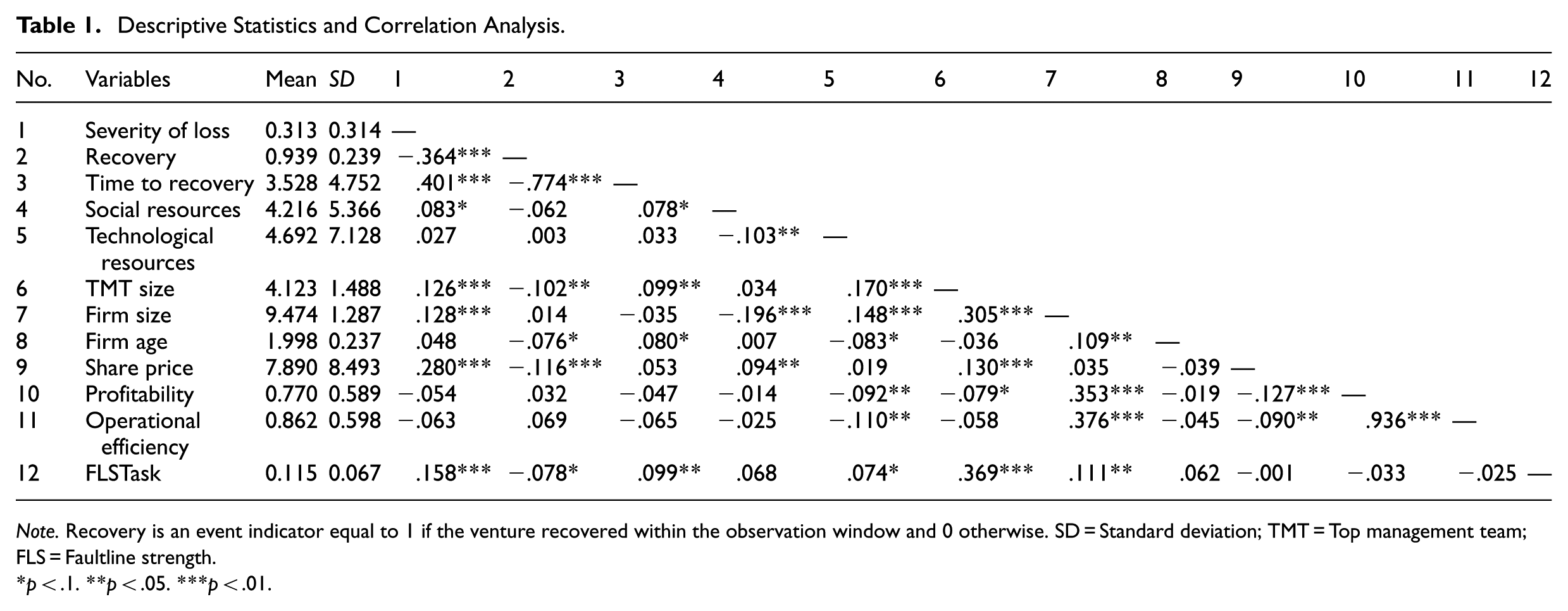
Note. Recovery is an event indicator equal to 1 if the venture recovered within the observation window and 0 otherwise. SD = Standard deviation; TMT = Top management team; FLS = Faultline strength.
p < .1. **p < .05. ***p < .01.
Descriptive Statistics of Divergent Resource Bundles of New Ventures.
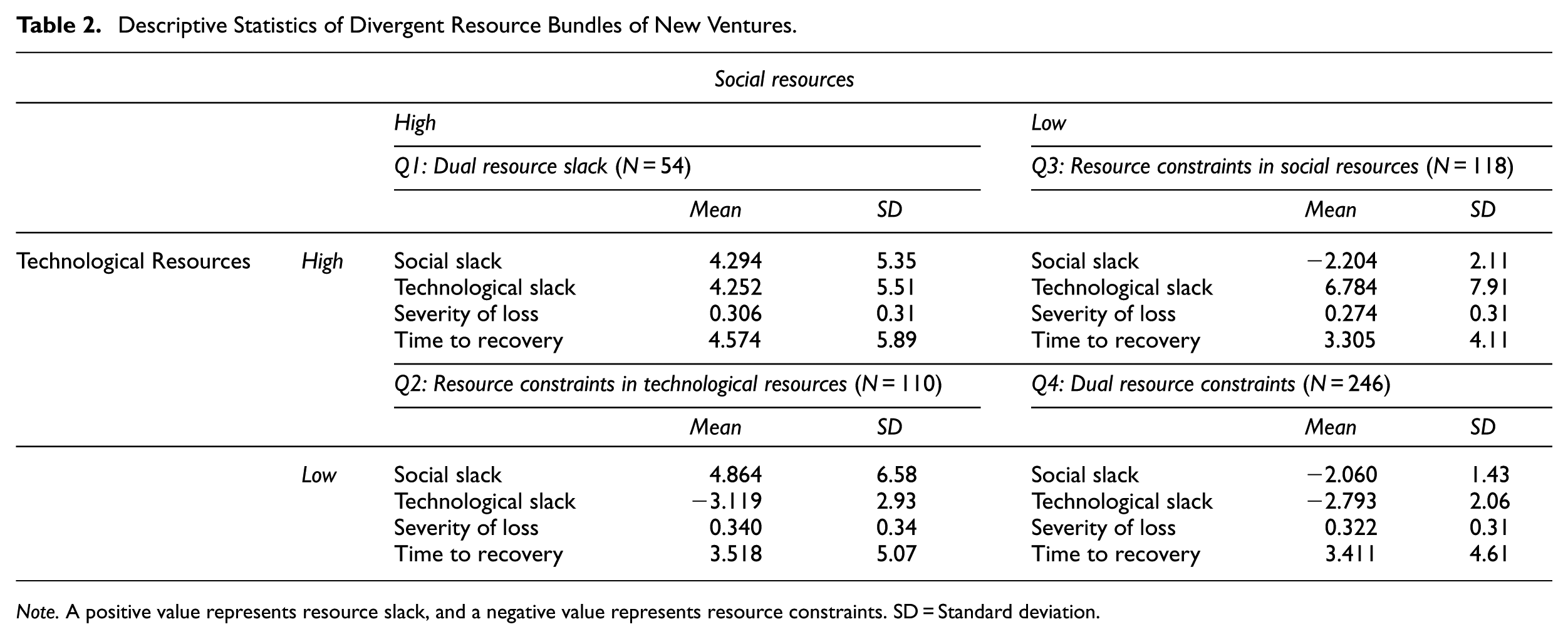
Note. A positive value represents resource slack, and a negative value represents resource constraints. SD = Standard deviation.
Results for Severity of Loss
Table 3 presents results from the fixed effects model examining the relationship between resource bundles and severity of loss (stability).
Fixed Effects Model Results for Severity of Loss.
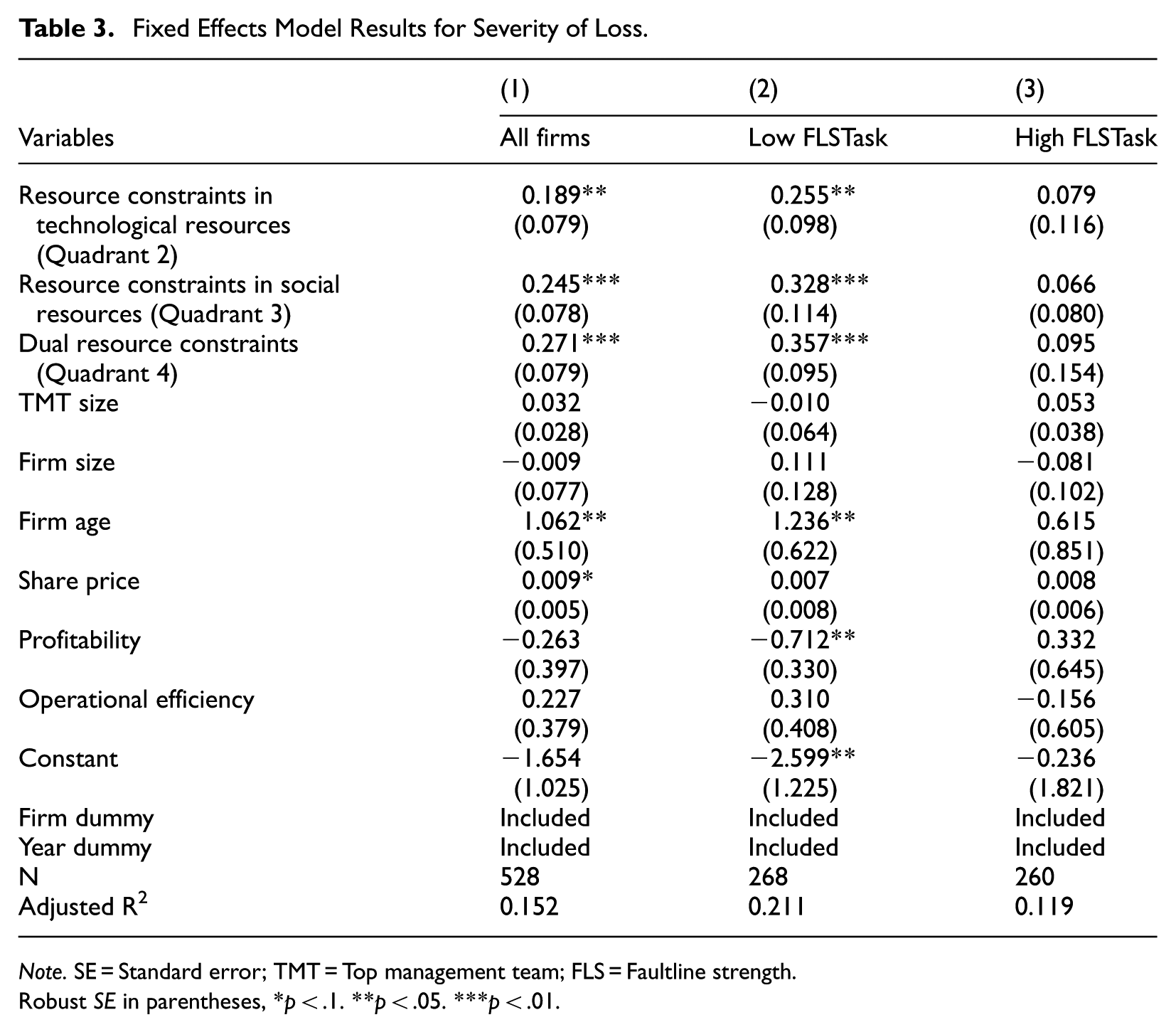
Note. SE = Standard error; TMT = Top management team; FLS = Faultline strength.
Robust SE in parentheses, *p < .1. **p < .05. ***p < .01.
Following Paeleman and Vanacker (2015), we use dual resource slack (Quadrant 1) as the reference category, with the remaining three quadrants interpreted relative to it. Model 1 reports results for the full sample, testing H1a and H1b. Models 2 and 3 focus on subsamples based on ETTF, testing H4a.
First, Model 1 results support H1a and H1b. Specifically, ventures with social resource slack but technological constraint (Quadrant 2) incur greater losses compared to those with dual resource slack (β = .189, p < .05). Similarly, ventures with technological resource slack but social constraint (Quadrant 3) show greater losses (β = .245, p < .01), and those with dual resource constraints (Quadrant 4) suffer the highest losses (β = .271, p < .01). Second, coefficient magnitudes in Model 1 show a clear ordering (Q2 < Q3 < Q4). The coefficient ordering is directionally consistent with H1b. Third, the subgroup pattern in Models 2 and 3 is consistent with H4a. Model 2 reports outcomes for ventures with low faultlines, while Model 3 focuses on those with high faultlines. In Model 2, ventures with resource constraints (Quadrants 2, 3, and 4) in the low faultline subsample exhibit significant differences in severity of loss, with all coefficients significant (β1 = .255, p < .05; β2 = .328, p < .01; β3 = .357, p < .01). However, in Model 3, where ventures have high faultlines, none of the coefficients are significant, indicating that high faultlines diminish the differences between ventures with constraints and those with dual resource slack. This shift from significant differences under low faultlines to nonsignificant differences under high faultlines suggests that high ETTF attenuates differences in severity of loss across resource bundles, which is directionally consistent with H4a.
Results for Time to Recovery
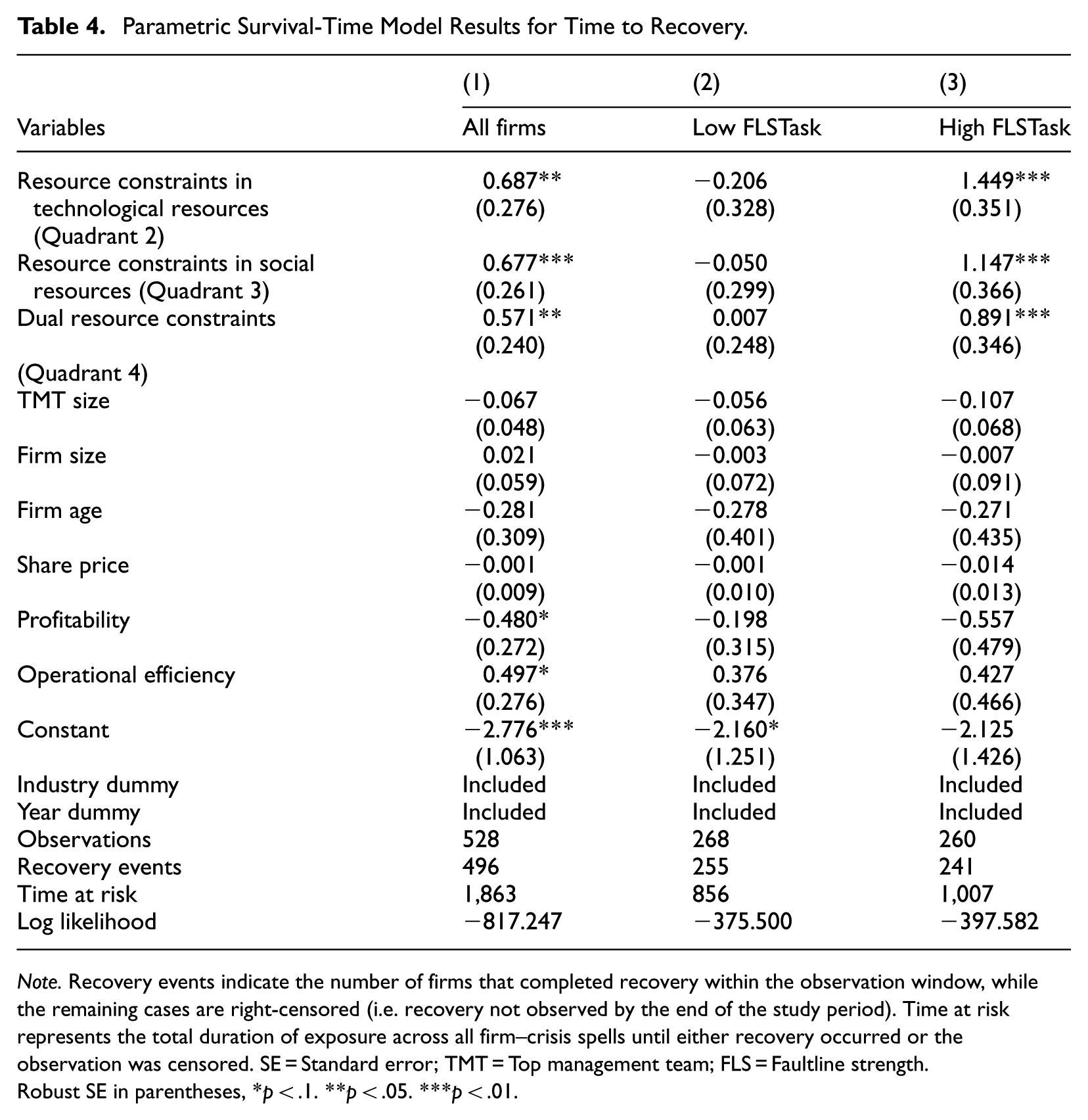
Table 4 presents results from the parametric survival-time model, assessing the relationship between resource bundles and time to recovery. Following Paeleman and Vanacker (2015), dual resource slack (Quadrant 1) serves as the reference category. In the event history analysis, exponentiated coefficients are interpreted as proportional changes in the recovery hazard relative to the reference category, calculated as [exp(coefficient)−1] × 100% (DesJardine et al., 2019). Model 1 examines the full sample, testing H2a and H2b, while Models 2 and 3 analyze subsamples based on ETTF, examining H4b.
Parametric Survival-Time Model Results for Time to Recovery.
Note. Recovery events indicate the number of firms that completed recovery within the observation window, while the remaining cases are right-censored (i.e. recovery not observed by the end of the study period). Time at risk represents the total duration of exposure across all firm–crisis spells until either recovery occurred or the observation was censored. SE = Standard error; TMT = Top management team; FLS = Faultline strength.
Robust SE in parentheses, *p < .1. **p < .05. ***p < .01.
First, our results support H2a, indicating that new ventures with dual slack take longer to recover than those facing resource constraints. Ventures with constraints in technological resources (Quadrant 2) exhibit a higher recovery hazard than those with dual resource slack (β = .687, p < .05). Similarly, ventures with constraints in social resources (Quadrant 3) and dual resource constraints (Quadrant 4) also exhibit higher recovery hazards than those with dual resource slack (β = .677, p < .01; β = .571, p < .05, respectively). Second, the coefficient pattern is directionally consistent with H2b, with Quadrants 2, 3, and 4 ordered as predicted in terms of recovery hazard, showing that ventures with constraints in technological resources outperform those with constraints in social resources, and both perform better than those with dual constraint.
Third, Models 2 and 3 are consistent with H4b, showing that differences in time to recovery across resource bundles are more pronounced when ETTF is high. Model 2, which includes the subsample with low faultlines, reveals no significant differences in recovery times among new ventures with resource constraints (i.e. Quadrants 2, 3, and 4) compared to those with dual resource slack (i.e. Quadrant 1). However, in the high faultlines subsample, Model 3 demonstrates significant coefficients (β1 = 1.449, p < .01; β2 = 1.147, p < .01; β3 = .891, p < .01), indicating that ventures with resource constraints recover more effectively than those with dual slack. This pattern is directionally consistent with H4b, suggesting that high ETTF makes differences in time to recovery across resource bundles more pronounced.
RSA Results on Resource Misalignment
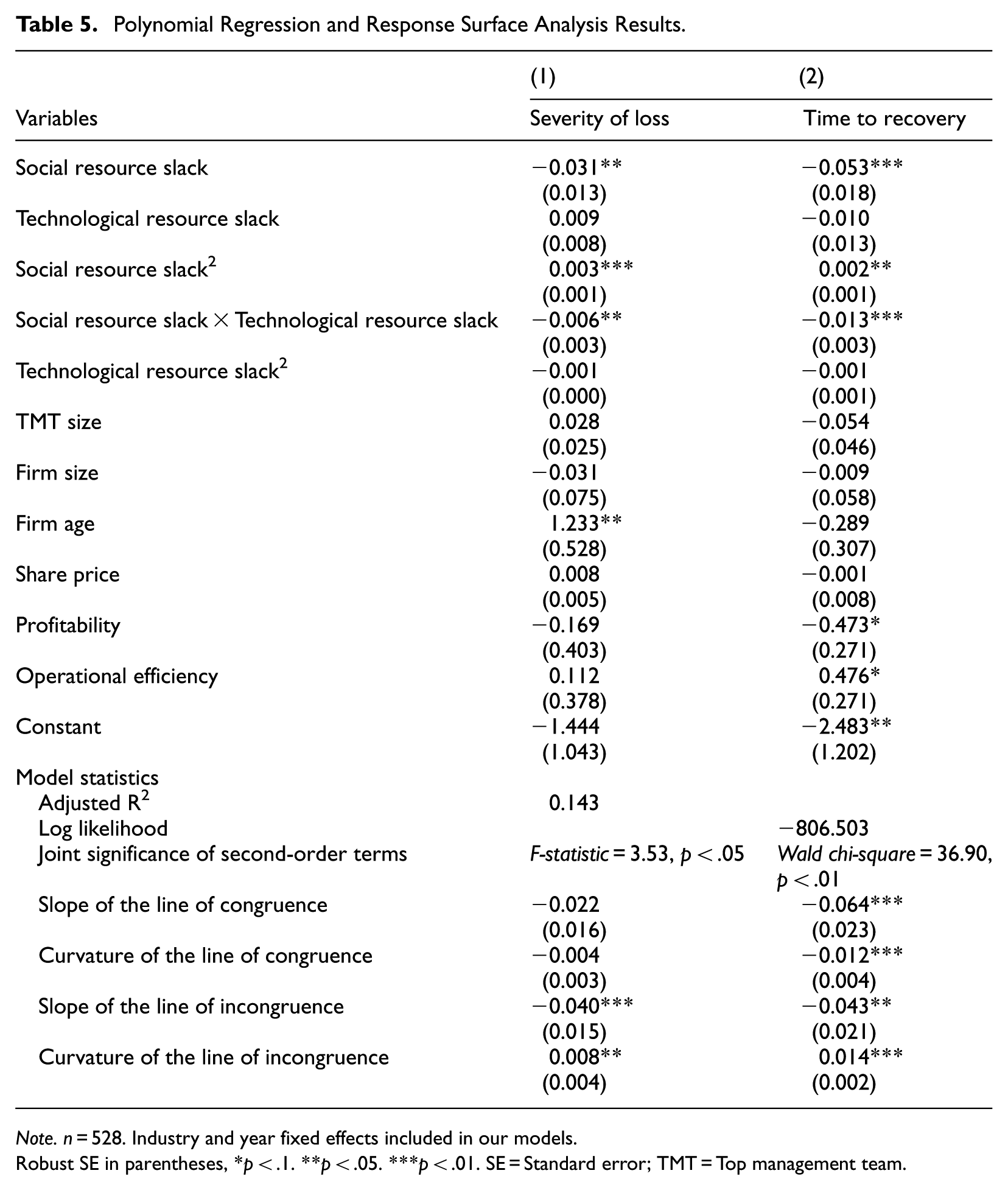
We test Hypotheses 3a and 3b by examining the effects of resource misalignment on severity of loss and time to recovery using RSA (Table 5 and Figure 2). Figure 2 presents polynomial response surface plots, with Panel A depicting predicted loss severity and Panel B depicting predicted recovery hazard. In both panels, the surfaces display the predicted outcomes when social and technological resources take values ranging from two standard deviations below the mean to two standard deviations above the mean, including all intermediate values.
Polynomial Regression and Response Surface Analysis Results.
Note. n = 528. Industry and year fixed effects included in our models.
Robust SE in parentheses, *p < .1. **p < .05. ***p < .01. SE = Standard error; TMT = Top management team.
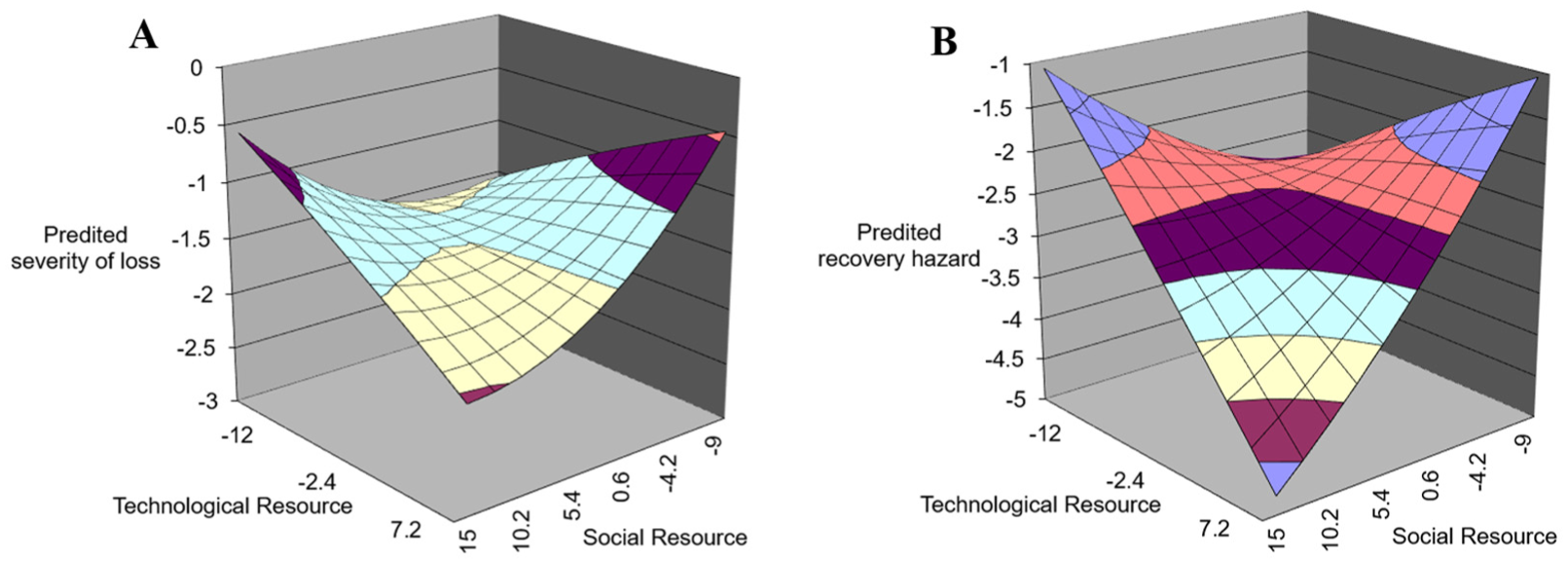
Polynomial response surface graphics for severity of loss and recovery hazard. Panel A: Predicted severity of loss; Panel B: Predicted recovery hazard.
Consistent with Hypothesis 3a, the curvature along the line of incongruence (LOIC) for severity of loss is positive and significant (a4 = 0.008, p < .05), indicating that as the discrepancy between social and technological resources increases, predicted loss severity increases. As shown in Figure 2A, the response surface bends upward along the LOIC, suggesting that greater resource misalignment exacerbates the immediate impact of shocks on entrepreneurial ventures.
For time to recovery, we again observe a positive and significant curvature along the LOIC (a4 = 0.014, p < .001). Given that the event history specification models the recovery hazard, this result indicates that greater misalignment between social and technological resources is associated with a higher hazard of recovery—that is, faster recovery and a shorter time to recovery—supporting Hypothesis 3b. As illustrated in Figure 2B, the response surface also bends upward along the LOIC, indicating that extreme misalignment is associated with faster post-shock recovery.
Taken together, these findings reveal that resource misalignment has distinct implications for the two dimensions of entrepreneurial resilience. While greater misalignment intensifies loss severity, it simultaneously accelerates post-shock recovery. This dual effect suggests that misalignment weakens ventures’ immediate shock-absorbing capacity but may also trigger more rapid post-shock adjustment.
Robustness Checks
To ensure the robustness of our analysis, we specified several alternative models and variables. Detailed results of these robustness checks are provided in the Supplemental Appendix.
Discussion
This study develops a framework to explain how bundles of social and technological resource slack and constraints shape organizational-level entrepreneurial resilience, captured by severity of loss (stability) and time to recovery (flexibility). We find that dual resource slack reduces loss severity but slows recovery, whereas dual resource constraint increases loss severity but is associated with faster recovery. We further show that ventures with technological resource constraints and social resource slack achieve relatively lower severity of loss among constrained bundles and shorter time to recovery. In addition, resource misalignment undermines stability but facilitates faster recovery, while ETTF attenuates differences in severity of loss across resource bundles and makes differences in time to recovery more pronounced.
Theoretical Implications
This study makes several contributions to theory and empirical research. First, we contribute to ROT by explicitly integrating entrepreneurial team and faultline perspectives into ROT, thereby advancing a three-theory framework that explains how internal resource bundles shape entrepreneurial resilience under crisis conditions. Although ROT has long emphasized that capabilities arise from structuring, bundling, and leveraging heterogeneous resources (Amit & Han, 2017; Sirmon et al., 2011), empirical research has more often focused on isolated resources or on the alignment between resource investments and leveraging strategies (Sirmon & Hitt, 2009; Symeonidou & Nicolaou, 2018). Our study shifts attention to within-firm resource configurations by showing that the resilience implications of social and technological resources depend not only on whether each domain is characterized by slack or constraint but also on how the two domains are bundled together and the degree to which they are misaligned. In this way, we extend ROT’s bundling logic by demonstrating that different combinations of social and technological resource slack and constraints generate systematically different resilience outcomes under crisis conditions. Our findings further show that the degree of misalignment itself also matters: greater misalignment undermines stability while facilitating faster recovery. We further clarify why these effects differ across resilience dimensions by linking stability to a resource compensation logic and flexibility to a crisis-induced resource reconfiguration logic. Taken together, these findings move ROT beyond single-resource reasoning and static bundle typologies by showing that both bundle composition and resource misalignment shape the development of distinct resilience capabilities in new ventures under crisis.
Second, we contribute to research on entrepreneurial teams (Harper, 2008; West, 2007) and faultlines (Lau & Murnighan, 1998; Thatcher et al., 2024) by extending the explanatory role of ETTF beyond their direct implications for organizational outcomes. Prior entrepreneurial team research has primarily examined the direct effects of team characteristics—such as team size, heterogeneity, or aggregated human capital—on venture outcomes (Jin et al., 2017; Klotz et al., 2014). Faultline research, in turn, has mainly focused on how aligned subgroup structures shape team processes such as conflict, coordination, and information processing (Lau & Murnighan, 1998; Thatcher & Patel, 2012). By integrating these two perspectives, we conceptualize ETTF as a structural condition of the entrepreneurial team that shapes how effectively internal resource bundles are translated into resilience capabilities under crisis. More specifically, our theorizing and findings suggest that ETTF matters because it structures the distribution of task-relevant expertise within the team (Chung et al., 2015; Richard et al., 2019), thereby influencing how members allocate attention across resource domains, recognize bottlenecks, and coordinate compensatory or reconfiguration responses under disruption. In this way, ETTF does not merely characterize team composition; it conditions the process through which entrepreneurial teams convert resource conditions into resilience outcomes. Our findings further suggest a more nuanced moderating pattern: for stability, higher ETTF attenuates differences in severity of loss across resource bundles by strengthening cross-domain compensatory coordination, whereas for flexibility, higher ETTF makes differences in time to recovery across resource bundles more pronounced by enabling more effective reconfiguration. This helps clarify why ventures with similar internal resource conditions may nevertheless exhibit different resilience outcomes under crisis.
Third, our study offers an empirical contribution to resilience research in entrepreneurship by uncovering how different resource configurations generate contrasting resilience outcomes under crisis conditions. Prior studies have largely emphasized the beneficial role of resource availability in supporting resilience (Anwar et al., 2023; Williams et al., 2017), often treating slack resources as uniformly advantageous buffers. Moving beyond this view, we show a clear double-edged effect: new ventures with dual slack exhibit stronger stability but lower flexibility, whereas, among constrained bundles, those combining social slack with technological constraints achieve relatively lower severity of loss and faster recovery. We further show that resilience should not be treated as a single outcome, because the same resource condition may support one dimension while constraining another. By highlighting the trade-offs between stability and flexibility, our findings offer a more nuanced understanding of how new ventures withstand and recover from disruption.
Practical Implications
This study offers practical guidance for new ventures seeking to enhance entrepreneurial resilience under external shocks. More broadly, our findings suggest that entrepreneurial resilience should not be treated as a single, undifferentiated objective. Rather, managers need to recognize that stability and flexibility involve distinct managerial challenges: the former concerns limiting loss severity through buffering and compensation, whereas the latter concerns accelerating recovery through timely reconfiguration. Resource arrangements that help ventures withstand shocks are therefore not always the same as those that help them recover quickly, and entrepreneurs should assess resilience preparedness along both dimensions rather than assuming that more slack will uniformly improve crisis responses.
First, new ventures should optimize existing resource structures rather than indiscriminately pursue additional resources. Managers should periodically assess the balance between social and technological resources and identify whether current bundle configurations create buffering capacity or expose vulnerabilities under crisis. In particular, ventures with dual slack should avoid complacency and maintain reallocation capacity, whereas ventures with social or technological constraints should invest selectively in the weaker domain to improve resilience. In this way, regular resource review and targeted adjustment can strengthen both stability and flexibility.
Second, managers should not treat resource misalignment as uniformly undesirable. Our RSA findings suggest that pronounced misalignment is harmful when the immediate priority is loss containment, but it may also be leveraged when the priority shifts to rapid recovery. As a result, when the managerial objective is to reduce loss severity, firms should avoid substantial imbalances between social and technological resources and maintain a more coherent buffering structure. By contrast, when the objective is to accelerate recovery, managers may mobilize the stronger domain to compensate for the weaker one. The practical challenge, therefore, is not simply to eliminate misalignment, but to judge when it should be reduced and when it can support reconfiguration.
Third, our findings highlight the importance of strengthening resource orchestration through deliberate team design and management. In particular, ETTF can reshape how resource bundle differences translate into loss severity and recovery timing when managed effectively. Ventures should therefore consider how members’ functional backgrounds and tenure combine within the team, rather than evaluating individuals in isolation. By building teams that support differentiated expertise and coordinated integration, new ventures can improve their ability to mobilize, recombine, and deploy resources under crisis conditions.
Limitations and Future Directions
This study has several limitations that offer directions for future research. First, our empirical analysis is based on Chinese new ventures. Although most sample firms are private enterprises operating in competitive, market-oriented environments, the generalizability of our findings may still be limited. Prior research suggests that cultural orientations (e.g. collectivism versus individualism) can shape how entrepreneurs mobilize and redeploy resources (Pinillos & Reyes, 2011), while institutional and regulatory arrangements (e.g. bankruptcy regimes, labor protections, and government intervention) may influence how resources are recombined during crises (Boudreaux et al., 2022). Future research could therefore extend our framework to Western economies and other emerging markets to examine how such contextual differences condition the resilience effects of resource orchestration.
Second, our study focuses primarily on social and technological resources. Yet entrepreneurial resilience may also depend on other underexplored resource types, such as cognitive resources (e.g. managerial attention and learning capacity) or cultural resources (e.g. organizational values). Future research could examine how these alternative forms of slack and constraints influence resilience and interact with social and technological resources.
Third, although stock prices provide a useful market-based lens to capture firm-related information, relying solely on stock market signals may constrain the generalizability of our findings. Future studies could incorporate richer data sources—such as financial accounting indicators, survey data on managerial perceptions, or text-based measures from corporate disclosures—to triangulate resilience more robustly at the organizational level. Importantly, our operationalization of severity of loss means that the current study’s conclusions apply only to ventures that experienced negative shocks. We do not capture cases where firms benefited from crises, for example by seizing market opportunities. Future research could extend our framework by explicitly modeling outcome directionality (loss vs. gain) and examining whether resource bundles differentially predict the trajectories of “losers” and “gainers.”
Finally, our study examines how different bundles of social and technological resources influence entrepreneurial resilience, but it does not provide direct evidence for the mechanisms linking these resource bundles to stability and recovery. Drawing on resource orchestration and slack- and constraint-based perspectives, we propose that ventures with distinct bundles may differ in their ability to redeploy resources quickly, their willingness to take risks, and their creativity in making do under constraints. Future research could therefore use finer-grained or survey-based evidence to directly test how these behavioral and cognitive mechanisms mediate the relationship between resource bundles and resilience outcomes, thereby shedding further light on the micro-foundations through which ventures translate resource endowments into resilience.
Supplemental Material
sj-pdf-1-etp-10.1177_10422587261453883 – Supplemental material for Resource Orchestration, Team Faultlines, and Entrepreneurial Resilience
Supplemental material, sj-pdf-1-etp-10.1177_10422587261453883 for Resource Orchestration, Team Faultlines, and Entrepreneurial Resilience by Jian Guan, Shengyuan Lin, Justin Tan and Jiamin Dong in Entrepreneurship Theory and Practice
Footnotes

Ethical Considerations
This article does not contain any studies with human or animal participants. There are no human participants in this article, and informed consent is not required.
Consent to Participate
All authors provided their written consent to participate in the preparation and submission of this manuscript.
Funding
The authors disclosed receipt of the following financial support for the research, authorship, and/or publication of this article: This work was in part supported by the National Natural Science Foundation of China grants 72302236, 72572174, 72272106, and 72472110.
Declaration of Conflicting Interests
The authors declared no potential conflicts of interest with respect to the research, authorship, and/or publication of this article.
Data Availability Statement
The data and code supporting the findings of this study are available from the corresponding author upon reasonable request.*
Supplemental Material
Supplemental material for this article is available online.
Author Biographies
References
Supplementary Material
Please find the following supplemental material available below.
For Open Access articles published under a Creative Commons License, all supplemental material carries the same license as the article it is associated with.
For non-Open Access articles published, all supplemental material carries a non-exclusive license, and permission requests for re-use of supplemental material or any part of supplemental material shall be sent directly to the copyright owner as specified in the copyright notice associated with the article.
