







Abstract
This study explores how perceived social support influences life satisfaction in mothers of children with intellectual disabilities, with psychological resilience and parental burnout examined as mediating variables. Data were collected from 238 mothers across 26 provinces in Turkey using validated scales for life satisfaction, social support, resilience, and burnout. Structural equation modeling and bootstrapping analyses revealed that perceived social support directly increased life satisfaction and indirectly influenced it by enhancing resilience and reducing burnout. The findings support the stress process model, suggesting that social support buffers stress-related outcomes. These results underscore the importance of bolstering social support systems and resilience-building programs to enhance the well-being of mothers of children with intellectual disabilities.
Introduction
The inclusion of a disabled individual in the family affects the family’s lifestyle (Gülsün & Cavkaytar, 2021) and psychology (Duru & Duyan, 2023). This impact varies depending on the severity of the child’s disability (Dew et al., 2019). In other words, while a child with mild intellectual disability may have a comparatively lesser impact on the family’s lifestyle and psychology, a child with severe intellectual disability is more likely to have a greater impact on the family’s lifestyle. There are specific reasons for this situation. First, parents expect their children to be born healthy. However, when children are not born healthy, they face unexpected situations. They cannot adequately explain this new situation to those around them, significantly affecting their psychology (Duru & Duyan, 2023). In addition, parents’ lack of knowledge about their child’s disability and the child’s additional health problems affects their psychology (Saunders et al., 2015). This is because these health problems place an additional burden on the family budget and require the family to visit the hospital constantly. Due to the child’s behavioral problems and learning difficulties, constant care and supervision may be necessary (Shahali et al., 2024). In Turkey, it is often perceived that the responsibility of caring for a child with disabilities primarily falls on the mother (Çitil & Doğan, 2019). Consequently, mothers may be more affected by these challenges since they frequently bear the primary caregiving role. Traditional gender roles in Turkey have tended to position mothers within the home and assign them a central role in children’s care. In addition, maternal instincts are sometimes suggested to contribute to greater sensitivity toward children with disabilities compared to fathers (Crnic et al., 2009). However, these patterns are culturally specific and may not apply universally across all families or societies. In some parts of society, the birth of a child with disabilities may be perceived as the mother’s failure. Such perceptions can contribute to mothers experiencing higher levels of guilt, unhappiness, stigmatization, stress, and lower life satisfaction compared to other family members (Bilge et al., 2014).
Parents may not always be negatively affected by their children’s disabilities. On the contrary, studies report that it has a positive effect on families (McConnell et al., 2015). The extent to which a family is affected varies depending on factors such as its economic structure, cultural and personality characteristics, religious beliefs, and the number of family members (Ardıç, 2012). According to Taunt and Hastings (2002), families may initially experience difficulties when a child with disabilities joins the family. However, over time, they become more hopeful about their future and their child’s future. According to Seideman and Kleine (1995), including a child with disabilities in the family can lead to positive change, enabling the family to set stronger goals and move forward with greater determination. In addition, some families state that their children bring happiness and joy to their lives, that they have come to understand the importance of valuing life and people, that they have become stronger by experiencing how to cope with the countless problems that come with having a child with disabilities, and that they have grasped the meaning of their lives (Stainton & Besser, 1998). Furthermore, studies indicate that not only parents but also siblings with typical development are positively affected. According to Rivers and Stoneman (2003), having a sibling with a disability positively impacts the life of an individual with typical development. The sibling who adapts to their sibling’s disability develops a sense of self and better self-control.
Life satisfaction is defined as an individual’s subjective evaluation of their life (Diener, 2013; Lubiewska & Derbis, 2016). Various factors are associated with life satisfaction, including income level, family, social relationships (Appleton & Song, 2008; Çam & Artar, 2014), occupation, social status, available resources, the state policies of the country in which they live (Appleton & Song, 2008), as well as age, gender, working conditions, education, religion, race, marriage, personality traits, and biological factors (Çam & Artar, 2014). A review of the literature suggests that the life satisfaction levels of parents of individuals with intellectual disabilities are often reported to be lower compared to other parents (Fianco et al., 2015; Ginevra et al., 2018). One possible reason for this finding is that individuals with disabilities may experience various health problems, which can increase family expenses and require frequent visits to health care facilities. These circumstances may also reduce the time parents spend with each other and contribute to social isolation (Shahali et al., 2024). Over time, such challenges are associated with increased stress (Darling et al., 2012), anxiety (Dizdarevic et al., 2020), psychological and physical health difficulties (Sadoughi & Hesampour, 2016), and depression (Dizdarevic et al., 2020) among parents. The extent to which families are affected by these factors varies depending on their personal characteristics, social environment, economic status, level of education, and access to social support (Di Giulio et al., 2014). In other words, these variables may contribute to decreased parental life satisfaction and highlight the importance of social support mechanisms.
Social support is considered an important resource that helps parents meet many of their basic needs and may enhance their resilience in the face of difficulties (Gugliandolo et al., 2021). Parents of individuals with intellectual disabilities are often reported to face significant challenges, and higher levels of social support are generally associated with a lighter caregiving burden (Sardjono & Supriati, 2019). Studies also show that adequate social support is linked to improvements in parents’ mental health and life satisfaction (Wang et al., 2017), whereas insufficient support is associated with a greater likelihood of reduced satisfaction (Altuğ-Özsoy et al., 2006). Social support can come from various networks, including colleagues, family members, neighbors, friends, or significant others (Melrose et al., 2015).
The Mediating Role of Burnout and Resilience
Mothers of children with intellectual disabilities experience more intense stress than mothers of typically developing children (Sharak et al., 2017). The stress experienced by parents can trigger parental burnout (Brianda et al., 2020). Parental burnout is defined as an increasing sense of exhaustion related to parenting responsibilities. According to parental burnout models (Roskam et al., 2017), burnout involves exhaustion and emotional distancing; however, these dynamics may manifest differently among parents of children with disabilities. Studies specific to disability contexts (e.g., Gérain & Zech, 2018, 2021) suggest that heightened caregiving demands may intensify these components rather than universally producing them. While parenting can be exhausting under normal circumstances, having a child with a medical condition can further exhaust parents, causing them to emotionally distance themselves from their children, reduce interaction, and feel less satisfied spending time with them (Gérain & Zech, 2021; Hubert & Aujoulat, 2018). This not only affects parents’ attitudes toward their children but also their attitudes toward each other. For example, due to stress and burnout related to special needs, spouses may be unable to devote enough time to each other because of the child’s care, and couples may not be able to fulfill their responsibilities toward each other (Aydogan & Kizildag, 2017). As a result, the communication between spouses may deteriorate, and they may divorce (Bodenmann et al., 2006). Therefore, this study will test the mediating role of burnout in life satisfaction.
While burnout can hinder parents from fulfilling their parenting duties (Roskam et al., 2017), resilience helps parents overcome burnout and resolve their challenges (Sorkkila & Aunola, 2022). The concept of resilience is defined as an effective process that enables individuals to cope strongly with encountered problems, make positive progress in addressing them, and remain strong in the face of significant life challenges (Hart et al., 2016). Parents of children with special needs face challenges due to the heavy care burden associated with their children. Resilience helps parents adapt to these challenging and stressful life events and contributes to their ability to overcome problems (Keniş-Coşkun et al., 2020; Yildirim et al., 2025). In the literature, resilience enables parents to adapt to their children’s disorders and accept their children’s condition (Valentia et al., 2017). In addition, resilience enables parents to gain self-efficacy and remain hopeful (Keniş-Coşkun et al., 2020). Reduces stress, improves psychology (Qomi & Bijestani, 2013), and improves quality of life (Jalili et al., 2013). Therefore, the mediating role of resilience will be tested in this study.
While burnout can prevent parents from fulfilling their responsibilities (Roskam et al., 2017), resilience is considered an important protective factor that helps parents cope with challenges and maintain well-being (Sorkkila & Aunola, 2022). Resilience is defined as an effective process that enables individuals to address difficulties, make positive progress, and remain strong in the face of significant life challenges (Hart et al., 2016). For parents of children with special needs, resilience facilitates adaptation to the heavy caregiving burden and stressful life events, thereby enhancing their ability to overcome problems (Keniş-Coşkun et al., 2020; Yildirim et al., 2025). Previous studies have shown that resilience enables parents to adapt to their children’s disorders and accept their condition (Valentia et al., 2017), while also fostering self-efficacy and hope (Keniş-Coşkun et al., 2020). Furthermore, resilience has been associated with reduced stress, improved psychological well-being (Qomi & Bijestani, 2013), and better quality of life (Jalili et al., 2013). Based on this evidence, the mediating role of resilience will be tested in the present study.
This research is structured based on the Stress Process Model (Pearlin et al., 1990) to explain the determinants of life satisfaction in mothers of children with intellectual disabilities. According to this model, stressors encountered in individuals’ lives (e.g., the burden of caring for a child with intellectual disabilities) can affect psychological outcomes such as mental health and life satisfaction. However, external protective factors such as social support can buffer these adverse effects and support the individual’s psychological adjustment (Steven & Whitlatch, 2023). In addition, the study also aligns with the protective factors framework. This approach highlights the importance of both individual (e.g., psychological resilience) and environmental (e.g., social support) protective factors in helping individuals cope with stressful life events (Hart et al., 2016). Psychological resilience, as examined in the study, is considered an important internal resource that helps mothers develop more positive coping strategies in the face of their child’s disability (Guo, 2017; Wu et al., 2022). Finally, the life satisfaction variable examined in the study was evaluated within the context of the subjective well-being theory. According to this theory, life satisfaction refers to an individual’s overall positive life evaluation. It is influenced by various factors such as social relationships, stress levels, and personal resources (Diener, 2013). Perceived social support both directly increases life satisfaction and strengthens this effect through intermediary mechanisms such as burnout and resilience (Hayes, 2018; Wang et al., 2017).
Current Study
When we look at the literature, we find studies that examine the relationship between social support and life satisfaction among parents of individuals with intellectual disabilities (Emam et al., 2023; Wang et al., 2017; Yildirim et al., 2025). However, no studies have been found that examine the mediating role of burnout between social support and life satisfaction or the mediating role of resilience in the relationship between social support and life satisfaction. Therefore, the current study aims to fill the existing gap in the literature by examining the potential mediating role of burnout and resilience between social support and life satisfaction. In addition, the findings of this study may provide clinicians and policymakers with concrete recommendations on how to activate social support mechanisms to improve the psychological well-being of parents of individuals with intellectual disabilities. Furthermore, the current research emphasizes the need to strengthen social support systems to increase the life satisfaction of parents of individuals with intellectual disabilities, highlighting the importance of community-based solutions. Finally, the current research contributes theoretically (by testing the mediating role of resilience and burnout) and practically (by guiding intervention programs); it also sheds light on social policies to improve the well-being of parents of individuals with intellectual disabilities. In line with this premise, the present study aims to examine the relationships between perceived social support, life satisfaction, psychological resilience, and parental burnout among mothers of children with intellectual disabilities in a cross-sectional sample from Turkey. Therefore, the mediating roles of psychological resilience and parental burnout in the relationship between perceived social support and life satisfaction among mothers of children with intellectual disabilities were investigated. In this context, the study aimed to address the following research questions:
Method
Participants and Procedure
In this study, convenience sampling was used to determine the participants. A total of 238 mothers with children with intellectual disabilities from 26 different provinces of Turkey were included in the study. The average age of the participating mothers was determined to be 34. The average age of children with intellectual disabilities was 10. When the distribution of mothers’ perceived economic status was examined, 59 mothers stated that their income was less than their expenses, 167 mothers stated that their income was equal to their expenses, and 12 mothers stated that their income was more than their expenses.
The data was collected in March 2025 through an online survey. The Scientific Research and Ethics Committee of Trakya University approved the study. The research team announced the survey to the participants through special education and rehabilitation centers. The participants were informed that a scientific study was being conducted to examine the effects of life satisfaction on mothers of children with intellectual disabilities. During the data collection process, it was emphasized that responding to the survey was voluntary. In addition, the data was collected anonymously, and participants were informed that they could withdraw from the study at any time. All participants accepted the informed consent form. There is no missing data, as all survey questions were answered thoroughly.
Measures
Life Satisfaction Scale
The Life Satisfaction Scale (LSS), developed by Diener et al. (1985), was adapted into Turkish & validated by Dağlı and Baysal (2016). The original scale consists of five items, is unidimensional, and uses a five-point Likert-type scale. The scale is scored as follows: (1) I strongly disagree, (2) I slightly disagree, (3) I somewhat agree, (4) I strongly agree, and (5) I agree. As a result of the validity and reliability study, it was also created as a five-item, five-point Likert-type scale with a single dimension. In the present sample, the Cronbach’s alpha coefficient of the scale was found to be 0.88.
Multidimensional Perceived Social Support Scale
The Multidimensional Perceived Social Support Scale (MPSS) was developed by Zimet et al. (1988). The scale was revised by Eker et al. (2001), and validity and reliability studies were conducted again. It is a 12-item Likert-type scale. The scale consists of three sub-scales: “family,” “friends,” and “a special person.” The seven-point Likert-type scale is scored from (1) Definitely no to (7) Definitely yes. In the present sample, the Cronbach’s Alpha coefficient of the scale is 0.89.
Psychological Resilience Scale
Developed by Işık (2016), the scale is a 21-item Likert-type scale. The scale consists of three sub-dimensions: “commitment,” “control,” and “challenge.” The scale is scored as follows: (0) Strongly Disagree, (1) Disagree, (2) Neither Agree Nor Disagree, (3) Agree, and (4) Strongly Agree. In the present sample, the Cronbach’s alpha reliability coefficient for the entire scale is 0.76.
Parental Burnout Scale
Roskam et al. (2018) developed the Parental Burnout Scale. The scale was adapted to Turkey by Arikan et al. (2020). The seven-point Likert-type scale consists of 23 items. The scale consists of the sub-scales “exhaustion in the parental role,” “exhaustion in the parental self,” “feelings of weariness,” and “emotional detachment.” The scale is scored as follows: (0) Never, (1) A few times a year, (2) Once a month or less, (3) A few times a month, (4) Once a week, (5) A few times a week, and (6) Every day. In the present sample, the Cronbach’s alpha reliability coefficient for the scale is α 0.90.
Data Analysis
This study used structural equation modeling (SEM) for data analysis. SEM is based on a structural model that tests causal relationships between multiple variables (Stephan & Friston, 2010). In this study, the perceived social support, life satisfaction, psychological resilience, and parental burnout of mothers with mentally disabled children were treated as latent variables. Anderson and Gerbing (1988) applied the two-stage structural equation modeling approach. The measurement model was tested in the first stage to evaluate the relationships between each latent variable and the observed variables. The structural model was tested using the maximum likelihood estimation method with AMOS Graphics software in the second stage. The following standard fit indices were considered to evaluate the model’s goodness of fit: comparative fit index (CFI), Tucker–Lewis index (TLI), and goodness of fit index (GFI) values. Values of 0.90 or higher for CFI, TLI, and GFI, and values below .08 for the root mean square error of approximation (RMSEA) and standardized root mean square residual (SRMR) were considered acceptable model fit (Hu & Bentler, 1999). In addition, the significance of indirect effects in testing the proposed mediating relationships in the model was evaluated using the bootstrapping method. In line with Hayes’ (2018) recommendations, the upper and lower limits of the 95% confidence interval for indirect effects were examined to test the mediating roles of psychological resilience and parental burnout. Bootstrapping is a flexible method that provides reliable results, especially in analyzing complex and contextually variable processes.
Results
Table 1 presents the descriptive statistics and correlation coefficients for the main study variables. The correlation analysis revealed several significant relationships among the study variables. Perceived social support was positively correlated with psychological resilience (r = .27, p < .01) and life satisfaction (r = .42, p < .01), while it was negatively correlated with parental burnout (r = –.17, p < .01). These findings suggest that higher levels of perceived social support are associated with greater psychological resilience, increased life satisfaction, and lower levels of burnout among mothers of children with intellectual disabilities.
Descriptive Statistics.
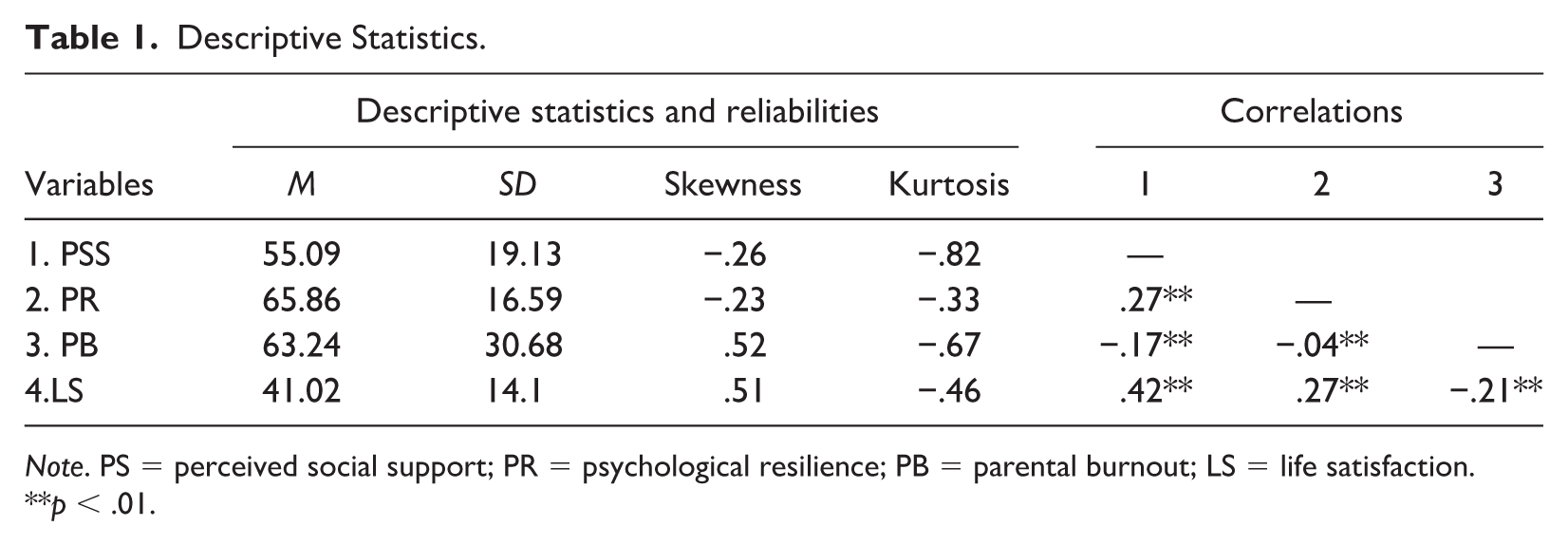
Note. PS = perceived social support; PR = psychological resilience; PB = parental burnout; LS = life satisfaction.
p < .01.
Psychological resilience was positively associated with life satisfaction (r = 0.27, p < .01), whereas parental burnout was negatively associated with both perceived social support (r = –0.17, p < .01) and life satisfaction (r = –.21, p < .01). A weak but statistically significant negative correlation was found between psychological resilience and parental burnout (r = –.04, p < .01).
Structural Equation Modeling
First, four latent structures (perceived social support, life satisfaction, psychological resilience, and parental burnout) and fifteen observed variables related to these structures were included in the measurement model in this study. The fit statistics showed that the measurement model fit the data well. The chi-square/degrees of freedom ratio (χ²/df = 1.88) and fit indices [CFI = 0.97, TLI = 0.97, GFI = 0.92, SRMR = .043, RMSEA = .061] are within the acceptable limits suggested by Hu and Bentler (1999). All factor loadings were found to be significant and ranged between 0.71 and 0.95. The reliability coefficients of the structures were above 0.70, which is an acceptable level.
In the subsequent testing of structural models, the direct effect between the predictor variable (perceived social support) and the dependent variable (life satisfaction) was tested in the first stage. The overall fit of the full mediation model to the data is acceptable (χ²/df = 2.02, CFI = 0.96, TLI = 0.95, GFI = 0.90, SRMR = .096, RMSEA = .071, AIC = 257.348, ECVI = 1.08). Following this stage, a partial mediation model was tested, in which the variables of psychological resilience and parental burnout as mediators and also included a direct path from perceived social support to life satisfaction. The partial mediation model showed a very good fit to the data (χ²/df = 1.86, CFI = 0.97, TLI = 0.97, GFI = 0.92, SRMR = .042, RMSEA = .060, AIC = 228.41, ECVI = 0.96). These results indicate that partial mediation models have acceptable fit indices. In addition, the SRMR value of the full mediation model is greater than .08. To determine model preference, AIC-ECVI values were compared, and the partial model was preferred because its AIC and ECVI values were lower than those of the full model (see Figure 1).
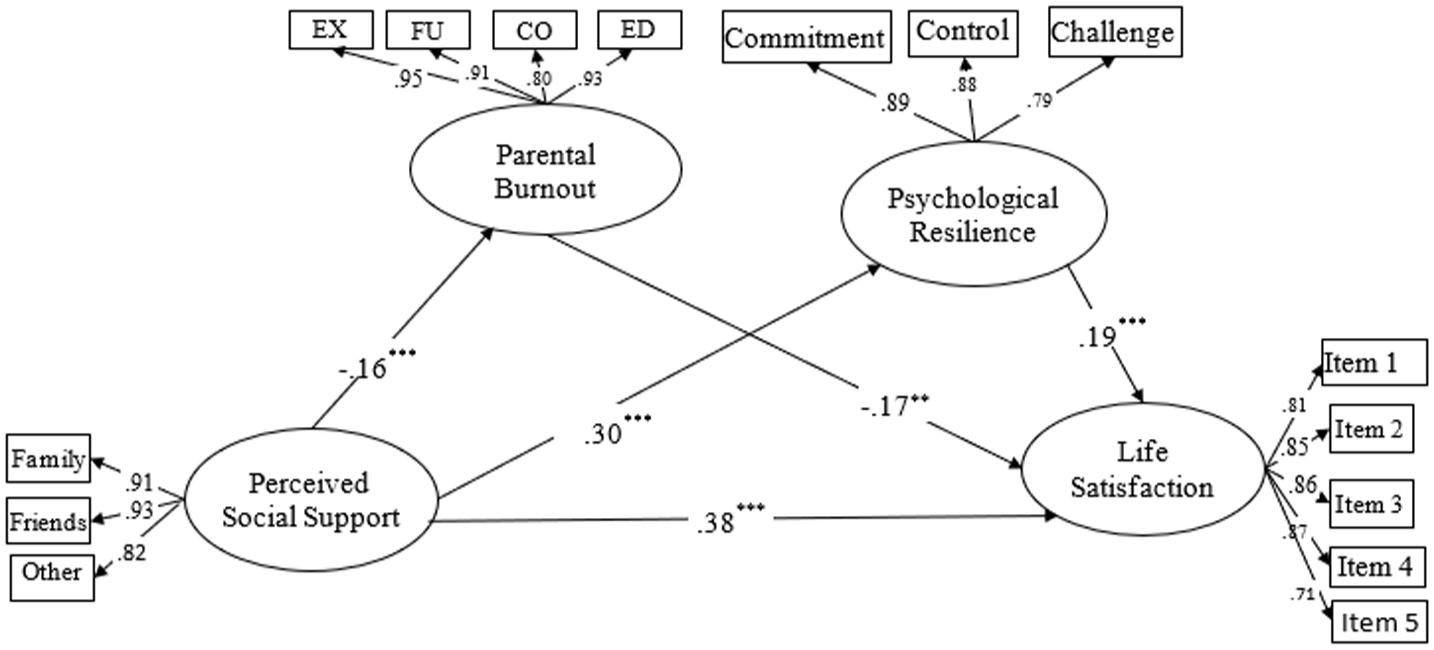
Structural Equation Modeling
Bootstrapping
The partial mediation model was tested for significance using the bootstrap estimation method. Direct, indirect, and total effects are presented in Table 2. Perceived social support was found to have a significant direct effect on life satisfaction (β = .056; 95% CI = .035, .077). In addition, perceived social support had a significant effect on parental burnout (β = −0.178; 95% CI = −0.340, −.025) and psychological resilience (β = 0.309; 95% CI = 0.160, 0.456).
Parameters and 95 % CIs for the Paths of the Model.
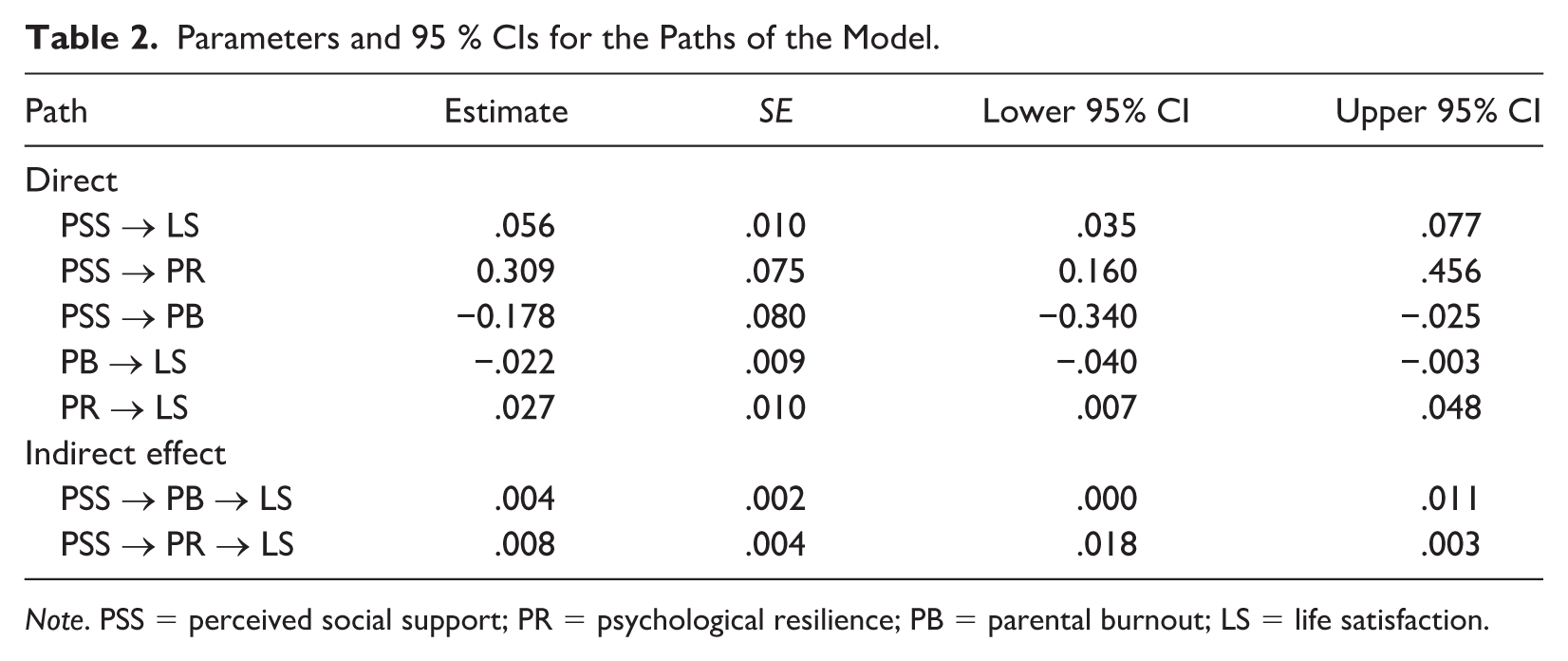
Note. PSS = perceived social support; PR = psychological resilience; PB = parental burnout; LS = life satisfaction.
Life satisfaction was directly influenced by both parental burnout (β = −.022; 95% CI = −.040, −.003) and psychological resilience (β = .027; 95% CI = .007, .048). In addition, the indirect effect of perceived social support on life satisfaction through parental burnout is 0.004 (95% CI = .000, .011). The indirect effect through psychological resilience is .008 (95% CI = .018, .003). These results indicate that as perceived social support increases, psychological resilience increases while parental burnout decreases. Perceived social support significantly increases life satisfaction both directly and through psychological resilience and parental burnout.
Discussion
This study formulated two hypotheses to test direct and indirect relationships and evaluate the proposed mediation model. The results showed that perceived social support was directly related to life satisfaction. At the same time, perceived social support was associated with life satisfaction through parental burnout and psychological resilience. Therefore, the proposed mediation model was accepted.
Within the scope of the study (RQ1), a significant positive relationship was found between perceived social support and life satisfaction. This finding indicated that mothers who perceive higher levels of social support reported greater life satisfaction. The result supports the theoretical framework, suggesting that social support serves as a protective factor in enhancing psychological well-being. It is also in line with previous research showing that perceived social support is a strong predictor of life satisfaction, particularly in populations facing increased caregiving demands, such as parents of children with intellectual disabilities (Emam et al., 2023; Sarı et al., 2012; Wang et al., 2017; Yildirim et al., 2025). It is known that parents of individuals with intellectual disabilities have higher stress levels than parents of typically developing children (Peer & Hillman, 2014). This level of stress can also lead to psychological problems (McConnell & Savage, 2015) and difficulties in providing the necessary support for their children (Obeid & Daou, 2015). In other words, stress prevents parents from fulfilling their parenting roles effectively. All of these factors are likely to affect parents’ life satisfaction negatively. However, providing appropriate social support would enable parents to perform their parenting duties adequately (Wang et al., 2017). Previous research suggests that parental stress may negatively affect psychological well-being—particularly among parents of children with ASD—and reduced well-being can make parenting more challenging (Obeid & Daou, 2015).
Within the scope of the study (RQ2), evidence partially supported the mediating roles of psychological resilience and parental burnout in the association between perceived social support and life satisfaction. When reviewing the literature, no study examined the mediating role of burnout between social support and life satisfaction. However, some studies report a negative relationship between social support and burnout (Dimala et al., 2024; Nazik et al., 2023), a negative relationship between burnout and life satisfaction (Aktan et al., 2020) and that social support positively affects life satisfaction (Gebeyehu et al., 2019; Sarı et al., 2012). When reviewing the literature, we see that burnout is an important predictor of the lives of parents of individuals with intellectual disabilities. The burnout levels of parents of individuals with intellectual disabilities are higher than those of parents of typically developing children (Gérain & Zech, 2018, 2021). Individuals with disabilities place an additional financial burden on the family budget, may force one of the parents to give up their job, prevent them from participating in social activities due to a lack of free time, and require constant care for the disabled child (Singh et al., 2014). All of these factors can cause parents to experience burnout. The results of this study showed that social support not only directly affected parents’ life satisfaction but also provided indirect support by reducing their burnout levels. The stress process model can explain this situation. According to the stress process model, social support can be interpreted as having a buffering effect in coping with stress sources such as the care burden faced by families, thereby alleviating parents’ feelings of burnout and increasing their life satisfaction (Steven & Whitlatch, 2023). In addition, the current study contributes to the literature by empirically testing the mediating effect of burnout in this relationship.
We caution against extending these findings to formal supports (e.g., counseling, support groups, respite or case-managed services), which were not measured in the present study. Prior work suggests that formal and informal supports can exert different associations with caregiver outcomes; in some contexts, informal support has been reported as more protective against stress, whereas formal services show benefits on other health markers and may vary by the child’s developmental stage (Emam et al., 2023; Lu et al., 2018; Steven & Whitlatch, 2023). Accordingly, the present results should not be taken to imply that formal supports will have identical effects on resilience, burnout, or life satisfaction. Moreover, families frequently report a pronounced “services cliff” as children exit school-based systems and transition into adulthood, with a sharp decrease in available services and coordination—an acknowledged stressor for caregivers that the present study did not assess (Steven & Whitlatch, 2023).
Within the same hypothesis, the mediating role of psychological resilience in the relationship between perceived social support and life satisfaction was also examined and partially accepted. A review of the literature reveals no research examining the mediating role of psychological resilience in the relationship between social support and life satisfaction among parents of children with intellectual disabilities. However, the current study is parallel to studies conducted in different fields. Wu et al. (2022) concluded in their study with medical personnel that social support increases resilience and positively affects life satisfaction. Guo (2017) conducted a study with college students and concluded that social support increases resilience, and resilience positively affects life satisfaction. These findings revealed the mediating role of psychological resilience in the relationship between the direct effect of social support on life satisfaction. When we look at the literature, social support provided to parents can reduce parental stress and increase parental resilience in the face of pain and problems.
Limitations
The current study has some limitations. First, the data were collected through self-report instruments, which may be subject to social desirability and recall bias. Participants may have underreported or overreported their levels of burnout, resilience, or satisfaction due to personal perceptions or the sensitivity of the topic. Second, the study sample consisted solely of mothers of children with intellectual disabilities residing in Turkey. Therefore, the findings may not be generalizable to fathers, caregivers in other cultural contexts, or those caring for children with different types of disabilities. In addition, the use of convenience sampling restricts the generalizability of the findings, and the modest sample size (N = 238) cannot be considered representative of all mothers of children with intellectual disabilities in Turkey or internationally. Third, participants self-selected into the study. Mothers who volunteered may have had particularly strong opinions about the study variables, and those with access to technological tools and available time may have been more likely to participate, which may have introduced self-selection bias. Fourth, the cross-sectional design of the study limits the ability to draw causal inferences. Five, the study did not examine potential moderating variables, such as the severity of the child’s disability, comorbidity, length of caregiving, socioeconomic status, or access to services, which may influence the relationships among perceived social support, resilience, burnout, and life satisfaction. Importantly, the Multidimensional Scale of Perceived Social Support (MSPSS) used in this study captures informal support from family, friends, and a significant other; thus, our inferences pertain to informal—not formal or professional—supports. Finally, the structural model tested in this study assumes unidirectional relationships (e.g., perceived social support → resilience/burnout → life satisfaction). However, given the cross-sectional design, causal direction cannot be determined. It is equally plausible that individuals with higher resilience or lower burnout are more effective in mobilizing social support, or that those with higher life satisfaction receive more positive engagement from their social networks. Future longitudinal or experimental studies are needed to disentangle the directionality of these associations.
Implications for Practice
The findings of this study underscore the pivotal role of perceived social support in enhancing life satisfaction among mothers of children with intellectual disabilities. Given that social support was found to influence life satisfaction both directly and indirectly—through increased psychological resilience and reduced parental burnout—there are several meaningful implications for practice. First, professionals working in disability services, family counseling, and educational settings should prioritize developing and maintaining robust support networks for caregivers. This includes community-based support groups, peer mentorship programs, and access to counseling or respite care services. Second, policymakers should consider integrating family-centered support models into disability care systems. Tailored interventions that simultaneously strengthen psychological resilience and alleviate burnout could significantly enhance maternal well-being and improve the overall caregiving environment.
Third, community-based organizations should be supported in implementing programs that foster resilience-building among caregivers. Such programs may include workshops on coping strategies, stress management, and self-care practices, especially targeting mothers of children with intellectual disabilities. Finally, researchers should further investigate context-specific variables (e.g., socioeconomic status, cultural attitudes) that may affect the accessibility and effectiveness of social support systems. By doing so, more inclusive and responsive policy frameworks can be developed to meet the unique needs of this population. Beyond informal support networks, formal support mechanisms can play a critical role in strengthening the well-being of parents of children with disabilities. Facilitated support groups and peer mentorship programs can help parents share experiences, access coping strategies, and reduce feelings of isolation. In addition, structured services such as respite care, specialized child care, and special recreation programs can alleviate caregiving burden by providing parents with protected time for rest and self-care. Integrating these formal supports into community and disability service systems may significantly reduce parental burnout and enhance the long-term sustainability of caregiving.
Footnotes
Disposition editor:Cristina Mogro-Wilson
Declaration of Conflicting Interests
The authors declared no potential conflicts of interest with respect to the research, authorship, and/or publication of this article.
Funding
The authors received no financial support for the research, authorship, and/or publication of this article.
