






Abstract
This article studies the deformation behavior of shape memory alloy materials under a constant uniaxial tension stress and the cycling of temperature considering damage. In the theoretical research, the influence of damage on the material’s permanent maturity in a single cycle is fully considered. By introducing damage into material parameters such as the module of elasticity and maximum uniaxial transformation strain, a thermodynamic constitutive model that can simulate the cyclic deformation behavior of shape memory alloy materials considering damage is established and the numerical results are compared with experimental and theoretical simulation results of others to verify the correctness of the model.
1. Introduction
Shape memory alloy (SMA) has been widely used in microelectromechanical system, biomedical and organ transplantation, transportation, aerospace and civil engineering due to its unique superelasticity and shape memory effects, and excellent biocompatibility and wear resistance (Duerig et al., 1999; Morgan, 2004; Van Humbeeck, 1999). SMA devices are inevitably subjected to thermal-force coupling cyclic loading during actual service. The cyclic deformation behavior and the resulting damage and fatigue failure problems determine the service reliability and service life of the device. To improve the service reliability and durability of SMA devices, the cyclic deformation behavior needs to be studied in depth. Therefore, the research on the thermo-mechanical coupling cyclic deformation behavior of SMA has urgent engineering requirements. However, before the 1990s, people were generally concerned about the improvement of material properties, superelasticity, and shape memory characteristics under monotonic loading conditions and their theoretical descriptions. There was not much attention to the cyclic deformation behavior and related fatigue problems of the SMA. In the past two decades, with the deep understanding of the thermo-mechanical coupling behavior of SMAs, more and more scholars pay more attention to the response of the alloy under the thermo-mechanical coupling cyclic load (Kang et al., 2015). And many achievements have been made in experimental, theoretical, and numerical simulations.
1.1. Study on macroscopic experimental
Certain researchers have developed macroscopic practical tests of the degeneration of SMA subjected to uniaxial cyclic loading. During the process of cyclic deformation, some researchers have found that the superelasticity of SMA gradually deteriorates, which is mainly reflected in four aspects: the accumulation of residual strain, the gradual decrease in martensitic transformation start stress, the gradual increase in phase transformation modulus, and the gradual decrease in dissipation energy. At the same time, the above phenomena has become saturated with the cyclic deformation in the literature (Gall and Maier, 2002; Lagoudas and Bo, 1999; Miyazaki et al., 1986; Sehitoglu et al., 2001; Song et al., 2014a; Wang et al., 2008). Furthermore, some other studies have focused on the impact factors for the superelastic deterioration behavior of SMA. The effect of external force is first introduced. Kang et al. (2009) have studied systematically the cyclic deformation of superelastic SMA under different stresses and have found that the evolution rate and saturation value of the above four aspects are related to the applied stress, and the superelastic deterioration phenomenon of SMA under cyclic loading is defined as transformation ratcheting. Song et al. (2014b) studied the inhibition of superelastic behavior caused by martensite plasticity under high stress and found that when the peak stress applied exceeds the martensitic plastic yield stress, the reverse phase transformation is suppressed, resulting in a rapid narrowing of the hysteresis loop and rapid loss of superelasticity. This proves the promotion of high stress loading on the transformation ratcheting behavior of the material. And the effect of thermal situation on circling stress is considered as follows by Lexcellent and Bourbon (1996) and Yu et al. (2014). They have further investigated on the cyclic deformation behavior of superelastic SMA at different temperatures, and the results have shown that the degree of superelastic deterioration gradually increased with increasing temperature. Then Bo and Lagoudas (1999), Miller and Lagoudas (2001), Hamilton et al. (2004), Saleeb et al. (2013), and Benafan et al. (2014) have researched on temperature cycling under constant axial stress. The results have shown that both the peak strain and the valley strain increase with increasing cycle times, and the value of increase will increase with axial stress. The starting temperature of martensite transformation will gradually decrease with the increase of cycle times, which means that the driving force of martensitic transformation will gradually increase with the increase of cycle times. In other words, the martensitic transformation becomes more and more difficult. As we remarked above, the degeneration performance of superelastic SMA involved in cyclic stress loading and in cyclic temperature loading have been developed.
1.2. Research on macroscopic constitutive model
The macroscopic constitutive model does not pay attention to the evolution details of the internal microstructure of the material, and only uses fewer internal variables to describe the current state of the material. This type of model is very convenient for engineering applications because of the small amount of calculation. When the model is transplanted to the finite element software, it can be conveniently used for the thermo-mechanical coupling response analysis of SMA. Representative work includes Brinson (1993), Boyd and Lagoudas (1996), Auricchio and Lubliner (1997), Zaki and Moumni (2007), and Chemisky et al. (2011). These above models are a good description of the thermo-mechanical coupling deformation properties of SMAs under isothermal conditions. However, the internal variables related to cyclic deformation are not introduced in these models, they are only applicable to the trained SMAs. It is not possible to describe the deterioration of superelasticity and shape memory effect of untrained materials during cyclic deformation. In view of the shortcomings of the above work, some scholars have made further research on the above constitutive model. Based on the existing experiments of cyclic deformation, Lagoudas and Entchev (2004), Auricchio et al. (2007), Zaki and Moumni (2007), and Lagoudas et al. (2012) established the cyclic constitutive model by considering interface defects and accumulation of residual martensite during cyclic deformation. In recent years, some other researchers have innovated the model for simulating cyclic deformation with considering up to date factors. A constitutive model based on crystal plasticity has been proposed (Dhala et al., 2019; Xiao et al., 2020). The model includes various inelastic mechanisms of deformation such as martensite transformation, dislocation glide in austenite phase, and twinning in the martensite phase. The effects of loading rate and phase transition rate on cyclic deformation behavior have been also added to the SMA constitutive model (Lu et al., 2019; Xiao et al., 2018). Besides taking crystal plasticity and loading rate into account, a fatigue criterion has been presented to investigate the torsional low-cycle fatigue of superelastic SMA on the basis of the stabilized dissipated energy (Mohammadzadeh et al., 2019).
Despite the analysis of degeneration effects of cyclic stress loading as well as cyclic temperature loading, the effect of damage on the cyclic deformation behavior of SMA is rarely mentioned in the current theory. To model the decay of superelastic response of this smart material by a simplified method, the constitutive law of SMA is supposed to be reduced. As a result, the damage in the level of macro-deformation is applied to present the influence of martensite residual as well as dislocation glide in crystal and of other factors. In front of the absence of damage factor in literature, the constitutive model of SMA considering damage should be studied in depth.
As it is declared before, a thermo-mechanical damage constitutive model of SMA materials will be introduced in this work and the damage of the alloys will be implemented on some material parameters such as the module of elasticity and maximum uniaxial transformation strain. Then the temperature-strain relationship of SMA materials under constant stress derived from our theory will be compared with the theoretical and experimental results in Xu et al.’s (2018) paper. Finally, the correctness of the model can be verified by result of comparison.
2. Constitutive modeling of SMA considering damage
According to Liu et al. (2019), the constitutive model for the SMAs considering the damage can be given by the following equations
where
where
where
To better model the phase transformation behavior of materials under temperature cycling, the volume fraction of martensite is corrected in this article. The corrected results are as follows. The expression of
Similarly,
where
In summary, the constitutive relationship of this article can be obtained from equations (2) to (7) and is as follows
3. Numerical results
The above theory will be applied to model the constitutive relationship of the SMA considering the damage and the residual strain. As a simple application of the constitutive equation derived, the response of SMA under uniaxial load is found. The components of the stress tensor are given by
Then the total strain
And the expression of
To verify the accuracy of the theory, an experiment of temperature cycling of the SMA is required. Due to imperfect experimental conditions, this experiment cannot be completed by us. The results of an excellent paper written by Lei Xu et al. (2018) are introduced in this article. In their paper, a temperature cycling experiment under a constant uniaxial stress of a NiTi SMA is completed. And the experimental results are also used to verify their own perfect theory.
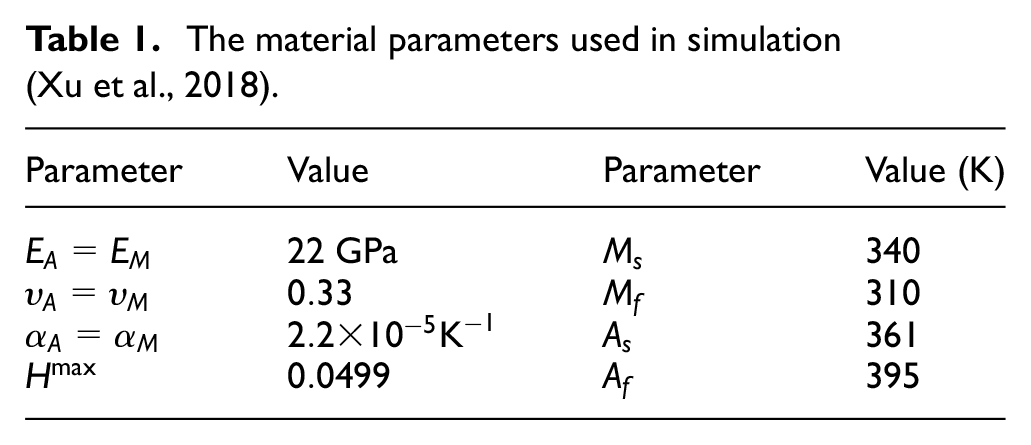
In Xu et al.’s paper, there is an experiment that an untrained SMA loaded under isobaric loading conditions and subjected to 100 thermal cycles. The SMA is initially loaded under a constant tensile load of 200 MPa and then undergoes thermal cycles where the temperature varies from 30°C to 165°C for 100 cycles. The material parameters used in this simulation are summarized in Table 1.
The material parameters used in simulation(Xu et al., 2018).
According to the laboratory results of Xu et al.’s paper, the value of maximum uniaxial transformation strain under each cycle is obtained by the cyclic deformation behavior. The relationship between the maximum uniaxial transformation strain and the number of cycles is shown in Figure 1.
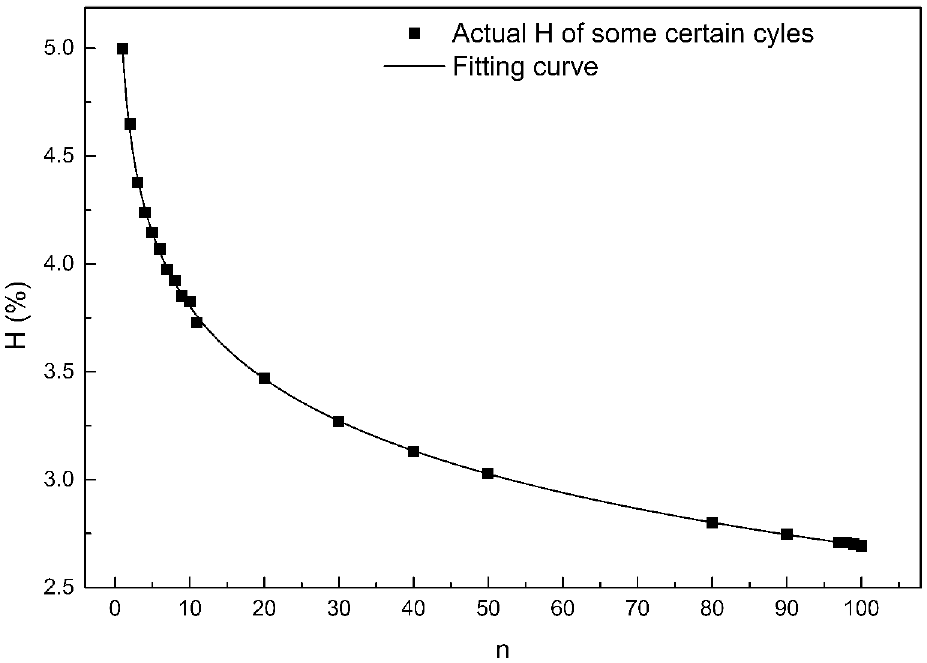
The relationship between the maximum uniaxial transformation strain and the number of cycles.
The relationship between the maximum uniaxial transformation strain
According to the Mechanics of Solid Materials (Lemaitre and Chaboche, 1990), the fatigue damage is caused by the repetition of stress and is a function of the cycle, which can be described as the evolution of the phenomenon from the non-damaged state to the formation of macroscopic cracks. When the temperature changes, due to the effect of constant stress, the SMA will undergo the mutual transformation of austenite and non-twin martensite. Phase transformation is the movement of crystal grains, such reciprocating movements will inevitably cause voids between the crystal lattices, leading to an increase in the internal defect area of the material and a decrease in the effective bearing area, which will cause damage. And the loading process of each cycle will cause damage to the material, and the accumulation of damage of the previous cycle will affect the behavior of the next cycle. It is well known that damage is difficult to measure directly, and the measurement of damage is related to the variable used to represent the phenomenon, which is the same as the measurement of all physical quantities. The tensile stress is constant this time, which means that the damage of modulus of elasticity cannot be obtained from the experiment. Because of this situation, the maximum uniaxial transformation strain, a parameter that is considered will be damaged in the previous research, is selected to obtain the damage factor
where
In this article, the relationship between the damage and the number of cycles can be obtained by combining the values of maximum transformation strain in each cycle of the experimental data of Xu et al. and equation (12).
Then the relationship between the damage factor
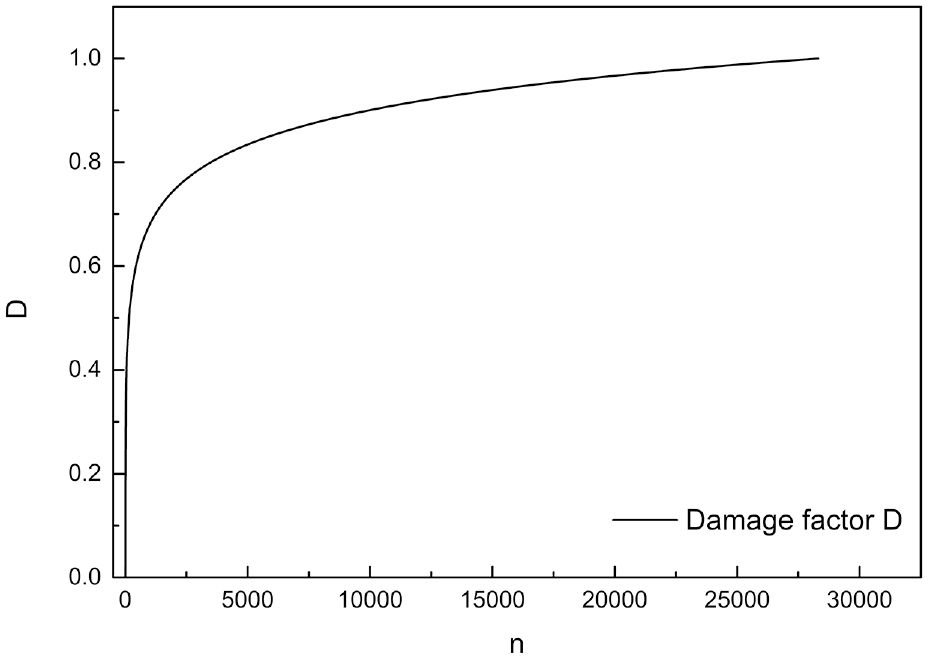
The relationship between the damage factor and the number of cycles.
For the residual strain, the relationship between residual strain and cycle number is obtained by Xu et al.’s experimental data of cyclic deformation behavior and shown in the Figure 3. Due to the fact that data can only be extracted from the figure of Xu et al.’s article, the true value of the 40–97 cycles cannot be distinguished well. However, in the 40–97 cycles, the residual strain increases almost linearly, and the increment gradually decreases, which is in line with the trend of the fitted curve. As shown in figure, the relationship between the residual strain and the number of cycles can be obtained by numerical fitting as follows
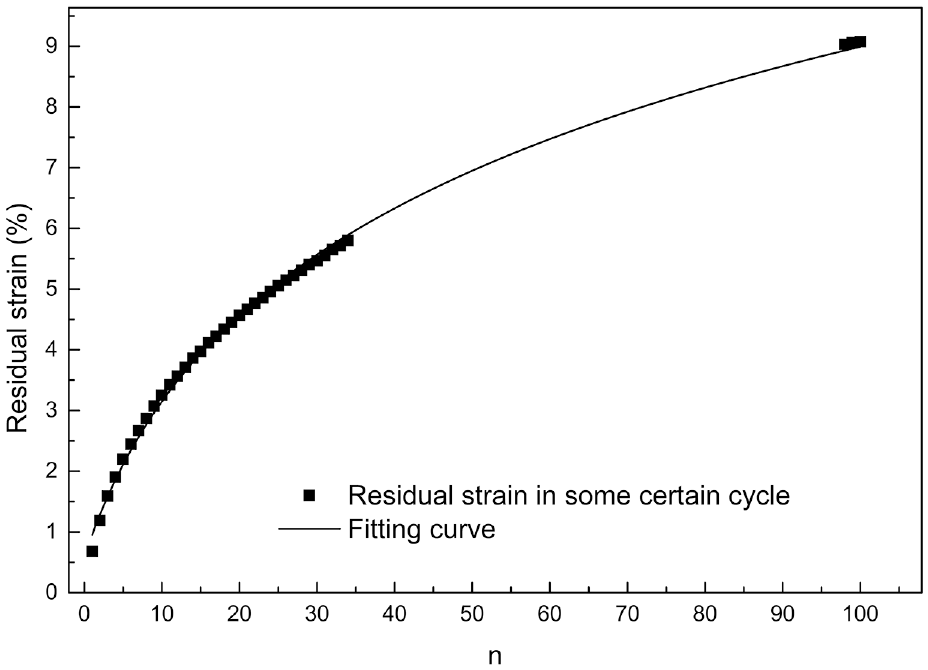
The relationship between the residual strain and the number of cycles.
In the first cycle, the experimental results of Xu et al., the theoretical simulation of Xu et al., and my theoretical simulation are shown in Figure 4. In the case of fixed uniaxial stress and temperature cycling, if the temperature starts to decrease from high temperature (higher than
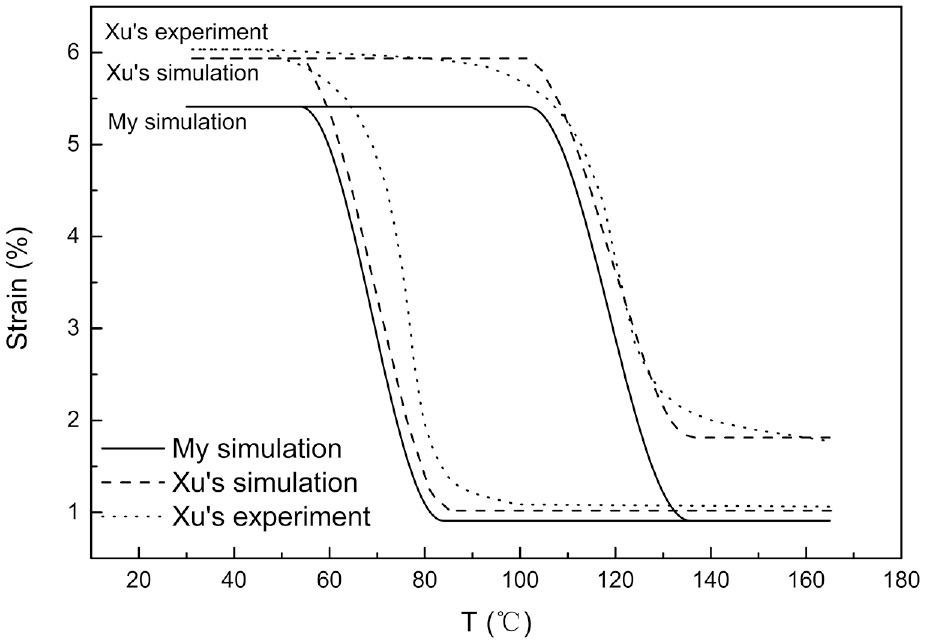
The experimental results of Xu et al., the theoretical simulation of Xu et al., and my theoretical simulation in the first cycle under 200 MPa.
Figure 5 shows the experimental results of Xu et al., the theoretical simulation of Xu et al., and my theoretical simulation in the 100th cycle. It shows that the theory of Xu et al. did not simulate the attenuation of the hysteresis curve very well. Because the attenuation of maximum uniaxial transformation strain is introduced in our theory, the temperature cyclic deformation behavior of SMA is well simulated. At the same time, due to the addition of the correction parameter, our theory can also simulate the attenuation of four phase transformation temperatures and the temperature-strain relationship of various SMAs with different material parameters.
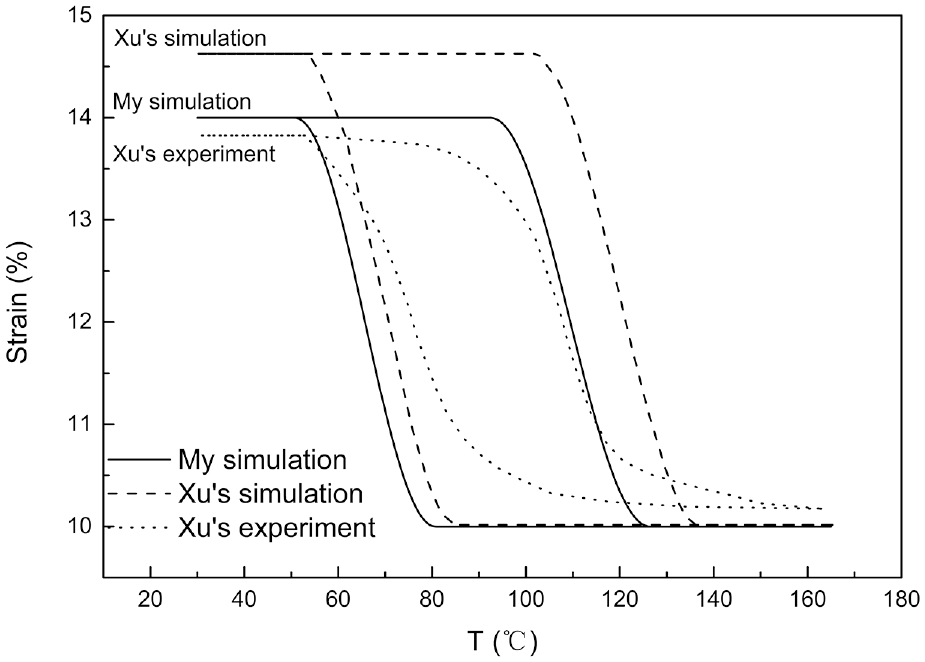
The experimental results of Xu et al., the theoretical simulation of Xu et al., and my theoretical simulation in the 100th cycle under 200 MPa.
The simulation result of the 1st, 10th, 20th, 50th, 100th, 500th, and 1000th cycle based on the theory of this article is shown in Figure 6. It can be observed from the Figure 6 that as the number of cycles increases, the four phase transformation temperatures gradually decrease, and the maximum uniaxial transformation strain is also attenuated. This is consistent with the experimental results of Xu et al. When the number of cycles is large, such as the 1000th cycle, due to the attenuation of the phase transformation temperature, the SMA cannot perform a complete phase transformation process in the original temperature range, and the material will be unable to achieve the required deformation and affect the driving effect.
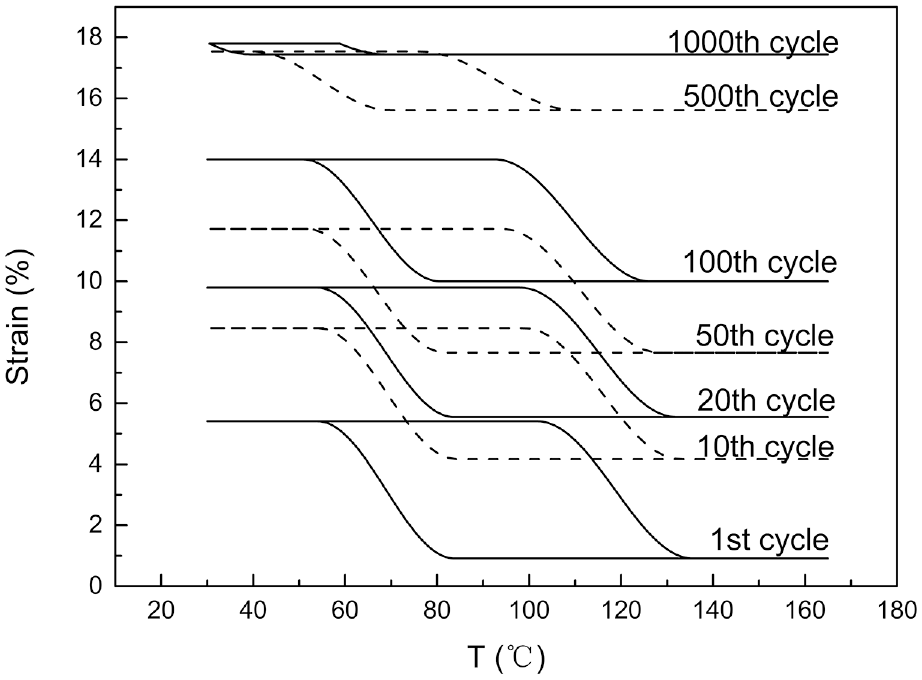
The simulation result of the 1st, 10th, 20th, 50th, 100th, 500th, and 1000th cycle based on the theory of this article under 200 MPa.
Figure 7 shows the relation between temperature and strain under different constant tensile stress based on the theory of this article. As the stress increases, the phase transformation temperature gradually increases. As shown in Figure 7, when the stress is 330 MPa, the austenitic transformation finish temperature is already greater than the maximum working temperature, which means that a large amount of martensite will remain in the material, which will adversely affect the subsequent cycle process. At the same time, using the theory of this article, it is found that as the damage increases, the increase in phase transformation temperature per MPa also increases, which means that with the accumulation of damage, the material will become more difficult to transform into austenite. This is consistent with the damage produced by residues of martensite which some articles pointed out.
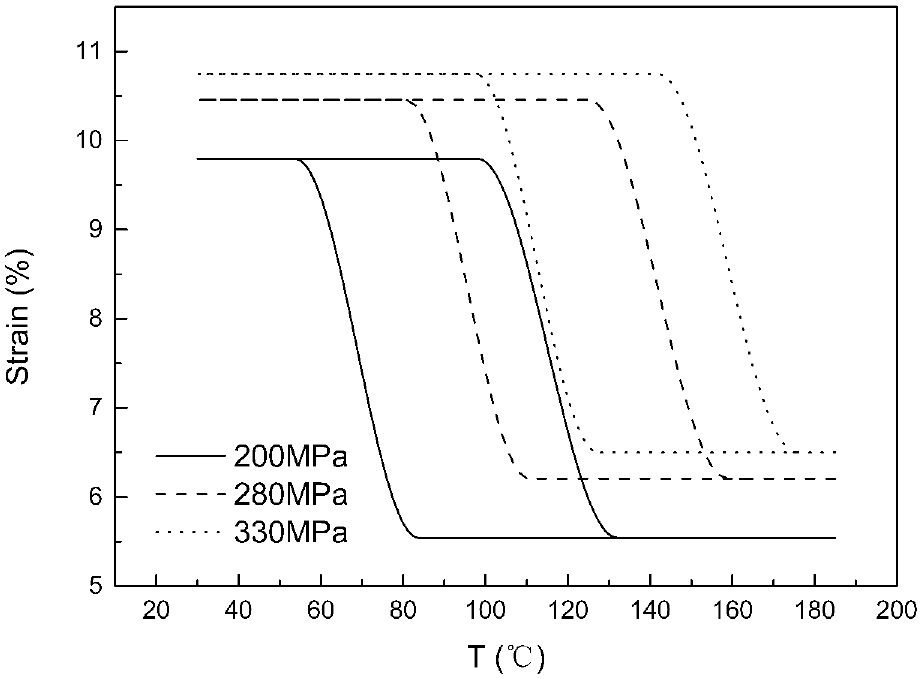
The simulation result of the 200, 280, and 330 MPa constant tensile stress based on the theory of this article at the 20th cycle.
In particular, if maximum uniaxial transformation strain is considered to decay as the increase of cycle and it also characterizes the attenuation of all material parameters, the material will completely fail when
4. Conclusion
An analytical constitutive model considering damage of SMA which can be applied to the simulation under the cycling of temperature has been developed in this work. As a simplified method, damage of the physical parameters of the material is added to the SMA constitutive relationship instead of the effects of martensite residue and so on. By introducing the damage into the maximum uniaxial transformation strain, a more accurate simulation result is obtained. In this way, the theoretical model in this article characterizes the shrinkage of the hysteresis curve in the experiment. And using the attenuation of the maximum uniaxial transformation strain, the fatigue life of the specimen under temperature cycling can also be estimated. After adjusting the simulation value of the first cycle through the correction parameters in the theoretical model, the subsequent cyclic deformation behavior of the experiment is well simulated. Considering the different damage accumulation of different SMA materials, the temperature-strain curve of different SMA materials under constant uniaxial stress can be obtained by changing the correction parameters and collecting the attenuation of the maximum phase change strain.
Footnotes
Declaration of conflicting interests
The author(s) declared no potential conflicts of interest with respect to the research, authorship, and/or publication of this article.
Funding
The author(s) disclosed receipt of the following financial support for the research, authorship, and/or publication of this article: The authors acknowledge the financial support of National Natural Science Foundation of China (No. 11502284) and the financial support of Fundamental Research Funds for the Central Universities (No. 3122018D039).
