







Abstract
A three dimensional elasticity analysis for the transverse free vibration characteristics of functionally graded magneto-electro-elastic plates based on the scaled boundary finite element method (SBFEM) incorporated with the precise integration algorithm (PIA) is presented. The material properties of magneto-electro-elastic plates are changing along the in-plane direction with arbitrary mathematical functions. In the proposed methodology, the strategies of only discretizing the in-plane surface and utilizing the two-dimensional spectral elements to construct diagonal coefficient matrices are adopted, which contributes to decreasing the calculation effort. The derivation process begins with the three dimensional governing equations of magneto-electro-elastic materials. Neither the plate mechanical kinematics nor invoking assumptions on the spatial distributions of electric and magnetic quantities are adopted. Built upon the introduced scaled boundary coordinates, the principle of virtual work and the technique of dual vectors, a first order ordinary differential SBFEM matrix equation for the in-plane functionally graded magneto-electro-elastic plates is obtained. Its general solution is analytically denoted as the matrix exponent. To improve the computation accuracy of the matrix exponent, the PIA is utilized to form the stiffness matrix. By virtue of the kinetic energy technique, it is convenient to construct the mass matrix of the in-plane functionally graded magneto-electro-elastic plates based on the SBFEM for the first time. Finally, comparisons of flexural frequency parameters with those from exact solutions and other numerical methods are provided. The accuracy, effectiveness, and versatility of the employed technique are validated. Moreover, additional numerical exercises are conducted to exhibit the influences of boundary conditions, material gradation functions, and aspect ratios on the free vibration behaviors of in-plane functionally graded magneto-electro-elastic rectangular, circular, and perforated plates.
Keywords
1. Introduction
In recent few decades, functionally graded and magneto-electro-elastic materials are incorporated with each other to form a new-type functionally graded magneto-electro-elastic composite material. In practical applications, the advanced functionally graded magneto-electro-elastic materials are usually fabricated as the plate structures to create the so-called functionally graded magneto-electro-elastic plates. This novel kind of plates simultaneously possess the characteristics of two constitute materials, which means that material properties of the produced plates are characterized by continuous and gradual distribution in the spatial domain and present the coupling effect of mechanical, electric, and magnetic fields. The functionally graded magneto-electro-elastic plates can be manufactured by the chemical vapor deposition, powder metallurgy, self-propagating high temperature synthesis, electrochemical method, and so on. Owing to the unique features, functionally graded magneto-electro-elastic plates are applied in plenty of fields such as smart sensors, actuators, vibration and stability control, health monitoring, medical devices, ultrasonic imaging transducers, and other utilizations.
The functionally graded materials with the gradation functions in terms of the transverse coordinate attract most of the researchers’ and engineers’ attention. However, it is noteworthy to point out that the in-plane gradation of material parameters is also able to produce better performance. To excellently design and optimize the relevant intelligent devices and equipment, it is necessary to carry out a good understanding on the free vibration responses of the functionally graded magneto-electro-elastic plates with in-plane material heterogeneity.
Due to the distinctive characteristics of multi-physical field coupling and smooth distributions of material coefficients, many explorations corresponding to the flexural vibration behaviors of functionally graded magneto-electro-elastic plates are conducted by lots of scientists. The exact solutions served as the benchmarks are important, which can be applied to verify the numerical approaches. Ootao et al. (2011) developed the exact analysis for variations of temperature change, magnetic potential, thermal stress, and electric potential in functionally graded smart magneto-electro-thermo-elastic material strips subjected to thermal loads. However, the exact results are only available for specific geometrical shapes and boundary conditions. To solve more complicated problems and simplify the three dimensional plates into two dimensional structures, scholars developed a set of plate theories, such as the first order shear deformation theory (Arshid et al., 2019), the high order shear deformation theory (Ebrahimi and Dabbagh, 2017; Ebrahimi et al., 2017; Shooshtari and Mantashloo, 2018; Zhang and Li, 2013), the layer-wise shear deformation plate theory (Kattimani and Ray, 2015), and so on. Chen et al. (2005) divided the simply supported functionally graded magneto-electro-elastic plates into several thin layers with equal thickness and introduced an approximate laminate model to reveal the free vibration behaviors. Ootao and Ishihara (2011, 2012) recommended the laminated composite model to study the transient structural responses of functionally graded magneto-electro-thermo-elastic hollow sphere and cylinder subjected to uniform temperature fields.
In two dimensional plate theories, the changing rules of elastic displacements are assumed to follow some functions according to the transverse coordinates. To model the plate structures more accurately, the finite element method (FEM) as a most widely used technology is introduced. Bhangale and Ganesan (2005) made utilization of the FEM to simulate the free vibration responses of functionally graded magneto-electro-elastic material finitely long cylindrical thin shells. With the aid of the FEM, Zheng et al. (2012) provided closed solutions to the free vibration behaviors of simply supported functionally graded magneto-electro-elastic plates and shells. Milazzo (2014) proposed a finite element formulation based on the refined equivalent single layer plate theory to solve the natural frequencies and modal variables of functionally graded magneto-electro-elastic rectangular and square plates. Depended on the FEM, Xie et al. (2016) conducted the sensitivity analysis of the dynamic behaviors for functionally graded magneto-electro-elastic square plates with clamped boundary condition. Cai et al. (2018) and Zhou et al. (2019) utilized the inhomogeneous cell-based smoothed FEM to examine the free vibration and non-linear transient behaviors of functionally graded smart magneto-electro-elastic beams under various boundary constraints. Meanwhile, a series of numerical methodologies including the asymptotic approach associated with the multiple scales method (Tsai and Wu, 2008; Wu and Tsai, 2010), Legendre orthogonal polynomial series expansion method (Wu et al., 2008; Yu and Ma, 2010), the propagator matrix incorporated with the successive approximation approach (Wu and Lu, 2009), the power series approach (Cao et al., 2012), Chebyshev spectral element approach (Xiao et al., 2016), and the polynomial expansions (Zhang et al., 2018) are also employed to investigate the dynamic responses of functionally graded magneto-electro-elastic plates.
Through the literature analysis, it can be found that a large number of investigations are paid attention to predicting the dynamic deformations of functionally graded magneto-electro-elastic plates with material parameters graded along the thickness direction; whilst few explorations are conducted on the in-plane functionally graded materials. Similar with the review mentioned above, two dimensional plate theorems are presented to examine the free vibration behaviors of functionally graded plates with in-plane stiffness. Built upon the classical plate theory, Liu et al. (2010) calculated the natural frequencies of the functionally graded rectangular plates with material coefficients varying along the y direction under simply supported, clamped, and free boundary conditions. Uymaz et al. (2012) took advantage of the Ritz method combined with the high order shear deformation plate theory to seek the solutions of modal frequencies and shapes for the in-plane functionally graded square and rectangular plates. Based on the higher order shear deformation plate theory, Amirpour et al. (2018) provided the analytical solutions to the free vibration behaviors of the 3D printed polymetric rectangular plates with in-plane functionally graded materials and compared the results with those obtained by the commercial finite element software and experimental tests.
Built upon the non-uniform rational B-spline, the isogeometric analysis as a useful tool to explore the vibration characteristics of in-plane functionally graded plates was conducted by many scientists. Yin et al. (2017) incorporated the isogeometric analysis with the Kirchhoff-Love theory to present the natural frequencies, mode shapes, and critical buckling loads of in-plane functionally graded square and circular thin plates. Lieu et al. (2018) performed the isogeometric analysis to examine the free vibration responses and deformable behaviors of functionally graded square and circular plates with varied thickness, in which the stiffness of the plate is changed with the volume fraction distribution obeying two kinds of power law functions. With the aid of the isogeometric analysis and the refined plate theory, Xue et al. (2018) investigated the free vibration characteristics of functionally graded square, skew, elliptical plates with material properties distributed as power law and exponential functions of in-plane coordinates. Lieu et al. (2019) carried out the isogeometric analysis incorporated with the generalized shear deformation theory to study the free vibration and buckling responses of functionally graded square plates with in-plane material inhomogeneity along x and y coordinates. Son and Huu-Tai (2019) conducted the isogeometric analysis to investigate the free vibration behaviors of multi-directional functionally graded rectangular, square, perforated, circular, and annular plates under simply supported and clamped boundary constraints. By means of the isogeometric approach, Xue et al. (2019) acquired the natural frequencies and mode shapes of porous functionally graded plates with the shapes of square, circular, rectangular with a circular cutout, and variations of material parameters in terms of the trigonometric functions.
At the same time, other numerical techniques such as the differential quadrature method (Sharma et al., 2012), the meshfree Hermite radial basis collocation technique (Chu et al., 2014), the Chebyshev collocation approach in conjunction with the differential quadrature method (Kumar, 2015), the finite Taylor series expansion approach (Boreyri et al., 2016), the Fourier series combined with the boundary smoothed auxiliary polynomials (Lyu et al., 2017), two dimensional Chebyshev spectral approach (Huang et al., 2019), the pseudo spectral approach (Heshmati and Jalali, 2019), and so on were applied to gain the vibration frequencies and mode shapes of in-plane functionally graded plates under various boundary conditions.
As far as the articles listed above are concerned, it is evident that there are no papers related to the examination on the free vibration responses of the in-plane functionally graded magneto-electro-elastic plates, which provides a main motivation to fill this void. By virtue of the SBFEM and PIA, the present work makes the first attempt to replenish the fundamental frequency solutions of functionally graded magneto-electro-elastic plates with the in-plane stiffness gradation.
When utilizing the SBFEM developed by Wolf and Song (2000) and Song and Wolf (2000) to investigate the structural responses of plates (Man et al., 2012, 2013, 2014; Xiang et al., 2014; Lin et al., 2018; Zhang et al., 2019, 2020a, 2020b), an arbitrary surface parallel with the top-plane is required to be discretized only, which helps to reduce the computational cost and increase the calculation efficiency. Comparing with the FEM (Fu et al., 2020; Li and Yu, 2018; Li et al., 2017a, 2018a, 2018b, 2018d, 2019a, 2020; Yu et al., 2018), the analytical formulations of the stiffness matrix along the thickness direction can be given out. Owing to these unique characteristics of the semi-analytical scheme and only discretization of the boundary, the SBFEM has been adopted in many engineering fields, such as modelling both the unbounded and bounded domains (Bazyar and Song, 2008; Birk et al., 2012; Chen et al., 2014; Song, 2009), voided materials (Sladek et al., 2015, 2016), parametrization (Arioli et al., 2019), weak discontinuities (Natarajan et al., 2020), the interaction of acoustic-structures (Li et al., 2018c; Liu et al., 2019b), uniform beams (Li et al., 2017b), cylindrical shells (Li et al., 2019b), and so on. The general solution of the SBFEM governing equation for plates is in the analytical form of a matrix exponent corresponding to the transverse coordinate. To improve the computation accuracy of fundamental frequencies, this paper employs the PIA proposed by Zhong (2004) to construct the stiffness matrix. As a kind of 2 N algorithm incorporated with the methodology of only tracking the incremental part, the PIA is accurate and stable to solve the matrix exponent and the precision of the obtained results can reach up to the full computer precision.
Aided by the SBFEM and PIA, the first attempt is carried out to assess the free vibration characteristics of in-plane functionally graded magneto-electro-elastic plates in this paper. The structure of the present paper is displayed in the following. Section 2 derives the SBFEM governing equation; the stiffness matrix acquired by the PIA and the mass matrix from the kinetic energy are given out in Section 3; Section 4 illustrates several numerical exercises; the final conclusion is drawn in Section 5.
2. The SBFEM governing equation
In this section, the governing equations for the in-plane functionally graded magneto-electro-elastic plates with the length l, width w, and thickness t are derived based on the SBFEM, as plotted in Figure 1. Only a surface of the plate parallel with the top-plane is discretized and the computational expense can be reduced a lot. Moreover, the stiffness matrix is formulated analytically. Aid by the kinetic energy method, the mass matrix of the in-plane functionally graded magneto-electro-elastic plates is constructed based on the SBFEM for the first time. The SBFEM can be seamlessly coupled with the FEM and the surface elements adopted in the FEM can also be applied in the SBFEM. In this paper, the 2D high-order spectral elements based on the Gauss-Lobatto-Legendre integral, as illustrated in Figure 2, are employed to mesh the plate with 605 degrees of freedom, which helps to simplify some coefficient matrices into diagonal ones and better display the curved boundaries. The derivation of the SBFEM governing equations rigorously starts from the three dimensional basic equations of magneto-electro-elastic materials without importing assumptions on the variations of magnetic, electric, and mechanical fields. Only the elastic displacements along the x, y, and z axes named as ux = ux(x,y,z), uy=uy(x, y, z), uz = uz(x, y, z), the electric potential Φ=Φ(x, y, z), and the magnetic potential Ψ = Ψ(x, y, z) are employed as the unknown variables. To facilitate the following derivation, a variable
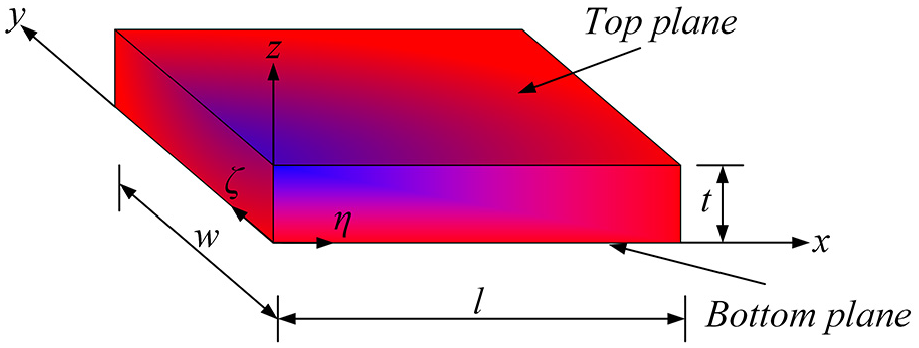
The in-plane functionally graded magneto-electro-elastic plate model.
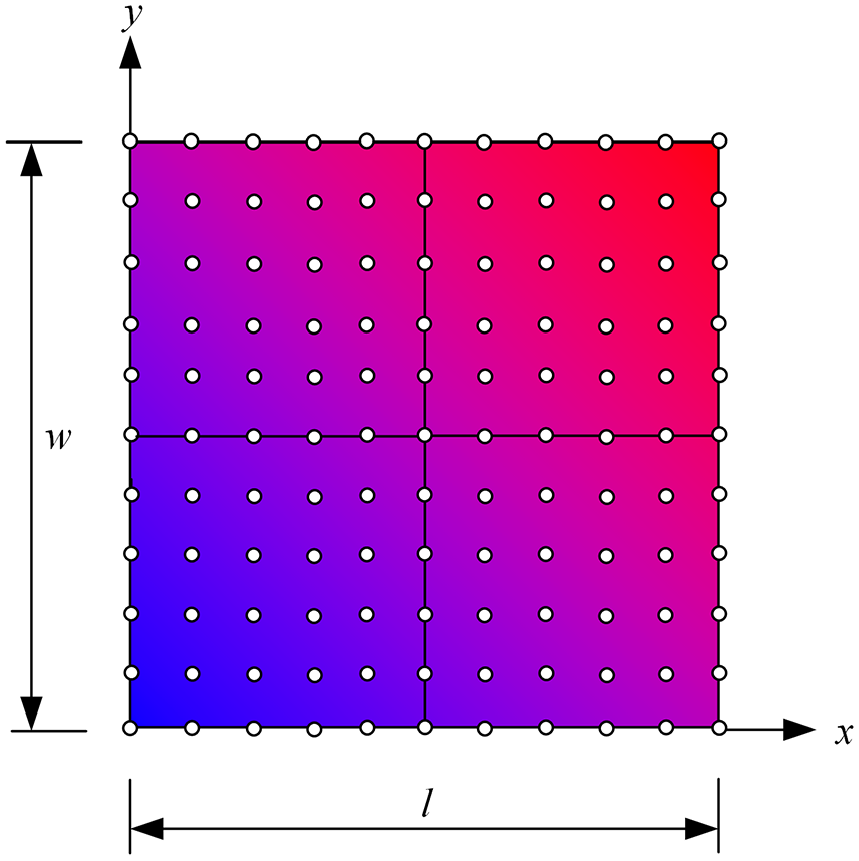
A square plate discretized with four fifth order spectral elements.
As for the in-plane functionally graded magneto-electro-elastic plates, the constitutive equations from the reference Pan (2001) are denoted as in equations (1) to (3) and the detailed formulae are listed in Appendix 1.



in which σij, εlk, Di, Bi, Ek, and Hk (i, j, l, k = x, y, z) represent the components of stress, strain, electric displacement, magnetic induction field, electric field, and magnetic field, respectively.
Meanwhile, in the above formulae cijlk(x,y), νik(x,y), μik(x,y), eijk(x,y), dik(x,y), qilk(x,y) stand for the coefficients of elastic stiffness, dielectric constants, magnetic permeabilities, piezoelectric constants, magnetoelectric, and piezomagnetic coupling constants respectively, which are mathematically modeled as the functions in terms of the in-plane x and y coordinates. As for the transversely isotropic magneto-electro-elastic material of Pan (2001), the material parameters are simplified as cij(x,y), νij(x,y), μij(x,y), eij(x,y), dij(x,y), qij(x,y). In this paper, the coefficient expressions for the in-plane functionally graded magneto-electro-elastic plates are selected as
Considering the magneto-electro-elastic material, groups of the geometric equation are expressed as
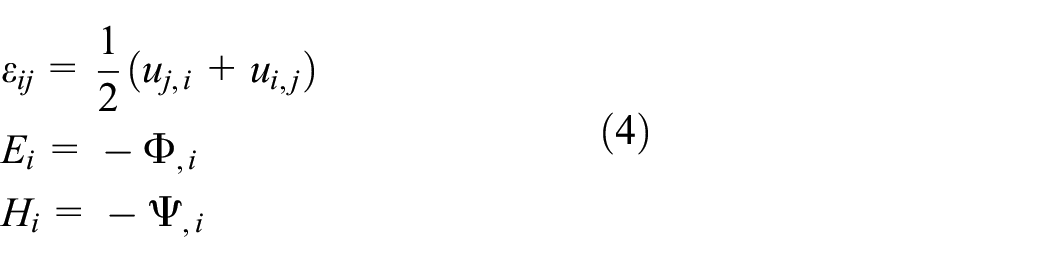
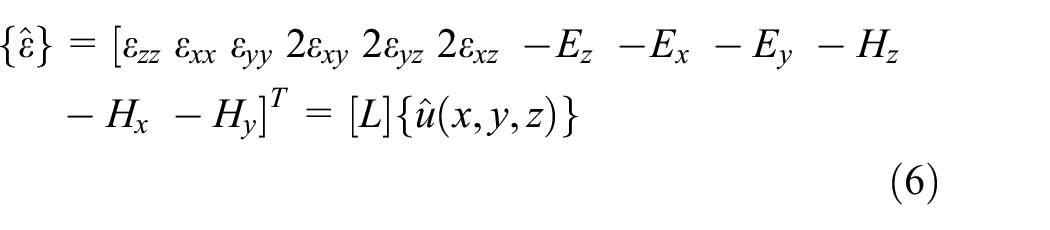
To facilitate the derivation, the differential operator [L] is introduced
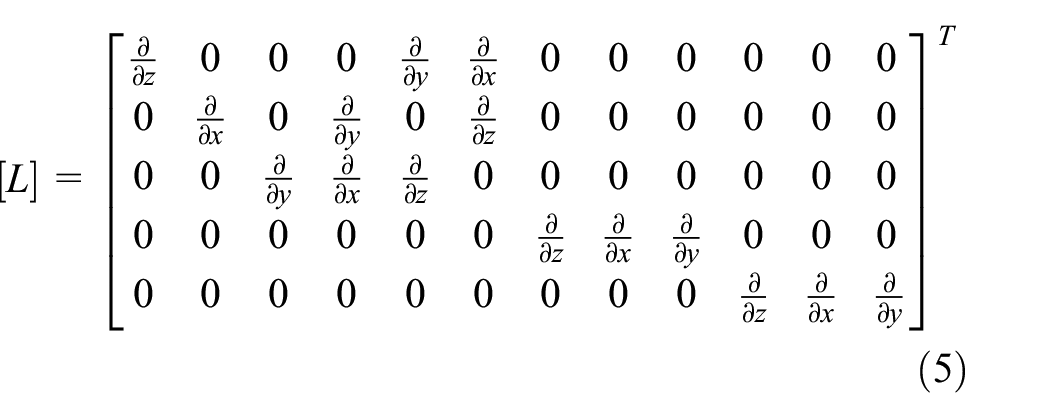
The geometric equations in equation (4) can be rewritten as
With regard to the in-plane functionally graded magneto-electro-elastic plates, the multi-physical coupled constitutive equation is denoted as

where the constitutive matrix is formulated as
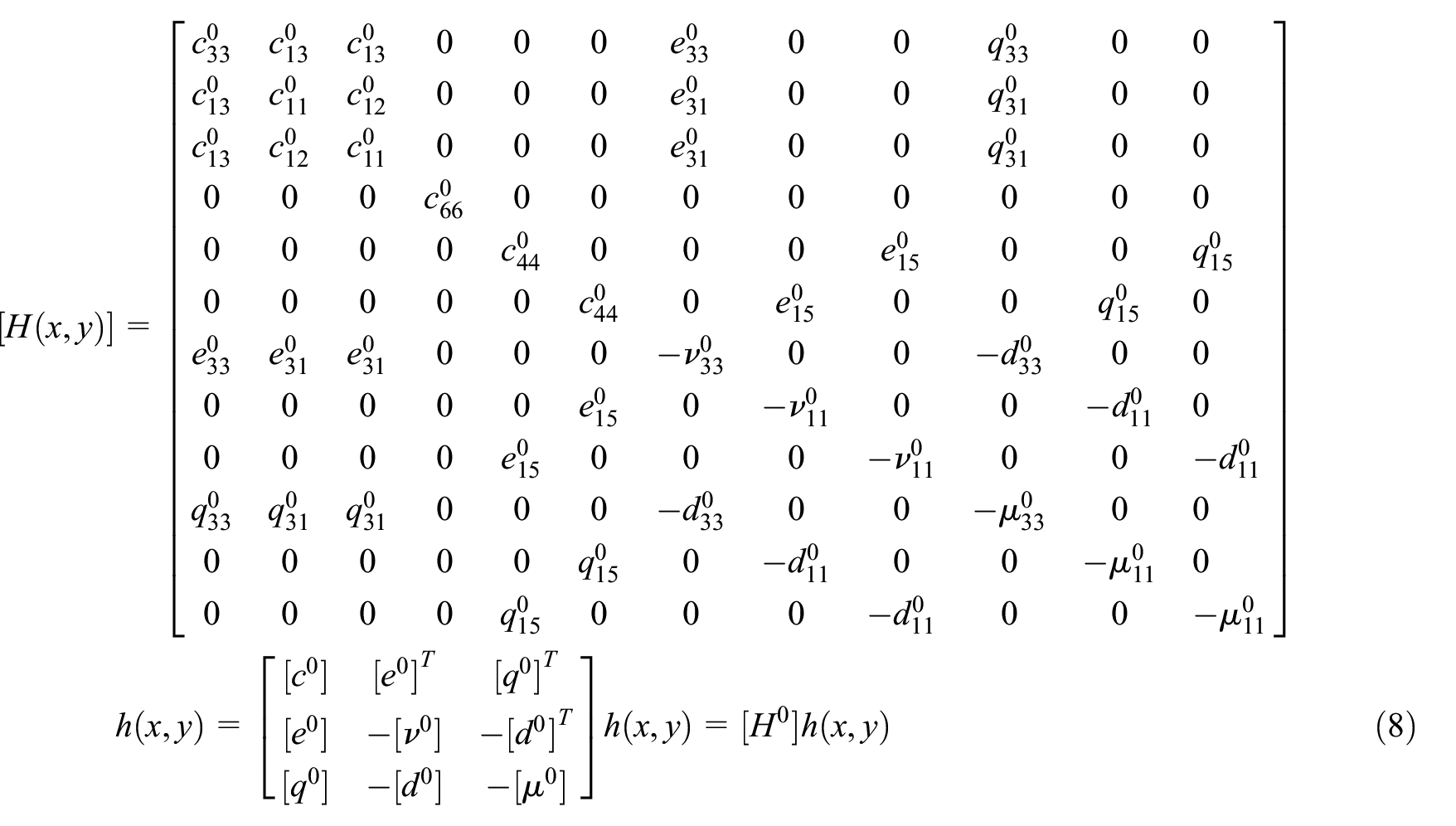
The basic equations of equilibrium without enforcing ad hoc assumptions on the plate kinematics are formulated as





With the help of the differential operator [L], the equilibrium equations are simplified as

To achieve the transformation from the key partial differential equilibrium equations in equation (14) into the ordinary differential ones, a set of the local scaled boundary coordinates η and ζ is introduced, as revealed in Figure 3. The lines perpendicular to the top-plane are selected as the study object. By virtue of moving the discretized plane along the thickness direction, the whole plate can be obtained, which means that the scaling center is set at the infinity. The in-plane coordinates at the mesh nodes of the spectral elements are indicated as {x} and {y}. The locations of any node on the plane can be acquired with the aid of the shape functions [N] = [N(η,ζ)] = [N1(η,ζ) N2(η,ζ) …].

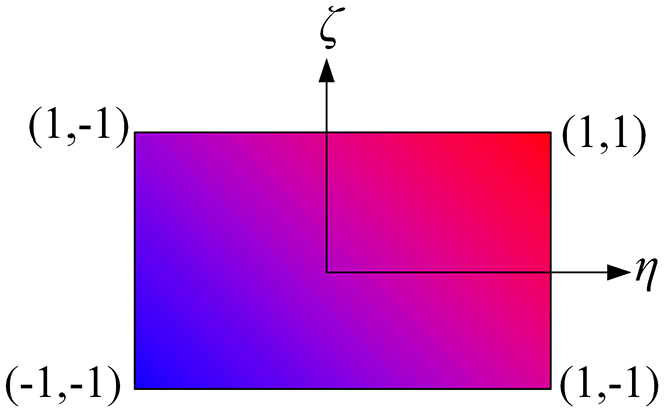
The scaled boundary coordinate system.
It is essential to point out that the two dimensional interpolation function [N(η,ζ)] in equation (15) is the product of one dimensional shape function [N(η)] and [N(ζ)].

In equation (16), the subscripts k and l represent orders of the one dimensional parent element related to the scaled boundary coordinates η and ζ respectively. Lagrange polynomials are utilized to construct the one dimensional Gauss-Lobatto-Legendre shape functions Nk(η) and Nl(ζ).
At the same time, by dint of the scaled boundary coordinates the constitutive matrix can be rewritten as

The relationship of the local scaled boundary coordinate and the global Cartesian coordinate system is expressed as
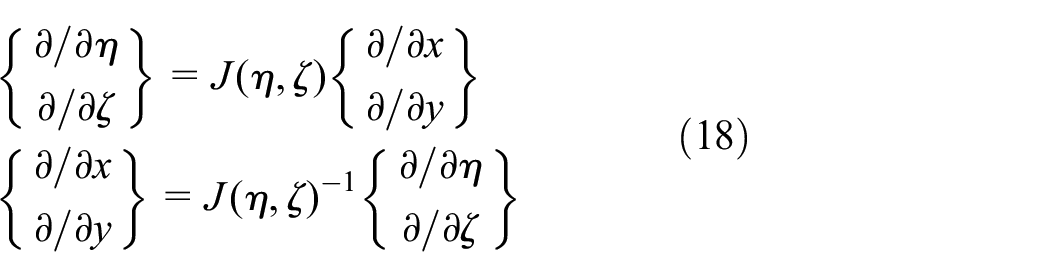
with the Jacobian matrix and its determinant


In accordance with the equation (19), the differential operator [L] can be rewritten as

with the coefficients matrices [b1], [b2], and [b3] formulated in Appendix 2.
Same as the coordinate interpolation, the mechanical, electric, and magnetic variables
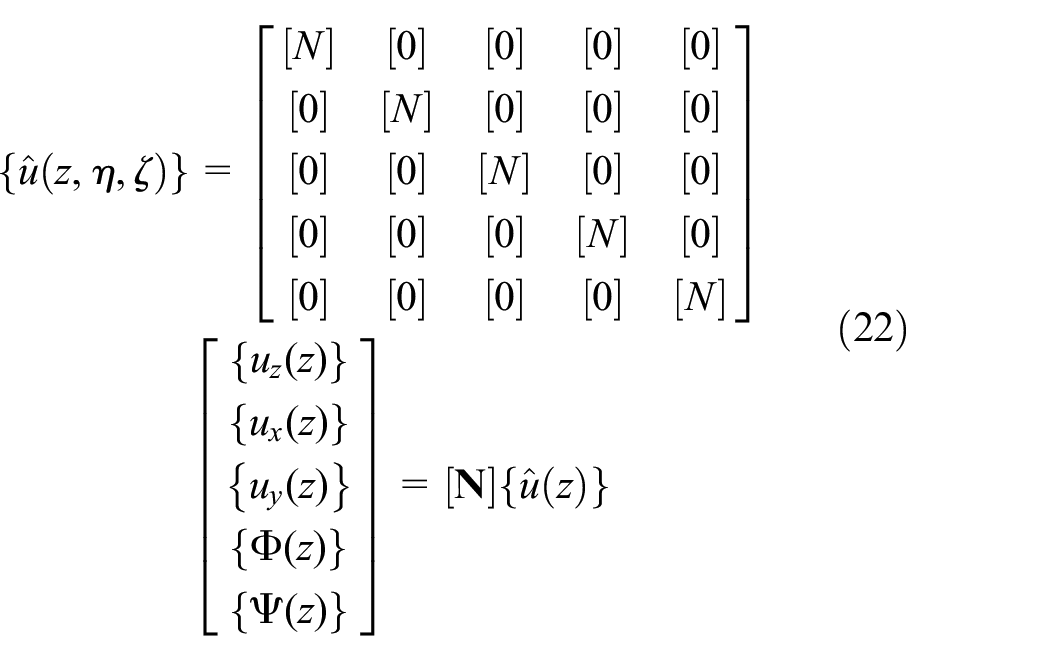
With the help of equations (21) and (22), the vector including strains, electric, and magnetic fields in equation (6) is formulated as

in which [B1]=[b1][
Accordingly, equation (7) can be expressed as

Aided by the virtual work principle, integration by parts and corresponding boundary conditions, the second-order ordinary differential SBFEM governing equation of the in-plane functionally graded magneto-electro-elastic plate is denoted as

with the coefficient matrices [E0], [E1], and [E2]



The aforementioned derivations are depicted only for an element of the SBFEM. With regard to the plate discretized with more elements, it is essential to conduct the process of element assembling for simulating the whole plate structure.
3. The stiffness and mass matrix
In this section, the stiffness and mass matrices for the in-plane functionally graded magneto-electro-elastic plates are constructed. To make sure the high accuracy, the PIA is utilized to create the stiffness matrix from the SBFEM governing equation. What’s more, the general solution of the SBFEM equation can be analytically formulated. For the first time, the mass matrix is given out based on the SBFEM.
To facilitate the analysis, it is necessary to introduce the internal nodal force served as the dual vector of

Built upon equation (29), a vector {X(z)} is developed

With the help of equation (30), the SBFEM governing equation in equation (25) is simplified into a first-order ordinary differential matrix equation.

with the coefficient matrix [Z]

The general solution to the first-order ordinary differential equation is expressed as

with the matrix exponent e-[Z]z and the integration constant vector {c}.
From equation (33), it is apparent that the mechanical, electric, and magnetic quantities across the thickness direction can be analytically formulated.
Substituting the relevant z-coordinates of the bottom and top planes, the following formulae are acquired

with the bottom and top planes abbreviated by B and T.
With the aid of the relation between the external and internal nodal forces, the expression in equation (34) is rewritten as
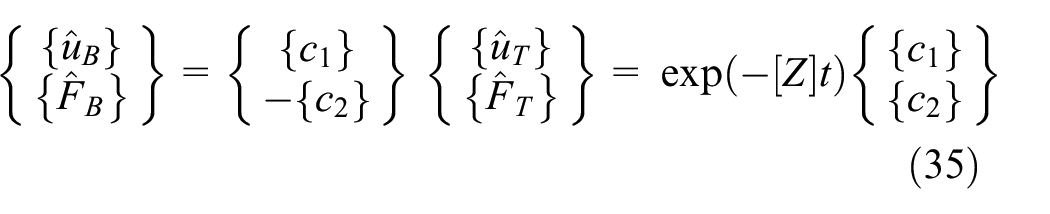
with the external force vectors
To improve the computational accuracy of the matrix exponent, the technique of PIA is adopted. The PIA needs to divide the thickness of the plate t into 2 N layers with equal thickness ξ.
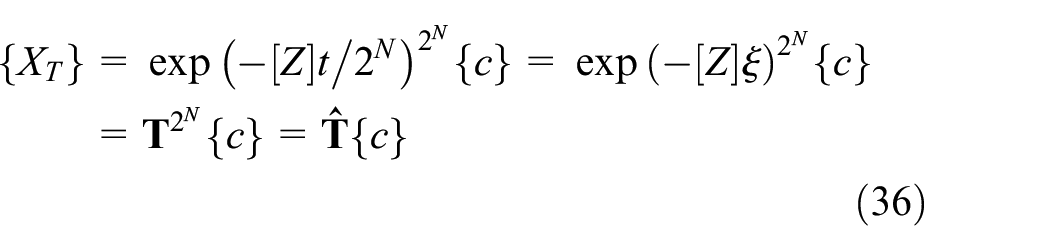
in which coefficient matrices
As usual, the matrix exponent
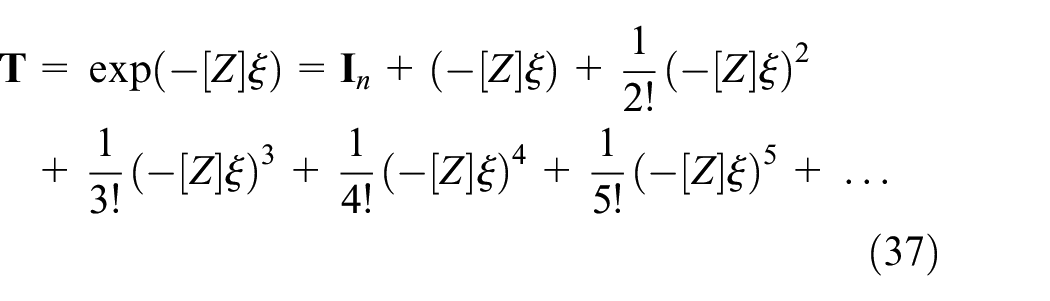
with the unit matrix
It is clear that ξ, which is equal to ξ = t/2 N , is an extremely small thickness. Therefore, the truncated Taylor’s expansion to the fourth order is carried out to promote the evaluation of the matrix exponent, which can insure to obtain enough accuracy.
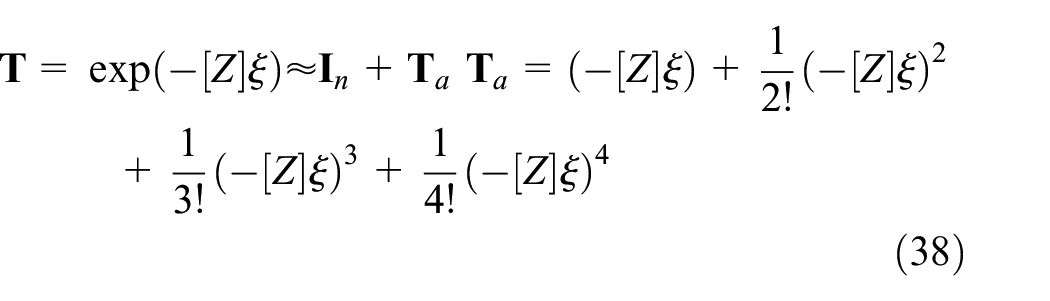
By dint of equations (36) and (38),


The foregoing computations are on the basis of the standard matrix algebraic operations, which is favorable to conduct the numerical calculation.
After solving the matrix exponent, equations (35) and (36) are converted into the following form
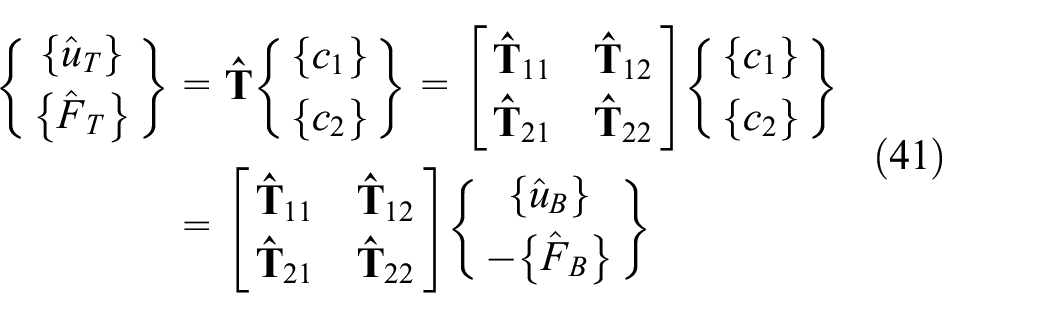
Transforming the unknown variable

with the stiffness matrix [K]

To examine the flexural free vibration behaviors of the in-plane functionally graded magneto-electro-elastic plates, the mass matrix is provided based on the SBFEM for the first time in the present paper. It is noteworthy to indicate that the mass density ρ(x,y) of the plate is also graded along x and y directions. By dint of the scaled boundary coordinates, the density can be reformulated as

with the constant ρ0 at the location x = y = 0.
Firstly,
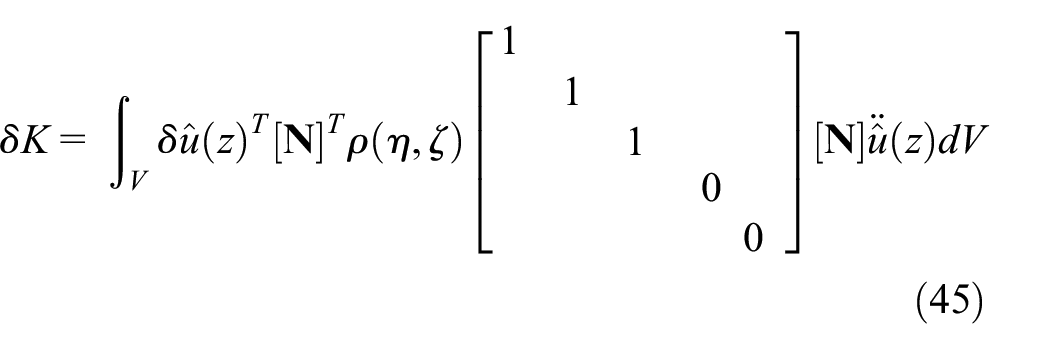
Relying on the Fourier transform into the frequency domain and the infinitesimal volume
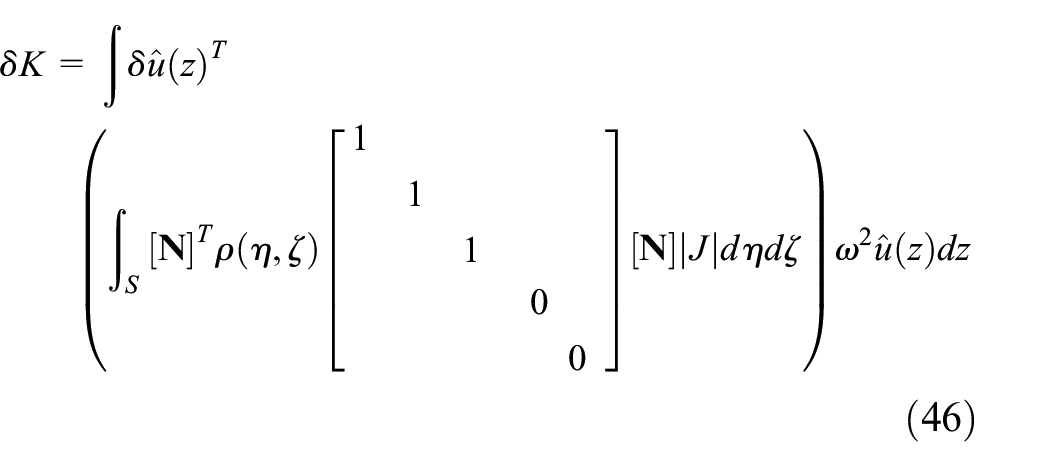
From equation (46), the mass matrix for the magneto-electro-elastic plate is constructed as

with MB and MT corresponding to the mass matrices of the bottom and top planes
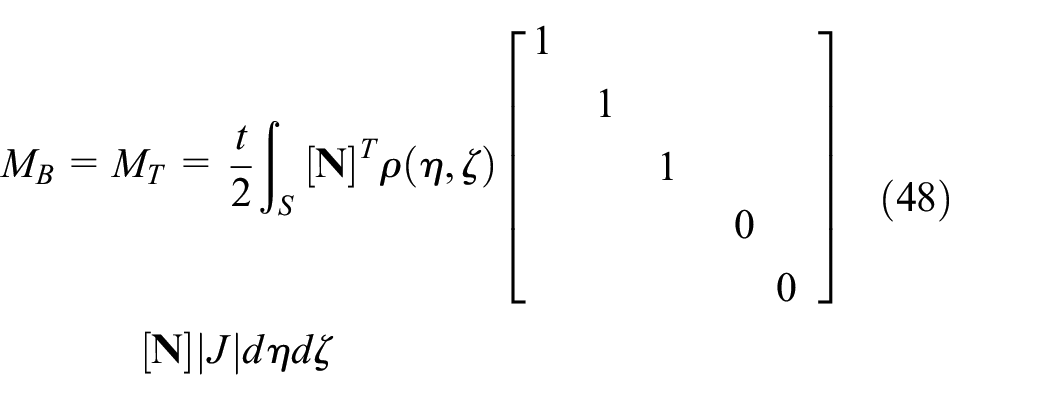
As observed in equations (43) and (47), the stiffness matrix [K] and mass matrix [M] are provided. Hence, variations of the fundamental flexural frequency parameters for the in-plane functionally graded magneto-electro-elastic plates are investigated by the following eigenvalue equation.

In the above formulation, ω is the eigensolutions and ω2 is the unknown variable. To obtain the natural frequencies, the determinant
4. Numerical examples
From the literature review, it is apparent that there is no reports on the free vibration analysis of in-plane functionally graded magneto-electro-elastic plates. On the basis of several numerical examples, this section will exhibit that the present technique is developed as an available tool to assess the dynamic structural responses of magneto-electro-elastic plates, in-plane functionally graded plates and in-plane functionally graded magneto-electro-elastic plates with arbitrary gradation functions. The first three examples are provided to demonstrate the accuracy and applicability of the proposed approach for investigating the distributions of natural frequencies in magneto-electro-elastic and in-plane functionally graded plates. The next three numerical exercises will discuss the effect of thickness-to-length ratios, gradient functions, boundary conditions and constituted materials on the flexural vibration behaviors of in-plane functionally graded magneto-electro-elastic rectangular, circular and perforated plates. All the magneto-electro-elastic material constants listed in Table 1 are from the references Wu and Lu (2009) and Alaimo et al. (2013). But it is essential to state that the superscripts a and b symbolize the different values of
Magneto-electro-elastic material parameters.
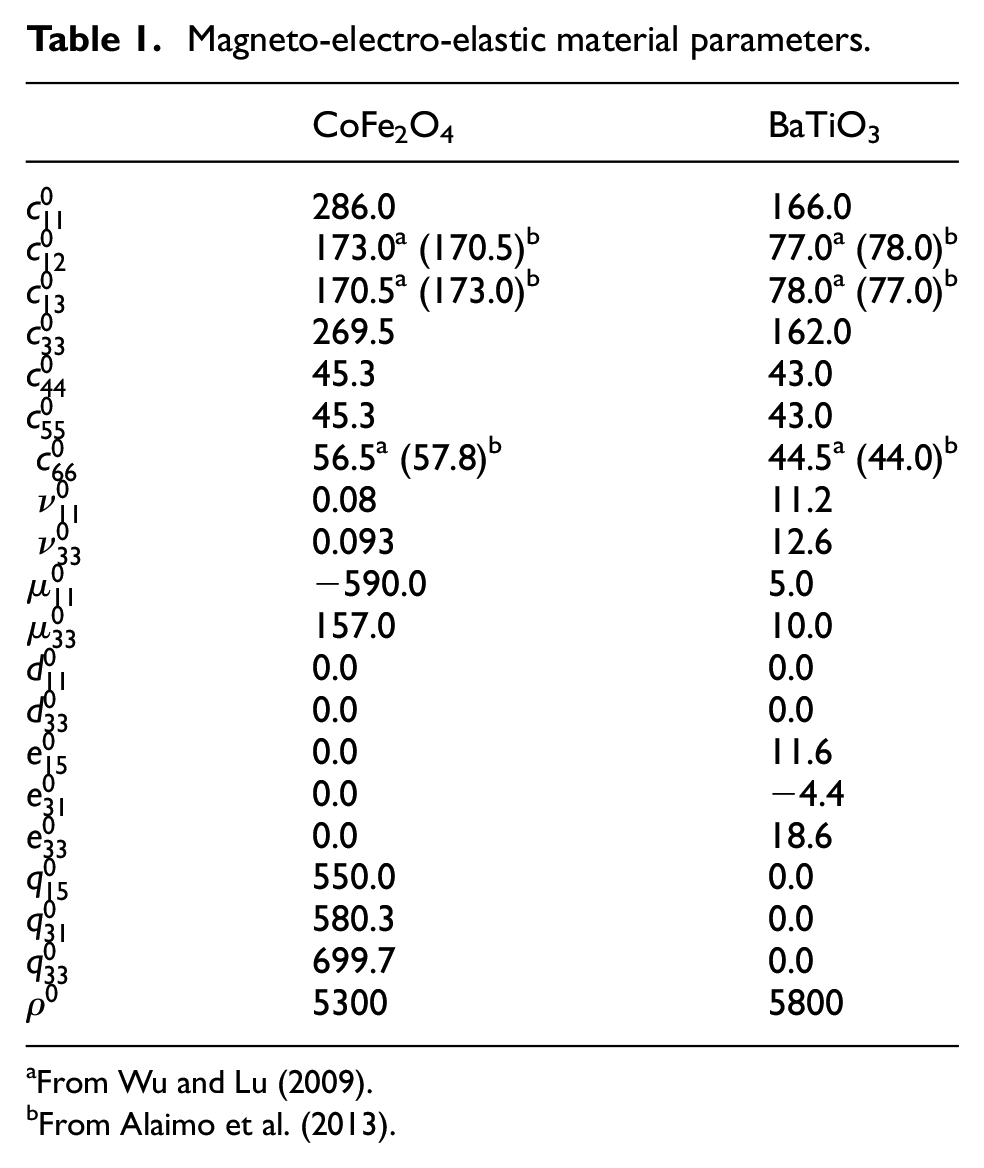
From Wu and Lu (2009).
From Alaimo et al. (2013).
In Table 1, it is necessary to indicate that the unit of the elastic stiffness coefficients
4.1. Verification
4.1.1. Magneto-electro-elastic plates
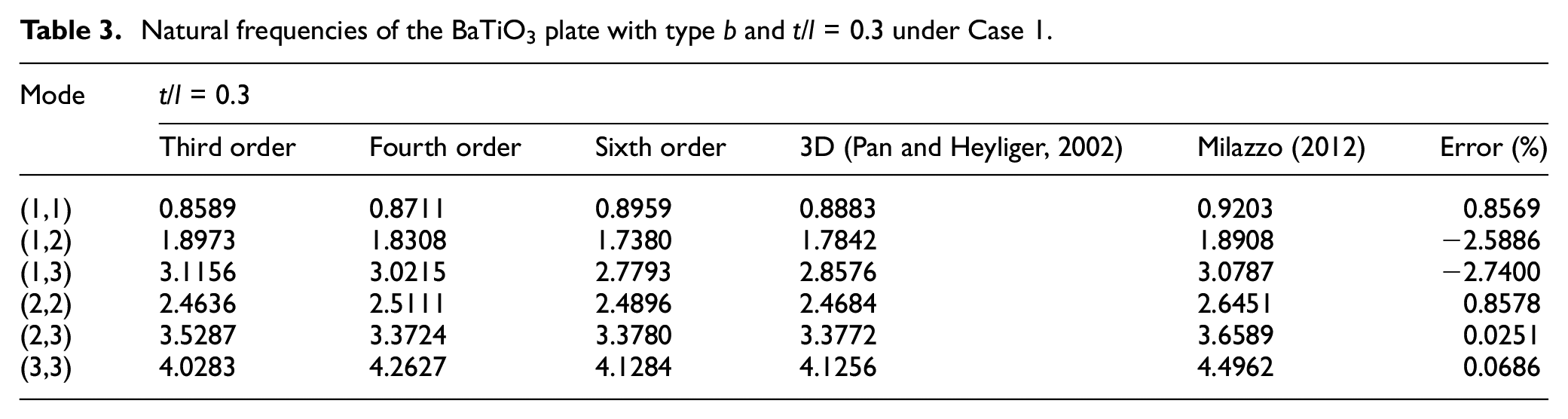
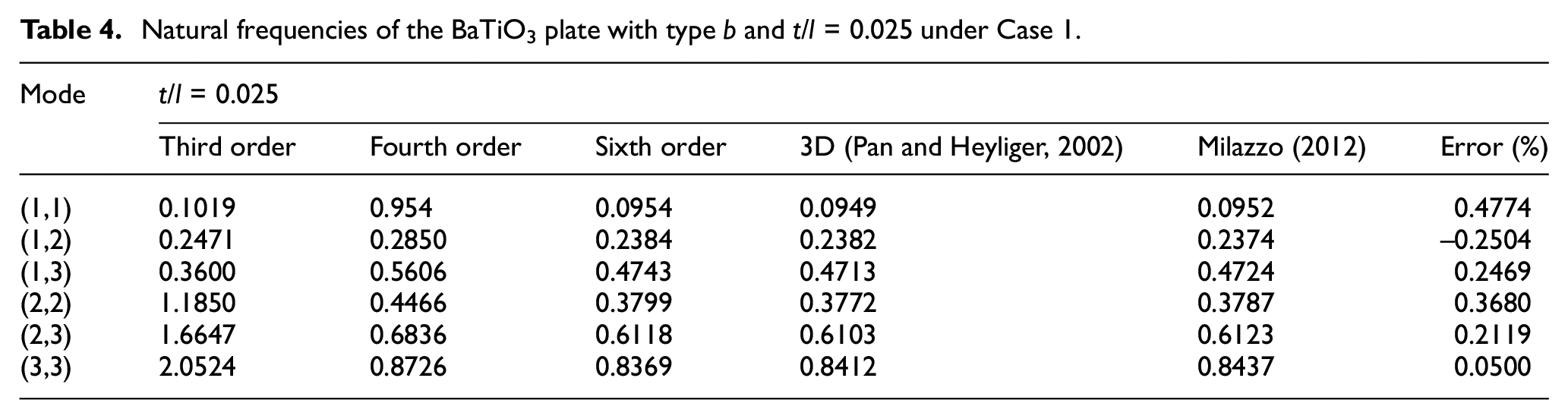
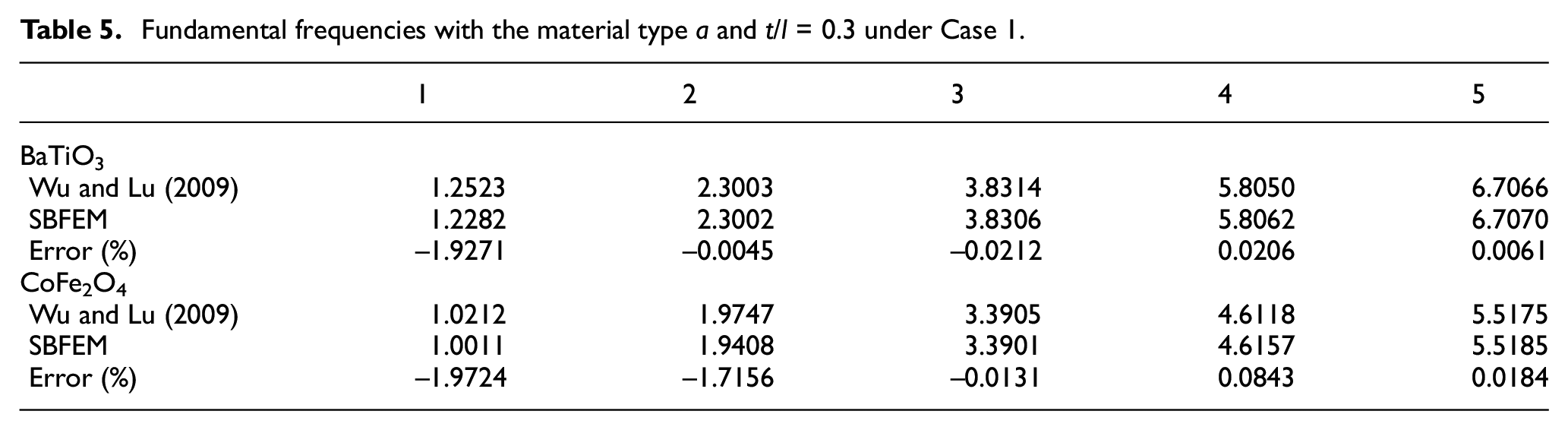
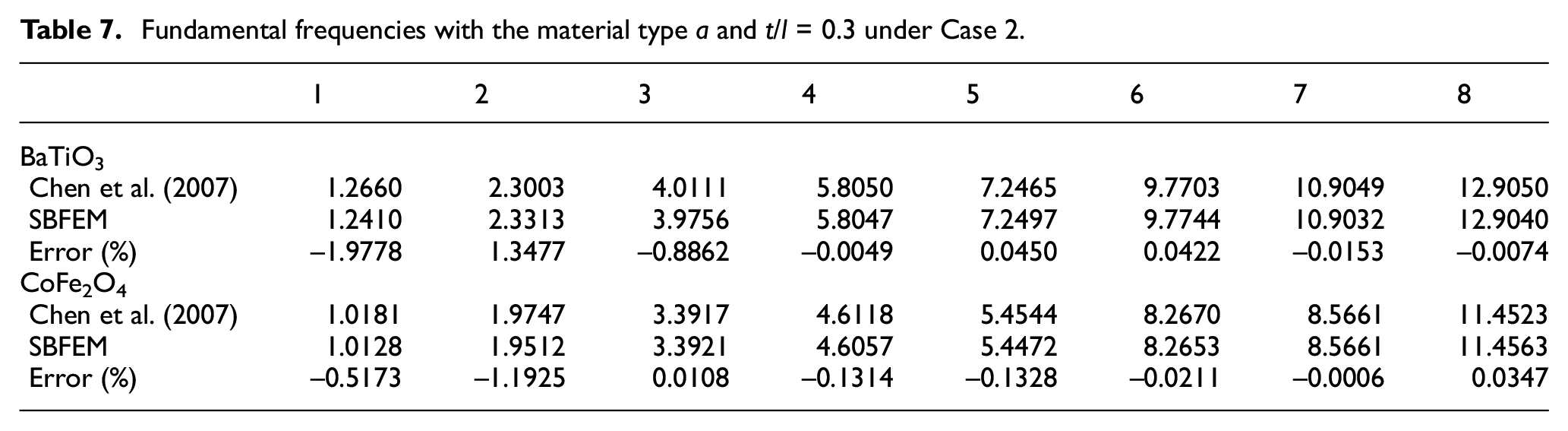
The first numerical example will pay attention to displaying the effectiveness of the introduced methodology in calculating the natural frequencies of magneto-electro-elastic square plates constituted by materials CoFe2O4 and BaTiO3 under different boundary conditions and thickness-to-length ratios. Figure 4 illustrates that a surface of the plate is discretized by only one spectral element with third, fourth, and sixth orders. The length of the plate is set as l = w = 1 m. The simply supported and grounded boundary conditions are prescribed on the four lateral edges of the plate, that is, uz = ux = Φ = Ψ = 0 at y = 0 and y = w, uz = uy = Φ = Ψ = 0 at x = 0 and x = l. Three different thickness-to-length ratios t/l = 0.5, 0.3, and 0.025 corresponding to the thick, middle thick, and thin plates are under consideration. As to the top and bottom planes, there are three types of surface constraints: Case 1, σzz = τxz = τyz = Φ = Ψ = 0 at z = 0 and t; Case 2, σzz = τxz = τyz = Dz = Bz = 0 at z = 0 and t; Case 3, σzz = τxz = τyz = Φ = Ψ = 0 at z = t; and σzz = τxz = τyz = Dz = Bz = 0 at z = 0. In this section, the calculated results are normalized as
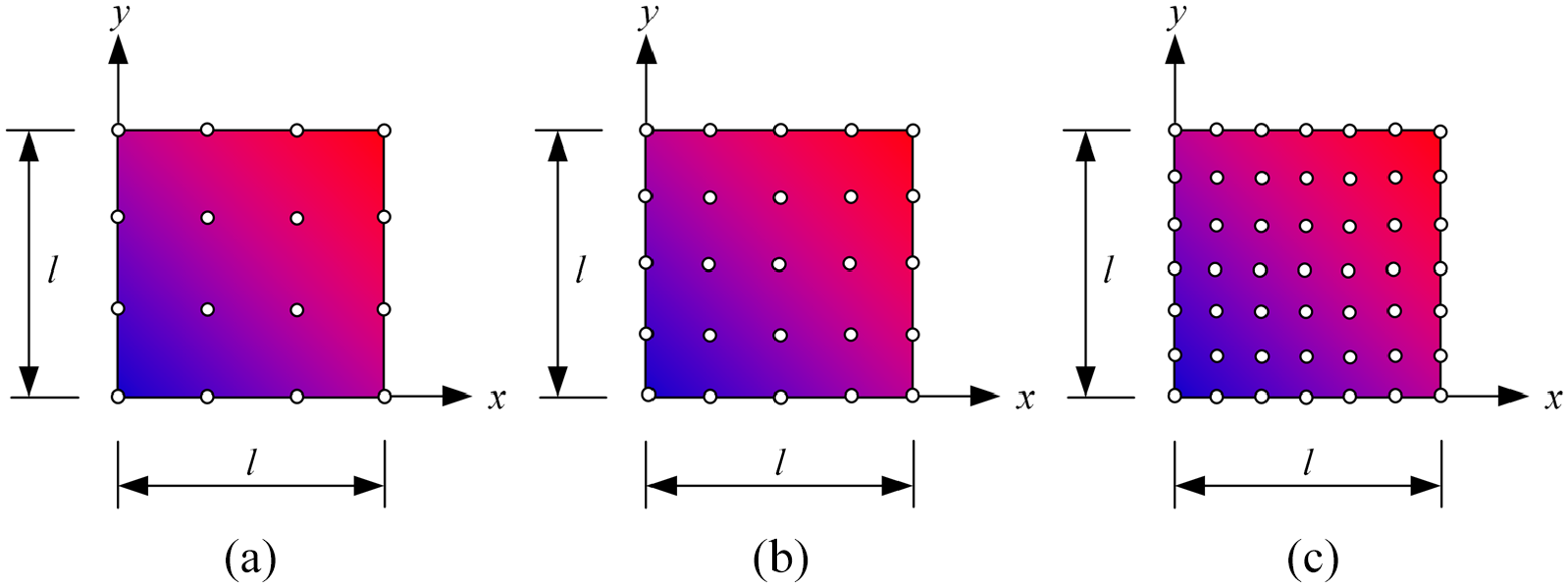
The square plate is meshed by only one spectral element with different orders: (a) third order, (b) fourth order, and (c) sixth order.
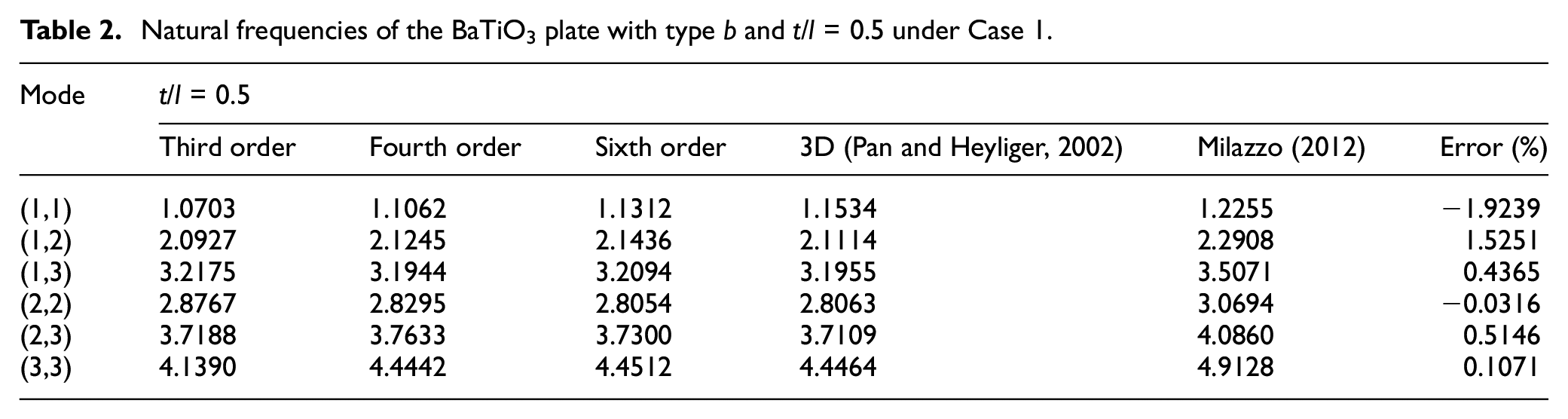
Natural frequencies of the BaTiO3 plate with type b and t/l = 0.5 under Case 1.
Natural frequencies of the BaTiO3 plate with type b and t/l = 0.3 under Case 1.
Natural frequencies of the BaTiO3 plate with type b and t/l = 0.025 under Case 1.
Fundamental frequencies with the material type a and t/l = 0.3 under Case 1.
Fundamental frequencies with the material type a and t/l = 0.3 under Case 3.

Fundamental frequencies with the material type a and t/l = 0.3 under Case 2.
Model 1:

4.1.2. In-plane functionally graded plates
In this section, two numerical examples are released to prove the high accuracy of the proposed approach when exploring the transverse vibration behaviors of in-plane functionally graded plates. The square and circular plates are taken as examples.
4.1.2.1. Square plates
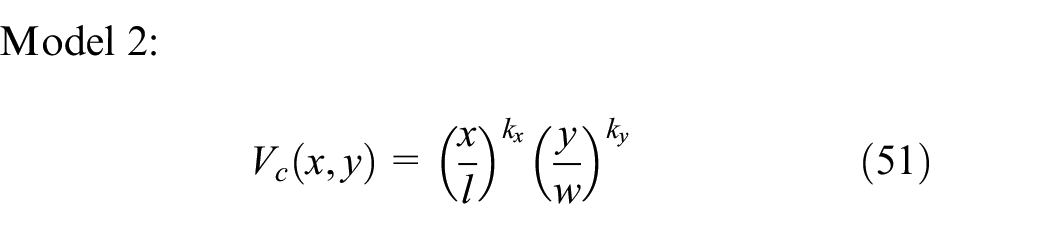
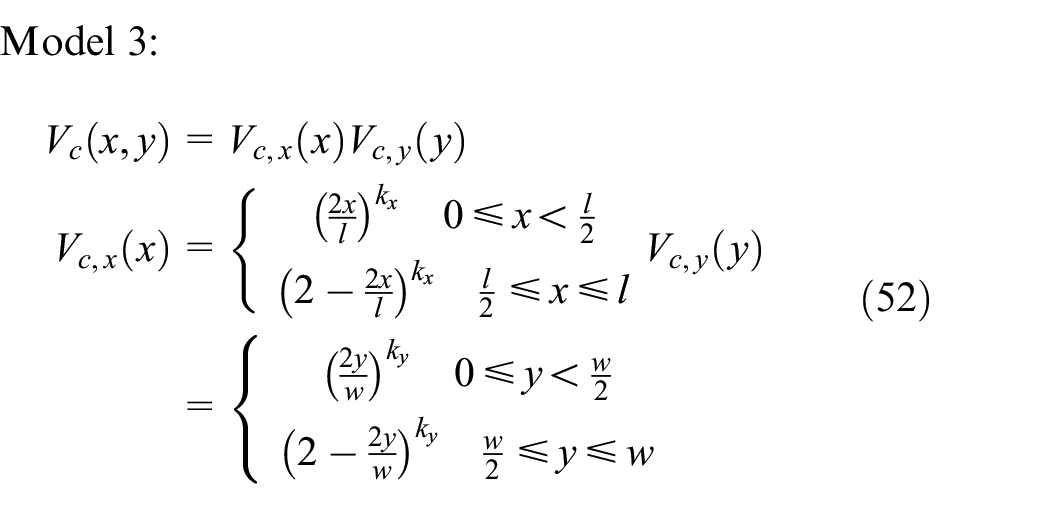
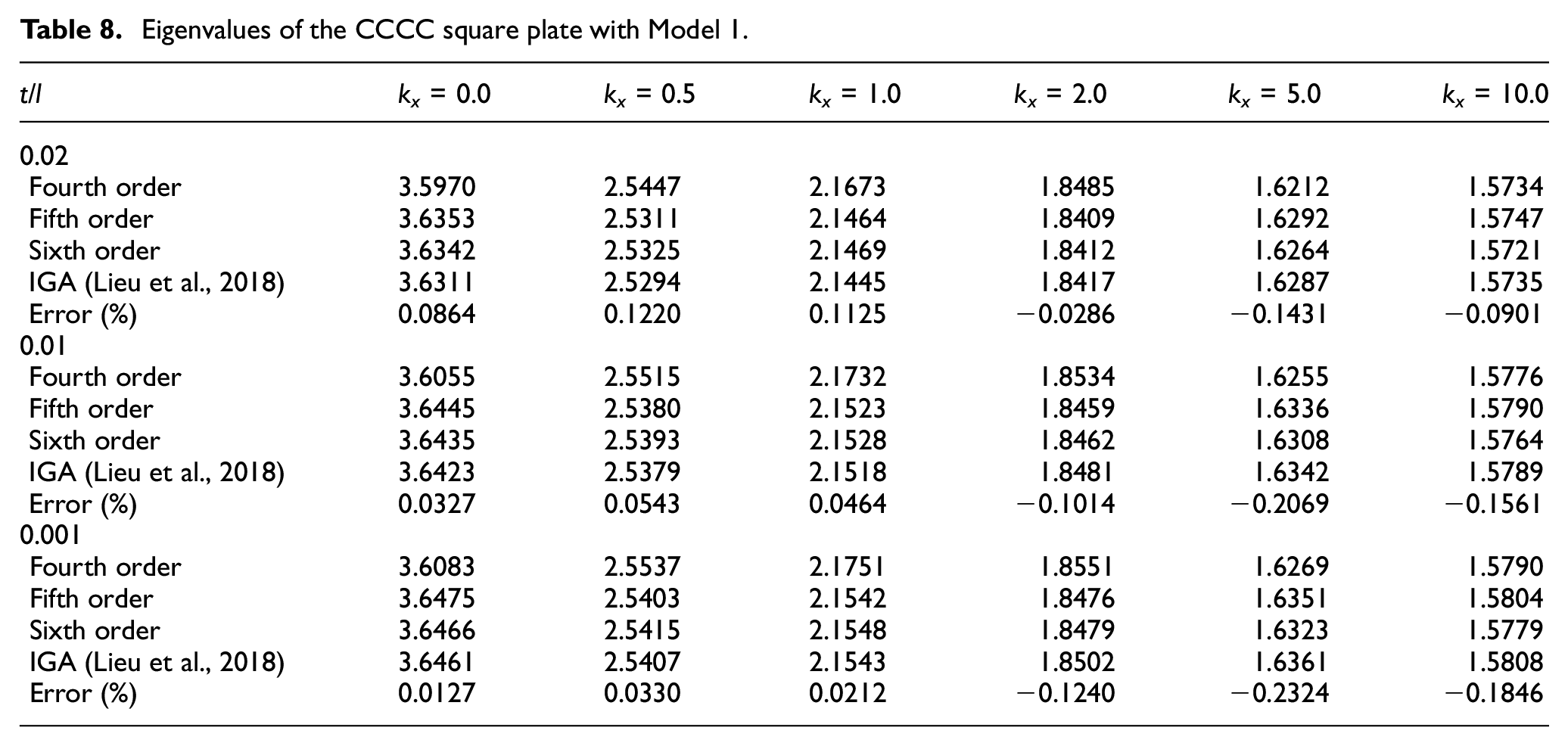
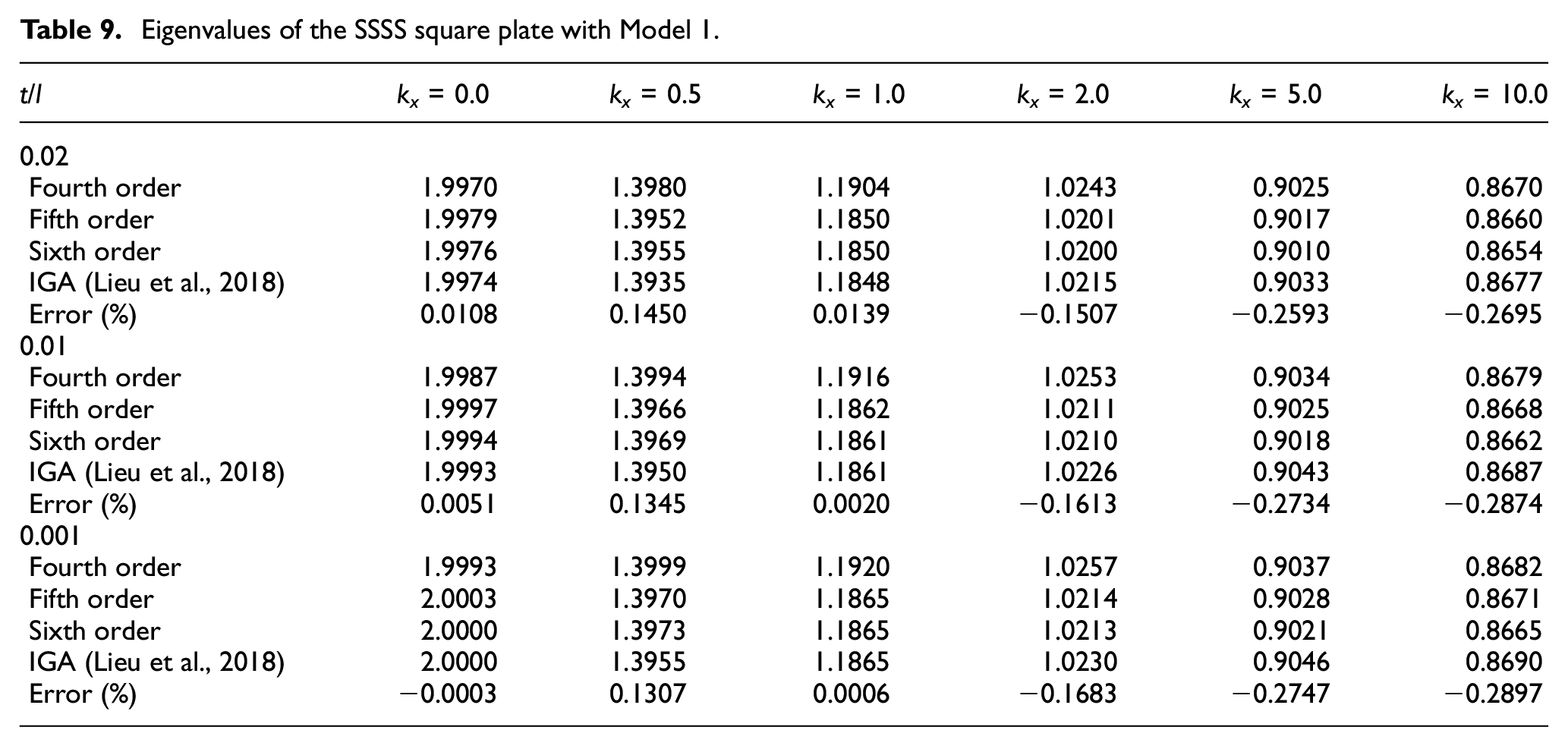
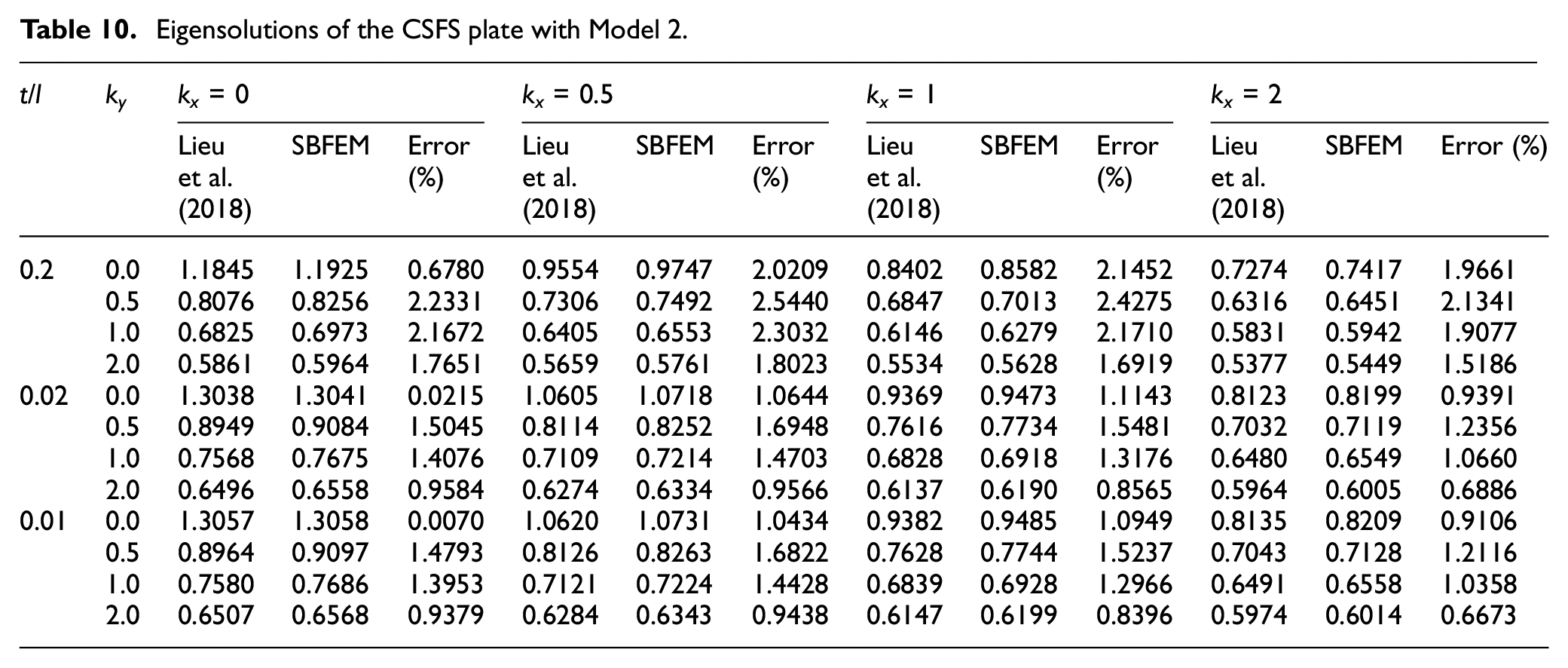
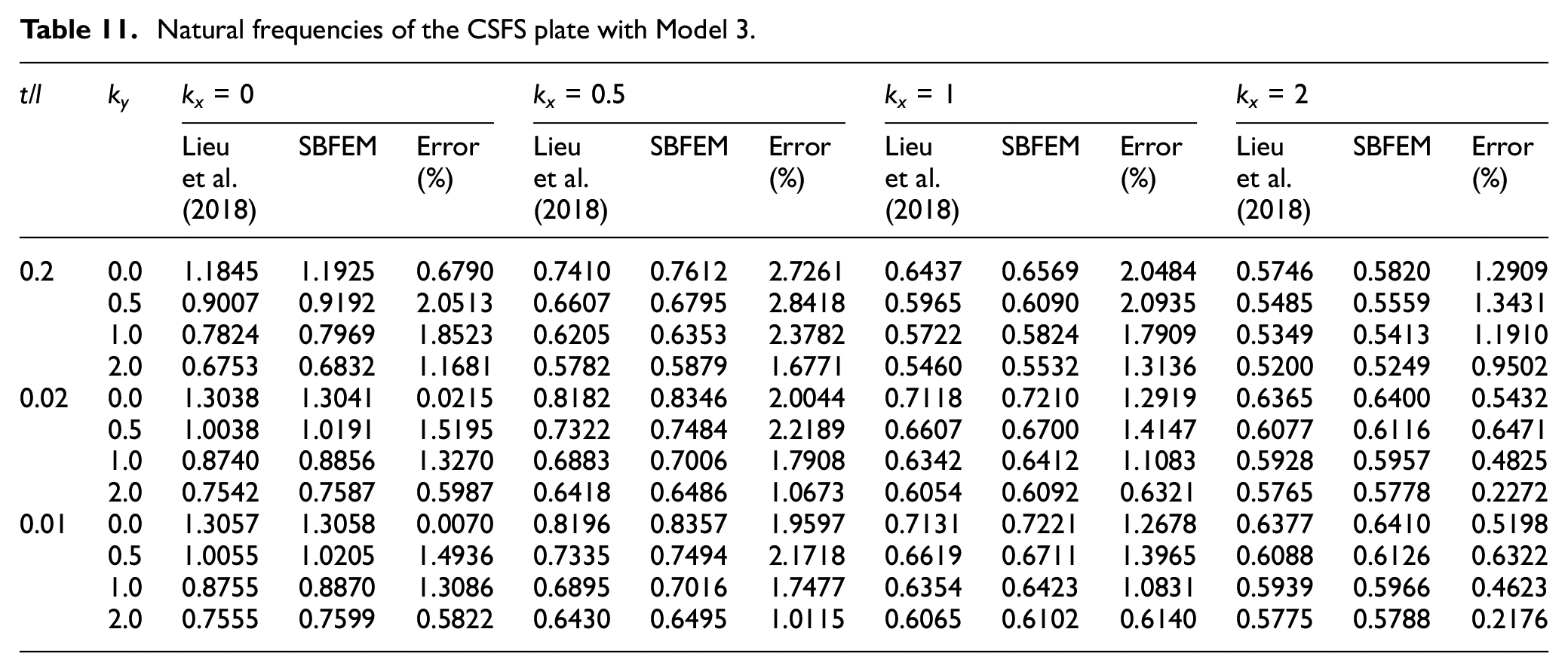
As a common structural component, square plates are extensively used in engineering applications. The length of the plate is selected as l = w = 1 m and four kinds of thickness-to-length ratios t/l = 0.2, 0.02, 0.01, and 0.001 are discussed. The functionally graded plate is composed of ceramic and metallic phase materials. The relevant Young’s modulus, Poisson’s ratio and mass density of ceramic and metallic compositions are set as Ec = 348.43 GPa, υc = 0.24, ρc = 2370 kg/m3, and Em = 201.04 GPa, υm = 0.3262, ρm = 8166 kg/m3 from Lieu et al. (2018), in which the subscripts of c and m stand for the ceramic and metallic materials respectively. The material constants for the functionally graded plates are computed by E=EcVc+EmVm, υ=υcVc+υmVm, ρ=ρcVc + ρmVm, and Vc + Vm = 1, in which Vc and Vm represent the volume fractions of ceramic and metallic materials in Lieu et al. (2018). In this example, the parameter Vc obeys the following three models, as exhibited in equations (50) to (52). Three different boundary constraints CSFS, SSSS, and CCCC are applied, in which C, S, and F symbolize the clamped, simply-supported, and free boundary conditions respectively. The vibration parameters normalized as
Eigenvalues of the CCCC square plate with Model 1.
Eigenvalues of the SSSS square plate with Model 1.
Eigensolutions of the CSFS plate with Model 2.
Natural frequencies of the CSFS plate with Model 3.
4.1.2.2. Circular plates
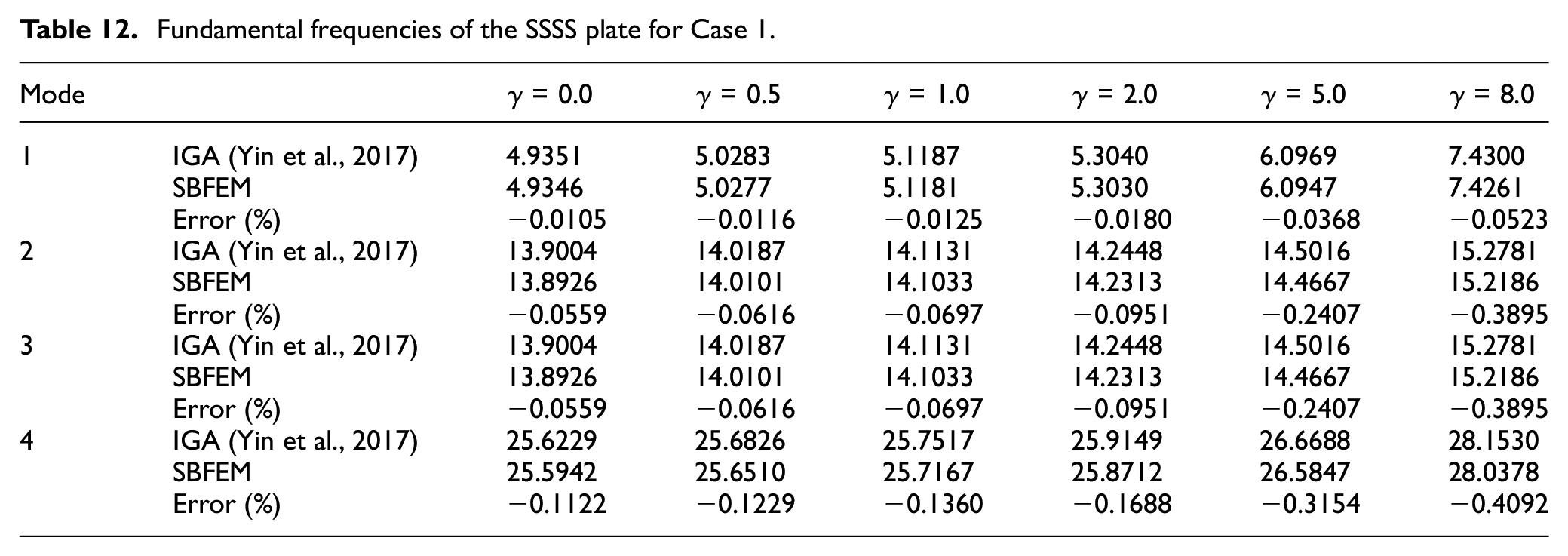
Circular plates are widely applied in various engineering practices. In this subsection, the geometric parameters of the circular plate are the radius R = 1.0 m and the thickness t = 0.01 m, as shown in Figure 5. The simply supported and clamped boundary conditions are imposed on the side edges of the plate. The material coefficients are graded along the radial direction following the two cases: Case 1, E = E0erγ, ρ = ρ0erγ with E0 = 206 GPa, ρ0 = 8000 kg/m3, and the Poisson’s ratio υ = 0.3 which is assumed to keep a constant; Case 2, E = EcVc + EmVm, υ = υcVc + υmVm, ρ = ρcVc + ρmVm, Vc + Vm = 1, and Vc = (r/R)
n
, (0 < r < R) in which the elastic parameters are the same as those in Section 4.1.2.1. The dimensionless flexural frequencies are expressed as
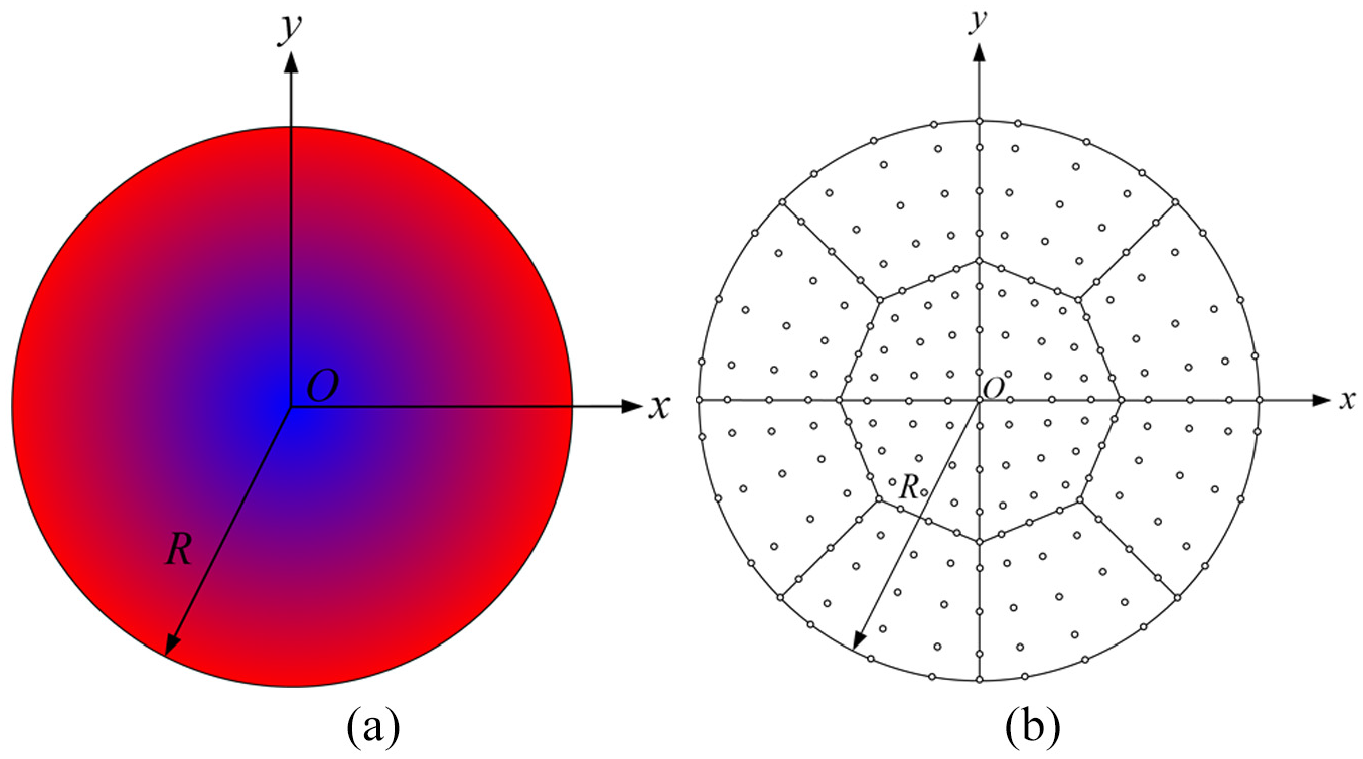
The in-plane functionally graded circular plate: (a) the plate model and (b) meshed with twelve fourth-order spectral elements.
Fundamental frequencies of the SSSS plate for Case 1.
Dimensionless frequency parameters of the SSSS plate for Case 2.
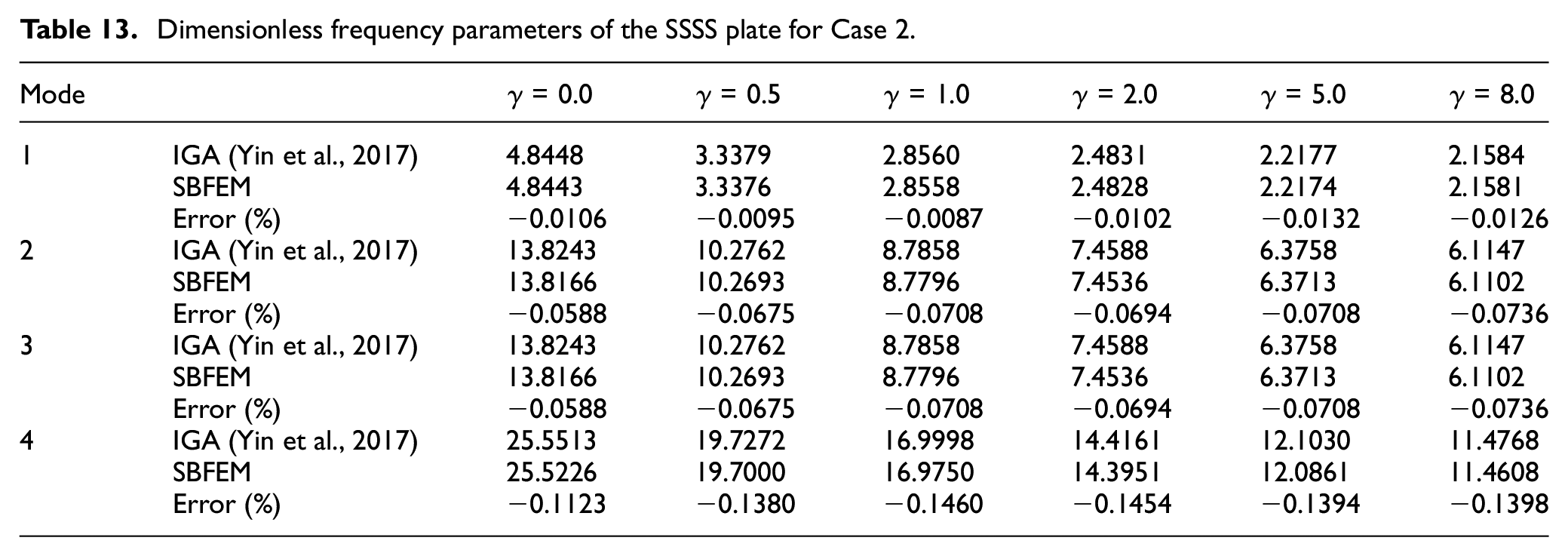
Fundamental frequencies of the CCCC plate for Case 1.
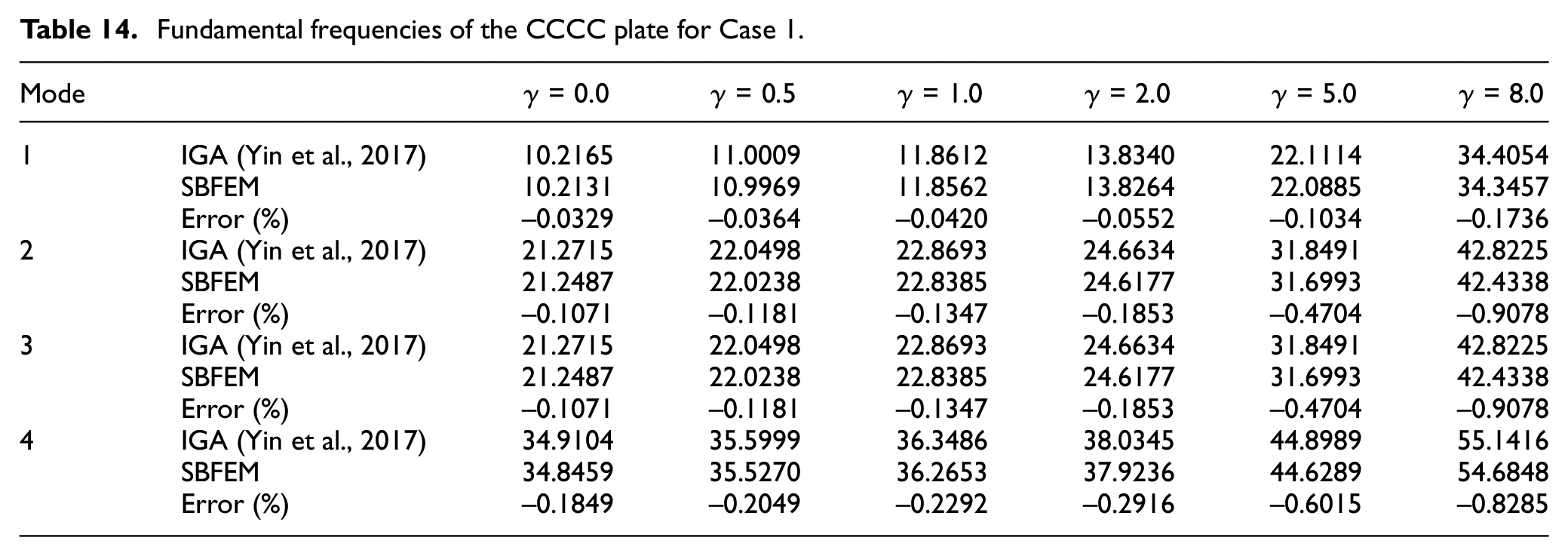
Dimensionless frequency parameters of the CCCC plate for Case 2.
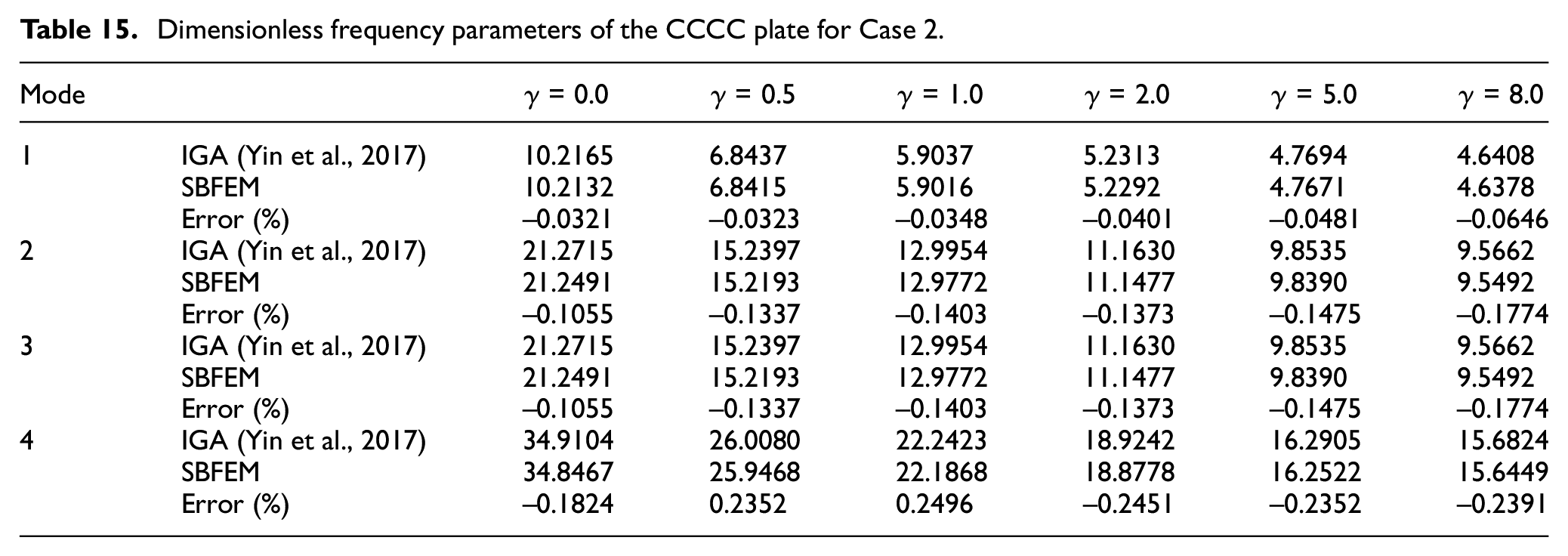
4.2. The magneto-electro-elastic rectangular plate
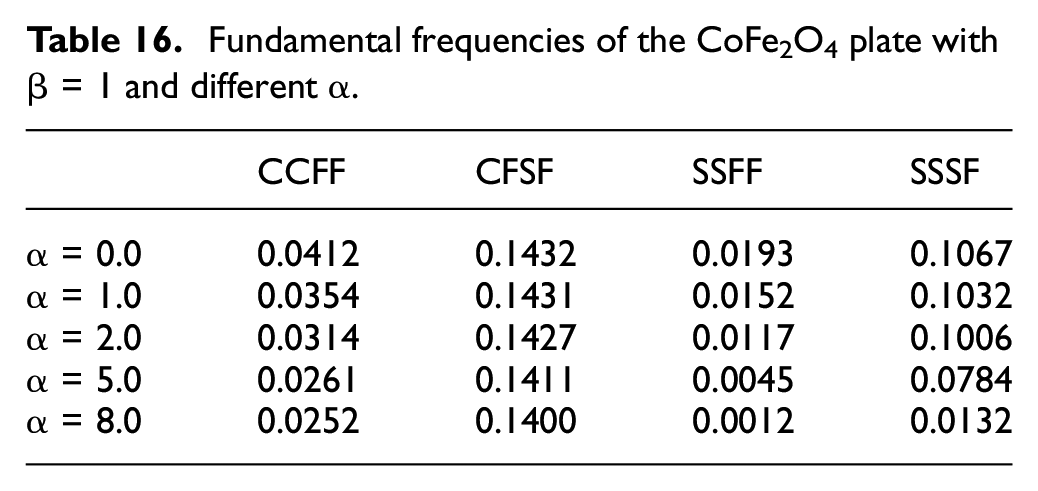
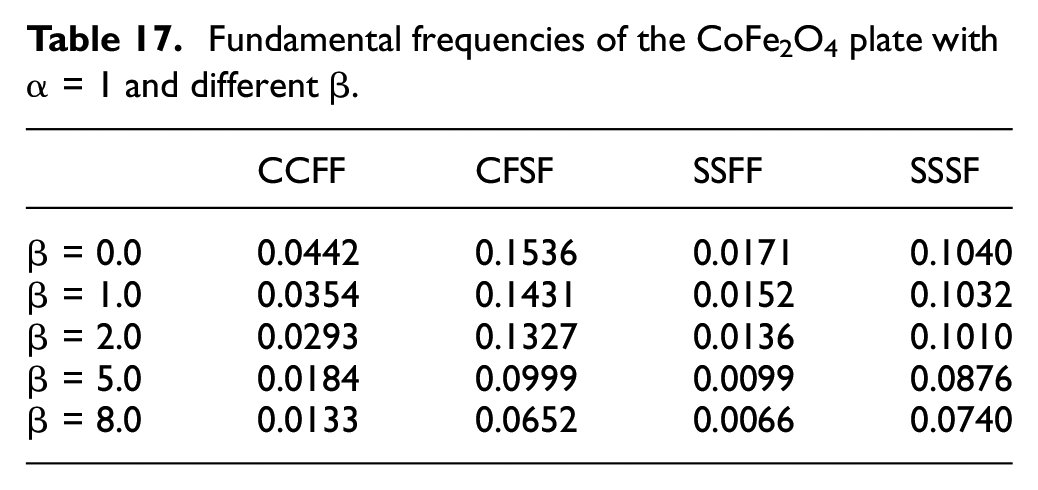
This example pays attention to analyzing the structural vibration responses of functionally graded magneto-electro-elastic rectangular plates with material constants varied along the x and y directions in terms of the exponential law. The gradient function is expressed as h(x,y) = eαx+βy. Figure 6 demonstrates the geometry parameters of the plate l = 1.5 m, w = 1 m, and t = 0.03 m. Moreover, this simulation selects the magneto-electro-elastic materials CoFe2O4 and BaTiO3 of type b. The eigensolutions of the magneto-electro-elastic plates under four different boundary constraints CCFF, CFSF, SSFF, and SSSF are estimated, as depicted in Figure 7. Additionally, the zero electric and magnetic potentials are applied around the sides and on the top and bottom surfaces. Meanwhile, the computed results are normalized as
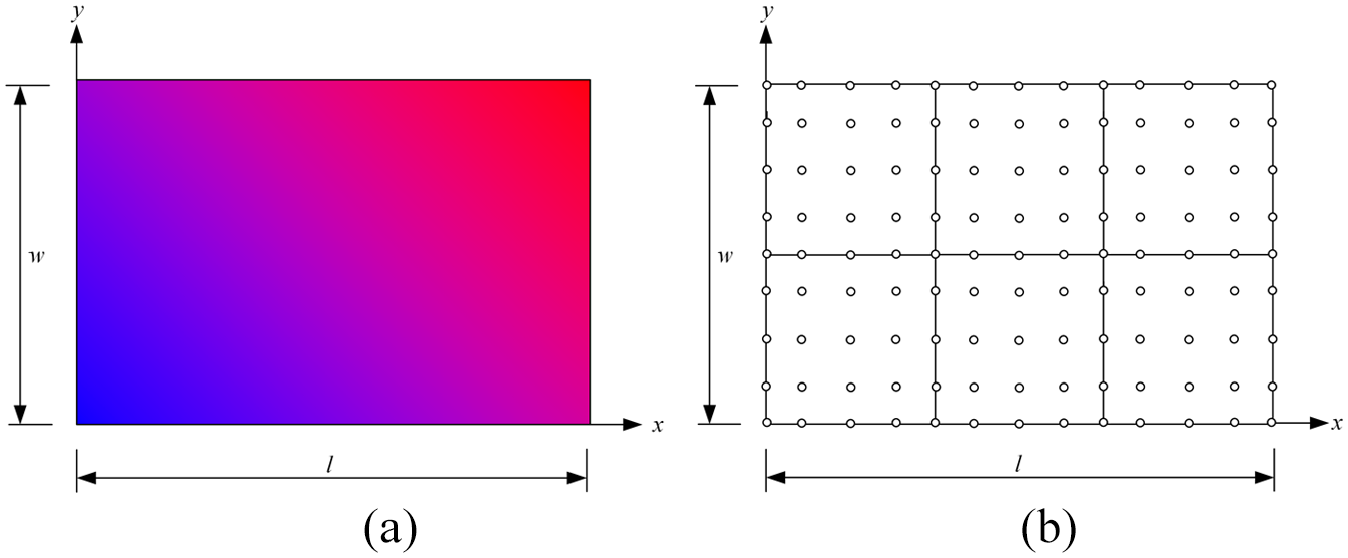
The in-plane functionally graded magneto-electro-elastic plate: (a) the rectangular plate and (b) discretized with six spectral elements.
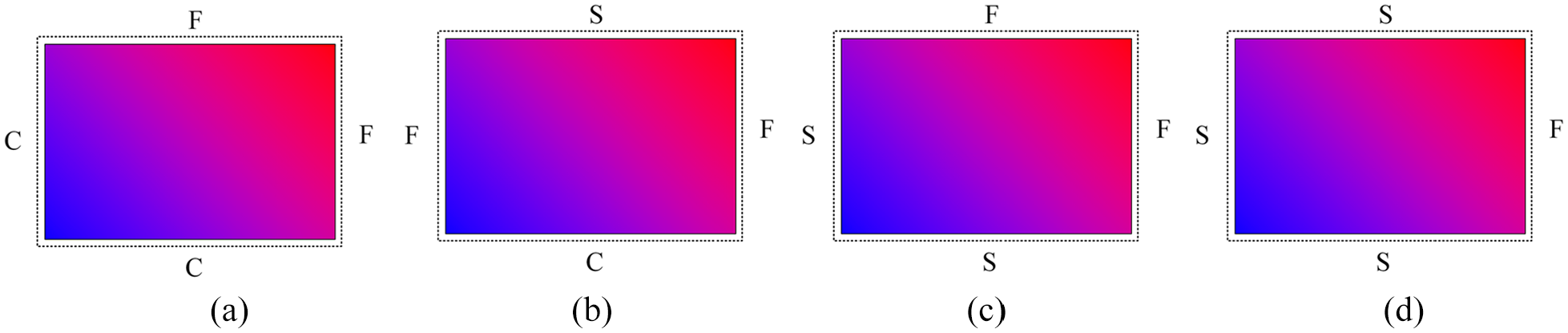
The four kinds of boundary conditions: (a) CCFF, (b) CFSF, (c) SSFF, and (d) SSSF.
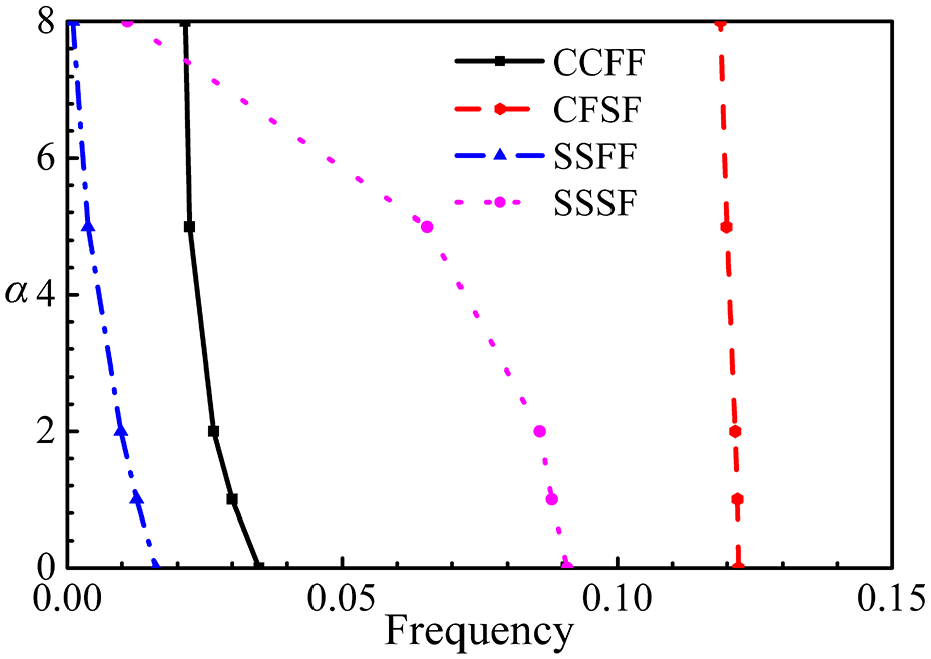
Natural frequencies of the BaTiO3 plate with β = 1 and different α.
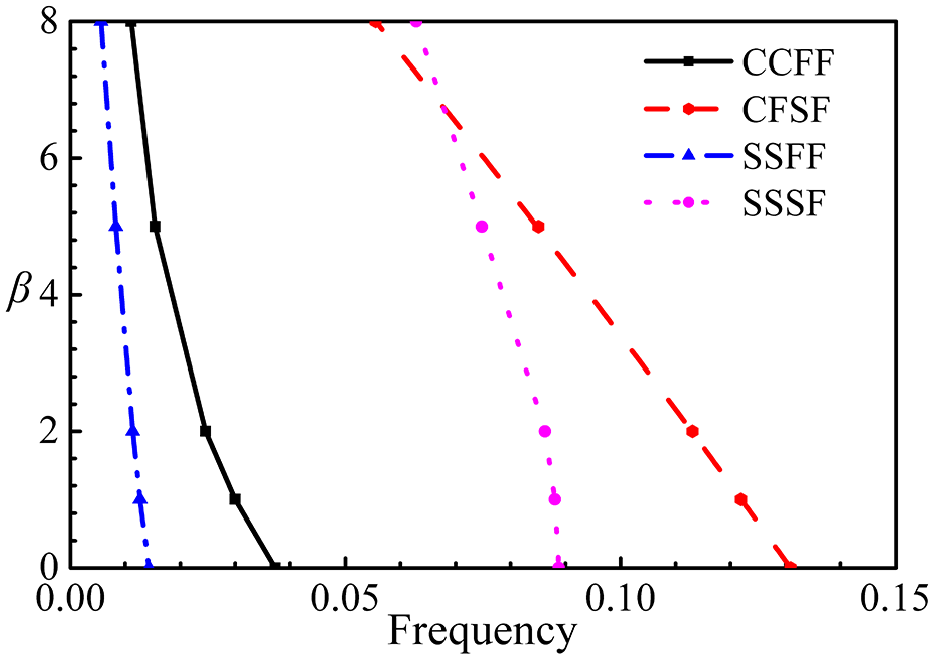
Natural frequencies of the BaTiO3 plate with α = 1 and different β.
Fundamental frequencies of the CoFe2O4 plate with β = 1 and different α.
Fundamental frequencies of the CoFe2O4 plate with α = 1 and different β.
4.3. The magneto-electro-elastic circular plate
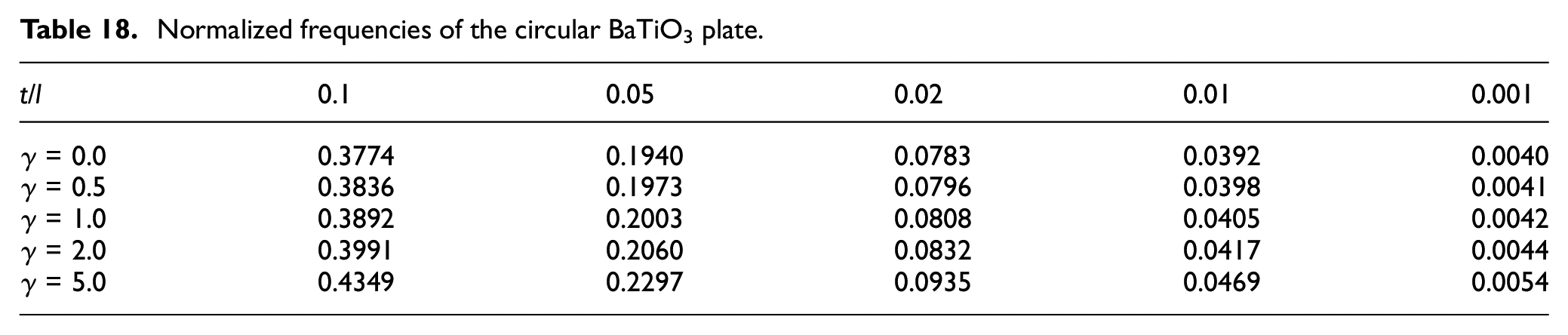
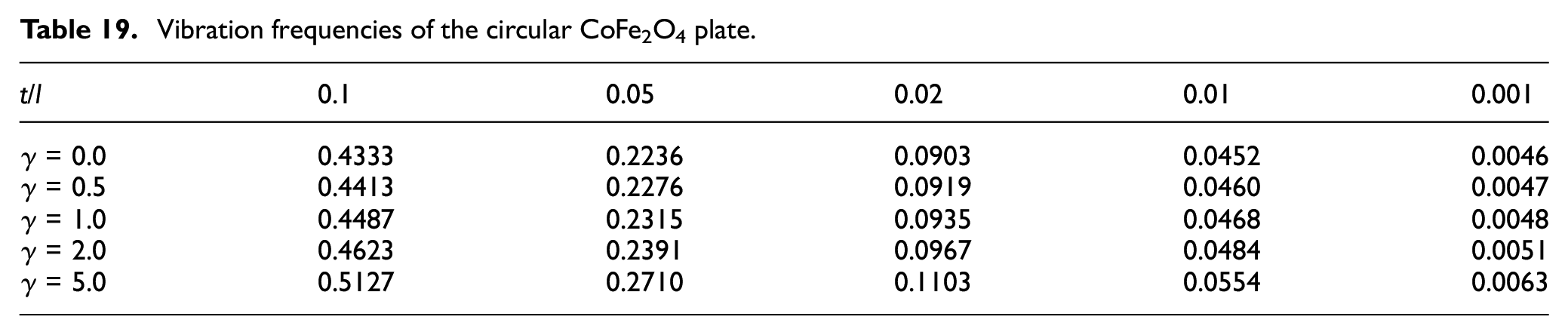
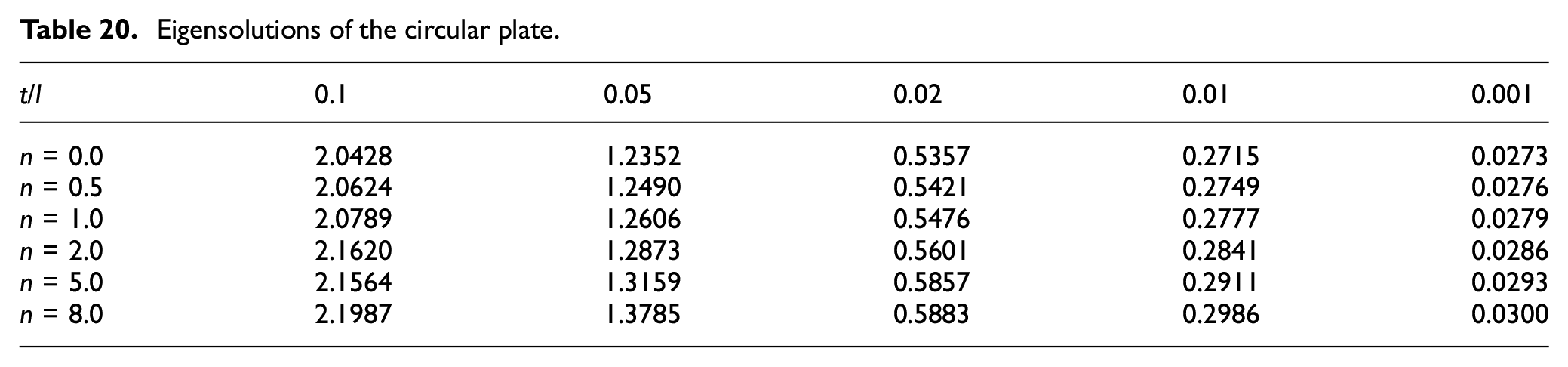
This section explores the free vibration behaviors of the functionally graded magneto-electro-elastic circular plates with material properties inhomogeneity along the radius direction. The semi-diameter of the circular plate is defined as R = 1 m and a characteristic length l = 2R is introduced. The effect of t/l = 0.1, 0.05, 0.02, 0.01, and 0.001 on the variations of natural frequencies is presented. Similar with the example in Section 4.2, the materials CoFe2O4 and BaTiO3 of type b and the same normalized formulation are adopted. The simply-supported boundary condition, that is, uz = Φ = Ψ = 0, is prescribed on the side of the circular plate. Meanwhile, the top and bottom planes are grounded, which means that the electric and magnetic potentials are set to zero. In this example, the eigenvalues of the circular plates with the gradation expression h(r) = eγr are predicted. The dimensionless flexural vibration parameters of the functionally graded magneto-electro-elastic circular plate with the in-plane heterogeneous material are performed in Tables 18 and 19. To demonstrate the free vibration behaviors of the magneto-electro-elastic plate with the power-law gradation function, a circular plate composed by the CoFe2O4 and BaTiO3 of type b is cited as an example. The material parameters are denoted as [H(r)]= [H0]BaTiO3(r/R) n +[H0]CoFe2O4[1− (r/R) n ], in which [H0]BaTiO3 and [H0]CoFe2O4 symbolize the elastic matrix of BaTiO3 and CoFe2O4. The clamped boundary condition uz = ux = uy = Φ = Ψ = 0 is applied. But no boundary constraints are enforced on the top and bottom surfaces. The non-dimensional eigenvalues of the circular plate with the power-law gradient function are listed in Table 20. From the presented results in Tables 18 and 19, the phenomenon that the normalized fundamental frequencies obtained from the CoFe2O4 plate are larger than those of BaTiO3 can be found in this example. What’s more, it can be seen that increasing the gradient index γ results in the increase of frequency parameters, which is due to a decrease in the flexural rigidity of the circular plate with a smaller γ. While keeping the gradation parameter γ fixed, it is revealed that the thicker the plate is, the bigger its corresponding non-dimensional vibration frequencies are. Variations of eigenvalues for thin plates, especially with the ratio t/l = 0.001, are less sensitive to the material gradation index than the thicker ones. It can be found from Table 20 that with increasing the gradient parameter n, the vibration frequencies of the circular plate will increase, which is parallel with the former discover. When the index n gets larger, values of the volume fraction (r/R) n decrease, which means that the proportion of the material CoFe2O4 in the composite plate increases. Meanwhile, the CoFe2O4 plates obtain larger frequencies than those with BaTiO3. Therefore, the bigger the coefficient n is, the larger the eigensolutions are. A conclusion can be drawn that the thickness-to-length ratios and gradation functions have an important role on the free vibration responses of in-plane functionally graded magneto-electro-elastic circular plates.
Normalized frequencies of the circular BaTiO3 plate.
Vibration frequencies of the circular CoFe2O4 plate.
Eigensolutions of the circular plate.
4.4. The magneto-electro-elastic circular plate with a circular cutout
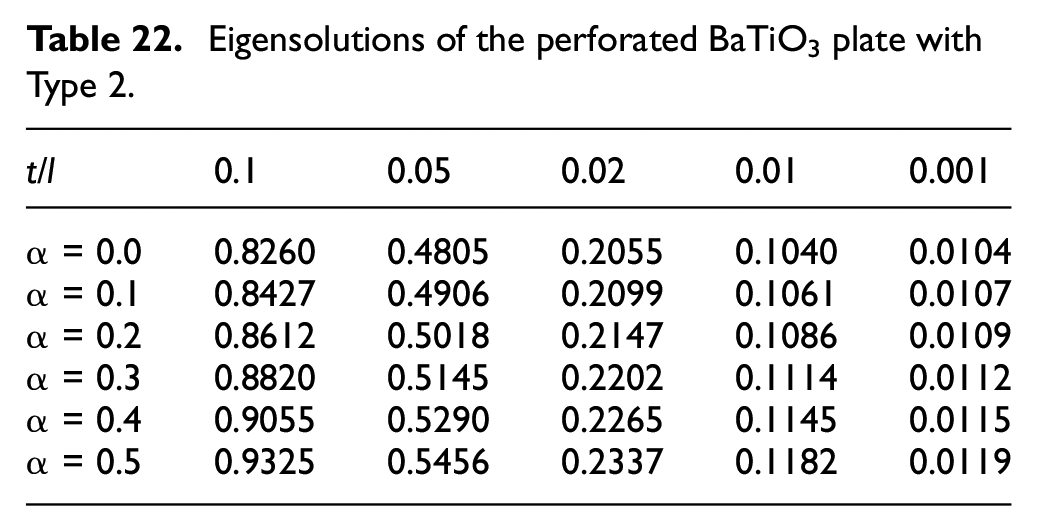
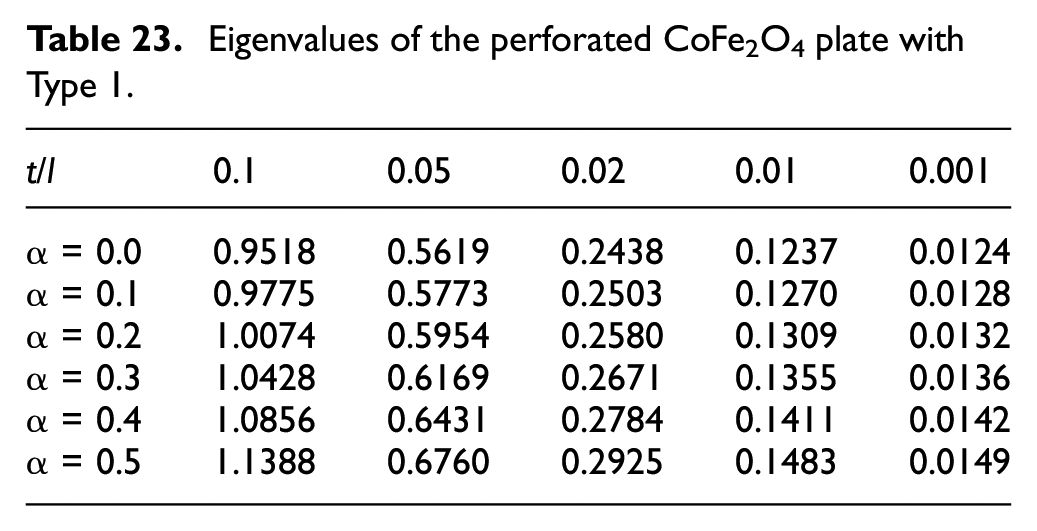
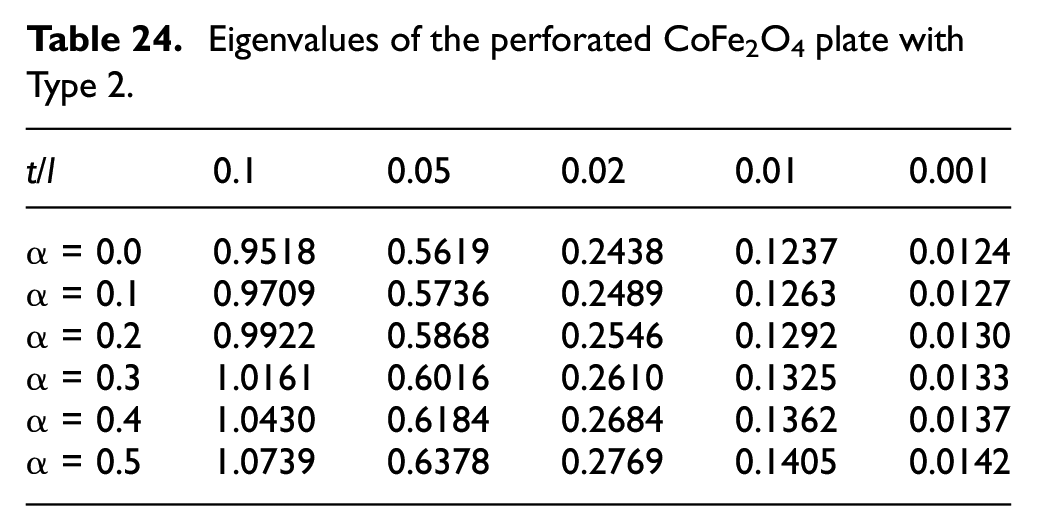
To demonstrate the serviceability of the proposed technique, a functionally graded magneto-electro-elastic perforated circular plate with material properties graded along the radial direction is shown as an example. The outer radius of the perforated plate is RO = 1.0 m and the inner one is Ri = 0.4RO, as displayed in Figure 10. The outer boundary is fully clamped, which means that uz = ux = uy = Φ = Ψ = 0; However, the inner one is completely free. In this example, the same characteristic length l = 2RO, thickness-to-length ratios t/l = 0.1, 0.05, 0.02, 0.01, and 0.001, the materials CoFe2O4 and BaTiO3 of type b, the normalized expression of natural frequencies and the grounded boundary conditions on the top and bottom surfaces as the above numerical example are adopted. To reveal the influence of gradient functions, variations of material constants obey the following two cosine formulae: Type 1, h(r) =1−αcos(πr/RO−π/2) and Type 2, h(r) = 1−αcos(πr/2RO). The non-dimensional fundamental frequencies of the in-plane functionally graded magneto-electro-elastic perforated plate under various aspect ratios and graded indexes are described in Tables 21 to 24. As thickness-to-length ratios of the perforated circular plates become smaller, its relevant flexural vibration frequencies decrease, which is the same as the foregoing finding. Similarly, it can be noticed that regardless of forms of the gradation functions, the increase in the value of the gradient parameter α leads to increasing the dimensionless eigenvalues. When the composed materials and gradation indexes are same, it is essential to point out that eigensolutions of the plates with Type 1 are larger than those with Type 2. So to design and apply the in-plane functionally graded magneto-electro-elastic perforated circular plates in practical engineering, the influence of gradation functions on distributions of the transverse vibration frequencies should not be neglected.
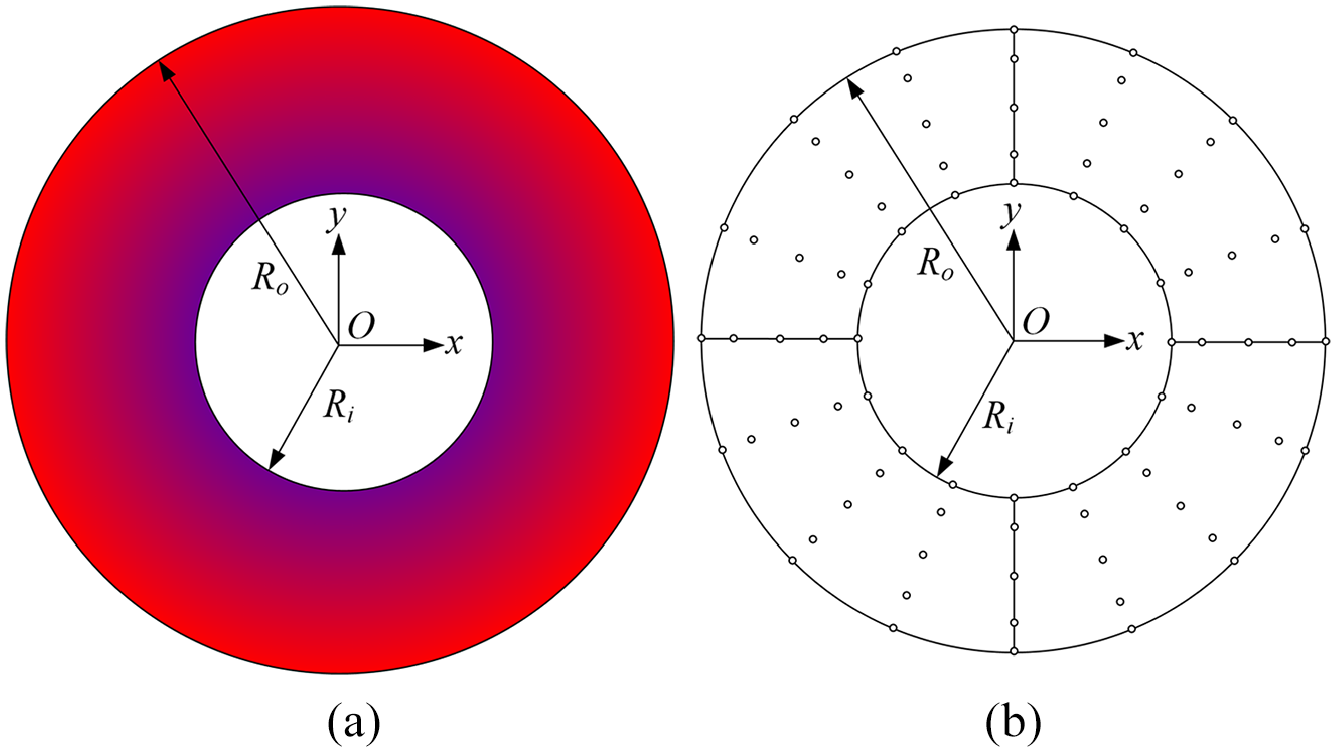
The in-plane functionally graded magneto-electro-elastic perforated plate: (a) the circular plate with a circular cutout and (b) meshed with four spectral elements.
Eigensolutions of the perforated BaTiO3 plate with Type 1.
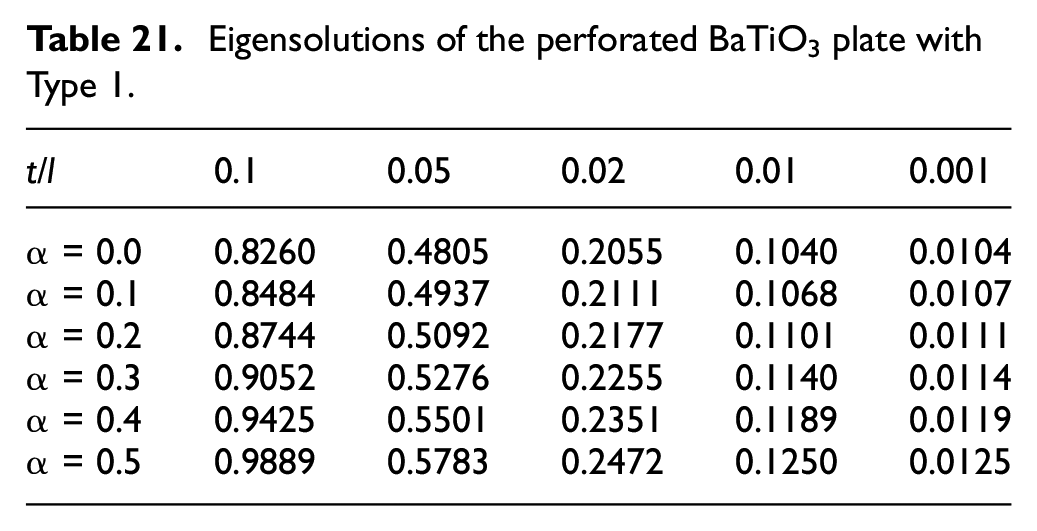
Eigensolutions of the perforated BaTiO3 plate with Type 2.
Eigenvalues of the perforated CoFe2O4 plate with Type 1.
Eigenvalues of the perforated CoFe2O4 plate with Type 2.
5. Conclusions
In this paper, the SBFEM in conjunction with the PIA is employed to investigate the transverse free vibration characteristics of in-plane functionally graded magneto-electro-elastic plates with arbitrary gradation functions. The general solution of the ordinary differential SBFEM governing equation is analytically expressed as the matrix exponent. The approach of PIA is applied to create the stiffness matrix, which can make sure high accuracy. Aided by the kinetic energy method, the mass matrix of the in-plane functionally graded magneto-electro-elastic plates based on the SBFEM for the first time is constructed.
According to the first three numerical examples, the high accuracy, serviceability, and effectiveness of the proposed technique to examine the free vibration behaviors of magneto-electro-elastic and in-plane functionally graded plates are verified. As for the in-plane functionally graded magneto-electro-elastic rectangular plates, with increasing the gradient exponents the dimensionless natural frequencies decrease. The vibration frequencies of the CFSF and SSFF plates will reach the highest and lowest values. With respect to the circular plate, increasing the gradient index γ results in the increase of frequency parameters. The thicker the plate is, the bigger its fundamental frequencies are. When the plate is under the power-law gradient function, with increasing the gradient parameter n, the vibration frequencies will increase. Regarding the perforated circular plate, eigensolutions of the plates with Type 1 are larger than those with Type 2. Therefore, a conclusion that boundary conditions, gradient indexes, thickness-to-length ratios, and forms of gradation functions play a significant role on the free vibration responses of in-plane functionally graded magneto-electro-elastic plates can be drawn. More meaningful results will be provided in the future.
Footnotes
Appendix 1
The detailed expressions for the constitutive relation between the stresses, electric displacements, magnetic induction field and strains, electric field, magnetic field from Guan and He (2006) are formulated as
Appendix 2
The coefficient matrices [b1], [b2], and [b3] are expressed as
Declaration of conflicting interests
The author(s) declared no potential conflicts of interest with respect to the research, authorship, and/or publication of this article.
Funding
The author(s) disclosed receipt of the following financial support for the research, authorship, and/or publication of this article: This research was supported by Grants 2018M641168 from China Postdoctoral Science Foundation, Grants 51908022, 2015CB57805, and 51774018 from the National Natural Science Foundation of China, Grant JDYC20200309 from the Pyramid Talent Training Project of Beijing University of Civil Engineering and Architecture, for which the authors are gratefully acknowledged.
