






Abstract
The cold sintering process (CSP) and self-healing ceramics represent two transformative strategies for addressing the long-standing challenges of energy-intensive processing and brittle failure in ceramics. CSP achieves densification at 120°C–300°C using transient solvents and pressure, enabling the integration of temperature-sensitive phases while reducing embodied energy. Self-healing ceramics restore structural and functional integrity through intrinsic oxidation or embedded healing agents, extending service lifetimes. This Perspective highlights the synergistic integration of these approaches. We propose CSP as both a fabrication route for hybrid healing architectures and a novel in-field repair technique for damaged ceramics. The opportunities include co-processing of ceramics with polymers, low-melting glasses, and microcapsules that are incompatible with conventional sintering. Critical challenges remain, including solvent-agent compatibility, activation energy mismatch, and balancing healing efficiency with mechanical strength. A forward-looking roadmap is outlined, emphasizing scalable CSP platforms, multiscale modeling, and lifecycle assessment. By linking processing science, materials chemistry, and sustainability metrics, we argue that CSP-enabled self-healing ceramics offer a pathway toward intelligent, damage-tolerant materials aligned with green manufacturing and circular economy goals.
Keywords
Introduction
Ceramics have become indispensable in modern technology, finding roles in microelectronics, energy storage, biomedical implants, structural components, and extreme environment applications. Their chemical stability, thermal resistance, and unique functional properties make them ideal for these demanding uses. However, two longstanding challenges limit their widespread adoption: the high energy demands of traditional processing methods and their inherent brittleness under mechanical stress. Conventional sintering requires extreme temperatures often exceeding 1000°C, which not only consumes large amounts of energy but also restricts the use of temperature-sensitive materials such as polymers, hybrid phases, or dopants that degrade at high temperatures. Simultaneously, the brittleness of ceramics and their poor fracture toughness lead to sudden failure when subjected to cyclic or impact loads, especially in structural and aerospace applications (Launey and Ritchie, 2009).
To address these bottlenecks, two disruptive strategies have emerged in the materials science landscape. The first is the cold sintering process (CSP), which enables densification of ceramics at temperatures as low as 120°C–300°C using transient liquid phases and uniaxial pressure (Galotta and Sglavo, 2021). This technique not only lowers processing energy but also expands design possibilities by enabling integration with heat-sensitive materials. For instance, BaTiO3 has been densified to >95% relative density at 200°C under 520 MPa using CSP, whereas conventional sintering requires ∼1350°C for comparable densification (Tsuji et al., 2020). Similarly, LLZO solid electrolytes reach ionic conductivities of ∼10−3 S/cm after CSP at 200°C with a short post-anneal, compared to >1000°C in traditional sintering (Zhang et al., 2022). These reductions translate into an estimated 60%–80% lower processing energy consumption per kilogram of ceramic processed (Grasso et al., 2020). Recent comprehensive reviews and experimental studies have expanded the scope of CSP beyond simple oxides, demonstrating its promise for proton-conducting perovskites and other functional ceramics; these works emphasize both new application spaces and the sensitivity of processing windows (solvent chemistry, pressure and post-treatment) that must be controlled for device-level performance (Bartoletti et al., 2024; Radhakrishnan et al., 2024). The second is the development of self-healing ceramics, materials capable of autonomously repairing internal cracks or surface damage through intrinsic oxidation mechanisms or embedded healing agents, mimicking biological systems (Aouadi et al., 2020). While both CSP and self-healing ceramics have independently shown transformative potential, their integration remains underexplored. As illustrated in Figure 1, CSP provides a unique processing environment where pressure, solvent-mediated transport, and low-temperature conditions interact to enable healing mechanisms that are not accessible in conventional sintering routes. This integrated framework highlights the coupling between densification and healing activation. This article posits that CSP can serve as a critical enabler for a new generation of self-healing ceramic systems. We propose that CSP’s low-temperature conditions are ideally suited to embedding healing phases that would otherwise degrade during high-temperature processing (Nie et al., 2023). Furthermore, we explore the novel potential of using CSP itself as an in-situ repair tool for damaged ceramic components.
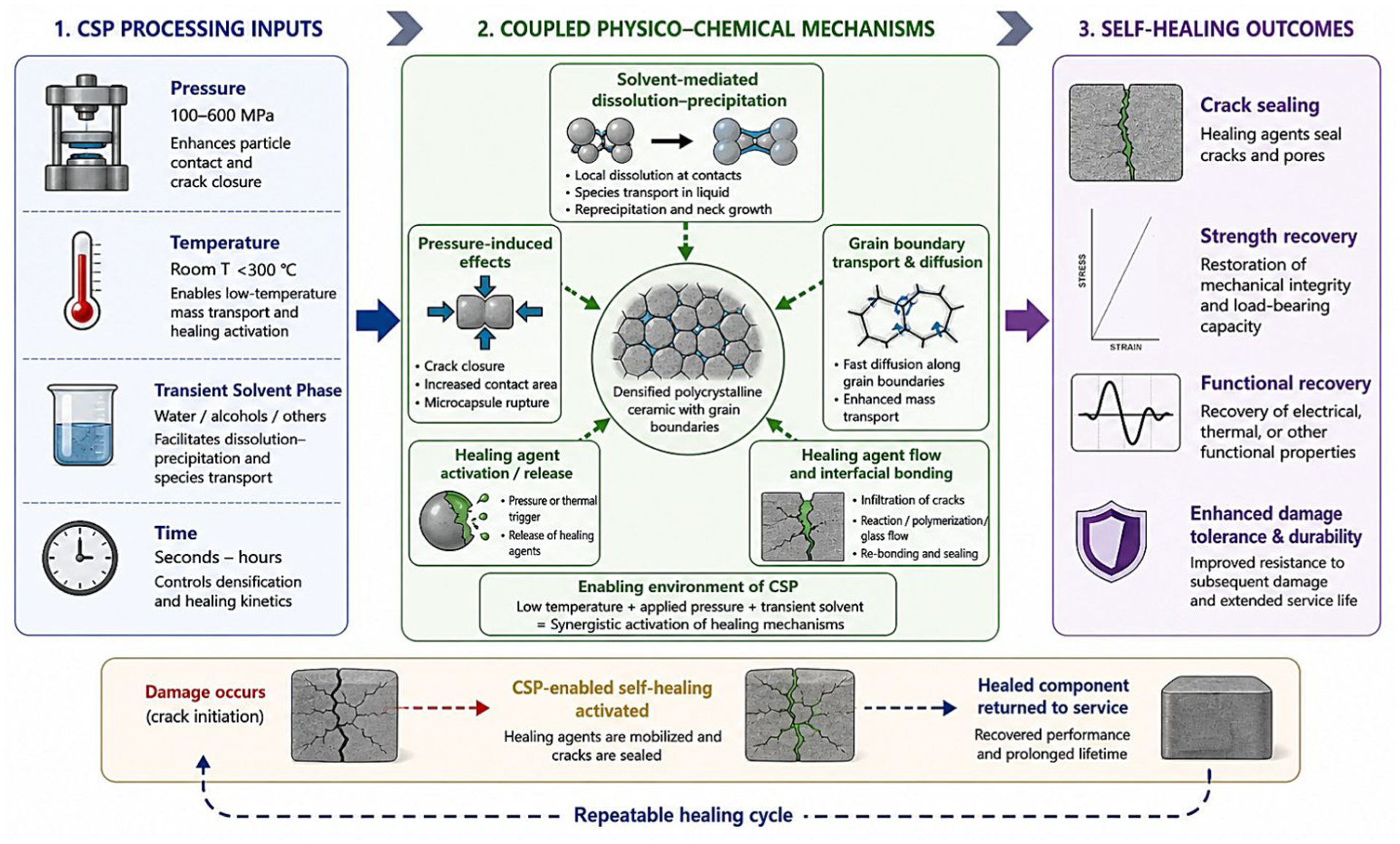
Conceptual framework illustrating the relationship between CSP parameters and self-healing mechanisms in ceramics. CSP inputs, including pressure, temperature, and solvent phase, drive coupled physico-chemical processes such as dissolution-precipitation, grain boundary diffusion, and pressure-assisted crack closure. These mechanisms enable the activation of intrinsic and extrinsic healing pathways, ultimately leading to improved damage tolerance, strength recovery, and functional restoration.
Despite the growing body of literature on CSP and self-healing ceramics, these two domains have largely evolved independently with minimal conceptual integration. Existing studies on CSP have primarily focused on low-temperature densification mechanisms, including dissolution-precipitation processes, grain boundary diffusion, and solvent-assisted transport (Grasso et al., 2020; Ndayishimiye et al., 2023). In parallel, the field of self-healing ceramics has predominantly emphasized high-temperature intrinsic healing or extrinsic capsule-based strategies, often requiring thermal activation conditions incompatible with low-temperature processing routes (Lgaz et al., 2025; Yazıcı et al., 2025). While recent reviews have explored hybrid ceramics and reprocessable materials enabled by CSP (Evangeline and Annamalai, 2025; Lai et al., 2025; Li et al., 2025; Mamaghani and Parvin, 2025a; Zhang et al., 2025), they do not explicitly address how CSP-specific parameters, such as applied pressure (typically 100–600 MPa), transient solvent phases, and low-temperature conditions (<300°C), can be leveraged to activate, enhance, or even redefine healing mechanisms. This Perspective aims to bridge this gap by proposing a new conceptual framework in which CSP is not only a densification technique but also a functional enabler for healing architectures. Specifically, we introduce the hypothesis that pressure-solvent-temperature coupling in CSP can facilitate: (i) pressure-assisted activation of embedded healing agents, (ii) solvent-mediated transport and redistribution of healing species at crack interfaces, and (iii) enhanced grain boundary mobility that promotes crack closure and interfacial rebonding. By positioning CSP as a coupled processing-healing platform, rather than a standalone fabrication method, this work provides new directions for designing damage-tolerant ceramics with integrated healing functionality under low-energy conditions. In summary, this work provides a comprehensive overview of current advances in both CSP and self-healing ceramics and outlines the synergy that can be achieved at their intersection. We aim to spark interdisciplinary research that bridges processing science, materials chemistry, and mechanical design to develop intelligent ceramic materials that are not only durable and efficient but also capable of sustaining their own performance over time.
Cold sintering: Mechanisms, materials, and capabilities
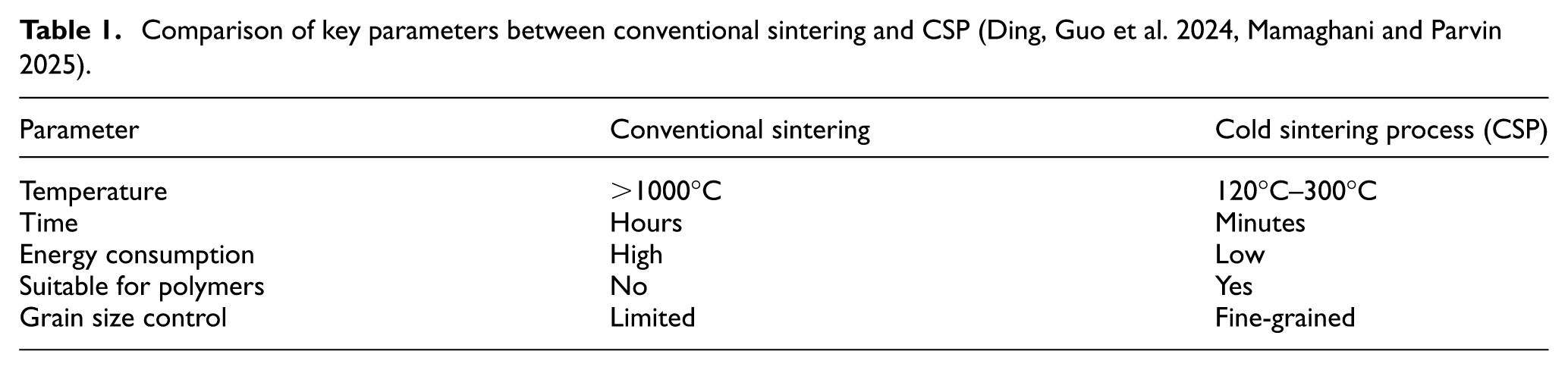
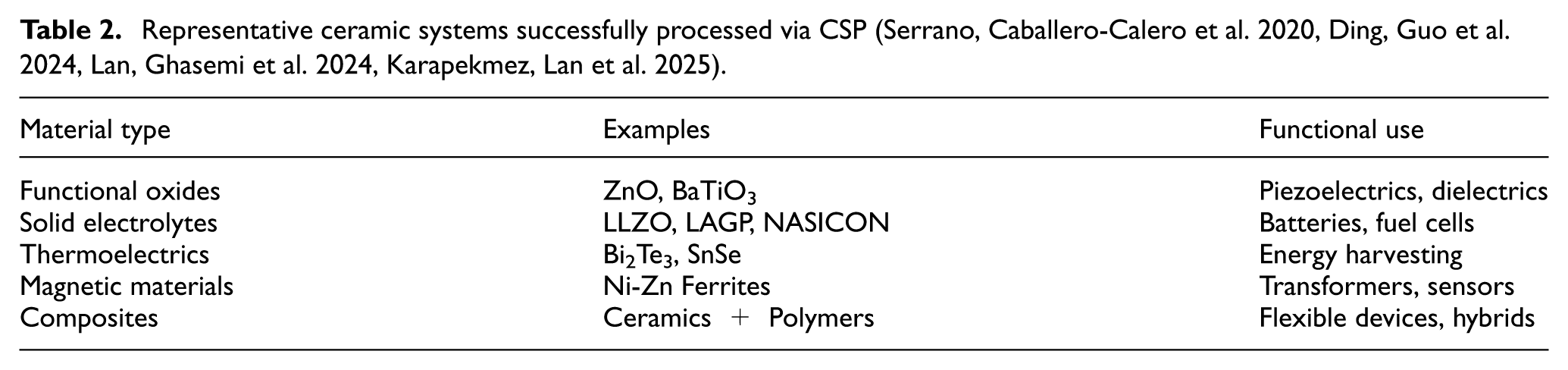
The CSP is an emerging processing technique that achieves ceramic densification at remarkably low temperatures, typically between 120°C and 300°C (Guo et al., 2016a). Table 1 compares CSP and conventional sintering methods across key parameters. This is accomplished through the synergistic effect of a transient liquid phase, usually water or an aqueous salt solution, and the application of uniaxial pressure (Guo et al., 2016a, 2016b). The process draws inspiration from geological mineral formation and relies on a series of interconnected mechanisms: particle rearrangement, dissolution-precipitation, enhanced grain boundary mobility, and capillary-driven densification (Lai et al., 2025). Figure 2 illustrates the microstructural evolution during CSP Unlike the simplified representation in the original version, the final densified ceramic retains a distinct grain structure with well-defined grain boundaries. These grain boundaries play a critical role in mass transport, solvent-mediated reactions, and potential healing processes, particularly in facilitating crack closure and interfacial rebounding. The typical CSP cycle involves mixing a ceramic powder with a small amount of liquid phase, applying moderate pressure (ranging from 50 to 600 MPa), and heating for several minutes (Evangeline and Annamalai, 2025). Under these conditions, partial dissolution of surface atoms occurs at contact points between particles. This is followed by reprecipitation and growth at grain boundaries, promoting densification without the need for high temperatures. A broader view of CSP-compatible ceramic systems and their applications is provided in Table 2. The CSP has been successfully applied to a diverse set of materials, including functional oxides such as ZnO, BaTiO3, and Al2O3; solid electrolytes including LLZO, LAGP, and NASICON; thermoelectrics such as Bi2Te3 and SnSe; magnetic materials including Ni-Zn ferrites; and composite systems that combine ceramic, polymeric, or metallic constituents (Bartoletti et al., 2024).
Comparison of key parameters between conventional sintering and CSP (Ding, Guo et al. 2024, Mamaghani and Parvin 2025).
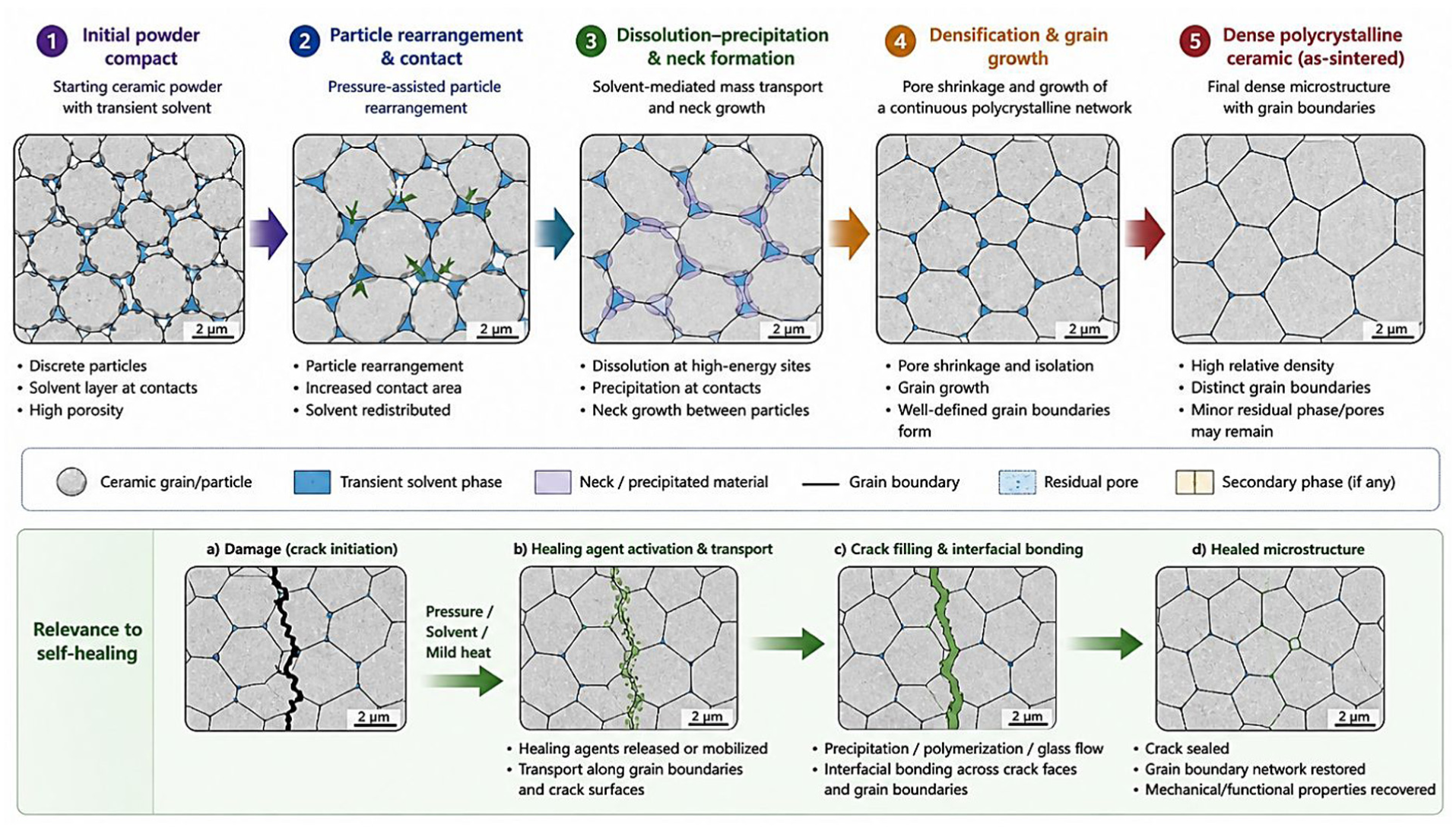
Schematic illustration of microstructural evolution during CSP. Starting from a powder compact with a transient solvent phase, densification proceeds via dissolution-precipitation and grain rearrangement under applied pressure. The final microstructure consists of polycrystalline grains separated by grain boundaries, which are essential for mass transport and healing-related processes.
Representative ceramic systems successfully processed via CSP (Serrano, Caballero-Calero et al. 2020, Ding, Guo et al. 2024, Lan, Ghasemi et al. 2024, Karapekmez, Lan et al. 2025).
One of the most compelling advantages of CSP is its ability to preserve temperature-sensitive phases and nanostructures (Mamaghani and Parvin, 2023). Unlike conventional sintering, which can lead to grain coarsening, phase decomposition, or oxidation, CSP maintains fine-grained microstructures and metastable compositions. Recent work also highlights CSP as a low-energy route for functional materials such as thermoelectrics and mixed conductors, while pointing out practical requirements for post-processing (e.g. short thermal anneals) to recover optimal electrical/ionic conductivity in some systems (Ding et al., 2024; Zhou et al., 2024). This makes it especially attractive for fabricating multilayer ceramics, hybrid devices, or materials with volatile components. However, CSP is not without limitations. The technique requires the base material to exhibit some degree of solubility in the chosen transient liquid, and the success of densification is highly sensitive to solvent chemistry, pH, particle morphology, and applied pressure profiles (Chi et al., 2019). Moreover, the scalability of CSP for industrial applications remains under active investigation, particularly for thick or large-area components (Kwon et al., 2025). Several recent reviews and experimental reports call for systematic scale-up studies and pilot tooling demonstrations, since component size, die geometry and hold-time strongly influence densification and the retention of embedded phases under realistic processing conditions (Bartoletti et al., 2024; Nečina, 2025; Radhakrishnan et al., 2024). Despite these challenges, CSP represents a paradigm shift in ceramic processing, not just in terms of sustainability and energy efficiency, but also in the ability to design new material architectures that were previously unattainable. Its compatibility with a wide range of materials and the potential for integration with additive manufacturing (Lim et al., 2025) or layered fabrication techniques further enhances its appeal as a versatile tool in next-generation ceramic engineering.
Self-healing ceramics: Intrinsic and extrinsic strategies
Ceramics are inherently brittle materials, prone to crack initiation and rapid propagation under mechanical stress. Unlike metals, which can plastically deform to dissipate energy, ceramics often fail catastrophically with little warning. This limitation poses significant challenges in applications where long-term reliability, cyclic loading, or impact resistance are critical. Self-healing ceramics, materials designed to restore their mechanical integrity after damage, represent a transformative approach to overcoming these limitations (Paladugu et al., 2022). Self-healing mechanisms in ceramics are typically categorized as intrinsic or extrinsic, based on whether the healing capability arises from the material’s own composition or from embedded foreign agents (Islam and Bhat, 2021).
Intrinsic healing mechanisms
Intrinsic healing relies on the material’s ability to undergo reversible physical or chemical transformations upon damage. These mechanisms are often thermally activated and do not require any external healing agent. Common strategies include oxidation-induced crack sealing, where materials such as SiC or Si3N4 form viscous SiO2 upon exposure to air at elevated temperatures (800°C–1200 °C), which flows into and seals surface or internal cracks; phase transformation, as observed in MAX phase ceramics (e.g. Ti3AlC2, Ti2AlC), where oxidation at crack sites produces protective Al2O3 or Cr2O3 layers that both heal the crack and prevent further degradation; and creep-driven grain boundary migration, in which some ceramics at high temperatures exhibit grain boundary mobility that can bridge microcracks over time (Li et al., 2018, Hammood et al., 2020; Sekine and Nakao, 2023; Wan et al., 2023b). These intrinsic systems are generally repeatable and chemically stable but are constrained by the need for high activation temperatures and oxidizing environments, which may not be suitable for all applications or materials.
Extrinsic healing mechanisms
Extrinsic healing involves the deliberate introduction of secondary phases or agents into the ceramic matrix that activate upon damage. Extrinsic healing involves the deliberate introduction of secondary phases or agents into the ceramic matrix that activate upon damage. These can include glass-forming particles (e.g. B4C, MoSi2, or other borides and silicides), which oxidize or melt at moderate temperatures (typically 500°C–900°C) to fill and seal cracks; low-melting metal alloys that can wet and bond fracture surfaces under mild thermal exposure; and encapsulated healing agents, such as microcapsules containing adhesives, polymer precursors, or solvents that are released upon crack propagation (Liu et al., 2023; Pezzin, 2023; Verma et al., 2025; Wan et al., 2023a). Extrinsic strategies offer design flexibility and can be activated at lower temperatures, but they are often limited to one-time healing and may reduce the overall mechanical properties of the host matrix if not optimally distributed.
Quantitative demonstrations highlight the effectiveness of these strategies. MAX phase ceramics (Ti3AlC2) exhibit up to 90% flexural strength recovery after oxidation-induced healing at 1100°C (Sung Lee et al., 2023). In extrinsic systems, Al2O3-modified SiCf/SiC-B4C composites retain ∼29% more strength after 100 h at 1400°C in wet-Na2SO4 atmospheres compared to virgin systems, owing to (AlO6→AlO4) transformations that repair the glass phase network and suppress SiO2 crystallization (Shan et al., 2025). Polyurethane microcapsules loaded with sodium silicate achieve ∼99.9% crack closure and a 33.9% strength gain at 4.5 wt% cement addition, while higher loadings reduce matrix integrity by ∼25% due to pore disruption (Jawahar and Vishnudas, 2025). Optimal dosage promotes secondary hydration, lowers sorptivity by ∼7%, and enhances durability under submerged curing, supporting long-term sustainability in cementitious systems. A comparative view of intrinsic and extrinsic healing approaches is shown in Figure 3, capturing the differing mechanisms of activation and repair. Notably, recent demonstrations of “plastic/ceramic” electrolytes and hybrid electrolytic layers show that low-temperature, mechanically flexible healing architectures can mitigate failure modes (e.g. dendrite penetration) in energy devices, suggesting direct synergy with CSP-compatible processing windows (He et al., 2024).
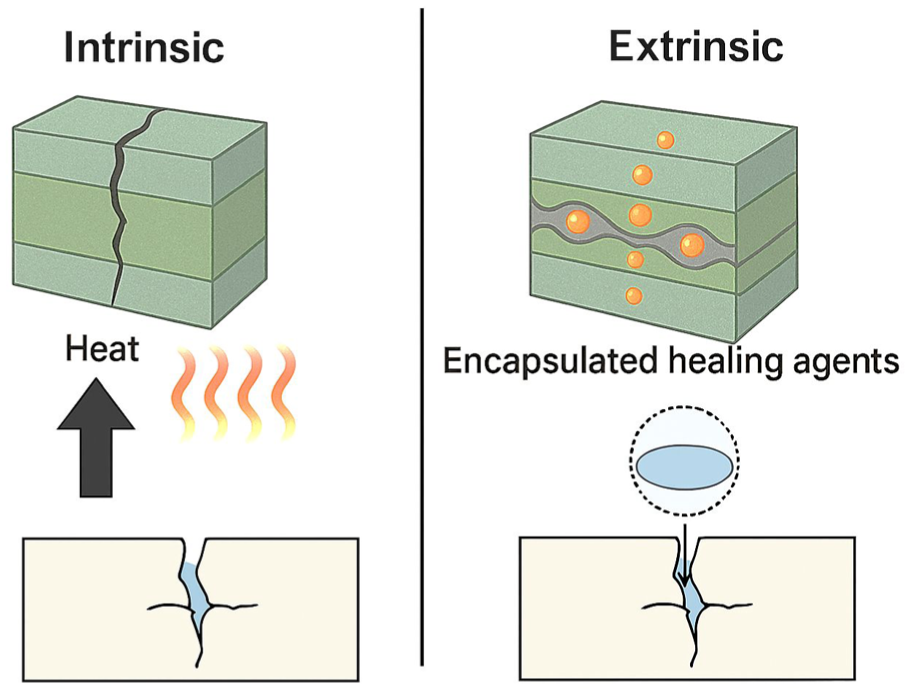
Comparison between intrinsic and extrinsic self-healing mechanisms in ceramics, highlighting activation triggers and typical healing agents.
Toward a quantitative framework for CSP-enabled self-healing ceramics
To move beyond qualitative conceptualization, it is essential to establish a semi-quantitative framework that relates CSP conditions to healing activation requirements; a comparison of the quantitative parameters between conventional sintering and CSP is summarized in Table 3. Figure 4 illustrates the overlap between CSP processing windows and the activation temperatures of common healing mechanisms. Conventional intrinsic ceramic healing typically requires temperatures above 600°C (Greil, 2012), while many extrinsic healing systems (e.g. polymer-based or glass-forming agents) activate in the range of 80°C–300°C. (Grasso et al., 2020; Nie et al., 2023). Notably, this range partially overlaps with CSP processing temperatures (<300°C), suggesting a unique opportunity for concurrent densification and healing activation. In addition to temperature compatibility, energy consumption provides a critical metric for evaluating sustainability (Zhao et al., 2026). Conventional ceramic sintering typically requires 5–20 kWh/kg depending on the material system and furnace conditions, whereas CSP has been reported to operate in the range of approximately 0.5–2 kWh/kg due to significantly reduced thermal budgets (Sohrabi Baba Heidary et al., 2018; Zhao et al., 2023). This represents a potential order-of-magnitude reduction in energy demand. In contrast, extrinsic healing approaches, such as polymer infiltration, microcapsule-based systems, or solvent-mediated transport, can operate within significantly lower temperature ranges and are therefore more compatible with CSP conditions. Notably, pressure-assisted activation in CSP introduces an additional dimension not present in conventional healing systems, potentially enabling new classes of extrinsic healing pathways.
Comparison of CSP and conventional sintering.
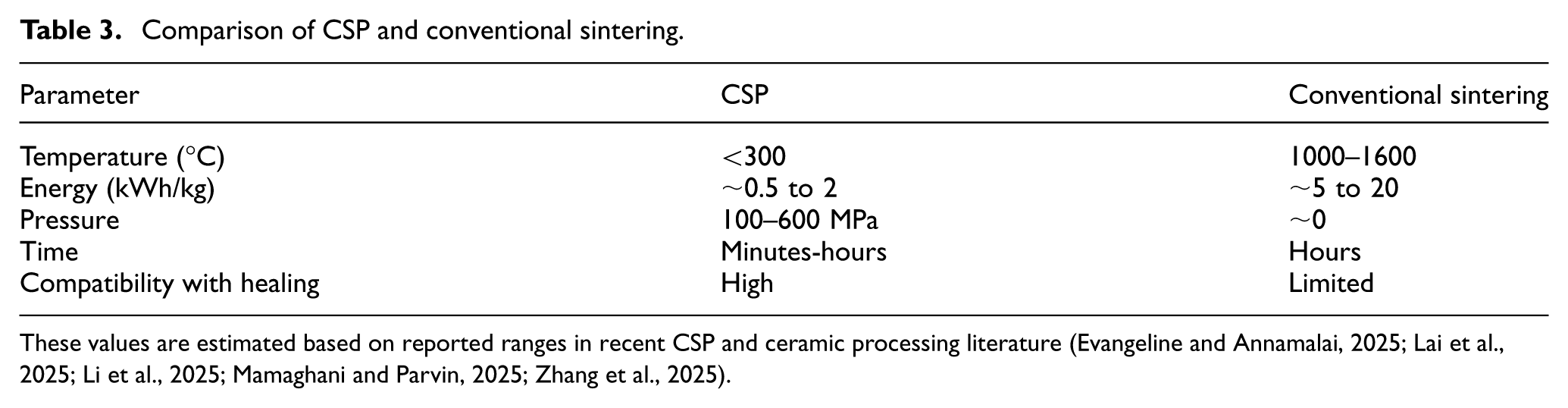
These values are estimated based on reported ranges in recent CSP and ceramic processing literature (Evangeline and Annamalai, 2025; Lai et al., 2025; Li et al., 2025; Mamaghani and Parvin, 2025; Zhang et al., 2025).
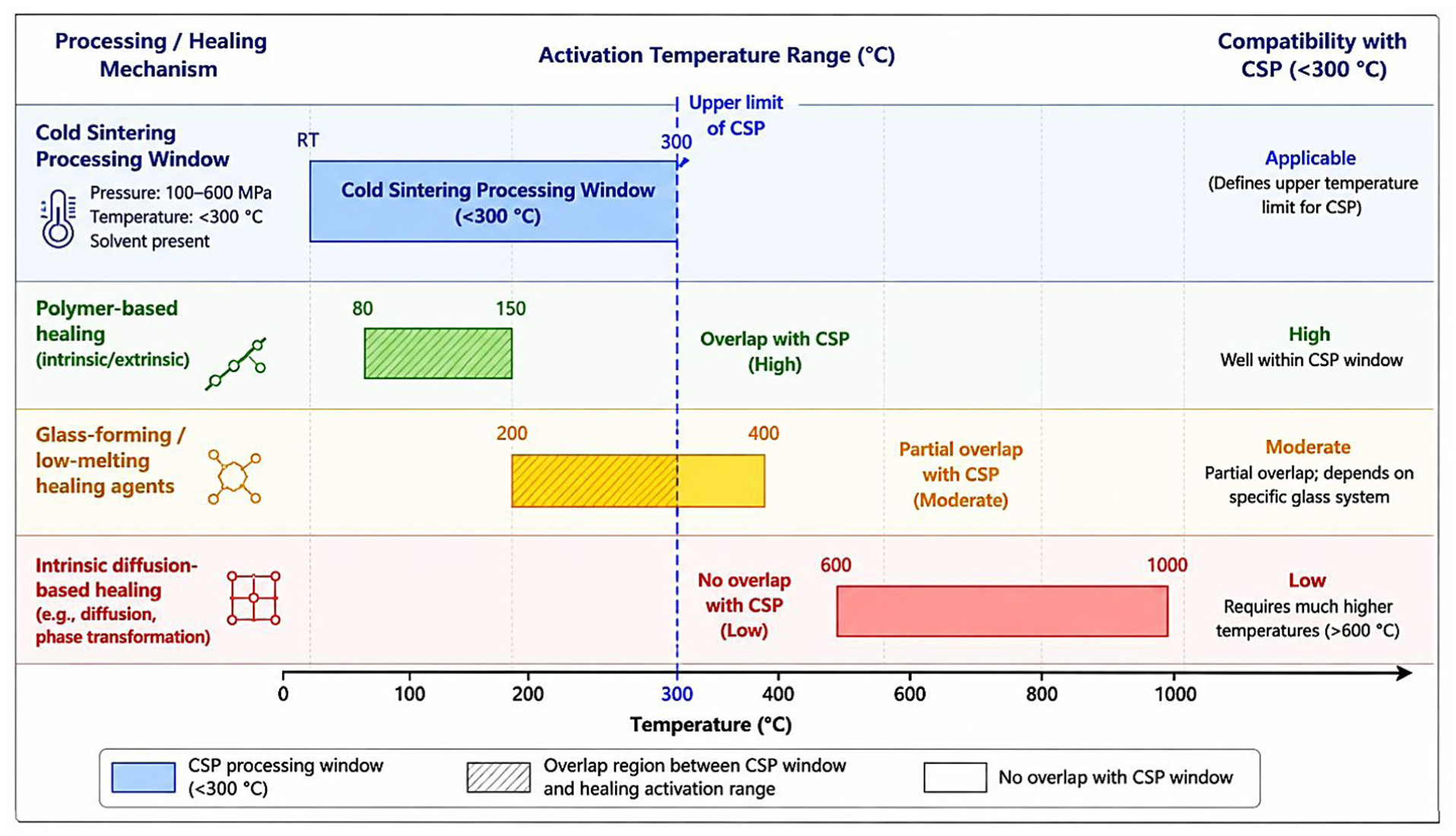
Overlap between CSP conditions and activation temperatures of various self-healing mechanisms in ceramics. This overlap highlights the unique opportunity for integrating healing functionality within low-temperature ceramic processing.
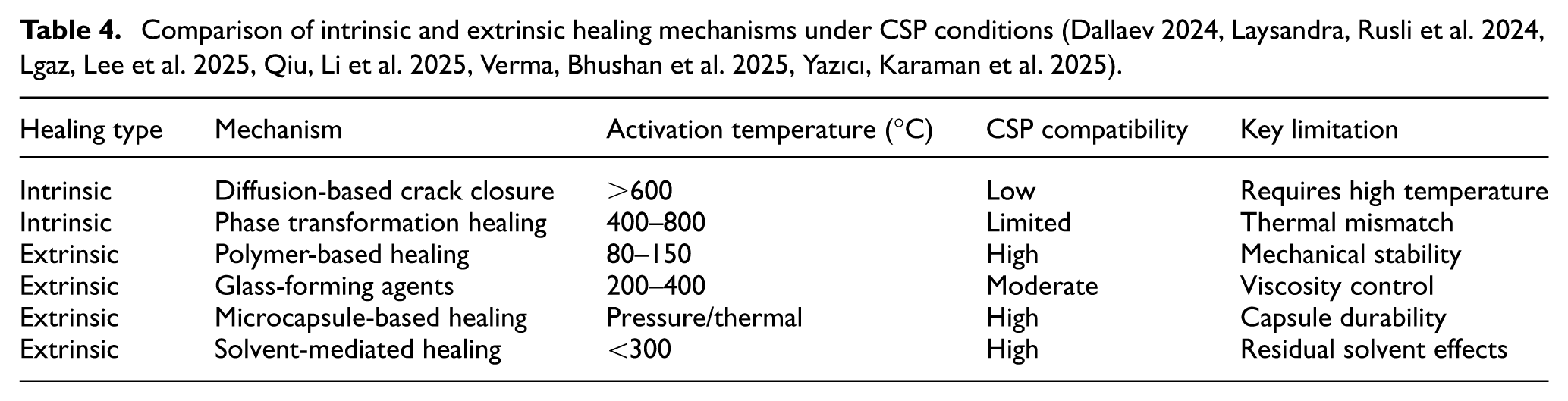
In this regard, Table 4 summarizes key self-healing strategies relevant to CSP applications, distinguishing between intrinsic (diffusion- and phase transformation-based) and extrinsic (polymer, glass-forming, microcapsule, and solvent-mediated) approaches (Qiu et al., 2025). As shown, intrinsic methods generally require high activation temperatures and exhibit limited CSP compatibility, whereas extrinsic mechanisms offer broader compatibility over lower temperature ranges but are constrained by issues such as mechanical stability, viscosity control, capsule durability, and residual solvent effects. In summary, a key distinction in the context of CSP-enabled healing lies between intrinsic and extrinsic mechanisms. Intrinsic healing in ceramics typically relies on thermally activated diffusion or phase transformations, which require elevated temperatures often exceeding 500°C–600°C (Li et al., 2018, Pezzin, 2023; Verma et al., 2025). As such, these mechanisms are generally incompatible with CSP processing windows. Importantly, the activation thresholds of different healing agents must be carefully matched with CSP processing conditions. For example, polymer-based systems typically activate between 80°C and 150°C, while glass-based healing agents may require temperatures approaching 300°C–400°C (Dallaev, 2024; Paladugu et al., 2022). This partial overlap with CSP conditions (<300°C) defines a critical design window for integrating healing functionality during or after densification.
Comparison of intrinsic and extrinsic healing mechanisms under CSP conditions (Dallaev 2024, Laysandra, Rusli et al. 2024, Lgaz, Lee et al. 2025, Qiu, Li et al. 2025, Verma, Bhushan et al. 2025, Yazıcı, Karaman et al. 2025).
From a performance standpoint, healing efficiency can be benchmarked using metrics such as strength recovery (typically 60%–95% in reported systems; Osada et al., 2017), electrical conductivity recovery, and healing cycle stability. However, these metrics must be evaluated in the context of densification-healing trade-offs. For example, increasing solvent content may enhance healing agent mobility but could adversely affect final density and mechanical integrity. To capture this interplay, we propose a conceptual densification-healing trade-off map, where optimal processing conditions are defined by balancing densification efficiency, healing activation, and microstructural stability. This framework provides a foundation for future experimental validation and process optimization in CSP-enabled self-healing systems.
Mechanistic coupling between cold sintering and healing activation
Understanding the mechanistic coupling between CSP and healing activation is critical to move beyond conceptual integration. Unlike conventional sintering, CSP operates through a complex interplay of pressure, transient solvent phases, and low-temperature diffusion processes, which can directly influence healing behavior. One key mechanism is solvent-mediated dissolution-precipitation. During CSP, transient liquid phases facilitate localized dissolution at particle contacts followed by reprecipitation, enabling mass transport at relatively low temperatures (Gonzalez-Julian et al., 2018). This mechanism can also enhance the mobility of healing species, allowing crack interfaces to be infiltrated and re-bonded through solution-assisted transport pathways. In addition to chemical transport, applied pressure (typically 100–600 MPa) plays a crucial role in both densification and healing activation. High pressure can promote crack closure, increase interfacial contact area, and potentially trigger the rupture of embedded microcapsules. Depending on capsule material and size, rupture thresholds may fall within the CSP pressure range, enabling pressure-activated release of healing agents.
Polymer-based or hybrid healing networks under CSP conditions may exhibit viscoelastic deformation, phase softening, or pressure-induced flow (Lai et al., 2024). These effects can facilitate redistribution of healing agents but may also lead to structural instability if not properly controlled. The interplay between polymer mechanics and ceramic matrix densification therefore requires careful design consideration. Furthermore, residual stresses generated during CSP, as well as solvent entrapment within grain boundaries or pores, may influence healing activation. While moderate residual stresses could enhance crack driving forces and healing kinetics, excessive stresses or trapped solvent phases may lead to delayed failure or degradation of functional properties. Overall, these coupled mechanisms suggest that CSP provides a unique environment in which mechanical, chemical, and transport phenomena interact to enable unconventional healing pathways. However, these mechanisms remain largely unexplored experimentally, highlighting an important direction for future research.
Key challenges and opportunities
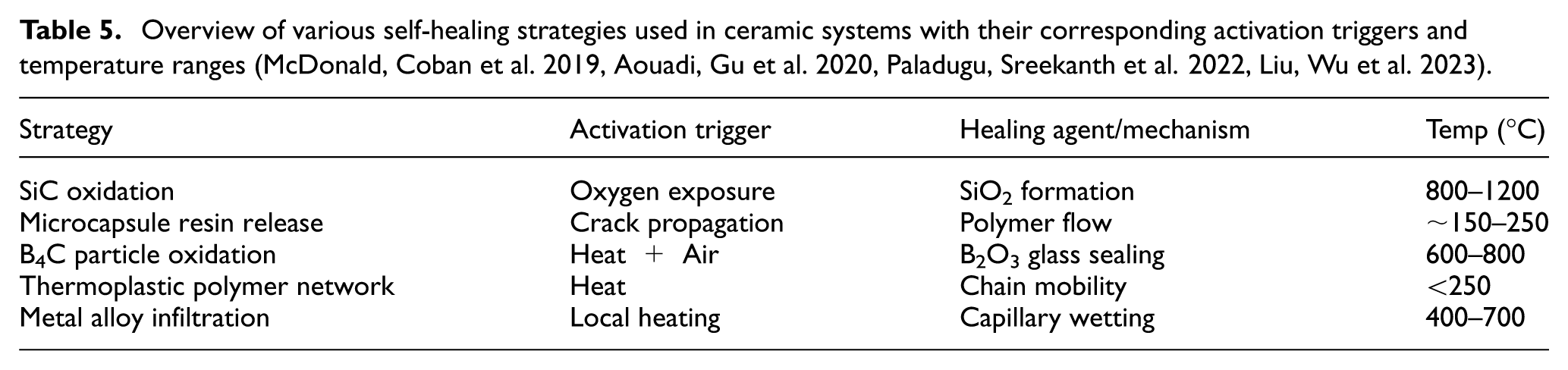
Table 5 summarizes commonly used self-healing strategies, their activation conditions, and material systems. Emerging characterization methods, such as acoustic-emission-based healing state mapping, are being developed to quantify healing kinetics and restored mechanical function, which will be critical for validating CSP-embedded healing agents under realistic load cycles (Yanaseko et al., 2024). Despite growing research in both categories, several issues remain unresolved, including achieving uniform dispersion of healing agents without compromising structural integrity (Jiang et al., 2024); tailoring healing activation temperatures to operational constraints; developing multi-healing or autonomous repair capabilities that function under realistic service conditions; and balancing mechanical strength, healing efficiency, and long-term stability in engineered systems. Recent advances in materials chemistry and nanostructure design have begun to blur the line between intrinsic and extrinsic approaches, enabling hybrid systems that combine the advantages of both (Paladugu et al., 2022). The next frontier lies in integrating these self-healing strategies with scalable, low-temperature processing techniques (such as CSP) to enable manufacturable, multi-functional ceramic systems.
Overview of various self-healing strategies used in ceramic systems with their corresponding activation triggers and temperature ranges (McDonald, Coban et al. 2019, Aouadi, Gu et al. 2020, Paladugu, Sreekanth et al. 2022, Liu, Wu et al. 2023).
Integration potential: Cold sintering meets self-healing
The convergence of CSP and self-healing ceramics presents an unprecedented opportunity to rethink how functional ceramic systems are fabricated, repaired, and deployed. Each technology (CSP and self-healing) has shown promise on its own. However, their integration could unlock capabilities that neither can achieve independently, especially in the context of sustainable manufacturing and long-term material resilience. This integration is not only conceptual but increasingly supported by pilot results. Recently, cold-sintered BaTiO3/PEI nanocomposites densified at 250°C via transient Ba(OH)2·8H2O/H2TiO3 phases exhibit suppressed grain growth, intergranular PEI layers (<10 nm), and stable dielectric response up to 200°C; at 20 vol% PEI, permittivity reaches ∼163 with tan δ ≈ 0.014 and breakdown strength enhanced by ∼81% over pristine BaTiO3 (Li et al., 2024). Such results suggest that healing agents with activation thresholds near 200°C–300°C could be co-sintered without loss of functionality, opening realistic design windows for self-healing composites.
Enabling low-temperature incorporation of healing agents
One of the primary barriers to implementing extrinsic self-healing mechanisms in ceramics is the incompatibility of many healing agents with high-temperature sintering. For example, organic compounds, low-melting alloys, and polymeric binders decompose or volatilize at temperatures above 500°C, ruling out their inclusion in conventional ceramic processing (Al-Samarai et al., 2025). The CSP, by contrast, operates at temperatures typically below 300°C, making it uniquely suited for co-processing ceramics with thermally sensitive healing agents. Recent interface-engineering studies have shown practical routes to integrate polymeric or glassy interphases with ceramic powders under solvent-assisted low-temperature consolidation, enabling graded and hybrid architectures that are difficult to achieve via conventional high-temperature sintering (Yanaseko et al., 2024). This opens several new design pathways, including the incorporation of microencapsulated healing agents (e.g. adhesives or low-viscosity resins) that can be embedded without rupture during processing; the dispersion of low-melting glass or alloy particles that remain chemically intact during sintering but activate upon thermal exposure during service; and the development of hybrid architectures that combine ceramic matrices with flexible polymeric interphases capable of absorbing damage and initiating repair (Lai et al., 2025). These strategies offer a more versatile and modular route to designing self-healing ceramics with tailored responses to specific damage modes or environmental triggers. Figure 5 visually summarizes the intersection between CSP and self-healing, illustrating how their integration enables new functionalities.
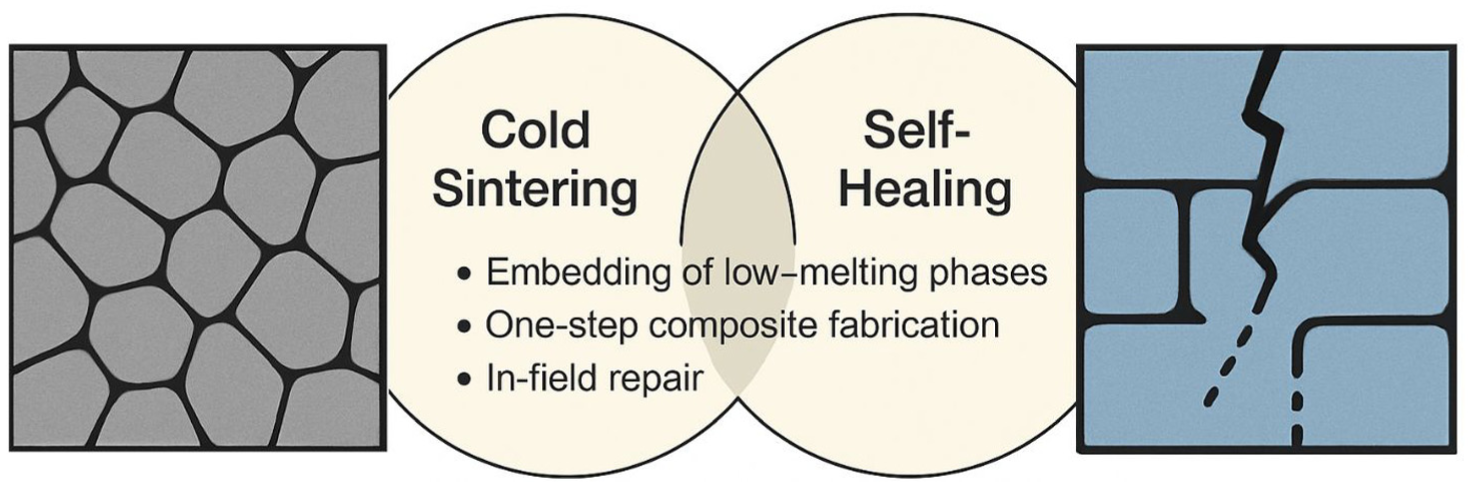
Integration of CSP and self-healing ceramics enabling low-temperature composite fabrication and in-situ repair functionality.
One-step fabrication of self-healing composites
The CSP’s compatibility with multi-material systems enables the simultaneous densification of ceramic matrices and embedded healing phases. This facilitates single-step fabrication of composites with integrated damage mitigation capabilities, eliminating the need for post-processing steps or multilayer assembly. For instance, a cold-sintered composite consisting of Al2O3 and B4C (Murugesan and Biswas, 2025; Zhang et al., 2024b) could exhibit excellent mechanical strength while enabling healing through boron oxide formation during service. Similarly, ceramic-polymer composites fabricated via CSP could embed thermoplastic or reversible polymer networks capable of healing at relatively low activation energies (Evangeline and Annamalai, 2025; Li et al., 2025). This one-step co-fabrication strategy also aligns with scalable manufacturing trends, including additive manufacturing and tape casting, where layer-by-layer integration of healing agents and ceramic particles is desirable.
Cold sintering as a post-damage repair method
Beyond initial fabrication, CSP also holds potential as a field-deployable repair technique. In long term, the idea can be developed to apply localized pressure and a transient liquid, possibly via portable tooling or automated systems, directly at the damage site; however, significant challenges related to pressure delivery and system integration must first be addressed. While largely conceptual to date, recent reviews argue that solvent-assisted, pressure-driven surface reformation could be adapted into localized repair workflows, provided that tooling and process control (e.g. solvent delivery, pressure localization) are engineered for in-field constraints (Bartoletti et al., 2024; Li et al., 2025). Under mild heating, this could initiate partial dissolution and reprecipitation at crack surfaces, effectively “cold welding” the damaged region without compromising the surrounding structure. This approach would be particularly impactful for aerospace components, where in-field repair is critical and conventional high-temperature reprocessing is impractical; electroceramic devices, where reflow or resealing of cracks must occur without disrupting circuitry or polymer encapsulation; and structural ceramics in defense or infrastructure applications, where minimizing downtime and maximizing service life are key. While this concept is still largely theoretical, early-stage investigations into solvent-assisted grain boundary reformation and low-temperature ceramic bonding lend credibility to its feasibility. Figure 6 conceptually illustrates how CSP may be applied for localized, in-situ repair of damaged ceramic components.
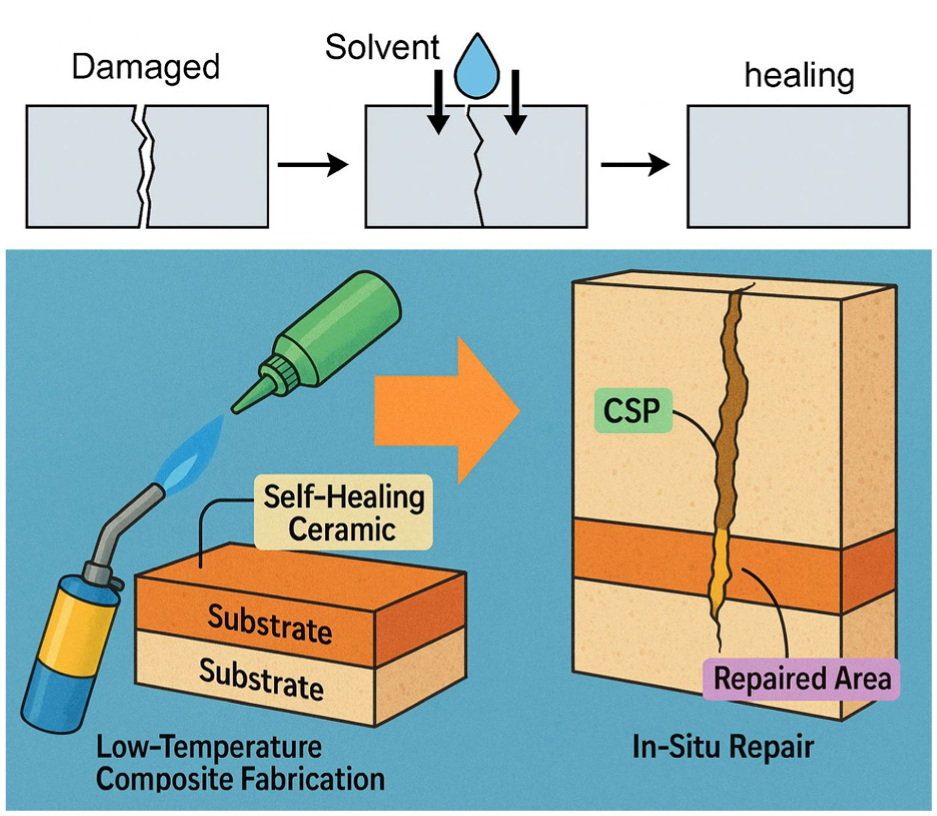
Illustration of CSP being used as a localized in-situ ceramic repair technique.
Technical challenges and research needs
While the integration of CSP and self-healing ceramics holds significant promise, several critical challenges must be addressed to transition this concept from laboratory feasibility to widespread application. These challenges span materials science, process engineering, and modeling, requiring coordinated interdisciplinary research efforts. Table 6 outlines key integration challenges and potential engineering strategies for successful implementation.
Key integration challenges in combining CSP and self-healing ceramics, with potential mitigation strategies.

Chemical compatibility and process integration
A fundamental constraint in CSP is the solvent-material interaction. Many ceramic systems require specific aqueous environments, acidic, basic, or neutral, for partial solubility and densification. However, these same solvents can degrade or deactivate sensitive healing agents such as polymers, microcapsules, or organometallic precursors. Thus, careful selection of solvent chemistry and pH (Mamaghani and Parvin, 2025b) is essential to ensure preservation of healing agent integrity during processing, prevention of unwanted side reactions or phase destabilization, and minimization of interfacial degradation between the matrix and healing phase. Advanced surface coatings, encapsulation techniques, or hydrophobic barrier layers may also be necessary to insulate healing agents from the surrounding liquid medium during sintering (Yazıcı, Karaman et al., 2025).
Activation energy mismatch
Most healing mechanisms, whether oxidation-based or phase transformation-driven, require elevated temperatures (typically > 500°C) to activate. In contrast, CSP occurs at sub-300°C, raising concerns about whether healing agents embedded during CSP can be selectively activated post-fabrication without compromising the matrix. This mismatch poses questions such as whether healing can be triggered independently of the sintering process, what the minimum energy thresholds are for initiating crack repair, and how one might engineer “on-demand” healing that responds only to mechanical or thermal stimuli. A key research gap lies in defining quantitative process windows. For example, healing agents such as thermoplastic networks activate around 180°C–250°C, overlapping CSP conditions, whereas glass-forming agents like B2O3 require 600°C–800°C, well above CSP. Establishing process maps that plot CSP densification efficiency (density vs T, P) against healing activation efficiency (% property recovery vs T) will be critical to identify viable overlaps. These issues highlight the need for triggerable healing systems (Ehrlich et al., 2025), such as thermally responsive polymers or encapsulated agents that activate under specific stress conditions.
Mechanical trade-offs and microstructural control
Integrating healing agents into a ceramic matrix introduces structural discontinuities that can compromise the mechanical strength, hardness, or thermal stability of the overall material. Maintaining a balance between healing efficiency and mechanical performance is a central challenge. Key considerations include optimizing the volume fraction and dispersion of healing phases, tailoring interfacial adhesion and load transfer between phases, and controlling grain size and porosity to avoid stress concentration sites (Li et al., 2018, Dallaev, 2024; Verma et al., 2025). Advanced processing approaches such as gradient architectures, core-shell particles, or layered composites may offer pathways to distribute healing agents effectively while maintaining structural integrity.
Distribution and retention of healing agents
Achieving uniform and stable dispersion of healing phases within a ceramic matrix is non-trivial. During CSP, applied pressure and liquid transport can cause agglomeration, migration, or leakage of embedded agents (McDonald et al., 2019). Addressing this challenge will require improved mixing and slurry stabilization protocols, microencapsulation or chemical tethering strategies to immobilize healing agents, and in-situ monitoring tools to verify their distribution during and after sintering (Yanaseko et al., 2024). In addition, standardized accelerated-aging and cyclic-loading protocols (recently proposed in the self-healing literature) will be necessary to quantify agent retention, repeated healing ability and property retention over service lifetimes (Dallaev, 2024). The long-term retention and stability of healing agents during storage, aging, or cyclic service conditions also remains an open question.
Predictive modeling and multiscale simulation
To optimize the integration of CSP and self-healing functions, new computational models are needed that can simulate solvent diffusion and dissolution-precipitation kinetics, crack initiation, growth, and closure in hybrid microstructures, and the thermomechanical behavior under realistic service conditions (Paladugu et al., 2022). The literature increasingly highlights the need for combined experimental-computational campaigns that couple dissolution-precipitation kinetics, solvent transport, and mechanical compaction models to predict microstructure evolution during CSP and subsequent healing cycles; such multiscale frameworks are essential for robust, transferable process windows. These models should operate across multiple scales, from atomistic interactions to grain-level mechanics to component-scale reliability, and be validated against experimental data.
Applications and impact
The fusion of CSP and self-healing functionality in ceramics opens a compelling frontier for materials design, one that emphasizes not only performance and efficiency but also resilience, longevity, and sustainability. This integration offers a versatile platform with wide-ranging implications across several industries. Figure 7 outlines the wide range of industries that benefit from cold-sintered, self-healing ceramics, from energy and aerospace to biomedical devices.
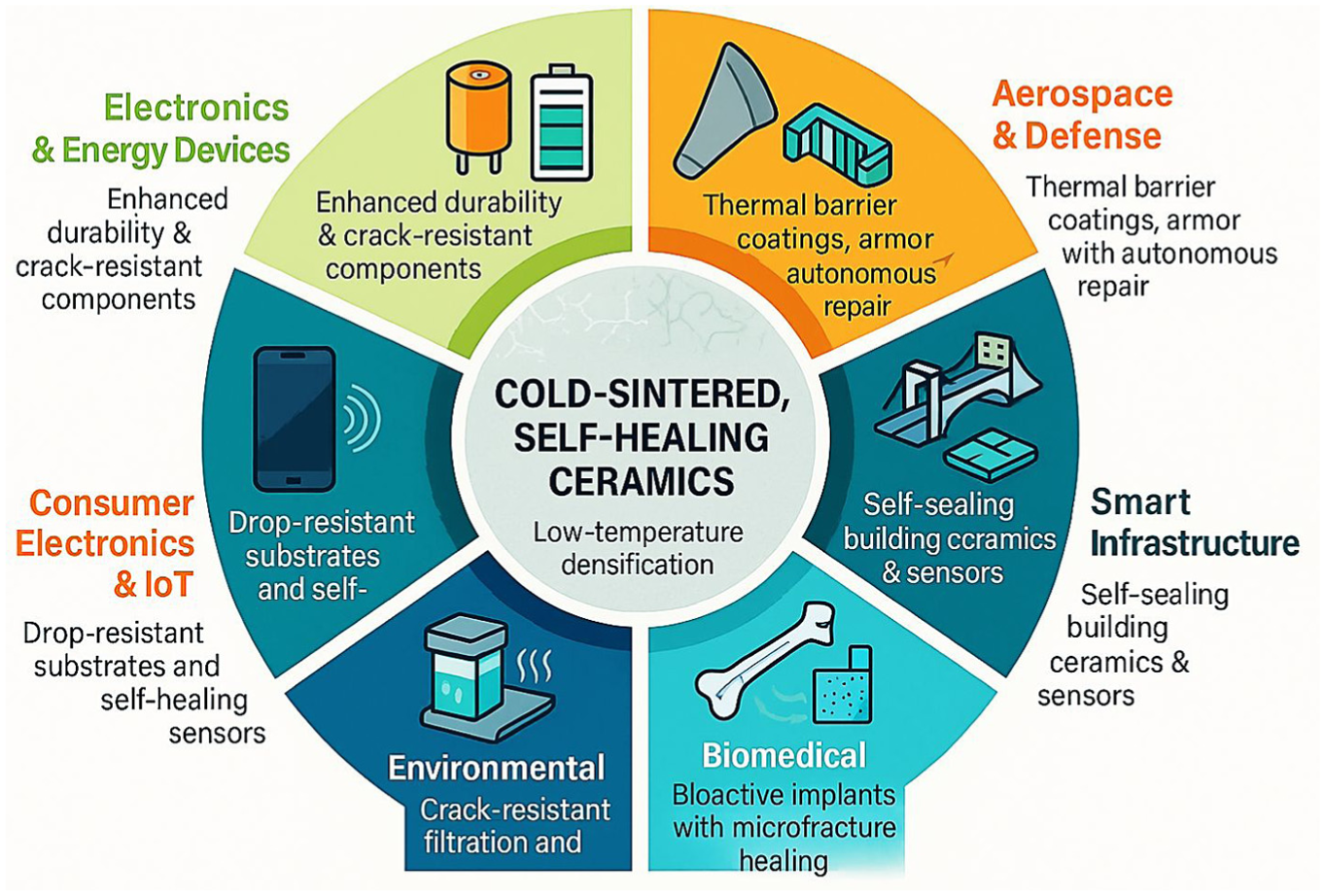
Diverse application domains that benefit from cold-sintered, self-healing ceramics.
Electronics and energy devices
In electronic applications, ceramics serve as dielectrics, piezoelectrics, semiconductors, and solid electrolytes. These components often operate under high electric fields, cyclic loading, or elevated temperatures, making them prone to microcrack formation and dielectric breakdown. CSP enables low-temperature processing of multilayer ceramics without damaging metal electrodes or polymer binders, the embedding of self-healing agents to prevent electrical failure due to crack propagation, and prolonged device life cycles in capacitors, sensors, and actuators through built-in damage tolerance. In energy storage systems, such as solid-state batteries, CSP allows the fabrication of dense, ion-conducting ceramic electrolytes (e.g. LLZO, LATP) at temperatures compatible with lithium or polymeric interfaces (Li et al., 2023). Cold-sintered LATP-Li3InCl6 composite solid-state electrolytes processed at 150°C achieve σ≈ 1.4 × 10⁻⁴ S cm−1 and stable Li plating/stripping for 1600 h at 55°C, overcoming oxide brittleness and interface resistance by introducing a halide boundary phase (Nie et al., 2024). Incorporating low-temperature healing phases in such electrolytes could mitigate dendrite growth, with potential to extend cycle life by >50% compared to unhealed counterparts. Self-healing features could further address issues like dendrite penetration or interfacial delamination. Concrete demonstrations using CSP for thermoelectrics and proton/mixed conductors illustrate both the energy and performance benefits of low-temperature densification for functional components, reinforcing the practical potential of CSP-enabled self-healing in energy technologies.
Aerospace and defense
Ceramic matrix composites and thermal barrier coatings are critical in aerospace engines and high-temperature structural components. These materials are subject to extreme thermal gradients, mechanical shocks, and erosive environments (Paladugu et al., 2022). The integration of self-healing mechanisms could seal microcracks in-flight, extending component life and reliability, reduce maintenance frequency and cost in aircraft and turbine systems, and enable field-level repair through CSP-based reprocessing, bypassing the need for full re-fabrication. The CSP is also advantageous in processing fiber-reinforced ceramic composites or ceramic laminates with tailored healing layers, enabling complex architectures without compromising interfacial integrity.
Infrastructure and construction materials
Ceramics used in civil infrastructure, tiles, cements, protective coatings, or smart sensors, face fatigue, impact, and environmental degradation over long service lives (Nguyen et al., 2023). Incorporating cold-sintered, self-healing elements into these materials offers smart functionality that adapts to cracking or stress changes, longer durability and reduced lifecycle costs in structural applications, and the potential for repairable and recyclable ceramic-based materials, aligning with circular economy goals.
Biomedical applications
Bioceramics such as hydroxyapatite, zirconia, or bioactive glasses are used in dental implants, bone scaffolds, and orthopedic devices (Manjubaashini et al., 2023). These applications demand biocompatibility, mechanical strength, and the ability to withstand physiological loads. The CSP preserves bioactivity and porosity essential for cell attachment and integration, allows incorporation of healing agents that can reseal cracks or stimulate tissue regeneration, and enables customized, patient-specific implants via additive manufacturing and low-temperature densification.
Sustainability and green manufacturing
Perhaps the most far-reaching impact of combining CSP and self-healing ceramics lies in the realm of sustainable materials processing. Moreover, CSP with nano-sized polymers (e.g. PTFE with BaTiO3) supports co-sintering and recycling of ceramic-polymer composites, highlighting its promise in sustainable material lifecycle (Zhang et al., 2024a). The approach directly addresses two critical goals: reducing embodied energy and CO2 emissions during fabrication by eliminating high-temperature kiln cycles, and extending component service life while minimizing waste through self-repair mechanisms. In doing so, this hybrid strategy aligns with global efforts in green manufacturing, lifecycle optimization, and sustainable product design, particularly as industries face increasing pressure to decarbonize and conserve resources.
Future outlook
The integration of CSP and self-healing strategies in ceramic materials is more than a technical innovation, it represents a paradigm shift toward intelligent, sustainable materials systems. However, realizing the full potential of this convergence requires focused research, technological refinement, and interdisciplinary collaboration.
Towards fully integrated, multi-functional ceramics
The next generation of structural and functional ceramics will need to do more than passively perform, they must actively respond to damage, adapt to environmental stress, and even repair themselves in service. The synergy between CSP and self-healing offers a viable path toward adaptive, resilient components that recover from wear and fatigue, low-temperature processing platforms that support multi-phase and hybrid systems, and on-demand repair technologies that reduce downtime and extend material lifetimes. To achieve this, future research must explore the co-design of microstructures, phase chemistries, and process conditions that enable these advanced behaviors without sacrificing performance.
Technological readiness and practical constraints
While CSP-enabled self-healing ceramics present a compelling conceptual framework, their practical implementation remains at an early stage of technological readiness. Most current demonstrations of CSP are limited to laboratory-scale densification under controlled pressure and solvent conditions, with limited integration of functional healing architectures. From a technology readiness perspective, CSP-based structural ceramics can be broadly considered within technology readiness level (TRL) 2–4, whereas integrated self-healing ceramic systems remain closer to TRL 1–2. Significant challenges must be addressed before real-world deployment becomes feasible.
Despite its advantages, the application of CSP to functional or electrical ceramics presents important limitations (Chi et al., 2019; Sharipova et al., 2025). The presence of transient solvent phases and potential residual species at grain boundaries may adversely affect electrical conductivity or dielectric performance (Radhakrishnan et al., 2024; Zhang et al., 2025). Hydrothermal-like reactions during CSP can introduce secondary phases, ionic impurities, or defect states that alter functional properties (Ndayishimiye et al., 2020). In addition, incomplete solvent removal or localized heterogeneities may result in performance instability over time (Rahimi Mamaghani et al., 2026). Therefore, while CSP offers promising pathways for structural and hybrid self-healing ceramics, its application to electrically sensitive systems requires careful control of chemistry, microstructure, and post-processing conditions.
One of the primary challenges is pressure delivery. CSP typically requires applied pressures in the range of 100–600 MPa, which are difficult to implement in field-repair scenarios or large-scale components (Mamaghani and Parvin, 2026). Developing localized or scalable pressure application methods remains a critical engineering barrier. In addition, solvent management presents both technical and environmental constraints. The use of transient liquid phases requires careful control to avoid residual solvent entrapment, which may degrade mechanical or functional properties over time. Material accessibility and component geometry further complicate practical implementation. For example, in-situ repair of complex ceramic structures would require not only pressure and solvent delivery but also precise control over healing agent distribution and activation. Finally, the feasibility of repeated healing cycles in CSP-fabricated ceramics remains largely unexplored. While pressure-assisted mechanisms may enable initial healing, cyclic performance could be limited by microstructural degradation, residual stresses, or depletion of healing agents. Therefore, while the integration of CSP and self-healing concepts is promising, its translation into practical systems should be viewed as a long-term research direction rather than an immediate technological solution.
Research priorities and technological needs
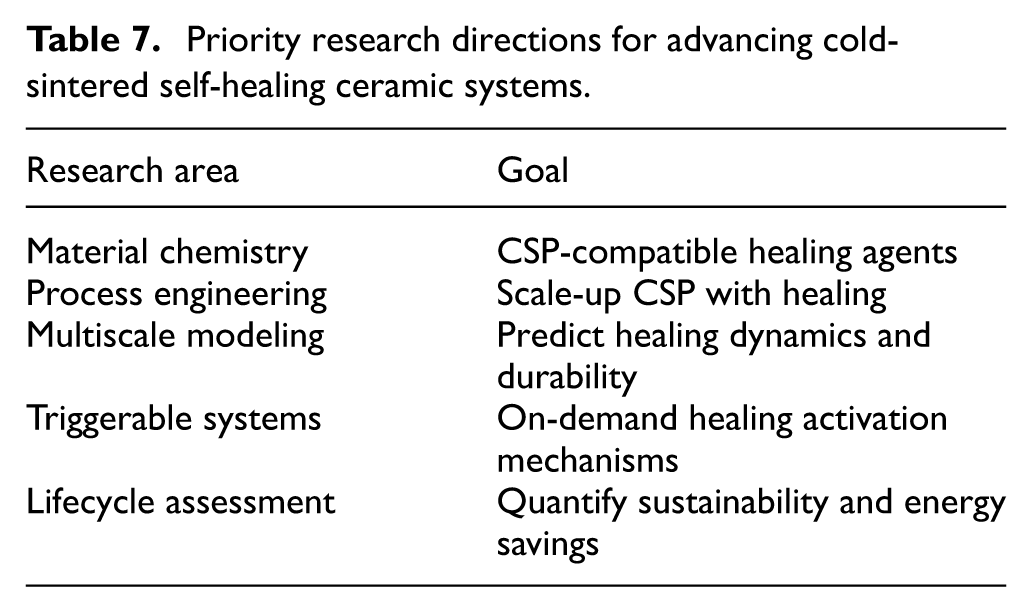
Table 7 highlights major research priorities aimed at advancing multifunctional, cold-sintered self-healing ceramic technologies. We identify several high-priority areas for future work: (1) Material system development: Expand the library of CSP-compatible ceramic systems that can accommodate or activate healing responses, especially under realistic service conditions. (2) Triggerable healing agents: Design healing phases that respond to mechanical, thermal, or chemical stimuli in a controlled, repeatable way, preferably at low temperatures. (3) Encapsulation and delivery technologies: Advance microencapsulation, surface modification, and functional dispersion methods to ensure stability and controlled activation of healing agents. (4) Scalable CSP platforms: Develop industrial-scale CSP tooling and workflows, including layer-by-layer manufacturing, in-situ monitoring, and hybrid fabrication techniques. And, (5) Lifecycle and durability modeling: Create multiscale simulation tools to predict long-term performance, healing efficiency, and reliability under cyclic and harsh conditions.
Priority research directions for advancing cold-sintered self-healing ceramic systems.
We recommend coordinated efforts on (i) pilot-scale CSP tooling development, (ii) insertion of standardized LCA and carbon-footprint metrics in early studies, and (iii) open datasets for process-microstructure-property relationships to accelerate industrial translation; recent community reviews support these priorities as critical for moving CSP from the lab to real systems. Another urgent need is the establishment of standardized benchmarks. At present, reports of healing efficiency vary widely (40%–90% property recovery) due to inconsistent testing protocols. Creating community-accepted metrics (e.g. fracture toughness recovery after N cycles or conductivity retention (%) after healing) will be essential for cross-comparison and industrial adoption. To clarify research priorities, Figure 8 presents a roadmap outlining short-, mid-, and long-term milestones for CSP/self-healing integration, ranging from near-term proof-of-concept demonstrations to long-term realization of intelligent, autonomously healing ceramics within a circular economy framework. The presented roadmap is not intended as a deterministic prediction but rather as an evidence-informed projection based on current trends in CSP, self-healing materials, and related fields such as pressure-assisted processing and functional ceramics. Recent advances in CSP have demonstrated rapid progress in densification of complex materials systems, including composites and hybrid structures, within the past decade. In parallel, the field of self-healing ceramics has evolved from high-temperature intrinsic healing toward more versatile extrinsic approaches, including microcapsule-based and polymer-assisted systems. The convergence of these trends suggests a plausible pathway toward integrated CSP-enabled self-healing systems. However, the timeline proposed here reflects a gradual progression from fundamental research (TRL 1–2) to potential prototype-level systems (TRL 3–4), rather than immediate technological deployment. Therefore, the roadmap should be interpreted as a conceptual guideline highlighting key research milestones, challenges, and opportunities, rather than a definitive forecast.
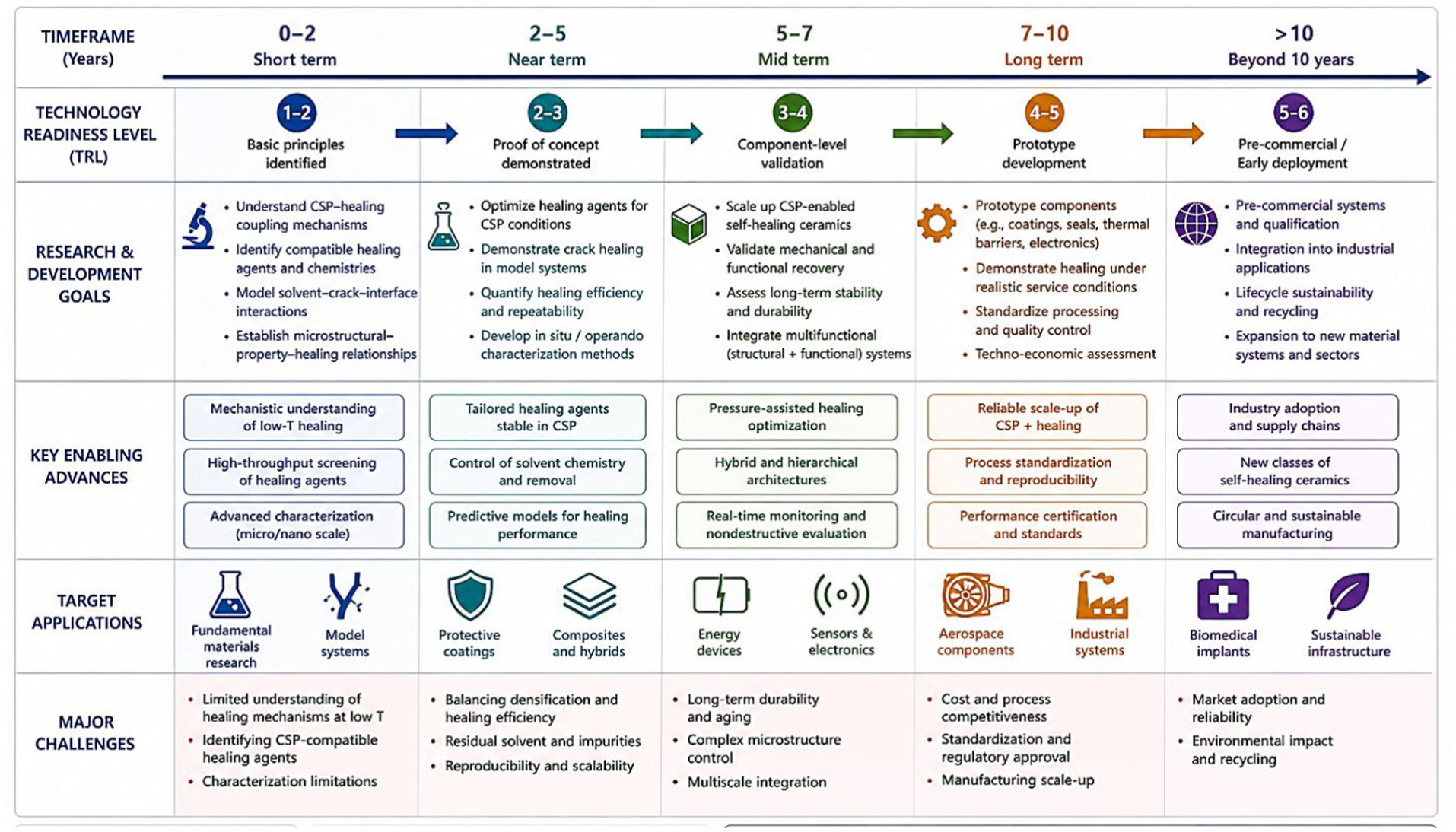
Proposed research and development roadmap for integrating CSP and self-healing ceramics. The timeline is based on current trends in CSP development, self-healing material systems, and pressure-assisted processing technologies, and reflects an evidence-informed projection of future research directions and technological milestones.
Interdisciplinary collaboration and impact
The challenges and opportunities presented by this field cannot be addressed by materials scientists alone. Progress will require coordinated input from chemists and polymer scientists, to develop responsive and compatible healing agents; mechanical and structural engineers, to model failure modes and validate healing under load; manufacturing experts, to translate lab-scale techniques into viable, scalable production lines; and sustainability analysts, to quantify lifecycle benefits and carbon reduction. With global emphasis on green manufacturing, circular materials design, and performance longevity, this integrated approach aligns strongly with emerging industrial and environmental goals. Ultimately, achieving commercially meaningful, self-healing cold-sintered ceramics will require shared benchmarks (mechanical, electrical, durability), pilot demonstrations that prove scaled process control, and life-cycle evidence of environmental benefit, steps that will persuade both industry and funding bodies to invest in this promising hybrid approach.
Conclusion
The convergence of CSP and self-healing ceramics represents a powerful new direction for the design of intelligent, sustainable materials. The CSP’s low-temperature, solvent-assisted processing enables the fabrication of ceramic systems that incorporate fragile or responsive healing agents, unlocking new functionalities that conventional sintering cannot achieve. Furthermore, CSP may itself be repurposed as an in-situ repair method, opening the door to portable, low-energy repair solutions for critical ceramic components. While scientific and engineering challenges remain (from phase compatibility to scalable integration) this synergy offers a compelling platform for innovation across electronics, energy, aerospace, biomedicine, and infrastructure. By bridging advances in processing, functionality, and durability, cold-sintered self-healing ceramics are poised to redefine the capabilities and expectations of ceramic materials in the 21st century.
Footnotes
Acknowledgements
The author wishes to thank the research board of the Amirkabir University of Technology for the financial support and the provision of the research facilities used in this work.

Author contributions
Kaveh Rahimi Mamaghani: Conceptualization, Validation, Formal analysis, Investigation, Data Curation, Writing-Original Draft, and Visualization. Nader Parvin: Resources, Writing-Review & Editing, Supervision, Project administration, and Funding acquisition.
Funding
The authors disclosed receipt of the following financial support for the research, authorship, and/or publication of this article: This research was supported by Amirkabir University of Technology (Tehran Polytechnic), Tehran, Iran.
Declaration of conflicting interests
The authors declared no potential conflicts of interest with respect to the research, authorship, and/or publication of this article.
Data availability statement
No data was used for the research described in the article.