






Abstract
Purpose
This study examined whether structured grief groups delivered with therapy dogs produced greater improvements in bereavement, prolonged grief, and resilience than the same groups delivered without therapy dogs.
Method
Using a quasi-experimental pre-post design, four 6-week groups were implemented in a county jail (n = 31), including two therapy dog-assisted groups (n = 20) and two non-animal-assisted groups (n = 11).
Results
Within-group analyses indicated significant reductions in bereavement symptoms in the therapy dog-assisted groups, whereas non-animal-assisted groups did not show statistically significant within-group change. However, between-group change-score analyses did not show statistically significant differences between conditions. Secondary combined analyses indicated significant overall decreases in bereavement and prolonged grief symptoms across participants. Resilience scores did not significantly change.
Discussion
Findings suggest grief support groups may benefit incarcerated individuals experiencing bereavement, with therapy dogs potentially enhancing emotional support and engagement.
Correctional settings pose distinct challenges to mental health and well-being. Individuals who are incarcerated experience grief and loss amid institutional and cultural conditions that often suppress emotional expression and limit opportunities for healthy coping (Hunt, 2021). At the same time, innovative approaches, such as animal-assisted interventions (AAI), have increasingly been explored to foster resilience, connection, and healing behind bars (Furst, 2006). The purpose of the current study was to examine whether structured grief and loss support groups delivered with therapy dogs produced greater improvements in bereavement, prolonged grief symptoms, and resilience than the same groups delivered without therapy dogs.
Grief, Loss, and Mental Health Needs in Correctional Settings
Grief and loss occupy a unique role within the prison system. Many individuals who are incarcerated are denied opportunities to participate in culturally meaningful rituals such as funeral services, wakes, and time with family and friends, and may also lack access to appropriate therapeutic support to process bereavement. In a study of 667 incarcerated adults aged 50 years or older, Maschi et al. (2015) found that 70% had experienced a traumatic life event, including the loss of a loved one, family separation, mental health challenges, and witnessing violence. These findings suggest that grief in correctional settings frequently occurs alongside other traumatic experiences and compounding stressors.
Incarcerated populations also experience disproportionately high rates of mental illness and substance use. Al-Rousan et al. (2017), in a study of 8,574 incarcerated individuals, reported that 48% had been diagnosed with a mental health disorder and 26% had a history of substance abuse. By comparison, the National Institute of Mental Health (2023) estimated that 23.1% of U.S. adults experienced any mental illness in 2022. This contrast underscores that incarcerated populations have elevated behavioral health needs relative to the general population, reinforcing the importance of accessible and effective therapeutic interventions.
Despite the high prevalence of mental health challenges, research indicates that incarcerated individuals’ treatment needs are often overlooked or inconsistently addressed. In a study examining incarcerated men's mental health experiences, Oliffe et al. (2018) found that incarcerated men frequently experienced disrupted or discontinued mental health treatment and struggled with the psychological burdens of confinement, isolation, and stigma, which worsened symptoms.
In Pennsylvania, where the current study was conducted, the availability of mental health treatment for state prison inmates has reportedly increased since a 2013 federal lawsuit (Little, 2022). However, national research indicates that correctional mental health care continues to be constrained by limited resources and insufficient knowledge among mental health professionals regarding the implementation of evidence-based practices in correctional environments (Grady et al., 2021; Ramezani et al., 2022). Together, these factors leave many incarcerated individuals with unmet mental health needs and few opportunities to develop coping skills while in custody.
Grief encompasses emotional, physical, social, and spiritual responses to loss, whereas mourning refers to the cultural and religious practices through which grief is expressed (Worden, 2008). Grieving in jail and prison settings poses unique challenges beyond those typically experienced in the community. Individuals who are incarcerated often face compounded losses, including the loss of freedom, autonomy, and daily contact with family and friends, as well as the death of loved ones during incarceration (Maschi et al., 2015). In correctional environments, individuals are often denied participation in mourning practices such as funerals, which may hinder adjustment to loss and complicate the grieving process (Lewin & Farkas, 2012).
In addition to institutional restrictions, prison culture often discourages emotional vulnerability. Prison culture often emphasizes emotional control, hypervigilance, and self-protection, where expressions of sadness or vulnerability may be perceived as weakness or create risk of victimization. Ward and Dewey (2024) emphasize that bereavement in prison may be actively suppressed because grief reactions can be interpreted as misconduct, weakness, or even suicidal intent. These cultural pressures may be reinforced not only by correctional staff but also by incarcerated peers. As Taylor (2012) describes in Grief Counseling in the Jail Setting, expressions of grief in jail can carry perceived risks of victimization, and emotional suppression may contribute to heightened institutional tension and violence. In this context, grief may remain unprocessed, displaced, or expressed through maladaptive coping strategies rather than healthy mourning.
The lack of supportive resources in correctional settings can further intensify these challenges. As mentioned above, licensed mental health professionals are not consistently available in many correctional settings (Grady et al., 2021; Ramezani et al., 2022), leaving individuals to manage bereavement with limited guidance or therapeutic support. Ward and Dewey (2024) conceptualized these experiences as incarceration-related cumulative grief. In their study of 74 individuals on parole, participants reported multiple forms of loss, including relationships (74.3%), time with loved ones (33.8%), reputation (18.9%), trust in family and self (20.3%), and freedom and independence (10.8%). These findings suggest that grief within correctional settings often reflects both bereavement and broader cumulative losses that may persist beyond incarceration.
Risks Associated with Unsupported Grief
When individuals are unable to grieve and process loss, psychological risks may intensify over time. Inability to mourn can contribute to serious psychological consequences, particularly when grief is suppressed and individuals cannot safely express emotions (Bryant et al., 2014). Unsupported bereavement has been linked to increased depression, anxiety, post-traumatic stress disorder, suicidality, and self-harm (Fahmy et al., 2024). These risks are especially concerning among correctional populations, who already face elevated rates of chronic stress, mental health challenges, and premature mortality (Fahmy et al., 2024).
When grief remains untreated, it may develop into prolonged grief disorder (PGD), a disabling condition affecting approximately 10% of bereaved individuals (Bryant et al., 2014). PGD is characterized by persistent yearning, difficulty accepting the death, emotional numbness, and impaired functioning, and it is now formally recognized in the DSM-5-TR (American Psychiatric Association, 2022). Recent scholarship continues to emphasize PGD's significant consequences for mental health, physical health, and daily functioning (Reynolds et al., 2023). For incarcerated individuals who face structural barriers to mourning and limited access to therapeutic support, the risk of PGD may be heightened.
The measures used in the present study have also been applied in correctional and animal-assisted intervention research. Most directly, Eaton-Stull et al. (2022) examined bereavement support groups for incarcerated women with recent or unresolved losses and compared groups delivered with therapy dogs to groups delivered without therapy dogs. Their study used the core bereavement items to assess bereavement symptoms and also measured symptoms of PGD before and after the intervention. In addition, resilience has been examined as an outcome in correctional research and correctional AAI studies. Kunz-Lomelin and Nordberg (2020) used the brief resilience scale in their evaluation of a dog-based animal-assisted intervention with men incarcerated in a Texas jail. The brief resilience scale, originally developed by Smith et al. (2008), provides a concise measure of individuals perceived ability to recover from stress and has also been used in broader correctional research with incarcerated women (Jagadish, 2021). Together, these studies suggest that the current measures are appropriate for evaluating grief-related distress and resilience in correctional intervention settings.
Animal-Assisted Interventions in Correctional Settings
Given these challenges, there is a clear need for accessible, contextually appropriate interventions that support mental health and coping in correctional settings. Research has documented significant mental health disparities between correctional populations and the general public, including higher rates of trauma exposure and psychiatric symptoms (Simes et al., 2022).
National correctional data from the United States also show disproportionately high rates of mental health problems among incarcerated individuals compared with the general population (Bronson & Berzofsky, 2017). These disparities have motivated researchers and clinicians to explore alternative approaches to supporting mental health and mitigating grief in correctional settings.
AAI involves structured interactions with animals, most commonly dogs, and has been implemented in clinical and community settings (Furst, 2006). In correctional facilities, AAI has been delivered through therapy visits, vocational dog training programs, and group-based therapeutic activities (Allison & Ramaswamy, 2016). Research has indicated that AAI can reduce stress, decrease anxiety, and foster empathy and self-worth among incarcerated participants (Topbaş & Şimşek, 2022; Villafaina-Domínguez et al., 2020). Eaton-Stull et al. (2024a) further demonstrated that incorporating therapy dogs into structured stress-reduction groups in U.S. jails and prisons produced significantly greater reductions in participant stress than groups without dogs. Similarly, Eaton-Stull et al. (2024b) found that animal-assisted dialectical behavior therapy (DBT) skills groups reduced self-harming behaviors and that participants reported greater calm, comfort, and focus during sessions.
Beyond individual studies, systematic reviews have indicated consistent psychosocial benefits. In a systematic review of prison dog programs, Villafaina- Domínguez et al. (2020) reported reductions in stress, aggression, and institutional tension along with increases in trust, empathy, and prosocial behavior. In a systematic review of animal-assisted interventions in correctional settings, Topbaş and Şimşek (2022) found improvements in inmates’ self-awareness, coping strategies, and emotional regulation. Participants frequently described experiencing unconditional acceptance and emotional support during interactions with animals, experiences that may contrast sharply with the emotional suppression typical of prison culture.
Importantly, evidence suggests that AAI may also support broader mental health and rehabilitative outcomes. Kunz-Lomelin and Nordberg (2020) reported meaningful reductions in posttraumatic stress, depression, and anxiety among male jail participants after a 5-week program. Duindam et al. (2020), in a meta-analysis of 11 studies on prison-based dog programs, found a positive overall effect, with the most substantial impact on recidivism reduction. Taken together, these findings suggest that AAI may provide both short-term psychosocial benefits and longer-term rehabilitative value.
Despite promising results, the evidence base for AAI in correctional settings remains limited. Duindam et al. (2020) noted that many studies rely on small samples, inconsistent outcome measures, and weaker research designs, with relatively few randomized controlled trials. They also highlighted the potential for publication bias, which may create an overly favorable impression of program effectiveness if null findings remain unpublished. Research in correctional settings faces additional structural barriers, including strict security protocols, selective program eligibility, and inconsistent implementation across facilities.
To strengthen the field, scholars have recommended clearer eligibility guidelines, stronger comparison groups, systematic tracking of program fidelity, and the inclusion of follow-up measures to assess longer-term outcomes (Allison & Ramaswamy, 2016). These methodological improvements are necessary to build a more reliable and generalizable evidence base. Further, although AAI has been examined in relation to stress reduction, emotional regulation, and rehabilitative outcomes, the existing body of research lacks sufficient evidence on its use to support incarcerated individuals experiencing bereavement. Given the prevalence of loss, restrictions on mourning in custody, and elevated mental health needs among incarcerated populations, this represents a significant gap in the literature.
The Current Study
The current study addresses this gap by comparing outcomes from structured grief and loss support groups delivered with therapy dogs to those from the same groups delivered without therapy dogs.
Research Questions
The current study examined whether therapy dog-assisted grief groups produced greater improvements in bereavement symptoms, prolonged grief symptoms, and resilience than grief groups delivered without therapy dogs among incarcerated individuals. These are the three research hypotheses: H1: Participants in the therapy dog-assisted grief groups will show greater reductions in bereavement symptoms, as measured by the Core Bereavement Items total score and the Images, Grief, and Separation subscales, than participants in the non-animal-assisted grief groups. H2: Participants in the therapy dog-assisted grief groups will show greater reductions in clinically significant Prolonged Grief Disorder symptoms from pre- to post-intervention than participants in the non-animal-assisted grief groups. H3: Participants in the therapy dog-assisted grief groups will show greater increases in resilience, as measured by the Brief Resilience Scale, than participants in the non-animal-assisted grief groups.
Method
This study employed a quasi-experimental, pretest–posttest comparison-group design to investigate the impact of animal-assisted grief and loss support on grief responses, prolonged grief symptoms, and resilience among individuals who were incarcerated. Quasi-experimental designs are used to examine intervention effects when participants are assigned to treatment and comparison conditions without full researcher-controlled random assignment (Shadish et al., 2002). In the present study, participants received grief and loss support either with or without therapy dogs; however, assignment was not fully random because participant selection and group placement were influenced by institutional considerations, including length of incarceration, dog allergies, safety, and logistical reasons. Groups were facilitated by a BSW student and an MSW student with support and assistance from doctoral-level faculty in social work, psychology, and criminal justice.
Participants
This research followed ethical requirements, and university IRB approval was granted.
Participants were recruited from a county correctional facility in Pennsylvania; this jail houses individuals who were recently arrested, sentenced to less than 2 years, sentenced to more than 2 years, and awaiting transfer to a prison. A recruitment flyer was distributed on the housing units, and interested individuals informed the Jail Security Captain if they wished to participate. The Captain reviewed potential participants for recent conduct issues (harm to others), cruelty to animals, or allergies to dogs.
A total of four groups were conducted: two groups with therapy dogs (AA), and two groups without therapy dogs (Non-AA). For the groups with therapy dogs, two certified therapy dogs and their handlers attended each session. Participants were able to hold, pet, and interact with the dogs throughout each session. Groups were separated by gender in accordance with correctional facility policies prohibiting mixed-gender programming among individuals who are incarcerated. Because the final groups were unequal in size, baseline comparisons were interpreted cautiously and used descriptively rather than as definitive evidence of group equivalence.
Each group started with 12 individuals, but due to the nature of jails, several participants were released from custody, transferred to another facility, or placed in restricted housing because of conduct issues; as a result, several participants were not able to complete the interventions. As an incentive, participants who completed the interventions were given an Addiction Recovery Workbook (Freedman, 2018). In the end, a total of 31 participants completed the study: 20 in the AA groups and 11 in the non-AA groups. Participants in both groups were in their late 30s, mostly male, and had been incarcerated, on average, between 4.8 and 7.8 times (Table 1). The most common current charges in both groups were substance-related.
Demographics by Group.
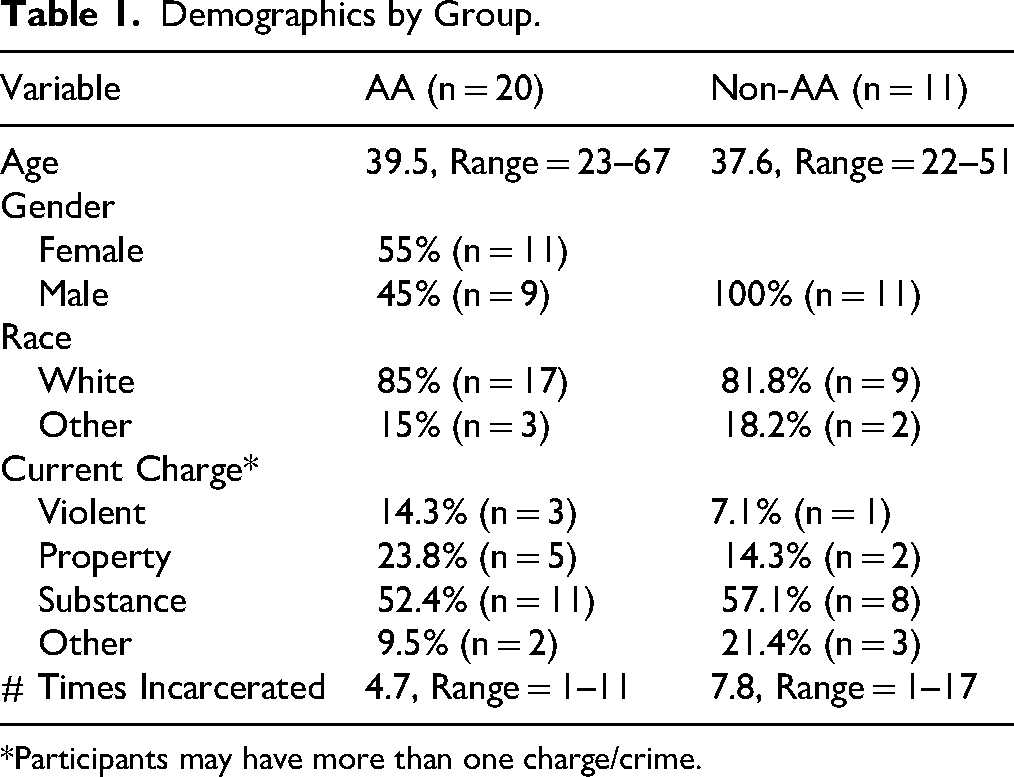
*Participants may have more than one charge/crime.
Measures
The study employed a pre- and post-test design to assess bereavement symptoms using the core bereavement items (Burnett, 1997; Burnett et al., 1997), PGD (Prigerson & Maciejewski, n.d.), and the brief resilience scale (Smith et al., 2008). Burnett's (1997) core bereavement items is a 17-item assessment measuring the severity of bereavement symptoms, with responses ranging from never to a lot of the time. The scale includes three subscales, images, grief, and separation, which evaluate intrusive images related to the loss, emotional responses to grief, and distress associated with separation from the deceased. In this sample, the core bereavement items showed excellent internal consistency (pre α = .939; post α = .935), and the subscales for images, grief, and separation demonstrated acceptable to excellent reliability (αs ranging from approximately .77 to .93). The PGD assessment evaluates the likelihood of the disorder by collecting information on separation distress, duration of distress, symptoms, and functional impairment (Prigerson & Maciejewski, n.d.; Prigerson & Maciejewski, 2025). This instrument provides a structured approach to determine whether grief reactions are persistent, severe, and interfere with daily functioning beyond normal expectations after a loss. It functions as a criterion-based diagnostic tool rather than a multi-item scale; therefore, internal consistency reliability indices like Cronbach's α were not calculated. Finally, Smith et al.'s (2008) brief resilience scale, an instrument with six items measuring resilience levels, uses responses from strongly disagree to strongly agree and demonstrated acceptable to good internal consistency in this sample (pre α = .808; post α = .758).
Participants in all groups completed the same paper-based assessments in person during the first and final group sessions. Research team members read survey items aloud to the group to support comprehension and accessibility while participants independently recorded their responses. Research team members were also available to answer participants’ questions or provide clarification as needed. These assessment tools were administered as pre- and post-tests during sessions 1 and 6. An additional informational survey (session 1) gathered data on demographics, incarceration duration, charges, losses, and level of loss support. The final survey (session 6) included questions about the helpfulness of the group in providing comfort and support in dealing with loss and its effectiveness in increasing coping skills, rated on a scale from 1 (strongly disagree) to 5 (strongly agree). It also contained open-ended questions about the most and least beneficial aspects of the groups.
Intervention Curriculum
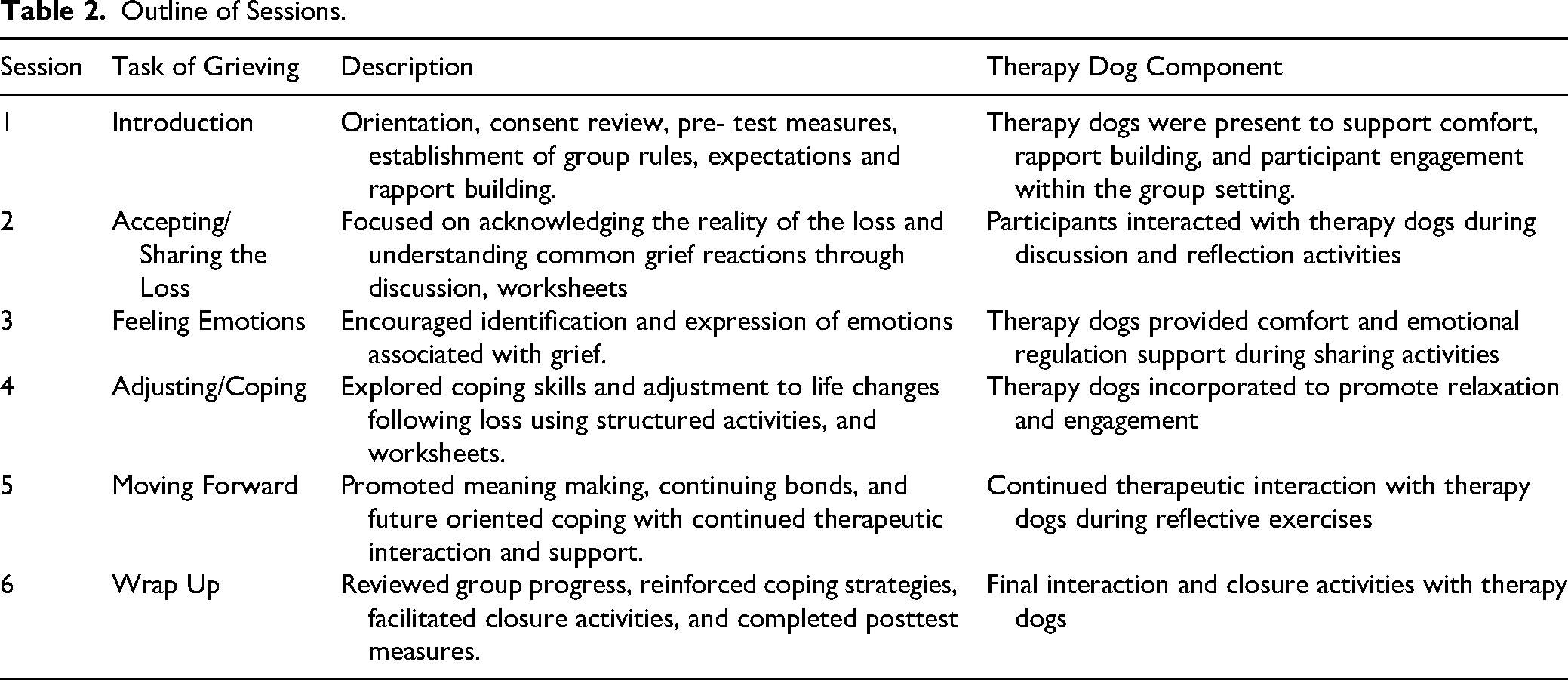
Each group lasted 1 hour and 15 minutes and occurred at the same time once a week for 6 consecutive weeks. Therapy dogs and handlers remained present throughout the AA sessions, allowing participants to interact continuously with the dogs during discussions and activities. The curriculum, based on Worden's (2008) tasks of grieving, included worksheets from Zamore and Leutenberg (2008) to assist participants in accomplishing the session goals (see Table 2 for an outline). All groups, with or without therapy dogs, received the same curriculum.
Outline of Sessions.
Analytical Plan
Data were analyzed in SPSS using nonparametric tests due to the small sample size, unequal group sizes, and non-normality of several outcome variables. Baseline differences between the AA and Non-AA groups were examined using Mann-Whitney U tests for bereavement and resilience scores and Fisher's exact test for PGD symptoms. Because the final group sizes were small and unequal (AA: n = 20; non-AA: n = 11), baseline comparisons were interpreted descriptively rather than as definitive evidence of group equivalence.
To directly evaluate the study hypotheses, change scores were calculated by subtracting pre-intervention scores from post-intervention scores. Mann-Whitney U tests were then used to compare AA and Non-AA change scores for total bereavement symptoms, the Images, Grief, and Separation subscales, and resilience. For PGD symptoms, improvement was coded as movement from PGD-positive at pre-intervention to PGD-negative at post-intervention, and Fisher's exact test was used to compare PGD improvement between groups.
Within-group pre- to post-intervention changes in bereavement symptoms and resilience were examined using related-samples Wilcoxon signed-rank tests. Changes in PGD symptoms were examined using McNemar's tests with exact p-values. Analyses were first conducted separately for the AA and Non-AA groups to examine changes within each condition. Combined group analyses were then conducted to explore whether participation in the structured grief and loss support groups, regardless of animal assistance, was associated with overall changes in outcomes. Because the combined analyses did not isolate the animal-assisted component, they were interpreted as secondary and exploratory.
Open-ended responses were reviewed as supplemental participant feedback rather than as formal thematic analysis. Responses were examined for recurring points of feedback about what participants found helpful, and selected quotes were used to contextualize the quantitative findings. Because the qualitative component was limited to a single open-ended item, findings are presented descriptively and should not be interpreted as a formal qualitative analysis.
Results
Results are presented in four sections. First, descriptive baseline comparisons are reported. Second, results are organized by the three study hypotheses. Third, secondary combined group analyses are presented to explore overall change across all participants. Finally, open-ended participant feedback is summarized descriptively.
Descriptive Baseline Comparisons
Baseline comparisons did not indicate statistically significant differences between the AA and non-AA groups on key outcome measures. The groups did not differ significantly in bereavement symptoms (U = 119.50, p = .699), resilience scores (U = 82.00, p = .26), or prevalence of clinically significant PGD symptoms (Fisher's exact p = .27). Given the small and unequal group sizes, these comparisons were interpreted descriptively rather than as definitive evidence of baseline equivalence.
Hypothesis 1: Bereavement Symptoms
Hypothesis 1 predicted that participants in the therapy dog-assisted grief groups would show greater reductions in bereavement symptoms, as measured by the core bereavement items total score and the images, grief, and separation subscales, than participants in the non-animal-assisted groups. Descriptively, total bereavement scores decreased more in the AA group (pre M = 27.60, SD = 12.01; post M = 22.40, SD = 10.12; mean change = −5.20) than in the Non-AA group (pre M = 25.68, SD = 11.02; post M = 24.95, SD = 11.20; mean change = −0.73). Change scores were compared between groups using Mann-Whitney U tests.
The between-group change-score test for total bereavement symptoms was not statistically significant, U = 85.00, p = .311, rrb = −.23, 95% CI [−.63, .21]. The negative effect size indicates that AA participants tended to show larger reductions in bereavement symptoms than Non-AA participants, but the confidence interval included zero, and the difference was not statistically significant. Change-score comparisons were also not statistically significant for the Images subscale, U = 97.50, p = .619, rrb = −.11, 95% CI [−.60, .39]; Separation subscale, U = 94.50, p = .532, rrb = −.14, 95% CI [−.55, .30]; or Grief subscale, U = 70.50, p = .104, rrb = −.36, 95% CI [−.75, .08].
Supplemental within-group Wilcoxon signed-rank tests indicated that the AA group showed statistically significant reductions in total bereavement symptoms (p = .010, r = .57), images (p = .048, r = .44), and grief (p = .001, r = .74), but not separation (p = .197, r = .29). The Non-AA group did not show statistically significant within-group change on total bereavement symptoms or any bereavement subscale. Thus, the within-group pattern was consistent with improvement in the AA condition; however, because the formal between-group change-score tests were not statistically significant, Hypothesis 1 was not statistically supported.
Hypothesis 2: PGD Symptoms
Hypothesis 2 predicted that participants in the therapy dog-assisted grief groups would show greater reductions in clinically significant PGD symptoms from pre- to post-intervention than participants in the non-animal-assisted groups. PGD improvement was defined as a change from clinically significant PGD symptoms at pre-intervention to no clinically significant PGD symptoms at post-intervention. In the AA group, 4 of 20 participants (20.0%) improved on PGD status. In the Non-AA group, 3 of 11 participants (27.3%) improved.
Fisher's exact test indicated that the proportion of participants who improved on PGD status did not differ significantly between groups, p = .676. The risk difference was −7.3% points, 95% CI [-38.9, 20.5], indicating that PGD improvement was not more common in the AA group than in the Non-AA group. Within-group McNemar's exact tests also did not show statistically significant PGD reductions when groups were examined separately (AA p = .125; Non-AA p = .250). Therefore, Hypothesis 2 was not supported.
Hypothesis 3: Resilience
Hypothesis 3 predicted that participants in the therapy dog-assisted grief groups would show greater increases in resilience, as measured by the brief resilience scale, than participants in the non-animal-assisted groups. Descriptively, resilience scores changed minimally in both groups. The AA group showed almost no change from pre-intervention (M = 3.10, SD = 0.77) to post-intervention (M = 3.10, SD = 0.87; mean change = 0.004), and the Non-AA group showed a small decrease from pre-intervention (M = 3.48, SD = 0.83) to post-intervention (M = 3.45, SD = 0.45; mean change = −0.04).
A Mann-Whitney U test comparing resilience change scores was not statistically significant, U = 126.00, p = .521, rrb = .15, 95% CI [−.31, .56]. The effect size was small, and the confidence interval included zero, indicating no clear evidence that resilience increased more in the AA group than in the Non-AA group. Supplemental within-group Wilcoxon signed-rank tests also showed no statistically significant resilience change in either the AA group (p = .737, r = .08) or the Non-AA group (p = .822, r = .07). Therefore, Hypothesis 3 was not supported.
Secondary Combined Group Analyses
Secondary analyses examined whether participation in structured grief and loss support groups, regardless of dog assistance, was associated with overall change. In the combined sample (N = 31), total bereavement symptoms decreased significantly from pre-intervention (M = 26.92, SD = 11.52) to post-intervention (M = 23.31, SD = 10.41), p = .034, r = .38. The grief subscale also decreased significantly from pre-intervention (M = 7.47) to post-intervention (M = 5.61), p = .002, r = .56. The Images subscale (p = .106), separation subscale (p = .383), and resilience scores (p = .990) did not show statistically significant change in the combined sample. McNemar's exact test indicated a statistically significant reduction in clinically significant PGD symptoms in the combined sample (p = .016). Because these combined analyses do not isolate the animal-assisted component, they are interpreted as evidence that structured grief-support groups may be beneficial overall, not as evidence of a specific therapy-dog effect.
Open-Ended Participant Feedback
Participants completed an open-ended question after the intervention asking them to describe the most helpful part of the group. These responses were reviewed to provide supplemental context for the quantitative findings rather than as a formal qualitative, thematic analysis. Written responses from participants in both the AA and Non-AA groups were examined for recurring points of feedback, and representative quotes were selected to illustrate how participants described the perceived benefits of the intervention.
Across responses, participants described the group as a setting that allowed them to speak openly about grief and loss. Several participants emphasized feeling comfortable, accepted, and less judged during group discussion. For example, participants stated, “I got to express myself without anyone looking down on me,” “Being able to comfortably talk,” and “Helped me be OK with talking around unknown people and get outta my comfort zone.”
Participants also described the value of shared experience and connection with others who had experienced loss. Responses suggested that hearing others’ stories helped reduce feelings of isolation and made grief feel more understandable and manageable. Participants described the helpfulness of “hearing other people's stories and how they dealt with them,” “being able to talk to people going through the emotions I am,” and “being able to open up and talk with others who have felt loss.”
Other participants focused on coping and reflection. Several responses indicated that the group helped participants identify coping strategies, think differently about their grief, and reflect on memories of loved ones. Participants stated that the group “got me to think of new coping skills,” helped with “recogniz[ing] what I was doing and how much I missed my loved one,” and “brought up good memories… and how to move forward.”
Finally, some responses highlighted the importance of contextual supports within the correctional environment. Participants described the value of being out of their cell and, among those in the AA groups, the comfort provided by the dogs. Examples included “getting out of my cell,” “the dogs really helped with stress. I always felt better after,” “talking about my past loss and also the comfort of the dogs,” and “having the dogs to pet.” These responses suggest that participants experienced the groups as supportive and meaningful, while also indicating that perceived benefits may have reflected multiple components of the intervention, including group discussion, shared grief experiences, coping-skills practice, temporary relief from the jail environment, and, for AA participants, interaction with therapy dogs.
Discussion
The findings of the present study suggest that structured grief and loss groups may be beneficial for incarcerated individuals experiencing bereavement, and that therapy dogs may serve as a meaningful adjunct to these groups. Participants in the AA group demonstrated significant within-group reductions in overall bereavement symptoms from pre- to post-intervention, including reductions in the images and grief subscales. Participants in the Non-AA group did not show statistically significant within-group changes on these outcomes. Although the additional between-group change-score analyses did not show that reductions in the AA group were statistically greater than those observed in the Non-AA group, the pattern of findings suggests that therapy dogs may have contributed to a supportive group environment that facilitated emotional expression, comfort, and engagement. Thus, the findings should be interpreted cautiously: they do not provide definitive evidence that therapy dog-assisted groups were superior to non-animal-assisted grief groups, but they do suggest that therapy dogs may be a promising adjunct to grief-focused group work in jail settings.
These findings are important given the unique challenges incarcerated individuals face when grieving. Incarcerated individuals often experience loss in the context of reduced autonomy, separation from family and social support, and limited access to mourning rituals, all of which may exacerbate the hardship associated with the death of a loved one (Harner et al., 2011). Correctional culture may also discourage open emotional expression, including sadness, longing, and vulnerability, leaving individuals with few opportunities to process grief in healthy ways (Hunt, 2021). This may contribute to disenfranchized grief, in which individuals have no appropriate outlet for mourning and limited closure through practices such as paying respects to the deceased or attending funeral services. As a result, incarcerated individuals may experience heightened depression, behavioral concerns, and social isolation, particularly when social support is limited (Fahmy et al., 2024).
The present findings suggest that grief-support groups may help address some of these unmet needs by creating structured opportunities for emotional expression, connection, and coping within the jail setting. Across groups, bereavement symptoms decreased from pre- to post-intervention, suggesting that the group intervention itself, not only the presence of therapy dogs, may have contributed to symptom reduction. This finding has important clinical implications. Although therapy dogs may support comfort, engagement, and emotional regulation, facilities that cannot offer AAI may still benefit from implementing structured grief-support groups. Group-based grief interventions can provide incarcerated individuals with a rare opportunity to speak openly about loss, hear others’ experiences, normalize grief reactions, and practice coping strategies in a supportive environment. In jail settings, where mental health resources are often limited and mourning rituals may be restricted, even non-AA grief groups may offer meaningful clinical value by creating space for emotional expression, connection, and reflection.
The role of therapy dogs should therefore be understood as potentially enhancing, rather than replacing, the therapeutic value of structured group work. In correctional settings, where emotional vulnerability may be discouraged and trust can be difficult to establish, therapy dogs may help create a calmer and less threatening environment for grief-related disclosure. Participant feedback from the AA groups supported this interpretation, with some participants specifically identifying the dogs as helpful for stress reduction, comfort, and emotional support. These responses are consistent with prior correctional AAI research suggesting that animals may promote calm, engagement, and relational safety (Máximo-Bocanegra et al., 2025; Villafaina-Domínguez et al., 2020). At the same time, because the between-group effects were not statistically significant, the present findings should be viewed as preliminary and should be tested in larger studies with stronger power to isolate the unique contribution of the therapy-dog component.
Although exploratory, the combined group analyses further support the potential value of structured grief-support groups in correctional settings. When all participants were examined together, bereavement symptoms and prolonged grief symptoms decreased significantly from pre- to post-intervention. These findings should not be interpreted as evidence of a unique therapy-dog effect because the combined analyses do not isolate the animal-assisted component. Rather, they suggest that structured grief-support groups may represent a feasible and clinically meaningful intervention for incarcerated individuals, including in facilities where therapy dogs are not available. This interpretation is consistent with prior research supporting the value of grief-focused interventions in correctional settings (Eaton-Stull et al., 2022). Given the lack of services for incarcerated individuals experiencing bereavement (Horowitz et al., 2025; Lewin & Farkas, 2012), interventions that provide human connection and opportunities to share experiences of loss and grief are especially needed.
Contrary to study predictions, resilience did not increase significantly for the AA group compared with the Non-AA group, nor did resilience increase overall when participants were examined together. Although the intervention included some resilience-building components, such as coping strategies, social support, and breathing exercises, these brief components may not have been sufficient to produce measurable changes in resilience over the 6-week period. More sustained, skill-based interventions grounded in models such as PERMA (positive emotion, engagement, relationships, meaning, and accomplishment) may be needed to produce detectable improvements in resilience (Seligman, 2018). In the present study, AAI may have been more relevant for supporting emotional expression, comfort, and engagement than for producing short-term changes in resilience.
Taken together, the quantitative and open-ended findings suggest that structured grief and loss groups may provide a valuable, trauma-informed intervention for incarcerated individuals. Therapy dogs may strengthen this process by increasing comfort, reducing stress, supporting emotional regulation, and helping participants engage more fully with difficult grief-related material. However, the findings also indicate that group-based grief support itself has clinical value, even when therapy dogs are not available. Overall, the study provides preliminary support for structured grief group interventions in jail settings and suggests that therapy dogs may be a promising adjunct that warrants further study in larger, more rigorous evaluations.
Limitations of This Study
The present study has several important limitations that must be acknowledged. First, the quasi-experimental design, which lacked random assignment, limits causal inference regarding the effects of animal-assisted intervention (AAI) on observed outcomes. In other words, this study could not definitively discern if having a bereavement group with dogs, a bereavement group in general, or “just” having a shared space for bereavement affects incarcerated individuals’ well-being and how they cope with their grief. The small overall sample size (N = 31) limited statistical power, increasing the risk of Type II error, particularly in between-group analyses, and unequal group sizes may have further compromised group comparability and estimates of intervention effects. With respect to generalizability, the predominantly White sample and the use of a single county jail restrict the applicability of findings to more diverse incarcerated populations and other correctional contexts. Participant self-selection may have resulted in a highly motivated sample with greater affinity for animals, potentially influencing intervention outcomes, and the absence of participant or facilitator blinding may have increased susceptibility to expectancy effects in the animal-assisted groups. Additionally, because both conditions involved structured groups with limited formal assessment of intervention fidelity, treatment contamination may have reduced the ability to isolate the unique contribution of therapy dogs. Some participants withdrew due to factors inherent to correctional settings, which may have introduced attrition-related bias and threatened internal validity. Measurement and timing limitations were also present, as the exclusive reliance on self-report measures heightened vulnerability to social desirability bias, the 6-week intervention period constrained detection of more gradual or cumulative changes, and the absence of follow-up assessments prevented evaluation of the long-term maintenance of observed effects. Finally, combining groups to increase statistical power may have obscured condition-specific effects, complicating the interpretation of the findings.
Future Directions
Future research should prioritize more rigorous experimental designs, including randomized or matched comparison approaches to strengthen causal inference regarding the effects of animal-assisted interventions (AAI) in correctional settings. Larger samples, different type of animals, and multi-site studies across jails and prisons are needed to improve statistical power and generalizability. Additionally, extending intervention duration, assessing intervention fidelity, incorporating longitudinal follow-up, and utilizing multi-method outcome measures beyond self-report will help determine the sustainability and scope of observed effects. Incorporating qualitative methods to explore participant perceptions may help illuminate the mechanisms through which AAI affects outcomes. Finally, intentional recruitment of more diverse incarcerated populations where feasible, and attention to culturally responsive adaptations will strengthen future research on the relevance and applicability of AAI across correctional populations.
Footnotes
Acknowledgments
A special thanks to the wonderful Alliance of Therapy Dog teams who assisted in making this research possible.

Funding
The authors disclosed receipt of the following financial support for the research, authorship, and/or publication of this article: This work was supported by the Slippery Rock University Grant for Student Research, Scholarly and Creative Activity Program.
Declaration of Conflicting Interests
The authors declared no potential conflicts of interest with respect to the research, authorship, and/or publication of this article.