






Abstract
Siblings of patients that have lengthy stays in the neonatal intensive care unit (NICU) may be affected emotionally by their brother’s or sister’s condition, separation, or even death. In an effort to assess the effect of perinatal loss on siblings a student-led inquiry was designed and tested. A scripted interview was composed to determine whether or not children were effectively processing the loss of their sibling. While a single case is reported, the methodology proved useful and opens the door to further consideration of providing sibling-oriented grief and bereavement services in the NICU.
Background
Having a child in the neonatal intensive care unit (NICU) is a stressful time for parents and a confusing time for siblings. With the family in crisis, parents and health care providers focus most of their energy on the well-being of the infant, sometimes leaving the needs of the siblings to be overlooked. 1,2 Siblings of all ages have expectations leading up to the birth of a new sibling and are also thrown into a state of confusion with the critical care needs of their new brother or sister. Many neonatal ICUs vary in their incorporation of siblings into visitation policies. 1 In a recent study where surviving siblings, now adults, were interviewed about their experience in the NICU they remembered desiring to be involved with their sibling, expressing that any involvement they had with their sibling was a treasured experience. 3 Knowing the value of NICU involvement for the sibling, the next steps are to provide resources for siblings to guide them through their time in the NICU, provide explanations, and also consider grief services that could extend beyond the family’s time in the NICU in the event that the infant dies.
As part of a student research initiative at the Vanderbilt University School of Medicine, the authors undertook a study to assess the effect of perinatal loss on siblings with a brother or sister who died after care in the NICU at the Monroe Carell Jr Children’s Hospital at Vanderbilt. This report relates the findings of one such case study conducted during this student-directed project.
Methods
A literature review was conducted and a paucity of published studies addressing sibling grief following a perinatal loss was noted. Families of infants who had died in the NICU during a period no more recent than 6 months or longer than 2 years were identified. The medical record was reviewed to note the presence of siblings. An initial letter introducing the investigators and the project was mailed, and after 2 weeks the parents were called to request participation and schedule interviews.
A scripted interview was composed for use in either by telephone or face to face with siblings of infants who had died in the NICU. The sibling needed to be 5 or more years old to participate in the study. Children aged 5 to 12 years were required to be physically present with their parent to conduct the interview. Interviews were conducted by the investigator at Vanderbilt, but away from the NICU, in the presence of the sibling’s parents. An NICU social worker was present for all interviews. Verbal responses were pursued, as were expressive responses to include artwork, writing, and song. Telephone interviews were an option for children 13 to 17 years of age—and would be conducted with the sibling, the parent, the social worker, and the investigator together on a conference call. The aim of the interview was to determine whether the child was effectively processing the loss of their sibling. The scripted interview is noted in Appendix A. Parental informed consent was sought for the interview, as was assent from the sibling—indicative of his or her willingness to participate. The institutional review board at Vanderbilt University Medical Center approved the protocol.
In addition to the scripted interview verbal responses, a facial expression coding system was composed by adapting the well-known and validated Wong-Baker FACES Pain Rating Scale. 4 The adaptation was made specific to this study’s interest in measuring sibling sadness. It incorporated a recognizable facial expression with the sibling child’s self-report of sadness when thinking about his or her sibling from the NICU who had died (Figure 1).
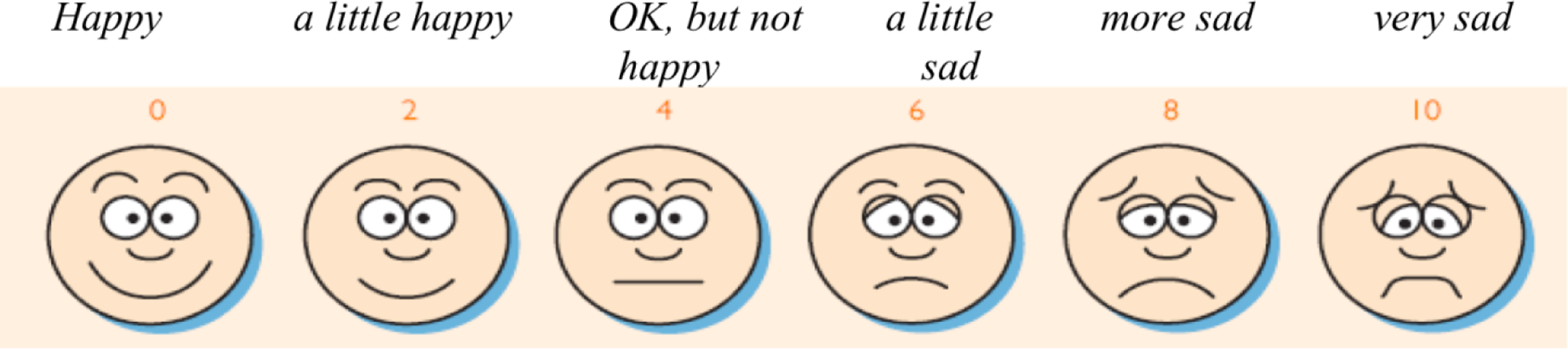
The sibling being interviewed is asked to circle the face that best represents their own feelings when they think about their sibling who died in the neonatal intensive care unit (NICU). Adapted from Wong-Baker FACES Pain Rating Scale.4 © 2001 The University of Texas MD Anderson Cancer Center, Revised April 5, 2001; Patient Education Office.
Results
A total of 30 eligible participants, from 20 families, were identified. Of these, 1 family had no traceable address and another opted out of the process. Of the remaining 18 families, 11 could not be reached by telephone, despite repeated efforts. Seven families were contacted by telephone. Two families were not interested in completing the study or concerned about their child’s participation. Three families expressed interest but could not schedule an interview during the 3-month window that this study was active. One of the remaining 2 families scheduled an interview but canceled the day that it was to be held for reasons unrelated to the project. In the end, 1 family participated and completed the interview.
The single interview (with Sarah, who was 10 years old) was conducted 20 months after the death of her sister, Shelby. Both parents were present. The results revealed the following. Sarah had both held her baby sister and fed her through a feeding tube while she was in the NICU. When her sister died, Sarah was “sad, shocked, mad.” She stated that she had no good memories of her Shelby, except that she got to hold her. Following her sister’s death, Sarah reported that she sometimes has anxiety about her parents dying. She does not know whether she would want to have a new baby brother or sister.
As an effort to cope with her sister’s death, Sarah talks with her parents about her baby sister, Shelby. Additionally, Sarah wrote a song with her dad (who plays the guitar) to honor her sister’s memory.
Discussion
From this single interview, and the research process and case reviews of potential beneficiaries of other interviews, it is evident that the loss of a perinatal sibling or a sibling child is devastating. That sibling grief occurs in the NICU should not be surprising, as childhood sibling death in other settings has been well reported. 5,6 Within the NICU, the loss of a twin, or other multiple birth, sibling has also been noted to pose difficulties for parents and surviving siblings alike. 7 Without adequate intervention, children may suffer unnecessarily from the consequences of complicated grief, which can impact on many areas of their lives for years to come. 3,8
What interventions can be viewed as beneficial for siblings in such a precarious environment? The potential value of a supervised introduction to the NICU for siblings has not been well explored. Visitation policies vary widely, and seasonal concerns for infectious disease exposure or the potential for sibling emotional or behavioral upset may preclude some NICUs from exploring this further. 1 Yet, if parents of a child in the NICU desire older siblings to both know and accept that they have a hospitalized baby brother or sister, it would appear natural to facilitate this in a patient and in a family-centered manner. Such a supervised introduction might be preceded by informal education, speaking with a nurse, social worker, psychologist, or child life specialist. It would also need to be developmentally appropriate—sensitive to the sibling’s age and cognitive development—and the forewarning of the infant being very sick, or even dying, might need to be considered in the individual family and cultural context. 9 Many hospitals host an annual memorial service for families who have experienced perinatal loss—including the death of a young infant in the NICU or pediatric critical care unit (PCCU). Inclusion of siblings in these events may prove beneficial—but this has not been formally studied.
Parents of NICU patients can also be advised upon admission of opportunities that might be made to allow for visitation and sibling education. Alternatively, given the stress and logistical inconvenience that parental presence in the NICU may have on a family, organized or supervised sibling care in a site outside of the NICU but easily accessible to parents or extended family would be worth consideration.
The staff in the modern patient and family-centered care NICU may need to make an effort to learn about the family composition of their patients. Are there older siblings? What are their ages? Do they understand—or do their parents desire assistance in helping them to understand—that their baby sibling is in the hospital and may be a long time in coming home? What if the sibling has never visited and the possibility of the NICU patient’s death is anticipated—should a trained social worker or bereavement counselor, chaplain, or psychologist be offered in support? A holistic approach to palliative care would, indeed, include sibling support among interdisciplinary supports provided to the family and may be a noticed, but minimally voiced, concern for NICU staff. As hospitals develop palliative care services and extend their services to young children and families with a loved one in a neonatal ICU or a PCCU, support services for families need to embrace siblings.
This study is limited by design to incorporate families who had an inclination to respond to an opportunity to interview. The authors cannot exclude the potential of selection bias in seeing participants—or the single case who completed the study—represent only those families that, more likely than not, had openly communicated about their loss in another setting (eg, at home, in counseling, or through a religious community). The original 3- to 6-month time frame for conducting this student-led study also constrained the option to follow through with larger numbers. However, the utility of this model, and method of inquiry, is offered with anticipation that a more formal study might be designed and conducted. Such a study would require more baseline information on sibling bereavement—poorly quantified at present—that could be gathered before the introduction of a testable sibling support program. Measures of the impact that such a program might have could be directed at parents, siblings, and NICU staff over a 1- to 2-year time frame.
Footnotes
Appendix A
Declaration of Conflicting Interests
The authors declared no potential conflicts of interest with respect to the research, authorship, and/or publication of this article.
Funding
The authors received no financial support for the research, authorship, and/or publication of this article.