







Abstract
This study aimed to clarify the general public’s perceptions of opioids and palliative care units (PCUs) and explore factors related to such perceptions. A cross-sectional, anonymous questionnaire was administered to 8000 people. Although a majority agreed with positive perceptions of opioids and PCUs, some also agreed with negative perceptions, such as opioids are addictive and shorten life (28% and 27%, respectively). Multiregression analyses revealed that respondents with a better knowledge of PCUs had higher positive perceptions than those without such knowledge (P <.001). The higher positive perceptions were associated with a higher sense of security regarding regional cancer care (P < .001). Providing the general public with adequate knowledge about palliative care may improve perceptions of palliative care and the sense of security.
Keywords
Introduction
The numerous barriers to quality end-of-life care are related to patients, families, medical professionals, and the health care system itself. 1 –3 In addition, knowledge, beliefs, and perceptions of palliative care in the general public represent potential barriers to providing quality palliative care. Previous studies 4,5 revealed that a significant number of the general public have insufficient awareness of palliative care units (PCUs) and incorrect beliefs and perceptions of palliative care, including misconceptions that “opioids shorten life.” Thus, palliative care education is important for the general public. For effective educational intervention, the associations between peoples’ characteristics and their perceptions need to be defined; however, previous studies failed to identify such associations.
A sense of security is being acknowledged as a comprehensive end point for regional cancer care 6 –8 ; therefore, we developed a “sense of security scale” to measure perceptions of the regional availability of competent professionals and adequate access to health care resources. 9 Despite the sense of security within a general population reflecting awareness and the quality of available regional health care services, 9 no empirical studies have explored the potential association between such a sense of security and perceptions of palliative care within the general public. By clarifying this association, interventions to alter perceptions of palliative care could potentially serve as a strategy for improving the sense of security.
Thus, the aims of this study were to (1) clarify the perceptions of opioids and PCUs; (2) explore factors related to the perceptions; and (3) explore the associations between the levels of a sense of security and perceptions of opioids and PCUs.
Methods
This study was conducted as part of the Outreach Palliative Care Trial of the Integrated Regional Model (OPTIM) study launched by the Ministry of Health, Labour, and Welfare in Japan. 10 –12 The OPTIM study is a regional intervention trial with the aim of establishing a regional palliative care model in 4 areas of Japan: a large urban area (Kashiwa, Chiba Prefecture), a smaller urban area (Hamamatsu, Shizuoka Prefecture), and 2 rural areas (Nagasaki, Nagasaki Prefecture and Tsuruoka, Yamagata Prefecture). In the first 3 areas, palliative care services are available, while in Tsuruoka such services are sparse.
We administered a cross-sectional, anonymous questionnaire survey. In the questionnaire, we explained the aim of the study and regarded returned and completed questionnaires as consent for participation. The ethical and scientific validity of this study was confirmed by the institutional review board, independent of the research project, which was organized by the Japan Cancer Society, the organization responsible for conducting the OPTIM study.
Population and Procedures
We identified 8000 participants within the general population from 40 to 80 years of age using a stratified, 2-stage random sampling of residents in the 4 areas (2000 participants in each area). We mailed questionnaires to potential participants in July 2007, and if the questionnaire was not returned, a reminder postcard was sent.
Measurements
We investigated the following topics: (1) perceptions of opioids, (2) perceptions of PCUs, and (3) the sense of security regarding regional cancer care. The questionnaire was developed through expert consensus among the present authors and based on previous studies 4,5 found through an extensive literature review.
We asked the respondents to rate, on a 5-point Likert-type scale (1 = strongly disagree, 2 = disagree, 3 = unsure, 4 = agree, 5 = strongly agree) the extent to which they agreed with statements about their perceptions of opioids and PCUs. Perceptions of opioids were examined using the following statements: positive beliefs were measured with the statements “opioids can relieve most pain caused by cancer,” while negative beliefs were measured with the statements that “opioids are addictive” and “opioids shorten life”. Perceptions of PCUs were examined using the following statements: positive perceptions were measured with 4 statements that PCUs “relieve pain and distress,” “support patients in living with dignity,” “provide care for families,” and “provide patients with autonomy”; and negative perceptions were measured with 5 statements that PCUs “provide no medical treatment such as infusion or radiation,” “are difficult to be admitted to because of long waiting times,” “represent a place where patients only wait to die,” “are where only patients who received cancer treatment in the hospital could be admitted to,” and “are expensive.”
The sense of security was measured using the 5-item scale to assess feelings of support and security regarding cancer care in each region. The statements were (1) “I would feel secure in receiving cancer treatment,” (2) “my pain would be well relieved,” (3) “medical staff will adequately respond to my concerns and pain,” (4) “I would feel secure as a variety of medical care services are available,” and (5) “I would feel secure in receiving care at home.” We asked participants to rate their level of agreement with the statements on a 7-point Likert-type scale (1 = strongly disagree, 2 = disagree, 3 = slightly disagree, 4 = not sure, 5 = slightly agree, 6 = agree, and 7 = strongly agree). Factor validity was established based on the emergence of 1 factor by explanatory factor analysis, and a high Cronbach’s α coefficient (.91) demonstrated sufficient internal consistency. 9
Demographic data, such as the age, gender, area where the respondent lived, duration of residence in the region, current treatment of health problems, diagnosis of cancer (whether the respondent is currently undergoing treatment or posttreatment), and family members’ experience of cancer as well as having sound knowledge of PCUs, were included in the questionnaire.
Statistical Analyses
Initially, we conducted descriptive analyses of demographic data and each response regarding perceptions of opioids and PCUs. Then, to identify factors associated with the perceptions, multiregression analyses were conducted. In the analyses, scores summing each of the negative perceptions of opioids (2-statement items), positive perceptions of PCUs (four-statement items), and negative perceptions of PCUs (5-statement items) were used as the independent variables; Cronbach’s α coefficients for each score were .72, .83, and .62, respectively. For the positive perceptions of opioids, scores of the single items were used as independent variables.
Furthermore, associations between the perceptions of opioids and PCUs and the sense of security were also considered using multiregression analyses. Responses regarding the perceptions of PCUs were missing in the Tsuruoka area because palliative care services were not available at the time of the survey in this region. Therefore, we considered the perceptions of opioids and PCUs in separate multiregression analyses.
Statistical analysis was performed using SAS version 9.1 (SAS Institute, Inc, Cary, North Carolina). The significance level was set at <.05 (2-tailed).
Results
Characteristics of Participants
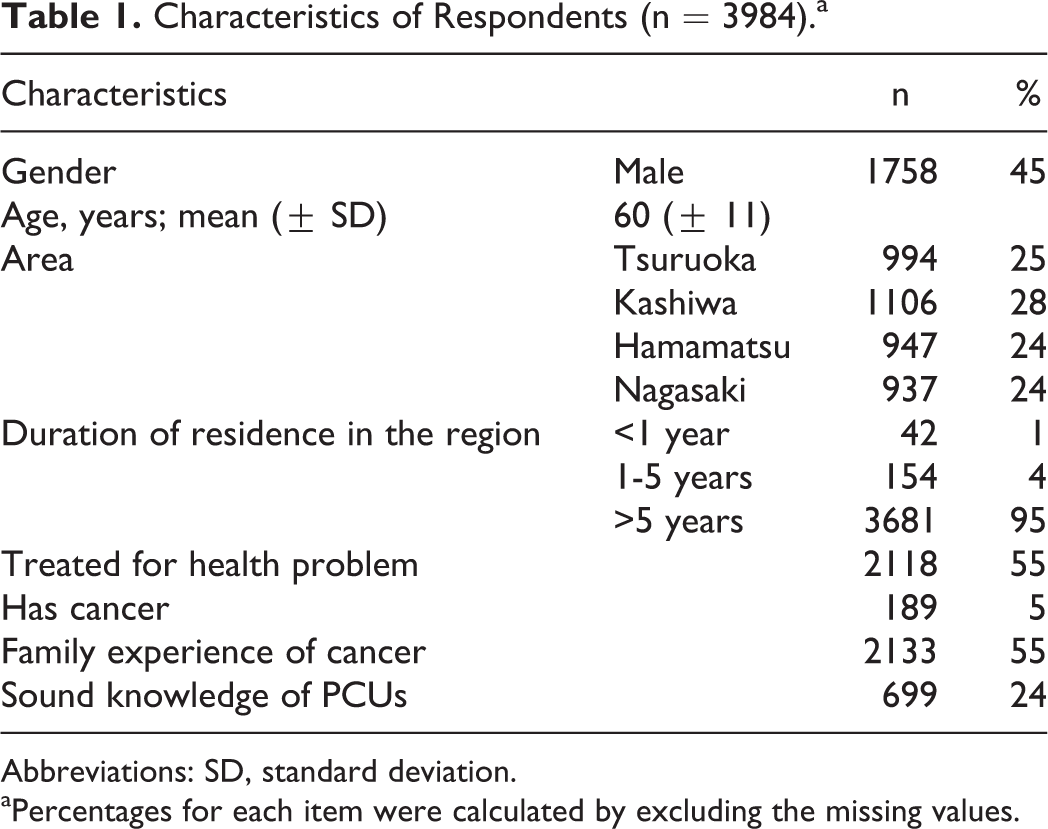
Of the 8000 questionnaires mailed, 26 were undeliverable and 3984 were returned and analyzed (for an effective response rate of 46.8%). Table 1 summarizes the characteristics of the respondents. The mean age ± standard deviation (SD) was 60 ± 11 years, and 45% were men. In all, 5% of the respondents had cancer and 55% had experience of cancer in the family; 24% of the respondents had a sound knowledge of PCUs.
Characteristics of Respondents (n = 3984).a
Abbreviations: SD, standard deviation.
aPercentages for each item were calculated by excluding the missing values.
Perceptions of Opioids and PCUs
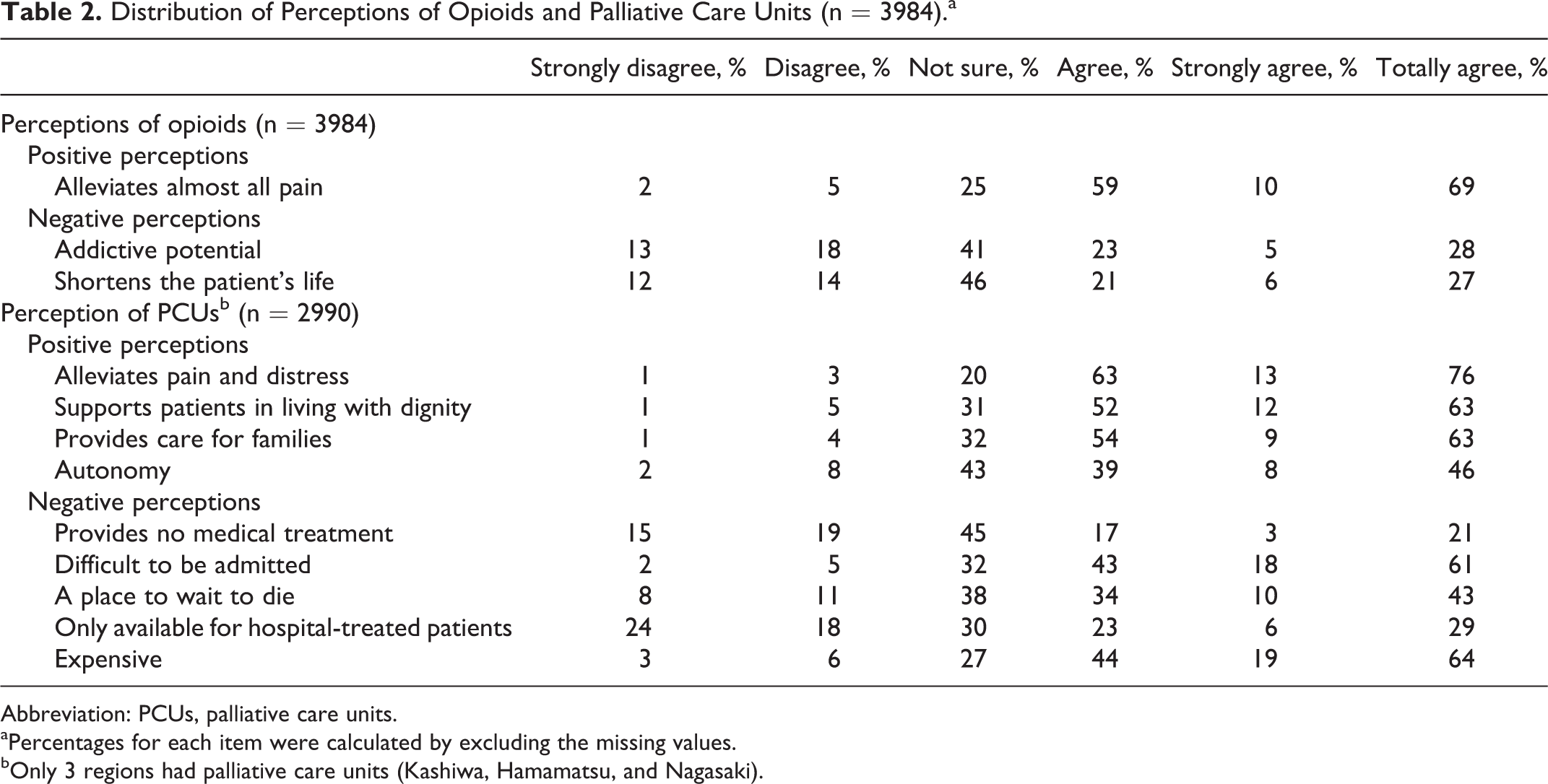
As shown in Table 2, although 69% of the respondents agreed that opioids can relieve most pain caused by cancer, 28% and 27% believed that opioids are addictive and shorten life, respectively.
Distribution of Perceptions of Opioids and Palliative Care Units (n = 3984).a
Abbreviation: PCUs, palliative care units.
aPercentages for each item were calculated by excluding the missing values.
bOnly 3 regions had palliative care units (Kashiwa, Hamamatsu, and Nagasaki).
Regarding perceptions of PCUs, although a majority of respondents agreed with positive perceptions, including beliefs that PCUs relieve pain (76%), maintain dignity (63%), and support the family (63%), 43% of the participants responded that they were “not sure” whether PCUs provided autonomy. Furthermore, many respondents also agreed with the negative perceptions that it is difficult to be admitted to PCUs (61%), the cost is expensive (64%), and that a PCU is a place to die (43%; Table 2).
Factors Associated With Perceptions of Opioids and PCUs
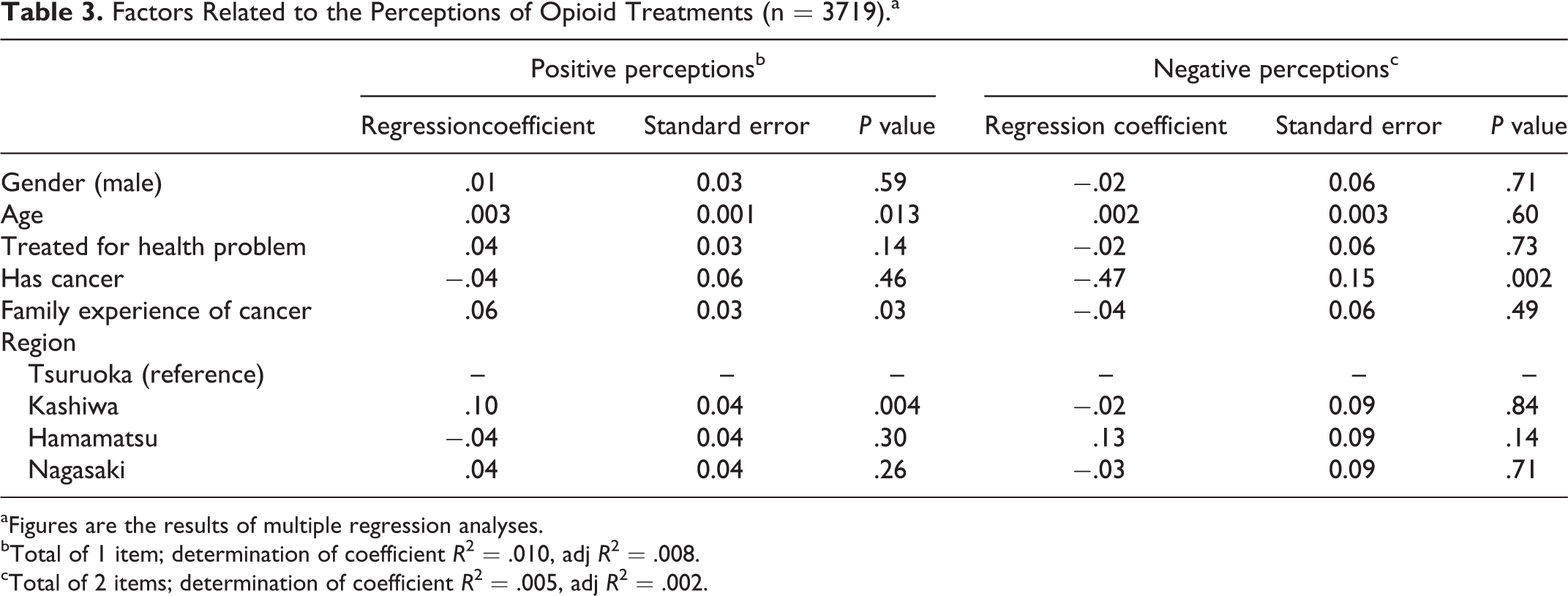
A significant association was observed between a higher score for positive perceptions of opioids and an older age (P = .013), having a family member experience cancer (P = .03), and living in the Kashiwa area (P =.004). Having cancer (P =.002) was associated with a low score for negative perceptions of opioids (Table 3).
Factors Related to the Perceptions of Opioid Treatments (n = 3719).a
aFigures are the results of multiple regression analyses.
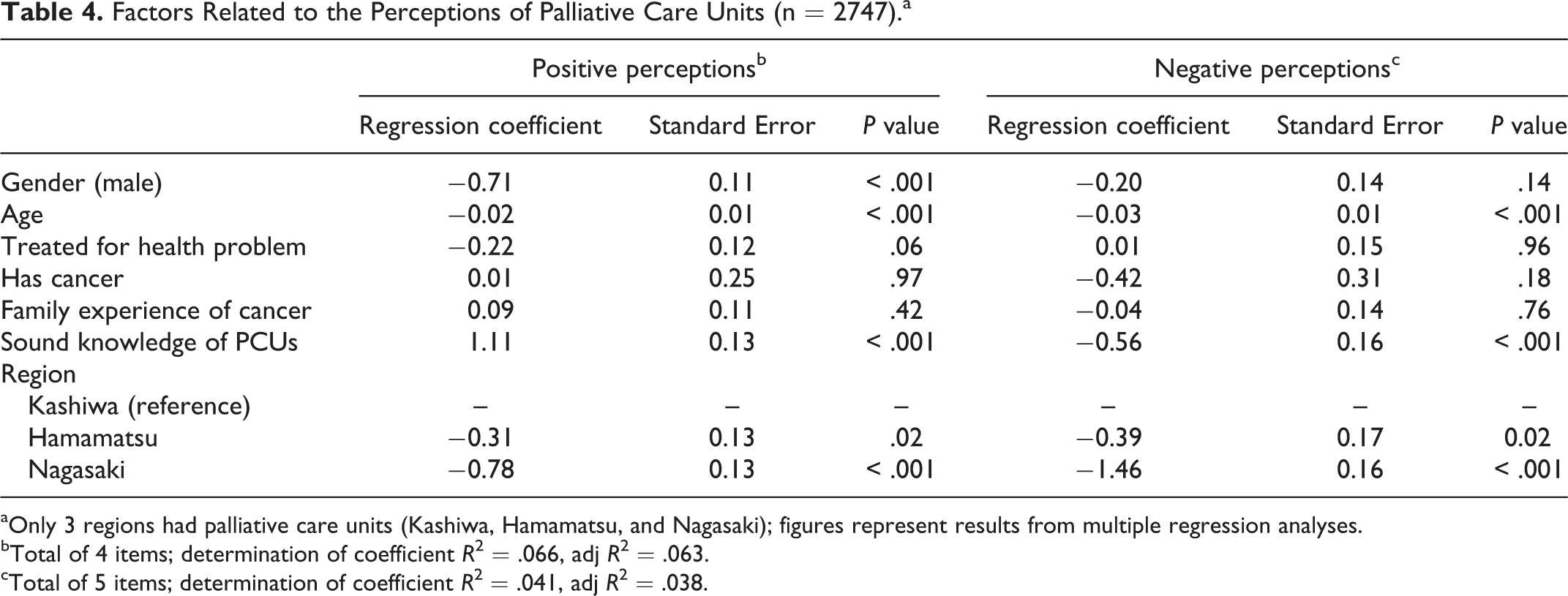
A higher score for positive perceptions of PCUs was associated with a female gender (P < .001), younger age (P < .001), sound knowledge of PCUs (P < .001), and living in the Kashiwa area (vs Hamamatsu area, P = .02; vs Nagasaki area, P < .001). Meanwhile, a higher score for negative perceptions of PCUs was associated with younger age (P < .001), poor knowledge of PCUs (P < .001), and living in the Kashiwa area (vs Hamamatsu area, P = .02; vs Nagasaki area, P < .001; Table 4).
Factors Related to the Perceptions of Palliative Care Units (n = 2747).a
aOnly 3 regions had palliative care units (Kashiwa, Hamamatsu, and Nagasaki); figures represent results from multiple regression analyses.
Associations Between a Sense of Security and Perceptions of Opioids and PCUs
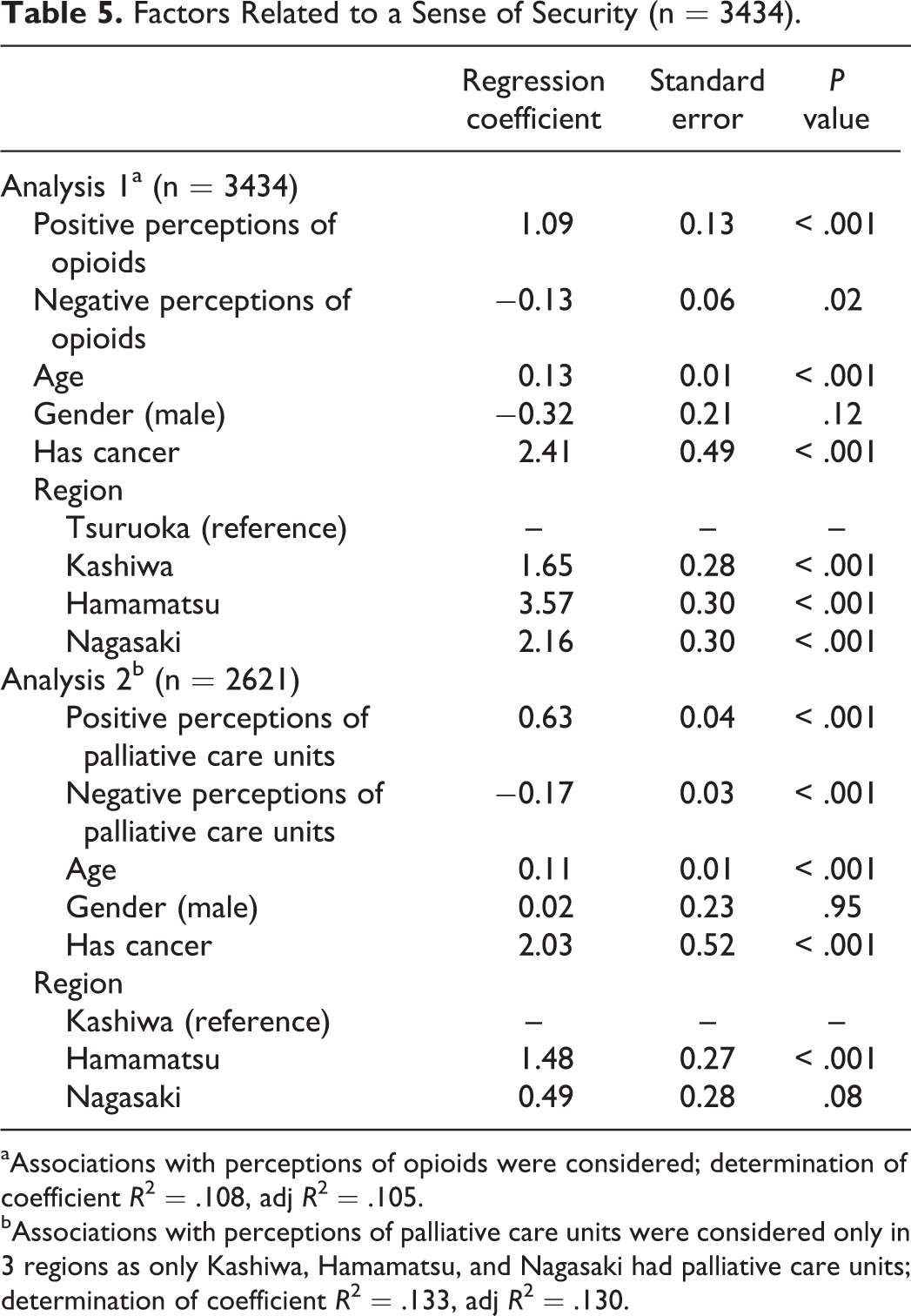
After adjustment for demographic variables, higher positive (P < .001) and lower negative (P = .02) perceptions of opioids were associated with a higher sense of security. Similarly, higher positive (P <.001) and lower negative (P <.001) perceptions of PCUs were also associated with a higher sense of security (Table 5).
Factors Related to a Sense of Security (n = 3434).
Discussion
In this study, as an expansion of previous studies that descriptively demonstrated perceptions of palliative care within the general public, 4,5 we explored multiple factors related to the perceptions of opioids and PCUs. To the best of our knowledge, this is the first study to demonstrate the associations between perceptions of opioids and PCUs and a sense of security with regard to regional cancer care. The significant findings of this study revealed that the majority of the general population had positive perceptions of opioids and PCUs; however, some had negative perceptions. Cancer-related experiences were significantly associated with a higher positive or a lower negative perception of opioids. Sound knowledge of PCUs was significantly associated with both higher positive and lower negative perceptions of these care units. The higher positive perceptions of opioids and PCUs were strongly associated with a higher sense of security regarding regional cancer care.
In order to discuss the effective strategies for improving perceptions of opioids and PCUs, we considered factors associated with the perceptions. For opioid treatments, people who were undergoing cancer treatment or posttreatment had significantly lower negative perceptions than those without cancer. People with experience of cancer in their family had significantly higher positive perceptions of opioids than those without such an experience. These results suggested that cancer-related experiences could improve perceptions of palliative care, consistent with previous studies. 4,5,13 The reason for this result might be due to people who have acquired a knowledge of palliative care through personal or family-associated cancer treatment, since, presumably, such experiences could lead to a reduction in nonspecific anxiety surrounding opioid treatments.
The results of this study also suggest that having information regarding palliative care could affect such perceptions. The results demonstrated that people within the general population, who had a sound knowledge of PCUs had a lower negative perception of them in addition to higher positive perceptions. This suggests that providing the general public with information regarding palliative care may effectively improve their perceptions of it. The potential effectiveness of providing information for the general public was partially supported by a previous study, which showed that, within a general population, misconceptions that opioids are addictive and shorten life expectancy were improved after a 1-hour educational lecture, with continued effects after a 6-month follow-up. 14,15
A younger age was associated with not only higher positive perceptions of PCUs but also higher negative perceptions of PCUs. The perception differences by age might be due to the degree of health information literacy among age groups; younger people have a higher health information literacy. 16 Providing information for younger people in order to improve negative perceptions of PCUs might be needed. Regarding gender, females had significantly higher positive perceptions of PCUs than males; such results were comparable to the previous studies demonstrating that females had a higher awareness of PCUs 13 and a higher sense of security 9 than males. A possible reason for such tendencies may be related to females having a positive attitude toward communicating with health care professionals 17 and receiving health care information to a greater extent.
Furthermore, perceptions of opioids and PCUs were associated with a sense of security regarding regional cancer care. Relatively speaking, the positive perceptions had a greater effect on the sense of security compared to the negative perceptions; such results were consistent with other analyses of patients with cancer. 18 In a previous study, we identified the association between having cancer and a strong sense of security, 9 and, in this study, we added perceptions of opioids and PCUs as factors potentially influencing independent variables in multiregression analyses. The results showed a significant association between them. Although experiences of having cancer and receiving care from health care professionals might lead to an increasing sense of security in cancer care, 9 the present study suggests that perceptions of palliative care might also affect the sense of security. Therefore, interventions for people other than those with cancer, aiming to improve positive perceptions of opioids and PCUs (ie, by providing adequate information on palliative care), might contribute to an improved sense of security in the general public.
This study had several limitations. First, it was cross-sectional; thus, the observed associations among variables might not be causal. Although there is a possibility of reverse causality that positive perceptions of PCUs affect sound knowledge of them, we consider that these variables interact with each other, and providing the general public with information about PCUs could be effective for improving their perceptions of them. Second, in the multiregression analyses, the determination coefficients (R 2 and adjusted R 2 ) were not high; there might be factors related to the perceptions of opioids and PCUs other than the factors measured in this study. In the future, in order to identify more effective strategies to improve perceptions of opioids and PCUs, we should search for these factors related to the perceptions. Third, the response rate of the survey was not high, and we could not clarify the characteristics of nonresponders; therefore, a response bias may exist. However, because the response rate of opinion-based surveys in the general public in Japan is generally about 50%, 4,5,19 –21 the response rate of the study may be acceptable.
In conclusion, this study revealed that, although a majority of the general population had positive perceptions of palliative care, the number of people who had misconceptions regarding opioids and negative perceptions of PCUs was also large. Cancer-related experiences and sound knowledge of PCUs were associated with higher positive perceptions of opioids and PCUs in the general population, and higher positive perceptions of opioids and PCUs were strongly associated with a higher sense of security. Providing information about palliative care might contribute to not only promoting perceptions of opioids and PCUs but also improving the sense of security, representing a comprehensive end point for regional cancer care.
Footnotes
Declaration of Conflicting Interests
The authors declared no potential conflicts of interest with respect to the research, authorship, and/or publication of this article.
Funding
The authors disclosed receipt of the following financial support for the research, authorship, and/or publication of this article: This work was supported by a grant-in-aid for the Third Term Comprehensive Strategy for Cancer Control in Japan. The founder was not involved in the conducting of this study or its submission.