







Abstract
This article presents survey data from a study on trends in technical and professional editing that focuses specifically on inclusive and accessible editing practices in the workplace and in the classroom. Scholarship focusing on inclusive communication and design practices is growing, but the role of technical and professional editing, though not excluded, remains underdeveloped. Frameworks for developing and maintaining editorial guidance must be designed to more explicitly incorporate concerns for accessible and inclusive content. Although editing instructors and researchers often look to the industry for such answers, this is an opportunity for them to take the lead.
In technical and professional communication (TPC), social justice and advocacy have been primary focuses for practice and research (Acharya, 2022; Agboka & Dorpenyo, 2022; Agboka & Matveeva, 2018; Bennet & Hannah, 2022; Jones, 2016; Walton et al., 2019). Agboka and Dorpenyo argued that although social justice is not necessarily new to the field, during the last decade, the goals of social justice have been foregrounded. They identify two areas of influence: “Social justice is not only important in opening up the field of TPC to inclusive, delegitimized, and diverse approaches, but it is also a necessary path toward magnifying the agency of disenfranchised or oppressed people” (p. 39). In other words, the social justice turn has affected the field's methods and approaches, but it also has a goal of promoting agency and participation with marginalized communities (e.g., Rose, 2016; Smith et al., 2021).
Social justice scholarship positions TPC practices as nonneutral in order to uncover ways that these practices support systems of oppression and marginalization as well as opportunities to leverage TPC practices to intervene in those systems. Bennett and Hannah (2022) analyzed three webinars to examine tensions between disability rights and disability justice perspectives and opportunities for TPC intervention. Their findings show that documentation bridging law and workplace policy goes beyond technical documentation as nonneutral in that it serves to reinforce rather than reimagine the design of existing systems (p. 340). And in a study about whether and how plain language guidelines can address social justice concerns in mortgage documentation, Jones and Williams (2017) demonstrated that such guidelines are not specifically geared toward social justice and are thus insufficient for evaluating this documentation in context to ensure it is not upholding a biased system: “Social justice takes into account not only agency and how it can be collaboratively amplified, but also identification and recognition of oppression and its root causes” (p. 413). As their study shows, a social justice perspective necessarily contextualizes mortgage documentation as part of a historic system of discrimination in the lending industry.
Overlapping with the social justice turn, accessibility scholarship in TPC extends disability research (Oswal, 2022; Oswal & Palmer, 2022), which has its roots in the Disability Rights Movement (Hamraie, 2016). Accessibility scholarship also emphasizes the importance of understanding audiences as diverse and resists prescriptive approaches in favor of process and value-driven approaches. In advocating for accessibility as a process rather than an outcome, Huntsman (2021) critiqued policies and guidelines that position accessibility as “an accommodation for a specific population and focus on correcting the product rather than the process of accessibility” (p. 222). Using two corporate examples and a case study at a university, she explored two approaches to accessibility: policy-driven (i.e., focusing on compliance with policy and legal requirements, which can position accessibility as a narrow set of benchmarks and barrier to organizational goals) and value-driven (i.e., centering accessibility as part of organizational goals and focusing less on a checklist of tasks than on ways that accessibility is part of the user experience).
Accessibility as a process, then, “is constantly revisited and reworked between the design/communication and its audience” (Strantz, 2021, p. 290). This approach builds from a social model of disability and requires technical communicators to approach users as contextualized individuals. Universal design principles and web standards are potential tools in the approach, but they must be scrutinized for being geared toward a one-size-fits-all rather than a diverse audience.
Research on inclusive and accessible editing practices (e.g., Baker et al., 2021; Benjamin & Schreiber, 2021; Clem, 2023; Mackiewicz & Durazzi, 2023), a growing concern in TPC, extends this social justice and accessibility research. As Mackiewicz and Durazzi (2023) noted, editors are “people charged with educating and advocating for readers and authors” (p. 1); thus, an editing perspective is particularly relevant in developing and implementing inclusive and accessible processes and practices. Even though editing is one of the most common courses in TPC programs (Melonçon, 2019; Melonçon & Henschel, 2013), technical editing is poorly defined (Clem, 2023; Melonçon, 2019; Schreiber, 2024), and Clem argued that this lack of a clear definition is an opportunity to focus technical editing on advocacy and social justice.
Inclusive and accessible technical editing, then, must support and empower diverse users by developing and applying content guidelines and processes that address both designed systems of oppression and designed points of access in content creation. In this article, I build from technical editing scholarship focusing on inclusive language, which tends to extend style guidance, in order to set the groundwork for building inclusive and accessible technical editing processes and frameworks. Although technical editing scholars have extended style guidance and models (e.g., style sheets), this extension has not adequately addressed the systemic design concerns that accessibility and social justice scholarship have raised. To begin this work, I present survey data from editors and editing instructors about the practices they implement and teach, including inclusive language practices (e.g., use of the singular “they”) and information-design practices (e.g., accessible links). My findings illustrate the range of practices that are currently being addressed in the classroom and industry and suggest future research and opportunities to develop and promote inclusive and accessible technical editing models and frameworks for the classroom and workplace.
Toward Inclusive and Accessible Technical Editing Practices
Technical editing scholars, industry professionals, and professional editing organizations have pursued issues related to inclusive and accessible editing practices, particularly concerning inclusive language guidance. Inclusive language, or what Yin (2024) described as “conscious language,” is “language that promotes equity” (p. 3). In its Brief Guide to Bias-Free and Inclusive Language, the American Psychological Association (APA, 2023a) provides “a wealth of science-backed guidance to help you describe other people with dignity and respect.” Addressing one of the most well-known inclusive language practices, Mackiewicz and Durazzi (2023) asked editors to provide feedback on a series of five sentences in order to gauge their perceptions of the use of “they” as singular. One of the interesting findings from the 80 editors who completed their survey was that few editors referenced style guidance in their rationale for letting the sentence stand, querying the author, or editing the sentence. Mackiewicz and Durazzi suggested that this lack of reference to style might have been because they provided information about the style guides used in another section of the survey. In a follow-up study, Mackiewicz et al. (2023) interviewed 15 of these editors about their recommendations for the five sentences as well as their use of style guides. They found that those editors strongly supported “they” as a pronoun to promote inclusivity but that some instances of that use of “they” created ambiguity for the reader when it was unclear who the word was referencing.
Organizational style instruments (e.g., house style guides, corporate style guides, style sheets) remain important editorial supplements for consistent content and adherence to major style manuals (Adhya, 2015). These style instruments and major style manuals also incorporate guidance for inclusive language. For example, ACES: The Society for Editing (2024) includes several supplemental style resources for diversity and inclusion. And the American Psychological Association, besides including inclusive language practices in its widely used style manual, publishes a separate Inclusive Language Guide (APA, 2023b), which is now in its second edition.
According to an inclusive language survey conducted by The Content Wrangler with the Center for Information Development Management and Content Science, 58% of the more than 650 participants who completed the survey (it is unclear how many individual organizations they represented) reported that their company incorporates inclusive language guidelines into its style guide (Acrolinx, 2023). About one-third (33%) of businesses reported department or team initiatives that included training writers and editors to identify and address noninclusive language and developing guidance dedicated to using inclusive language (p. 11). Further, Scott Abel, Chief Executive Officer of The Content Wrangler, noted that some companies are expanding their diversity, equity, and inclusion (DEI) initiative to expressly include accessibility (p. 2).
Drawing from survey data and an analysis of industry style guides, Adhya (2015) argued that style guides have become more widely available and perhaps even more useful in online platforms but remain a challenge to keep current. The survey data suggest that language usage is one area that corporate style guides both regularly feature and regularly update as new products, definitions, and acronyms are added. The data also suggest that companies are prompted to make quick changes to language and usage guidance in order to address biased language—for example, as one participant pointed out, the use of “master and slave” to refer to technical components, nearly 20 years after Graves and Graves (1998) identified this phrasing as problematic in engineering and information technology contexts.
Because discriminatory, violent, and problematic language can become standardized in the workplace through phrases and metaphors, Graves and Graves (1998) concluded that editors, writers, and researchers of technical communication are in a unique position to use their expertise not only to produce top quality documents, but also to examine and raise for discussion those linguistic constructions and conventions that portray reality in questionable ways. (p. 412)
To develop inclusive and accessible editing models and frameworks, editors and researchers have to consider not only inclusive language practices but also communication-design concerns that affect accessibility and inclusion (Benjamin & Schreiber, 2021). Moeggenberg et al. (2022) described some ways to enact inclusive editing practices (e.g., specific accessibility practices such as converting a PDF to HTML) that may be introduced in the classroom as essential to the editor's toolkit. Baker et al. (2021) advocated for an editing process to support editors who are blind or have limited vision. Using Microsoft Word as an example, they described how screen readers, refreshable Braille displays, and Braille notetakers interact with the editing and markup features in word processing programs. They also provided a tutorial for using keyboard strokes to navigate features such as comments and track changes. But in addition to this guidance for “blind or visually impaired people,” they offer “an important opportunity for sighted technical and professional communication teachers and practitioners to better understand the processes that their blind or visually impaired students and colleagues must follow when editing documents” (p. 285).
Smith (2023) suggested using corpora linguistics to provide empirical data to support rhetorically sensitive editing practices in the classroom and workplace. He argued that corpora linguistics adds to the technical editors’ toolkit and can provide data and context beyond style guidance. Also addressing prescriptive language practices, Clem and Cheek (2022) argued for linguistic variation and greater attention to social justice in technical editing and that the field should “train editors that their job is to care for a text rather than police it” (p. 142). Their inclusive editing paradigm positions editors as sharing agency with authors and to resist prescriptive practices such as the uncritical enforcement of American Standard English.
And Hodges and Ponce (2022) argued that editing for a global audience means embracing linguistic diversity and resisting “standard language ideology” (p. 54). They proposed a framework for evaluating editing textbooks that extends Walton et al.’s (2019) three Ps (positionality, privilege, and power), suggesting, for example, that editing textbooks should include linguistically diverse examples.
Technical editing scholarship illustrates a wide range of concerns related to inclusive and accessible editing. There is a substantial focus on inclusive language, including how editors address specific inclusive language practices such as the singular “they” and style guidance that addresses inclusive language (e.g., Durazzi, 2022; Mackiewicz & Durazzi, 2023). Other research areas include designing editing technologies for accessibility (e.g., Baker et al., 2021) and developing editing practices that promote linguistic diversity and resist prescriptive editorial recommendations (Smith, 2023). Although inclusive and accessible technical editing is a growing area of research, there is more work to be done.
Research Questions
In this article, I present data on inclusive and accessible editing practices from my larger study on trends in technical and professional editing (Schreiber, 2024). My four main research questions address how editors and editing instructors incorporate and build on inclusive and accessible content practices:
How are technical and professional editors and editing teachers adopting practices for inclusive content? How are technical and professional editors and editing teachers adopting practices for accessible content? How are technical and professional editors and editing teachers developing practices for inclusive content? How are technical and professional editors and editing teachers developing practices for accessible content?
These research questions seek out any practices and guidance that are being adopted and developed to ensure consistently inclusive and accessible content in both the classroom and industry. While acknowledging that inclusive and accessible content practices overlap, I pose them as separate research questions both to allow for overlap in what editors and editing teachers may consider to be accessible and inclusive and to draw out specifics for each. In operationalizing these questions in the survey, then, I also separate them.
Method
In this article, I present survey data from my larger study on trends in technical and professional editing (Schreiber, 2024), which was approved by the Institutional Review Board at my university (No. H21132). The survey instrument developed for the study included question sets specifically designed for editors and editing instructors (see the Appendix) and was administered from January 2021 to December 2021 via Qualtrics. Participants self-selected their editing roles, with 60 participants identifying as editing instructors, 30 identifying as editors, and two identifying as both. The two participants who identified as both editing instructors and editors completed both sets of survey questions. After answering the survey questions, participants were given options to provide demographic information and to participate in a semistructured interview.
In designing the questions, I wanted to provide enough options for participants to easily complete the survey on a mobile device but still allow them to provide other options and feedback. Although the survey included mostly closed-ended questions, participants had the opportunity to provide additional comments. To best support mobile users, each screen paired a closed-ended question with an open-ended question that prompted users to provide additional feedback related to the closed-ended question. Participants could move back and forth between screens. Because there is a wide range of editorial activities, roles, tasks, and practices, I wanted to design the questions in a way that would support readability and avoid a laundry list of options. Most participants completed the survey in 10 min or less. Two subject-matter experts and one expert in quantitative survey methods tested the instrument.
I designed the questions for the editors and editing instructors to gather parallel data. Editors were asked about the types of subject matter they edit, industries in which they work, major style manuals they use, practices they use to ensure quality and accuracy, and guidance they follow to ensure accessible and inclusive content. They reported a wide range of job titles, including technical writer and technical editor. Editing instructors were asked about what they teach in terms of editing roles, skills, topics, style, accessibility, and inclusive editing practices. I present here the data from editors and editing instructors regarding their inclusive and accessible editing practices.
The 62 participants who identified as editing instructors were asked the following questions to identify from a list of options the inclusive and accessible editing practices that they cover in their courses:
What DEI concerns do you include in your professional and technical editing courses? Please select all that apply. What accessibility concerns do you cover in your professional and technical editing courses? Please select all that apply.
The 32 participants who identified as editors were also asked questions about their inclusive and accessible editing practices. Of these 32 participants, 29 completed the following questions about ensuring that the content from their organization is inclusive and accessible:
How important is ensuring inclusive content at your organization? Are there specific editorial processes and guidelines at your organization to address any of the following? Please select all that apply. How important is ensuring accessible content at your organization? Are there specific editorial processes and guidelines at your organization to ensure the accessibility for any of the following? Please select all that apply.
This series of questions prompted editors to indicate how their organization valued inclusive and accessible practices and whether it had editorial guidance to support inclusive and accessible content. Although an organization might value inclusive and accessible content, it still might not provide its editors with the time and resources to develop and maintain clear and cohesive guidelines for ensuring such content.
Although many of the survey researchers in TPC have historically relied on recruiting participants from the Society for Technical Communication's Technical Editing Special Interest Group, Kreth and Bowen (2017) made a compelling case that this group no longer provides a broad enough representation of people involved with professional and technical editing. Thus, following Kreth and Bowen's recruitment approach, I contacted several editing organizations. Most of those that were still active suggested working directly with ACES: The Society for Editing. ACES generously shared my survey via its LinkedIn, Twitter, and Facebook accounts. I also posted to academic listservs and social media groups related to TPC.
I analyzed the closed-ended survey responses using both counts (number of participants) and percentages (frequency of participants) because most of the closed-ended questions allowed participants to select multiple options. As Remler and Van Ryzin (2021) noted, using counts alone can be misleading and should be paired with rates or percentages to illustrate the importance of the frequency of the counts. I analyzed the open-ended survey responses using thematic analysis.
Results
In presenting these survey results, I first discuss the editing instructors’ responses regarding the topics they cover in the classroom concerning inclusive and accessible editing. Then I discuss the editors’ responses regarding the inclusive and accessible practices that they incorporate into their work.
Editing Instructor Responses: Inclusive Editing in the Classroom
The participants who were editing instructors were asked about the DEI topics that they included in their classroom. They were first asked, “What diversity, equity, and inclusion concerns do you include in your professional and technical editing courses? Please select all that apply.” Figure 1 shows a breakdown of their responses.
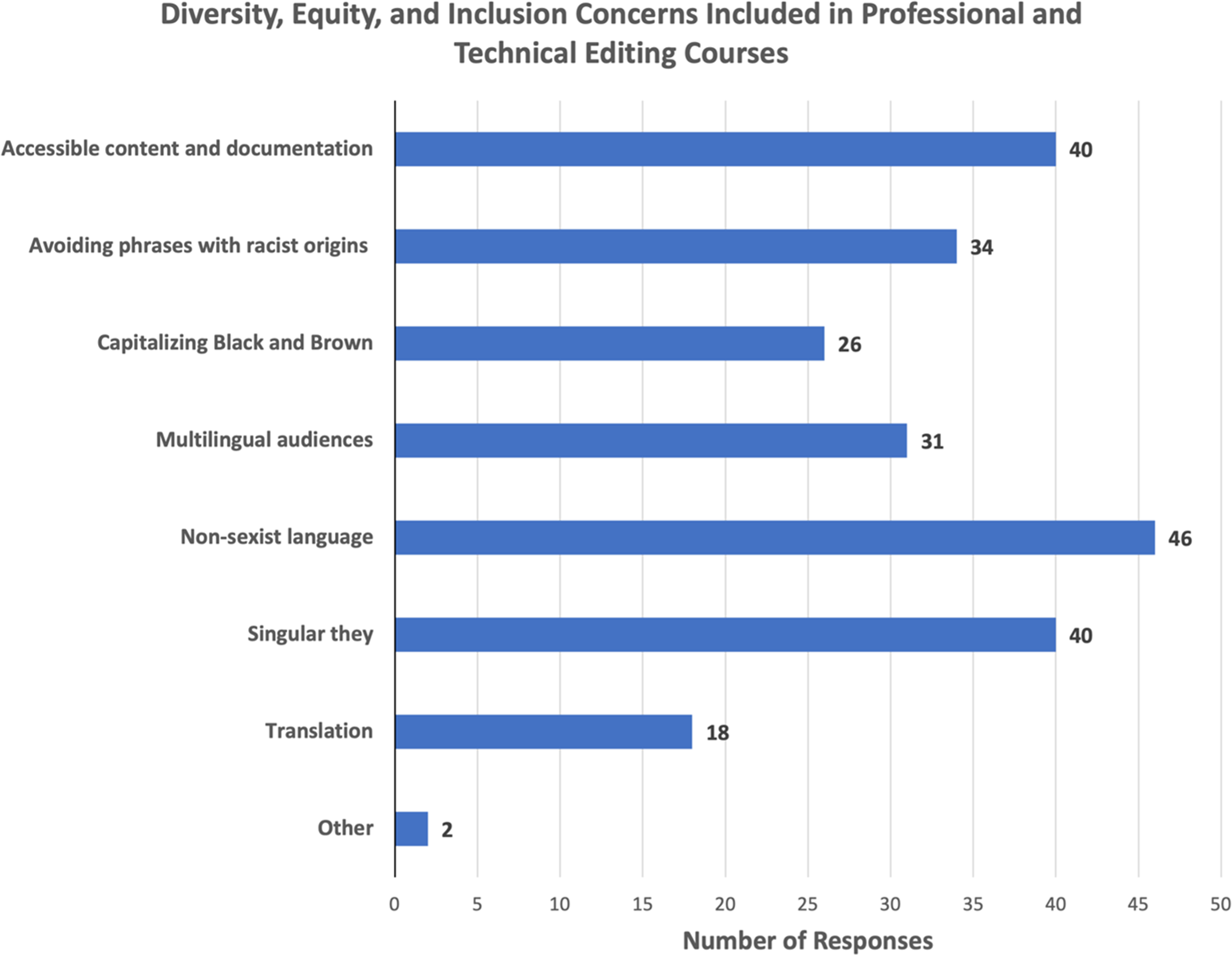
Breakdown of the editing instructors’ responses to the question “What diversity, equity, and inclusion concerns do you include in your professional and technical editing courses? Please select all that apply.”
The 62 participants who self-identified as editing instructors were asked to indicate the DEI concerns that they included in their courses by selecting all of the items listed that applied and, if necessary, naming additional ones that were not listed. The most popular response, nonsexist language, was selected by 46 participants whereas 40 participants selected singular they, 40 selected accessible content and documentation, 34 selected avoiding phrases with racist origins (e.g., “grandfathered in”), 31 selected multilingual audiences, 26 selected capitalizing Black and Brown, 18 selected translation, and two selected other, adding “capitalizing Indigenous” and “avoiding all forms of bias.”
The majority of the editing instructors (74%) indicated covering at least one inclusive editing concern in their course. The most popular selections focused on avoiding sexism and gender discrimination, with 46 of the 62 editing instructors (74%) selecting nonsexist language and 40 (65%) of the 62 instructors selecting singular they as topics they cover in their courses. Accessible content and documentation were also selected by 65% of the instructors. Just 55% of the instructors selected at least one option focused on racial discrimination, with 55% of the 62 editing instructors (n = 34) selecting avoiding phrases with racist origins and 50% (n = 31) of the 62 instructors selecting capitalizing Black and Brown as topics they cover in their courses. Future research might investigate whether discriminatory practices related to sex and gender are covered more frequently or given more treatment than content practices related to other areas of discrimination, such as race.
The selections that editing instructors made suggest their interest in incorporating and perhaps expanding on these topics in their courses, but these numbers are low in relation to the importance of these topics as the baseline for preparing students to hone their inclusive editing practices. The responses of the editing instructors suggest that they are aware of the need to improve these numbers and that there is more work to be done.
Six participants provided additional feedback to the questions. One of them indicated that their classroom has been including more about inclusive language over time, and another indicated that the list in the survey provided ideas of what to add. Some commented that they covered such topics with textbook readings and not necessarily by incorporating them into editing assignments. For example, one participant stated that there was no room for accessibility in the course projects but that students were expected to read about accessibility in the textbook. Other comments suggest that editing teachers have done more to incorporate inclusive language practices in their courses and that class discussion is where they discuss options for supporting diverse audiences. These comments demonstrate that inclusive content practices are important to editing instructors and that they want to include more in their courses. Their concern is not whether inclusive language practices belong in the course but rather how to best incorporate them.
Editing Instructor Responses: Accessible Editing in the Classroom
The editing instructors were asked about the accessibility topics that they included in their classroom. Although they could identify accessible practices in general when asked about inclusive editing practices, a separate question prompted them to indicate the specific accessible practices that they covered: “What accessibility concerns do you cover in your professional and technical editing courses? Please select all that apply.” Figure 2 shows a breakdown of their responses to this question. The two most chosen responses were readability and plain language, which were selected by 48 and 46 participants, respectively. More than 30 participants selected information hierarchy (n = 36), alternative text for images (n = 34), and accessible images and charts (n = 32), and accessible hyperlinks and navigation were each selected by 29 participants. Far more participants selected accessibility features for Microsoft Word (n = 28) than for Google Docs (n = 13), and 19 participants selected accessibility features for PDF documents. Accessible tables and accessible lists were each selected by 17 participants. The option other was selected by one participant, who wrote in “UX [user experience],” and one participant selected the option none. I found it interesting that alternative text for images (n = 34), accessible images and charts (n = 32), and accessible hyperlinks (n = 29) were selected more often than the most-selected word processing program, Microsoft Word (n = 28).
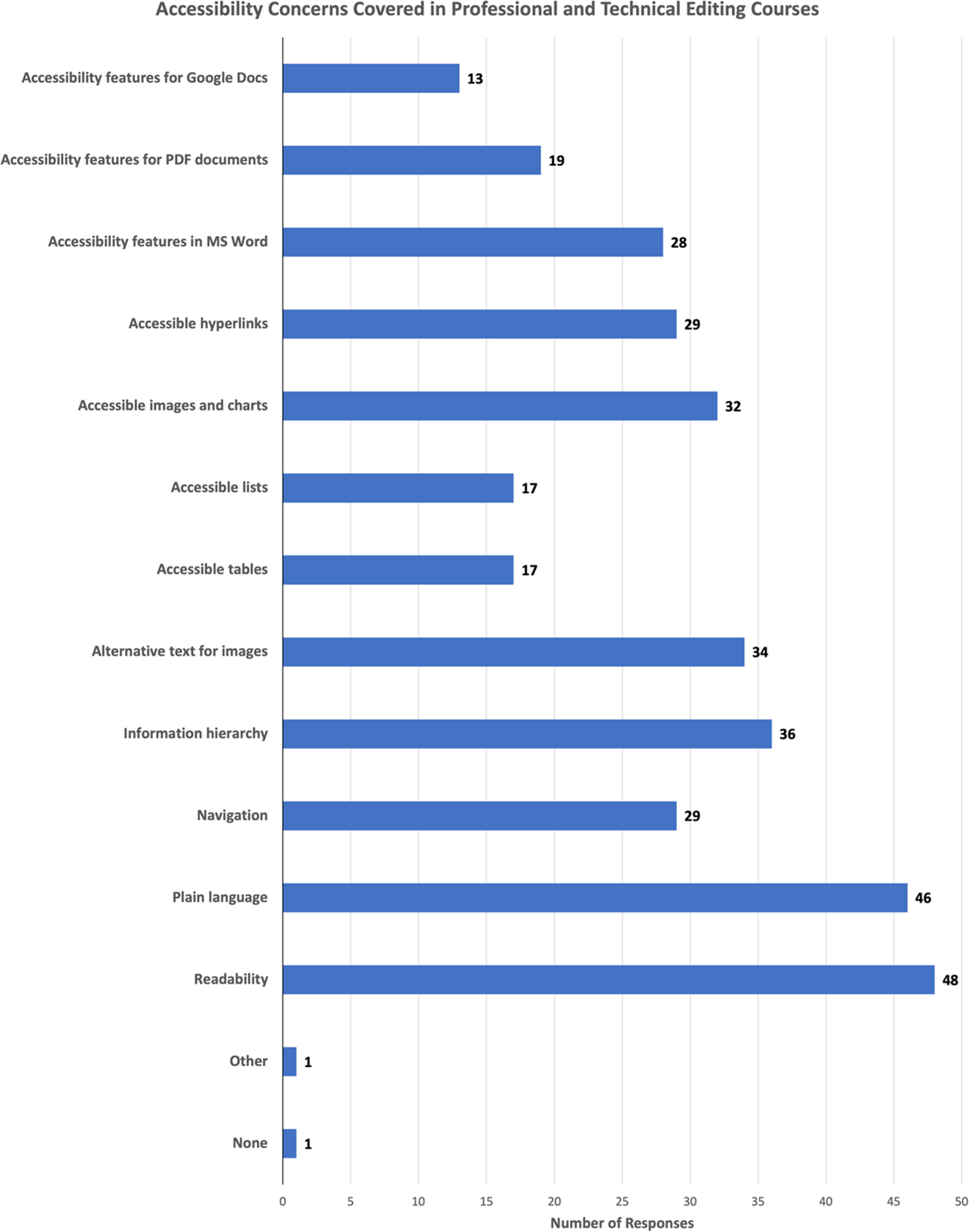
Breakdown of the editing instructors’ responses to the question “What accessibility concerns do you cover in your professional and technical editing courses? Please select all that apply.”
It is also interesting that 40 of the 62 (65%) editing instructors selected accessible content and documentation when asked about DEI topics that they covered in their courses (see Figure 1) but that when they were asked specifically about what accessibility concerns they covered, they selected both readability (77%) and plain language (74%) more often than any of the choices that included features for making content and documentation more accessible. This finding could be a result of the instructors having different approaches to defining accessibility, the topics not being explicitly framed from the perspective of accessibility in class, or the specificity of the list prompting participants to better identify topics that they cover.
Participants had the option to provide comments on this question about accessibility practices in the classroom. Two participants provided comments, with one of them expressing hope that this study would yield some best practices for incorporating accessible content and documentation and the other explaining that they had not yet covered accessibility but planned to do so in the future. Overall, their responses to this question, as do their responses to the previous question on inclusive editing in the classroom, show that participants had a strong interest in incorporating accessibility content into their editing courses and that many of them were already incorporating accessibility practices.
Although none of the editing instructors’ responses to either question directly request additional frameworks or models for incorporating inclusive and accessible content practices into the editing course, they do collectively reflect the desire for incorporating more inclusive and accessible content practices as well as indicate that the pathway for incorporating them is not quite clear. This might be an area for future research.
Editor Responses: Perception of Importance that the Organization Places on Inclusive Content
The participants who were editors answered the question “How important is ensuring inclusive content at your organization?” by responding to the statement “Ensuring inclusive content is important to the organization” on a five-point Likert scale (ranging from strongly agree to strongly disagree). Table 1 shows their responses to that statement. In asking about organizational support for inclusive and accessible content, I wanted to show that editors have little control over developing strong guidance for these areas without the support of their organization. While these data are not statistically significant, they do indicate that editors think that their organization finds inclusive and accessible content important. Of the 29 participants who responded to the statement, 15 indicated that they strongly agree that their organization values inclusive content, 8 responded that they somewhat agree, 3 responded that they neither agree nor disagree, and 3 responded that they somewhat disagree. No participants strongly disagreed.
Editors’ Responses to the Question “How Important Is Ensuring Inclusive Content at Your Organization?”
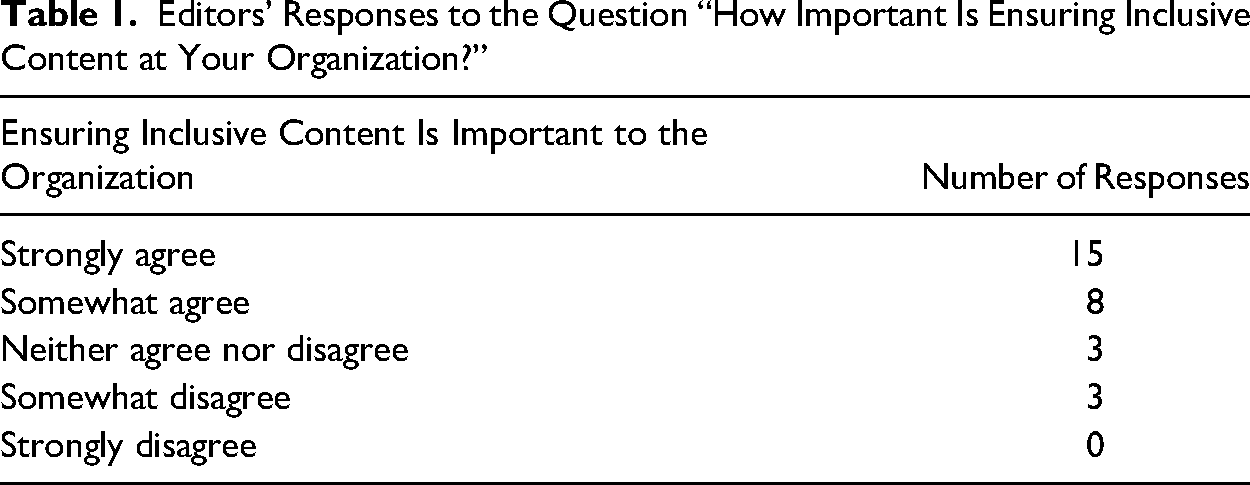
These responses suggest that inclusive content is supported to varying degrees at most of the participants’ organizations. More than half of the participants (52%) indicated strong support, and 79% of them either strongly agreed or somewhat agreed that ensuring inclusive content is important to their organization.
Two participants provided comments on this question. One of them explained that although there is never an intention to make anything exclusive, a complex subject matter such as engineering may require prior knowledge. The other participant remarked that inclusive and accessible content is more important to some clients than others and that it needs editorial support. The comments suggest that inclusivity may be more of an editorial value than a client value and that complex topics may be exclusive to subject-matter experts. The participants do not mention whether their organization tries to ensure that they use plain language practices in order to make complex topics clearer to lay audiences.
Editor Responses: Editorial Guidelines and Processes for Inclusive Content
The editors were asked the question “Are there specific editorial processes and guidelines at your organization to address any of the following? Please select all that apply.” Figure 3 shows the breakdown of the 29 participants’ responses. The range of options—from specific inclusive language practices that have been broadly incorporated into major style manuals (singular they, capitalizing Black and Brown) to audiences addressed by specific editorial guidance (multilingual audiences, international audiences)—covered an array of categories that editors and organizations may have developed guidance to address.
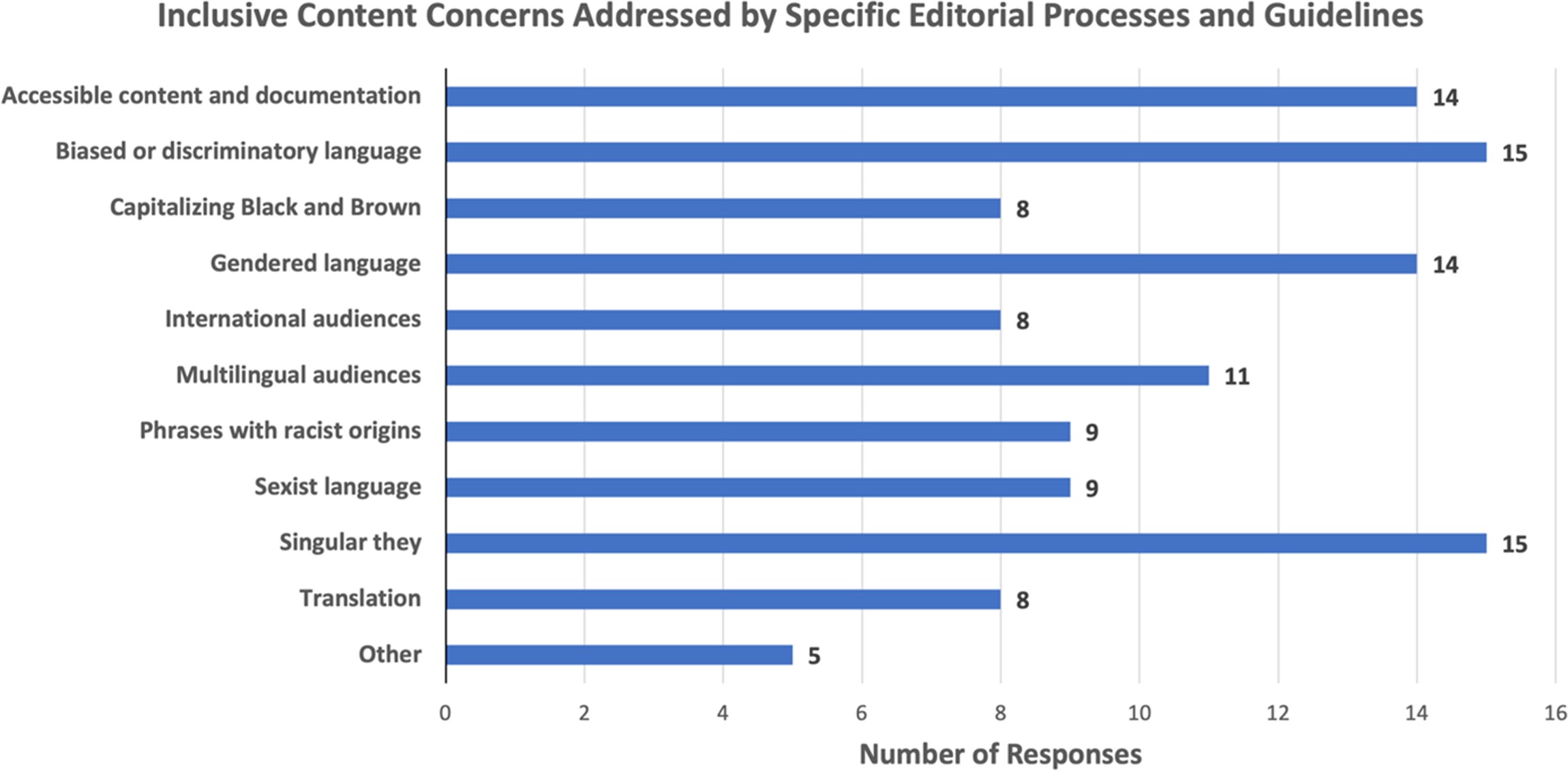
Breakdown of the editors’ responses to the question “Are there specific editorial processes and guidelines at your organization to address any of the following? Please select all that apply.”
Participants were asked to select all the options that applied to the editorial guidance they developed or used in their jobs. Of the 29 participants, 15 selected biased or discriminatory language and singular they; 14 selected accessible content and documentation and gendered language; 11 selected multilingual audiences; nine selected phrases with racist origins (e.g., “grandfathered in”) and sexist language; eight selected capitalizing Black and Brown, international audiences, and translation; and five selected other. The responses of the five participants who selected other ranged from specific types of guidance such as what to include in warnings for triggering content to broader categories such as guidance for cultural competence and technical terms. One participant listed “disability,” perhaps considering it a separate category from accessibility, and another listed “PoC/BIPoC.”
Like the editing instructors, the editors more often selected broad categories—such as accessible content and documentation, gendered language, and biased or discriminatory language—than more specific ones (with the exception of singular they), such as capitalizing Black and Brown. Although these results are not statistically significant, it is worth noting that the two most commonly selected options—biased or discriminatory language and singular they—were chosen by only 15 (52%) of the participants. This finding suggests that there is not one specific area that editors are drawn to for developing inclusive editorial guidance.
Four participants provided additional feedback. Their comments suggested that although editors care about inclusive content, they do not necessarily have specific guidance to support it. Furthermore, their organization may value inclusive content in theory but still not provide them with time and resources to develop guidance. One participant, who does not belong to an organization, claimed to have an editorial process that is grounded by “anti-oppressive language practice.” Another participant was not aware of having any particular processes but just tried to catch any noninclusive content. And another participant associates plain language training with making content accessible: “We don't have specific processes in place, but our editors consider accessibility and to try to avoid bias. We are all trained in plain language, which makes content more accessible and inclusive.” Finally, one participant indicated that the organization may use sensitivity readers on some projects but does not have a clear process for determining what projects meet the threshold for needing them, so things are likely missed.
These comments suggest that it is ultimately up to the editors to ensure that content is inclusive even if their organization has no specific processes for ensuring that such work is done consistently. Freelance editors, in particular, might not receive any type of editorial guidance for a project and may be relying on their own processes and values.
Editor Responses: Perception of Importance That the Organization Places on Accessible Content
The editors answered the question “How important is ensuring accessible content at your organization?” by responding to the statement “Ensuring accessible content is important to the organization” on a five-point Likert scale (ranging from strongly agree to strongly disagree). Table 2 shows their responses to that statement. Of the 29 participants, 10 strongly agreed, 10 somewhat agreed, five neither agreed nor disagreed, three somewhat disagreed, and one strongly disagreed that ensuring accessible content was important to their organization. Thus, although 79% of the editor participants strongly or somewhat agreed that their organization wanted to ensure inclusive content, only 70% of them strongly or somewhat agreed that their organization wanted to ensure accessible content.
Editors’ Responses to the Question “How Important Is Ensuring Accessible Content at Your Organization?”
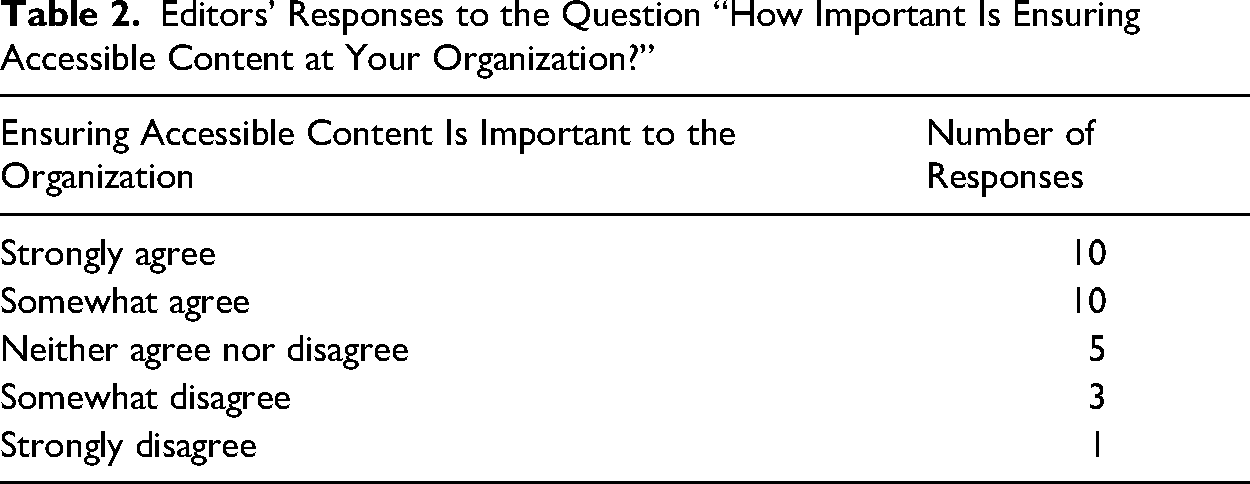
Two participants included feedback. One commented about personally ensuring that the final products are accessible even though the submission guidelines do not specifically address accessibility. Another commented that accessible content depends on the content type and vendor and that proprietary guidelines and restrictions make handling each piece of content a bit different. These comments indicate that the content, client, and vendor are better indicators of the value of accessibility than the overall organization. One comment suggests that even without guidance, accessibility is ensured, but the comment is unclear about how accessibility is ensured in a consistent way without specific guidelines. Is it an ad hoc process or a responsibility assigned to another role? The other comment suggests that guidance is vendor-specific. These are just two comments, and they do not indicate a particular pattern other than to suggest that accessible guidance may be project- or department-specific rather than applicable to all content.
Editor Responses: Editorial Guidelines and Processes for Accessible Content
The editors were asked the question “Are there specific editorial processes and guidelines at your organization to ensure the accessibility for any of the following? Please select all that apply.” Figure 4 shows the breakdown of their responses. Editors were provided a list of possible accessibility categories and asked to select each of those that their organization addresses with specific guidance or processes. These response options included broad content categories such as digital and print, mediums such as websites, and specific content items such as charts, tables, and images that are not exclusive to any particular content category. The most popular content item was images, and the most popular content category was digital content. The category that participants most often selected was images, with 17 responses, followed by digital content, with 13 responses. Charts and tables, print-based content, social media content, and websites each had 10 responses. Video content and topic-based content each had eight responses, none had five responses, and other had two responses. The two participants that selected the category other listed “508 COMPLIANT” and “.PDF Documents.”
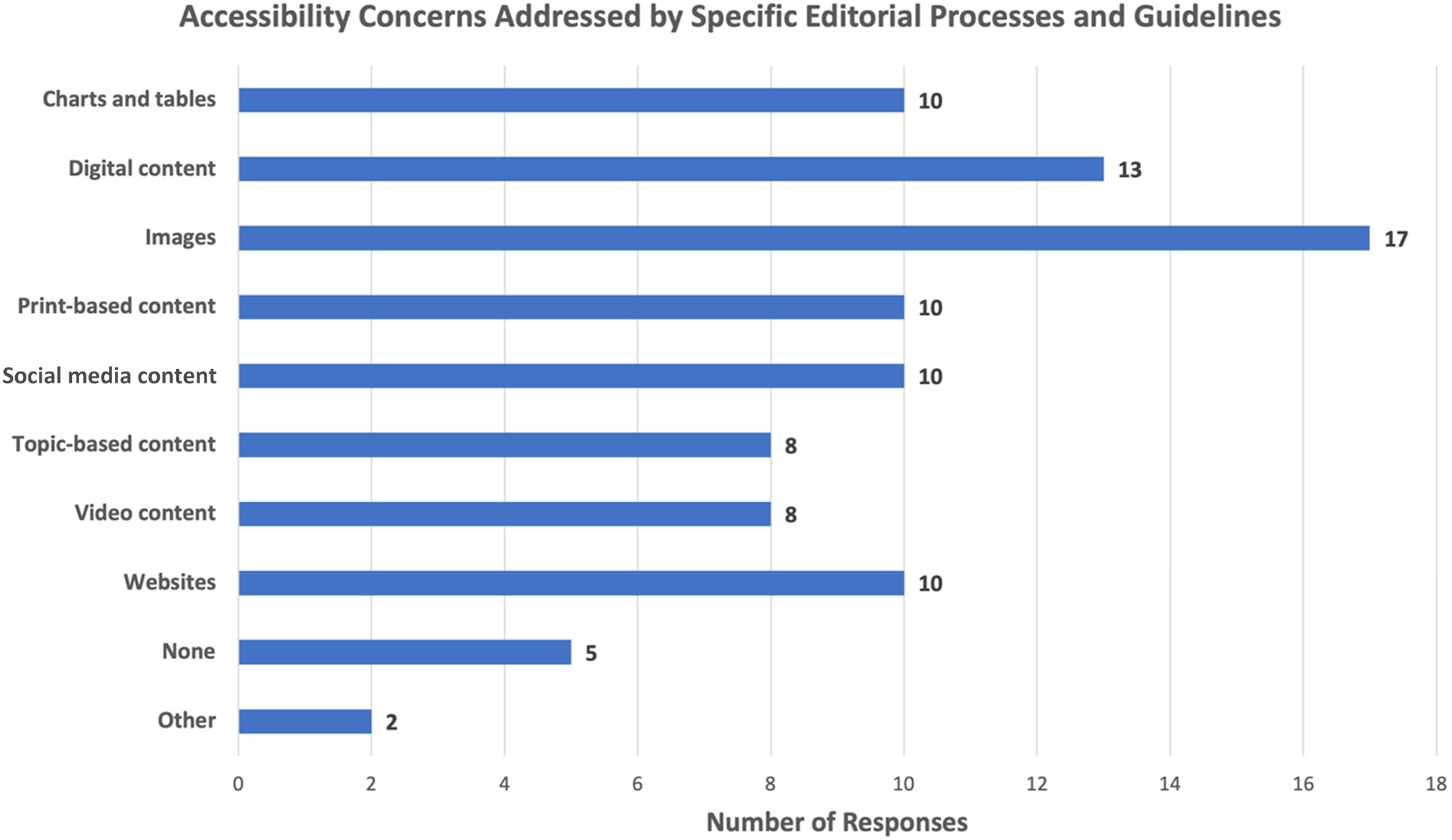
Breakdown of the editors’ responses to the question “Are there specific editorial processes and guidelines at your organization to ensure the accessibility for any of the following? Please select all that apply.”
Of the 29 editors who completed this survey, only 17 (59%) identified at least one accessibility category that their organization addressed with editorial guidance, and 5 (17%) indicated that their organization had no guidance for accessibility. Six participants chose to provide additional feedback. One of them did not belong to an organization but claimed to pay attention to accessibility. Two of them noted that their organization may have guidance that they are not aware of, and another one commented that this is an area that needs significant improvement. Another participant referred to a response from the previous question that accessibility is a consideration for editors and that their plain language training helps to make content more accessible, but there is no specific guidance. The sixth participant provided details about the processes that different departments undergo: It depends on the department but each department has to follow standards for the quality of work that is being produced, especially if it relates to an external audience. Different departments own different aspects—for example our marketing team owns the social media and outward-facing video content that is produced. They go through a rigorous editing system and have strict style guidelines that they have to follow. Since I work in engineering and not in marketing, it would not be appropriate for me to post using the companies’ social media platforms, since that is not my job and I am not familiar with their standards. Different ownership of the various projects affects that process that needs to be followed.
Limitations
Although this study provides valuable insights, it has some limitations. First and foremost, the number of responses does not allow for generalizable data. Another limitation has to do with questions about organizations that were included in the editor question set. To allow the editors to show that their values may be distinct from those of their organization, I designed questions to gather data on their perceptions of organizational values. But comments from both the survey and the interviews suggested that this approach had the unintended consequence of making freelance editors feel excluded.
Conclusions
Social justice and accessibility scholars highlight the importance of treating marginalized communities as experts and participants in developing and refining TPC practices and moving away from approaches based on prescriptive rules toward ones based on processes. These scholars also point out that nonneutral TPC practices can marginalize and foreground ways in which discrimination and exclusion are designed. In promoting inclusive editing practices, technical editing scholars highlight the importance and important expansions of style guidance (Adhya, 2015; Durazzi, 2022), but they also illustrate the limitations of style guidance for inclusive content (Benjamin & Schreiber, 2021; Mackiewicz & Durazzi, 2023). Scholars have paid some attention to incorporating and developing accessible processes and practices (Baker et al., 2021; Moeggenberg et al., 2022), but not enough.
Some themes have emerged from this study: Editing instructors and editors want to grow inclusive and accessible editing practices, existing frameworks in the classroom and the workplace make it difficult to incorporate accessible and inclusive editorial practices other than in an ad hoc way, and organizations want content to be accessible and inclusive but may be unevenly supporting the development and maintenance of editorial guidance. The results suggest that accessibility and inclusive editing are valued but that accessibility practices are not always part of inclusive editing practices and pedagogies. Inclusive language is a more prominent part of existing inclusive editing practices in the classroom and workplace. The results also suggest that editors rely more on their intuition than on editorial and style guidance, which aligns with Mackiewicz and Durazzi's (2023) finding, but the results do not show whether editors are developing (or have the support to develop) additional guidance and processes or whether they feel prepared to do so. The Acrolinx (2023) survey suggests that additional training is needed to help writers and editors use and identify issues with inclusive language (p. 11).
Recommendations for Editors
These findings, then, suggest that the important work of developing and maintaining guidance is not foregrounded and that editors rely on their own values and intuition. The development and maintenance of editorial guidance for consistent content is an important way to frame the value of technical and professional editing work. Such guidance can be a more direct way to incorporate accessibility and inclusivity. Freelance editors should be provided with their clients’ existing guidance, or they might consider developing guidance as another service they provide to help clients maintain their content over time.
Accessible and inclusive content practices should be shared across departments because these practices could serve not as a checklist but as a baseline for all other content decisions. As Huntsman (2021, 2022) maintained in her scholarship on accessibility and analysis of alt text, a checklist model is inappropriate for these knowledge domains, which must be continuously cultivated and maintained. Furthermore, accessibility and inclusion should be seen not as extensions of UX design but as grounding it. Best practices may be operationalized differently in various types of content (e.g., marketing and technical) or media, but the major principles and practices to build from should be the same.
Editors should advocate at their companies and through their professional organizations for additional training to support inclusive and accessible editing, as Acrolinx (2023) suggested (p. 11). Training should go beyond inclusive language and style guidance toward process-oriented approaches, particularly to support accessibility (Huntsman, 2021; Strantz, 2021).
Recommendations for Editing Instructors and Program Coordinators
Editing instructors and program coordinators should be thinking about how to develop pedagogies that support process-oriented approaches to inclusive and accessible editing. Editing teachers should prepare students to think beyond style guidance to other tools and frameworks (Smith, 2023) and to evaluate how inclusive language guidance may be improved (Mackiewicz & Durazzi, 2023). Students should also be prepared to consider process-oriented approaches to editorial guidance (Huntsman, 2021; Strantz, 2021). Specific practices for thinking beyond language to improve accessibility should also be incorporated in the classroom, such as Moeggenberg et al.'s (2022) suggestion to include converting PDF documents to HTML.
The results indicate that editors and editing instructors want to ensure that content is accessible and inclusive, but how to go about developing guidance or what guidance to develop is unclear to participants. The field often looks to the industry for models to bring into the classroom, but the industry does not have a clear approach. This is perhaps a point for collaboration between the industry and the academy. Emphasizing the role that editors play in developing and maintaining guidance is a way to provide students with new knowledge and practices.
Foregrounding editorial guidance for inclusive and accessible content also opens up space for discussing the structures of dynamic content and the need to think beyond inclusive language. Although inclusive language practices and clear subject matter are complex and important, addressing them alone is not enough to ensure inclusive and accessible content. Perhaps now is the time to rethink the types of guidance developed and the frameworks and models currently available—as well as to clarify concepts.
Foregrounding editorial guidance and editing as applying and developing guidance opens up opportunities for curricular placement and connection to other courses. Program coordinators can work with editing teachers to develop additional courses and ensure strong connections from other courses to editing. For example, a move toward editing as guiding content is a way to introduce content strategy and UX or to bring together lessons from content strategy and UX, as Hodges and Ponce (2022) recommended. By doing so, instructors would incorporate editing into other areas without trying to make editing cover everything. At my own institution, I am piloting a new course on plain language and accessible design in which I explicitly connect these topics to quality approaches in technical editing.
Future Research
Researchers can directly contribute to foregrounding the importance and value of editorial guidance and rethinking existing frameworks. The importance of developing and maintaining editorial guidance in editorial work may be underemphasized in both the classroom and the workplace. This is an area in which researchers and teachers might take the lead in developing and improving frameworks, particularly to support inclusive and accessible content practices. Researchers have shown that editorial guidance, such as house and department style guides, continues to be used but is difficult to maintain. Since practices for maintaining inclusive and accessible content are constantly changing, it is important to have a clear system for developing and maintaining that guidance. That system should include sharing existing guidance with freelance editors.
As these results show, existing editorial guidance is often siloed. Thus, researchers and scholars need to directly address freelance editors and freelance editing practices as well as improve and clarify definitions across different types of editing and industries. In addition to being areas for continued research and inquiry, they are a foundation from which to start building new practices and frameworks that might better serve editors, editing instructors, authors, subject-matter experts, and most important, people who need to use their content.
Plain language and readability are widely covered by editing teachers to address accessibility, but they were not presented as options for editors. One editor, however, noted that their plain language training helped them develop more inclusive and accessible content. It will be important for editing teachers to make any connection between plain language and accessibility critically and carefully. As Jones and Williams (2017) demonstrated, plain language does not necessarily address social justice concerns, and conflating it with accessibility could also be harmful. While plain language and accessibility should not be conflated, the connection is worth investigating for making critical connections in the classroom, for developing editorial models, and for further research.
Finally, scholars have pointed out the need to refine and redefine technical editing. Clem (2023) has directly argued for the need to align technical editing with social justice, and I have argued that TPC's long history with developing procedural knowledge uniquely positions it to both redefine technical editing and develop new frameworks (Schreiber, 2024), but this work also opens up opportunities to specifically connect to accessibility and develop editorial processes to support and promote accessibility. Technical editing is a neglected area of the field (Flanagan & Albers, 2019) that is defined more often by textbooks than by scholarship. As this study has shown, there are opportunities to expand this work to support inclusive and accessible technical editing frameworks, processes, and practices.
Footnotes
Appendix
Trends in Professional and Technical Editing Survey
Editing Instructor Questions
How many years have you been teaching at least one professional and technical editing course? How many years of experience do you have editing academic publications? Please include combined years of experience serving in roles such as managing editor, layout editor, copyeditor, book review editor, or special issue editor for academic publications. How many years of editing experience in the industry (outside academic publications) do you have? At what level do you teach editing course(s)? What editing roles do you cover in your course(s)? Please select all that apply. What style manuals do you cover in your editing course(s)? Please select all that apply. What textbooks do you currently use in your editing course(s)? Please select all that apply. What topics do you include in your editing course(s)? Please select all that apply. What theories do you include in your editing course(s)? Please select all that apply. What editing activities do you include in your course(s)? Please select all that apply. What DEI concerns do you include in your professional and technical editing courses? Please select all that apply. What accessibility concerns do you cover in your professional and technical editing courses? Please select all that apply.
Editor Questions
Industry: Current Job Title: What types of editing do you do? Please select all that apply. What types of subject matter do you edit? Please select all that apply. What style manuals are used at your organization? Please select all that apply. What types of content do you edit? Please select all that apply. What authoring tools do you use for information development or content management? Please select all that apply. How does your organization ensure content quality and accuracy? Please select all that apply. How does your organization ensure consistent content and information design? Please select all that apply. How important is ensuring inclusive content at your organization? Are there specific editorial processes and guidelines at your organization to address any of the following? Please select all that apply. How important is ensuring accessible content at your organization? Are there specific editorial processes and guidelines at your organization to ensure the accessibility for any of the following? Please select all that apply.
Declaration of Conflicting Interests
The author declared no potential conflicts of interest with respect to the research, authorship, and/or publication of this article.
Funding
The author received no financial support for the research, authorship, and/or publication of this article.
