






Abstract
South Korean schools are increasingly encountering students with disabilities from immigrant backgrounds. Difficulties experienced by these students have often been attributed to individual language ability or family background. In South Korea, students with disabilities from immigrant backgrounds are generally categorized as “multicultural students,” yet multicultural education and special education continue to operate through separate pathways. Consequently, processes linking evaluation to instruction and support are fragmented, leaving schools to rely heavily on individual judgment in the absence of clear guidance. This article shifts the focus to structural conditions within the South Korean education system that fail to adequately address cultural and linguistic diversity. Rather than reporting the effects of a specific policy, the article examines what remains disconnected in school practice and offers evaluation-focused questions and directions relevant for practitioners and administrators.
Keywords
Introduction
South Korea has transitioned into a multicultural society within a relatively short period of time. According to data from the Ministry of the Interior and Safety (2025), the number of children in international-marriage families and foreign-resident households in South Korea is estimated at approximately 320,000, including preschool-aged children. Of these, more than 200,000 are school-aged children and adolescents, accounting for about 4% of the total student population (Ministry of Education, 2025a). This demographic shift indicates that schools can no longer operate on the assumption of a linguistically and culturally homogeneous student population.
Special education statistics show that, as of April 2025, approximately 120,735 students have been identified as eligible for special education services (Ministry of Education, 2025b). These students receive educational support through a variety of placement options, including special schools, special classes within general education schools, and inclusive classrooms in general education settings. In terms of disability categories, a large proportion of students receiving special education services fall within the category of developmental disabilities (82.8%). Among all students eligible for special education, intellectual disability accounts for approximately 49.3%, followed by autism spectrum disorder (21.2%) and developmental delay (12.3%). Other disability categories include physical disabilities, speech or language impairments, hearing impairments, learning disabilities, emotional or behavioral disorders, and health impairments.
Although a nationwide census has not yet been conducted, a government survey of approximately 16,000 multicultural households reported that 19.9% of families have a child with a disability, an increase of 8.5 percentage points from 2021 (Ministry of Gender Equality and Family, 2025; see Table 1). These trends suggest that schools will increasingly encounter students with disabilities from multicultural backgrounds. As a result, there is a growing practical need to examine how evaluation, instruction, family collaboration, and service coordination currently operate in school settings when supporting students with disabilities from multicultural backgrounds.
Proportion of Family Members With Disabilities in Multicultural Households (Selected Years).
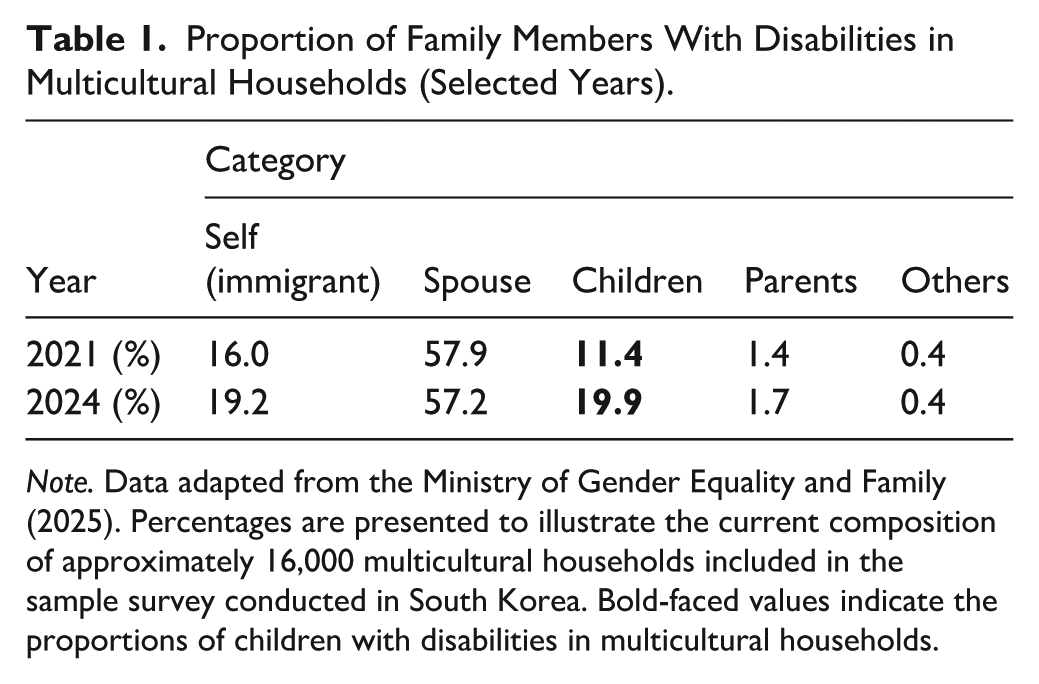
Note. Data adapted from the Ministry of Gender Equality and Family (2025). Percentages are presented to illustrate the current composition of approximately 16,000 multicultural households included in the sample survey conducted in South Korea. Bold-faced values indicate the proportions of children with disabilities in multicultural households.
In response to these demographic changes, the Ministry of Education has emphasized multicultural competence encompassing not only Korean language education but also cultural understanding and coexistence as a key component of the national school curriculum (Ministry of Education, 2018). However, the development of these policies has largely focused on students from multicultural backgrounds who are not disabled. Comparatively less systematic attention has been given to the learning characteristics, evaluation processes, and individualized support needs of students with disabilities from multicultural backgrounds. Multicultural education policies have primarily focused on Korean language acquisition and school adjustment, whereas special education has centered on disability identification and the development of individualized education programs (IEPs). Students with disabilities from multicultural backgrounds, who exist at the intersection of these two systems, often lack clearly defined support pathways, and schools frequently receive limited practical guidance regarding appropriate procedures and criteria for supporting them.
Against this backdrop, this article explores aspects of school practice that remain insufficiently connected in the Korean educational context and explores key issues and practical directions for more consistent linking of evaluation to instructional planning and educational support. Although grounded in the South Korean context, the discussion may also offer practical insights for schools in other countries that are educating students with immigrant backgrounds.
What Challenges Look Like in Schools
The challenges experienced by students with disabilities from multicultural backgrounds in school settings do not primarily arise from individual student characteristics. Rather, they emerge from structural conditions in which key support processes such as evaluation, instruction, family collaboration, and service coordination are not sufficiently connected. This section examines how these structural limitations appear in school practice, focusing on four interrelated domains.
Identification and Assessment
Many assessment tools and procedures currently used in schools operate within Korean linguistic and cultural frameworks. For example, widely used instruments in Korean special education include the Korean Wechsler Intelligence Scale for Children–IV (K-WISC-IV) and the Korean Child Behavior Checklist (K-CBCL), both of which were standardized on Korean child populations (Kwak et al., 2011; Oh et al., 1997). The Korean Scales of Independent Behavior–Revised (K-SIB-R) is also commonly used to assess adaptive functioning within the Korean assessment context (Baek et al., 2003).
International research has similarly noted that when assessment procedures do not adequately account for linguistic and cultural diversity, they may be limited in their ability to accurately identify students’ learning needs (Harry & Klingner, 2014). Such concerns are not unique to South Korea; they are widely discussed in countries that educate students with immigrant backgrounds. However, because the increase in multicultural student populations in South Korea has occurred relatively recently, systematic discussion and policy responses regarding equitable assessment remain in an early stage of development.
In this context, the challenges observed in schools should not be understood simply as issues of individual teacher expertise. Rather, they need to be interpreted in relation to the broader structural conditions of the assessment system. In assessment systems designed primarily around Korean language and cultural norms, linguistic and cultural differences may not be adequately accounted for. As a result, concerns have been raised that students with disabilities from multicultural backgrounds may be overidentified or underidentified in disability categories such as intellectual disability, learning disability, and autism spectrum disorder (Choi, 2025; Jeong & Jung, 2022).
Teacher Capacity
Teachers in South Korea receive training in both multicultural education and special education during their teacher-preparation programs. However, practical guidance on how these two domains intersect in classroom instruction and IEP development remains limited. Teachers often receive little support with methods to address the needs of students with disabilities from multicultural backgrounds within everyday instructional and evaluation practices.
Multicultural education training for inservice teachers is provided regularly, typically requiring approximately 15 hours every 3 years. In recent years, some training programs have begun to include topics that reflect school-level needs, such as identifying language delays or learning disabilities in a special school context (Seoul Metropolitan Office of Education, 2026). Nevertheless, the overall training structure continues to focus largely on supporting Korean language acquisition and promoting general multicultural awareness. As a result, concerns have been raised that professional competencies such as educational decision-making and IEP development for students with disabilities from linguistically diverse backgrounds are not sufficiently addressed in current training programs (Choi, 2025; Jeong & Jung, 2022).
Choi (2025) suggests that although special education teachers recognize the importance of multicultural special education, they experience considerable difficulty in providing appropriate educational support for students with disabilities from multicultural backgrounds. In many cases, the diagnostic and evaluation processes for children from multicultural families rely heavily on individual teachers’ efforts and experiences. Researchers have noted the need for more systematic support in areas such as multidimensional assessment procedures, multidisciplinary team collaboration, and facilitating meaningful parent participation (Jeong & Jung, 2022).
Family–School Communication
Family–school communication represents another important challenge. Language barriers, differences in cultural expectations regarding disability, and unfamiliarity with school procedures can complicate collaboration between schools and families. Some families may experience uncertainty or mistrust regarding disability-identification processes, or they may hesitate to participate actively due to concerns about stigma or misunderstanding. These communication gaps can weaken the connection between evaluation findings and educational decision-making, as essential family context, such as a child’s developmental history, language exposure, and daily functioning, may not be fully incorporated into school-based decisions.
These challenges are not solely attributable to individual family characteristics but also to the broader social context in which multicultural families in South Korea have emerged. The multicultural context in South Korea differs from that of traditional immigrant-receiving countries. A large proportion of multicultural families have been formed through international marriage, and in many cases, substantial differences exist between parents in language use, educational backgrounds, and socioeconomic conditions (Ministry of Gender Equality and Family, 2025).
Such conditions may influence both the home learning environment and students’ adjustment to school, often requiring additional coordination in communication with schools. For example, when communication between parents and schools is limited, important information, such as a child’s early developmental history, the language environment at home, and prior educational experiences, may not be adequately shared during the evaluation process. These information gaps can make it difficult to determine whether a student’s learning difficulties are related to language-acquisition processes or to disability-related needs. For students with disabilities from multicultural backgrounds, more systematic information-sharing and collaboration between families and schools are therefore particularly important during evaluation, educational planning, and ongoing support.
Fragmented Service Pathways
Because multicultural education and special education operate under separate policy frameworks, schools often lack clearly defined lines of responsibility across evaluation, support, and service coordination. As a result, student support may depend heavily on local resources or individual schools’ capacity, which can lead to variability across schools and regions. Within such a structure, it becomes difficult to ensure that evaluation results are consistently translated into educational support. Ultimately, the challenges experienced by students with disabilities from multicultural backgrounds are less about the absence of specific policies and more about the parallel institutional structures in which evaluation and support are not sufficiently integrated.
Table 2 illustrates how key components necessary to support students with disabilities from multicultural backgrounds are distributed across multiple laws and policy documents. Some policies regulate evaluation procedures and IEP implementation, but provide limited guidance regarding language access or family collaboration. Conversely, other policies address language and family support but are not sufficiently linked to special education identification or instructional planning. When these systems do not intersect consistently at the school level, gaps may emerge in translating evaluation outcomes into educational support. Thus, the key issue highlighted in Table 2 is not whether policies exist, but whether they are designed to function as continuous and integrated support pathways within school practice.
Legal and Policy Basis for Educational Support Components for Multicultural Students With Disabilities.
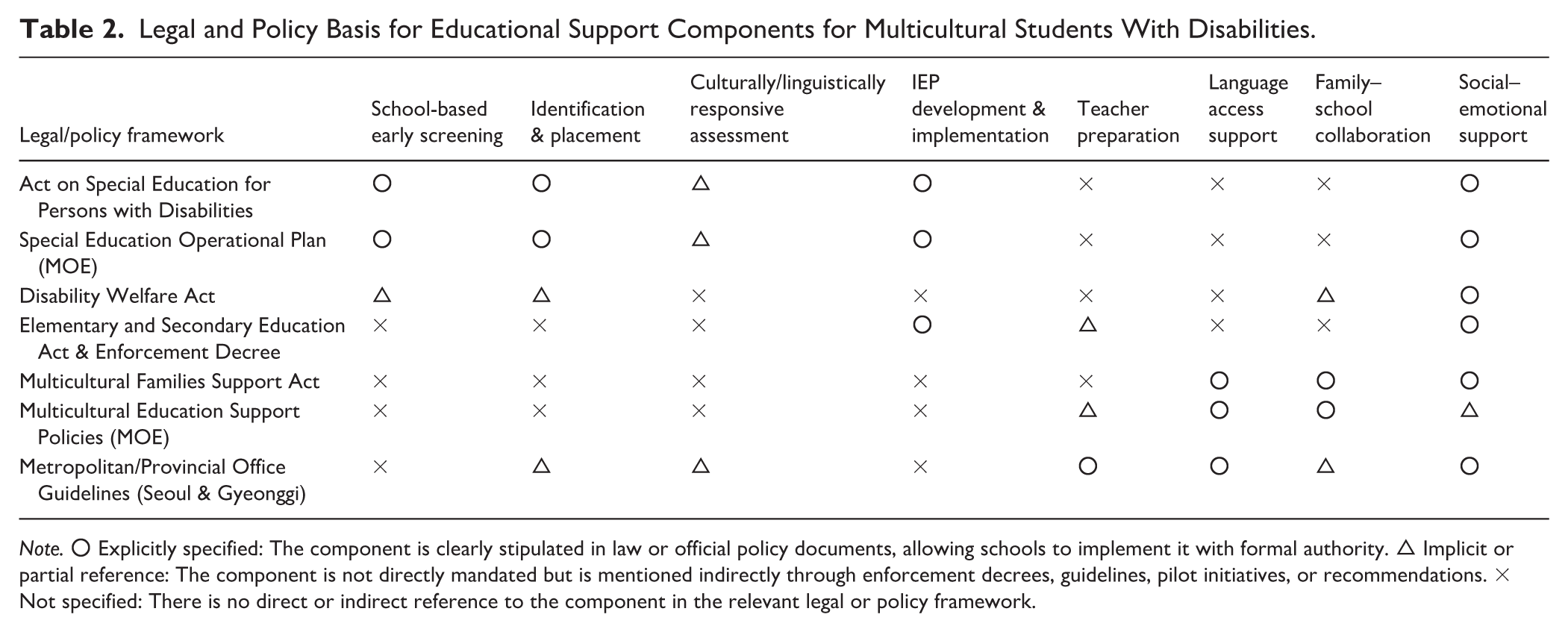
Note. ○ Explicitly specified: The component is clearly stipulated in law or official policy documents, allowing schools to implement it with formal authority. △ Implicit or partial reference: The component is not directly mandated but is mentioned indirectly through enforcement decrees, guidelines, pilot initiatives, or recommendations. × Not specified: There is no direct or indirect reference to the component in the relevant legal or policy framework.
Implications for Practice: Equitable Evaluation in Multilingual and Culturally Diverse Contexts
Supporting students with disabilities from multicultural backgrounds requires reframing evaluation not as the final step of disability identification but as the starting point for educational planning. Rather than relying primarily on standardized, language-dependent test scores as the basis for decision-making, the key question is whether evaluation procedures help educators understand how students learn across linguistic, cultural, and instructional contexts (Artiles, 2011).
Research suggests that evaluation becomes more valid when schools move beyond reliance on a single test and instead integrate multiple sources of evidence, including classroom-based data, family information, and approaches such as dynamic assessment or curriculum-based measurement (Harry & Klingner, 2014). In South Korea, multicultural education and special education often operate as parallel systems (see Table 2), and evaluation results are not always effectively connected to instructional planning or IEP support. For this reason, evaluation should be understood not as an isolated technical procedure but as a school-based practice that informs support design, learning monitoring, and IEP decision-making. The following five steps outline practical approaches that schools can apply to integrate policy implementation in practice and better meet the needs of multicultural students with disabilities.
Step 1. Conduct a Context-Sensitive Pre-evaluation Review
Before initiating a formal disability evaluation, schools should briefly review contextual factors that may influence student performance. These factors include language background, prior educational experiences, attendance patterns, and the student’s adjustment to school routines. Such a review helps prevent difficulties associated with multilingual development, interrupted schooling, or cultural adjustment from being prematurely interpreted as disability-related needs. Schools can conduct this preliminary review using readily available information such as:
classroom observation records focusing on task engagement, response to instruction, and peer interaction
student work samples that demonstrate learning processes and outcomes
attendance records and school adjustment reports
brief teacher checklists addressing language use, attention, and self-regulation
information about previous schooling experiences and language use at home
For students who have recently entered a new educational environment after migration, it is particularly important to move beyond a simple records review during the pre-evaluation stage. Schools should examine students’ prior educational experiences, changes in language use before and after migration, and potential psychological stress or anxiety related to the transition (Klingner & Harry, 2006; Shimada, 2018).
This preliminary review provides an important starting point for distinguishing whether difficulties observed in the classroom reflect persistent learning needs related to disability or differences in language access and prior school experience.
Step 2. Integrate Family Interviews and Ensure Language Access
Family information provides essential context for understanding the school performance of students with disabilities from multicultural backgrounds, yet it is often insufficiently obtained during the evaluation process due to language barriers or families’ unfamiliarity with school procedures. Information such as language use at home, prior educational experiences, and migration history can play a critical role in interpreting a student’s learning difficulties.
Family interviews can be used to gather information such as:
languages used by the students at home and at school
developmental and educational history, including schooling interruptions
family perspectives on the student’s strengths and learning needs
previous experiences with disability identification or support services
In many South Korean schools, full-time interpreters are not routinely available. As a result, parents may sometimes bring relatives or acquaintances to serve as interpreters during school meetings. However, this approach may have limitations regarding communication accuracy and confidentiality. Schools can instead request formal interpretation services through multicultural family support centers, regional interpretation and translation services, or multicultural support personnel affiliated with local education offices.
Because teachers are not always fully aware of these resources or how to access them, teacher training programs should provide guidance on securing interpretation support during key stages, such as initial family interviews, eligibility-related meetings, and IEP conferences. Establishing consistent procedures for language access can help ensure that important family information is accurately incorporated into the evaluation process.
Step 3. Use Dynamic Assessment or Curriculum-Based Measures to Examine Learning Potential
Standardized test results alone may not fully capture a student’s actual learning potential. For multilingual students in particular, expressive language abilities may appear limited, which can result in lower performance on language-dependent assessments. However, such outcomes do not necessarily reflect the student’s level of comprehension or learning capacity. Research on school-aged children from multicultural families has shown that vocabulary and literacy development may vary considerably depending on home language environments and school experiences (Kim & Lee, 2016).
For this reason, evaluation processes should consider not only test scores but also students’ responses to instructional support in classroom settings. For example, teachers may observe how a student’s task performance changes when explanations are modified or when visual supports are provided. Teachers can also monitor a specific task over time, documenting changes in accuracy, task completion, or the level of support required. Such approaches shift the focus of evaluation from identifying what a student cannot do to understanding the instructional conditions under which learning becomes possible.
Step 4. Establish Team-Based Decision Routines That Translate Evaluation into Support
For evaluation results to lead to meaningful educational support, decision-making should not rely solely on an individual teacher’s judgment but instead involve a team-based structure that includes multiple professionals. Prior research has consistently emphasized that collaborative discussions among teachers, related professionals, and families during the development and implementation of IEPs play an important role in accurately understanding students’ learning needs and designing appropriate educational supports (e.g., Harry & Klingner, 2014; Klingner & Harry, 2006).
In South Korea, IEP meetings are formally established as a procedural mechanism for such collaboration. However, in practice, time constraints and limited personnel may make it difficult for all relevant professionals to participate consistently. Some studies have also reported that IEP implementation is often centered primarily on special education teachers (Woo & Kim, 2020).
This issue is particularly important for students with disabilities from multicultural backgrounds, whose learning performance may be influenced not only by disability-related characteristics but also by language environment, prior educational experiences, and family cultural background. Considering these intersecting factors requires collaborative discussions in which general education teachers and special education teachers jointly review students’ classroom performance. When necessary, additional perspectives from school counselors, multicultural support personnel, or interpretation services may further support a more comprehensive understanding of students’ learning contexts.
In such discussions, it is important to consider multiple sources of information rather than relying solely on individual test scores. These may include classroom observation records, student work samples, attendance and school adjustment records, family interview information, curriculum-based assessment data, and formal evaluation results. Within this process, the central question guiding discussion should shift from “Does this student meet eligibility criteria?” to “What support does this student need to participate in learning, and how will we know whether that support is effective?”
At the school level, these collaborative discussions can be organized as regular, small-scale meetings. For example, general education and special education teachers may periodically review student learning materials and observation records together to discuss appropriate support strategies. For such collaborative structures to be sustained, strong school leadership, particularly the principal’s active involvement and support, is critical in the South Korean school context. Principals play a central role in school management and decision-making. When principals recognize collaborative discussions as an official component of school practice and actively support their implementation, collaboration among teachers can become more stable and sustainable. Such collaborative structures help ensure that evaluation results are translated into instructional adjustments and educational support, enabling decision-making that accounts for the linguistic and cultural contexts of students with disabilities from multicultural backgrounds.
Step 5. Translating Evaluation Into Instructional Support
Collaborative discussions of evaluation results should not remain limited to information sharing but should lead directly to instructional support. For example, team discussions may lead to instructional adjustments such as simplifying the language used in tasks or providing visual structures and models to support understanding. When necessary, teachers may also implement targeted small-group instruction or short-term progress monitoring to observe how students respond to specific support. Information gathered through these processes can then serve as a basis for refining IEP goals or adjusting support strategies. In this sense, evaluation should not be understood as a single step of identification but as an ongoing process in which classroom evidence, family information, and student responses to instruction inform instructional adjustments and IEP implementation.
As illustrated in Figure 1, evaluation should function as a cyclical process in which classroom-based evidence, family input, and dynamic assessment results inform collaborative decision-making, instructional adjustments, and the ongoing refinement of IEPs (Fujikawa, 2023).
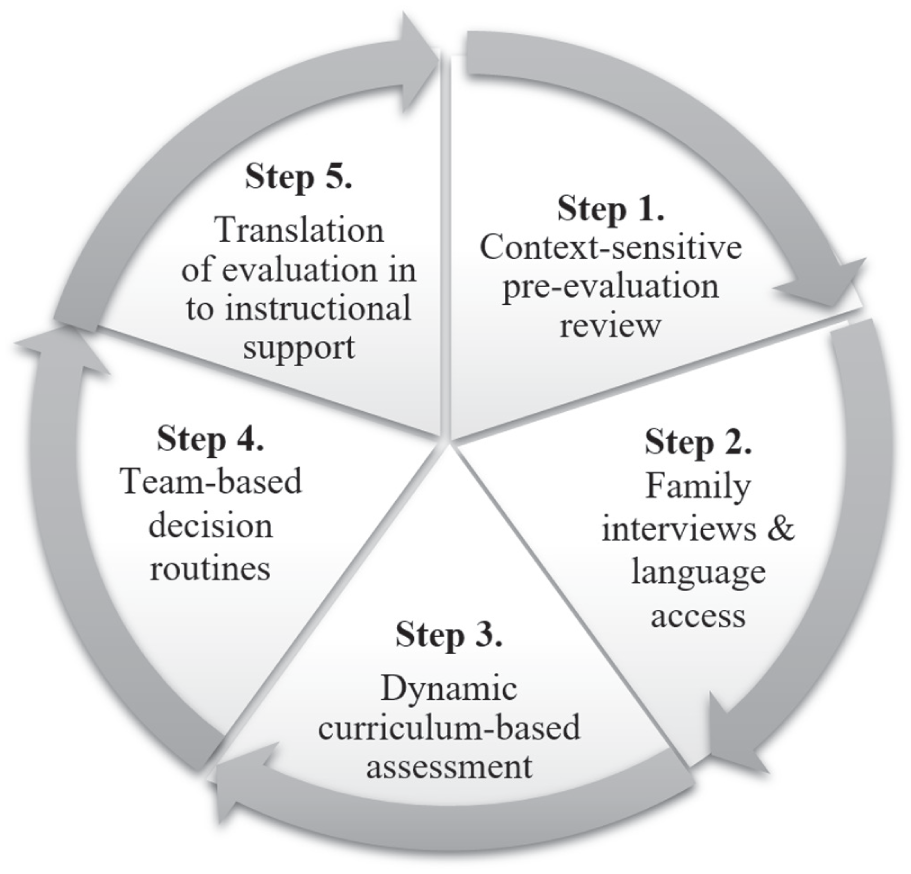
Evaluation-to-IEP support cycle for multicultural students with disabilities.
Who Should Act Next?
Equitable support for students with disabilities from multicultural backgrounds cannot be achieved through the efforts of a single group or individual. Challenges observed in schools often arise from structural conditions in which evaluation, instructional support, family collaboration, and administrative support are not sufficiently connected. Addressing these challenges, therefore, requires coordinated roles among teachers, school administrators, policymakers, and families.
Teachers play an important role in connecting evaluation with instructional practice. Observing and documenting how students respond to instructional supports in everyday classroom contexts can provide valuable insights into students’ learning needs. However, when such practices rely solely on individual teachers’ discretion or additional effort, they are difficult to sustain in everyday school settings. In South Korea, teachers are often expected to manage multiple responsibilities simultaneously, including conducting evaluation, making instructional adjustments, and communicating with families. When linguistic diversity and disability-related needs intersect, the workload required to respond appropriately can increase further.
For this reason, school administrators and policymakers play a critical role in ensuring that these practices are supported structurally rather than left to individual teachers. Institutional support, such as protected time for collaborative discussions, access to interpretation and language support services, and professional learning opportunities grounded in real school cases, is an important condition for implementing equitable evaluation and educational support in schools. Such structures help ensure that evaluation findings are more consistently translated into classroom instruction and educational planning.
At the policy level, multicultural education and special education should not be treated as separate policy domains but rather as interconnected components of an integrated support system. When these areas operate under separate policy structures, the processes of evaluation, instructional support, and family collaboration may become fragmented at the school level. Developing policy and administrative structures that connect multicultural education to special education can therefore reduce the burden placed on individual teachers while enabling schools to provide more coherent support for students.
Families are also important partners in the educational support process. Information about home language use, prior educational experiences, and cultural context provides essential background for understanding students’ learning situations. When communication between schools and families is built on trust, this information can be meaningfully incorporated into the interpretation of evaluation results and the development of educational plans.
When the roles of these stakeholders’ function in complementary ways, evaluation, instructional support, and family collaboration can operate not as isolated procedures but as interconnected processes within schools. This perspective shifts attention away from viewing students with disabilities from multicultural backgrounds as exceptional cases and toward recognizing them as members of school communities whose equitable access to educational opportunities must be continuously supported.
Conclusion: Future Directions
As diversity within South Korea’s public education system continues to increase, the educational needs of students with disabilities are also becoming more complex. This discussion emphasized the importance of recognizing students with disabilities from multicultural backgrounds not as an exceptional group, but as an existing and growing part of school communities.
The central issue raised in this paper is not the adoption of a single policy or the implementation of short-term programs, but rather how evaluation, instructional support, family collaboration, and service coordination can operate as a coherent, continuous system at the school level. As discussed, current challenges are more closely linked to structural fragmentation among policies and practices than to the capacity of any single stakeholder.
Future directions should therefore begin not with proposing new solutions, but with examining how existing evaluation, instructional, and support systems can be better aligned and coordinated within local school contexts. In this process, professional judgment by teachers, institutional support, collaboration with families, and ongoing monitoring must function in complementary ways and cannot be reduced to any single component.
Rather than offering a definitive conclusion, this discussion is intended as a practical starting point that can be adapted and refined across schools and regions. Through such efforts, educational participation and learning opportunities for students with disabilities from multicultural backgrounds may be supported more consistently and equitably in everyday school practice, moving beyond declarative policy toward sustained implementation.
Footnotes

Funding
The authors disclosed receipt of the following financial support for the research, authorship, and/or publication of this article: The present research was supported by the research fund of Dankook University in 2025.
Declaration of Conflicting Interests
The authors declared no potential conflicts of interest with respect to the research, authorship, and/or publication of this article.