






Abstract
Language is more than a means to communicate information. It is connected to our cognitive processes, social structures, and identities. Unfortunately, for many students with learning disabilities (LD), including multilingual learners with LD, developing and using language in meaningful ways is confined to the limited opportunities created in the classroom. Misinterpretation of the recent rescission of seminal guidance for the education of multilingual learners, may give educators pause in supporting and scaffolding the languages of multilingual learners, especially those students with LD. This article provides a framework for intentionally creating supportive, language-rich classrooms that affirm students’ identities, promote language development, and enhance learning.
Keywords
Introduction
Meeting the needs of our students with learning disabilities (LD), including multilingual learners with LD, is complex. Students are tasked with learning rigorous academic content while simultaneously developing English proficiency. If simultaneous content and language attainment were not difficult enough, their learning is compounded by challenges related to their disability and the sociocultural context in which they live.
Multilingual learners with LD frequently demonstrate limited oral language skills (Spies & Xu, 2018) stemming from either their developing English proficiency, disability-related needs, or both. Irrespective of the root cause, limited oral language skills significantly impact school success (Koutsoftas & Srivastava, 2020). They are the foundation for understanding and communicating in all content areas (e.g., problem-solving in math [Kong & Orosco, 2016]; reading comprehension [Spies et al., 2017]). Equally important is the critical role language plays in students’ social interactions and identity (Choi, 2024). Even though language is associated with culture, identity, and academic achievement, many classroom teachers do not see language development for their multilingual learners as their responsibility (Polat et al., 2019) and feel under-prepared to teach their students (Li & Jee, 2021).
Rescission of federal guidance in the support of students’ language development leaves it up to the states to ensure students have meaningful access to the general education curriculum. Misinterpretation of these rollbacks may give educators pause in supporting and scaffolding the language needs of multilingual learners with LD. Further, it may stifle efforts to recognize the relationship between language, identity, and academic outcomes. More than ever, it is critical that all teachers identify as language teachers. All schools and all teachers can do this by creating language-rich classrooms supportive of all students. The goal of this article is to provide educators with guidance in developing language-rich classrooms that affirm students’ identities and support language development, leading to improved academic outcomes.
Oral Language
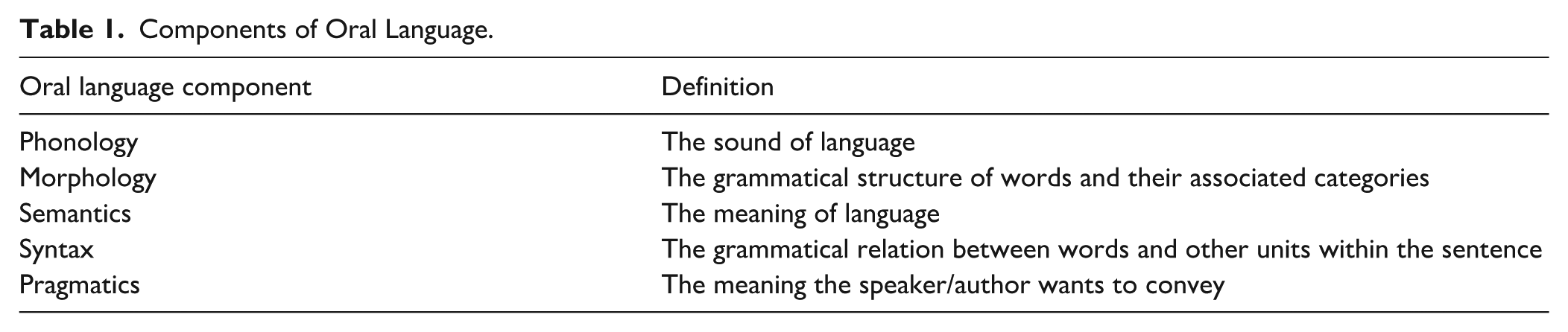
Oral language encompasses a set of interdependent language skills (i.e., phonology, syntax, morphology, semantics, and pragmatics; see Table 1 for a description of each component) through which individuals communicate and acquire knowledge (Foorman et al., 2015). It is the foundation for students’ ability to comprehend, read fluently, and write effectively (Worthington & Fitch-Hauser, 2018). Oral language allows for precise communication of thoughts and ideas and facilitates understanding of speech. Language can be categorized into receptive language skills and expressive language skills.
Components of Oral Language.
Receptive Language Skills
Receptive language skills include listening and reading with the goal of language understanding (Spies, 2023). As students receive or “take in” language, they construct ideas through the analysis of vocabulary and sentences (Nelson & Wiig, 2018). Students with LD who are multilingual learners may struggle with receptive language skills due to differences in how they process language.
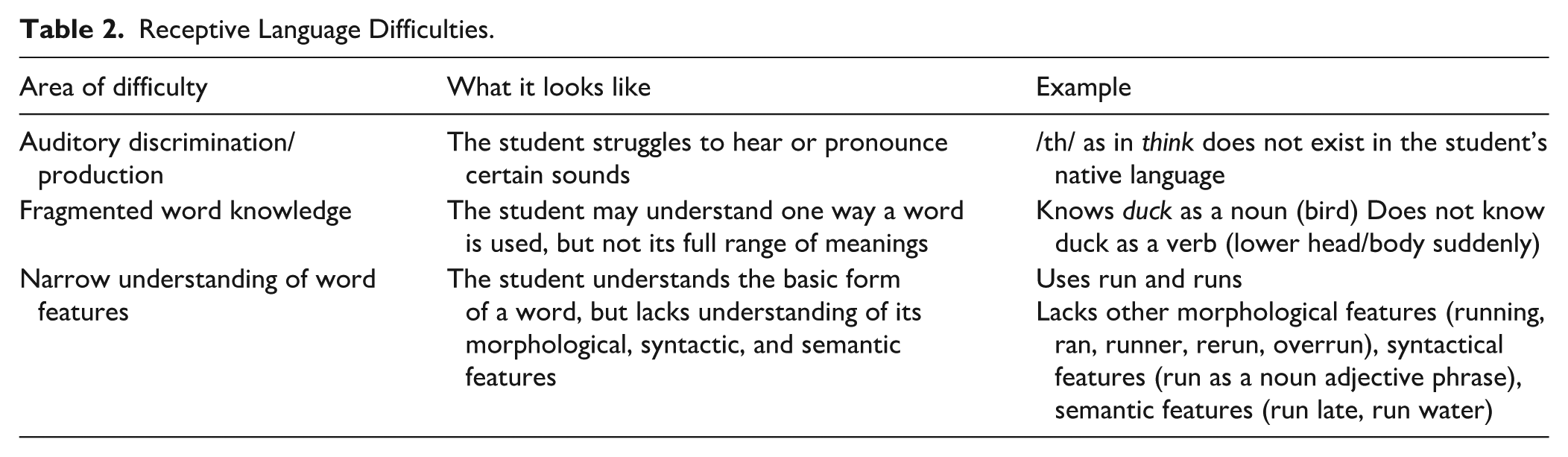
Although each student is unique, there are some common receptive language difficulties. A student may have challenges with auditory discrimination and tuning out background noise (Spies, 2023). For example, a Spanish-speaking student may have difficulty hearing or using the /sh/ sound because it does not exist in Spanish. Multilingual learners often have fragmented word knowledge, a narrow understanding of word features, less exposure to vocabulary, and limited access to high-quality language environments, resulting in a lack of depth and breadth of words (Wood et al., 2021). For instance, a student may understand a table as a piece of furniture but may be unaware that a table can also refer to a chart in mathematics or science, or to a place to postpone an idea. The student may not understand the idiomatic use, such as “turn the tables.” Table 2 expands upon potential receptive language difficulties a student with LD who is a multilingual learner may exhibit.
Receptive Language Difficulties.
Expressive Language Skills
Expressive language skills include speaking and writing with the goal of language formulation (Spies, 2023). When students produce language, they construct ideas through the selection of vocabulary and formulation of sentences (Nelson & Wiig, 2018). Students with LD who are multilingual learners may struggle with expressive language due to information-processing difficulties.
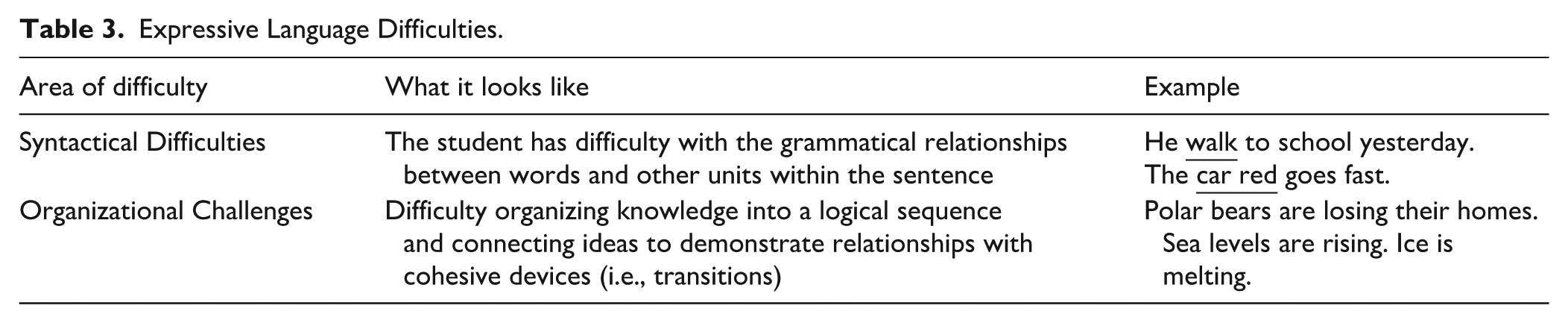
A student with a disability who is a multilingual learner often exhibits difficulties with syntax and language organization, which may affect their expressive language abilities (Spies & Xu, 2018). This is evident when a student is less accurate with tense-marking morphemes, such as the use of –ed for the past tense. They may apply syntactical structures of their native language to English. Table 3 expands on the potential expressive language difficulties a student with LD who is also a multilingual learner may exhibit.
Expressive Language Difficulties.
To bolster language and academic development while also affirming students’ cultural and linguistic identities, educators can focus on designing language-rich classrooms. Creating a language-rich classroom supports language development, fosters engagement, enhances learning, and creates positive learning environments critical to school success. Language-rich classrooms that benefit all learners require minimal preparation or additional work – simply intentionality.
A Framework for Creating Language-Rich Classrooms
Designing language-rich classrooms to improve students’ oral language skills and create a sense of belonging requires constructing extensive opportunities for expressive and receptive language use. There are many ways to build a language-rich classroom, but it must be intentional. Intentional in that the environment and opportunities are “done on purpose, deliberate” (Oxford English Dictionary, n.d.). Language-rich classrooms are intentional in creating
S: Safe and Supportive Environment
Creating a language-rich classroom begins with considering the emotional well-being of students through a safe and supportive environment. An intentionally designed classroom environment is strengths-focused with proactive practices that are immediately welcoming and supportive to all students (Cioè-Peña, 2022). The SPEAK framework focuses on lowering the student’s affective filter.
The affective filter refers to the emotional and psychological factors that either support or hinder a student’s language learning (Krashen, 1981, 1982). When a student’s affective filter is high, they feel anxious or self-conscious, thereby limiting the amount of language input they can process. On the other hand, when a student’s affective filter is low, they feel safe and confident, equipped to take in more language. Given the current circumstances surrounding immigration policies, families of multilingual learners may live in fear, fear the unknown, and are overcoming trauma; attention to the affective filter is critical. When considering ways to lower the affective filter, aim to lower student anxiety, increase motivation, and build self-confidence (Krashen, 1981).
Lower Anxiety
To lower anxiety, the SPEAK framework emphasizes a foundational approach: creating a predictable environment for students. A predictable environment reduces anxiety and helps the student feel safe and confident (Hernández & Darling-Hammond, 2022). It also reduces the chance of unintentional noncompliance. A central component of a predictable environment is a visual schedule. A visual schedule shows the layout of the student’s day without relying solely on language. With a picture of the day’s sequence, the student can anticipate transitions and develop autonomy and confidence (Hume et al., 2014). A visual schedule removes the fear of the unknown.
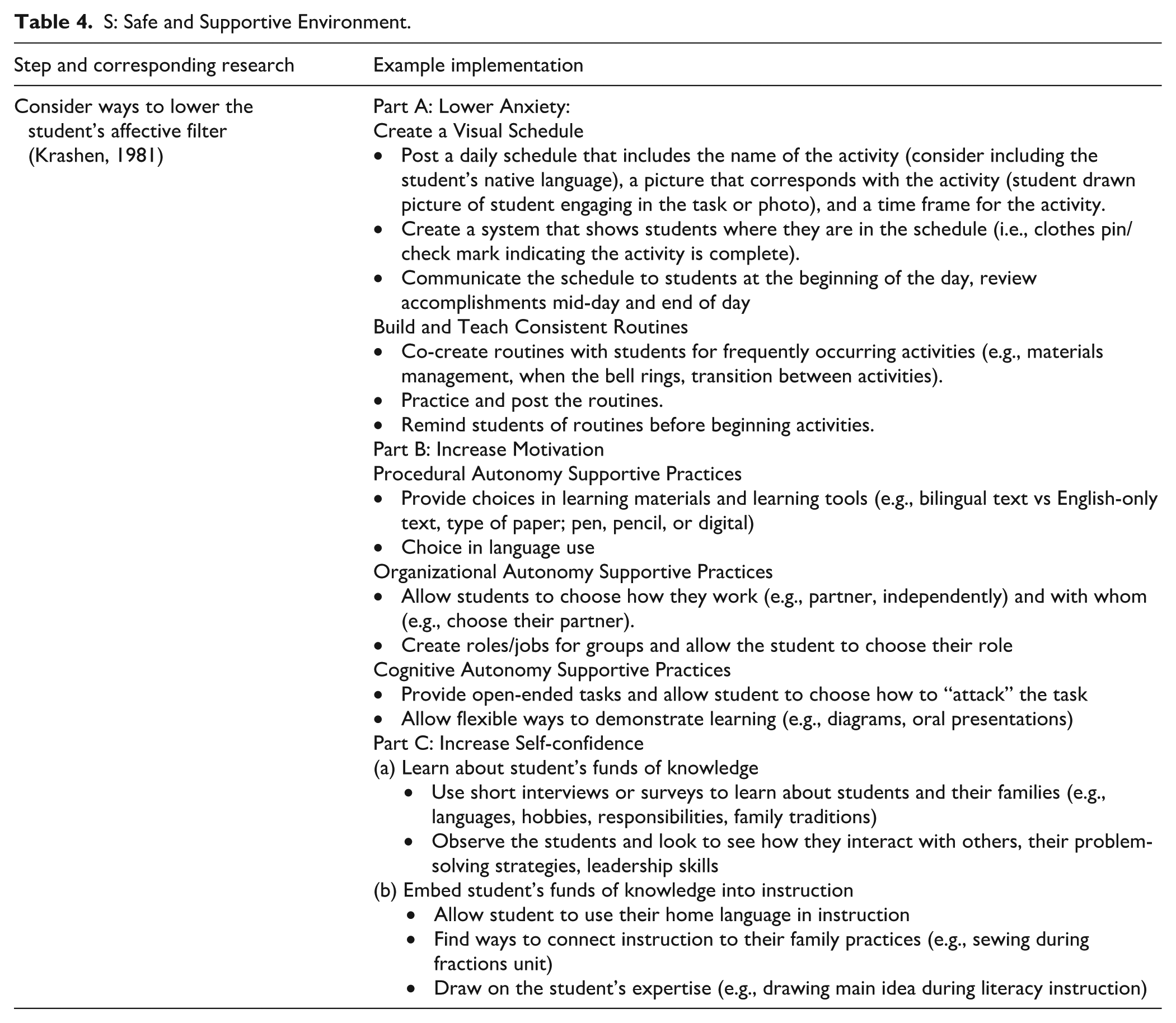
Another way to lower anxiety is to co-create and practice classroom routines and procedures. Teachers may take photos or have students create visuals of what expectations for routines and procedures look like (Lane et al., 2024). With consistent, predictable routines, the student does not have to expend cognitive energy wondering whether they are “doing it right.” Knowing the routines creates a sense of belonging and more cognitive space for learning. See Table 4, Part A, for steps to implement a visual schedule and build predictable routines.
S: Safe and Supportive Environment.
Increase Motivation
When addressing the student’s affective filter, educators should also consider ways to increase motivation. One way to do that is through autonomy-supportive teaching. In autonomy-supportive teaching classrooms, the psychological needs and intrinsic motivation of learners are nurtured (Ryan & Deci, 2000). Autonomy-supportive teaching behaviors can be categorized into (a) procedural, (b) organizational, and (c) cognitive. Procedural autonomy practices empower students to choose how they engage in learning tasks. Organizational autonomy practices grant students opportunities to make choices about the learning environment in how the work is structured. Cognitive autonomy allows students to choose how they engage in learning at a higher cognitive level (Deniz et al., 2024). By incorporating autonomy-supportive teaching practices, multilingual learners with LD feel agentic and competent because learning is relevant and meaningful (Hernández & Darling-Hammond, 2022). See Table 4, Part B, for steps to implement procedural, organizational, and cognitive autonomy-supportive practices.
Increase Self-Confidence
Lowering the affective filter also involves increasing the student’s self-confidence. One way to do this is to embed, center, or highlight the student’s funds of knowledge in the classroom. Funds of knowledge refer to one’s historically accumulated and culturally developed body of knowledge and skills essential for household and individual function and well-being (Moll et al., 1992). Funds of knowledge challenges deficit views of diversity by focusing on the students’ strengths (Deniz et al., 2025). This requires learning about students’ funds of knowledge and embedding their cultural and linguistic strengths in instruction. By embedding the students’ funds of knowledge, they feel safe and validated (Hernández & Darling-Hammond, 2022). See Table 4, Part C for steps on how to increase a multilingual learner’s self-confidence through a funds of knowledge approach.
P: Physical Spaces to Promote Meaningful Communication
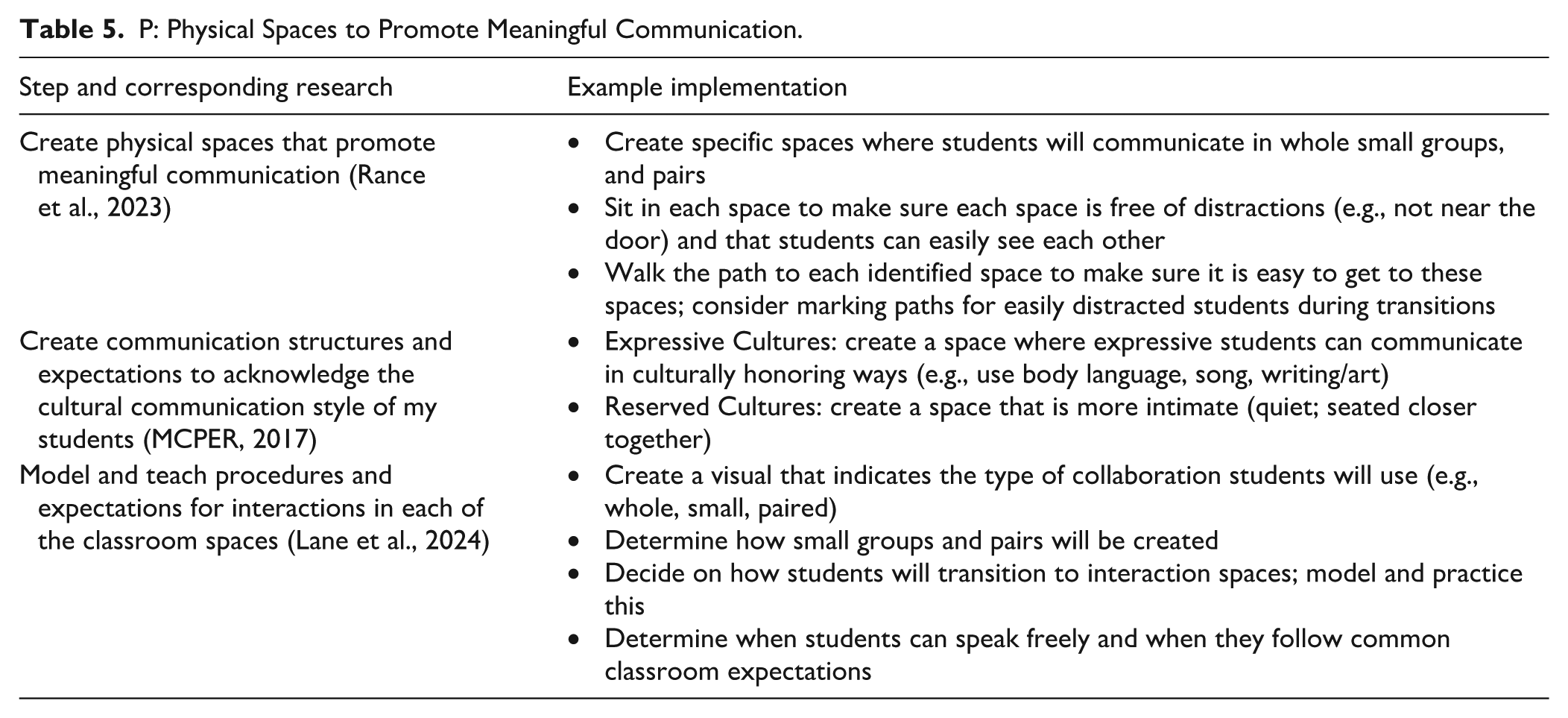
After establishing a language-rich classroom environment, the next component to consider is the physical space for promoting meaningful communication (Rance et al., 2023). The physical spaces in the SPEAK framework promote communication through their design, consideration for communication structures, and the modeling and teaching of expectations. The intentional design of the physical spaces focuses on promoting meaningful communication, making language learning more equitable, and honoring communication styles.
Physical spaces in the SPEAK classroom support whole-group, small-group, and paired conversation. To promote meaningful communication, teachers consider how to make each space free of distractions (Spies, 2023) and easy to transition into from all parts of the room. In creating these spaces, teachers may also account for student needs and preferences, including the communication styles of expressive and more reserved cultures (The Meadows Center for Preventing Educational Risk [MCPER], 2017).
Teaching routines and procedures are also important in creating physical spaces designed for meaningful communication. Determine routines and procedures across all aspects of communication structures (e.g., whole, small, pairs) and support them through explicit teaching, visuals, and reminders (Lane et al., 2024). See Table 5 for steps on how to create physical spaces for meaningful communication.
P: Physical Spaces to Promote Meaningful Communication.
E: Expansive Translanguaging
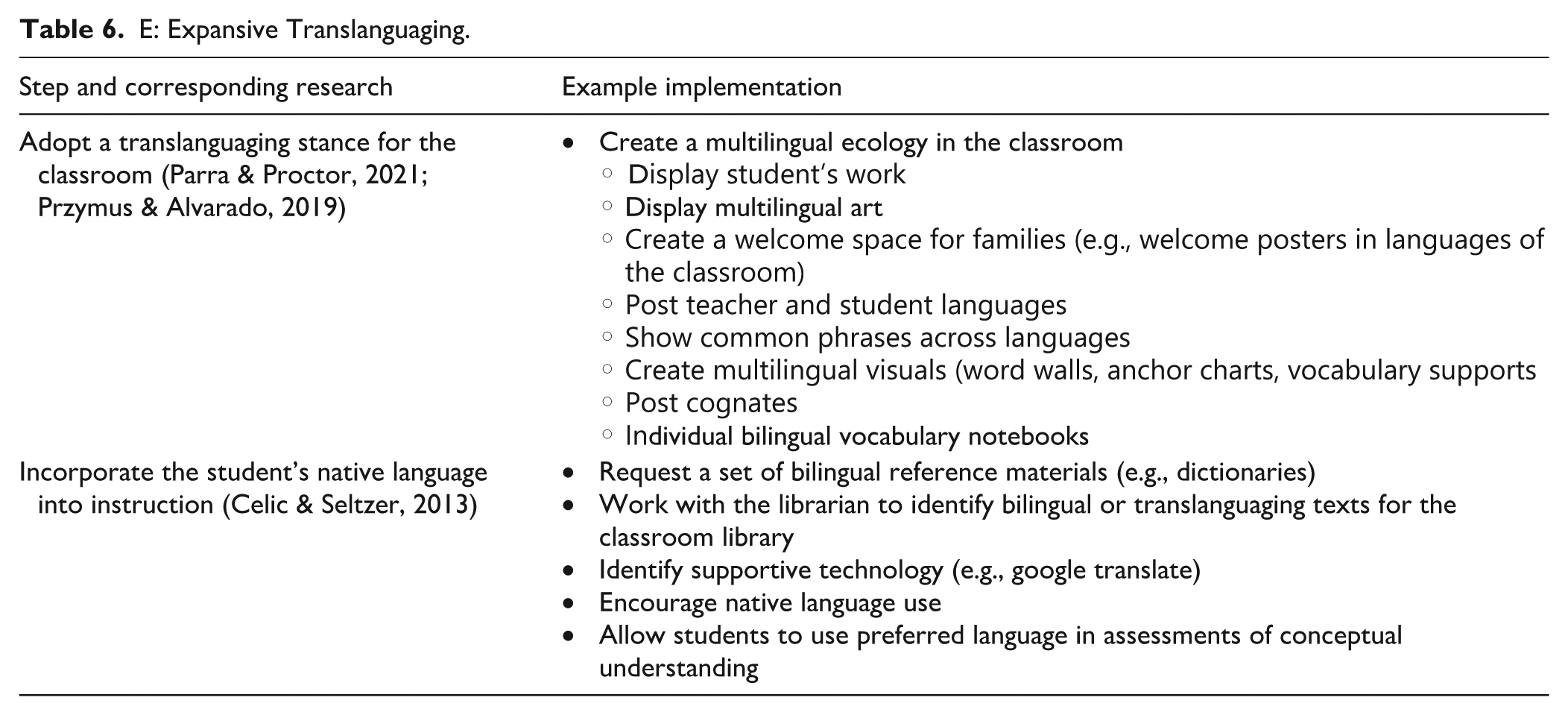
Once the physical and emotional environment is established, expand to a translanguaging stance to affirm the student’s linguistic resources and enable deeper levels of learning. Translanguaging recognizes that the languages within bi-/multilingual individuals are not distinct but rather constitute a single linguistic repertoire used flexibly for meaningful communication (García & Wei, 2014). In adopting a translanguaging stance, teachers recognize, value, and strategically use a student’s full linguistic repertoire. They believe their full linguistic repertoire and cultural backgrounds are assets for learning. Classrooms where students’ home languages are spoken increase students’ self-esteem, sense of belonging, and confidence while also enriching the learning environment for all students (Parra & Proctor, 2021; Przymus & Alvarado, 2019).
Although there are multiple ways to adopt a translanguaging stance, the SPEAK framework begins with creating a foundational multilingual ecology. A multilingual ecology recognizes the full range of students’ language practices and ensures that the school’s languages are visible and heard (B. Collins & Guzman-Valerio, 2015). A multilingual ecology builds community, bridges language barriers, and supports the acquisition of English literacy and other languages.
As the multilingual ecology is being built, teachers can incorporate students’ native languages into instruction, regardless of their level of proficiency in those languages. By encouraging the use of the student’s native language and English, the student’s meaning-making process is privileged as they use their full linguistic repertoire (García & Kleifgen, 2020). Educators may seek out instructional resources in the student’s native language, such as videos or reading materials. Teachers may consider grouping students by native language during modeling and guided practice to encourage translanguaging. See Table 6 for steps on how to expand translanguaging efforts in the classroom.
E: Expansive Translanguaging.
A: Amplify Language
Thus far, the SPEAK framework has been grounded in creating an affirming space for meaningful communication. At this point, the framework shifts toward teaching moves and planning to support language development (See Figure 1). Amplifying language is a broad concept in second-language acquisition in which learning experiences for multilingual learners are enhanced, expanded, and enriched rather than simplified (Walqui et al., 2020). Amplifying replaces traditionally simplified learning experiences for students with emerging English proficiency with high expectations, scaffolded and supported through multiple opportunities to engage with the content (Kibler et al., 2015). It can lead to better comprehension, increased engagement, and a deeper understanding of the content.
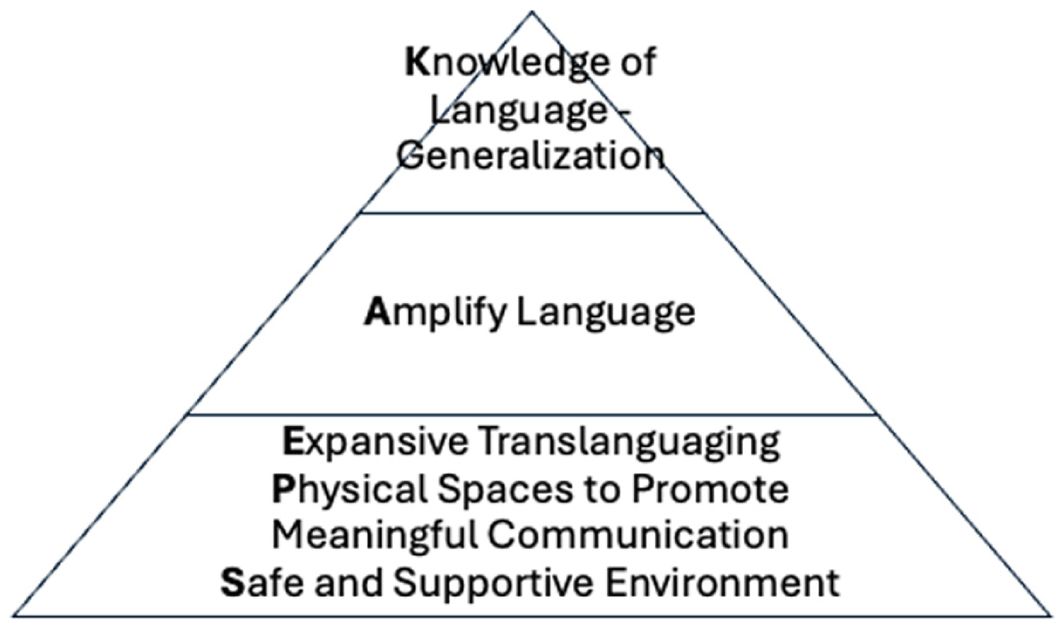
SPEAK framework.
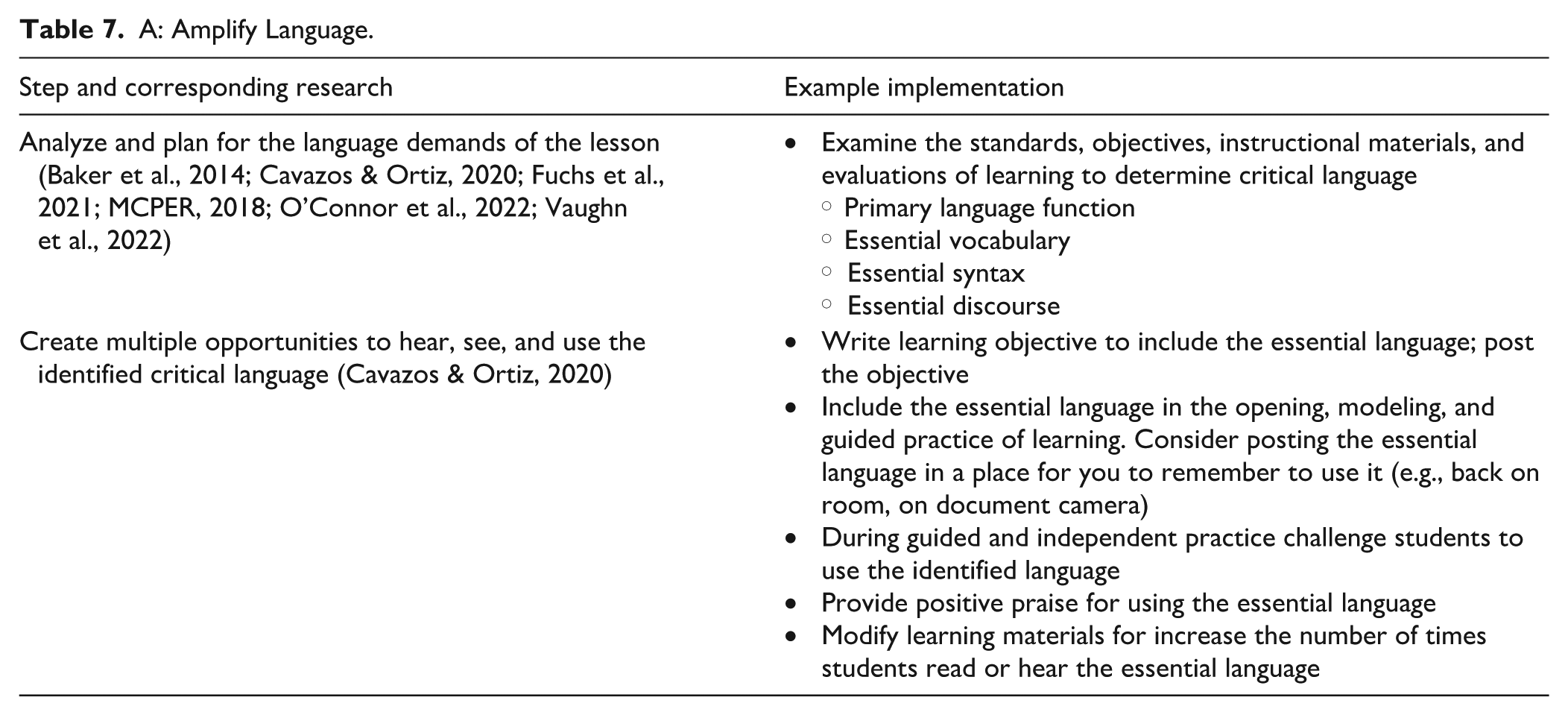
Amplified language involves intentionally planning multiple opportunities to engage with the lesson’s language functions and demands, in both receptive and expressive ways. Language functions are the purposes for which language is used (e.g., describe, explain). Language functions are typically derived from the verbs of learning standards (Sacco et al., 2022). For example, a lesson objective may be: students will organize, represent, and interpret data using three categories in bar graphs. The language functions, or the purposes for which language is used, for this lesson could be describing, classifying, or comparing. Language demands refer to the language students use to participate in learning, including essential vocabulary, primary syntactic structures, and discourse markers (Sacco et al., 2022). Language demands for this lesson include comparative language, such as more than, fewer than, or the same as, and declarative statements, such as this bar shows. . .
Once teachers have determined the language functions and demands, they can plan multiple opportunities for students to hear and use the identified essential language. Teachers aim to include the target language in every component of the lesson, including the objective. They find ways to both challenge and support the student in using the targeted language. Educators may consider modifying the instructional materials to increase the number of exposures to targeted language (e.g., text language). See Table 7 for steps on how to amplify language.
A: Amplify Language.
K: Knowledge of Language – Generalization
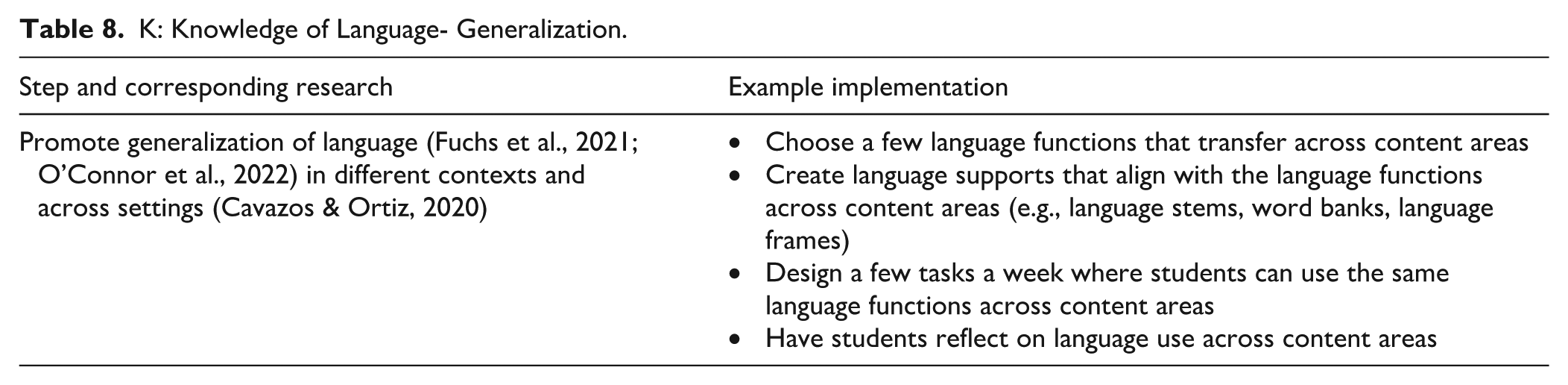
Once the student has had multiple opportunities to interact with the target language in the specific content area, teachers can plan opportunities for the student to use the language in different contexts. Generalization refers to the student’s ability to apply knowledge and skills in different situations and settings beyond where they were first taught (B. C. Collins, 2012). The SPEAK framework builds off special education’s generalization principle and applies it to language. Teachers may plan for the essential language identified in the amplification component of the framework to be used across settings and contexts. For example, if a student learned to compare in the English language arts (ELA) classroom, they may also be intentional in using it in science, math, and/or social studies. A discourse stem used in the ELA comparison lesson, such as “Both _____ and ________,” can then be purposefully used in other subject areas. See Table 8 for steps to plan for the generalization of learned language.
K: Knowledge of Language- Generalization.
Although the SPEAK components are presented as separate entities, they overlap significantly in affirming students’ identities and supporting their language development. Still, safe and supportive environments, physical spaces, and expansive translanguaging are foundational prerequisites to amplifying language and knowledge of language generalization. Too often, “deficits” in students’ language proficiency and academic achievement are prioritized, failing to account for the crucial role of a student’s emotional well-being in learning.
This framework is not comprehensive. It is a tool for initial reflection on the educational experiences provided to multilingual learners with LD. Educators are challenged to use the framework as a starting tool and are encouraged to expand it and make it their own. The SPEAK framework is to begin the process of creating a culture of “language for all.”
Conclusion
Communication is a fundamental human right (National Joint Committee for the Communication Needs of Persons with Severe Disabilities, 2024). The strength-based view of the SPEAK framework recognizes each student’s communication rights. As students advance in their schooling, language becomes more abstract and increasingly important to academic outcomes. Oral language difficulties impact all areas of an individual’s development. Language difficulties decrease enjoyment for learning and limit social connections in school. This understanding necessitates all teachers taking responsibility for the language development of all students.
Footnotes

Funding
The author received no financial support for the research, authorship, and/or publication of this article.
Declaration of Conflicting Interests
The author declared no potential conflicts of interest with respect to the research, authorship, and/or publication of this article.