







Abstract
Background
Repetitive transcranial magnetic stimulation (rTMS) is a noninvasive and painless technique used to modulate central nervous system activity. It has shown promise in improving motor, swallowing, speech, and cognitive functions in patients after stroke. However, limited research has focused on its effect on post-stroke balance, and stimulation parameters remain inconsistent.
Objective
To systematically evaluate the efficacy of rTMS on balance function in stroke patients by analyzing stimulation parameters, target sites, and clinical outcomes from recent RCTs, and to identify optimal evidence-based protocols for post-stroke balance rehabilitation.
Methods
The PubMed, Embase, Cochrane Library, and Web of Science databases were systematically searched for RCTs. Eighteen RCTs were included. All included studies demonstrated high methodological quality (PEDro scores ≥ 6).
Results
The primary motor cortex (M1) and cerebellum were the most frequently targeted stimulation sites. Most studies employed low-frequency rTMS (LF-rTMS) or iTBS. Across the included studies, rTMS demonstrated improvements in balance(BBS), lower-limb motor function(FMA-LE) and gait parameters compared with control groups (P < 0.05). Effect sizes varied depending on stimulation site and parameters. Clinical improvements were sustained across multiple assessment domains. Some studies reported a greater reduction in pdBSI in the rTMS group (mean difference: −0.12, 95% CI:-0.22 to −0.02, P = 0.026) and a smaller increase in MEP amplitude (mean difference: 8.5 μV, 95% CI:0.9 to 16.1 μV, P = 0.028).
Conclusion
Current evidence suggests that rTMS targeting M1 or cerebellum may effectively improve balance in stroke patients. Preliminary evidence supports either (1) LF-rTMS to the unaffected M1 or (2) cerebellar iTBS as potentially effective protocols. However, further high-quality trials are needed to establish standardized treatment parameters.
Introduction
The latest Global Burden of Disease (GBD 2021) data reveals that stroke results in more than 160 million disability-adjusted life years (DALYs) lost globally.1,2 The worldwide economic impact of stroke has surpassed $890 billion per year, accounting for roughly 0.66% of global GDP. Projections suggest this financial burden could nearly double by 2050. 3 Post-stroke mobility and postural control deficits are highly prevalent, occurring in nearly 67% of survivors. 4 Diminished lower-extremity function and compromised postural stability significantly restrict activities of daily living (ADLs) and social participation, while substantially elevating fall risk in the aging population. 5 The incidence of falls in stroke survivors ranges from 25% to 75%, and approximately 10%–25% of these falls lead to serious injuries or other adverse outcomes.6,7 Wee et al. 8 reported a negative correlation between the Berg Balance Scale (BBS) scores and length of hospital stay, suggesting that improved balance may shorten hospitalization, reduce healthcare costs, and alleviate the financial burden on families. 9 Therefore, developing innovative therapeutic strategies to enhance post-stroke balance and gait function is a key research priority in stroke rehabilitation. 10
Postural stability, or balance, is the ability to control the relationship between the center of gravity and base of support. 8 Postural control represents a global neural process involving distributed brain networks rather than localized circuits, with virtually all cerebral regions capable of modulating balance function. 11 The key neural nodes involved in postural control include the brainstem, cerebellum, basal ganglia, thalamus, and multiple cortical regions. 12 Growing evidence indicates that the Motor cortex (MC) contributes to normal walking, both in animals and humans. Furthermore, the homologous leg motor cortical areas in each hemisphere communicate mainly with each other via callosal motor fibers located in the posterior limb and isthmus of the corpus callosum. Under physiological conditions, the two cerebral hemispheres maintain postural equilibrium through interhemispheric inhibition mediated by the corpus callosum. 13 After stroke, damage to the corticoreticulospinal and vestibulospinal tracts disrupts this interhemispheric inhibitory balance, leading to increased excitability of the unaffected hemisphere. This imbalance impairs motor control, resulting in gait asymmetry, balance dysfunction, reduced walking stability, and a heightened risk of falls. 14
Transcranial magnetic stimulation (TMS) 15 is a noninvasive neuromodulation technique widely used in research, diagnosis, and treatment of neurological and neuropsychiatric disorders.16,17 It delivers magnetic or electric fields to the cerebral cortex at specific frequencies, generating induced currents that modulate cortical excitability and influence cerebral metabolism and neural activity. 18 Common stimulation paradigms in post-stroke repetitive TMS (rTMS) include high-frequency rTMS (≥ 5 Hz) and intermittent theta-burst stimulation (iTBS), which increase cortical excitability and have a long-term facilitatory effect on neuronal function. Conversely, low-frequency rTMS (1 Hz) and continuous theta-burst stimulation (cTBS) reduce cortical excitability and produce long-term inhibitory effects. 19
Existing research has proposed three principle theoretical models explaining how TMS promotes brain plasticity and functional recovery: the compensatory model, the interhemispheric competition model (IHC), and the biphasic balance recovery model. The IHC model emphasizes increasing excitability in the affected hemisphere while concurrently suppressing excessive excitability in the unaffected hemisphere. In contrast, the compensatory model focuses on enhancing cortical activation in the intact hemisphere, promoting the formation of new neural circuits, and establishing ipsilateral control pathways to compensate for lost contralateral dominance. The biphasic balance recovery model 20 suggests that the choice between these two mechanisms depends on the extent of structural preservation in the brain. When patients present with extensive lesions and severe network disruption, recovery is unlikely to occur through the original pathways, and a compensatory approach is more appropriate. Conversely, in cases of mild injury with limited structural damage, bilateral cortical excitability can be modulated to re-establish interhemispheric balance, favoring the IHC-based treatment strategy.
Several reviews have confirmed the clinical efficacy of rTMS in improving lower-limb motor function and balance among patients with stroke. Veldema et al. 21 reviewed non-invasive brain stimulation approaches for gait, balance, and lower-limb motor recovery, demonstrating that electroencephalography-based and spinal cord electrical stimulation significantly promoted motor improvement. Xia et al. 22 investigated cerebellar rTMS efficacy, demonstrating therapeutic benefits for diverse neurological disorders such as post-stroke spasticity, gait-balance impairments, cervical dystonia, Parkinsonian tremor, cerebellar ataxia, and essential tremor. Their findings underscore the cerebellum's significance as a neuromodulation target. Su et al. 23 examined optimal parameters for iTBS in post-stroke lower-limb dysfunction and found that protocols involving 15 or more sessions of cerebellar iTBS with 1200 pulses per session significantly improved balance and ADL.
Despite evidence supporting rTMS for balance recovery, critical knowledge gaps persist regarding optimal stimulation parameters,target sites, and treatment duration. This systematic review addresses these gaps by synthesizing current evidence, identifying effective protocols, and proposing evidencebased recommendations for poststroke balance rehabilitation.
Methods
Protocol and registration
Search strategy
Relevant studies published from January 2010 to June 2025 were identified by systematically searching the PubMed, Embase, Cochrane Library, and Web of Science databases. The following search terms were used: stroke or cerebrovascular accident, poststroke, transcranial magnetic stimulation, rTMS, iTBS, cTBS, lower extremity, gait, walking, and balance. For example, the PubMed search was performed using the following query: (((“Stroke” [Mesh]) OR “Cerebrovascular Accident” [Mesh]) OR “post-stroke”) AND (((“Transcranial Magnetic Stimulation” [Mesh]) OR “rTMS”) OR “iTBS” OR “cTBS”) AND ((“Lower Extremity” [Mesh]) OR “gait” OR “walking” OR “balance”).
Study selection
The inclusion and exclusion criteria were defined according to the PICO framework.
Data Items and Prespecified Outcomes
Inclusion criteria
Participants were required to meet all of the following conditions: (1) diagnosed with ischemic or hemorrhagic stroke hemiplegia; (2) received rTMS intervention with clearly reported stimulation parameters, while the control group received either conventional rehabilitation or sham stimulation; (3) outcomes assessing functional recovery included validated measures such as the BBS, FMA-LE, or TUG; (4) the study design was a randomized controlled trial (RCT); and (5) the study was written in English.
Exclusion criteria
Studies were excluded if they met any of the following criteria: (1) non-RCT designs (reviews, meta-analyses, observational or experimental studies), case reports, study protocols, or conference abstracts); (2) animal studies; (3) publications not in English; (4) withdrawn articles or evaluation commentaries; (5) studies involving participants without a history of stroke; or (6) studies lacking a control group.
Titles and abstracts of all retrieved records were screened for relevance. When eligibility was uncertain, the full text was reviewed. Data extraction was conducted using a standardized template, including author, year of publication, sample size, intervention type, study design, outcome measures, intervention frequency and duration, and key results. Two independent reviewers (Chen NL and Xu S) performed the screening and data extraction. Disagreements were resolved through discussion until consensus was reached.
Quality assessment
The methodological quality of the included RCTs was evaluated using the PEDro scale. The PEDro scale consists of a 10-item checklist assessing internal validity and statistical reporting. Studies were classified as high quality (scores 6–10), moderate quality (scores 4–5), or poor quality (scores ≤ 3).
Effect measures and synthesis methods
Certainty (GRADE)
This study is registered with
As reported in the Results section, all 18 included studies achieved PEDro scores ≥ 6,confirming high methodological quality across the evidence base.
Results
Literature search results
A total of 1808 studies were retrieved from the database search. All records were imported into Endnote software, and 1639 duplicates were removed using the built-in deduplication function. The titles and abstracts of the remaining studies were independently screened by two reviewers according to the predefined inclusion and exclusion criteria. The full texts of the remaining 97 studies were downloaded and read by the two reviewers. After full-text assessment, 79 studies were excluded: 54 did not meet the inclusion criteria, and 25 lacked complete data. Ultimately, 18 studies met all eligibility criteria and were included in the final analysis. These 18 RCTs collectively enrolled a total of 712 patients with stroke. The PRISMA flow diagram illustrating the literature selection process is presented in Figure 1.
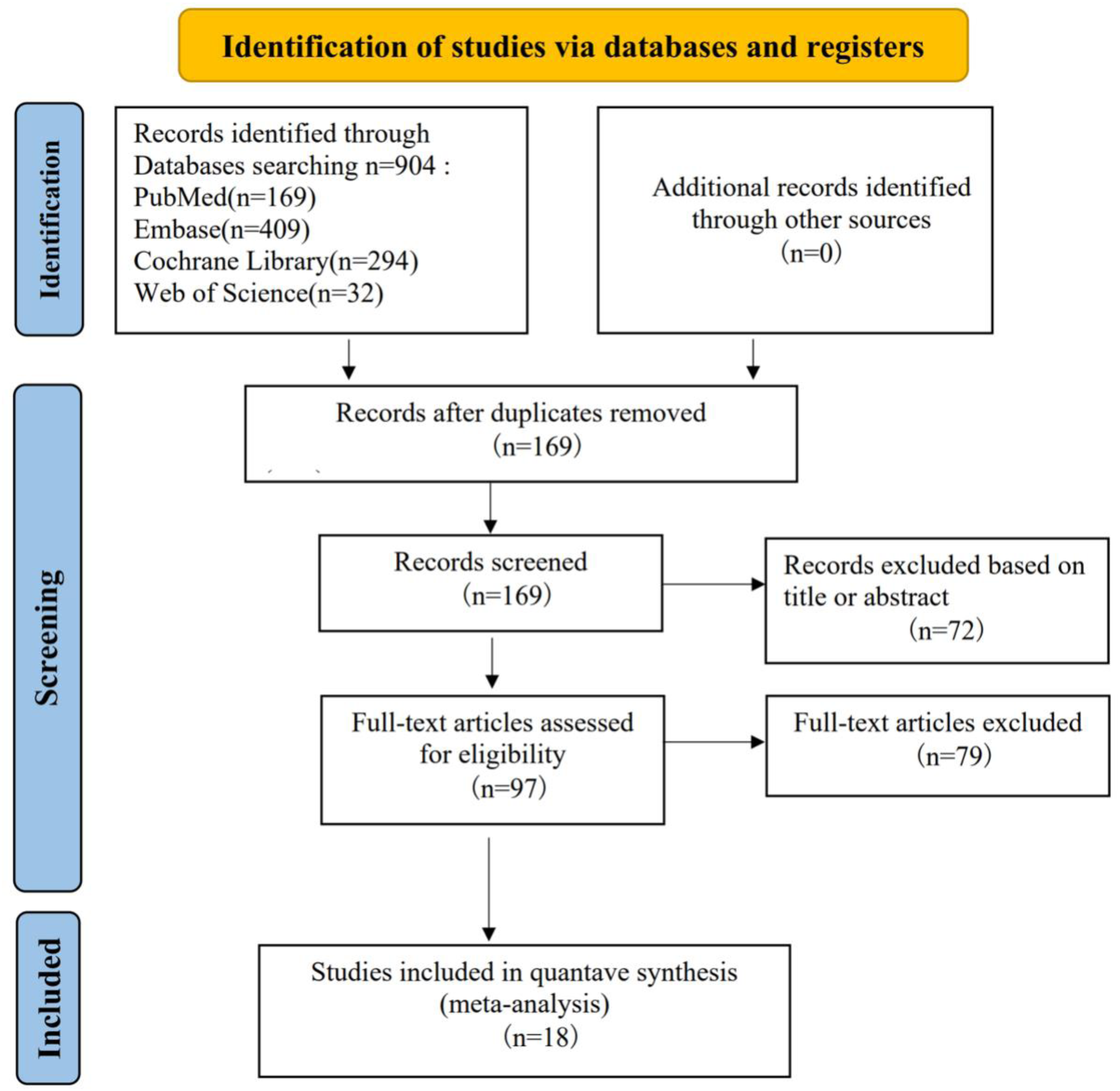
Flow chart of literature screening.
Characteristics and quality assessment of included studies
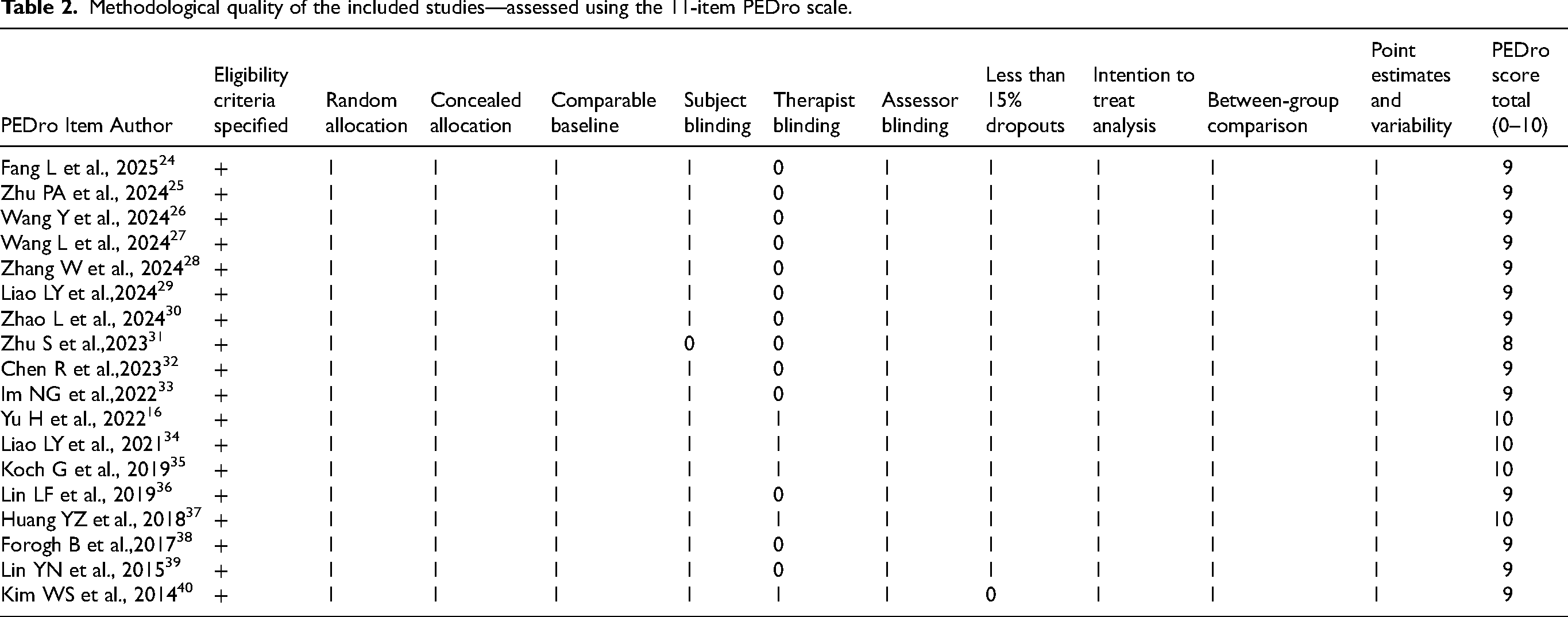
The main characteristics of the 18 included studies are summarized in Table 1. Particular attention was given to the design of stimulation parameters and the selection of stimulation sites. Quality assessment using the PEDro scale demonstrated that all studies achieved scores ≥ 6, indicating high methodological quality. Specifically, four studies scored 10 points, 13 scored nine points, and one scored eight points (Table 2).
Overview of studies investigating rTMS/iTBS in supporting gait, balance and/or lower limb motor function in patients with stroke.
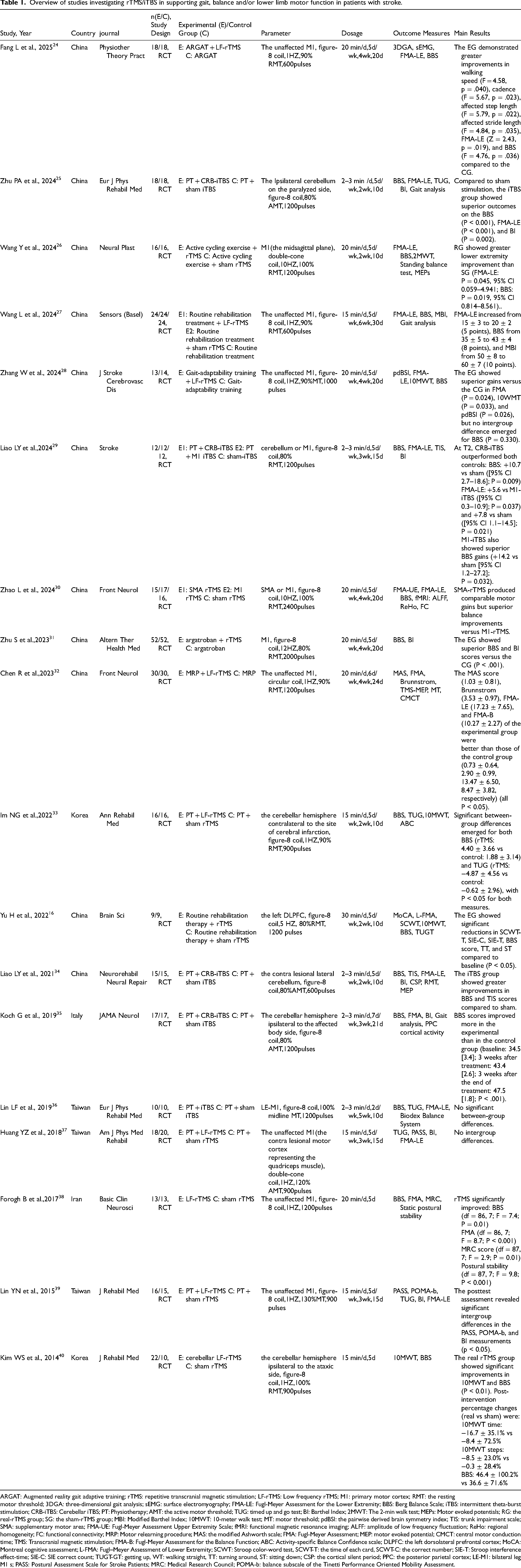
ARGAT: Augmented reality gait adaptive training; rTMS: repetitive transcranial magnetic stimulation; LF-rTMS: Low frequency rTMS; M1: primary motor cortex; RMT: the resting
motor threshold; 3DGA: three-dimensional gait analysis; sEMG: surface electromyography; FMA-LE: Fugl-Meyer Assessment for the Lower Extremity; BBS: Berg Balance Scale; iTBS: intermittent theta-burst stimulation; CRB-iTBS: Cerebellar iTBS; PT: Physiotherapy; AMT: the active motor threshold; TUG: timed up and go test; BI: Barthel Index; 2MWT: The 2-min walk test; MEPs: Motor evoked potentials; RG: the real-rTMS group; SG: the sham-rTMS group; MBI: Modified Barthel Index; 10MWT: 10-meter walk test; MT: motor threshold; pdBSI: the pairwise derived brain symmetry index; TIS: trunk impairment scale; SMA: supplementary motor area; FMA-UE: Fugl-Meyer Assessment Upper Extremity Scale; fMRI: functional magnetic resonance imaging; ALFF: amplitude of low frequency fluctuation; ReHo: regional homogeneity; FC: functional connectivity; MRP: Motor relearning procedure; MAS: the modified Ashworth scale; FMA: Fugl-Meyer Assessment; MEP: motor evoked potential; CMCT: central motor conduction time; TMS: Transcranial magnetic stimulation; FMA-B: Fugl-Meyer Assessment for the Balance Function; ABC: Activity-specific Balance Confidence scale; DLPFC: the left dorsolateral prefrontal cortex; MoCA: Montreal cognitive assessment; L-FMA: Fugl–Meyer Assessment of Lower Extremity; SCWT: Stroop color-word test, SCWT-T: the time of each card, SCWT-C: the correct number; SIE-T: Stroop interference effect-time; SIE-C: SIE correct count; TUGT-GT: getting up, WT: walking straight, TT: turning around, ST: sitting down; CSP: the cortical silent period; PPC: the posterior parietal cortex; LE-M1: bilateral leg M1 s; PASS: Postural Assessment Scale for Stroke Patients; MRC: Medical Research Council; POMA-b: balance subscale of the Tinetti Performance Oriented Mobility Assessment.
Methodological quality of the included studies—assessed using the 11-item PEDro scale.
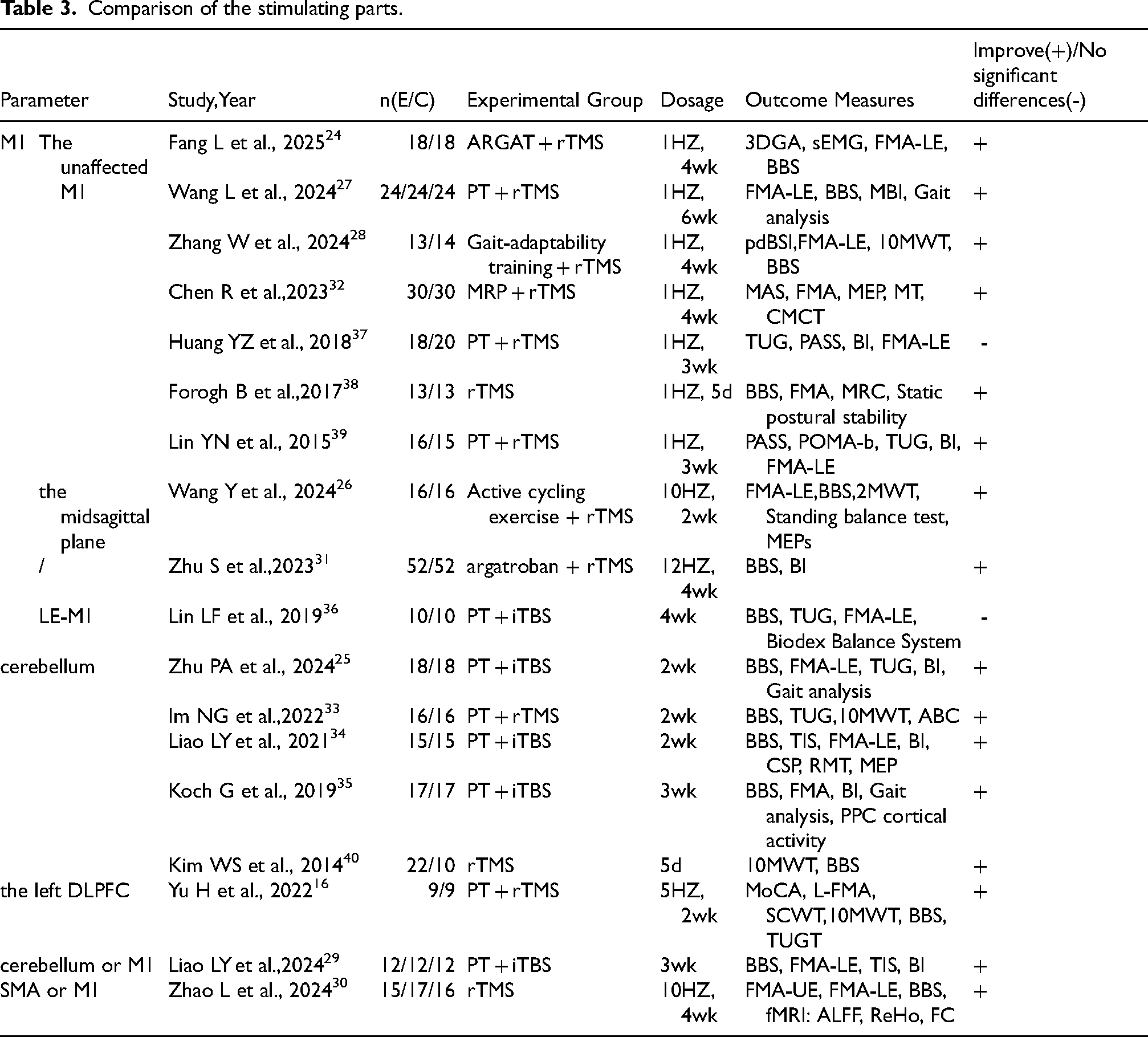
Among the 18 included studies, M1(n = 10) and cerebellum (n = 5) were the most frequently targeted sites. Direct comparisons revealed that cerebellar iTBS demonstrated superior FMA-LE improvements compared to M1 iTBS (P = 0.037), while both targets significantly improved balance function (Table 3).
Comparison of the stimulating parts.
Stimulation protocols
Target site selection
Ten studies targeted the M1, of which eight applied stimulations to the unaffected hemisphere and two to the affected hemisphere. Five studies selected the cerebellum as the stimulation target, one targeted the left DLPFC, one compared stimulation of the M1 and cerebellum, and one compared the efficacy of M1 and the SMA.
Stimulation parameters
Stimulation frequencies ≥5 Hz or iTBS exert excitatory effects, whereas 1 Hz or cTBS induces inhibitory effects on cortical excitability. Nine studies used low-frequency (1 Hz) stimulation, five employed iTBS, and four applied high-frequency stimulation (two used 10 Hz, one used 5 Hz, and one used 12 Hz).
Ten studies applied intensities between 80% and 100% of the RMT, with four using 90%, three using 80%, and three using 100%. Four studies applied intensities ranging from 80% to 120% of the AMT (three used 80%, one used 120%), and three studies used intensities between 80% and 130% of the MT (one used 90%, one 100%, and one 130%).
Eight studies delivered 1200 pulses per session, four delivered 900 pulses, and three delivered 600 pulses. One study used 1,000, 2,000, and 2400 pulses, respectively.
Five studies implemented a 2-week intervention (five sessions per week). Four studies used a 4-week protocol (five sessions per week), and three applied a 3-week protocol (five sessions per week). Two studies conducted a 1-week intervention (five sessions per week). The remaining studies included a 6-week protocol (five sessions per week), a 5-week protocol (two sessions per week), a 4-week protocol (six sessions per week), and a 3-week protocol (seven sessions per week).
Outcome measures
The BBS was the primary outcome measure across all studies. Secondary outcome measures included the FMA-LE, BI, TUG, and 10MWT. The results of these studies are summarized in Table 2. Objective outcome measures included MEP recordings, gait analysis, fMRI, and the pdBSI. The results of these objective indicators are presented in the following sections
Scale evaluation results
Four studies, Fang et al. (2025), Wang et al. (2024), Zhang et al. (2024), and Forogh et al. (2017), applied 1 Hz rTMS to the M1 of the unaffected hemisphere All four studies reported significant improvements in both the BBS and FMA-LE scores compared with the control groups (P < 0.01 and P < 0.001, respectively). These results suggest that LF-rTMS applied to the unaffected M1 can enhance lower-limb motor function in patients with stroke, thereby improving gait and balance.
Three studies, Zhu et al. (2024), Liao et al. (2024), and Koch et al. (2019), used iTBS applied to the cerebellum. In all three, the iTBS group showed greater improvement in BBS scores compared with the sham stimulation groups (SG) (P < 0.01). These results indicate that cerebellar iTBS promotes and accelerates functional recovery in patients with stroke.
Objective evaluation results
Motor-Evoked potentials (MEP)
Wang et al. (2024) applied high-frequency rTMS to M1 using a double-cone coil. Before treatment, MEPs were elicited on the ipsilateral side of the lesion in only eight patients (five in the rTMS group and three in the SG). After 2 weeks, this number increased to 16 (12 in the rTMS group and four in the SG). The MEP induction rate on the ipsilateral side in the rTMS group was significantly higher than at baseline (P = 0.016) and higher than in the SG (P = 0.012).
Chen et al. (2023) applied LF-rTMS to the unaffected M1 using a circular coil. After 4 weeks, the MEP extraction rate in the experimental group (EG) (96.7%) was significantly higher than that in the control group (CG) (73.3%). The motor threshold (0.26 ± 0.05) and CMCT (14.84 ± 4.30) were both significantly lower than those in the CG (0.33 ± 0.09 and 17.46 ± 3.03, respectively; all P < 0.05).
Liao et al. (2021) applied iTBS to the cerebellum using a figure-8 coil. After 2 weeks, the increase in MEP amplitude in the affected hemisphere of the rTMS group was lower than that in the SG (P = 0.028). No significant between-group differences were observed in other cortical excitability measures, including the RMT and CSP (P > 0.05).
Together, these studies, targeting different brain regions and using distinct stimulation protocols, demonstrated that rTMS modulates cortical excitability. An increase in the MEP induction rate within the lesioned hemisphere may predict better recovery of lower-limb motor function. Overall, M1 excitability within the lesion showed a consistent upward trend following intervention.
Gait analysis
Fang et al. (2025) applied LF-rTMS to the M1 of the unaffected hemisphere using a figure-8 coil. After 4 weeks of treatment, the EG demonstrated significant improvements compared with the CG. Specifically, walking speed (F = 4.58, p = 0.40), cadence (F = 5.67, p = 0.023), affected step length (F = 5.79, p = 0.022), stride length (F = 4.84, p = 0.035), FMA-LE score (Z = 2.43, p = 0.019), and BBS score (F = 4.76, P = 0.036) all improved significantly. Additionally, sEMG analysis showed a significant increase in the knee joint co-contraction index (CCI) in the EG (F = 14.88, p < 0.001), whereas no significant change was observed in the CG (F = 2.16, p = 0.151). However, no significant differences were detected in the ankle joint CCI in either group (F = 1.58, P = 0.218).
Zhu et al. (2024) used a figure-8 coil to deliver iTBS to the cerebellum. After 2 weeks, the EG showed significant within-group improvements in gait parameters, including cadence, stride length, speed, and step length (P < 0.05), compared with baseline. The CG showed a significant improvement only in cadence (P < 0.05). Between-group comparisons demonstrated significant differences in cadence (P = 0.029), stride length (P = 0.046), speed (P = 0.002), and affected lower-limb step length (P = 0.024).
Wang et al. (2024) also used a figure-8 coil for LF-rTMS applied to the unaffected M1. After 6 weeks of treatment, gait parameters in the EG improved significantly compared to the SG and CG. Gait cycle time decreased from 2.05 ± 0.51 s to 1.02 ± 0.11 s, stride length increased from 0.56 ± 0.04 m to 0.97 ± 0.08 m and walking speed rose from 35.95 ± 7.14 cm/s to 75.03 ± 11.36 cm/s (all P < 0.001).
Koch et al. (2019) applied cerebellar iTBS using a figure-8 coil. After 3 weeks, the real-stimulation group showed a decrease in stride length (mean [SE], baseline: 16.8 [4.8] cm; post-treatment: 14.3 [6.2] cm; P < 0.05) and increased neural activity in the posterior parietal cortex (PPC).
The four studies mentioned above, which used either LF-rTMS on the unaffected M1 or CRB-iTBS, showed significant improvements in gait parameters (cadence, stride length, speed, and step length) (P < 0.05). These results suggest that both LF-rTMS on the unaffected M1 and CRB-iTBS can effectively improve gait parameters and muscle activation, thereby improving balance and lower-limb motor function in patients with stroke by inducing long-term changes in cortical excitability and improving overall motor dynamics.
fMRI
Zhao et al. (2024) applied high frequency rTMS to the SMA and M1. After 4 weeks of treatment, fMRI scans were conducted. The amplitude of low-frequency fluctuations (ALFF) was analyzed to assess spontaneous neuronal activity (higher ALFF values indicate stronger spontaneous activity), while ReHo was used to evaluate the synchronicity of neural activity across localized brain regions (higher ReHo values indicate stronger synchronicity). Functional connectivity (FC) analysis assessed the strength of interactions between brain regions (higher FC values indicate stronger functional connectivity).
The results showed that increases in ALFF values in the affected supramarginal gyrus were positively correlated with recovery of upper-limb motor function measured by the FMA-UE. Increases in ALFF values in the affected middle temporal and middle frontal gyri were positively correlated with improvements in the BBS scores, while increased ALFF values in the unaffected cerebellum were negatively correlated with BBS score improvements. In the SMA group, changes in FC between the SMA and ipsilateral cerebellum were positively correlated with changes in BBS scores.
These results suggest that SMA-rTMS is comparable to M1-rTMS in improving motor function and may have superior effects on balance, possibly due to its modulation of temporal lobe-cerebellar connectivity.
Pairwise derived brain symmetry Index (pdBSI)
Zhang et al. (2024) applied LF-rTMS to the unaffected M1 using a figure-8 coil. After 4 weeks, a significant difference was observed in the BSI of the EG before and after treatment (P = 0.001), whereas no similar change occurred in the CG (P = 0.582). Paired analysis revealed a more pronounced decrease in BSI in the EG (P = 0.026). Additionally, within the cortical subgroup of the EG, BSI values were significantly lower than those in the CG (p = 0.006). These results suggest that LF-rTMS applied to the unaffected M1 helps restore interhemispheric balance by reducing cortical asymmetry.
Efficacy
Among the 18 studies included in this review, 13 employed rTMS. Seven studies used the LF-rTMS protocol targeting the unaffected M1 region. Six of these studies reported significant improvements in lower-limb function, including balance and gait performance, in patients with stroke, whereas one study found no significant differences between the EG and CG. Two studies applied the CRB LF-rTMS protocol, one used a left DLPFC 5 HZ-rTMS protocol, one applied an M1 10 HZ rTMS protocol, and one used an M1 12 HZ rTMS protocol. All demonstrated varying degrees of improvement in balance and lower-limb motor function. One study compared the different stimulation targets (M1 vs. SMA) using high-frequency rTMS and found that stimulation of the SMA produced superior improvements in lower-limb balance function compared with M1 stimulation (P = 0.034).
Five studies used iTBS. Of these, three employed the CRB-iTBS protocol, with all showing greater improvements in BBS scores in the iTBS group than in the SG (P < 0.01). One study applied M1 iTBS, which showed no significant differences between groups. Another study compared of different stimulation targets (M1 vs. CRB) using iTBS and found that CRB-iTBS was superior to M1-iTBS in improving FMA-LE scores (P = 0.037).
Summary: LF-rTMS of the unaffected M1 and CRB-iTBS were the most frequently used protocols. Based on current evidence, these protocols appear promising for improving lower-limb balance, though optimal parameters require further validation. Commonly reported effective parameters included 90% RMT with 1200 pulses per session for at least 2 weeks (5 sessions per week).
Discussion
Regarding stimulation parameters and target sites, our findings suggest that LF-rTMS applied to the unaffected M1 and iTBS applied to the cerebellum are the most common and effective protocols. The following discussion elaborates on the treatment parameters, therapeutic efficacy, and underlying mechanisms.
Parameter analysis
The acquisition and maintenance of balance are complex processes involving multiple regions of the central nervous system, notably the M1 and cerebellum. These structures perform complementary roles: M1 contributes to the early learning and consolidation of balance tasks, whereas the cerebellum regulates postural stability and the coordination of voluntary movement. Both M1 and cerebellum are therefore key stimulation targets in the treatment of post-stroke motor dysfunction.29,41,42
Stroke commonly results in impaired corticospinal output due to M1 injury on the affected side and excessive transcallosal inhibition from the unaffected to the affected hemisphere. 43 In the early post-stroke period, compensatory activation of the affected hemisphere is limited, whereas the contralesional M1 demonstrates hyperexcitability. 44 Consequently, selecting the appropriate stimulation site on M1, unaffected or affected, becomes crucial. It is generally easier to localize the stimulation hotspot in the intact hemisphere, 45 and stimulating the damaged region increases the risk of seizure induction. 46 Therefore, according to the IHC model, LF-rTMS targeting the unaffected M1 offers greater clinical advantages than high-frequency stimulation of the affected hemisphere. This is consistent with our analysis, which showed that most studies adopted the LF-rTMS protocol on the unaffected M1.
Although this review demonstrates that 1 Hz rTMS significantly improves walking, balance, and lower-limb function in patients with stroke, 21 a recent meta-analysis reported that 5–20 Hz protocols may yield stronger effects on motor recovery. These findings suggest that stimulation frequencies above 20 Hz could further enhance motor outcomes. However, stimulation frequencies up to 50 Hz, though successfully applied in neurorehabilitation, 47 are associated with an elevated risk of rTMS-induced seizures. Thus, the potential therapeutic benefits of high-frequency protocols must be balanced against their safety considerations. 48
The cerebellum represents another promising stimulation target. Similar to M1, it plays a critical role in motor learning and adaptation. 49 Following stroke, compensatory mechanisms within the cerebellum may facilitate cortical reorganization and support recovery of motor control. 50 Liao et al. 34 reported that cerebellar iTBS produced greater (though not statistically significant) improvements in BBS scores compared with M1-iTBS. 29 Koch et al. 40 similarly demonstrated that cerebellar iTBS enhanced the excitability of the posterior parietal cortex, resulting in improved balance and gait in patients with chronic stroke. Moreover, CRB-iTBS has been shown to enhance cerebellar neural activity and synaptic plasticity, 51 leading to significant improvements in posture and gait performance in patients with posterior-circulation stroke. 52
The SMA, another important motor-related cortical region, also plays a significant role in post-stroke balance and gait recovery.22,53–55 Zhao et al. 30 observed that changes in the amplitude of low-frequency fluctuations (ALFF) within the contralateral cerebellum after stroke were negatively correlated with BBS scores. Conversely, preservation of ALFF in the affected middle temporal gyrus was positively correlated with BBS performance, indicating that the temporal cortex contributes to balance regulation. Furthermore, post-treatment analyses showed that, compared with the M1 group, functional connectivity between the damaged SMA and ipsilateral cerebellum was significantly strengthened in the SMA-stimulated group, and this enhancement positively correlated with BBS improvement. These findings raise the possibility that rTMS targeting the SMA could modulate cerebellar-SMA coupling differently or with greater impact than M1 stimulation, which is consistent with the proposed functional integration between the cerebellum and SMA.
Efficacy analysis
Wang et al. (2024) 27 reported that improvements in the FMA-LE, BBS, MBI, and gait parameters were significantly greater in the LF-rTMS group than in the sham stimulation and CG. This improvement may be attributed to the regulatory effects of LF-rTMS on M1, which enhances excitability in the affected hemisphere while simultaneously inhibiting excitability in the unaffected hemisphere, thereby restoring hemispheric balance.
Koch et al. (2019) 35 demonstrated that greater improvements in gait and balance function were associated with a significant reduction in stride length and an increase in TMS-induced PPC activity. These effects may result from activation of the cerebellum–thalamus–cortex pathway, which modulates the parietal-frontal network. The 3-week CRB-iTBS protocol used in this study may have induced long-term potentiation at the cerebellar cortical level, subsequently enhancing the interconnected PPC network in the contralateral damaged hemisphere. A possible mechanism is that CRB-iTBS modulates GABAergic neural activity at thalamic and cortical levels. Furthermore, the M1 GMFP amplitude in the affected hemisphere significantly increased in both the intervention and CGs, whereas PPC-GMFP (P3) exhibited a significant difference only in the CRB-iTBS group, suggesting that CRB-iTBS selectively enhances contralateral parietal neural activity.
Huang et al. (2023) 37 applied LF-rTMS using a figure-8 coil over the LE-M1 on the unaffected hemisphere in patients with subacute stroke but found no significant between-group differences. The rTMS strategy was based on the IHC model originally developed for upper-limb rehabilitation, which posits that stroke disrupts cortical excitability balance between hemispheres and that rTMS can promote recovery by re-establishing this balance. However, the negative findings suggest that direct application of this model to lower-limb rehabilitation without specific validation may not be appropriate. One possible explanation is bilateral cortical inhibition caused by excessive stimulation. The figure-8 coil used in this study delivers relatively focal but shallow stimulation, and its intensity setting, higher than that in most previous studies, may have caused concurrent inhibition of both M1 regions. By contrast, a conical coil produces deeper and broader stimulation, which could help target lower-limb motor regions more effectively. This bilateral inhibition phenomenon highlights a potential limitation of the IHC-based approach for lower-limb motor recovery, as it may counteract therapeutic effects.
Lin et al. (2023) 36 applied iTBS using a figure-8 coil with an air-cooling system to stimulate bilateral M1 in patients with stroke but similarly observed no significant improvements. This may be due to several factors. The study determined stimulation intensity based on the MT of the unaffected hemisphere (100% MT of the unaffected left lateral M1 midline), which might not have been sufficient to activate the affected hemisphere to induce neuroplastic changes. Furthermore, the 70-mm figure-8 coil used in the study delivers a relatively concentrated and superficial magnetic field, potentially limiting its ability to stimulate deeper motor areas. The timing of the intervention and possible ceiling effects among participants with near-complete recovery could also have contributed to the absence of significant between-group differences.
Potential mechanisms
LF-rTMS
LF-rTMS enhances interhemispheric balance by suppressing corticospinal excitability in the unaffected hemisphere and increasing excitability in the affected hemisphere.56,57 Zhang W. et al. (2024) 28 reported that the cerebral blood flow perfusion index (BSI) in the EG significantly decreased after rTMS combined therapy, whereas the CG, which received only gait adaptation training, showed no significant change. Further subgroup analysis revealed that the decrease in BSI was more pronounced in the cortical than in the subcortical regions. These results indicate that 1 Hz rTMS applied to the unaffected hemisphere reduces interhemispheric asymmetry, thereby improving neural balance.
In addition, LF-rTMS has been shown to modulate neurotransmitter activity by increasing gamma-aminobutyric acid (GABA) release and reducing glutamate levels, thus restoring excitatory-inhibitory balance in the cortex. It also promotes dendritic and axonal plasticity, enhances synaptic remodeling, and facilitates the regeneration of damaged neural networks, collectively contributing to improved lower-limb motor function after stroke.58–60 Furthermore, rTMS may modify the microenvironment of injured brain tissue by activating glial cells and promoting myelin repair, which supports synaptic reconstruction and neural circuit reactivation essential for functional recovery.61,62
CRB-iTBS
The mechanisms underlying CRB-iTBS appear to involve modulation of intermediate neuron populations that depend on GABAergic signaling. 63 These neurons play a pivotal role in driving neuroplasticity during post-stroke recovery. 64 The long-term potentiation-like (LTP-like) effects induced by CRB-iTBS may strengthen cerebellum–thalamus–cortex low-frequency circuits that govern spatial-motor learning required for coordinated movement. The cerebellum contributes to motor regulation by influencing M1 neuron excitability and the corticospinal output pathway through inhibitory postsynaptic connections between Purkinje cells and the deep cerebellar nuclei (DCN). The DCN, in turn, establishes excitatory projections to the motor cortex via the ventral thalamus.34,65,66 Therefore, CRB-iTBS likely facilitates cerebellum-dependent motor learning by promoting structural and functional plasticity across cerebellar-cortical pathways, supporting the observed clinical improvements in balance and gait recovery.
Recommendations
Repetitive transcranial magnetic stimulation promotes neuroplasticity and neural repair by regulating cortical excitability and neurobiological function. This technique has received “Class A evidence” for its clinical application in post-stroke motor rehabilitation. 67 Importantly, none of the 18 studies included in this review reported significant adverse events, indicating that rTMS is a safe therapeutic intervention. Based on the findings and potential mechanisms described above, several recommendations can be made. The M1, cerebellum, and SMA are all functionally linked to motor control, yet variability in stimulation parameters, target hemispheres, and patient characteristics complicates direct comparison across studies. 21 Further high-quality trials are needed to establish standardized protocols and to validate rTMS applications in regions beyond M1. Although clinical scales such as the BBS and FMA-LE remain the most used outcome measures, incorporating objective balance testing devices may provide more precise quantification of postural control. Current neurophysiological assessments in stroke rehabilitation primarily rely on MEP as an index of corticospinal excitability; however, MEPs cannot be reliably recorded in the affected hemisphere. 68 Complementary techniques such as EEG, fMRI, and fNIRS should therefore be considered to provide a more comprehensive evaluation of cortical reorganization and interhemispheric dynamics.
Additionally, the type of stimulation coil may influence treatment efficacy. The figure-8 coil, while most frequently used, delivers relatively focal and superficial stimulation. In contrast, conical coils can produce deeper and more diffuse magnetic fields, allowing for more effective modulation of subcortical motor areas. 69 Future studies should explore optimal coil selection according to stimulation site and desired therapeutic outcomes.
Limitations
This review has several limitations that should be acknowledged. First, considerable heterogeneity existed in stimulation parameters across studies, making direct comparisons challenging. Second, most studies lacked long-term follow-up data, limiting ourunderstanding of sustained therapeutic effects. Third, insufficient stratification by stroke severity, lesion location, or time since stroke onset prevented subgroup analyses. Fourth, as a narrative synthesis without meta-analysis, we could not quantify overall effect sizes. Finally, publication bias may exist, as studies with negative findings are less likely to be published.
Conclusion
This systematic review suggests that rTMS targeting either M1 or cerebellum may effectively enhance balance function in stroke patients. Current evidence indicates that rTMS represents a promising adjunctive therapy for stroke rehabilitation. The findings suggest that rTMS may serve as a safe and potentially effective adjunctive therapy for stroke rehabilitation. However, clinical application should be individualized, and further research is needed to establish standardized protocols and identify optimal patient selection criteria.
Footnotes
Acknowledgements
Startup Fund for scientific research, Fujian Medical University (Grant number: 2021QH1261).
ORCID iDs

Ethical approval
Ethical approval was deemed not necessary for this study.
Informed consent
Not applicable.
Author contributions
Ningling Chen and Shuo Xu contributed equally to this work and should be listed as co-first authors.
Funding
The authors received no financial support for the research, authorship, and/or publication of this article.
Declaration of conflicting interests
The authors declared no potential conflicts of interest with respect to the research, authorship, and/or publication of this article.
Data availability statement
No datasets were generated or analyzed during the current study.