







Abstract
A multi-scale micromechanical model is proposed to predict the damage degree of hybrid fiber-reinforced concrete under or after high temperatures. The thermal degradation of hybrid fiber-reinforced concrete is generally composed of the damage of the cement paste caused by thermal decomposition and thermal incompatibility, the deterioration of aggregates and fibers, and the interfacial damage between aggregates and the matrix. In this multi-scale model, four levels of hybrid fiber-reinforced concrete structures are considered when the thermal damage degree is derived; namely, the equivalent calcium silicate hydrate (C–S–H) product level, the cement paste level, the concrete level, and the hybrid fiber-reinforced concrete level. At the cement paste level, thermal decompositions of C–S–H product and calcium hydroxide are taken into account. In addition, a dimensionless parameter of the crack density is introduced to represent the thermal cracking of the matrix. At the concrete level, the interfacial damage of aggregates is simulated by a spring–interface model, in which the interfacial parameters are assumed to be functions of temperature. Moreover, at the cement paste level and the hybrid fiber-reinforced concrete level, a sub-stepping homogenization method is proposed to determine the effective properties. Comparisons between previously published experimental data and predictions and discussions illustrate the feasibility of the proposed multi-scale model in predicting thermal damage of concrete and hybrid fiber-reinforced concrete.
Keywords
Introduction
Fire accidents present challenges to the safety and operation of civil engineering structures during construction and services, such as high-rise buildings and underground structures (Chen et al., 2016; Ju and Wu, 2015; Kale and Ostoja-Starzewski, 2016; Park et al., 2016; Wu and Ju, 2016; Yan et al., 2017). Mechanical degradation of concrete exposed to high temperatures has been taken into consideration on the fire-resistant design of fiber-reinforced composites (Xiao and König, 2004; Ziao et al., 2018). At the macro level, fire tests on the mechanical properties of concrete, including the compressive strength, tensile strength, stress–strain relationship, and elastic moduli, were conducted comprehensively in recent years (cf. Ma et al., 2015). Test results (Ma et al., 2015; Xiao and König, 2004; Ziao et al., 2018) indicate that the water/cement ratio (w/c), aggregate type, curing condition, and heating and cooling regime have impacts on concrete damage. In general, a significant decrease can be found when the temperature is beyond 400℃ (Phan and Carino, 1998; Ma et al., 2015; Xiao and König, 2004). At the mesoscale, the thermal degradation of cement paste and aggregates, and the deterioration caused by thermal incompatibility between aggregates and the matrix are the factors dominating the overall damage of concrete.
Aggregates usually account for a large proportion of volume in the concrete (60–80%) (Bazant and Kaplan, 1996), which suggests that the thermal properties of concrete can be significantly influenced, such as thermal conductivity, thermal expansion, and specific heat capacity. The effects of different types of aggregates, namely, semi-crushed silico-calcareous aggregates, crushed calcareous, and rolled siliceous aggregates, on the evolution of thermal, physical, and mechanical properties of concrete with temperature were extensively investigated. Test results (Razafinjato et al., 2016; Xing et al., 2011, 2015) indicated that the residual mechanical behavior varied depending on the type of aggregates. Severe cracking could be observed in siliceous–calcareous concrete. As for calcareous concrete, the volume increase of aggregates caused by rehydration of lime would lead to the disintegration of concrete. On the other hand, at 573℃, crystal transition of siliceous aggregates from the α−one to the β−one might undergo volume expansion, which initiated cracking at the interface transition zone between aggregates and the matrix (Xiao et al., 2018; Xing et al., 2011, 2015; Yoon et al., 2015). In addition, the weight loss of a siliceous aggregate was approximately 9% at 100℃, while a calcareous aggregate lost about 50%. Researches (Xing et al., 2011, 2015) also indicated that the weight loss in siliceous aggregates was mainly due to the dehydration of some mineral components containing water. With respect to calcareous aggregates, the decomposition of carbonates was the main factor. Apparently, the cracking and decomposition of aggregates can result in mechanical degradation of concrete.
The thermal incompatibility between aggregates and the cement paste also plays an important role in concrete cracking. The hardened cement paste expands firstly with temperature up to 150℃. No further expansion, however, appears in the temperature range of 150–300℃. Between 300℃ and 800℃, thermal shrinkage appears. At ambient temperature, the average linear coefficient of thermal expansion of aggregates used in ordinary concrete ranges from 5.5 × 10⁻⁶ to 11.8 × 10⁻⁶ ɛ/℃ (Uygunoğlu and Topçu, 2009), which is generally lower than that of the cement paste. When the temperature increases to 700℃, the linear coefficients of thermal expansion for sandstone, limestone, granite, and anorthosite increase to 2.5, 11, 11.5, and 3 times the values at ambient temperature, respectively (Yoon et al., 2015). Furthermore, the thermal shrinkage of the cement paste and the expansion of aggregates will intensify the nonuniform stress field of concrete and initiate serious cracking at elevated temperature.
At the microscale, the cement paste under high temperature usually undergoes a continuous and irreversible process of decomposition reactions. The dehydration of cement paste will lead to the decline of hydration products and the coarsening and worsening of pore structure, which are the key factors of thermal damage of the cement paste. Heating removes both water molecules and OH– groups and further leads to the loosening of the packing density (Cong et al., 1995). Based on a statistical analysis of numerous nanoindentation tests, Dejong and Ulm (2007) attributed the thermal degradation of cementitious materials to the thermally induced change of the packing density of the two C–S–H phases.
On the other hand, free or evaporable water and a small part of the bound water may escape between 30℃ and 105℃, which makes contributions to the accumulation of water vapor. As a result, the buildup of pore pressure may induce the spalling of chunks of concrete during heating (Kodur, 2014). Polypropylene fibers are expected to provide an effective method to reduce the risk of the explosiveness of concrete. This is mainly because many micro tunnels can be left after polypropylene (PP) fibers melt at around 170℃, which is beneficial to the releasing of pore pressure (Fu et al., 2006). Nevertheless, the induced micro tunnels can connect the microcracks and increase the porosity. Although the compressive strength may suffer a considerable loss with the increase of PP fiber content at ambient temperature (Li, 1992), this effect is not pronounced after heating to a high temperature (Ma et al., 2015). Moreover, the melting of PP fibers makes the FRC exhibit a similar tensile strength to plain concrete after being exposed to high temperatures. Therefore, the incorporation of steel fibers is expected to enhance the tensile strength, as well as to alleviate the explosive spalling of cementitious composites. However, the improvement in concrete spalling is not as clear as that in tensile strength. Accordingly, many researchers have attempted to generate a synergistic response and to overcome the drawbacks caused by monotype fibers by combining the advantages of different types of fibers (Xiao et al., 2018). Among these hybrid fiber-reinforced concretes (HFRCs), concrete mixed with PP fibers and steel (ST) fibers is the most common to improve the mechanical properties of concrete under or after high temperature (Qian and Stroeven, 2000).
The elastic moduli of HFRC are essential to the fireproof design of engineering structures. Apparently, they are also important parameters on the estimation of structural health condition after fire disasters. The studies above on the elastic properties of HFRC exposed to elevated temperature were conducted experimentally. By contrast, the theoretical analysis seems to be insufficient. For instance, based on the kinetic and stoichiometric analysis, a numerical method was presented by Zhao et al. (2012) to predict the thermal decomposition of hardened cement paste. Subsequently, he used this method to predict Young's modulus of heated cement pastes on the basis of the mechanics of composite materials (Zhao et al., 2014). In Lee et al.'s (2009) model, the decomposition of various constituents of cement paste was assumed to be a linear function of temperature. The degradation of Young's modulus of heated concrete was estimated by applying the theory of composite damage mechanics. It is clear that these theoretical models neglect the interfacial damage between aggregates and the matrix, and they cannot be applied to HFRC immediately since the contribution of fibers to the effective moduli is not taken into consideration.
To overcome the drawbacks of the existing models mentioned above, a multi-scale model is formulated to estimate the thermal damage of HFRC. There are four levels in our proposed model; namely, the equivalent C–S–H products level, the cement paste level, the concrete level, and the HFRC level. The rest of this paper is organized as follows. In Basic micromechanical theory section, the basic micromechanical theory is introduced briefly. Decomposition of cement paste section presents the thermal decomposition analysis at the cement paste level. Then the multi-scale model is developed to estimate the thermal damage of HFRC; comparisons between experimental data and predictions are conducted to validate the proposed model in Model validation and discussion section. In the last section, several conclusions are made.
Basic micromechanical theory
Basic governing equations
Building the correlation between elastic properties of multiphase composites and corresponding micro parameters is beneficial to the material design and optimization, which can be performed by an ensemble–volume averaged process within a reasonable representative volume element (RVE) (Ju and Chen, 1994a, 1994b; Li, 2019; Lin et al., 2009; Lv et al., 2019; Olsen-Kettle, 2019). Following the framework proposed by Ju and Chen (1994a, 1994b), four governing field equations for composites with identical shape n-inclusions can be expressed as




The elasticity of two-phase composites by considering probabilistic pairwise particle interactions
According to equation (1), the effective elastic moduli of two-phase composites are analytically derived by considering the pairwise interaction between particles, based on the assumption that all randomly dispersed particles are identically shaped and impenetrable. In the case of a two-phase composite, the overall ensemble–volume average stress and strain (the ensemble–average operators are omitted for the convenience of expression) reduce to

Additionally, the effective stiffness tensor

With respect to the relation between the averaged eigenstrain

The effective stiffness of a two-phase composite can be obtained by substituting the averaged eigenstrain



The parameters
The elasticity of three-phase composites
In terms of a three-phase composite reinforced with two different inclusions, the overall ensemble–volume average stress and strain in equations (1) and (2) reduce to

Referring to the paper by Lin and Ju (2009), the averaged eigenstrain

Accordingly, substituting the expressions of

The detailed expressions of the fourth-rank tensors

Decomposition of cement paste
Hydration products
The effective properties of cement paste are dominated by the component and structure at the microscale. In general, the hydration of cement can produce the calcium silicate hydrate (C–S–H), calcium hydroxide (CH), and aluminate hydrates. Besides these hydration products, the cement paste also contains unhydrated clinker, gel pores, and capillary pores. As for the hydration product, two types of products were identified firstly based on the nanoindentation tests (Constantinides and Ulm, 2004), which were inner product and outer product. Test results based on nanoindentation are the macro properties of the combination of inner product and gel pore (Gao, 2014; Sun, 2011). Therefore, the gel pore is considered as a part of C–S–H product in this study. In addition, the aluminate hydrate is also expected to exist in the C–S–H product founded on the research by Gao (2014). Because it is difficult to distinguish the decomposition between them when C–S–H is subjected to high temperature, we will account for them as integrity (C–S–H product).
In order to calculate the volume fractions of the components of cement paste, Power's model is adopted (Tennis and Jennings, 2000). Therefore, the volume fractions of unhydrated clinker


Previous studies indicate that the volume fraction of CH dominates 20–25% of the hydration product (Gao, 2014).
Decomposition analysis of cement paste
The volume fraction of each constituent in the cement paste heavily depends on the conversion degree due to thermal decomposition. Following Lee et al. (2009) and Zhao et al. (2012), the loss of water of the reactants is expected to increase the porosity.
The expressions of the decomposition of C–S–H and CH under high temperature can be represented as


The volume fractions of decomposed products at the cement paste level owing to thermal decomposition can be obtained on the basis of the proposed method by Zhao et al. (2012), which can be written as


The values of coefficients in equation (20).



The values of parameters in equations (21) and (22).

Model development
Representation of the multi-scale microstructure of HFRC
There are four levels in our model; namely, the equivalent C–S–H product matrix level, cement paste level, concrete level, and HFRC level, as displayed in Figure 1.
The multi-level homogenization procedures of HFRC.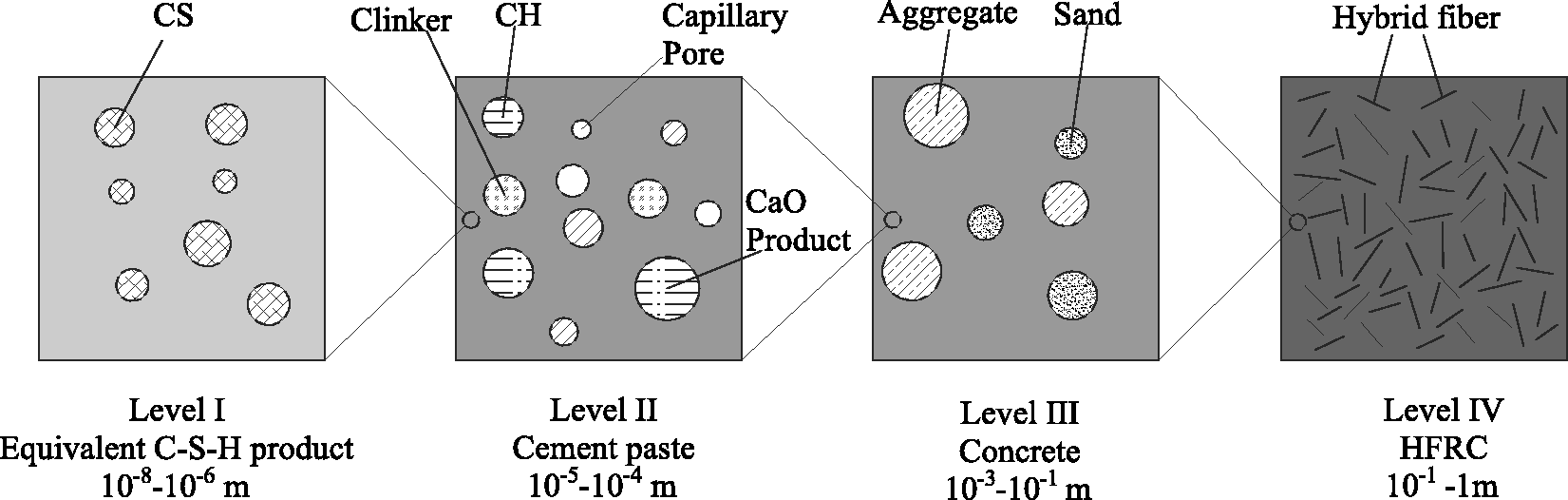
At the level I, the equivalent C–S–H product matrix level contains C–S–H product and its thermal decomposed product. The characteristic length scale of this level is 10−8 to 10−6 m, which is currently the smallest material scale that can be accessible by nanoindentation test (Bernard et al., 2003; Constantinides and Ulm, 2004; Jiang et al., 2017). At this level, the C–S–H product is regarded as the matrix, the decomposition product is the inclusion. Therefore, level I is the starting point for our multi-scale thermal damage model.
At the level II, the equivalent C–S–H product matrix, CH, CaO product, unhydrated clinker, and capillary pores form the cement paste level. At this level, the scale ranges from 10−6 to 10−4 m, which is large enough to contain all the information on cement paste. In addition, the equivalent medium of level I is the matrix; CH, CaO product, unhydrated clinker, and capillary pores are the inclusions. Therefore, the cement paste is expected to be a five-phase composite.
The level III is the concrete level, the scale of which is 10−3 to 10−1 m. Apparently, concrete is a three-phase composite material (Sun and Li, 2016). It should be noted that the interfacial transition zone is neglected. Instead, a spring–interface mechanism is employed to describe the interfacial performance, which is able to consider the damage of the interface. Additionally, as indicated by extant studies (Chen et al., 2016, 2018; Pichler et al., 2008, 2009), the morphology of particle inclusions is spherical.
At level IV, short fibers are assumed to randomly distribute and orient. At this level, the scale of the RVE is 10−1 to 1 m, which is the scale of engineering application (Pupurs and Varna, 2017). Similar to level II, HFRC is considered as a multiphase composite (this mainly depends on the number of fiber types). The sub-stepping homogenizations are adopted to realize the transition from the concrete level to the HFRC level. The fiber is considered as a spheroidal inclusion (needle shape; cf. Zhang et al., 2017b).
Estimation of the thermal damage of HFRC
Estimation of the effective properties at the level I
As mentioned above, the C–S–H product is regarded as the matrix. The decomposition product is the inclusion. The initial properties of C–S–H product at ambient temperature can be obtained through the model proposed by Zhang et al. (2017b). Considering the pairwise interaction between particles, the effective bulk modulus and shear modulus can be derived on the basis of the elasticity of two-phase composite (cf. The elasticity of two-phase composites by considering probabilistic pairwise particle interactions section). With the assumption that the decomposition product (CS: the product after C-S-H loses water) is a sphere, the effective moduli can be expressed as

The volume fraction of CS
Estimation of the elastic moduli at the level II
Homogenization scheme
With respect to the five-phase composite, it is almost impossible to derive the analytical expression of the effective properties by considering the interaction between particles directly. Instead, a sub-stepping homogenization scheme is presented here. As exhibited in Figure 2, two phases are considered in the first homogenization procedure; then another two phases are homogenized in the second step. At each step, the effective moduli are obtained by considering pairwise interacting spherical particles with distinct elastic properties.
The homogenization scheme of the cement paste.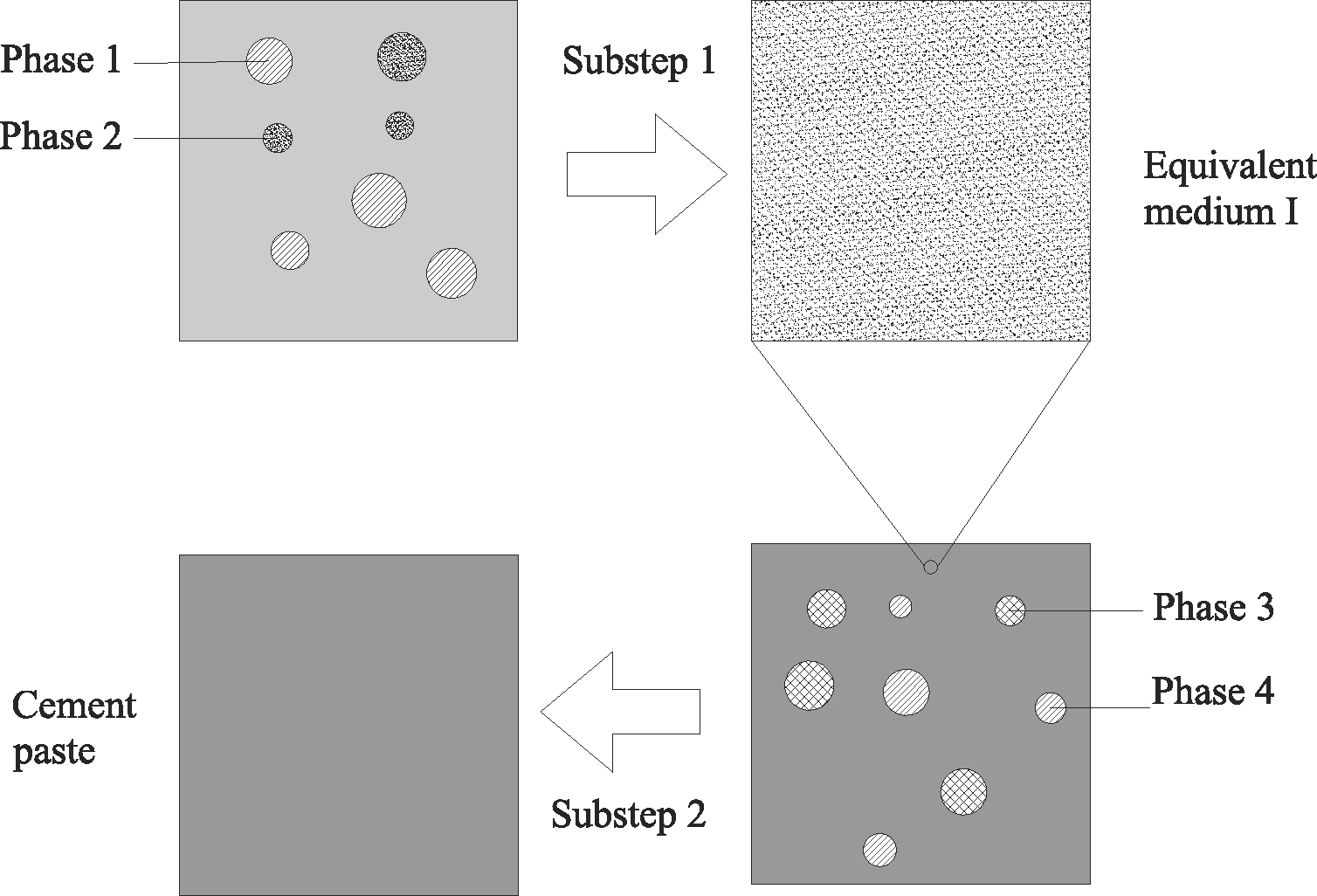
As derived in The elasticity of three-phase composites section, the bulk modulus and shear modulus of a three-phase mixture can be rephrased in the following form when the isotropic properties are considered.

Identification for the different homogenization schemes
The homogenization scheme at the concrete level.
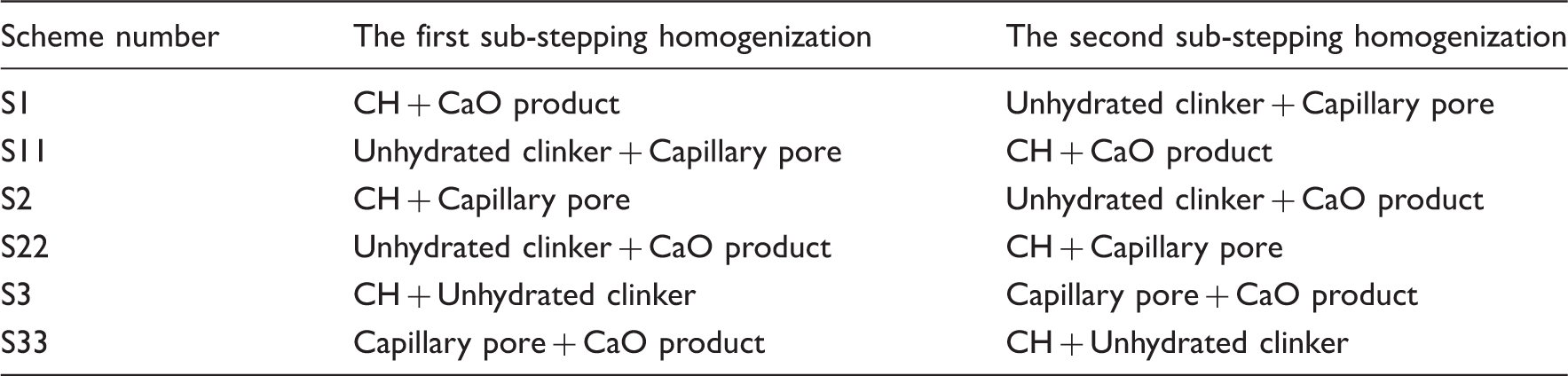
Figure 3 displays the variations of the effective bulk modulus and shear modulus of the cement paste with different CaO product volume fractions using the six homogenization schemes tabulated in Table 3. From Figure 3, it can be observed that the homogenization scheme has the influence on the bulk modulus of cement paste, but the predicted results are very close to one another for different volume fractions of CaO product when various matrix properties and w/c ratios are taken into account. Similar conclusions can be made on the effective shear modulus. Simulations indicate that the homogenization scheme plays a negligible role in the predictions for the cement paste. Therefore, the proposed homogenization framework shows adequate consistency and stability for different homogenization schemes.
The influence of homogenization scheme: (a) bulk modulus, E
CSHP
= 40 GPa; (b) shear modulus, E
CSHP
= 40 GPa; (c) bulk modulus, E
CSHP
= 30 GPa; (d) shear modulus, E
CSHP
= 30 GPa; (e) bulk modulus, E
CSHP
= 20 GPa; (f) shear modulus, E
CSHP
= 20 GPa; (g) bulk modulus, E
CSHP
= 10 GPa and (h) shear modulus, E
CSHP
= 10 GPa.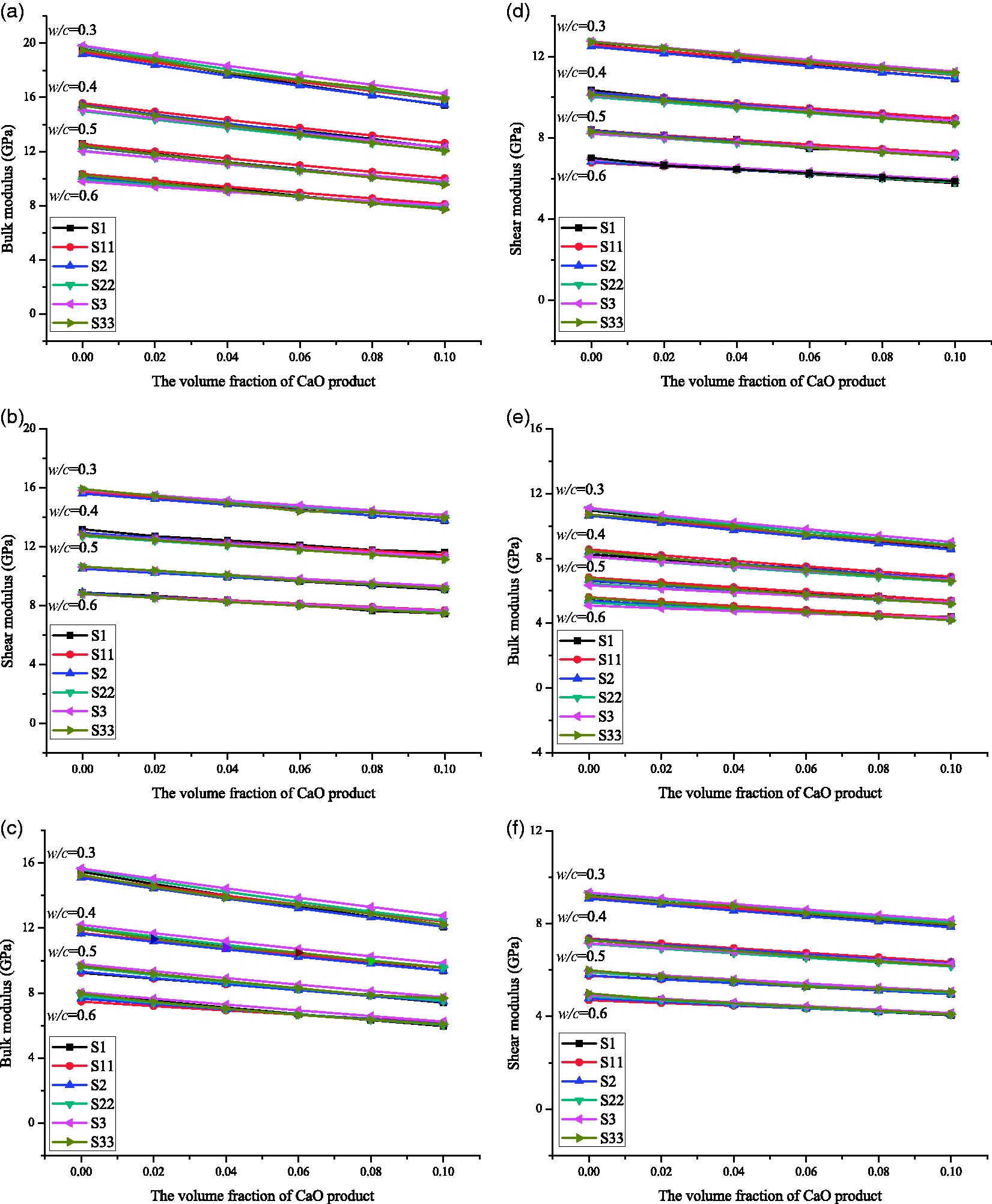
Estimation of the elastic moduli at the level III
At this level, the cement paste is the matrix, and the sand and the aggregate are the inclusions. The thermal damage is composed of the degradation of cement paste, sands and aggregates, and the deterioration caused by the thermal incompatibility between inclusions and the matrix. The degradation of cement paste at elevated temperature is generated from the decomposition of hydration products, which can be determined based on the decomposition kinetics (Lee et al., 2009; Zhao et al., 2012, 2014), as described in Decomposition analysis of cement paste section. The damage evolution of aggregates or sands can be obtained from the test results.
Thermal damage model of the interface between aggregates or sands and the matrix
Indeed, the cement paste will expand firstly, then will shrink at a higher temperature, while aggregates will always expand, as described in Introduction section. Compared to the cement paste, the aggregates act as the rigidity at elevated temperature. Thus the shrinkage of cement paste will be restrained by aggregates, which can induce microcracking. In order to describe the interfacial damage, the spring–interface model (Duan et al., 2007; Yanase and Ju, 2012, 2014) is adopted, as exhibited in Figure 4.
The spring–interface model (Yanase and Ju, 2012, 2014).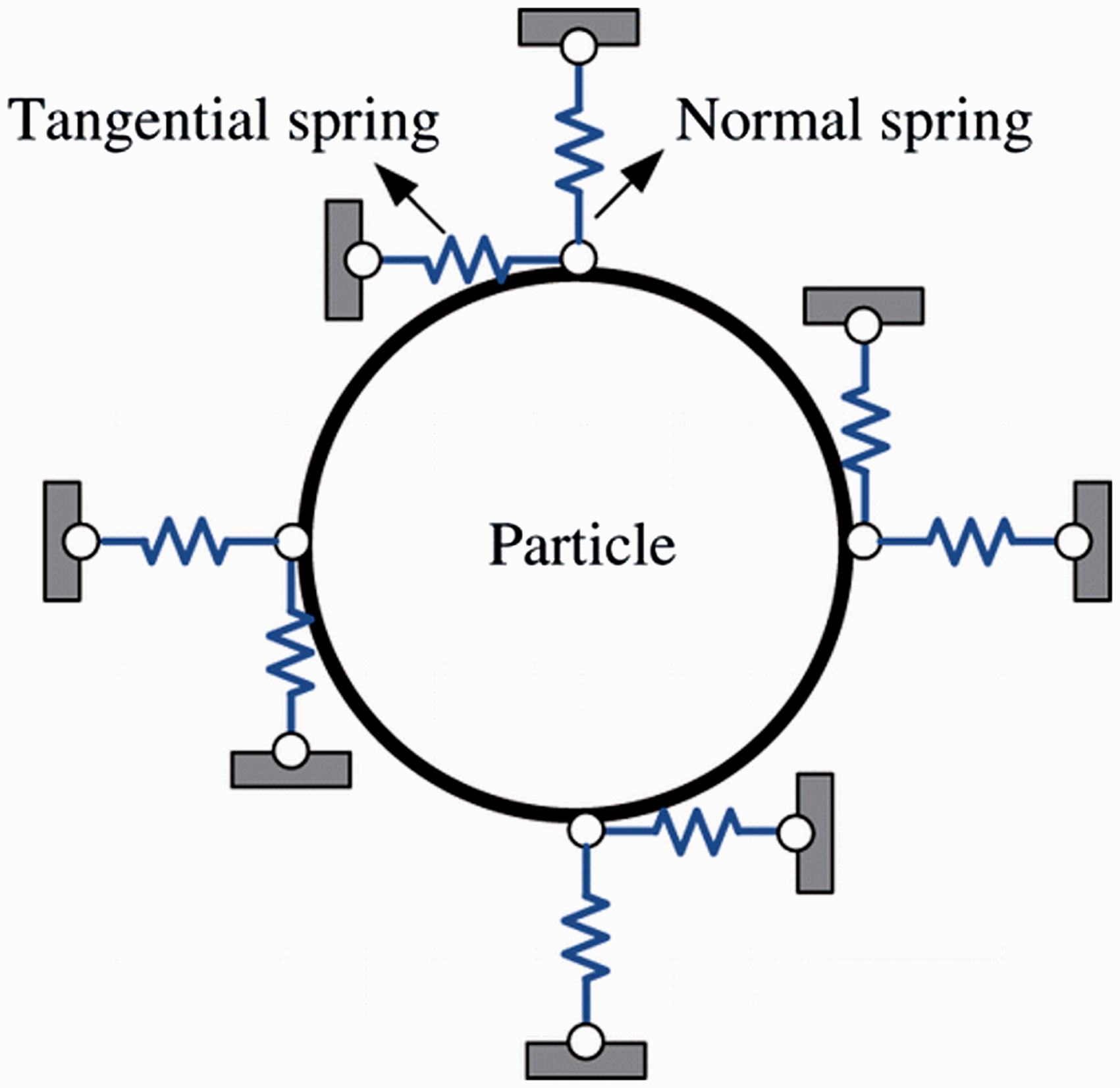
Based on the energy equivalence, the equivalent elastic moduli of particles from Duan et al. (2007) are utilized to describe the interfacial damage, which can be represented as





Effective moduli of concrete
At this level, cement paste is the matrix, and aggregates are inclusions. The aggregates are assumed to be spheres, as presented in Figure 1. With the known properties of aggregates and the matrix, the effective elastic moduli can be calculated through substituting the equivalent properties of aggregates into equation (24).
The damage degree of concrete 
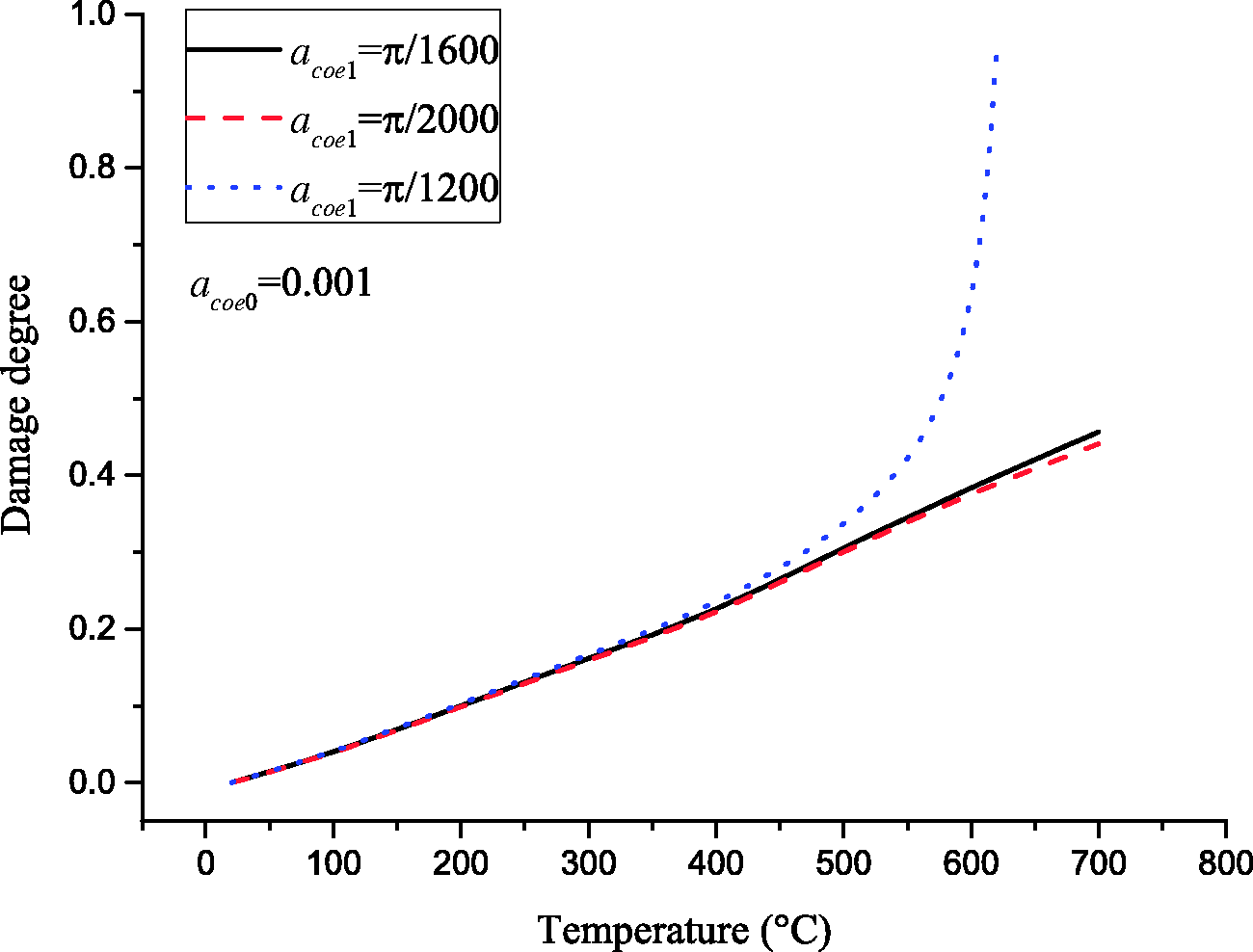
To discuss the effect of interfacial parameters on the damage degree of concrete, cement paste with the w/c ratio of 0.61 and the hydration degree at 28 days from Haecker et al. (2005) is used as the matrix. The volume ratio of cement paste/sands/aggregates is 1: 1.45:1.38. Thermal damage evolutions of sands and aggregates are fitted based on the experimental data from Liu and Xu (2015) (sandstone) and Kumari et al. (2017) (granite). In addition, it is assumed that the interfacial parameters of sands are the same as those of aggregates. According to the discussion by Yanase and Ju (2012), the tangential parameter has no significant influence on the elastic moduli of the composite. Therefore, the interfacial parameters in the tangential direction are assumed to have the same values as those in the normal direction. The simulated results are displayed in Figures 5 and 6. From Figure 5, it can be observed that damage degree reaches 0.8 when the heating temperature increases to 150℃ or above in case of The effect of acoe0 on the damage degree of concrete. The effect of acoe1 on the damage degree of concrete.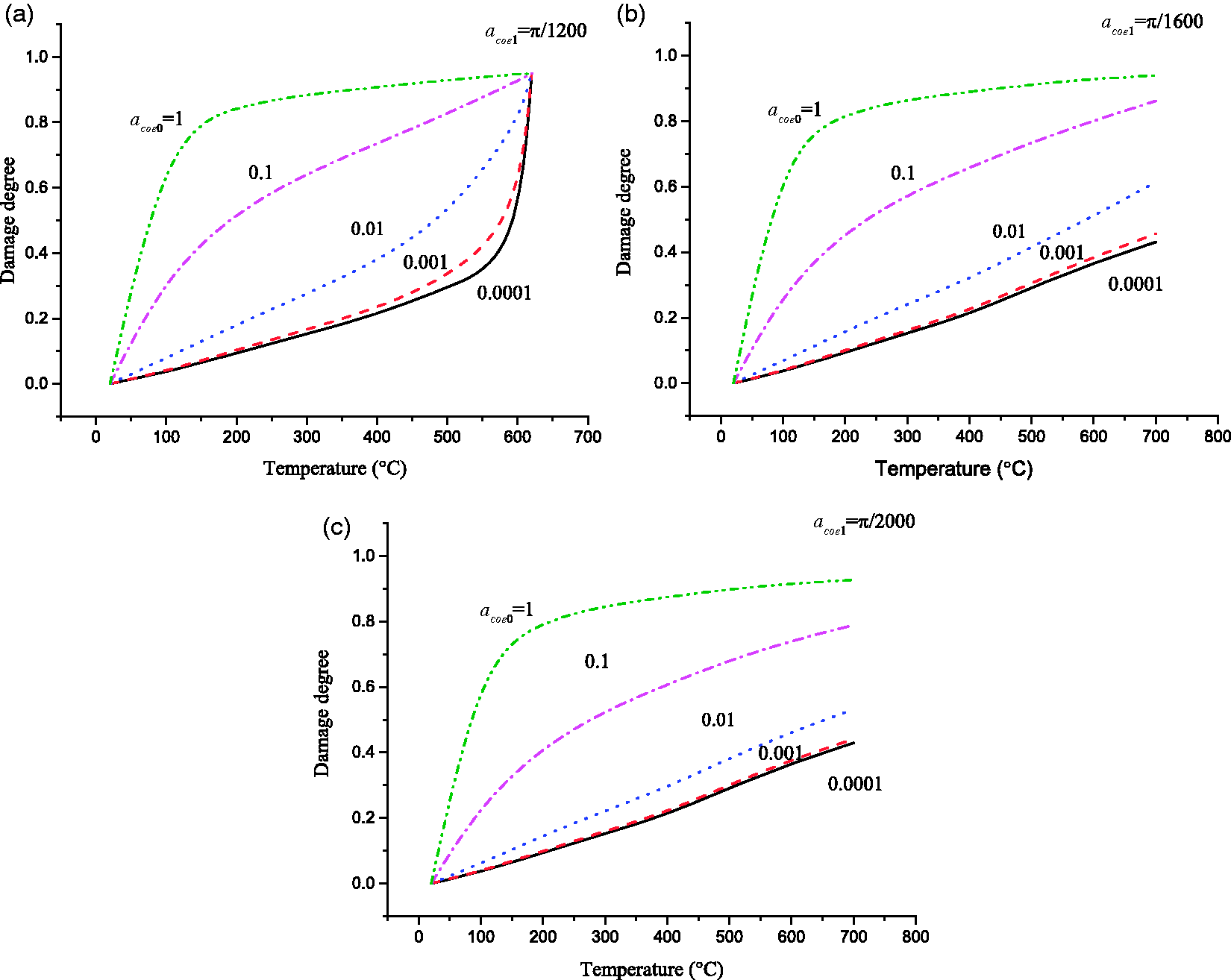
Estimation of the thermal damage of HFRC
Two or more types of randomly distributed and oriented short fibers can be incorporated into the concrete. In the HFRC, steel fibers, and PP fibers are the most commonly used ones. The shape of the fiber is considered as spheroidal (needle shape). As previously mentioned, the sub-stepping homogenizations are adopted to estimate the effective properties of HFRC, as displayed in Figure 7. The probabilistic average and angle (orientation) average are employed to account for the locations and angles. The test results (Abdallah et al., 2017) indicate that the interfacial performance between the steel fiber and the matrix shows no significant degradation before 600℃. Here, the interfacial bonding is presumed to be perfect. Thus, the fiber and the matrix are assumed to be perfectly bonded here. In our companion paper (Zhang et al., 2017b), the specific derivation of the elastic moduli of HFRC is represented step by step. Here, we only provide the derived results for simplicity.
The homogenization of HFRC from the concrete level: (a) the first homogenization step; (b) the second homogenization step; and (c) the nth homogenization step.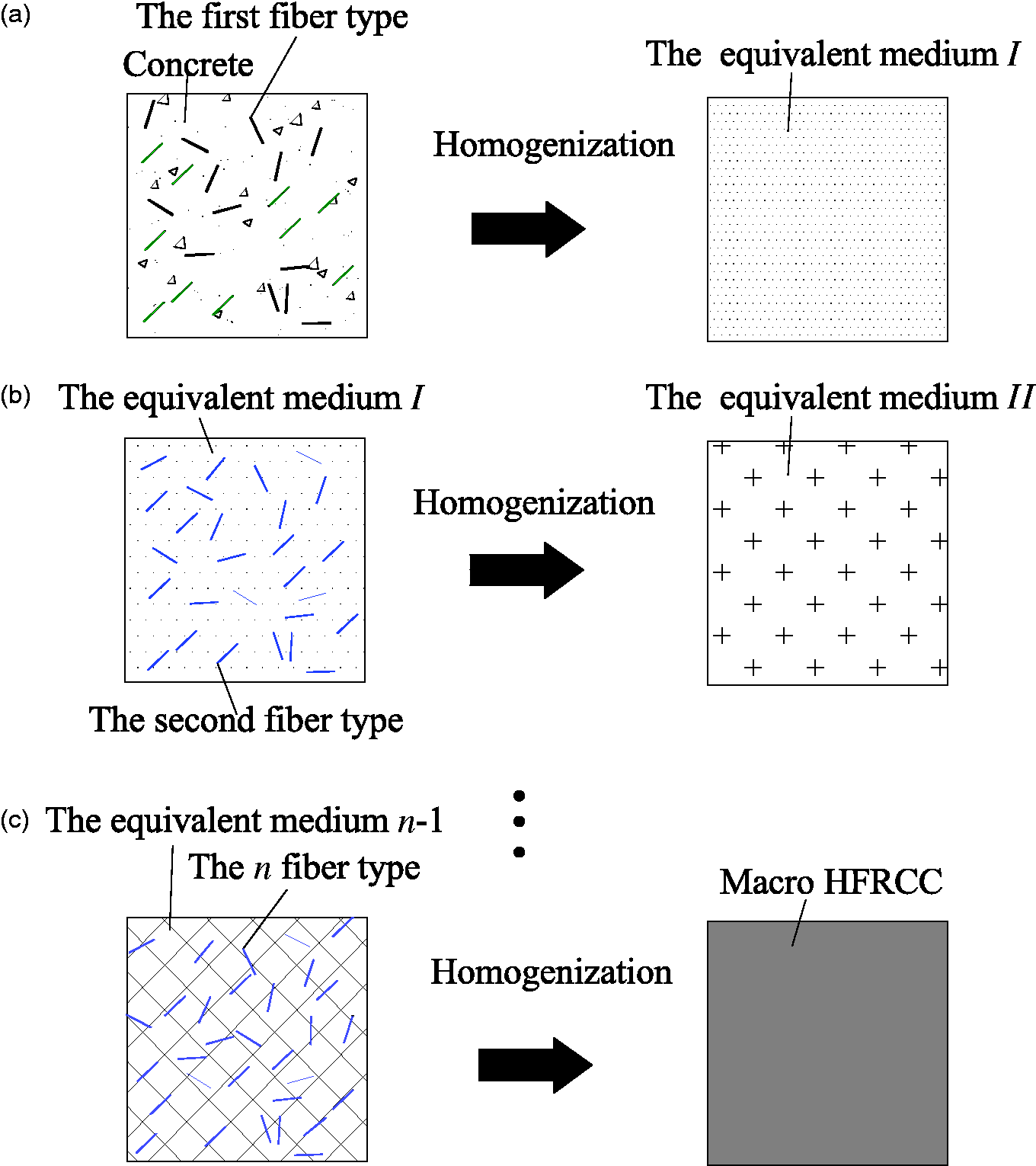
In the first step, concrete is regarded as the matrix, the first type of fibers is the inclusion. The effective stiffness of equivalent medium I (cf. Figure 7) can be acquired by

In the second step, the equivalent medium I is the matrix, and the second type of fibers is the inclusion. Similarly to equation (29), the stiffness tensor of the equivalent medium II can be obtained

As for HFRC reinforced with two types of fibers, the elasticity of equivalent medium II is our goal. The thermal damage degree can be defined similarly to equation (28) on the basis of Young's modulus at ambient temperature and the one at elevated temperature.
Model validation and discussion
Comparison with experimental data
Experimental data of concrete exposed to high temperature from Li and Guo (1993) are utilized to validate the proposed multi-scale thermal damage model. In their test, two different types of coarse aggregates were used, namely limestone and granite. The fine aggregate was sandstone, and the w/c ratios were 0.61 and 0.46, which corresponded to two compressive strengths: C20 and C40, respectively. For each strength level, two types of coarse aggregates were mixed. Therefore, there were four groups of specimens, which were C20L, C20G, C40L, and C40G, respectively. L and G mean that the coarse aggregates are limestone and granite, respectively. The hydration degree at 28 days was acquired from the test results obtained by Haecker et al. (2005). Referring to Lee et al. (2009), Young's moduli of C–S–H product and CH are 32 GPa and 38 GPa, respectively. While corresponding Poisson's ratios are 0.24 and 0.3, respectively. Moreover, Young's modulus of CaO product is 8.35 GPa. Meanwhile, the elastic moduli of CS are determined through a method adopted by Lee et al. (2009), which is 24.7 GPa. While the Poisson's ratios of CS and CaO product are assumed to remain the same as those of C–S–H product and CH under or after heating treatment. The parameters of other phases at the cement paste level can be found in the paper by Zhang et al. (2017b). In addition, the degradation evolutions of sandstone, limestone, and granite are fitted based on the experimental data from Liu and Xu (2015), Zhang et al. (2017a), and Kumari et al. (2017), respectively. The variations of Poisson's ratio of aggregates with temperature can be also obtained from Sirdesai et al. (2017), Kumari et al. (2017), and Zhang et al. (2017a). As depicted in Figure 8, the predicted results are very near to experimental data, which illustrate the capability of the proposed model in predicting the damage of concrete after high temperature.
The comparison between the predictions and measured results of concrete (Li and Guo, 1993). (acoe0 = bcoe0 = 0.04, acoe1 = bcoe1 = π/1400 for sands; a
coe0
= b
coe0
= 0.06, a
coe1
= b
coe1
= π/1400 for limestone; a
coe0
= b
coe0
= 0.06, a
coe1
= b
coe1
= π/1400 for granite).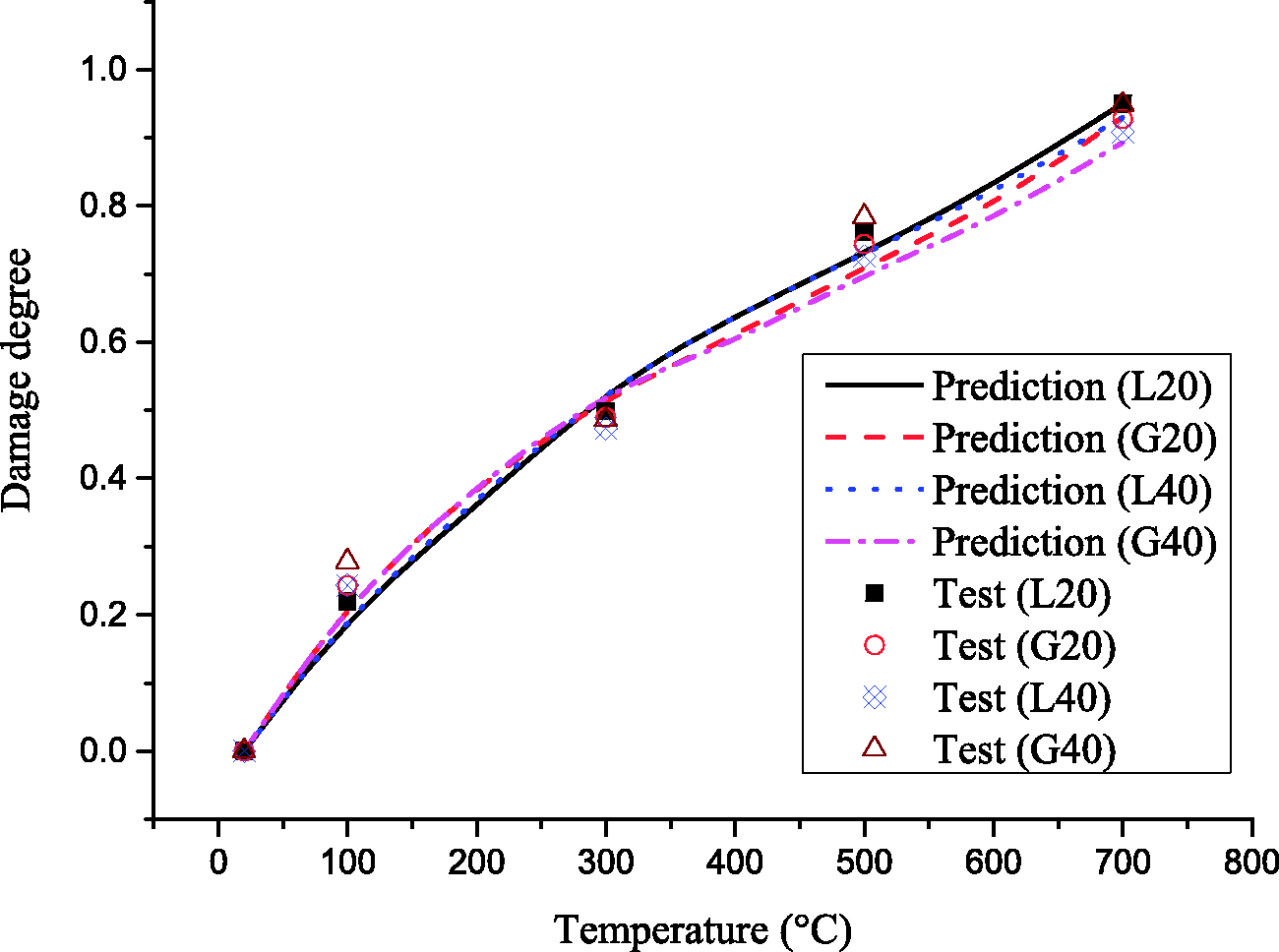
To verify the presented multi-scale micromechanical model for HFRC, the results tested by Suhaendi and Horiguchi (2006) are employed, in which the steel fiber and PP fiber were utilized. The volume fractions of PP fibers (P0.5) and steel fibers (S0.5) are 0.5% for FRC. In HFRC, 0.25% PP fiber and 0.5% steel fibers are mixed. The degradation of steel from Lv (1996) is adopted. Figure 9 shows the comparisons between our predictions and the experimental data. From this figure, it can be seen that the proposed model can predict the trend of the damage evolution with temperature. Nevertheless, the predictions overestimate the damage at 200℃ and underestimate the damage at 400℃. The gap between the predictions and the experimental data may be because thermal cracking in the matrix is not taken into consideration in the proposed model. With the increase of temperature, the cracking induced by thermal incompatibility pore pressure, and shrinkage become more seriously. As a result, the crack density may show a significant increase in comparison with that at ambient temperature. Moreover, neglecting the influence of the fiber incorporation on the initial crack density in the present model can cause a large deviation from experimental data. Therefore, it is necessary to render a quantitative description of the effect of cracks on the thermal damage in the following section.
The comparison between our predictions and experimental data of HFRC in Suhaendi et al. (2006). (acoe0 = bcoe0 = 0.04, acoe1 = bcoe1 = π/1400 for sands; a
coe0
= b
coe0
= 0.06, a
coe1
= b
coe1
= π/1400 for coarse aggregates).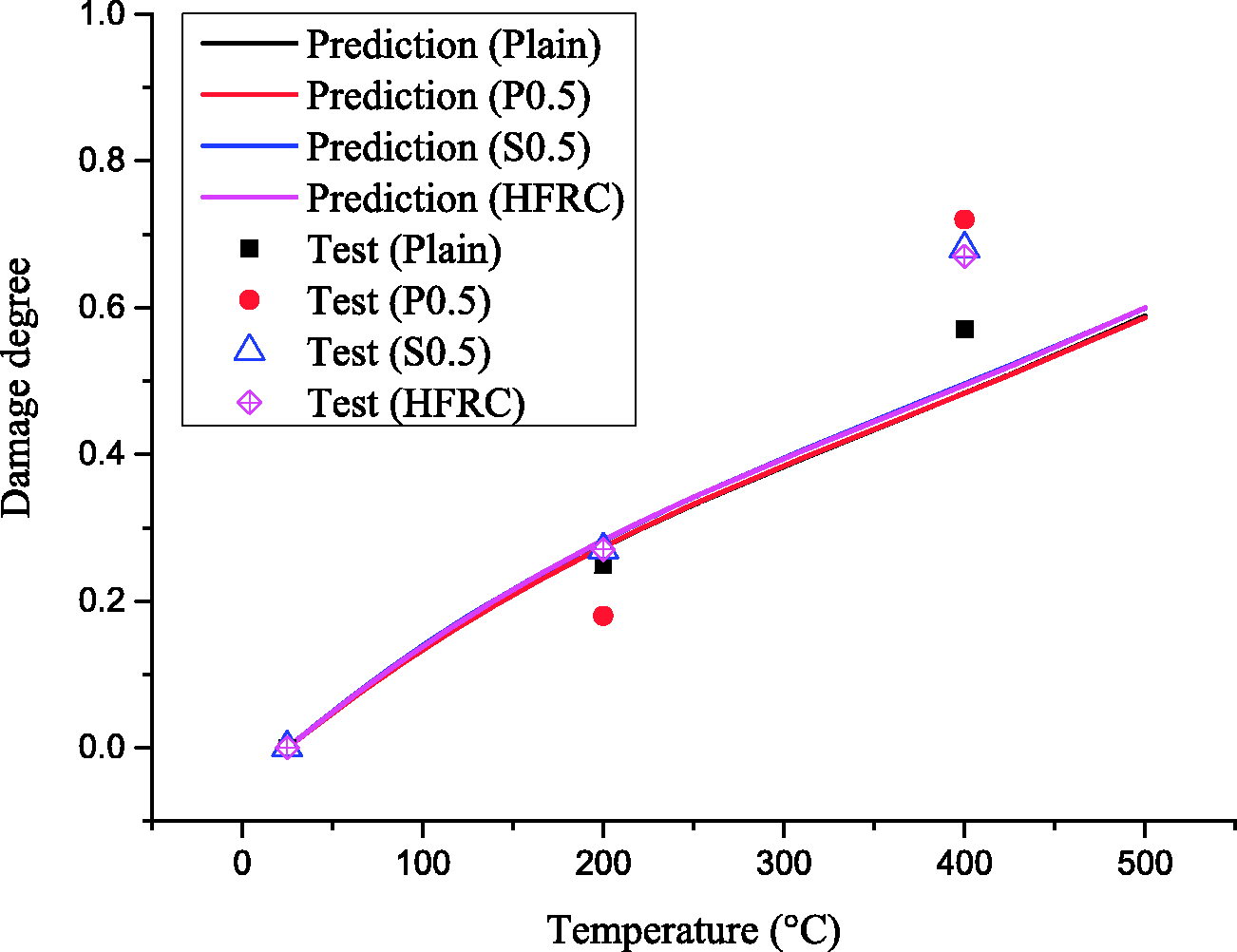
Discussions
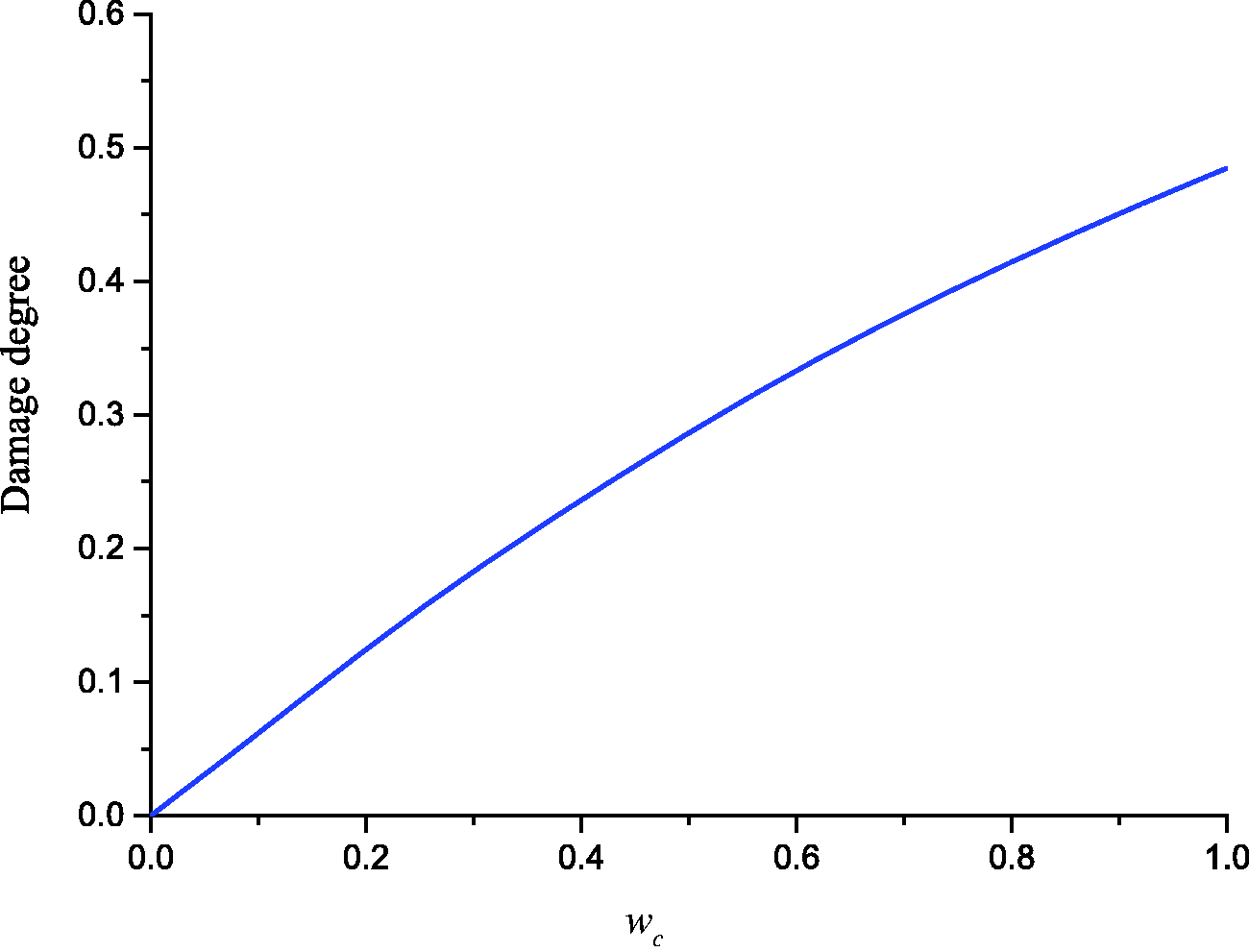
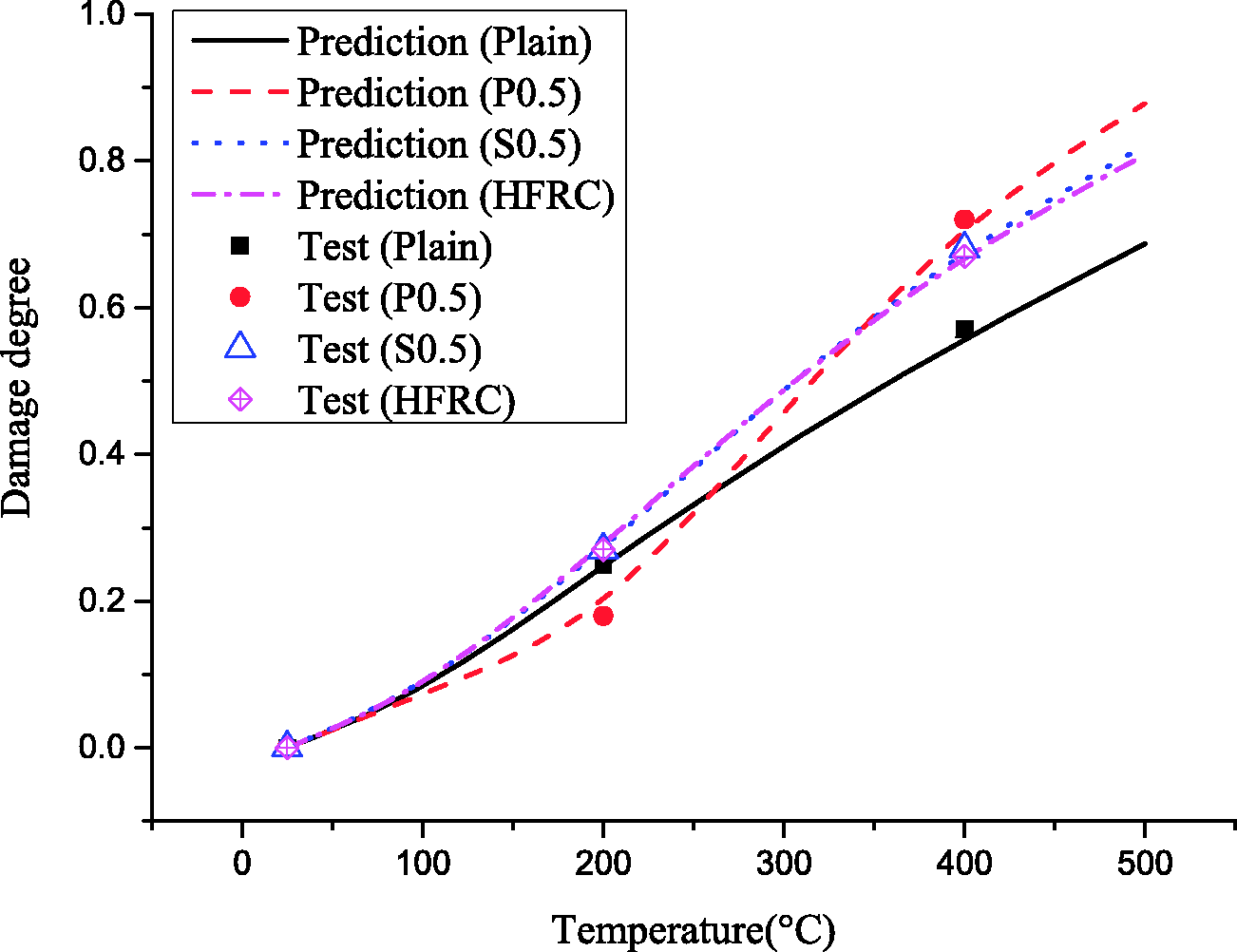
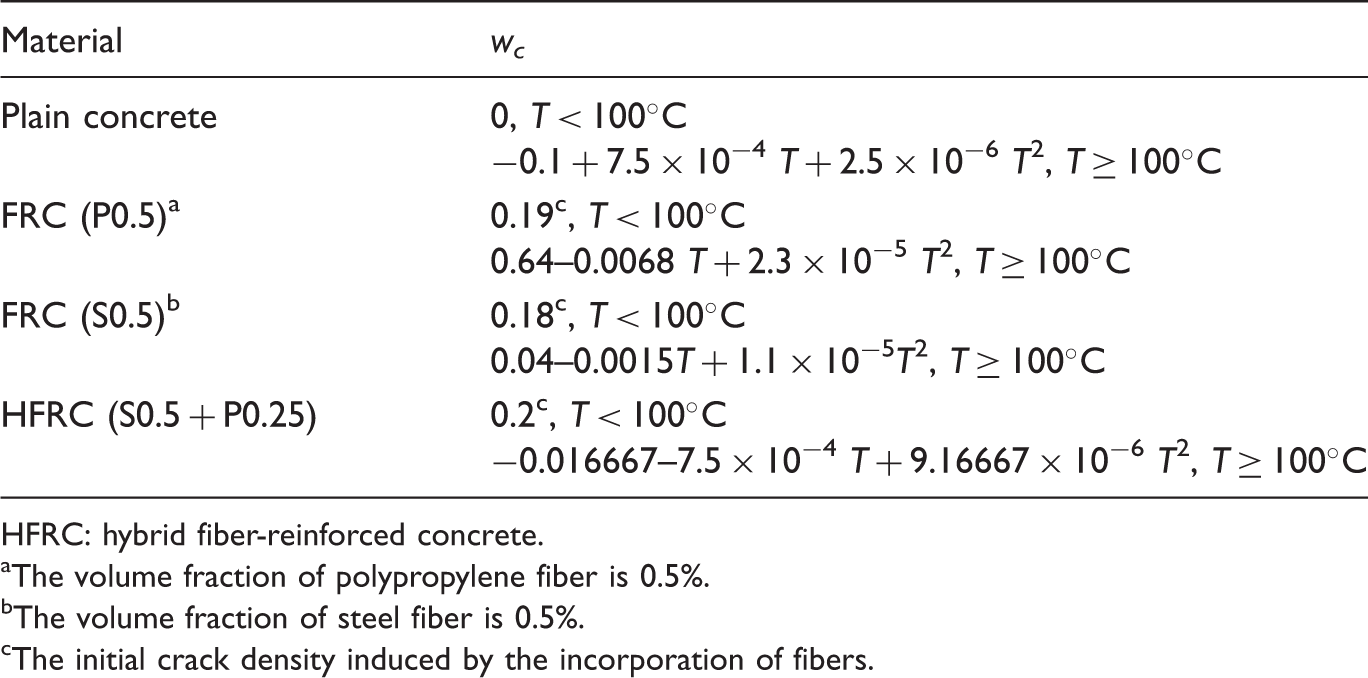
Compared to plain concrete, the addition of fibers may generate more initial cracks or defects due to the reduction of workability in the fresh state and the mixing process (Li, 1992; Lerch et al., 2018). On the other hand, the addition of PP fibers can release the pore pressure, which can reduce the cracking. Therefore, ignoring initial cracks cannot accurately consider the effect of fiber incorporation on the elastic modulus of FRC or HFRC. In addition, the thermal mismatch between aggregates and the matrix can induce thermal cracking in the cement paste matrix (Fu et al., 2004). If the thermal cracks in the cement paste are overlooked, the deviation may become pronounced, particularly at a higher temperature. However, the initiation, propagation, and coalescence of microcracks in the concrete at elevated temperature cannot be determined through experimental study directly. In order to evaluate the influence of microcracks on the elastic modulus of cementitious composites at ambient temperature, Yu and Feng (1995) proposed a micromechanical model. With the assumption that the heat-induced microcracks are uniformly distributed and oriented (Zhao et al., 2014), Young's modulus The influence of the crack density on the damage degree of HFRC. The comparison between our predictions and experimental data of HFRC in Suhaendi et al. (2006) with consideration of the effect of cracks. The calibrated evolution of crack densities for plain concrete, FRC, and HFRC. HFRC: hybrid fiber-reinforced concrete. The volume fraction of polypropylene fiber is 0.5%. The volume fraction of steel fiber is 0.5%. The initial crack density induced by the incorporation of fibers.


Conclusions
A multi-scale micromechanical damage model is proposed to predict the thermal damage degree of HFRC under or after high temperature. To realize the upscaling transition from parameters at the micro scale to the macro effective properties of HFRC, four elementary levels of the HFRC microstructure are considered in this model; namely, the equivalent C–S–H product level, cement paste level, concrete level, and HFRC level. At the equivalent C–S–H product level, C–S–H product is the matrix, while its thermal decomposition product (CS) is the inclusion. At the cement paste level, the cement paste is regarded as a five-phase heterogeneous material, which is composed of the equivalent C–S–H product matrix, unhydrated clinker, capillary pore, CH, and corresponding CaO product. In addition, a sub-stepping homogenization scheme is proposed to estimate the effective properties of cement paste. Meanwhile, the influence of different homogenization schemes on the elasticity of cement paste is also discussed, and results indicate that negligible effects are found. At the concrete level, a three-phase composite is considered. Moreover, a spring–interface model is adopted to account for the interfacial thermal damage between aggregates and the cement paste matrix. At the HFRC level, the effective moduli are predicted through several sub-stepping homogenizations, as a result of which the damage degree evolution of HFRC with temperature can be estimated. The additional cracks induced by the thermal incompatibility between the cement paste and aggregate, pore pressure, and the addition of fibers are accounted by a dimensionless crack density. Comparisons between the predictions and experimental data illustrate that the proposed model is capable of predicting the damage degree of HFRC under high temperatures.
From this study, the following main conclusions can be drawn:
The proposed multiscale model is capable of considering the influence of thermal decomposition of C–S–H and CH on the thermal damage of HFRC, which also accounts for the thermal degradation of aggregates or sands. The discussion upon the effect of cracks in the matrix indicates that ignoring the cracks may underestimate the thermal damage, particularly above 400℃ when the cracking becomes serious. According to the discussion, the initial cracks or defects induced by the fiber addition should be also considered. In addition, more experimental data are warranted to configure an evolution of thermal crack density in a specific HFRC with the same manufacturing operation, since the number of experimental data on the same type of specimen is small in this study. Compared with the experimental data, estimations of the modified multiscale model show a better consistency when the temperature is higher.
Footnotes
Declaration of conflicting interests
Declaration of conflicting interests The author(s) declared no potential conflicts of interest with respect to the research, authorship, and/or publication of this article.
Funding
The author(s) disclosed receipt of the following financial support for the research, authorship, and/or publication of this article: The authors acknowledge financial supports from the National Natural Science Foundation of China (51578410, 51478345), the National 1000 Talents Program (Ministry of Central Organization), and the Research Program of State Key Laboratory for Disaster Reduction in Civil Engineering, the Fundamental Research Funds for the Central Universities (300102218511), and the funds from China Scholarship Council. In addition, Yao Zhang also sincerely appreciates the financial support and encouragements from Xiang-yang Zhang.