







Abstract
This paper advances an enactive-ontogenetic framework for understanding mental disorders, challenging static and reductionist models. Drawing on the Simondonian turn in the enactive approach, it conceptualizes mental conditions as developmental conditions, highlighting their dynamic character and their relation to the person’s individuation process. The paper integrates the enactive-ontogenetic perspective with dynamical network models, advocating a shift from symptom-based snapshots to diachronic, individualized models. Central to this approach is the role of character traits—understood as diachronically sedimented sensorimotor patterns—in channeling vulnerability to mental conditions. By situating mental disorders within a broader developmental landscape, the work offers a process-oriented account of mental conditions as emergent from the individuation of the person, emphasizing their variability, path-dependence, and irreversibility. This integrative model has significant implications for diagnosis, treatment, and the ethical framing of mental health, advocating for a vulnerability paradigm over traditional pathology-based views.
1. Introduction
The nature of mental conditions has long been a complex and controversial topic in the field of psychology and psychiatry (Zachar & Kendler, 2007). Traditional neuro-essentialist approaches and the Diagnostic Statistical Manual V (DSM-V) categorization system have often conveyed a static and reifying picture of mental conditions. Based on a set of symptoms caused by an underlying neurological factor, neuro-reductionist approaches also overlook the dynamic and multifactorial nature of these conditions. The DSM’s symptom-based classification has been challenged on various grounds (e.g., comorbidity, individual variability within categories, and the failure to establish necessary and sufficient conditions for class membership). Additionally, the DSM operates under the nomothetic assumption that individuals sharing a diagnosis have an essential characteristic feature (i.e., an underlying common cause) that justifies the use of standardized intervention protocols (Hyman, 2010). One of the main concerns is that the reification tendency of the DSM conveys an overly static picture of mental conditions, which has dominated epistemic practices in research and clinical interventions, dismissing individual developmental trajectories that result in seemingly static pathological portraits.
As an alternative, dynamical network models have been proposed as 1) they overcome the common-factor view towards a model that integrates multiple factors of multiple domains, 2) they provide a dynamical picture of mental conditions, and 3) they can be used to generate individualized models rather than subsuming individuals to a reference class. Dynamical network models, however, are formal models that require an underlying theory to endow them with meaning (de Haan, 2020; Eronen & Bringmann, 2021; Robinaugh et al., 2020). In this regard, the enactive approach has been proposed as a suitable theory of cognition, offering a comprehensible and integrative framework that encompasses factors from the organic, sensorimotor, and intersubjective domains (de Haan, 2020; Maiese, 2022; Nielsen, 2023). A central contribution of this perspective is its processual orientation, which understands cognition as sense-making, that is, the normative interaction between an organism and its environment that unfolds through a history of organism–environment couplings (Di Paolo, 2021). This view aligns naturally with the dynamic aspirations of network approaches. Yet, the adoption of network models in enactive psychiatry has tended to focus on synchronic rather than diachronic aspects. This emphasis often leads to relatively static representations of mental conditions, portraying them as attractor-like states, that is, as rigid, maladaptive, and inflexible states. Such representations, however, risk neglecting the diachronic dimension of mental conditions: the fact that they change over time, exhibit dynamic patterns of onset, recovery, relapse, and persistence, and are shaped by longer-term processes such as the person´s developmental history.
This paper proposes an enactive-ontogenetic approach to understanding mental disorders, highlighting its relevance for network models of mental health. The article is structured as follows: First, the paper introduces the enactive approach to psychiatry, outlining its theoretical foundations and its underlying processual ontology, distinguishing between synchronic and diachronic perspectives. Second, it introduces dynamical network models (both cross-sectional and longitudinal) and their link with the enactive framework. Third, it presents the enactive-ontogenetic model of mental disorders. This includes defining character traits within the enactive sensorimotor approach and presenting a developmental model of the emergence of mental conditions. It also reflects on how character traits could be incorporated into dynamic network analysis and puts forward testable hypotheses. Lastly, it discusses some ethical, theoretical, and practical implications. In doing so, this paper emphasizes the inherently dynamic nature of the mind and views pathological patterns as emerging from the individual’s ongoing process of individuation, thereby accounting for individual differences in sense-making and its disturbances as distinct cognitive-developmental paths. Thus, it calls for a shift away from the often implicit, a priori, static assumptions about human cognition, advocating instead a view grounded in process ontology and development.
2. Enactive Psychiatry
In recent years, the enactive approach has been systematically applied to the study of mental conditions and is gaining prominence in theoretical psychopathology as an integrative, non-reductionist framework. Enactive psychiatry defines mental conditions as structurally disordered patterns of sense-making that emerge from complex, nonlinear, causal, and constitutive relationships among organic, sensorimotor, and intersubjective factors (de Haan, 2020; Gallagher, 2024; Maiese, 2022; Nielsen, 2023). These patterns emerge within the context of the individual as a whole and typically entail a reduction in autonomous agency, accompanied by a disruption in the coherence of the self-world relationship (García, 2023; Maiese, 2022). Mental conditions are not limited to the brain or to biological or neural dysfunctions. Rather, their underlying mechanisms and sustaining processes encompass socially distributed sensorimotor patterns and extend beyond the physical boundaries of the body, incorporating interpersonal interactions (Fuchs, 2017; García, 2025). In this way, the enactive approach offers an integrative theory of cognition that brings together the multiple factors left unintegrated by the bio-psycho-social model (de Haan, 2021a), thereby promoting novel forms of therapeutic intervention (e.g., Maiese, 2025).
Despite variations in emphasis and explanatory scope (see Nielsen, 2025; Núñez de Prado-Gordillo & López-Silva, 2025 for comprehensive reviews), they all advocate for a dynamical, process-oriented perspective (Vintiadis, 2022). Rather than being static properties that a person either possesses or lacks, mental conditions are seen as dynamic processes that individuals undergo and enact. From this perspective, mental conditions are not treated as fixed traits or internal states, but as organizational forms of doing—that is, recurring patterns of behavior, thought, and affect—enacted in relation to one’s sociomaterial environment. Mental conditions are not external entities that “invade” the person and can be isolated or removed. Instead, they are inherently interconnected with agency, autonomy, behavior, values, identity, and ultimately, their developmental process of individuation as autonomous living beings. Consequently, mental conditions are not merely passively experienced but are actively enacted as metastable forms of reduced adaptivity in the interaction of the person with their environment.
Most proponents of enactive psychiatry reject binary distinctions between function and dysfunction 1 or health and pathology, instead embracing a gradualist perspective (Barandiaran, 2025; García & Barandiaran, 2025; Pinto-Candenas et al., 2026). This approach enables nuanced differentiation between better and worse modes of functioning across contextually relevant domains and conceptualizes the relationship between health and illness as a continuous and pluralistic spectrum. However, this does not imply that there are no qualitative distinctions among modes of functioning. Instead, as complex and dynamic forms of organization, mental conditions can be understood as discrete and metastable states that self-sustain, often depicted as attractor-like states. In other words, they constitute qualitatively— not merely quantitatively —distinct conditions. While many contemporary dimensional models portray this continuity as linear and uniform (e.g., the Research Domain Criteria, Insel et al., 2010), the enactive approach can account for qualitative discontinuities within continuity (de Haan, 2020). Indeed, from a complex systems perspective, continuous and linear collective variables can generate transitions and emergent patterns, giving rise to qualitatively distinct organizational states.
However, within enactive psychiatry, two (complementary) aspects of this processual orientation can be distinguished: 1) The synchronic thesis focuses on the constitutive-mereological aspect. Mental conditions are constituted by processes occurring at multiple levels—organic, sensorimotor, and intersubjective—that are interconnected through circular and reciprocal causal and constitutive relations. 2) The diachronic thesis highlights the developmental aspect. Mental conditions are conceived as changing over time, characterized by patterns of emergence, persistence, recovery, and relapse that manifest uniquely in each individual’s history. To date, enactive debates have placed greater emphasis on the synchronic dimension, depicting mental conditions as fixed, attractor-like configurations—rigid, maladaptive, and inflexible (e.g., de Haan, 2020; Gallagher, 2022). Reduced adaptivity and metaflexibility appear to be hallmarks of psychopathology, as difficulty in changing patterns of behavior or experience characterizes many mental conditions. Framing them in this way, however, neglects their developmental aspect, that is, it obscures their temporal unfolding and their changes over time. This is a form of “synchronic artifact,” that is, an illusion of staticity that appears when the timescale of analysis is artificially limited (Serpico & Guala, 2026). Moreover, although proponents of enactive psychiatry agree on the historicity of mental conditions, to date, there is no historical-developmental model that describes these temporal dependencies. Rebalancing this bias is important, as understanding mental disorders as changing patterns allows us to understand how they intertwine with the individual’s development process, disrupting or constraining the person’s growth and diachronic adaptive engagement with the environment.
This aligns with the Simondonian, process-oriented turn within enactivism, which places increasing emphasis on processes of becoming and individuation, rather than treating organisms as fixed or fully constituted entities (Di Paolo, 2021; García, 2023; García & Arandia, 2022). This metaphysical shift involves extending the understanding life as a self-organizing, self-maintaining system to incorporate its conception as an open-ended process of becoming. On this view, meaning do not solely originate from already individuated organisms; rather, processes of meaning-making also participate in the individuation of the organism, which is transformed by the process of sense-making (Werz, 2026). This shift comes from focusing on concrete material bodies, rather than merely on formal structures, which allows us to account for the dynamic fields of regulatory tension that traverse material bodies (Dengsø, 2024; McGann, 2024 ). As a result, process-oriented enactivism focuses on the ontogenetic history of individuation of concrete bodies and, thus, on the developmental emergence and evolution of mental conditions. This process-oriented perspective is also particularly well suited to clinical practice, where we need dynamic conceptualizations that account for and facilitate the transformation of concrete people.
3. Network Models in Enactive Psychiatry. Beyond Static Representations
In addressing and operationalizing the dynamic aspects of mental disorders, tools from dynamical network modeling have proven particularly valuable. The use of such models is not merely ancillary but stems directly from the ontological commitments of enactive theory (e.g., Di Paolo et al., 2017). Network models equip enactive psychiatry with both descriptive and explanatory resources, capturing complex, temporally extended patterns of interaction among multiple factors. But the enactive framework also contributes to network modelling: as network models are formal and mathematical, they are, in principle, devoid of intrinsic semantic content and require theoretical grounding to acquire interpretive significance. In this respect, enactive theory provides a processual ontological framework that can inform key modeling decisions—such as the selection of relevant nodes, the incorporation of contextual factors, and the specification of relevant domains and timescales (de Haan, 2020; Gallagher, 2022; García, 2025).
Network models conceptualize mental disorders as systems of dynamically interacting elements—usually symptoms (Borsboom et al., 2018; Bringmann et al., 2022). In contrast to the common cause approach of the DSM, network models suggest that symptoms causally interact with one another. For instance, in Major Depressive Disorder, insomnia may cause fatigue, which may cause rumination, which, in turn, may reinforce insomnia. Although network theories do not rule out the existence of underlying common causes (Bringmann & Eronen, 2018), their proponents argue that the dynamical interdependencies and causal loops between clusters of symptoms constitute the mental disorder itself. In this way, they aim to capture the complexity of mental disorders while avoiding reductive explanations that privilege a single level of analysis (Barabási, 2011; Borsboom et al., 2018). Network theorists, therefore, aim not only to provide statistical tools for the study of mental disorders but also to advance claims about the ontological structure of psychopathology (Borsboom & Cramer, 2013).
While early network models were typically constructed from observable symptoms—represented as either binary variables or continuous measures—recent work has expanded the scope to include a wider range of factors, including behavioral, emotional, cognitive, physiological, experiential, and social variables. These heterogeneous and multidimensional networks have been described as “conforming constellations” (Serpico & Petrolini, 2026), “dynamic gestalt patterns” (Gallagher, 2024), “homeostatic property clusters,” or “mechanistic symptom clusters” (Kendler et al., 2011). Here, the membership to a category depends on patterns of mutually reinforcing features rather than strict necessary and sufficient conditions. From an enactive perspective, this shift is significant because it aligns with a process-oriented understanding of psychopathology. Mental conditions are not merely clusters of properties but clusters of processes that stabilize over different timescales. As we will see in the next section, from an ontogenetic-diachronic perspective, however, the membership to a class might not be determined by the shared properties or features between members, but by the common developmental trajectories (Serpico & Guala, 2026). Assessing the dysfunctional character of a condition, therefore, requires attention not only to the presence of certain elements, symptoms, or factors but also to their temporal organization and historical development within the person’s life.
In this regard, the distinction between synchronic and diachronic analyses in enactive psychiatry maps the distinction between cross-sectional and longitudinal network models. Synchronic approaches focus on the structure of a mental condition at a single moment, much like cross-sectional network analyses that map symptom associations based on one-time or aggregated measurements. In contrast, diachronic approaches emphasize how mental conditions unfold over time, paralleling longitudinal network models that track changes in symptom interactions across temporal sequences. Cross-sectional representations can be informative about the organization of symptom clusters, but they do not by themselves capture the temporal processes through which these patterns emerge, evolve, or dissolve. Longitudinal network approaches, by contrast, examine how interactions among symptoms unfold over time.
Longitudinal models can reveal, for example, how fluctuations in one symptom reliably precede changes in another, uncovering patterns of temporal influence that remain invisible in cross-sectional analyses. By tracking how symptom relations strengthen, weaken, or reorganize over time, longitudinal networks enable the identification of evolving dependencies and the emergence or dissolution of symptom pathways. Empirical work in longitudinal network analysis is an increasing field of research and different timescales are being monitored in different mental conditions, from 2–3 months to 2–3 years (e.g., Bai et al., 2025; Chavez-Baldini et al., 2022). Longitudinal networks, thus, uncover patterns of temporal influence that remain invisible in cross-sectional analyses, highlighting the importance of temporal modeling for understanding psychopathology as a dynamic process (Conlin et al., 2022). As we will see in the next section, longitudinal analyses would help us to understand which specific character traits generate propensities to develop specific symptoms.
From an enactive standpoint, longitudinal modeling is particularly promising because it aligns with the view that mental disorders are temporally extended processes rather than static states. However, time-series analyses based on ecological momentary assessment typically operate on relatively short timescales—capturing fluctuations over weeks, months, or a few years. Yet, many of the processes relevant to psychopathology unfold across much longer temporal horizons, including developmental, interpersonal, and existential transformations. As we will see in the next section, processes such as the formation of character and sedimented styles of interaction stabilize over the years. These longer-term dynamics are difficult to operationalize within the high-frequency sampling, but they might expose unfolding pathways and developmental patterns that would never surface in analyses limited to brief intervals or immediate correlations. Overcoming these barriers requires not only technical and statistical development, but also a theoretically informed formulation of hypotheses—one that the enactive framework is uniquely positioned to formulate and support.
4. The Enactive-Ontogenetic Perspective of Mental Conditions
The enactive framework adopts a developmental perspective, viewing cognition not in terms of “mental states” but as processes that emerge and evolve through an organism’s ongoing engagement with its environment. In particular, the so-called simondonian turn in enactivism emphasizes that cognition is not a matter of mental states, but a dynamic, embodied process deeply intertwined with the individuation of the person (Di Paolo, 2021; García & Arandia, 2022). Sense-making, thus, concerns also the continual formation of identity and the negotiation of boundaries between self and world. This perspective opens new ways of understanding cognition and subjectivity as ongoing, co-constructed processes rather than pre-given structures, thereby implying a fundamental shift in our understanding of mental conditions (e.g., García, 2023).
4.1. Conceptualizing Character Traits
In providing an ontogenetic perspective, a central concept in sensorimotor enactivism is the concept of habit. In Sensorimotor Life, Di Paolo et al. (2017) describe bodies, not only as organic bodies, but also as sensorimotor bodies—dynamic systems constituted by self-sustaining webs of sensorimotor habits. These habits are not isolated routines but interconnected patterns of activity that emerge through the organism’s engagement with the world. Habits can be understood as ecological and self-organizing structures, which should not be viewed as opposed to rational and volitional processes, but rather as the fundamental embodiment of intentionality. They are not rigid, stereotyped, or unconscious, but fluid and adaptive; that is, they remain metastable, maintaining a state of dynamic criticality and flexibility that allows for their continued development. Habits are operationally closed, precarious, self-sustaining, and adaptive networks engendering dynamic behavioral patterns. They constitute the metastable foundational structure that facilitates flexible organization of behavior in response to changing circumstances and the acquisition of new capabilities, serving as a crucial source of normativity for the agent (García & Barandiaran, 2025).
Habits are interconnected entities, where the viability of individual sensorimotor patterns hinges on the collective whole. Indeed, habits are organized in multiscalar and nested complex networks. One consequence is that our actions and behaviors are also constrained by higher-scale processes, contexts, and situations (Pentland et al., 2012). For instance, a handshake may vary depending on the broader activity in which it occurs (e.g., a political meeting or a job interview), the particular interactional style individuals enact (Di Paolo, 2026), and the cultural and societal habits it is embedded in. Thus, larger developmental processes also tinge our actions with certain intensities, styles, rhythms, expressions, and affective qualities. These sensorimotor structures, which are largely stabilized through our participation in the social world, are central to the individuation of the person, as they consitute their habitual way of interacting with the world. That is, the individual is not a static substrate upon which cognition is added, but a living, evolving sensorimotor body where identity and meaning co-emerge through embodied (inter)action.
However, the sensorimotor identity of agents should not be seen as a monolithic, completely coherent, and stable unity either, but as a topology of regional identities composed of sets of habits dependent on their (socially) contextual performance (Maiese, 2022). For instance, one’s identity as a scholar, as a cello player, or as a member of her family is constituted by sets of habits that are conjointly performed in socially framed situations. These micro-identities or networks of habits form a self-organized, autonomous (eco)system that sustains through dynamic interactions with the environment and constitute the complex sensorimotor identity of the individual (Ramírez-Vizcaya & Froese, 2019). Networks of habits form regional identities and micro-identities that are in dynamic tension within the process of individuation. Rather than being pathological, this friction is seen as a driving force of personal transformation, enabling the ongoing negotiation and evolution of the self (García & Arandia, 2022).
According to the sensorimotor theory, individuation unfolds through Piagetian mechanisms of equilibration, in which organisms continually negotiate the balance between assimilation and accommodation. Through this ongoing adjustment of sensorimotor schemes, patterns of action are created, transformed, integrated, differentiated, discarded, or reorganized. Over time, these adaptive modifications give rise to a progressively structured repertoire of habits. This developmental process amounts to a gradual refinement of sensorimotor coordination, generating an ontogenetic landscape of learning possibilities (Di Paolo et al., 2014). Thus, the sensorimotor body is not a fixed entity but an open-ended process of equilibration, in which recurrent patterns of behavior become stabilized through repeated engagement with the world.
An important aspect worth emphasizing is that this conception of sensorimotor autonomy allows us to define what we commonly refer to as character traits: recognizable styles of behavior, moods, vitality, attention, perception, and action patterns that are stabilized in an individual. Character traits are observable in the expressive style of a person’s sensorimotor performance. They are forms of vitality (Stern, 2010) that develop through time and constitute the characteristic style of a person, such as being agile and energetic, or calm and graceful, upon which personality is built. Empirical evidence shows that these character traits evolve from the temperament in newborns to a full-fledged personality in adulthood, and they can be traced back through habitual embodied styles of interaction. For example, a longitudinal study has shown that personality traits observed in late adolescence (around age 17) can already be predicted by psychomotor abilities measured in childhood (around age 9) (Tsomokos, 2025). These findings provide strong evidence for mediation effects, suggesting that early psychomotor skills shape later personality development by influencing cognitive abilities, self-regulation, and social skills. Regional ratios of stability and plasticity in the sensorimotor network of habits appear to be crucial for explaining these differential developments.
Moreover, sensorimotor autonomy explains how these traits achieve a certain degree of persistence and coherence across different contexts, while remaining plastic and responsive to environmental and intersubjective influences. In accordance with Hovhannisyan and Vervaeke (2022), I propose an enactive reformulation of individual differences in traits, viewing them as reflections of differences in “styles of world-enactment” or “dispositional tendencies for how we come to optimally grip our distinctly human worlds.” Character traits can be conceptualized as patterns of sensorimotor and cognitive tendencies that guide how individuals regulate and stabilize their interactions, enabling them to “grip” or make sense of their environment in ways that are uniquely tuned to their developmental histories and contexts. In this view, character traits are not merely behavioral regularities but are dynamically sustained forms of organization—reflecting the individual's way of inhabiting the world, perceiving affordances, and enacting meaning.
Noticeably, within the enactive perspective, these traits are not viewed as fixed internal properties or isolated dispositions, but rather as emergent, embodied patterns that arise through the ongoing interaction between the individual and their sociomaterial environment. Indeed, character traits are largely stabilized through social coordination and interaction, actively formed by and with others (Di Paolo, 2026). They are stabilized through recurrent sensorimotor engagements and shaped by the individual’s history of activity, affective regulation, and situated normativity, which is scaffolded by interpersonal interactions. Indeed, sensorimotor schemes are materially constituted by the sociomaterial environment, often involving coordination patterns with others. 2 They are neither subjective nor objective, nor internal nor external, nor individual nor social, in the traditional sense. They are not static either. Character traits are not something a body possesses, but rather interactive styles, that is, bundles of attentional, perceptual, affective, and action patterns that are stabilized over a larger timescale and shape the agent’s landscape of behavior and learning.
4.2. Ontogenesis of Mental Conditions
The proposal advanced here is that the stabilization of character traits exerts a long-term constraining influence on the development, persistence, and recovery of mental conditions, and should therefore be recognized as a significant set of risk factors within psychiatric research and practice. Importantly, pathological traits or patterns do not emerge in isolation; rather, they arise from and are continuous with pre-existing, recognizable patterns of interaction that are already present in an individual’s sensorimotor and affective repertoire.
Certain sensorimotor habits can gradually stabilize into character traits that shape how individuals engage with the world and, in doing so, may predispose them to particular mental conditions. For example, repeatedly responding to uncertainty by withdrawing—avoiding eye contact or leaving social situations early—can stabilize into a trait of habitual avoidance, biasing perception toward threat and increasing vulnerability to anxiety disorders. Similarly, impulsivity can be understood as a pattern of sensorimotor habits involving rapid perception–action coupling with limited inhibition, quick attentional shifts, and immediate responses. When entrenched, these patterns bias individuals toward action-oriented responses, such as those found in obsessive-compulsive. In these cases, character traits can be understood as sedimented sensorimotor dispositions that shape patterns of sense-making and thereby contribute to developmental pathways toward specific mental conditions.
This perspective emphasizes the developmental continuity between so-called normal and pathological forms of behavior. However, it is important to clarify that this does not imply pathologizing character traits themselves. On the contrary, character traits are a ubiquitous and essential aspect of human psychological life, reflecting the natural variability in affective, cognitive, and behavioral functioning across individuals and forming part of the normative spectrum of human diversity. Rather, the central point is that certain configurations of traits may unfold into developmental trajectories that increase vulnerability to psychopathological outcomes. In this sense, while we are all potentially vulnerable to mental conditions, we are vulnerable to different conditions and to different degrees. This individual vulnerability or propensity is partly defined by relatively stable constellations of character traits. Thus, ultimately, the ontogenesis of character traits represents a key step for understanding how lived experiences, embodiment, and interpersonal histories shape both resilience and susceptibility in mental health.
In clarifying the relationship between character traits and mental conditions, the epigenetic model of mental disorders offers a particularly illuminating framework. Serpico & Petrolini (2026) draw on Waddington’s metaphor of the epigenetic landscape and conceptualize mental conditions as ontogenetic trajectories shaped by a series of bifurcations or developmental tipping points. These critical junctures progressively reorganize the internal dynamics of the individual’s cognitive, affective, and behavioral dispositions, channeling them towards different endpoints. Importantly, these bifurcation points represent ontological thresholds—moments where the system undergoes qualitative, rather than merely quantitative, transformations. In other words, they mark shifts in the structure of functioning that fundamentally alter how an individual engages with the world. This framework thus helps explain how stable character traits may gradually evolve into clinically significant mental conditions through a process of emergent, nonlinear change—without positing a sharp distinction between health and pathology. 3
While Serpico & Petrolini (2026) remain within a narrow interpretation of the epigenetic model—using it primarily to argue against any linear mapping between genotype and phenotype—I draw instead on the broader ontogenetic landscape metaphor to represent sensorimotor individuation (Figure 1). From this perspective, developmental tipping points may expand or constrain the agent’s behavioral possibilities. What becomes pathological, thus, is not a particular endpoint but the creode itself: the specific developmental pathway, or channel, through which the system moves. A creode’s more or less inflexible character depends on its depth—how strongly it canalizes behavior— deeper creodes reducing the likelihood that the system generates new tipping points or shifts onto alternative developmental trajectories. Crucially, this model is not deterministic; creodes describe tendencies or probabilistic pathways rather than pre-fixed outcomes. Illustration of Waddington’s epigenetic landscape, commonly used as a metaphor for developmental trajectories. In this framework, a ball rolling down the landscape represents an individual’s developmental pathway. Valleys correspond to creodes—stabilized behavioral patterns—while bifurcations represent critical thresholds that reorganize psychological and behavioral functioning. Character traits can be understood as early developmental pathways (diverging at t1) that shape the trajectory toward more or less constrained states (t2). These states may emerge from proximal causes (as illustrated by the divergence between Creode A and B) or develop independently as amplification of character traits (Creode C). In this illustration, the depth of each valley reflects the degree of inflexibility: deeper valleys indicate more rigid, less metastable states and therefore greater “pathological” fixation.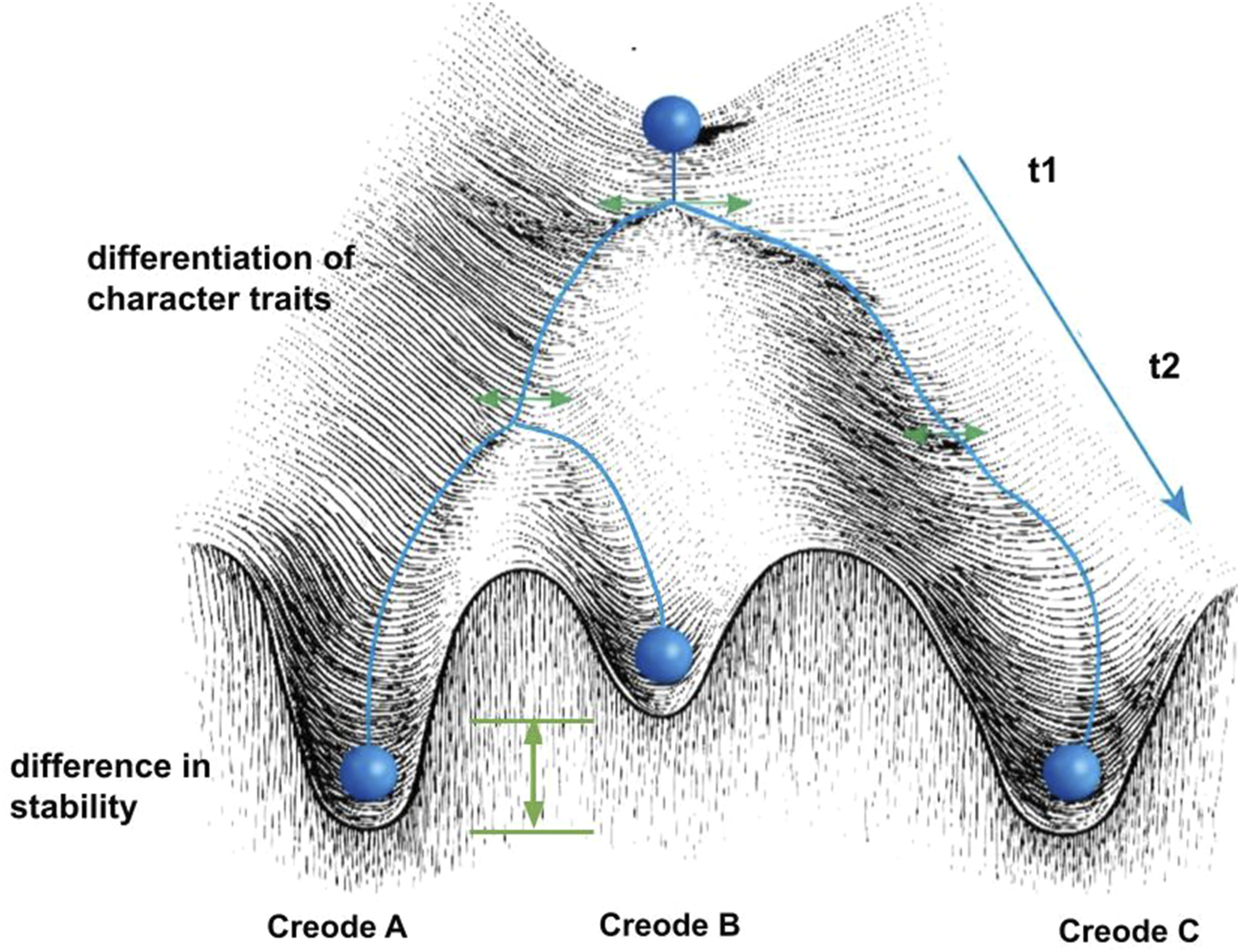
If a condition is more or less adaptive, on this view, is not defined by an externally imposed criterion (such as a categorical diagnosis or a deviation from population norms), but by a reduction in an individual’s diachronic metaflexibility—their capacity to keep multiple developmental possibilities open over time. The relevant comparison is not between an individual and a statistical average, but between the individual’s current trajectory and the range of trajectories that could have been available to them given their embodied history. Many complex systems naturally experience a narrowing of developmental potential across the lifespan—for example, aging is typically accompanied by increasing rigidity—but failing to account for these long-term dynamics risks generating what Serpico and Guala (2026) call “synchronic artifacts”: distortions that arise when we focus on short timescales without considering the broader historical trajectory in which present patterns are embedded.
The central proposal advanced here is that certain sensorimotor organizations—which underpin specific character traits—are not inherently pathological but occupy particular positions within a broader developmental landscape that may channel them into specific pathological trajectories. Within this framework, “closeness” denotes the developmental and dynamical proximity of a given sensorimotor configuration to deep creodes, indicating a higher likelihood of transitioning into an inflexible or pathological condition under certain environmental or experiential pressures. Crucially, this perspective enables a more nuanced understanding of character traits as context-sensitive risk factors: they may remain functionally adaptive or even advantageous in many situations, yet their structural positioning within an individual’s developmental landscape renders them more susceptible to specific destabilizations. Rather than viewing such traits as intrinsically dysfunctional, this model emphasizes their role in modulating vulnerability in response to specific conditions of stress, breakdown, or perturbation.
Empirical evidence from the Cybernetic Big Five Model introduced by De Young and Krueger (2018) provides significant insight into the relationship between character or personality traits and the predisposition to develop specific mental conditions. Their comprehensive review highlights robust correlations between the major dimensions of psychopathology and the fundamental trait dimensions of personality. For example, the trait of “neuroticism,” characterized by a general tendency toward negative affectivity and emotional instability, is consistently linked with increased risk factors for anxiety disorders, depressive episodes, and phobic conditions. Conversely, low levels of “conscientiousness” are associated with a higher propensity for externalizing behaviors, including impulsivity, substance use disorders, and attention deficit/hyperactivity disorder (ADHD). Importantly, the relationship between personality traits and psychopathological categories is not reducible to a simple one-to-one mapping; rather, it reflects a complex, multidimensional interplay. This complexity underscores the necessity of moving beyond categorical diagnostic models toward a more integrative framework that accounts for the continuous and interactive nature of personality and mental health vulnerabilities. Interestingly, recent work by Hovhannisyan and Goicoechea (2023) and Hovhannisyan and Vervaeke (2022) highlight the compatibility between De Young’s cybernetic theory of personality and the foundational organizational principles of enactive theory. This interdisciplinary convergence provides a promising explanatory framework for how mental conditions evolve from ongoing individuation of character traits.
However, these models should be interpreted cautiously. De Young and Krueger adopt a dimensional approach to personality traits, drawing on the Hierarchical Taxonomy of Psychopathology (HiTOP) proposed by Kotov et al. (2017) alongside the well-established Big Five Personality model articulated by De Raad (2000). Despite the prominence of the Big Five framework, ongoing debate persists regarding its capacity to fully capture the entire spectrum of personality variation and its effectiveness in predicting psychopathological symptoms (McCrae & Sutin, 2007). This debate raises important questions about whether personality traits are best understood as existing on a dimensional continuum or as part of a categorical system, as well as about the adequacy of current classificatory frameworks in representing the complex diversity of human personality. Nevertheless, the findings of De Young and Krueger’s research highlight the concept that considerable individual variability can be observed within any given category of mental disorder. This variability emerges from the unique constellation of disordered patterns that function as an “amplification” or continuation of an individual’s inherent personality traits, suggesting that psychopathology does not simply overwrite personality but rather builds upon and modifies pre-existing dispositional structures.
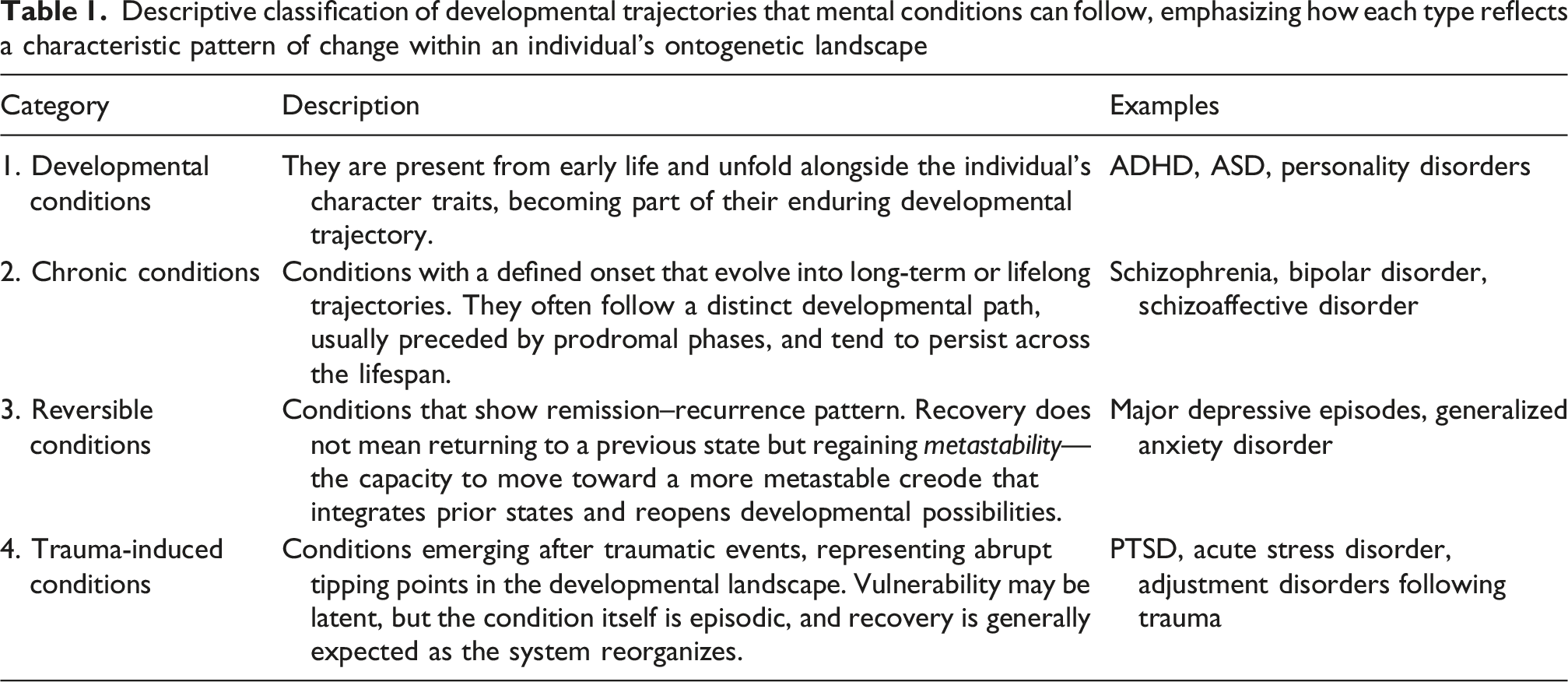
Descriptive classification of developmental trajectories that mental conditions can follow, emphasizing how each type reflects a characteristic pattern of change within an individual’s ontogenetic landscape
4.3. Character Traits in Dynamical Network Models. A Path for Research
A key remaining challenge concerns how to effectively integrate larger-scale developmental processes and character traits within network models of mental conditions. One might initially assume that simply inserting personality traits as additional nodes within symptom networks would be sufficient to capture their influence. While it is true that personality traits can be statistically linked to specific symptoms—even in the absence of a fully elaborated theoretical framework describing their relationship—reducing traits to a single aggregated category risks oversimplification. Instead, personality traits themselves can be conceptualized and modeled as complex networks, which can be analyzed using both between-subject and within-subject methodologies (Costantini et al., 2019; Costantini & Perugini, 2016). In this context, multilayer network models offer a promising solution, as they allow the representation of multiple interrelated networks—such as symptom networks and personality trait networks—that interact either through direct node-to-node connections or through nodes composed of subnetworks (Kivelä et al., 2014).
Multilayered frameworks can accommodate the dynamic relationships among processes that stabilize at different temporal scales. For example, multilayer network analysis has been applied to the study of personality traits, revealing hidden interdependencies across layers of functioning (Brooks et al., 2020), offering an alternative to latent variable models for studying the comorbidity between personality disorders and other pathologies (Köhne & Isvoranu, 2021; O’Driscoll et al., 2022). This is particularly relevant in cases such as the pronounced symptom overlap observed in cross-sectional networks between Borderline Personality Disorder and Major Depression (Kew et al., 2025). Longitudinal multilayered networks could, thus, help understand which specific character traits generate propensities to develop specific symptoms.
One significant advantage of this approach is its capacity to model the reciprocal influences between mental conditions and personality traits. This bidirectionality is evident in cases like post-traumatic stress disorder (PTSD), where not only do certain personality traits predispose individuals to develop PTSD, but traumatic experiences and ensuing symptoms can also induce enduring changes in personality structure (Steinberg et al., 2022). These dynamics help explain observed individual differences in the centrality of traumatic events within symptom networks, as well as phenomena like “post-traumatic growth”, meaning the positive psychological and character changes—such as greater resilience, deeper relationships, or a renewed sense of meaning—that some individuals experience as a result of struggling with highly challenging or traumatic life events.
5. Discussion
In this work, I have argued that the process ontology underlying the enactive approach invites us to view mental conditions as developmental phenomena that encompass multiscale processes of constitution. As a take-home message, it can be said that not only those disorders labeled as “developmental disorders” are indeed developmental. To clarify, my claim is not to suggest that personality traits alone can fully explain the complexity of mental disorders. Instead, I emphasize the importance of adopting a developmental perspective when addressing the multifaceted and multivariate nature of mental conditions. It would be fruitful, then, to explore further the relationship between ontogenetic, larger-scale processes of individuation and character building in relation to a person’s propensity for certain types of mental conditions. Treating mental conditions as continuations of characteristic sensorimotor patterns is helpful for making sense of variability, divergences, convergences, and qualitative changes in mental health network models.
The enactive-ontogenetic view of mental conditions suggested here has some theoretical implications. First, this perspective helps to account for two well-documented and interrelated phenomena: Comorbidity and variability. For the former, rather than assuming that comorbid conditions reflect independent, co-occurring pathologies, this view suggests that shared underlying character paths—such as heightened sensitivity, impulsivity, or rigid interpersonal styles—can give rise to divergent pathological outcomes at once, depending on context, life events, and relational dynamics. Regarding variability, conversely, different initial traits may also lead to the same diagnostic category, explaining the variability we find within the same category. Thus, the same diagnostic label may mask very different developmental histories and risk factors, while different labels may emerge from overlapping origins. Indeed, developmental trajectories are both canalized and plastic, and two individuals with different character traits can have a propensity toward the same pathological state.
Relatedly, recovery processes must be understood as path-dependent and individualized, meaning they are significantly shaped by the individual’s characterological background—the specific sensorimotor, affective, and cognitive patterns from which the pathological state originally emerged. These ontogenetic and characteristic factors are crucial because individuals presenting with similar symptom networks may exhibit markedly different responses to the same interventions, depending on their underlying personality traits and developmental trajectories. For instance, two patients may manifest comparable clinical symptoms, yet their trajectories of recovery can diverge substantially as a function of the distinct character traits that influenced their progression into illness. Indeed, empirical studies have consistently demonstrated that personality traits serve as important predictors of treatment outcomes across various conditions and therapeutic modalities (Bagby et al., 2016; Bucher et al., 2019; Fassino et al., 2013; Thalmayer, 2018). This recognition highlights that recovery is a temporally asymmetric process, deeply contingent on prior developmental history and the organization of personality. Contrary to the notion of standardized treatment protocols applicable uniformly across diagnoses, it is the individual’s character traits that critically determine the effectiveness of any given intervention. This approach thus favors personalized and precision psychotherapy. By constructing individualized, diachronic networks, we can simulate how interventions may affect a particular individual, track patterns of relapse and recovery, and identify the most relevant target nodes for that particular person.
A further implication of this perspective is the irreversibility and asymmetry of therapeutic processes. Recovery is not simply a matter of reversing dysfunction or returning to a previous baseline state; rather, it entails moving toward a new state, which is shaped by both the specificities of the condition and the individual’s unique life trajectory. Acknowledging this complexity enables a move beyond rigid diagnostic categories toward a more integrative framework that synthesizes problem-based and person-centered approaches. Instead of focusing solely on the question “What is the disorder?” clinicians and researchers are encouraged to ask “Who is this person, and how do their enduring traits interact with their present difficulties?” This shift opens the door to more tailored, nuanced interventions grounded not only in symptomatic expression but also in the person’s embodied history, affective dispositions, and characteristic patterns of relational engagement.
Finally, I would like to outline several practical and ethical implications of the ontogenetic perspective presented in this paper, which open promising avenues for future research. First, it aligns with the shift from a pathology paradigm to a vulnerability paradigm. A process perspective to mental conditions shifts the commonly understood relation between health and pathology. While pathology is traditionally understood as a deviation from the normal functioning of the organism, meaning we consider health to be the standard state of the organism, the vulnerability paradigm focuses on the inherently precarious and vulnerable character of all living beings. From this perspective, mental health is not the given state of the organism, but an ongoing achievement that is actively sustained by the person, that is, a precarious equilibrium that needs to be actively maintained. Consequently, every human being would have a propensity or differential risk, even if to varying degrees, to certain harmful patterns due to their character traits and developmental history. Consequently, a vulnerability paradigm gives rise to a conceptualization that reduces reification and stigma. For instance, we would like to replace the term “schizophrenia,” which connotes a “hopeless chronic brain disease,” with “vulnerability to psychosis.” Just like precariousness is a condition for understanding life as a self-organized process, recognition of psychological vulnerability is the condition for mental health.
In addition, this perspective goes along with some versions of neurodiversity. 4 Indeed, the ontogenetic perspective enables us to move away from a static and highly normative understanding of pathology as deviation from normality, understood as statistical normality or functional normality, towards a more diverse and encompassing perspective. We take path dependence and variability as primary data, as the starting point, rather than as accidents or exceptions. In this way, human variability and diversity are a direct consequence of the enactive model. This, of course, does not imply that developmental outcomes and mental conditions are completely open. The logic of individuation, indeed, constrains the space of developmental possibilities in such a way that identifiable patterns of behavior and cognition emerge. Thus, this does not imply that mental condition categories are not identifiable or useful. But the variables and aspects we use to aggregate non-typical patterns of behavior might vary depending on the perspective we adopt in assessing and contrasting those networks.
The ontogenetic perspective presented here may also shed light on the self-illness ambiguities we find in certain conditions (Dings & de Bruin, 2022). This ambiguity is reflected in questions like “Is it me or my pathology?” It arises from understanding the self as a coherent set of beliefs, affects, and interaction patterns, and pathologies as agency-diminishing entities that can impede the proper functioning of the individual. For the enactive perspective adopted here, habits, whether considered pathological or not, do not stem from internal or external factors, nor are they merely subjective or objective, voluntary or involuntary; rather, they emerge from the interaction between the individual and their socio-material environment. This has certain implications for understanding the self as a web of habits, desires, norms, and affects that are not necessarily completely coherent. Instead, the complex web of habits might allow us to identify regional identities, which are promoted, though not solely, through participation in different social groups, contexts, and activities (Maiese, 2022). The claim that mental conditions are “enacted” rather than just suffered implies an involvement of the intentional living being and the investment of agentic capacities. Plainly put, if cognizing is an action people do rather than a substance they have (i.e., mind), then mental conditions are types of processes that people enact and go through, rather than properties they have. Thinking of the self-illness ambiguity in terms of developmental pathways and dynamics of onset might shed some light on the degree of identification one has with one´s mental condition, which depends strongly on the developmental patterns identified in table 1. Exploring these relationships in detail remains an open question for future research.
Footnotes
Acknowledgments
The author thanks Mayo Pinto Candenas and Laura Nuno de la Rosa for the discussion of ideas and revision of an early version of this manuscript.

Funding
The authors disclosed receipt of the following financial support for the research, authorship, and/or publication of this article: This work was supported by the author gratefully acknowledges support from the Marie Skłodowska-Curie Actions, Horizon Europe programme (Grant Agreement No. 101205668) funded by the European Commission. This work was also supported by the Basque Government projects to Consolidated groups to the IAS Research (IT 1668-22. PI: Jon Umerez, and Grant PID2023-147251NB-I00 for project “OUTAGENCIES: Varieties of autonomous agency across living, humanimal and technical system” (PI Xabier Barandiaran) funded by MCIU/AEI/10.13039/501100011033 and FEDER/EU.
Declaration of conflicting interests
The authors declared no potential conflicts of interest with respect to the research, authorship, and/or publication of this article.
Notes
Author Biographies