






Abstract
In this article, the author discusses the lack of ergonomics input in developing countries generally and the lack of collaboration between Africa and other countries, particularly developed nations. She describes forestry ergonomics collaboration between South Africa and Chile and a consultancy project completed by a South African company for an industry in Zimbabwe and Zambia. Noteworthy was the focus on low-cost and no-cost interventions aimed at improving the well-being of workers, who are generally of poor health and who participate in labor-intensive industries in poorer countries. The successes of these simple yet effective interventions are highlighted.
Keywords
Labor-intensive work in developing countries can be eased with simple, low-cost solutions.
Ergonomics is about people at work (Scott, 2009). Given that most ergonomics research and practice has focused on developed countries, it is reasonable to state that because the vast majority of the world’s working population resides in developing regions, ergonomics has been of benefit only to a select few. Accordingly, ergonomics as a discipline has a long way to go in achieving the objective of “improving the quality of life for all” (International Ergonomics Association [IEA] mission statement, quoted by Scott, 2009).
This is particularly the case in sub-Saharan Africa, where the preponderance of the populace lives below the poverty line and which has been marginalized from the discipline of ergonomics. Although seemingly unattainable for the typical sub-Saharan national state, the successful development of the field of ergonomics is essential and requires engagement at all levels. Whether or not possible, the ideal would be for African states to act collectively, particularly as the knowledge and impact of ergonomics is extremely diverse within and between nations.
South Africa’s relative economic and ergonomic dominance on the continent, especially in southern Africa, suggests that ergonomists in that country should be steering the development of the profession in these areas. Furthermore, the southern African region has always been a critical supplier of labor to South Africa, particularly prior to 1994, from the earliest days of gold mining on the Rand and the colonization of other parts of the region.
With regard to the level of ergonomics in sub-Saharan Africa, the first ergonomics society on the African continent − the Ergonomics Society of South Africa (ESSA) − was inaugurated in February 1985. To my knowledge, there is only one other affiliated society in Africa, which was established in 2006 in Nigeria. ESSA has seen fluctuating support through the years, with academic dominance coming from Rhodes University in Grahamstown. As a result, there are only a handful of qualified ergonomists working in the country.
This fact, coupled with a lack of awareness of ergonomics in the country generally, means that the discipline is still struggling to make a difference in a country that so clearly needs the implementation of sound ergonomics principles. So although the rest of Africa may need the support of South Africa in terms of ergonomic development, the profession still needs to solidify itself nationally before extending to the rest of Africa. This area is where international collaboration and support from IEA is imperative, though that topic is beyond the scope of this article.
South Africa
Although South Africa has a great deal of first-world influence with many large multinational industries, most of the population is either unemployed or working in the informal sector. Contributor elements to the country’s poor socioeconomic status include the fact that many South Africans are still minimally educated and are forced into the unskilled labor market, which pays poorly. In a country that has seen considerable political change in the past 17 years, it is interesting to note that rural, mostly poor people still constitute approximately 40% (16 million) of the total population (Statistics South Africa [StatsSA], 2000).
In addition, rural unemployment is higher than 50% in most regions; more than 60% of rural people have no tap water in or near their homes, and more than 70% do not have electricity (StatsSA, 2000). Inadequate housing and meager sanitation result in a high incidence of disease (Christie, 2001) and an unhealthy manual workforce. Given that the World Health Organization states that the wealth of poor people is in their individual capabilities and their “assets,” the most important being their health, it is ironic that those least capable of hard physical labor are required to do just that (Christie, 2001).
Furthermore, these workers are exposed not only to the demands of their jobs but also to demands outside the work environment. For example, many workers have to walk extreme distances to and from work every day and have to do manual at home as well, such as collecting water and firewood. Some workers, because of pitiable wages, even take on second jobs to support their extended families. The situation is calamitous; most of these workers are unhealthy, have poor diets, live in poor conditions, do hard physical work, and live a tough life at home.
Although the negative consequences associated with these demanding lifestyle factors on the work capacity of laborers appear obvious, such consequences generally have not been considered by ergonomists. So, whereas ergonomics in Westernized societies may focus specifically on the work environment itself, in countries such as South Africa, the focus needs to be on the 24-hour cycle and on low-cost interventions that are effectual (Scott, 1993, 2009).
Ergonomics in Africa
Because there is only one ergonomics research unit in South Africa (at Rhodes University in Grahamstown) and a few other tertiary education departments around the country that run ergonomics modules, ergonomics research has been limited within the South African context. As a result, in major corporations, many guidelines from first-world industries are directly applied in the South African working environment without consideration of unique capabilities of workers and their 24-hour lifestyle cycle, despite the many obvious differences between the workforce in South Africa and that in other nations from which these guidelines are drawn. Furthermore, most work environments in South Africa are not privy to any type of ergonomics input if not part of an international consortium.
There are two important aspects of work to which ergonomics can make valuable contributions. The first, and the one most pertinent to developing countries, is heavy manual labor. The limited amount of research done in South Africa has reported on the high physical demands of all aspects of manual work, which lead to a depletion of nutrition stores, increased body temperature, dehydration, and ultimately, fatigue, all of which can lead to injuries and sometimes even fatal accidents (Christie, Meyer, James, & Apud, 2009). The other position is represented by mechanized work, whereby human energy is replaced by machines. In these conditions, the workers become progressively more sedentary in often highly monotonous and repetitive work.
Despite this mechanization and the associated health problems related to sedentarism, the main focus of this article is on labor-intensive industries. I contend that to ensure that ergonomics makes meaningful and lasting contributions, the application needs to be specific to the country involved. I further propose that ergonomists need to consider more than just the work itself by including aspects such as the socioeconomic status of the workers, health and nutritional status, and cultural and political contexts, to name a few (Christie et al., 2009).
Global Ergonomics Collaborations
Many international industries in South Africa receive ergonomics input from their Asian, European, or American counterparts. However, the predominant work in South Africa is performed not in global industries but in the informal sector. Thus, although input from ergonomists in the developed world is acknowledged, in industries specific to South Africa, the best collaborations often come from working with researchers and practitioners from within the country or from other developing countries that are facing similar challenges.
Two examples of such collaborations reported in this article include both a practical and a research example from industry and research collaboration. In the next section I describe, first, the collaboration between researchers in Chile and South Africa working in the field of forestry ergonomics and, second, collaboration between an ergonomics consultancy company in South Africa and industries in two other sub-Saharan nations.
Forestry collaboration
Forestry is an industry that imposes extreme physical demands that are not isolated to workers in developing countries but that are relatively similar around the globe. However, the applicability of the findings of ergonomics research from developed forestry regions to developing countries, such as South Africa and Chile, is disputed because of the distinctive nature of all work sites. It is imperative, for the outcome of any ergonomics project to benefit the local workers, that ergonomics research is conducted in the different regions of a particular country and on the native workforce in specific regions.
The forestry research in Chile began in 1968 by Nils Lundgren, a Swedish medical doctor and ergonomist (Christie et al., 2009). When he left the country, a team headed by Elias Apud was organized to continue Lundgren’s work. The studies performed in the first years following Lundgren’s departure were devoted to understanding the physical characteristics of forest workers in Chile, their social and working environment, and the quantification of food intake and habits in relation to the energy expenditure required for forest activities (Apud, 1983; Apud, Bostrand, Mobbs, & Strehlke, 1989). The researchers also attempted to improve simple manual methods for the various tasks associated with forestry, with the aims of reducing workload and increasing efficiency.
Apud and his team first set out to determine the physical capabilities of Chilean forestry workers. They found that these workers were ectomorphic and well trained despite the fact that productivity was low. The reasons for low productivity were multifactorial, although the strongest correlation was between dietary intake or composition and productivity; they found that the most productive workers ate more energy-dense foods, and their diets were more varied (Apud, 1983). Apud and colleagues (1989) demonstrated that forestry workers would need to eat in excess of 16,000 kJ per day to meet their daily energy requirements. Their assessment of task demands highlighted that the physical loads placed on these workers were similar to loads imposed on workers doing equivalent work in Scandinavia, Canada, and New Zealand. The most notable differences were the poor salaries paid to workers in Chile and their poor living conditions and dietary intakes.
In 2002, Patricia Scott from Rhodes University initiated a collaboration with Apud’s team, with consideration given to the fact that conditions were similar in the two countries. By that time, Apud had done widespread ergonomics research and practice in the forestry industry in Chile and was approached by the South African researchers to assist them in initiating similar research in the South African forestry context.
From 2002 to 2006, more than 100 South African forestry workers were assessed in an industry that had had no prior legitimate ergonomics input. Although it was expected that worker profiles would be similar between countries, the forestry workers in South Africa were in much poorer physical condition than were those in Chile. This difference was attributed to the HIV/AIDS pandemic in South Africa and the fact that these workers did not live on site and were paid less. These workers performed hard physical labor, which they started as early as 4:00 a.m.; worked to complete the allocated task to finish work early (after a 4:00 a.m. start in summer); and then typically took on a second job to supplement their income.
Furthermore, whereas the Chilean workers lived on site and ate food given to them by the company, the South African forestry workers did not. These workers were required to bring in their own sustenance to work but often chose not to eat so that they could finish work early. As such, dietary analyses revealed abysmal diets; workers ate only half the recommended daily allowance for a sedentary individual of equivalent age.
Thus, the primary interventions focused on improving dietary intake, the benefits of which were reported previously even though it was impossible to completely match energy expenditure to energy intake (Christie, 2008, 2010). Furthermore, many of these workers were severely dehydrated following their work shift, losing up to 4% of their body mass (Christie, 2008). Most workers did not want to stop working to take water into the field. Other reasons cited included the fact that the water could not be kept cold, and workers did not want to carry it. A low-cost or no-cost intervention strategy was to provide cool, clean water on site and to get supervisors to deliver the water to the operators, who were often deep in the field. The benefits of this intervention were immediate, and postintervention levels of dehydration were reduced to approximately 1% (Christie, 2010).
The success of this collaboration was clear and was appreciated by both workers and managers, leading to further research in the forestry industry in South Africa and the appointment of the first permanent ergonomist in the forestry sector. The experience reiterated the point of specificity: Even though there are more similarities between two developing nations than between an industrialized and a developing country, each country and its workers are still unique, requiring unique investigation and input.
Consultancy collaboration
An ergonomics consultancy in South Africa recently consulted for a cotton ginnery in Zimbabwe and Zambia. The company approached the consultancy to carry out ergonomics risk identification. As with most interventions in developing regions, the focus was on low-cost or no-cost interventions, and most of the recommendations related to changing work habits and education about ergonomics at all levels within the company (Lombaert, 2010).
For example, to avoid awkward working postures while picking up cotton (Figure 1), workers were advised to use a wide, fanned plastic garden rake with a long handle (Figure 2) to prevent them from adopting a stooped posture and using their hands to pick up the cotton. The benefits of this method still have to be quantified, although the obvious expectation is that lower-back pain, prevalent among the workers, should be reduced.
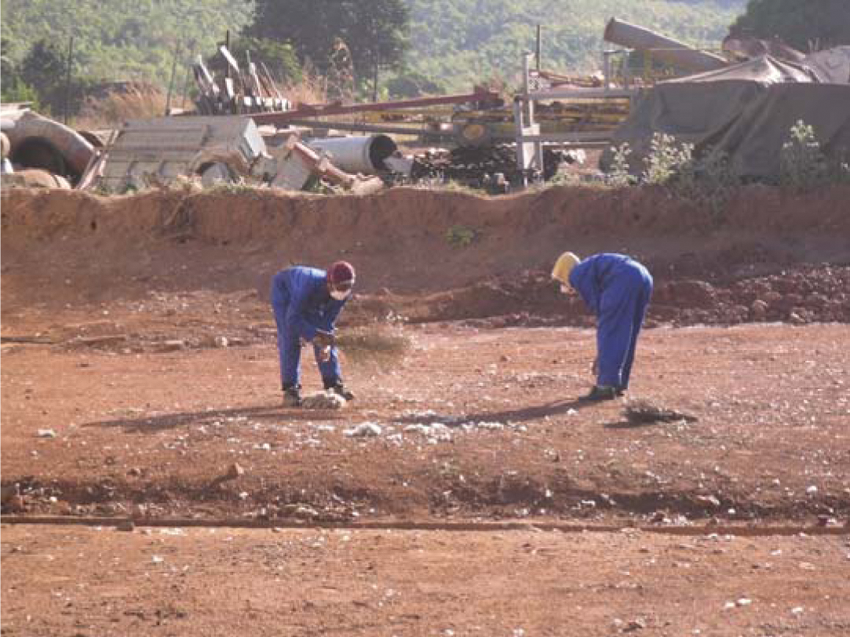
Awkward working postures adopted while picking up cotton.

Rake for collecting the cotton and avoiding stooped postures.
A second recommendation revolved around safety issues, given that the gin was situated about 3.5 km from the main road with accessibility only by a dirt road. Thus, when the gin closed in the evenings, all floodlights were switched off and no other lighting was provided. To address this problem, Lombaert (2010) designed a “glow in the dark” wristband bearing the company’s health and safety motto so workers could locate other workers in the dark. It was also recommended that all workers wear reflective bibs and add reflective tape to their overalls (Lombaert, 2010).
To date, reflective tape has been added to workers’ overalls at both cotton gins, and all employees in the southeast Africa operations wear safety bands, simple interventions that could save lives and a good example by South Africa of advising other countries in Africa while also spreading the word of ergonomics.
Conclusion
Although global ergonomics collaborations with South Africa are few and far between, there are individuals who are trying to make a difference by whatever means possible. Despite these efforts, much still needs to be done to ensure that ergonomics becomes truly global and benefits the majority of the world’s working population.
In her book Ergonomics in Developing Regions: Needs and Applications, Scott (2009) succinctly stated that “ergonomics has yet to become a ubiquitous global discipline” and that the time is right for IEA to put more resources into the development of ergonomics in developing regions. She further challenged IEA to achieve the seemingly impossible: to have more federated societies from industrially developing countries than from the developed world (Scott, 2009). It remains to be seen whether IEA embraces this challenge.