






Abstract
Since Watergate, more than two hundred fifty members of the House of Representatives have been involved in various scandals. The author finds that roughly 40 percent of incumbents did not “survive” their scandal. Incumbents who stood for reelection lost 5 percent of the general election vote share, on average, but the electoral repercussions vary across types of scandals and could be magnified in the presence of a quality challenger. A scandal-tainted incumbent defending his or her seat does not necessarily fare better than an untainted open-seat candidate, a finding that provides a justification for stronger ethics rules.
When an elected official’s character is called into question, what are the electoral consequences? One possibility is that alleged misconduct undermines voters’ assessments of the accused, making the incumbent more vulnerable to defeat. Representative government has been described as a principal-agent relationship, in which the principals (voters) face uncertainty in evaluating their agent (the elected official). An elected official possesses hidden information about his or her interests and qualities and can take hidden actions that reward himself or herself, financially or otherwise, rather than pursue constituents’ interests. Within this framework, involvement in a scandal might provide a cheap and clear signal that an incumbent lacks quality (Mondak 1995). Alternatively, involvement in a scandal might reveal a violation of the trust between elected officials and their constituents, who “are asked to accept a lot on faith despite intrinsic reasons for skepticism” (Jacobson and Dimock 1994, 603; see also Fenno 1978). A competing possibility is that voters separate elected representatives’ private behavior from their public images. A legendary congressman, Charlie Wilson, famously offered his opinion while embroiled in a financial scandal: “I think the people of East Texas knew they weren’t electing a CPA [certified public accountant]” (Clarence 1992). A third possibility is that constituents may be largely ignorant of and unresponsive to accusations of misconduct, but political elites are acutely sensitive to incumbents’ potential vulnerabilities. Prospective candidates might be more apt to challenge a scandal-tainted incumbent and more able to raise campaign funds, and therefore might pilfer votes from scandal-tainted incumbents even if voters do not autonomously connect the alleged misbehavior with their votes.
Laboratory studies by political scientists indicate that experimental participants do respond negatively to scandal, whether measured by their candidate evaluations or by their vote intentions. 1 These researchers have examined different types of scandals and usually find that voters respond more negatively to financial scandals and/or to abuses of power than to extramarital affairs—perhaps indicating that voters do distinguish some forms of private misbehavior. However, these findings have not been bolstered by or validated with voter surveys and election results. Furthermore, the hypothetical effects of scandals on challenger quantity, quality, and campaign spending have been examined only in narrow contexts, like the House Bank scandal.
The aim of this article is to fill the gap in the scholarship with a large-scale study of House elections using a new, comprehensive database of congressional scandals and elections covering four decades, from 1972 to 2012. This time period has provided no shortage of scandals, and exposés have been penned about “Koreagate,” “Abscam,” Jack Abramoff, and congressmen Wayne Hays, Tony Coelho, Jim Wright, Gary Condit, Tom DeLay, and Randy Cunningham. 2 These episodes represent a fraction of scandals, and these case studies provide little insight into voters’ reactions to scandals since most of the accused members chose not to seek reelection.
The significance of electoral responses to scandals is magnified by Congress’s historically passive stance toward misbehavior by its members. As I document, accusations against a representative for immoral and/or unethical behavior arise frequently, but representatives rarely are expelled, censured, or reprimanded for misbehavior. Congressional committees aggressively pursue scandals involving the president or executive branch officials, but Congress typically leaves it to the electorate to oust a tarnished incumbent, unless the sullied member exits voluntarily. This implies that the electorate’s response to scandal is the primary determinant of representatives’ incentives to act ethically and/or morally.
This article provides evidence on the frequency and consequences of scandals involving members of the House of Representatives. In the next three sections, I survey the scholarship on congressional scandals, describe prior data collection efforts, and introduce a new database of House scandals since Watergate. I then analyze scandals’ effects on the general election vote share. Finally, I analyze scandals’ effects on candidate exit and entry and on incumbent victory. I find that involvement in a scandal costs an incumbent 5 percent of the general election vote, which is roughly equal to the average effect of facing a quality challenger. But when I combine retiring, resigning, being expelled, and losing a primary or general election, only 59 percent of scandal-tainted incumbents returned to the House in the subsequent Congress, compared to 87 percent of incumbents who were untainted by scandal.
Scholarship on House Scandals
In this section, I survey observational studies of the effects of scandals. Only five studies have examined scandals’ electoral effects across multiple election years. Two studies of alleged misbehavior by members of Congress focused on the period from 1968 to 1978 (Peters and Welch 1980) and from 1982 to 1990 (Welch and Hibbing 1997); together they found that only 63 percent of scandal-tainted incumbents won reelection. Of the incumbents who did not survive the scandal, 56 percent lost in the general election, 31 percent voluntarily resigned or opted not to seek reelection, and 13 percent failed to secure renomination in a contested primary election. Herrick (2000) inspected House incumbents accused of unethical behavior between 1977 and 1996. She confirmed that roughly 60 percent of accused members survived their scandal; two-thirds of the victims of scandal lost in the primary or general election, and one-third retired or resigned. Herrick also found that the probability of survival was significantly related to incumbents’ margin of victory in the previous general election, and Brown (2006) found that involvement in a scandal subtracted 7.2 percent (±1.8 percent) from the incumbent’s general election vote share, implying that an incumbent occupying a favorable district or possessing a sizable “personal vote” will be better able to weather the storm of scandal. 3 Finally, Lazarus (2008) showed that scandal-tainted incumbents were more likely to face opposition in the primary and general elections and were more likely to face challengers with electoral experience.
A single event generated an intense but brief flurry of research into congressional scandals. 4 This event, the House Bank scandal, has been called “a gift to students of electoral politics” (Jacobson and Dimock 1994, 602). In September 1991, it was revealed that representatives had been overdrawing their checking accounts in the House Bank without penalty. A General Accounting Office investigation revealed that in one twelve-month period in 1989 and 1990, a stunning 8,331 bad checks were written by members of the House. Some blame was due to the bank’s loose operating standards, but the House Ethics Committee identified seventeen members who seemed to take advantage of the system. Eleven of these seventeen members resigned or lost their reelection bids, and two were convicted of crimes ranging from campaign finance violations (converting contributions to personal use) to felony bribery and conspiracy.
On April 16, 1992, six months before the general election, all House members’ overdrafts were disclosed to the public. Observational studies found that members who wrote more bad checks were more likely to retire, to face primary challenges, and/or to lose their primary than members who wrote fewer bad checks (Alford et al. 1994; Banducci and Karp 1994). However, two factors that were unique to 1992 may have affected the election context. First, redistricting placed multiple incumbents in many districts, and incumbents who would face other incumbents were more likely to retire. Second, a “golden parachute” provision that allowed some incumbents to cash in their war chests made retirement more palatable. Groseclose and Krehbiel (1994) find that if these factors were controlled, then overdrafts did not affect retirements significantly. 5 More overdrafts increased the likelihood of facing an experienced challenger in the primary election, especially in states with a late filing deadline (Banducci and Karp 1994; Jacobson and Dimock 1994), but the evidence on whether more overdrafts raised challengers’ experience in the general election and/or subtracted from the incumbent’s vote in the general election is equivocal. According to one summary of the scandal, “by the time of the general election, the short half-life of the scandal was played out and its effect was negligible” (Alford et al. 1994, 797).
Even if there was unequivocal evidence that the House Bank scandal had substantial effects on the 1992 election, a problem arises in extrapolating from one scandal or one year. Newer research on the 2006 election suffers from some of the same flaws. These studies were propelled by a scandal that broke in 2005, when The Washington Post first uncovered a pattern of Indian tribes with casino gambling interests contributing to Republican officeholders and leadership political action committees and paying millions of dollars of fees to “superlobbyist” Jack Abramoff and his network of consultants and conservative organizations (see Stone 2006). 6 At least a dozen members of the House, mostly Republicans, received trips, gifts, and employment opportunities for family members and former colleagues.
Abramoff aside, the 109th Congress was so scandal-plagued that ABC News created a “Scandal Watch” list to highlight tainted House incumbents, Roll Call listed House members under federal investigation, and Citizens for Responsibility and Ethics in Washington (CREW) compiled its first list of the “most corrupt” members of the House (CREW 2006). Hendry, Jackson, and Mondak (2008) identified twenty-five scandal-tainted incumbents who sought reelection in 2006 and estimated that involvement in a scandal subtracted 4.8 percent (±2.8 percent) from the incumbent’s general election vote. Grose and Oppenheimer (2007) used Hotline’s list of seventeen scandal-affected incumbents and estimated that scandal-affected Republican incumbents lost 4.0 percent (±3.2 percent) and scandal-affected Democratic incumbents lost 6.9 percent (±3.7 percent). 7 In each of these studies, however, only two of the scandal-tainted incumbents were Democrats, and the studies do not use the same Democrats! 8 Studies that focus on a single year also suffer from small sample sizes and from inadequate control for confounding factors that make individual election years unusual.
Nevertheless, the existing research has identified a variety of possible effects of scandals. The following six questions guide my empirical investigations below. First, assuming the incumbent seeks reelection, do scandals affect the incumbent’s share of the vote and probability of winning reelection? Second, do scandals affect challenger quality? Third, does challenger quality heighten the general election’s effects of scandals? Fourth, do scandals affect incumbents’ choices of whether to seek reelection? Fifth, do scandals lead to primary losses by incumbents? Sixth, do incumbents’ exit prior to the general election—due to either retiring, resigning, or losing the primary—affect their party’s share of the vote and probability of holding the seat? With sufficiently detailed data, it would also be possible to address whether some answers to these questions vary across types of scandals.
Problems in Data Collection
A scholar who wishes to address these questions and examine the consequences of congressional scandals faces a shortage of accessible, reliable, and richly detailed data. The first efforts to assess scandals’ effects (Peters and Welch 1980; Welch and Hibbing 1997) examined all instances in which corruption charges played a prominent role in election campaigns. Coders used the Congressional Quarterly Weekly Report, especially the biennial special election reports published in the second week of October, and followed a permissive coding strategy: allegations would be counted if they were widely reported, regardless of whether they were substantiated. Across eleven election cycles, coders identified 168 House incumbents who were accused of wrongdoing.
Subsequent efforts to measure scandals use reference sources that listed members who were investigated, reprimanded, censured, stripped of committee seniority, expelled from Congress, and indicted for or convicted of crimes. Relying on Congressional Quarterly (1992) and Thompson (1995), Herrick (2000) identified 98 scandal-tainted House incumbents between 1977 and 1996, and Brown (2006) identified 107 scandal-tainted House incumbents between 1966 and 2002. The House issued a historical summary of ethics investigations in 2004, adding episodes in which a member was investigated but ultimately no formal action was taken. Committee reports, particularly the biennial “Summary of Activities,” aid in identifying situations in which a legitimate complaint was filed, but the investigation was halted by a Justice Department or grand jury request or because jurisdiction would be lost upon the incumbent’s impending retirement or resignation or following an electoral defeat.
One shortcoming of these reference sources is that a scandal might receive no mention if no law or House rule has been broken. This particularly presents a problem for data collection when a scandal involves sexual infidelity. For instance, Gary Condit lost reelection in 2002 after his affair with Chandra Levy, an intern who disappeared under mysterious circumstances, was revealed. Condit was not formally investigated by the Ethics Committee, hence his name does not appear in official sources, but the scandal was a significant cause of his defeat. 9
Another shortcoming of these reference sources is that some scandals that spawn a formal investigation are truly insignificant. This point is exemplified by the dueling ethics complaints of Robert Torricelli and Dick Zimmer, who faced each other in New Jersey’s 1996 Senate election. Both representatives were investigated for misuse of office after each filed a complaint alleging the other’s use of official fax machines to send campaign statements. Torricelli was found liable, and he reimbursed the government $2.83 (the estimated cost of four sheets of paper and toner), and the complaint against Zimmer was dismissed.
Studies that rely solely on House documents or accounts of the congressional ethics process will fail to count many scandals, because of jurisdictional issues and committee deference toward the judicial system and the electorate, and risk treating minor violations of the ethics code on equal terms as corruption. Studies that rely solely on campaign allegations also will include false positives, that is, unsubstantiated allegations of wrongdoing. Moreover, studies that focus on a single election year (e.g., 2006) or a single scandal (e.g., the House Bank scandal) can be misleading in three ways. First, such studies can overstate the frequency of scandals, because scholars will naturally focus on years in which an unusually large number of scandals have occurred. Second, such studies can overstate the direct effects of scandals. Consider that in 2006, scandal-tainted Republican incumbents’ share of the vote averaged 8.3 percent less than their 2004 vote share, whereas scandal-tainted Democrats’ share of the vote averaged 2.6 percent less than their 2004 vote share. Roughly half of those lost votes for Republican incumbents were a by-product of an unfavorable national tide (see Grose and Oppenheimer 2007, 546). In short, 2006 was an unfortunate election year for Republican incumbents; the fact that most scandal-tainted incumbents were Republicans makes it imperative to separate losses due to scandal from losses due to national party tides. Third, such studies can overstate the indirect effects of a scandal. If many of the primary defeats and retirements in 1992 ought to be attributed to redistricting and the “golden parachute” provision (see Groseclose and Krehbiel 1994), then the House Bank scandal’s apparent effect is an illusion.
Congressional Incumbents’ Scandals in the Post-Watergate Era
To expand the list of scandals and election years, I have compiled a new database of congressional scandals since 1973, drawing on a wider set of sources than were used previously. First, I collected reports from the House Committee on Standards of Official Conduct (in 2011 renamed the House Ethics Committee) and press statements by the chair and ranking member. The biennial “Summary of Activities” reports are available on Lexis-Nexis back to the 102nd Congress, and earlier Congresses are summarized in the “Historical Summary of Conduct Cases in the U.S. House of Representatives.” To code scandals in the 111th and 112th Congresses, I used press statements plus reports on each investigation. 10 Second, four books on congressional ethics—Congressional Quarterly (1980, 1992), Herrick (2003), and Thompson (1995)—describe many of the major and minor scandals in the House and Senate and provide lists of members who have faced criminal indictments, who have been convicted, and who have been punished formally by the House. Third, I used four books that identify themselves as an “encyclopedia” or “almanac” or “compendium” of political corruption or scandal: Roberts (2001), Long (2007), Grossman (2008), and Marion (2010). Fourth, I drew on three exposés that devote substantial attention to extramarital affairs, immorality, and alleged corruption: Kessler (1997), Hilton and Testa (1998), and Tolchin and Tolchin (2001). Fifth, I drew on the “Beyond DeLay” and “Most Corrupt” reports that CREW has published annually since 2005 (CREW 2005). For the 2006 election, I cross-referenced with Brown (2007); Grose and Oppenheimer (2007); Hendry, Jackson, and Mondak (2008); Stern et al. (2007); and Stone (2006).
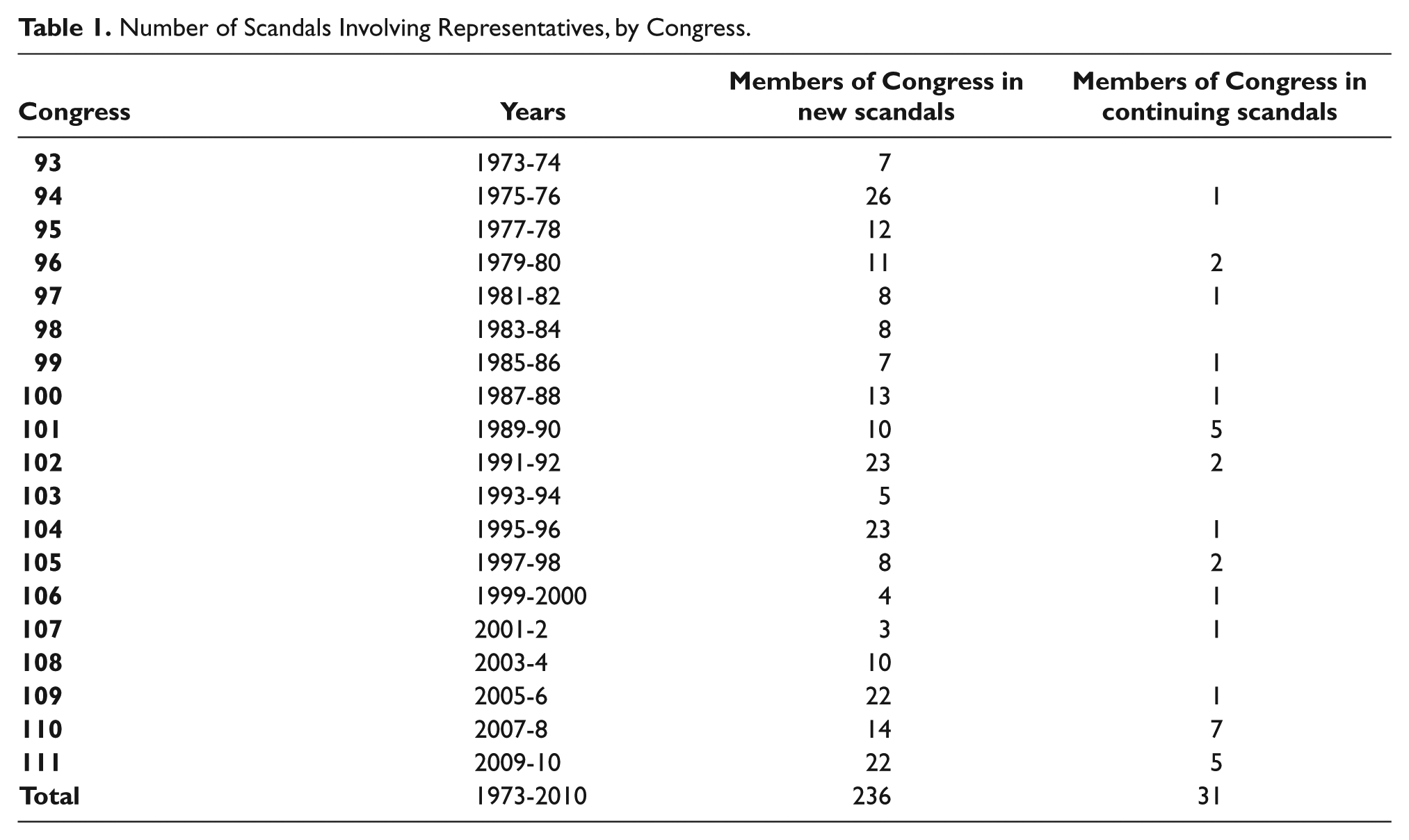
The numbers of scandals in each Congress are listed in Table 1. The count in the first column reflects the number of House members involved in scandals, regardless of whether they stand for reelection. When a scandal spanned multiple Congresses because the Ethics Committee delayed its investigation or because it extended an investigative subcommittee’s work, the second column registers continuing scandals. In total, 237 House members were named in scandals during nineteen Congresses, an average of 12.5 scandal-tainted incumbents per Congress. Note that Table 1 counts only the seventeen members identified as serial offenders in the House Bank scandal during the 102nd Congress, not all 266 members who had at least one overdraft. The largest number of scandals in a Congress was twenty-six, attained in the 94th Congress, which includes eleven representatives who were frequent guests at hunting lodges belonging to defense contractors—a situation akin to the Abramoff scandals that would rock the 109th Congress. So far in the 112th Congress, twenty-five representatives have been involved in new scandals (plus three in continuing scandals), and three members have already resigned. This number does not include the dozens of members that Schweizer (2012) accuses of insider trading or that The Washington Post’s “Capitol Assets” series accuses of targeting earmarks to groups to which they have family ties or to projects that will benefit their own investments.
Number of Scandals Involving Representatives, by Congress.
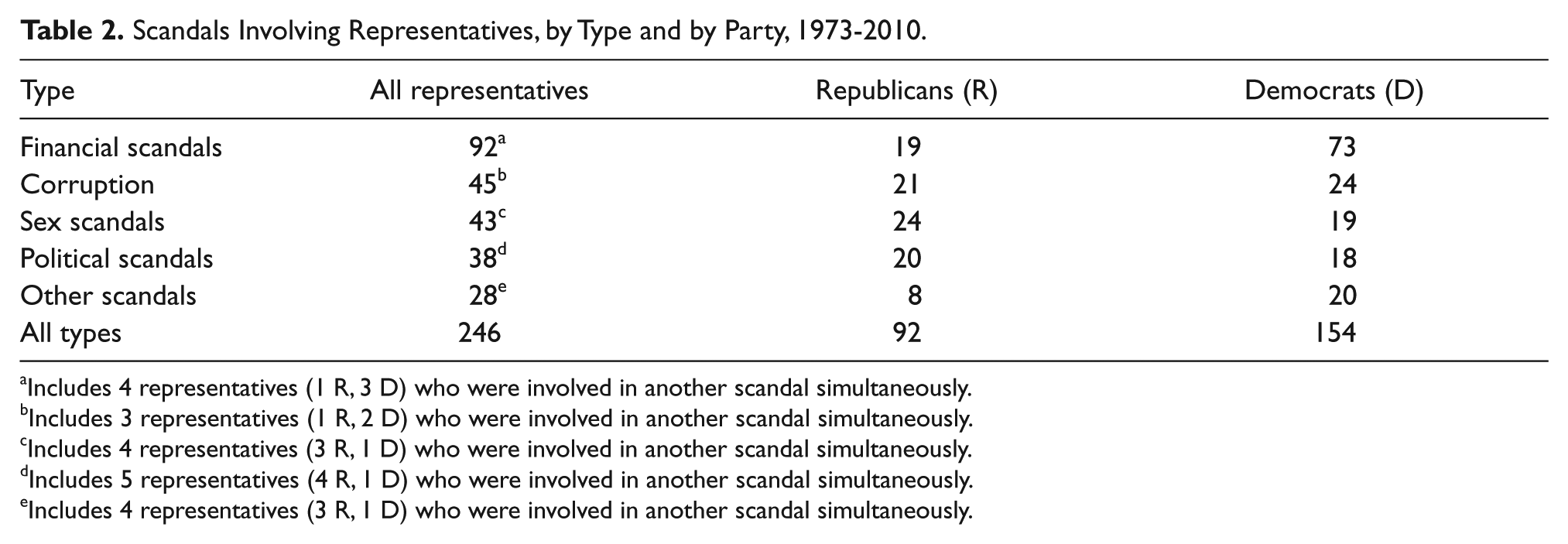
I have classified scandals into four major categories. Financial scandals includes inadequate financial disclosures; tax evasion or fraud; illegitimate outside income; conflict of interest; illegal gratuities and gifts; improper employment practices, such as payroll kickbacks; and converting campaign funds to personal use. The defense contractors’ hospitality scandal, the Koreagate scandal in the late 1970s, the House Bank scandal, and the recent probe of five members’ free Caribbean vacations belong to the financial scandal category. Corruption includes bribery, conspiracy, obstruction of justice, and influence peddling, such as the Abscam scandal that cost six representatives and one senator their seats in Congress. The sex scandals category includes extramarital affairs, solicitation of a prostitute, sodomy, sexual assault, sexual harassment, and “retaining an employee on the payroll for immoral purposes” (i.e., Wayne Hays’s affair with Liz Ray and John Young’s affair with Colleen Gardner). The House page scandals of 1982 and 2006 are included in the sex scandals category. The political scandals category includes election fraud and campaign finance violations, such as inadequate disclosure of donations and solicitation of donations from illegitimate sources, such as foreigners. Misuse of campaign donations belongs to this category if the funds were not converted to personal use, as does misuse of congressional offices or office equipment, official letterhead, stationary, and the congressional seal. Other scandals is a residual category that includes trespassing, speeding, vehicular homicide or manslaughter, assault, illicit drug use, driving while intoxicated, public intoxication, resisting arrest, disorderly conduct, and lying about military service.
In Table 2, I divide the scandals by their type and by the party of the member alleged to have misbehaved. Table 2 reveals that roughly 40 percent of the House scandals involve alleged financial malfeasance. Another 21 percent of scandals involve alleged corruption, and 17 percent of scandals involve sexual misconduct. Overall, Democrats were involved in more scandals, but they also occupied more House seats across the time period. Democrats were involved in more than three-quarters of financial scandals, and this category of scandals accounts for more than half of Democrats’ scandals overall. Republicans were involved in more than two-thirds of the political scandals. The parties are evenly divided in corruption and sex scandals.
Scandals Involving Representatives, by Type and by Party, 1973-2010.
Includes 4 representatives (1 R, 3 D) who were involved in another scandal simultaneously.
Includes 3 representatives (1 R, 2 D) who were involved in another scandal simultaneously.
Includes 4 representatives (3 R, 1 D) who were involved in another scandal simultaneously.
Includes 5 representatives (4 R, 1 D) who were involved in another scandal simultaneously.
Includes 4 representatives (3 R, 1 D) who were involved in another scandal simultaneously.
Electoral Effects of Congressional Incumbents’ Scandals
In this section, I report the results of analyses of scandals’ effects on general election outcomes. Initially, I examine just races in which the incumbent stood for reelection, looking at whether involvement in a scandal affected his or her vote share. Next, I compare the results in open seats to examine whether exit by scandal-tainted incumbent, whether due to retirement or a lost primary, alleviates the expected electoral effect of a scandal.
The simplest analysis that suffices to assess congressional scandals’ electoral effects is a “difference- in-differences” analysis. Generally speaking, the best predictor of the vote share that the incumbent will earn in an election is the vote share that the incumbent earned in the previous election. Indeed, a regression of current general election vote share on prior general election vote share and a dummy variable for scandal yields a coefficient of 1.001 on prior vote (SE = 0.002) and a coefficient of −0.051 on scandal (SE = 0.007), with an adjusted R2 of .986. The first step in the difference- in-differences analysis is to compute the interelection vote difference for an incumbent, using the percentage of the two-party vote in contested general elections. 11 The second step is to compare the mean interelection vote differences for scandal-free and scandal-tainted incumbents. If scandals have their expected effects, incumbents who were involved in a scandal will experience a negative change, on average, whereas incumbents who were not involved in any scandal should average zero change. Additionally, districts in which the incumbent vacates the seat (whether due to retirement, resignation, expulsion, or death) should also experience a negative change in vote share.
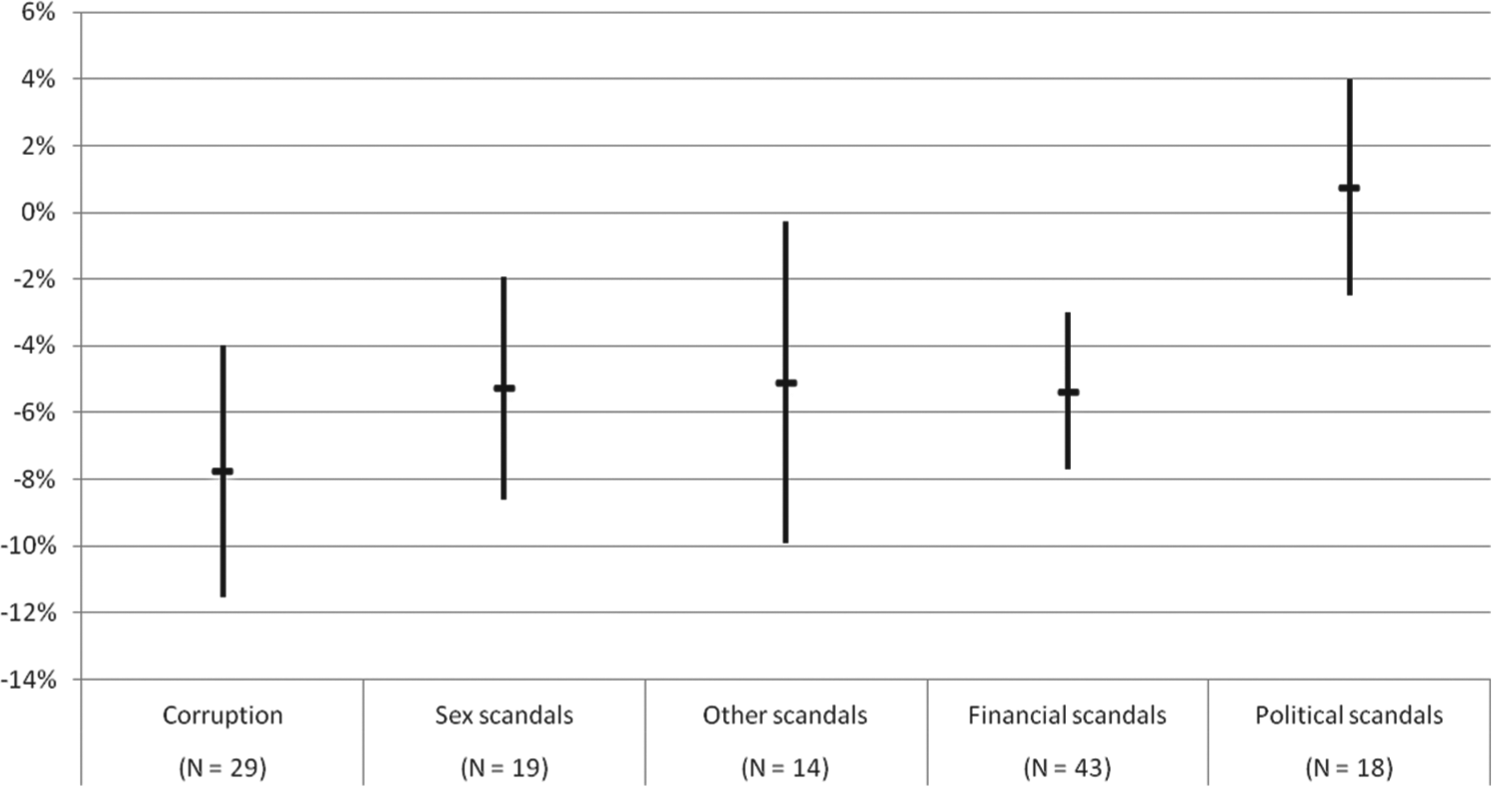
Figure 1 confirms these expectations, illustrating the mean interelection differences in vote share and the 95 percent confidence interval estimate of the effect. Figure 1 displays interelection vote share differences for open-seat elections, for scandal-tainted incumbents who stood for reelection, and for scandal-free incumbents. The mean interelection vote swing for a scandal-free incumbent is +0.5 percent. The mean interelection vote swing for a scandal-tainted incumbent is −5.1 percent of the vote. 12 An open-seat candidate attempting to defend his or her party’s seat after an incumbent suffers an average interelection vote swing of −7.7 percent. 13 Figure 2 displays the interelection difference in vote shares for the five categories of scandals. When scandals are disaggregated, the confidence intervals are larger because of smaller sample sizes; nevertheless, some patterns can be observed. 14 Corruption scandals appear to have the worst effect on the incumbent’s vote, dragging the vote down by 7.8 percent on average. Sex scandals and financial scandals each subtract 5.3 percent of the incumbent’s vote on average. Political scandals have an effect that is statistically indistinguishable from zero.
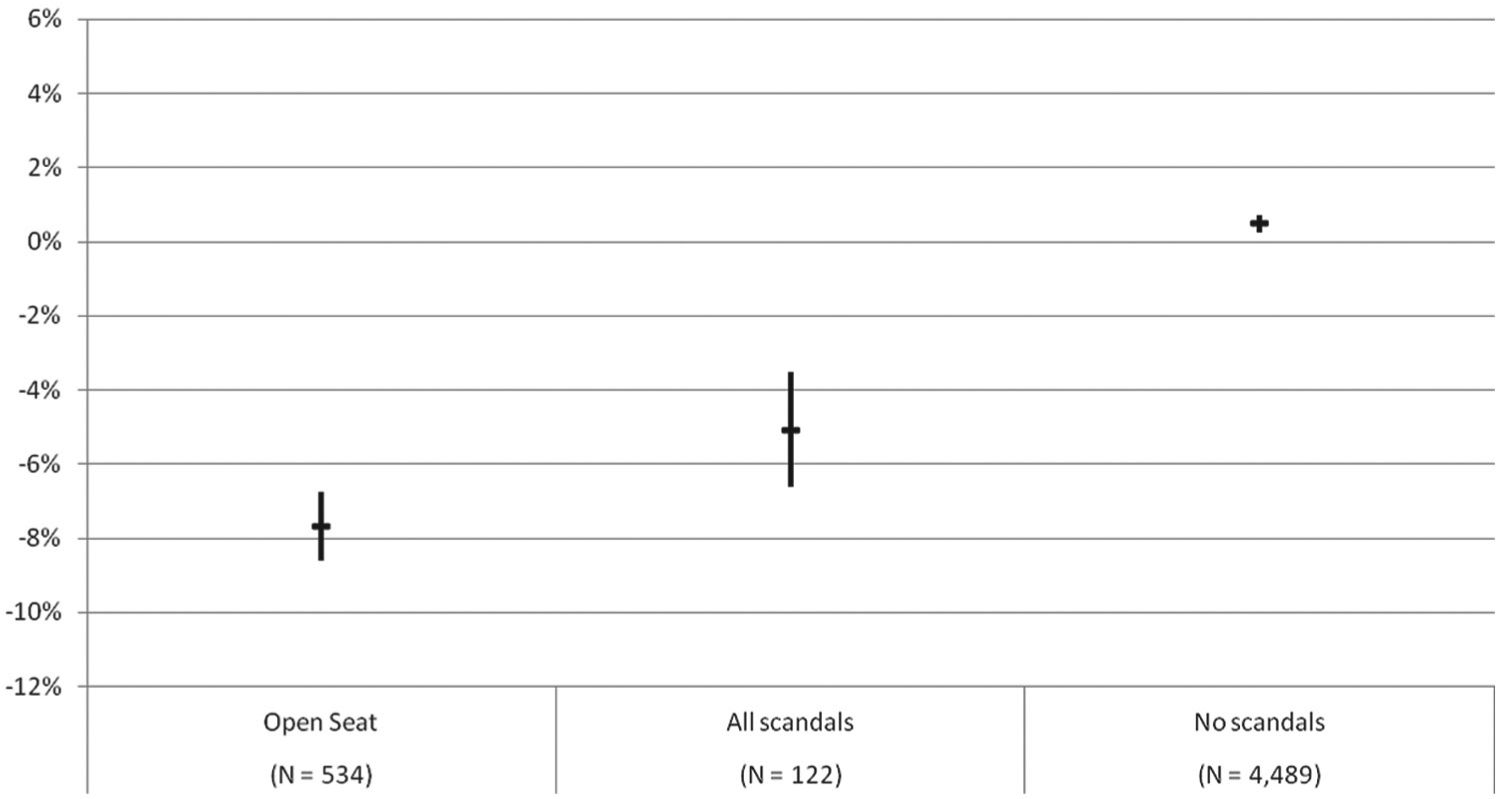
Interelection vote differences for (A) open-seat elections, scandal-tainted incumbents who stood for reelection, and scandal-free incumbents and (B) the five categories of scandals (mean and 95 percent confidence interval).
Campaign conditions, by scandal.
Of the six research questions, the first has been addressed already, and the initial evidence indicates that scandals reduce the incumbent’s expected general election vote by roughly 5 percent, on average. The impact may be slightly larger for corruption than for financial scandals or sex scandals, but all three types of scandals consistently subtract votes from the incumbent.
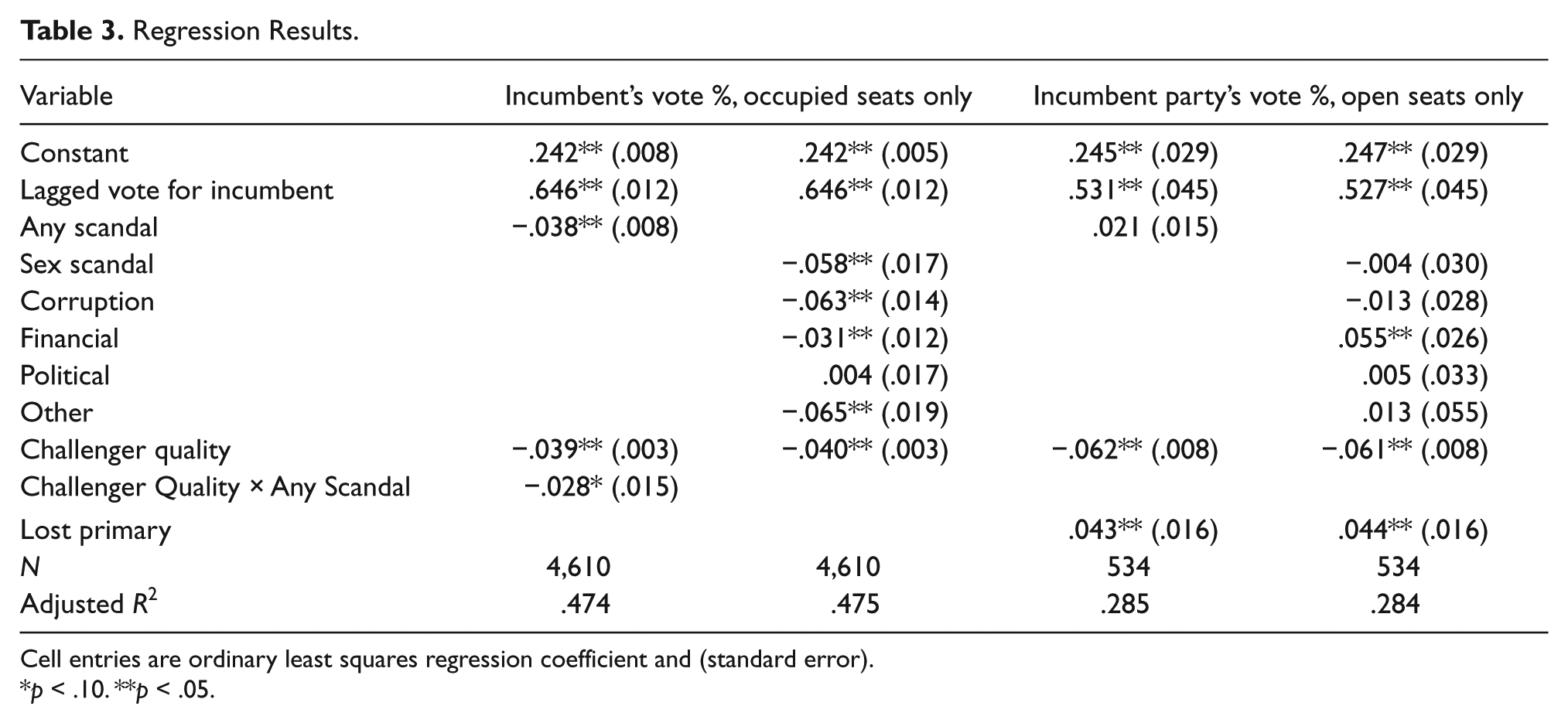
Table 3 displays the results of four ordinary least squares regressions in which the vote share received by incumbent party’s candidate is the dependent variable. The first two columns show only incumbent-contested districts, and the last two columns show only open-seat districts. The incumbent’s vote share in the previous election serves as the key control for district predispositions, and every model contains dummy variables for scandals and for challenger quality. 15 Challenger quality indicates whether the candidate belonging to the nonincumbent party had ever won elective office; I will discuss the possible endogeneity of this factor (second question) in the next section. In column 1, an interaction between scandals and challenger quality is also included to assess whether experienced challengers are more effective at exploiting a scandal. Columns 3 and 4 include a dummy variable indicating whether the incumbent lost the primary election.
Regression Results.
Cell entries are ordinary least squares regression coefficient and (standard error).
p < .10. **p < .05.
The estimated effect of scandals on the general election vote is negative and statistically significant; scandals appear to subtract almost 4 percent of the incumbent’s vote total. The effect of an experienced challenger is to subtract almost 4 percent of the vote from the incumbent. The interaction between challenger quality and scandal is negative and statistically significant, indicating that experienced challengers can exploit a scandal more than inexperienced challengers; this finding answers the third question affirmatively. When the types of scandals are assessed separately, corruption and sex scandals have larger estimated effects, financial scandals have smaller effects, and political scandals have zero effect. When the open-seat races are examined, the incumbent’s involvement in a scandal does not subtract votes from the open-seat candidate of the incumbent’s party; open-seat candidates replacing incumbents who were in financial scandals surprisingly outperform other open-seat candidates. Open-seat candidates who defeated the incumbent in the primary are estimated to earn more than 4 percent more of the vote share than when the incumbent retired or resigned. In summary, the difference-in-differences analysis and the regression analyses agree that scandals have substantial effects on vote shares. The regression analysis indicates that the effects are heightened in the presence of a quality challenger but are lessened when the incumbent is not present in the general election.
Indirect Effects of Congressional Incumbents’ Scandals
My attention now turns to scandals’ impact on candidates’ choices, particularly whether the incumbent seeks reelection, whether a quality challenger contests the election, and whether the incumbent is challenged at all. Subsequently, I take a second look at the election outcome, looking now at the probability that the incumbent wins reelection, assuming that he or she stands for reelection, and at the probability that the incumbent’s party retains that seat. 16
The universe of data that will be analyzed in this section is larger than in the previous section. I include all congressional districts that were not newly created by reapportionment or redistricting and that did not combine two existing districts. Even if redistricting had occurred since the previous election, it usually is possible to identify the single incumbent who occupied the seat. Between the 1972 and 2010 elections (twenty election cycles), there were 8,565 House races that fit this description, not including special elections. In 247 of these House races, the incumbent was involved in a scandal (new and continuing).
Figure 3 illustrates the prevailing campaign conditions in congressional districts. Overall, 91 percent of scandal-free incumbents were candidates in the general election, compared to 73 percent of scandal-tainted incumbents. The top three rows of bars of Figure 3 display the frequencies with which the incumbent was present in the general election and faced no challenger, an amateur challenger, or a quality challenger, respectively. Incumbents who were not involved in any scandal faced no opposition in 14 percent of districts, faced an amateur challenger in 61 percent of districts, and faced a quality challenger in 16 percent of districts (and the remaining 9 percent exited prior to the general election). Incumbents who were tainted by scandal faced no opposition in only 8 percent of districts, faced an amateur challenger in 51 percent, and faced a quality challenger in 14 percent of districts (and the remaining 27 percent exited prior to the general election). The initial evidence indicates that scandals affect challenger quantity more than challenger quality. Focusing on races in which the incumbent is present in the general election, a scandal-tainted incumbent faced an experienced challenger in 18 percent of races and an amateur challenger in 67 percent (a ratio of 3.78 to 1), but a scandal-free incumbent faced an experienced challenger in 19 percent of races and an amateur challenger in 69 percent (a ratio of 3.68 to 1); the difference between these ratios is not statistically significant. 17
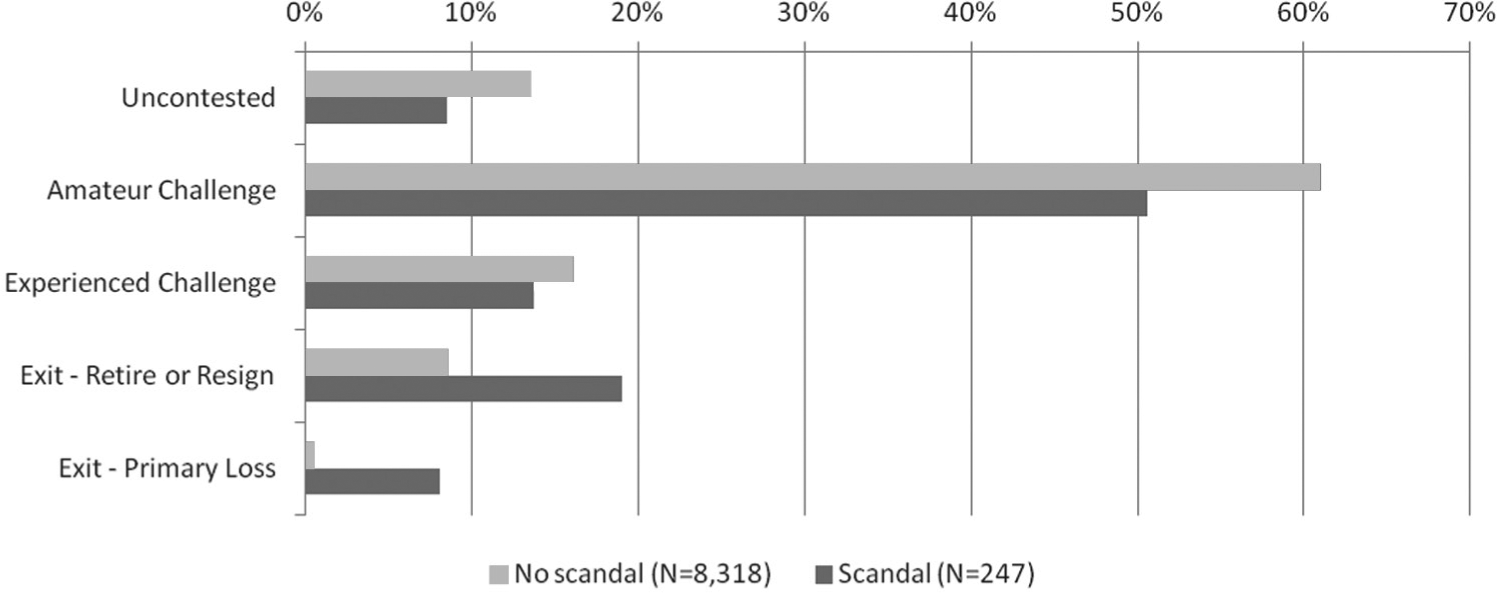
Proportion of seats lost by incumbent party, by campaign condition and scandal.
The bottom two rows of bars in Figure 3 display the frequencies with which the incumbent is not in the general election and either retired, resigned, or lost the primary. Between 1974 and 2010, eighty-nine incumbents did not win renomination, but seventeen of those losses occurred in a postredistricting contest where losers faced another incumbent in their own party, leaving seventy-two incumbents who lost to a primary challenger. Of those seventy-two, twenty were involved in a scandal (more than 8 percent of all scandal-tainted incumbents) and fifty-two were not (less than 1 percent of all scandal-free incumbents). If we look at voluntary forms of exit, 19 percent of scandal-tainted incumbents retired or resigned, versus only 9 percent of scandal-free incumbents. These findings help to answer the fourth and fifth questions that I posed earlier. Scandals affect incumbents’ choices of whether to seek reelection and also lead to primary losses by incumbents. The rate at which scandal-tainted incumbents retire and resign is 2.21 times as great as the rate at which scandal-free incumbents retire and resign; the rate at which scandal-tainted incumbents lose a primary is 12.95 times as great as the rate at which scandal-free incumbents lose primaries.
Since scandals have substantial effects on elections, one can examine whether scandals contribute to partisan change in House seats. Figure 4 displays the frequency with which the party that occupied a seat holds that seat in four different conditions (four instead of five, since incumbents who face no contest invariably win). Overall, the seats occupied by a scandal-tainted incumbent are lost in 19 percent of elections, whereas the seats occupied by a scandal-free incumbent are lost in 7 percent of elections. If the incumbent is present in the general election, then the second and third rows of bars indicate that challenger quality has important effects on the election outcome, particularly in the presence of scandals. Almost half (47 percent) of scandal-tainted incumbents who faced quality challengers lost the general election, versus 13 percent of scandal-free incumbents who faced quality challengers. Of incumbents facing inexperienced challengers, 14 percent of scandal-tainted incumbents lost the general election, versus 3 percent of scandal-free incumbents.
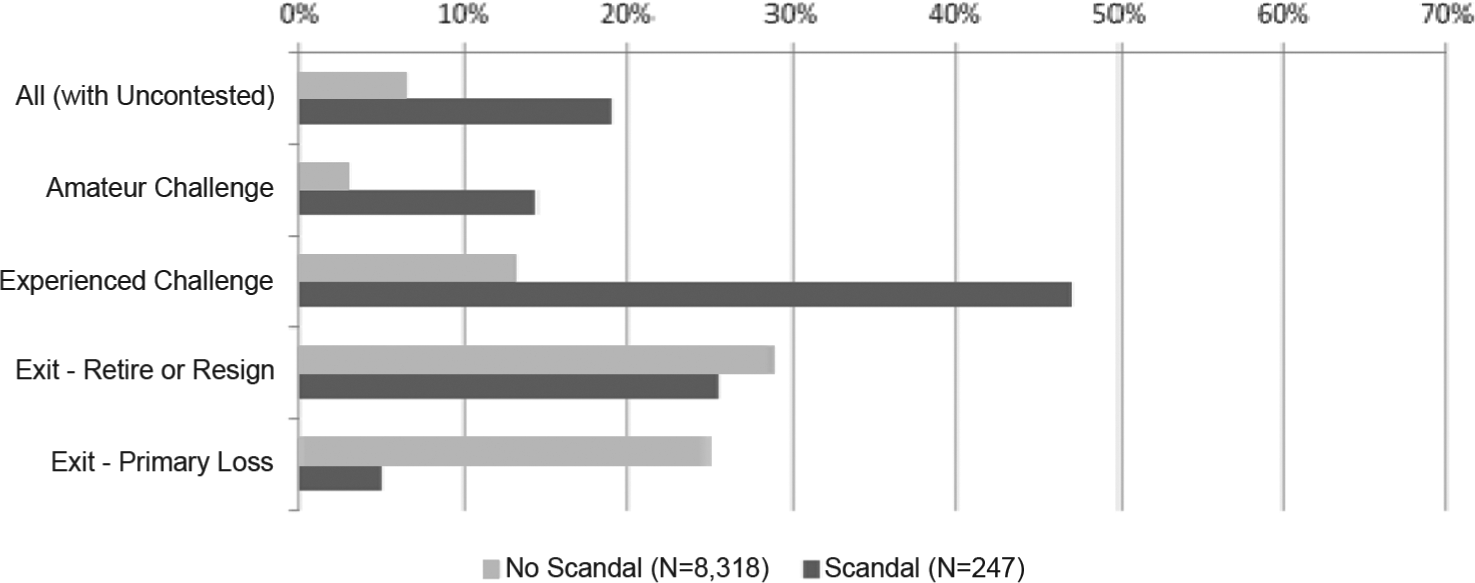
Proportion of Seats Lost by Incumbent Party, by Campaign Condition and Scandal.
Surprisingly, if the incumbent exited, whether due to retirement and resignation or to a primary defeat, the incumbent’s party actually held the seat more often following a scandal. The incumbent’s party lost 19 percent of seats when the incumbent exited after a scandal, compared to 29 percent of seats with no scandal. This result is attributable in part to scandals involving members occupying slightly safer districts. The average “normal vote” (measured using presidential election vote shares) for scandal-tainted House incumbents is 59.2 percent, compared to 56.4 percent for scandal-free House incumbents. If the losses are disaggregated by the causes of exits, the incumbent’s party lost the seat in 26 percent of races when a scandal-tainted incumbent retired or resigned, versus 29 percent of scandal-free incumbents who retired or resigned. But the incumbent’s party lost the seat in 5 percent cases when a scandal-tainted incumbent lost the primary, compared to 25 percent of cases when a scandal-free incumbent lost the primary (this does not include situations when the incumbent lost to another incumbent of the same party). This evidence suggests that primary elections allow a party to sacrifice a scandal-tainted incumbent without losing the seat.
To summarize the findings presented thus far, scandal-tainted incumbents are far more likely to exit before the general election than scandal-free incumbents, especially due to losing a primary. Scandal-tainted incumbents are slightly more likely to face general election opposition and to face quality challengers, but they are more likely to lose the general election than scandal-free incumbents, especially when they face quality challengers. Overall, 73 percent of scandal-tainted incumbents survived to the general election, and 81 percent of them won reelection; open-seat candidates substituted for the other 27 percent of scandal-tainted incumbents, and the incumbent’s party held 81 percent of those seats. In comparison, 91 percent of scandal-free incumbents survived to the general election, and 96 percent of them won reelection; open-seat candidates substituted for the other 9 percent of scandal-free incumbents, and their party held 72 percent of seats. It may be coincidental, but it is interesting to note that the victory rate in seats in which the incumbent was involved in a scandal is the same—81 percent—regardless of whether the incumbent is a candidate in the general election.
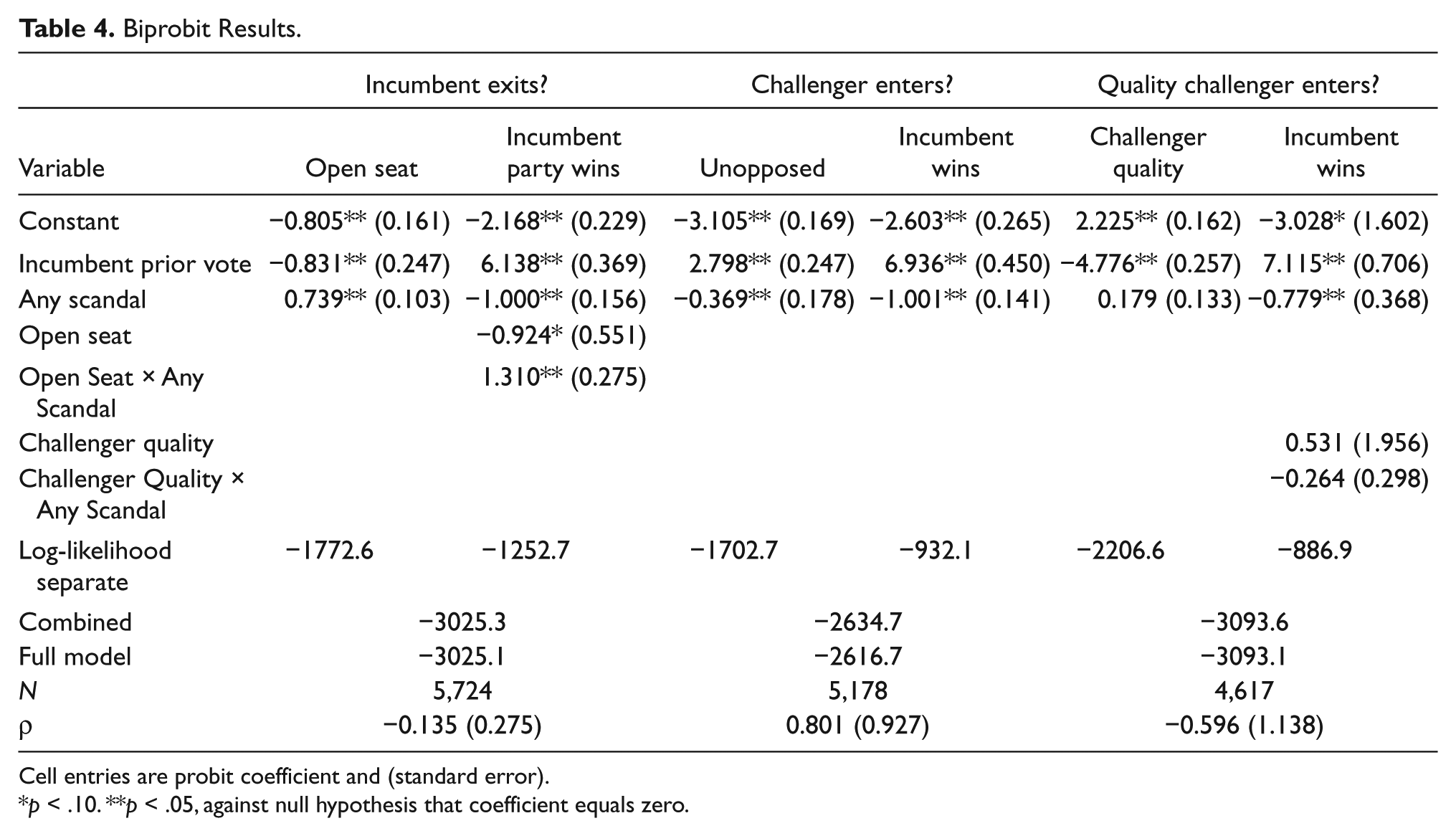
To distinguish scandals’ indirect and direct effects, Table 4 displays the results of three biprobit analyses; a pair of probit equations is estimated simultaneously for the same sample, and the contemporaneous correlation between the two equations is controlled. 18 The first two columns of Table 4 displays how scandals affect an incumbent’s exit and the incumbent party’s success in the general election. I find that a scandal increases the probability that the seat will be open, indicated by the positive and statistically significant coefficient for scandal in column 1, and decreases the probability that the incumbent’s party will hold the seat, indicated by the negative and statistically significant coefficient in column 2. The probability that the incumbent’s party holds the seat is lower when the seat is open rather than defended by an incumbent, so scandals have indirect effects as well. The impact of a scandal is not fully mitigated by the incumbent’s exiting prior to the general election, since the positive coefficient on the interaction of scandal and open seat has smaller magnitude than the sum of the coefficients of scandal and open seat.
Biprobit Results.
Cell entries are probit coefficient and (standard error).
p < .10. **p < .05, against null hypothesis that coefficient equals zero.
The third and fourth columns of Table 4 show how scandals affect challenger entry and the incumbent’s success in the general election in districts where the incumbent stood for reelection. A scandal reduces the probability that a seat will be uncontested and reduces the probability that an incumbent who stands for reelection will win in contested seats. The fifth and sixth columns of Table 4 show how scandals affect challenger quality and the incumbent’s success in the general election. I find that scandals have no effect on challenger quality among contested seats; this result contradicts Lazarus’s (2008) finding that scandals affected challenger entry in the general election. When I control for other factors, such as the incumbent’s prior vote and the presence of a scandal, challenger quality does not have a significant direct effect on the probability that the incumbent wins reelection, and challenger quality does not have a significant interactive effect either (i.e., it does not heighten the effects of a scandal). Thus, the earlier finding that quality challengers facing scandal-tainted incumbents win a large share of contests (47 percent) is attributable to the following combination of facts: quality challengers tend to appear where incumbents are vulnerable, and scandals have an independent, unmitigated effect on lessening the probability that the incumbent wins reelection.
In summary, scandals increase the probability of an incumbent’s exit, and they especially increase the probability that the incumbent loses the primary election and decrease the probability that the incumbent’s party retains its hold on a congressional seat. Scandals slightly increase the odds of a contested election but do not affect challenger quality in the general election. 19 Finally, the presence of a quality challenger affects vote shares but does not affect the probability of victory when the endogeneity of challenger quality to incumbent vulnerability is taken into account.
Discussion
Since Watergate, hundreds of members of the House of Representatives have been involved in scandals. Since thousands of members have served in this period, one should not jump to the conclusion that most members of the House are corrupt. But enough members have been involved in scandals to allow an examination of their electoral consequences. Nearly three-fourths of scandal-tainted incumbents were on the general election ballot in the next election, and their constituents reelected more than four-fifths of them, but they lost more than 5 percent of their vote, on average. Open-seat candidates replacing scandal-tainted incumbents fare at least as well in the election as the incumbent would have: they have smaller average vote losses (−4.3 percent vs. −5.1 percent) and an equal victory rate (81 percent).
In the introduction, I provided three conjectures about the electoral effects of scandals. The evidence is most supportive of the first of the three possibilities: alleged misconduct reduces the share of votes received by the incumbent. At the aggregate level, at least, the electorate does not seem to make sharp distinctions between sex scandals and financial scandals, suggesting that voters do not view elected representatives’ private behavior and public image as being distinct. Figure 1B illustrates the 95 percent confidence intervals for the average vote loss for the incumbent for different types of scandal; these confidence intervals overlap substantially for all but political scandals. Thus, even if politicians would wish that voters would judge sex scandals differently than corruption, this does not seem to be the case. The public deems that politicians’ sins are relevant to their character, which is relevant to their electability. With regard to the suggestion that elites step in where the public is incapable, the evidence here undermines the notion that voters are not responsive to scandals whereas strategic challengers are responsive. In fact, challenger quality does not differ significantly between scandal-tainted and scandal-free incumbents, although there is some evidence that the presence of a quality challenger heightens the electoral consequences of a scandal, at least with respect to vote shares.
In total, more than 40 percent of scandal-tainted incumbents do not survive their scandal but, rather, lose the general election, lose the primary, resign, or retire. Although the House of Representatives has adopted a passive stance toward punishing its members’ misbehavior, anyone who is concerned about congressional ethics should appreciate the evidence that the electorate is not totally unresponsive. The fact that open-seat candidates who replace scandal-tainted incumbents fare as well as the incumbent would have fared, hypothetically speaking, suggests that the parties have no incentive to insulate members from facing consequences for their own misbehavior.
Footnotes
Acknowledgements
This article extends research delivered at the 2011 Southern Political Science Association conference and the 2011 Midwest Political Science Association conference. I thank panel participants and audience members for their feedback. I gratefully acknowledge the generosity of Lara Brown, Gary Jacobson, and Jeffrey Lazarus, who shared their data.
Declaration of Conflicting Interests
The author(s) declared no potential conflicts of interest with respect to the research, authorship, and/or publication of this article.
Funding
The author(s) received no financial support for the research, authorship, and/or publication of this article.