







Abstract
This article theorizes costly commitments in autocracies. Populist leaders who ascend to power through anti-establishment appeals confront a strategic dilemma between consolidating winning coalitions and maintaining the loyalty of their selectorate. Rooted in rhetoric that delegitimizes political parties, such leaders face constraints to regime institutionalization as their popular base remains resistant to formal party structures. Costly commitments occur where autocratizing leaders commit to their ideological messages to sustain popular support, which compromises the formation of ruling parties as instruments of elite cooptation. The 2021 executive takeover in Tunisia illustrates this dilemma emerging from incompatible incentives to commit to ideological narratives and forming a ruling party. We adopt a multi-method approach to discuss contemporary Tunisian politics as a theory-generating case study. To this aim, we leverage qualitative interviews with party officials, legislative election candidates, and members of Saied’s electoral campaign along with data from an original, nationally representative phone survey in Tunisia, and available public opinion data. Following Kais Saied’s move against the democratic order, elites engaged in party initiatives in support of his political project. Yet, Kais Saied rebuffed these advances, choosing to rely on the popular anti-party sentiment that had contributed to his rise to power.
Why do some autocratizing leaders eschew forming a ruling party? This article introduces a theory of costly ideological commitments during authoritarian regime formation. Drawing on selectorate theory, we posit that costly commitments emerge in processes of autocratization when authoritarian incumbents face incentives to meet incompatible demands from their popular support base, which helps them come to power (selectorate), and the emerging ruling coalition established to sustain the regime (winning coalition). Autocrats develop ideological cues and programmatic commitments to speak to their popular base and generate political support in marginalizing their political rivals. Where such ideological cues entail anti-establishment and anti-institutional narratives, they constrain incumbents’ ability to institutionalize their ruling coalitions.
Costly commitments occur where incumbents absorb political costs when they implement policies inspired by ideological platforms and programmatic promises. They can emerge from among diverse dynamics of authoritarian politics (Knutsen and Rasmussen 2018; Prorok and Cil 2022; Wang and Yeung 2025). In this article, we illuminate one such pathway that characterizes many contemporary autocratization processes. Authoritarian regime formation has often been characterized by authoritarian incumbents’ development of populist, anti-political establishment narratives (Mudde 2004; Pappas 2019; Weyland 2020). Such programmatic cues can help autocrats generate a popular support base, win elections, and sustain political legitimacy amid authoritarian regime formation. Yet, programmatic cues and policy promises can turn into costly commitments in that they inhibit regime institutionalization. Populist narratives benefit politically from anti-establishment and anti-political party sentiment. Where incumbents stay committed to their programmatic ideals, they would find it difficult to justify the establishment of ruling parties amid their very own anti-party discourse.
We use Tunisia as a theory-generating case study to show how populist agents of autocratization remain ideologically committed to anti-establishment politics in authoritarian regime formation. On 25 July 2021, Tunisia’s president Kais Saied usurped power in an executive self-coup and, within subsequent months, transformed Tunisia’s political order into a hyper-presidentialist system. Yet, Saied’s efforts to consolidate power have not featured a core aspect of authoritarian regime building elsewhere: the formation of a party in support of the new regime. This is despite societal support for the emergence of a ruling party, including a proliferation of party initiatives trying to curry the president’s favor and providing incentives for the formation of a broad political platform for elite cooptation.
We suggest that Saied’s refusal to form a ruling party can be understood as a consequence of his true ideological commitment to the anti-party message which undergirded his rise to power. Staying committed to ideological messaging has helped Saied sustain support from his popular base, fundamentally inspired by anti-party and anti-political establishment attitudes. The fact that these ideological commitments have come at the expense of regime institutionalization renders the anti-party message credible.
We adopt a multi-method approach to empirically substantiate our expectations about a dilemma emerging amid populist authoritarian regime formation: incentives to institutionalize a winning coalition and meeting expectations from the selectorate. For one, field research in Tunisia uncovers incentives to form a political platform to consolidate an emerging elite coalition. For our case study, we leverage qualitative interviews with party officials, legislative election candidates, and members of Saied’s electoral campaign along with data from an original, nationally representative phone survey in Tunisia. For another, we use available survey data to show how popular support can be a catalyst for the emergence of an authoritarian selectorate: Kais Saied’s ideological commitments indeed meet widespread preferences in Tunisian society rooted in anti-political establishment and hyper-presidentialist sentiment.
The remainder of this article proceeds as follows. The first section draws on selectorate theory and debates on authoritarian regime institutionalization to introduce a theory of costly commitments in authoritarian regime formation. We then introduce Tunisia as a theory-generating case study to show opportunities for ruling party formation, including organization-building efforts by Saied’s supporters. The next section draws on survey evidence to illustrate the costs of ruling party formation and explains Saied’s adoption of one-man rule over regime institutionalization. The final section concludes our analysis with a discussion of the broader applicability of our argument as well as key theoretical implications.
Theorizing Costly Commitments Amid Autocratization
Research on democratic backsliding and autocratization has grown exponentially in recent years (Grillo et al. 2024; Waldner and Lust 2018), with extant arguments mainly examining the dynamics of power concentration within the executive (Baturo and Tolstrup 2023; Bermeo 2016) and the role of polarization and partisanship in generating public support for autocratizing leaders (Graham and Svolik 2020; Simonovits et al. 2022). We add to this literature in two ways. First, we shift focus from the starting point to the outcome of autocratization, emphasizing that autocratization not only involves the erosion of democratic institutions, but also the emergence of new regimes (Lührmann and Lindberg 2019). Second, we draw attention to how leaders in authoritarian regime formation are constrained by their own commitment to ideological convictions during their ascent to power.
Costly commitments emerge where political leaders face costs emanating from the implementation of programmatic and policy commitments made to their social constituencies. They are common features in democracies where elected incumbents are held accountable for their promises in subsequent elections (Bellodi et al. 2024; Harding and Stasavage 2013). Costly commitments, however, also emerge from political dynamics outside of democratic elections, including violent intergroup conflicts (Lang et al. 2024; Prorok and Cil 2022) and in authoritarian regimes (Schutz et al. 2026; Wang and Yeung 2025).
That autocrats are subject to costly commitments is seemingly counterintuitive as they do not allow themselves to be held accountable in free and fair elections. Autocracies institutionalize precisely because they cannot credibly commit to policies benefiting broad social constituencies (Magaloni 2008; Reuter and Remington 2009; Svolik 2012). And yet, autocrats do rely on elements of political legitimacy and often negotiate nominally democratic procedures that constrain their behavior (Gerschewski 2018; Meng 2020; Truex 2016). Authoritarian leaders recognize narrow social constituencies for their political survival and face incentives to make good on their promises in social and economic policy making (Eibl and Hertog 2024; Knutsen and Rasmussen 2018; Wang and Yeung 2025). Recent research demonstrates that autocratic rhetoric is not cheap talk but can have real policy consequences (Baturo et al., 2025).
Selectorate Theory and Autocratization
We draw on selectorate theory to show how costly commitments can shape autocratization (de Mesquita et al. 2003; Svolik 2012). Selectorate theory distinguishes between the selectorate and the winning coalition. The selectorate consists of key social constituencies determining a political leader’s access to political power. In democracies, the selectorate are the voters; in authoritarian regimes, they comprise a narrower support base. The winning coalition, in turn, is a smaller group that directly ensures and sustains a political leader’s political survival over time. In democracies, the winning coalition is “the group of voters who elected the leader,” while in authoritarian regimes, “it is the set of people who control enough other instruments of power to keep the leader in office” (Bueno de Mesquita et al. 2003, 8).
Autocratization requires a fundamental reconfiguration of both the selectorate and the winning coalition. Much like new democracies, autocracies face significant institutional and regime uncertainties at the time of their inception (Lupu and Riedl 2013). To begin with, agents of autocratization reduce the number of people that make up the winning coalition. They are comprised of family members and trusted advisors in monarchies, cliques of military officers in junta regimes, and members of ruling parties in civilian-bureaucratic regimes (Buehler and Ayari 2018). The selectorate, in turn, comprises a narrower popular base that publicly supports authoritarian leaders, including in nominally democratic procedures, and from which authoritarian leaders recruit members of the winning coalition.
Narrow coalitions help the leader sustain power, while avoiding democratic alternance. Yet, such narrow winning coalitions come with risks and costs. First, sharing power in ruling coalitions comes with commitment problems regarding the allocation of economic resources (Boix and Svolik 2013; Magaloni 2008; Reuter and Remington 2009). Second, they generate threats to the leader’s hold on power from within—through military coups, palace coups, assassinations, and the takeover of rival elites in ruling parties (Bueno de Mesquita and Smith 2017; Svolik 2009). In an authoritarian cost-benefit analysis, the risks of being overthrown from within is smaller than falling to democratic alternance. Where such a trade-off exists, leaders engaged in regime formation strive to establish narrow winning coalitions and hence institutionalize authoritarian rule.
In uncertain processes of autocratization, however, political leaders have incentives not only to establish a narrow winning coalition but also to transfer their democratic winning coalition—the group of voters propelling them into office—into an authoritarian selectorate. They strive to implement programmatic and policy promises made to those voters that helped them come to power. This is to establish the selectorate under authoritarianism and therefore sustain crucial support from among a social base beyond the smaller winning coalition. Losing support from the selectorate poses secondary costs in addition to the aforementioned risks of regime institutionalization: the selectorate may opt to support intra-elite rivals to the incumbent in power. Costly commitments intervene in this process where the political leader’s commitment to programmatic and policy promises made to their voters (democratic winning coalition) and support base (authoritarian selectorate) constrain the institutionalization of authoritarian rule and hence establishment of a small winning coalition.
Populism, Ruling Parties, and Costly Commitments
How do costly commitments occur in the empirical reality of autocratization? Perhaps the most elucidating scenario for these dynamics can be found in autocrats who come to office on populist platforms and strive to consolidate power through the establishment of ruling parties. Unless they rely entirely on repression or military juntas, autocrats have strong incentives to form such ruling parties as they need to integrate representatives of social groups salient for power maintenance into winning coalitions (Smith 2005; Svolik 2012).
There is a lot to like about ruling parties. They help to manage authoritarian elite coalitions (Brownlee 2007), substantiate elite cohesion (Slater 2010), institutionalize power sharing arrangements (Magaloni 2008; Meng 2020), control political opposition (Mirić and Pechenkina 2023; Reuter and Robertson 2015), and facilitate distributive politics (Reuter and Remington 2009). While the existence of a ruling party per se does not guarantee political stability and protracted authoritarian rule (Smith, 2005), ruling parties make autocracy more durable compared to other authoritarian regime types (Geddes et al. 2014). Single-party authoritarian regimes are also more likely to survive than no-party regimes (Hadenius and Teorell 2006, 13). Hence, it does not come as a surprise that most modern autocracies do form a ruling party as an element of political order (Magaloni and Kricheli 2010).
And yet, a dilemma emerges for autocrats coming to power and sustaining their support base through populist programmatic platforms. Populism has served as a major ideological driving force for the emergence of political outsiders, generating popular support for the dismantling of democracy (Pappas 2019; Weyland 2020). Contrasting the “real people” and a “corrupt elite” is the core defining feature of populists (Mudde 2004). To the extent that authoritarian leaders base their appeal on a populist, anti-establishment message, however, they also face disincentives for the institutionalization of their regimes. Populism is based fundamentally on anti-political establishment and anti-political party elements, hence contradicting the ruler’s eventual efforts at regime institutionalization: the very establishment of ruling parties represents an organizational form of interest representation—political parties—despised by the popular support base of the new ruler. This argument is consistent with personalist conceptions of populism that foreground the absence of intermediaries between populist leaders and their followers. As Weyland argues, “populism rests on personalistic leadership, seeks to boost its autonomy and power, and contests, pushes aside, or dominates other types of actors, such as elite factions and organized political parties” (Weyland 2017, 56).
Figure 1 illustrates how costly commitments emerge en route to autocracy. Authoritarian leaders face delicate dynamics of regime formation, balancing the need to institutionalize their rule with sustaining political legitimacy and popular support from the selectorate. Unlike democratic incumbents, autocrats can rule without parties and maintain political legitimacy (Gerschewski 2018). Scholarship tells us that such sources of authoritarian legitimacy, for instance, come from revolutionary narratives (Way and Levitsky 2022), ethnic ties and religious traditions (Collins 2004), leaders’ individual appeal based on charisma and personality (Greene and Robertson 2017), protection pacts as a core feature of social contracts (Slater 2010), policy performance and responsiveness (Truex 2016), distributive politics (Slater et al. 2014), and programmatic policy commitments (Schutz et al. 2026). Costly commitments in authoritarian regime formation.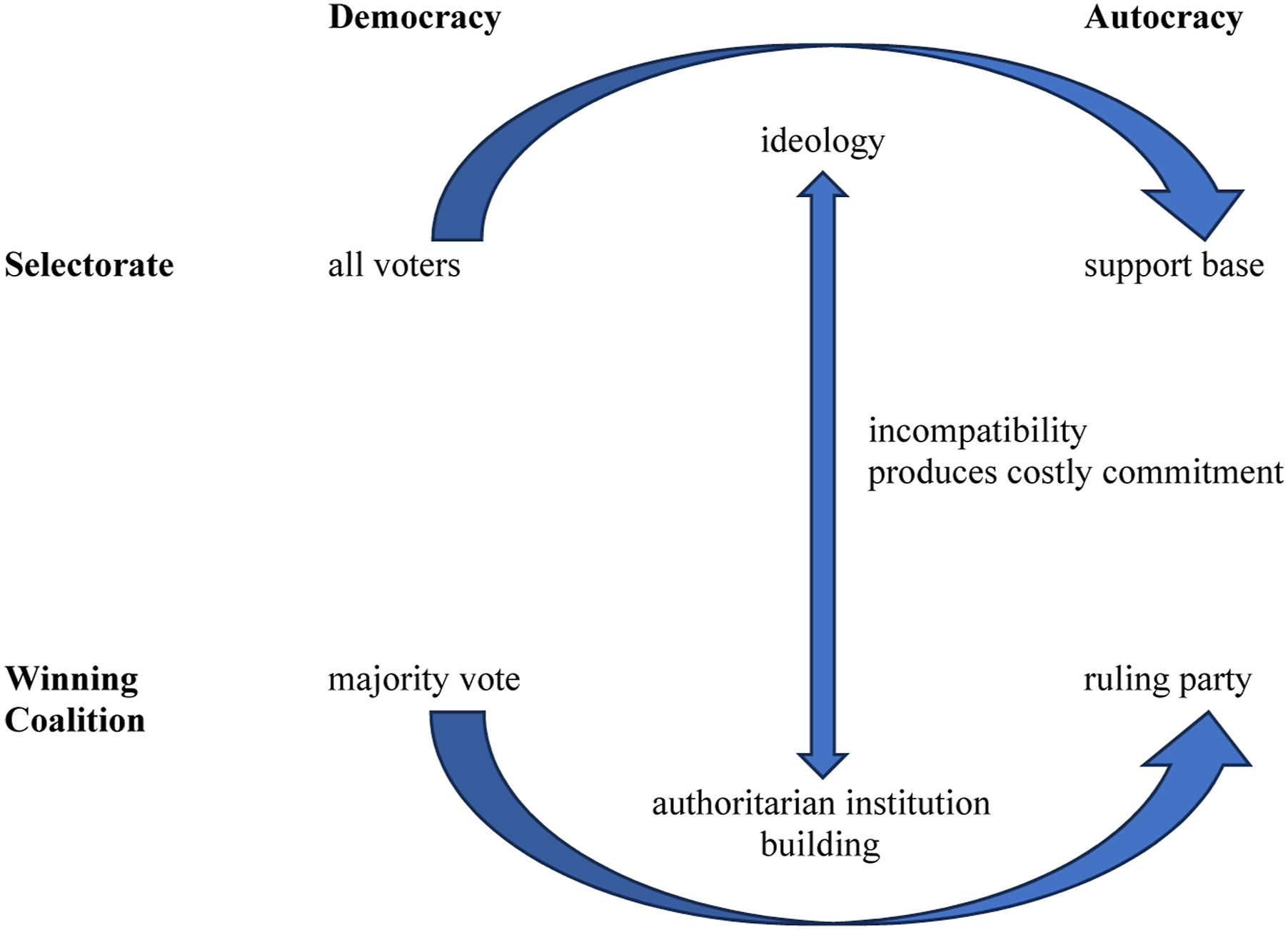
While they may recognize the benefits of elite cooptation through ruling parties, autocrats will consider ideological consistency as an alternative driving force amid regime formation: their commitments to populist platforms and ideological messaging sustains support from the selectorate. This decision comes at a cost, as it defies the preferences of the leader’s winning coalition, which would typically favor the establishment of a party to consolidate power and distribute patronage. By rejecting party formation, the leader signals a commitment to ideological consistency—particularly anti-party or anti-elite populist values—which may enhance credibility among a broader selectorate. This strategic posture allows the leader to cultivate direct support from the selectorate, rather than relying on intermediary institutions like political parties. In this sense, the absence of a ruling party is not merely a weakness or failure, but a signaling device that communicates ideological purity and reinforces populist appeal.
Research Design: Autocratization in Tunisia in Comparative Perspective
How do authoritarian incumbents solve this dilemma? Faced with the trade-off between regime institutionalization and sustaining a support base, some autocrats will recognize the benefits of the former and opt for the establishment of a ruling party, possibly responding to reduced support from their popular base with increasing repression. The large number of ruling parties is evidence for the supremacy of regime institutionalization over ideological consistency. Yet, there is empirical evidence, past and present, for agents of autocratization to commit to their populist messaging at the expense of regime institutionalization.
Uruguay’s Juan Maria Bordaberry, for instance, came to power through the Colorado Party, established a military-backed dictatorship, and attempted to ban all political parties prior to his own overthrow in 1976. Congo’s Mobutu Sese Seko established a populist dictatorship, marked by a cult of personality and a “national authenticity campaign.” Rather than an authoritarian ruling party, designed to institutionalize a narrow winning coalition, the country’s Popular Movement of the Revolution was a populist mass organization with compulsory membership for every citizen. Peru’s Alberto Fujimori won the 1990 elections as an outsider to the political establishment, engineering the country’s populist-authoritarian turn throughout his decade-long spell in office. Both Libya’s Mu’ammar Qadhafi and, more recently, Egypt’s Abdelfattah El-Sisi staged military coups but quickly installed personalist strongman rule, endorsing decidedly populist political platforms.
We take a closer look at contemporary Tunisian politics as a theory-generating case study to show how costly commitments shape authoritarian regime formation. Rather than discussing variation in authoritarian decision-making processes—addressing why some autocrats chose to form ruling parties, while others did not—a thick description of Tunisian politics unpacks how costly commitments work in practice and how discrete incentives establish the dilemma between regime institutionalization and ideological consistency. Case studies are particularly useful for the generation of new theoretical ideas (George and Bennett 2005). Tunisia represents cases where populist preferences among a large part of the people are at odds with institutional politics more broadly and the formation of an authoritarian ruling party more specifically. After launching an executive self-coup, Kais Saied was presented with an opportunity to establish a broad political platform in support of his project. Yet, strong anti-political party preferences among his core social support base contradict such attempts at regime institutionalization.
To unpack these political dynamics, we adopted a multi-method approach, drawing on quantitative analyses of original survey material and qualitative field research. Our methodological approach allows us to leverage different types of data to support different parts of our argument, namely, measuring incentives for Kais Saied to both form a ruling party and sustain his genuine ideological commitment to populism. As to the former, we analyze bottom-up initiatives to form a winning coalition by political activists associating themselves with Saied’s political project and standing for office as candidates in the 2022 parliamentary election. This is to establish expectations about Kais Saied’s Tunisia to be a likely case for ruling party formation.
To this aim, we collected qualitative evidence based on three months of field research in Tunisia in the fall of 2022, including interviews with civil society activists, journalists, and representatives of political parties and grassroots groups in support of Kais Saied that emerged ahead of legislative elections in December of that same year. In our interviews, we focused on activists and party leaders from the political spectrum that supported Saied’s 2019 presidential bid and/or expressed support for his July 2021 actions. These include Hirak 25 July, the Popular Front (al-Tayar al-Sha`abi), the People’s Movement (Harakat al-Sha`ab), and the Democratic Patriots’ Unified Party (Hizb al-Dimuqratiyyin al-Wataniyyin al-Muwahad, Watad). We supplement interview materials with news articles, including published interviews with Saied before and after his presidential campaign.
The purpose of these interviews was to gain insights into the dynamics of party formation in the context of authoritarian regime formation. Drawing on these observations, we will show how multiple grassroots groups emerged, keen on organizing as a political platform in support of Saied’s project. Hence, we trace political dynamics that have generated both incentives and opportunities for the foundation of a ruling party—a move ultimately dismissed by Kais Saied.
In addition, we draw on an original nationally representative telephone survey, carried out in June 2022, and supplement it with off-the-shelf data from the Arab Barometer and Afro-Barometer projects to explore a second part of our argument. 1 These data allow us to do two things. First, we test a key observable implication of our argument, namely, that members of the selectorate who harbor negative attitudes toward political parties should be more likely to support the leader. Our analysis finds that individuals who reject political parties are significantly more likely to express support for President Saied. Second, and relatedly, we are able to empirically identify a substantial sub-section of Tunisian society that can serve as an authoritarian selectorate for Kais Saied conditional on the absence of a ruling party. These findings offer empirical support for the plausibility of our theoretical claim. As we will show, Kais Saied’s anti-party stance amid authoritarian regime formation can be understood as a costly commitment to ideological consistency, particularly anti-party or anti-elite populist values.
A Turn Toward Hyper-Presidentialism
Tunisia’s 2021 turn is a textbook case of autocratization through an executive self-coup. The country—credited as the sole success story of the Arab Spring in 2011—witnessed the surprise victory of Kais Saied in the 2019 presidential elections. A law professor and political outsider, Kais Saied capitalized on an effective ground campaign and popular support for a quintessential populist message centered around a prominent anti-political party narrative (Albrecht et al., 2023; Ridge, 2022).
Notably, Saied’s rise to power in the 2019 presidential elections occurred in the context of increasing popular disenchantment with the political establishment and amid a fragmented field of presidential candidates, which allowed Saied to advance to the second round of presidential elections with a meager 18.4 percent of the vote in the first round. Hence, while he was able to position himself successfully as an outsider of the political establishment, public support for him and his political project was limited. Once in power, however, Saied dissolved parliament, suspended the constitution, and ruled by decree to navigate a transition period of authoritarian regime formation (Grubman, 2022; Huber and Pisciotta, 2023).
Saied’s July 2021 actions occurred in the context of popular discontent with established political parties and overlapping political, economic, and health crises (Albrecht et al., 2023; Weipert-Fenner, 2025). Rife with infighting and charges of corruption, parliament was paralyzed. At the same time, Tunisia experienced a severe health crisis, with a skyrocketing number of COVID-19 cases in the summer of 2021. Tunisia’s economy suffered considerably, especially given the impact of restrictive lockdown measures on the country’s tourism revenues. In addition, Saied ascended to the presidency in a semi-presidential system, resulting in conflict between the president, the prime minister, and the speaker of parliament. The absence of a constitutional court to adjudicate these disputes further aggravated political tensions.
Autocratization in Tunisia was marked by the destruction of the entire institutional infrastructure of the previous regime, including parliament and the existing party system. It concluded with the adoption of the new constitution in July 2022 (Tamburini, 2023), which transformed Tunisia into a hyper-presidentialist system, with presidential powers expanded to appoint the prime minister and other cabinet members, dissolve the cabinet, impose greater restrictions on citizens’ rights and freedoms under “exceptional circumstances,” and the ability to appoint judges. The 2022 constitution also removed parliament’s ability under the 2014 constitution to impeach the president through a vote of no-confidence (Maboudi 2020). Finally, the 2022 constitution did away with the prerogatives of the Supreme Constitutional Court to adjudicate legal conflicts regarding the president’s powers. Within one year from his power grab, Saied had thus completely remodeled the Tunisian legal and institutional system and established one-man rule to lead efforts at authoritarian regime formation. Apart from institutional change, this transition period was marred with increasing assaults on civil rights and liberties. Greater restrictions on freedom of association have included the use of emergency measures related to COVID-19 to stifle protest and the use of violence to quell anti-Saied protests (Guetat and Agrebi 2021).
In addition to a decidedly anti-immigration discourse and imprisonment of prominent black rights activists (Bufano 2026), Tunisian authorities have cracked down on Saied’s political opponents through the arrest and imprisonment of lawyers and major opposition figures. Since July 2021, authorities have mounted a sustained attack on Tunisia’s largest political party, Ennahda, shutting down its offices across the country and arresting several of its members, including its leader Rached al-Ghannoushi. Trade unions have been influential organizations in Tunisia’s pre-2021 political establishment and were not spared from this recent crackdown. In early 2023, several trade unionists were arrested for participating in strike activities.
Institutional Support Base: Ruling-Party Initiatives
The period immediately following Kais Saied’s 2021 executive self-coup was characterized by an authoritarian turn in state-society relations. Yet, it also witnessed multiple bottom-up initiatives at pro-Saied party formation. Hence, an opportunity presented itself for Saied to institutionalize regime formation, establish a broad political platform to facilitate future electoral success, and co-opt a coalition of pro-regime figures beyond his narrow support base of activists that helped him campaign in the 2019 presidential elections. In other words, Tunisia’s early autocratization period was characterized by a societal push for ruling party formation to facilitate the establishment of an authoritarian winning coalition.
We trace developments of pro-Saied party initiatives in the run-up to legislative elections in December 2022. These initiatives are markedly different from existing political parties in Tunisia as they have been formed in explicit support of the man in office, rather than emphasizing strong ideological preferences or building on networks from Tunisia’s authoritarian past (Berman and Nugent 2020). They represent alliances consisting of pro-Saied political activists, local notables, and low-level former members of the pre-2011 ruling party Democratic Constitutional Rally. We distinguish between party initiatives aimed at establishing election platforms (ex-ante vote-seeking parties) from initiatives emerging from parliament once elected (post-hoc initiatives). While the period 2021–2022 was marked by such grassroots efforts at regime party formation, we show how Kais Saied dismissed these initiatives to stay true to his anti-party stance, forgoing opportunities to institutionalize an authoritarian winning coalition.
Ex-Ante Party Formation: Running in Elections
Various flanks of Saied’s supporters embarked on organizing efforts in the post-July 2021 period, in the lead-up to the 2022 parliamentary elections, and in the aftermath of the parliamentary elections in the form of parliamentary blocs. These initiatives are analytically different from political parties that had existed prior to Kais Saied’s rise to power and offered political support for the president after his July 2021 self-coup. Such smaller parties, often representing socialist and nationalist agendas, included the Popular Movement (Harakat al-Shaab) and the Popular Current (al-Tayyar al-Shaabi).
The initiatives that concern us most represent efforts by core Saied supporters to institutionalize his support base as additions to the Tunisian party spectrum. These initiatives have roots dating back to the 2019 parliamentary and presidential elections. The earliest incarnation of a grassroots support group for Kais Saied, whose initiators had ambitions to form a political party, was the Tunisian National Youth Movement (Harakat Shabab Tunis al-Watani, HSTW), later renamed the 25 July Movement (Hirak 25 July, H25J). HSTW was established as a political party in early 2019, prior to the presidential and legislative elections in that year. 2 In contrast to other initiatives comprising Saied’s supporters, such as members of his own electoral campaign, HSTW enjoyed legal status and registered under the 2011 political party law. 3 HSTW and its successor organization H25J were led by Thamer Bedida, a former employee in Tunisia’s prison system and Facebook activist. Bedida went into self-imposed exile owing to legal troubles but has continued to serve as the party’s leader from abroad. 4
The party endorses a reformist political ideology in the spirit of anti-colonial movements such as the Jeunes Tunisiens (Young Tunisian). 5 More important than its ideological outlook, however, is the party’s claim to have contributed to Saied’s successful 2019 presidential campaign through Facebook pages and volunteer campaigners. 6 After Saied’s 2021 self-coup, HSTW quickly recognized the new political realities and openly supported this move by renaming its organization Hirak 25 July. H25J began setting up a pro-Saied electoral platform ahead of the 2022 legislative elections. This platform was designed to establish a broad support base, including young Facebook activists in Kais Saied’s 2019 campaign, but also second-tier members of the former ruling party under Ben Ali, officials in the security establishment, and local notables without prior political involvement. 7
Including former members of Ben Ali’s ruling party, the Democratic Constitutional Rally (Rassemblement Constitutionnel Démocratique, RCD) was a sensitive issue for a movement in support of Kais Saied, an outspoken proponent of the 2011 revolution. One former RCD member, for instance, admitted that his membership in H25J—and ultimately his candidacy for the 2022 legislative elections—was vetted by the party’s leadership. 8 Yet, the fact that RCD members have been included among Hirak 25 July shows its ambition to establish a broad-based party platform, including various political currents and in support of Kais Saied’s post-coup political project. As 142 candidates for the 2022 elections claimed to be associated with H25J, 9 its initiators clearly aimed at establishing a broad pro-regime political platform.
Hirak 25 July campaigned ahead of the 2022 constitutional referendum and had candidates in the 2022 parliamentary elections. Ultimately, this initiative was unsuccessful. Very few members in parliament were in fact associated with H25J, and the party quickly disbanded after the inauguration of parliament in early 2023. Moreover, the movement somewhat disintegrated, with several of its members forming rivaling parties including, for instance, the Party of the Future Republic (Hizb Jumhouri al-Mustakbal, formed in November 2022) and the Path of July 25 (Massar 25 July, formed in March 2023). 10
The main reason for the failure of H25J was that Kais Saied kept his distance from bottom-up attempts at party formation. In a television interview following his victory in the first round of the 2019 presidential elections, Saied maintained that he did not have a campaign manager and that those who helped with his campaign are simply “volunteers.” 11 He dismissed, on multiple occasions, the role of HSTW in his own 2019 successful bid for the presidency and stuck to his anti-party narrative. In a June 2019 newspaper interview, Saied asserted that political parties are on the “margin of the world” and in a “dying state,” and that their role will “end” in a “few years” (quoted in Al-Ash et al. 2022, 101). Some party leaders acted in open support of the president’s 2021 takeover of political power. For instance, in April 2023, the Path of July 25 called on Saied to nominate himself for the 2024 elections and announced its intention to organize an early campaign showcasing Saied’s accomplishments in office. Yet, relations between Saied and these activists have been complicated by his refusal to accept party formations. H25J was initially critical of the electoral law passed ahead of the 2022 parliamentary elections and threatened to boycott the elections but eventually participated. 12
While Saied dismissed the political initiatives emerging from HSTW’s Facebook groups, some of his closest supporters and members of his 2019 electoral ground campaign have embarked on their own efforts to organize the president’s support base. One such initiative is the coalition For the Victory of the People (li-Yantasir al-Shaab, YS), whose founders included members of Saied’s inner circle who have been close to him since his political ambitions surfaced in 2011—Rida Shihab Mekki and Ahmad Shaftar (Redissi et al. 2020). Another strand of Saied’s core supporters from his 2019 electoral campaign coalesced around another initiative, The People Found (al-Shaab Yu’assis). 13
The foundation of YS was announced in October 2022. Its founding statement was initially signed by 25 individuals, including Mekki and Shaftar, along with a number of people who had not been among Saied’s early supporters. Individuals jumping on the Kais Saied bandwagon included the former head of the lawyers’ syndicate and current speaker of parliament Ibrahim Bouderbala, two former assistant secretary generals of the Tunisian General Labor Union (UGTT), and the secretary general of the Popular Current, Mohammed Zouhir Hamdi. The founding statement asserts that YS is a “national, popular, horizontal framework,” “open to all Tunisians…who believe in the path of 17 December – 25 July and the complete break with the system that preceded 2010 and 2021.” 14 Among its goals, the initiative sought to facilitate coordination ahead of the 2022 parliamentary elections. According to a member of the initiative, over 130 parliamentary candidates were associated with YS. 15 Amid their electoral campaigns, YS-associated members would emphasize local development issues in their electoral constituencies, rather than a broader vision for political and economic trajectories. 16 Yet, members of the initiative also expressed interest in the long-term use of the coalition for future electoral contests, despite the fact that the new electoral law dictates individual candidacy.
On the one hand, one member of li-Yantasir al-Shaab fell in line with Kais Saied’s anti-party stance and suggested that it was not, and would not become, a political party. 17 Yet, another prominent leader would not discard the possibility of a broad-based national movement, which would seemingly put it at odds with the political incumbent the movement intended to support. 18 There were also hints at ambitions to turn the movement into a broad alliance moving beyond the 2022 elections. Both the founding statement and members of the initiative asserted that the goal of the initiative was not simply electoral in nature. Instead, as Hamdi put it, the broader goal was to try to create the seeds of a national bloc that can fill the political vacuum and lead the national project. 19 In this context, Muhsin al-Nabti, a member of the initiative, argued that the goal was to form a block that presents a clear vision and an economic program for the country.
Post-Hoc Bloc Formation in Parliament
The 2022/2023 parliamentary elections were the first to be held under a new electoral law that did away with party-based candidacy in favor of a system based on individual candidacy. Ideologically, members of the 2023 parliament were united in their broad support for the post-July 2021 political order, including candidates associated with one of the pro-Saied initiatives discussed above as well as independent candidates. Despite many candidates’ independence, the new law’s shift away from political parties, the broader popular disillusionment with political parties, and Kais Saied’s clear anti-party narrative, members of the newly elected parliament almost immediately began discussing the formation of parliamentary blocs. This reflects continued efforts on the part of Tunisia’s political elite to organize in support of Kais Saied political project.
To begin with, Saied himself referred to efforts by parliamentarians to form parliamentary blocs as a thing of the past. 20 Parliament’s opening session on March 13 featured some debate about the utility of parliamentary blocs, a topic that was addressed in discussions around the parliament’s bylaws. Speaker of parliament Ibrahim Bouderbala, a member of li-Yantasir al-Shaab, said that conflicting blocs do not serve parliamentary life, suggesting that “from this moment we are one bloc.” 21 For his part, Abderrazek Aouidet, member of the parliament’s bylaws committee and a member of the Popular Movement (Harakat al-Shaab), said that there was no alternative to parliamentary blocs. The purpose of parliamentary blocs was to facilitate parliamentary life given the overlap that different groups of parliamentarians had regarding economic, social, and political programs. Several other members of parliament also expressed support for the formation of parliamentary blocs, arguing that they were referenced in the constitution and that their presence was necessary for discussing draft laws. 22
Efforts to organize parliamentary blocs began soon after parliament was seated. By May 2023, six blocs were announced. Li-Yantasir al-Shaab formed a bloc composed of 15 members. Parliamentarians affiliated with the Popular Movement, the Unified Watad Party, and other independents formed the National Sovereign bloc, composed of 15 members. In all, a vast majority of parliamentarians (115 out of 154) have joined parliamentary blocs. 23 Notably, parliamentarians represented by the initiative al-Shaab Yu’assis, which includes some members of Saied’s inner circle, chose not to form or join any parliamentary blocs. This represents an orientation of ideological consistency with Saied’s populist project, most forcefully advocated by Sonia al-Charbti, political activist and close confidant of the president. 24
Support Base for Autocracy: Anti-Establishment Sentiment and Hyper-Presidentialism
In the immediate post-2021 transition period, Tunisia witnessed substantial efforts at party formation of a new political elite motivated to support Kais Saied’s political project and in opposition to the old political order. While there was widespread support for leaving behind the system of representative democracy outlined in the 2014 constitution, this support has not been institutionalized. What is more, Saied and members of his inner circle have repeatedly rebuffed numerous attempts by pro-Saied activists to provide such an institutional anchor in the form of a pro-regime party. What explains this hesitancy to build a ruling party? In this section, we examine regime preferences among Saied supporters beyond the rejection of the pre-2021 status quo.
As we argued above, Saied’s refusal to build a regime party might well be rooted in his specific populist ideology, one that encapsulates both a decidedly anti-institutionalist element and a right-wing ideology emphasized in an anti-immigration discourse. We draw on multiple sources of survey data to explore popular support for Saied’s 2021 self-coup and its aftermath. This is to show how Saied met initial widespread popular support for his 2021 self-coup, only to face challenges of declining popular support after an initial honeymoon period between himself and the Tunisian public. At the same time, we draw on these data to test a key empirical implication of our argument: those among the selectorate who harbor negative attitudes toward political parties should be more likely to support the leader. We find that individuals who reject political parties are significantly more likely to express support for President Saied. These findings offer empirical support for the plausibility of our theoretical claim.
We identify strong, sustained populist and anti-political establishment sentiment within Tunisian society—public opinion preferences that associate well with Saied’s status as a political outsider and strong executive figure. Staying true to his anti-political party message should hence be seen as a costly signal of ideological consistency designed to appeal to his core political constituency to draw on sustained mass support as an alternative to institutionalized elite cooptation. Widespread anti-party sentiment in Tunisian society illustrates the political risks involved in building a ruling party, especially for a populist autocratizer such as Saied. While Saied’s decision-making may not be the direct result of public opinion as presented in the following section, it illustrates how Saied was ideologically committed to his base in the wake of generally declining popular support. Rather than institutionalize his winning coalition, Saied chose to pursue autocratization based on support from his selectorate.
Public Support for Executive Takeover
The president’s executive takeover was initially very popular among Tunisians. Saied’s approval rating shot up from 35 percent in June 2021 to 82 percent in August 2021, indicating that a broad majority of Tunisians did not believe that the existing institutional system was worth preserving. 25 Indeed, the seventh round of the Arab Barometer fielded in October and November 2021 suggests that 78 percent of respondents in Tunisia agreed with the suspension of parliament. 26 At the same time, Saied’s approval remained unstable. His favorability rating declined steadily following his July 2021 executive takeover. In other words, while most Tunisians were in favor of dismantling the old constitutional order, this did not necessarily translate into sustained public support for Kais Saied.
According to the ninth wave of the Afro-Barometer fielded in February and March 2022, for example, 74 percent trusted Kais Saied and a staggering 90 percent approved of the president’s performance over the preceding months. At the same time, only a relatively meager 46 percent said they would have voted for Kais Saied had there been fresh presidential elections. This discrepancy between the president’s popularity and his levels of political support highlights the problem of sustaining public support (see Figure 2, Panel A). Public attitudes toward Saied, July 25, and representative institutions.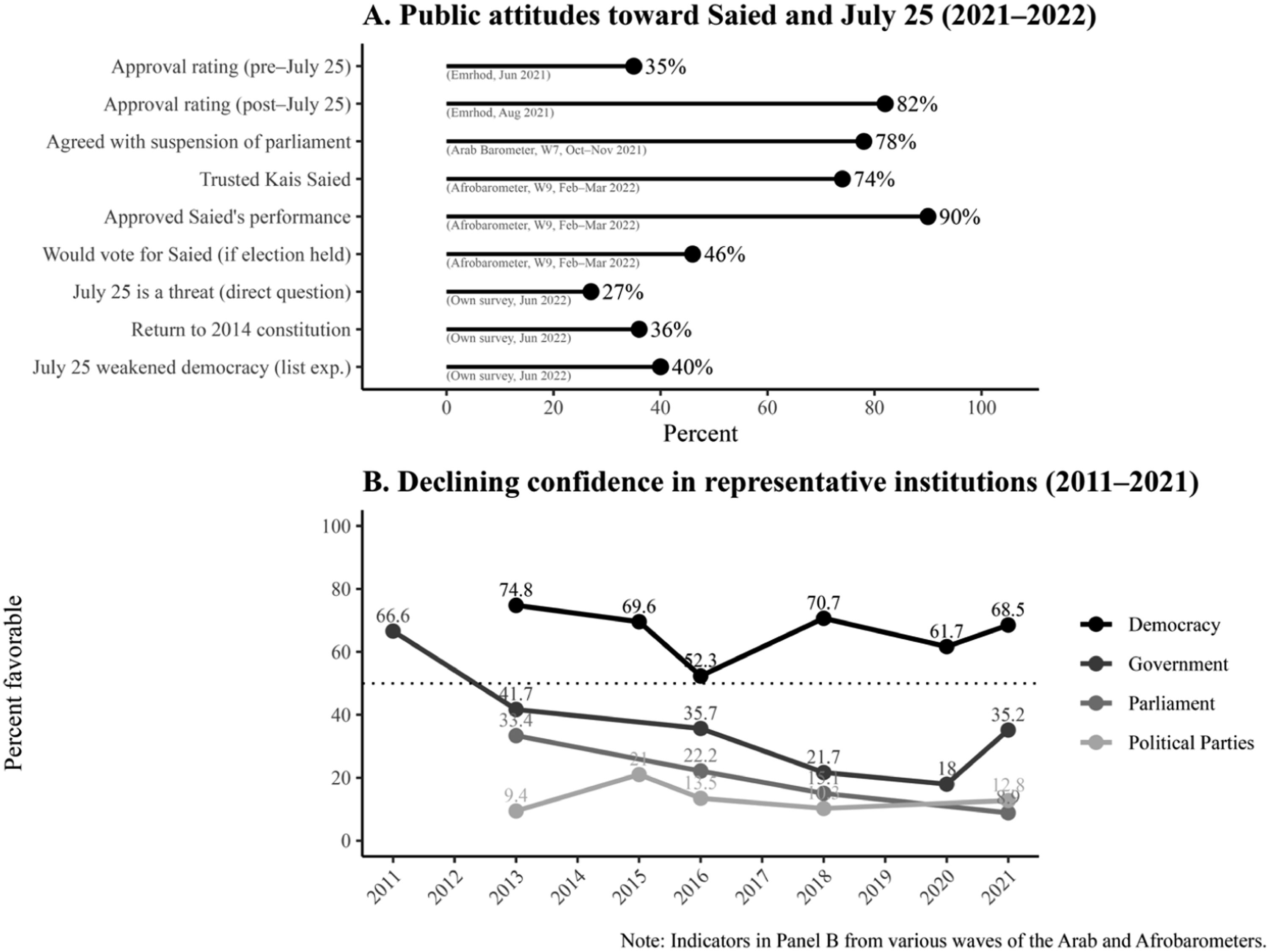
Support for the executive takeover was driven by widespread anti-establishment sentiment. Through Tunisia’s democratic experiment following the 2011 revolution, Tunisians had grown increasingly skeptical of the democratic order and its institutions, in particular of parliament and political parties. While approval of democracy as a form of rule remained relatively stable at around 70 percent, approval of parliament declined from 33 percent in 2013 to 9 percent in 2021 and approval of political parties from a high of 21 percent in 2015 to 13 percent in 2021 (see Figure 2. Panel B). At the same time, Tunisians increasingly disengaged from formal political participation as evidenced in decreasing rates of electoral turnout (Koehler 2023, 11).
These developments went along with a rise of anti-establishment sentiment among Tunisians and public support for various alternatives to representative democracy (Albrecht et al., 2023; Ridge, 2022). By the time of the 2019 electoral cycle, which had led to the rise of Kais Saied, anti-establishment sentiment was almost universal: according to Module 5 of the Comparative Study of Electoral Systems survey fielded in 2019, between 68 and 92 percent of respondents held anti-elite sentiments, while between one-third and two-thirds of respondents endorsed views critical of representative democracy (Mehrez et al. 2025). In brief, anti-establishment sentiment and attitudes critical of political elites constituted a main element of Tunisian public opinion around the time of Kais Saied’s rise to power, even though there was no direct correspondence between these attitudes and electoral support for the new president.
While anti-establishment sentiment alone cannot explain Saied’s rise to power, such attitudes do drive support for his executive takeover in 2021. We fielded a nationally representative phone survey in Tunisia in June 2022 that included a set of questions tapping into anti-establishment sentiment as well as items gauging respondents’ support for the July 25 takeover. Our survey asked respondents whether they (strongly) agreed or disagreed with the following statements: “Members of parliament very quickly lose touch with ordinary people after they assume office” (62 percent agreement or strong agreement), “elected officials talk too much and take too little action” (80 percent agreement or strong agreement), and “the people, not politicians, should make the most important policy decisions” (71 percent agreement or strong agreement).
Moreover, we included two questions assessing respondents’ support for the executive takeover. The first question asked whether respondents thought July 25th threatened the democratic transition, or whether it represented a necessary correction. The second question asked whether respondents wanted to return to the 2014 constitution. As expected, the first question reveals a lower level of attitudes critical of the executive takeover. When given the choice between whether the executive takeover should be seen as a necessary correction or a threat to the democratic transition, 27 percent of respondents endorsed the statement framing the events as a threat. By contrast, 36 percent of respondents agreed or strongly agreed that Tunisia should return to the 2014 constitution that had been suspended by Kais Saied as part of his executive takeover. To deal with potential issues of preference falsification due to social desirability bias or fear of repercussions, we also included a list experiment with the statement “the president’s actions on July 25, 2021, weakened the democratic transition” as the sensitive item. The experiment reveals that, accounting for potential preference falsification, 40 percent of respondents were critical of executive takeover under Kais Saied. This suggests that the question of returning to the 2014 constitution is a fairly accurate measure of the actual level of opposition against Saied’s autocratic turn.
To examine the relationship between populist attitudes and support for Saied’s executive takeover, we constructed a scale from the three anti-establishment items following established procedures (Wuttke et al. 2020). The resulting measure is scaled to range from zero to one, with higher values representing more populist sentiment. There is a clear relationship between populist sentiment and both our measures of support for Kais Saied’s executive takeover: respondents who want to return to the 2014 constitution score 0.07 lower on the populism scale (p = 0.004) than those who do not support the old constitution; similarly, respondents who see July 25 as a necessary correction score 0.08 points higher on the populism scale (p = 0.001). Both relationships hold in a multivariate context controlling for a range of demographic factors, such as levels of education, age, income, and gender. Figure 3 plots the estimated effect of populist attitudes (independent variable) on (a) whether respondents think July 25th threatens democracy and (b) whether they want to return to the 2014 Constitution (dependent variables), based on separate regression models. The effect of populism on support for executive takeover. Demographic controls included but not shown. Full models in Table A2 in the appendix.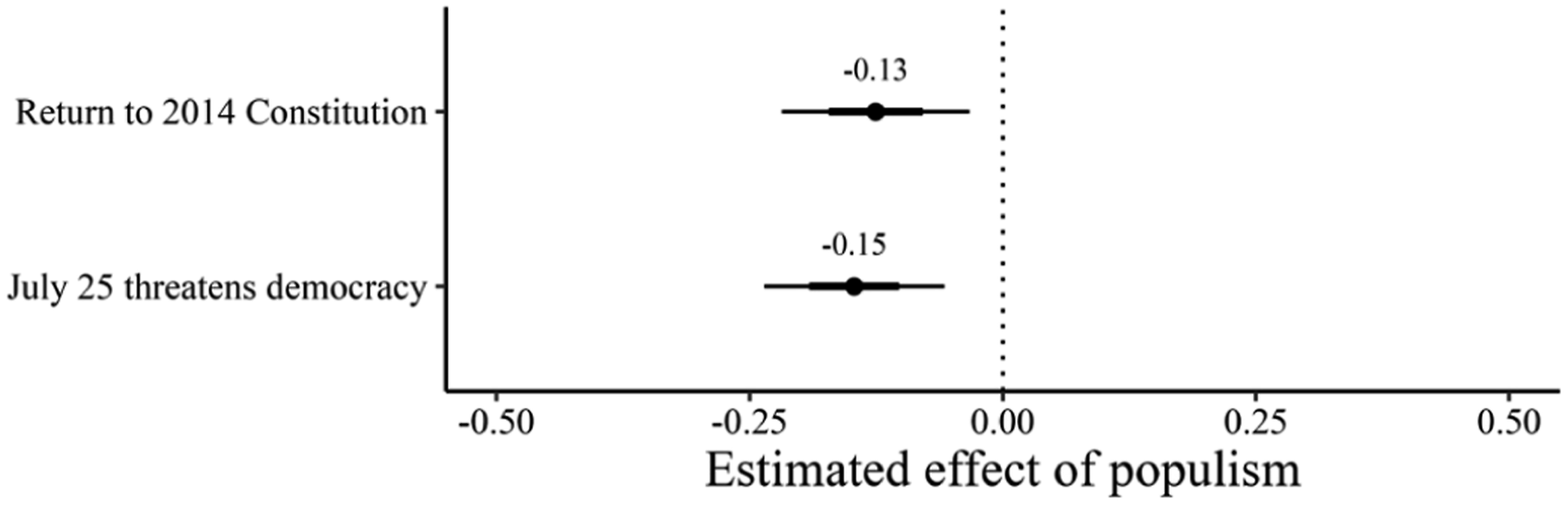
Taken together, we observe a decline in support for his 2021 executive takeover and Kais Saied as a political figure, but a relatively large reservoir of potential support for his core ideological message, namely, his anti-political establishment and anti-party stance. Hence, there is a large constituency of people offering support in pursuit of Saied’s sustained bid to stay in power, should he be able to successfully appeal to these populist sentiments.
Moreover, there is also a constituency in favor of the institutional design Saied erected. We draw on 2022 Afro-Barometer data to examine regime preferences among the Tunisian public. This survey includes a set of items measuring respondent’s preferences regarding the political regime, such as questions on the freedom of association and the press, government accountability, executive-legislative relations, or support for military or single-party rule (see Table A3 in the appendix). We suspect that these different variables tap into several underlying dimensions when it comes to Tunisians’ regime preferences.
We use factor analysis to extract three common dimensions along which respondents’ preferences align. 27 The analysis follows a two-step procedure. First, we include 18 of the variables listed in Table A3 in the appendix. 28 Based on the results of this first factor analysis, we then exclude variables that do not load with 0.3 or higher on at least one of the factors and can thus be considered unrelated to the three underlying dimensions. This leaves us with 9 of the 18 variables for a second factor analysis. We include the results of the factor analysis in the appendix (Table A4 in the appendix). Substantively, the factor analysis reveals three broad groups: respondents with authoritarian, hyper-presidentialist, and liberal views. Liberal respondents highlight the freedom of organization as well as government accountability. They also see the government as an employee of the people, rather than its boss. Authoritarian respondents, in turn, support single-party or military rule and want to abolish parliament. Hyper-presidentialist respondents, finally, want the president to pass laws without taking the views of parliament into account. They oppose parliamentary oversight over the presidency and presidential term limits. Together, these three factors explain about 30 percent of the variation.
Next, we create composite variables reflecting these three factors. We scale all component variables to a mean of zero and a standard deviation of one and then take the average across the various components. We use these variables as our main independent variables of interest in models examining various dimensions of support for Kais Saied.
Figure 3 shows coefficient plots for three logistic regressions. Model 1 regresses the authoritarianism, hyper-presidentialism, and liberalism scales on a variable capturing the intention to vote for Kais Saied, Model 2 on a variable measuring whether respondents trust Saied, and Model 3 on a measure of approval of the president. All models include a set of controls, most notably respondents’ own assessment as to whether Tunisia is democratic, their level of education, age, gender, and rural/urban origin. As Figure 4 shows, support for Kais Saied in all three models is driven primarily by hyper-presidentialist attitudes, not by authoritarianism as such (with the exception of the approval model where the authoritarianism scale is significant at p = 0.0172). Liberals, not very surprisingly, are opposed to the president. Moreover, respondents who perceive the current Tunisian political context as democratic are more likely to support Saied, suggesting that such support is not based on ideological opposition against democracy as such. Drivers of support for Kais Saied. Full models in Table A5 in the appendix.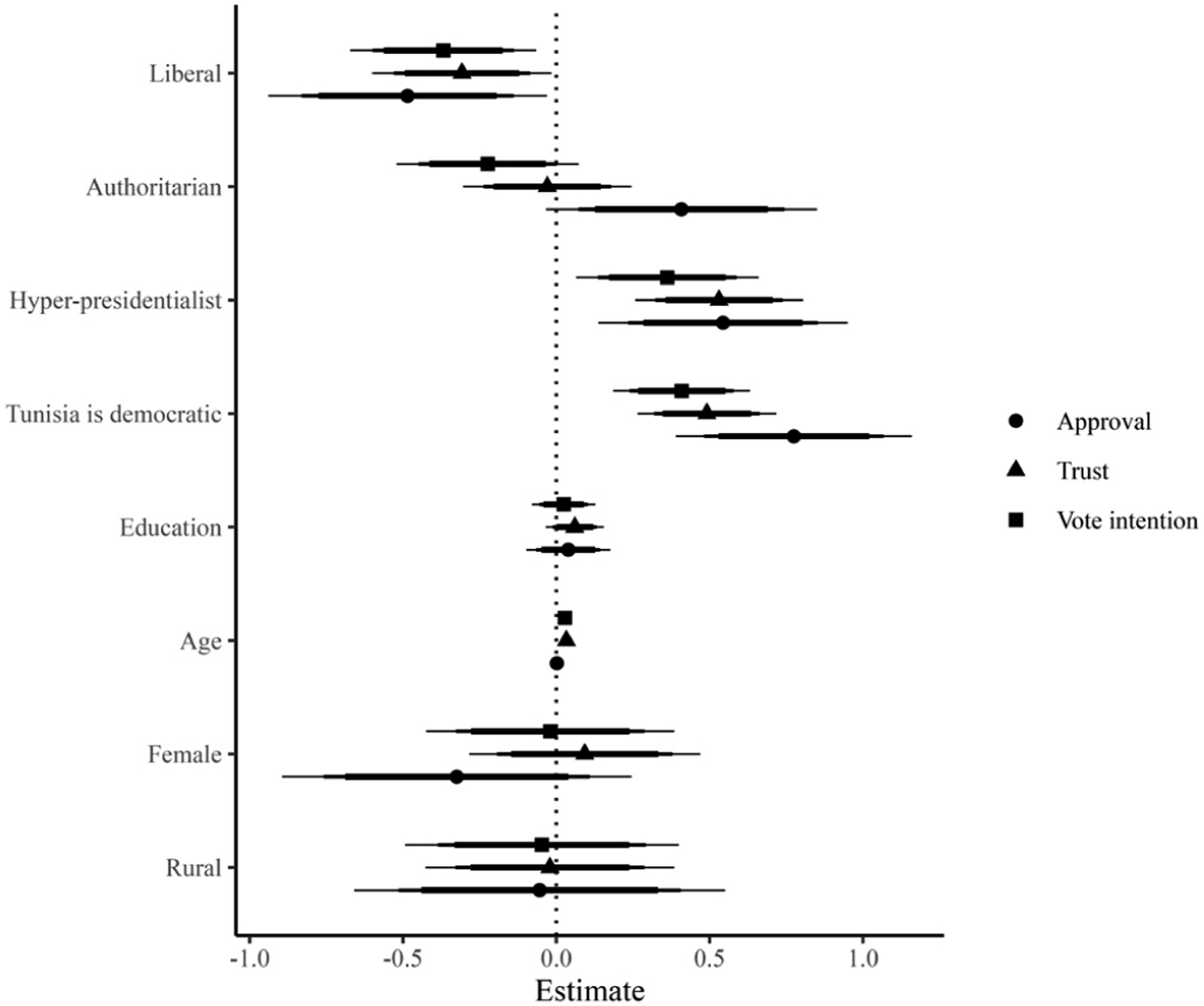
Apart from supporting an unconstrained presidency, what do Tunisian hyper-presidentialists want? One important aspect is their negative attitude toward party politics. The Afro-Barometer survey includes two questions that allow us to assess this issue. The first is a question asking respondents to consider two statements on political parties. Statement 1 suggests that “[p]olitical parties create division and confusion; it is therefore unnecessary to have many political parties in Tunisia,” while statement 2 reads as follows: “Many political parties are needed to make sure that Tunisians have real choices in who governs them.” Respondents were asked to agree or strongly agree with either statement.
We dichotomized the measure into a variable coded 1 if respondents agree with statement 1. The second question asks respondents whether they feel close to any political party. This variable is coded 1 if respondents answered in the affirmative. Figure 5 shows coefficient plots for two models regressing the attitude scales along with the controls mentioned above against the two-party variables. Drivers of attitudes on political parties. Full models in Table A6 in the appendix.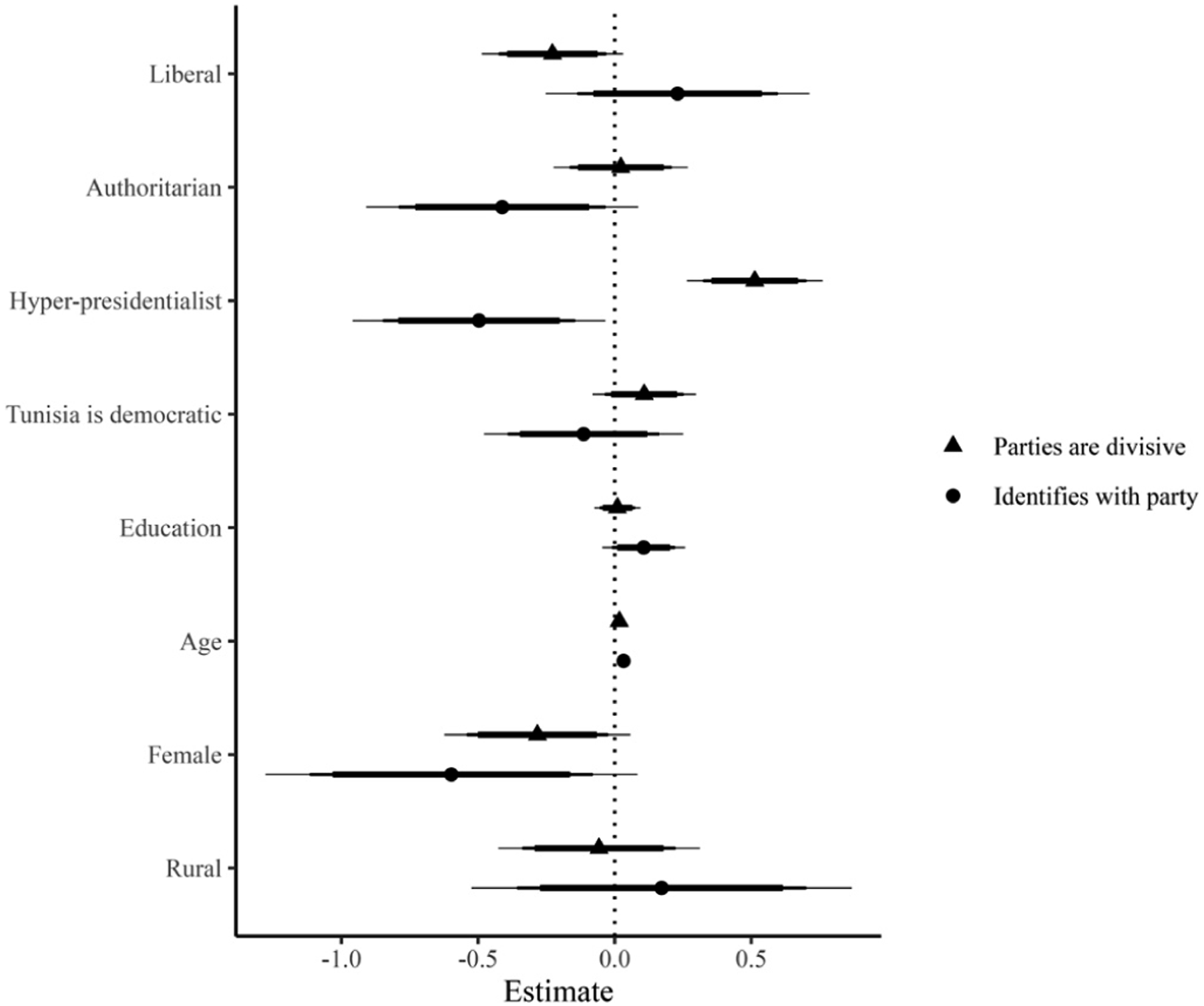
As is apparent from this figure, hyper-presidentialism is the one variable that consistently predicts negative attitudes toward political parties. This suggests that hyper-presidentialism in Tunisia might be conceived of as a reaction to the political deadlock the country had experienced under multiparty politics. Taken together, Kais Saied finds a political constituency in favor of both his one-man ruling style and his sustained anti-political party stance. While forming a party offers benefits for regime institutionalization, it would as well come to the detriment of sustained support from this core constituency. Faced with the trade-off between sustaining popular support and regime institutionalization, Saied has chosen the former over the latter.
Conclusion
This article theorizes costly commitments in autocracies, namely, processes of autocratization where political leaders rise to power through populist appeal. Populist autocratizers face a dilemma regarding the establishment of winning coalitions vs. sustaining support from the selectorate. To the extent that they base their appeal on a populist, anti-establishment message, they face important constraints on regime formation. Autocratizing leaders have incentives to sustain a popular support base, which may compromise opportunities for the formation of political parties or movements as instruments of elite cooptation and social control.
The Tunisian executive self-coup of July 2021 illustrates this dilemma. Following Kais Saied’s move against the democratic constitutional order, a range of pre-existing and new parties or movements tried to curry favor with the president and offered themselves as political vehicles for Saied’s political project. Yet, Saied rebuffed them all, staying true to his anti-party and anti-establishment political message. In short, Kais Saied chose to rely on the popular anti-establishment sentiment that had contributed to his rise to the presidency and generated support for his executive takeover, rather than putting his regime on a more solid footing by coopting a supportive coalition of political elites. As we have shown, this can be explained with a trade-off between maintaining popular support and institutionalizing a political regime. As a populist political outsider, Kais Saied drew on widespread anti-establishment and anti-elite sentiment among the Tunisian public.
What is more, we find a distinct political constituency supportive of Saied’s particular style of hyper-presidentialist one-man rule. We argue that Saied could either continue to bank on his direct appeal to the people or attempt to institutionalize his regime based on a ruling party. Given the distribution of public preferences, however, he could not have it both ways. Faced with this trade-off between a populist strategy of direct appeal and the establishment of an intermediary organization charged with coopting elite actors, Kais Saied stayed true to his ideological project.
The Tunisian case speaks to the broader literature on authoritarian regime formation and autocratization efforts more specifically. While existing research has shown that autocrats resort to institutionalization as a mechanism to resolve commitment problems (Boix and Svolik 2013; Magaloni 2008; Reuter and Remington 2009), we show how autocrats may avoid institutionalization to send credible signals of ideological alignment with their selectorate. Populist autocratizers in particular may become constrained by their anti-party ideological stances, making it difficult for them to engage in regime consolidation through the institutionalization of autocracy. In an almost ironic twist, populist projects can undermine both democracy and the consolidation of authoritarianism.
How does our notion of costly commitments in autocratization travel beyond the case of Kais Saied’s Tunisia and the dilemma of populist ideology facing party formation? We believe costly commitments are a common feature characterizing authoritarian regime formation. Ideological commitments at the time of regime inception will come with adverse consequences beyond regime institutionalization. In our empirical case, historically Tunisia saw the post-colonial rise of the leftist regime of Habib Bourguiba, producing a master cleavage of conflict with conservative, religious parts of society represented by an Islamist movement. More broadly, scholars have found how ideological commitments at the time of regime formation have catalyzed regime support but also created winners and losers in society culminating in future social conflicts (Reuter 2025; Schutz et al. 2026).
Supplemental Material
Supplemental Material - Costly Commitments in Authoritarian Regime Formation: Evidence From Tunisia
Supplemental Material for Costly Commitments in Authoritarian Regime Formation: Evidence From Tunisia by Holger Albrecht, Dina Bishara, and Kevin Koehler in Political Research Quarterly.
Footnotes
Acknowledgments
We thank Santiago Anria, Killian Clarke, Ellen Lust, Kenneth Roberts, and Sidney Tarrow, along with the reviewers and editors of Political Research Quarterly, for their helpful feedback and comments.

Funding
The authors disclosed receipt of the following financial support for the research, authorship, and/or publication of this article: Research for this article was supported by Cornell University, The University of Alabama, and the European Research Council, Grant Agreement ID 101044015. Views and opinions expressed are, however, those of the authors only and do not necessarily reflect those of the European Union or the European Research Council Executive Agency.
Declaration of Conflicting Interests
The authors declared no potential conflicts of interest with respect to the research, authorship, and/or publication of this article.
Supplemental Material
Supplemental material for this article is available online.
Notes
References
Supplementary Material
Please find the following supplemental material available below.
For Open Access articles published under a Creative Commons License, all supplemental material carries the same license as the article it is associated with.
For non-Open Access articles published, all supplemental material carries a non-exclusive license, and permission requests for re-use of supplemental material or any part of supplemental material shall be sent directly to the copyright owner as specified in the copyright notice associated with the article.
