






Abstract
During Vice President Kamala Harris’s 2024 presidential bid, there was a substantial wave of social media messaging aimed at mobilizing voters. Previous research indicates that many American voters obtain political news through social media; therefore, political candidates often use social media as a critical campaign strategy to garner widespread attention. We examine the influence of different Harris TikTok videos during the shortened 2024 presidential election to assess which affect favorability towards Harris. We demonstrate that during presidential elections with polarizing political candidates, social media messaging matters. We find that traditional campaign videos posted on the platform have greater influence than trendy TikTok “edits.” In particular, long form campaign ads posted to TikTok increased favorability for Harris. On the other hand, videos in which Harris explicitly discussed race or called out JD Vance or President Trump had limited influence on support, with some exceptions. In an increasingly digitized political environment, our findings are the first to document the effects of short-form videos on candidate favorability, the effectiveness of social media, the effectiveness of sharing social media with networks, and the use of different messages for voters.
Introduction
In July of 2024, Former President Joe Biden exited the 2024 presidential contest and endorsed Vice President Kamala Harris’ nomination to the Democratic Party ticket. In many ways, this decision stunned American voters nationwide, leaving the country on the brink of a historic election. Not only would Vice President Harris be left to campaign for the presidential election in just over 3 months, but she was not formally nominated during the primary, leaving her campaign team to think “outside of the box” to gain public recognition.
Throughout the campaign, the Harris team worked toward amplifying the Vice President’s platform by focusing on outreach, especially to young voters on social media platforms such as Instagram and TikTok—an undertaking that was relatively new to the American electorate. Social media is a digital medium for communication that allows people to share ideas, information, and content within virtual communities and networks. These platforms feature “short form” video content, which refers to videos that are generally around 60–90 seconds and posted to outlets such as TikTok, Instagram Reels, or YouTube shorts. Often, the exact same videos are posted on different platforms. Through engaging in extensive social media outreach, the Harris campaign vastly outspent the Trump campaign by nearly 50 million dollars 1 . Given the widespread nature of Harris’s social media presence during the 2024 presidential election cycle, our study examines the effectiveness of TikTok videos during this time period that were geared towards mobilizing voters.
We focus exclusively on TikTok, due to its influence in the 2024 Presidential election. 2 TikTok users—primarily a younger audience—globally use the platform to create, share, and repost videos about the elections. TikTok’s largest demographic is young people, particularly Gen Z (ages 18–24) and millennials (25–40), many of whom are first-time voters. TikTok’s algorithm prioritizes engaging content and can make videos go “viral” through shares and reposts, meaning that short, catchy political messages may quickly reach millions. Given that TikTok is a relatively new platform, there are few studies in political science and political communication that explore its impact on voting behavior. While past research has examined political social media, it has typically focused on older platforms such as Facebook and Twitter (Munger 2017; Settle 2018). It is therefore our intent that our paper contributes to this important discourse by presenting new knowledge about the potential effects of TikTok on political attitudes during the 2024 presidential election cycle, specifically towards former Vice President Kamala Harris.
In recent years, Americans have increasingly turned toward social media for their political information. According to the Pew Research Center, 54 percent of Americans indicate that they use social media as their primary form of political information “sometimes” or “often.” 3 Relatedly, between 2021 and 2024, TikTok usage increased, with nearly a third of all Americans indicating that they frequently use the platform, a 12% point increase. 4 During the 2024 presidential election cycle, the Harris campaign team ran its own TikTok account, “@KamalaHQ,” which shared videos about Harris’ policy platform. Our findings indicate that exposure to campaign-related videos did have an important impact on voter attitudes towards Harris in the 2024 presidential election, with some nuance.
Despite TikTok’s growing relevance, we find that TikTok videos had limited success in increasing support for Vice President Harris, though her policy-oriented campaign video on the economy produced the strongest positive effect on candidate favorability, compared to other media frames. Notably, we also find that Democratic participants, Black participants, participants who indicated they use TikTok often, as well as participants with prior knowledge of the platform, and participants who indicated they followed the election closely exhibited high levels of support for Harris when exposed to certain videos. On the other hand, participants who score high on racial resentment and modern sexism demonstrate decreased support for Harris, relative to participants who score low on these measures, in most of our treatment conditions. Overall, while Harris’s policy-oriented campaign videos modestly increased candidate favorability, videos invoking identity-based appeals or incivility produced more limited or negative effects among some respondents, particularly those scoring high on racial resentment and modern sexism. In other words, longstanding racialized and gendered attitudes persist across newer digital campaign environments, including TikTok. Moreover, given the importance that social media continues to play in providing Americans with political information and knowledge, we argue that it is imperative to examine its effectiveness in political campaigning.
Evaluations of Black Women Political Elites
Black women political elites face a myriad of unique experiences when compared to political elites who adhere to other race-gender groups, most stemming from their appearance, racial and gendered attitudes of voters, and perception of their stance on policy issues. For example, Brown and Lemi (2021) find that Black women politicians that wear straightened hair, rather than in its natural state, are often perceived as more respectable. Austin and Dowe (2023) similarly reveals that Black women mayors are sometimes subject to stereotype-based criticism for factors such as their hair or clothing choices. Racial and gender attitudes among voters also tend to decrease support for Black women candidates seeking elective office. Voters with high levels of racial resentment (as defined by Kinder and Sanders 1996) are less likely to support Black political candidates (Highton 2004; Moskowitz and Stroh 1994; Reeves 1997; Stephens-Dougan 2016; Terkildsen 1993). Similarly, voters who exhibit high levels of modern sexism (as developed by Swim et al. 1995) are less likely to prefer female candidates to male candidates (e.g., Knuckey 2019; Ratliff et al. 2019; Swim and Cohen 1997). Recent work by Carr (2026) reveals that among voters who score simultaneously high on both racial resentment and modern sexism, Black women are more susceptible to being perceived as “angry” and “aggressive,” relative to Black male, White male, and White female political elites. Together, these findings demonstrate that Black women candidates are evaluated and confront a distinct intersection of racialized and gendered bias that shapes voter perceptions in ways not experienced by other demographic groups.
Former Vice President Kamala Harris also faces distinct political evaluations from voters due to her racial, ethnic, and gendered identity. Clayton et al. (2023), find that cueing both race and gender identity influenced public support for Biden and Harris following the 2020 presidential inauguration: when Harris’s identity as a Black woman was made explicit in an experimental setting, participants’ support for both Biden and Harris increased. Riley Emmitt and Peterson (2023) also find that White Americans who skew both younger and older as well as those who score high on the racial resentment measure are more likely to hold more negative attitudes towards Harris. Lemi et al. (2022) additionally examines the implications of Harris’ dual racial identity as both Black and Indian American, and reveals that generally, Indian Americans were more supportive of the Biden-Harris 2020 campaign, relative to Black Americans, Black-Indian Americans, and non-mixed-race Americans. Harris’s candidacy therefore activates complex and often competing racialized and gendered attitudes among voters, illustrating how intersectional identities shape contemporary evaluations of Black women political elites.
Next, we outline four key topic areas that we believe will have important implications for the influence of social media on voter evaluations of Harris during the 2024 presidential election.
The Impact of General Campaign Information
First, research finds that exposure to political advertising leads to a mass public that is more informed and engaged in the political process (Freedman et al. 2004). When it comes to the influence of general campaign ads at the presidential level, there is mixed evidence with regard to their effect (Kalla and Broockman 2018; Sides et al. 2022). On the one hand, Kalla and Broockman (2018) find that campaign advertising has zero effect in general elections. Instead, people vote based on the “fundamentals” of an election. However, Sides et al. (2022) find that televised campaign ads matter up and down the ballot, but have a greater influence down ballot than in presidential elections. In addition, past work finds that candidates who emphasize policies are often perceived as more knowledgeable and competent, strengthening their appeal to undecided voters (Iyengar 1994).
Incivility and Candidate Evaluations
Next, we look toward incivility, which has been defined as “a rudeness or impoliteness that violates some agreed-upon standard of society” or “outrage discourse” (e.g., Maisel 2012; Sobieraj and Berry 2011). Outrage discourse is characterized by speech that is inflammatory or misleading, often aimed at stoking fear or anger in its audience. Sobieraj and Berry (2011) find that this form of speech is used in both liberal and conservative media, but appears far more frequently in conservative media. When voters view televised political disagreements, there is often a decrease in their trust in government, not their attitudes towards candidates (Mutz and Reeves 2005). Historical stereotypes about Black women’s anger and aggressiveness further shape these evaluations (Harris-Perry 2011). Taken together, it is plausible to suggest that incivility involving Black women candidates may activate racialized and gendered stereotypes in ways that shape public evaluations differently than incivility involving candidates of other race-gender groups.
Candidate Usage of Racialized Language
Media coverage that invokes racialized language also has important implications for voter attitudes. Candidates of color utilize this rhetoric needed to appeal to voters, and, in some cases, to minority voters in particular. Past work finds that racial cues have long been utilized among political candidates during salient elections as a way to appeal to voters (e.g., Caliendo and McIlwain 2006; Hurwitz and Peffley 2005; Hutchings et al. 2021; Mendelberg 2001; Stephens-Dougan 2021; Valentino et al. 2002; Wamble and Laird 2020). This research demonstrates that racialized political messaging and media framing continue to shape voter perceptions, campaign mobilization strategies, and public responses to candidates of color. These racialized appeals—such as the “Black Jobs” comment resemble the strategies employed by the Harris-Walz 2024 campaign to mobilize voters and build political support through social media outreach.
The Impact of “Attack” Advertisements on Candidate Support
On the other hand, the impact and effectiveness of candidates’ use of attack advertisements varies on public opinion and support. Political campaigns most frequently use attack ads to tear down an opponent rather than offer positive solutions or a constructive vision for the future (e.g., Dowling and Wichowsky 2015; Geer 2008; Phillips 2021). Findings in this area are mixed: some show that attack ads can be a useful campaign strategy, while others show that these advertisements can lead to decreased public support (Banda and Windett 2016; Dowling and Wischowsky 2015; Phillips 2021). These mixed findings suggest that the effectiveness of attack advertisements is highly contingent on the political context, the candidates involved, and the ways voters interpret campaign negativity.
Theory
The studies that we highlight in the aforementioned sections provide us with a critical theoretical framework upon which our paper rests. First, as noted above, research finds that while identity is an important component of how candidates appeal to voters, voters value candidates’ policy positions over these identity-based factors (Mikkelborg 2025; Wakefield 2025; Wamble 2025). Mikkelborg (2025) finds that White voters’ support for Black candidates cannot be reduced to an aesthetic preference; it reflects their desire to support candidates who support racial justice policies. Relatedly, Wamble (2025) finds that Black voters will not support Black candidates simply on the basis of their race. Black candidates must demonstrate community commitment and aligned policy preferences. For these reasons, we expect that TikTok videos that feature core components of Harris’s policy issue positions will result in increased support among voters relative to the control video.
Regarding our next expectation, recent scholarship also finds that identity matters for voters’ perceptions of incivility (Gubitz 2021). Voters are less likely to perceive incivility directed at Black candidates and more likely to perceive incivility when it is targeted towards White candidates. Other research finds that White men are most likely to identify incivility in online rhetoric when it comes from a Black woman (Hawkins et al. 2023). Intersectionality also plays an important role in online discourse, and Black women are uniquely punished by White men when it comes to such discourse (Hawkins et al. 2023). With this in mind, it would be reasonable to expect that voters may perceive greater incivility when it is directed at JD Vance or Donald Trump than Kamala Harris, for example. We therefore expect that TikTok videos from @KamalaHQ that feature some form of incivility will lead to decreased support for Harris relative to the control video.
Scholarship in race, ethnicity, and political science has long argued that explicit racial appeals are ineffective (Mendelberg 2001). Stephens-Dougan (2016) finds that White Democratic candidates are penalized for associating with Black people. In other research, Stephens-Dougan (2020) also demonstrates that Black candidates often racially distance themselves from other Black people to appeal to racially moderate voters. At the same time, however, candidate usage of racialized language may be useful for the purposes of mobilizing voters (e.g., Hutchings et al. 2021; Stephens-Dougan 2021; Wamble and Laird 2020). While its plausible that @KamalaHQ videos that make an explicit alignment with Black voters will have a negative overall effect on evaluations of Harris, it may have positive effects on evaluations of Harris among Black voters. Consequently, social media posts that appeal to Black identity may lead to increased support for Harris relative to the control video, particularly among Black participants.
We also expect that videos posted to the @KamalaHQ platform that feature some form of negative partisanship/attack against her opponent will lead to decreased support Harris relative to the control video. Past work indicates that while many political candidates use often use “attack” advertisements as a way to mobilize voters, these ads often result in decreased voter support for that particular candidate (e.g., Banda and Windett 2016; Dowling and Wischowsky 2015; Phillips 2021). Coupled with past work that reveals that Black women political elites are often penalized on account of perceptions that they are too “angry,” or “aggressive,” (e.g., Carr 2026; Harris-Perry 2011), it is likely that attack ad content will result in decreased support for Harris.
Hypotheses
Taken all together, each of the literatures that we examine inform our hypotheses. Moreover, we pose the four following expectations.
Policy: We expect that exposure to the TikTok videos from @KamalaHQ that feature core components of the HarrisWalz2024 campaign, such as, their advocacy surrounding certain policies, will lead to increased support for Harris.
Incivility: We expect that exposure to TikTok videos from @KamalaHQ that feature some form of incivility will lead to decreased support for Harris.
Identity: We expect that exposure to TikTok videos from @KamalaHQ that explicitly appeal to Black identity will lead to increased support for Harris, particularly among Black participants.
Attack Ads/Negative Partisan: We expect that exposure to TikTok videos from @KamalaHQ that feature some form of negative partisan attack against the TrumpVance2024 campaign will lead to decreased support for Harris, particularly among Republican participants.
Data and Methods
To test the effects of social media messaging on political behavior during the 2024 presidential election, we conducted a survey experiment on Prolific, a survey research firm that uses a nationally diverse U.S. sample to recruit participants for our experiment, and administered it to voters during the early-voting period in November 2024. @KamalaHQ was the official TikTok account for Vice President Kamala Harris’ 2024 presidential campaign that was created to engage with younger voters through sharing campaign updates and creative content. 5 When selecting the videos used in our experiment, we aimed to capture the diverse range of content posted by the @KamalaHQ account.
Our design is straightforward: We examine campaign messages and their support for Harris relative to a generic message about the campaign. First, we compare the baseline control to the average effect of all three treatments. Then we examine the effect of each treatment relative to the control condition. We next examine the differences between the treatment conditions. We require 900 respondents for Cohen’s d = 0.20, across four treatment conditions and a control condition. We recruited more participants than required because we are interested in oversampling young voters and African Americans. However, we only detect meaningful differences across treatments, not across race and ethnicity or age. We test four videos taken directly from the @KamalaHQ (KHQ) platform that we expect to increase support for Vice President Harris among registered voters, relative to a campaign video. Admittedly, because our experiment does not occur within the TikTok app, users are exposed to only one video at a time, whereas users on the app often encounter multiple videos on their “For You” page, which provides them with videos curated based on their interests. However, research indicates that many TikTok users encounter videos outside the app when friends and family members text them videos directly from TikTok (Shaul 2023). With that in mind, our experimental design is based on the experience of receiving a video directly from TikTok.
We use a quota sample and recruit respondents to match national demographics on race, gender, and age. However, given that we are especially interested in how Black participants might respond, we oversample Black participants to ensure a sufficient number in our study. In total, our sample includes approximately 1,200 participants. We also include two manipulation checks in our experiment: the first asks respondents to recall the first line of the video they were just exposed to, and the second asks them to name the narrator. The study is a 2 × 4 factorial design: participants either viewed a generic campaign video on VP Harris’ policy or a TikTok focused on incivility, negative partisanship, or identity. The control video is a 13-s clip of two teenagers performing a choreographed dance to Eminem’s “Slim Shady.” We explain the rationale behind each treatment condition below.
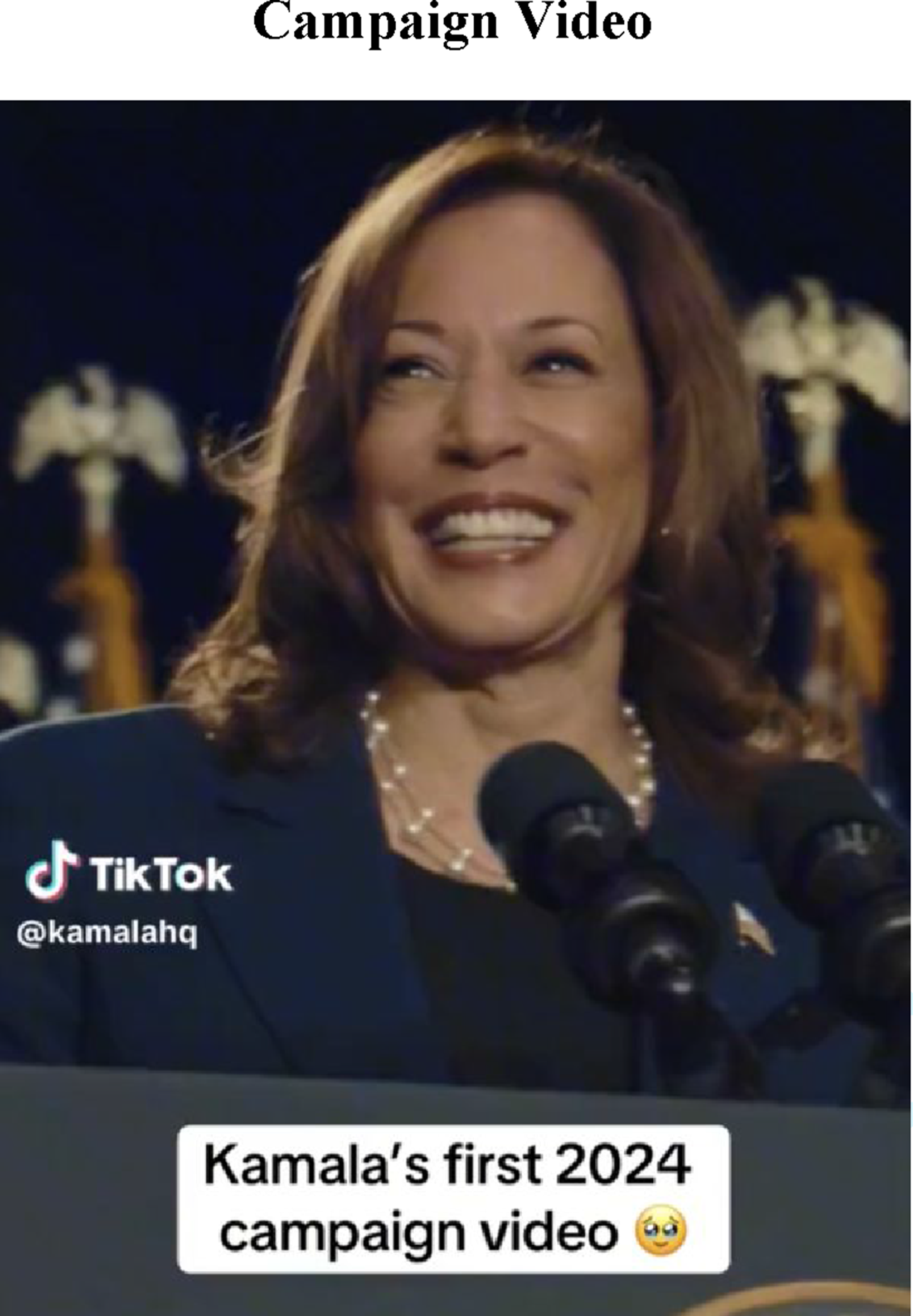
First, we examine the effects of the policy frame (Campaign Video). The caption on the TikTok reads as follows: “Kamala’s first 2024 campaign video.” In the video, Kamala Harris narrates her campaign platform, with an emphasis on freedom over the popular Beyoncé tune “Freedom.” The clip runs 1:19 long and has a montage of images of different Americans. In the clip, Harris says, “We believe in the promise of freedom, and we’re ready to fight for it, and when we fight, we win.” 6 We choose this video given that it emphasizes some of the core components of the Harris-Walz 2024 presidential campaign from a policy standpoint. Furthermore, such framing can increase voter mobilization, as individuals are more likely to participate in elections when they see tangible stakes in policy decisions (Gerber and Green 2000). That being said, the policy frame is significant here, as it allows us to investigate the extent to which exposure to Harris-Walz 202 policy positions leads to more favorable attitudes of Harris. Given the literature that we review earlier on (e.g., Iyengar 1994; Sides et al. 2022), we expect that exposure to this video will increase support for Harris relative to the control video.
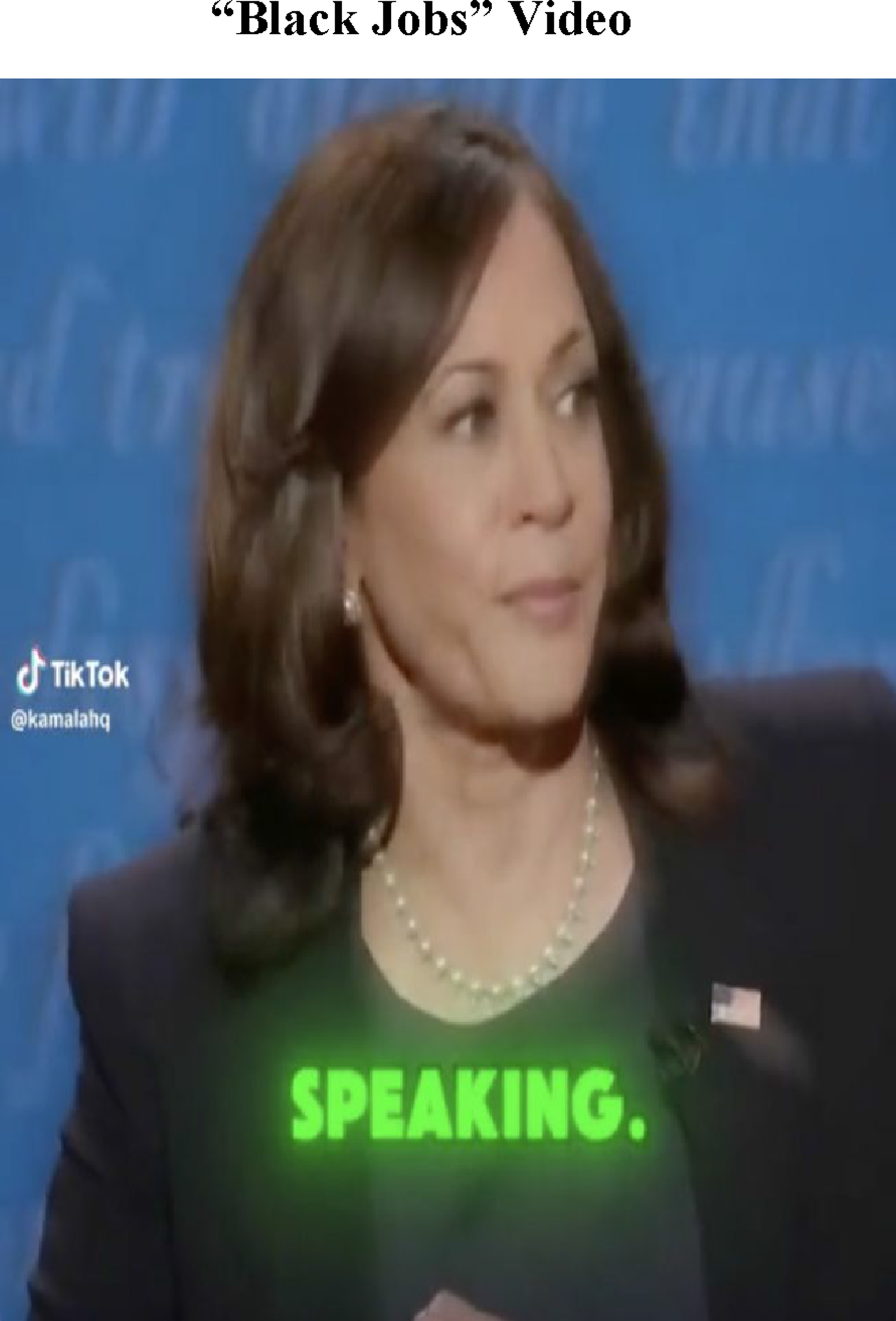
Second, we examine the effects of the identity frame (Black Jobs Video). This 11 s clip does not have a caption and includes a montage of Kamala Harris as California Attorney General, California senator, and U.S. Vice President. The background music is an audio mixed song of Michelle Obama saying, “Who is going to tell him that the job that he [Donald Trump] is currently seeking is one of those Black Jobs.” We chose this video given that its emphasis on language surrounding “Black jobs” is likely intended to appeal to Black voters. To this end, we build our reasoning for this particular frame upon prior work in this area that demonstrates the impact of candidate race-based language on public attitudes (e.g., Hurwitz and Peffley 2005; Hutchings et al. 2021; Hutchings and Jardina 2009; Mendelberg 2001; Stephens-Dougan 2021; Valentino et al. 2002; Wamble and Laird 2020). In addition, many campaigns focus on breaking barriers, framing a candidate’s identity as part of a more significant historical moment (e.g., Brown 2020). It is therefore plausible to expect that participant exposure to this particular frame will lead to an increase in support for Harris, especially among the Black participants in our study.
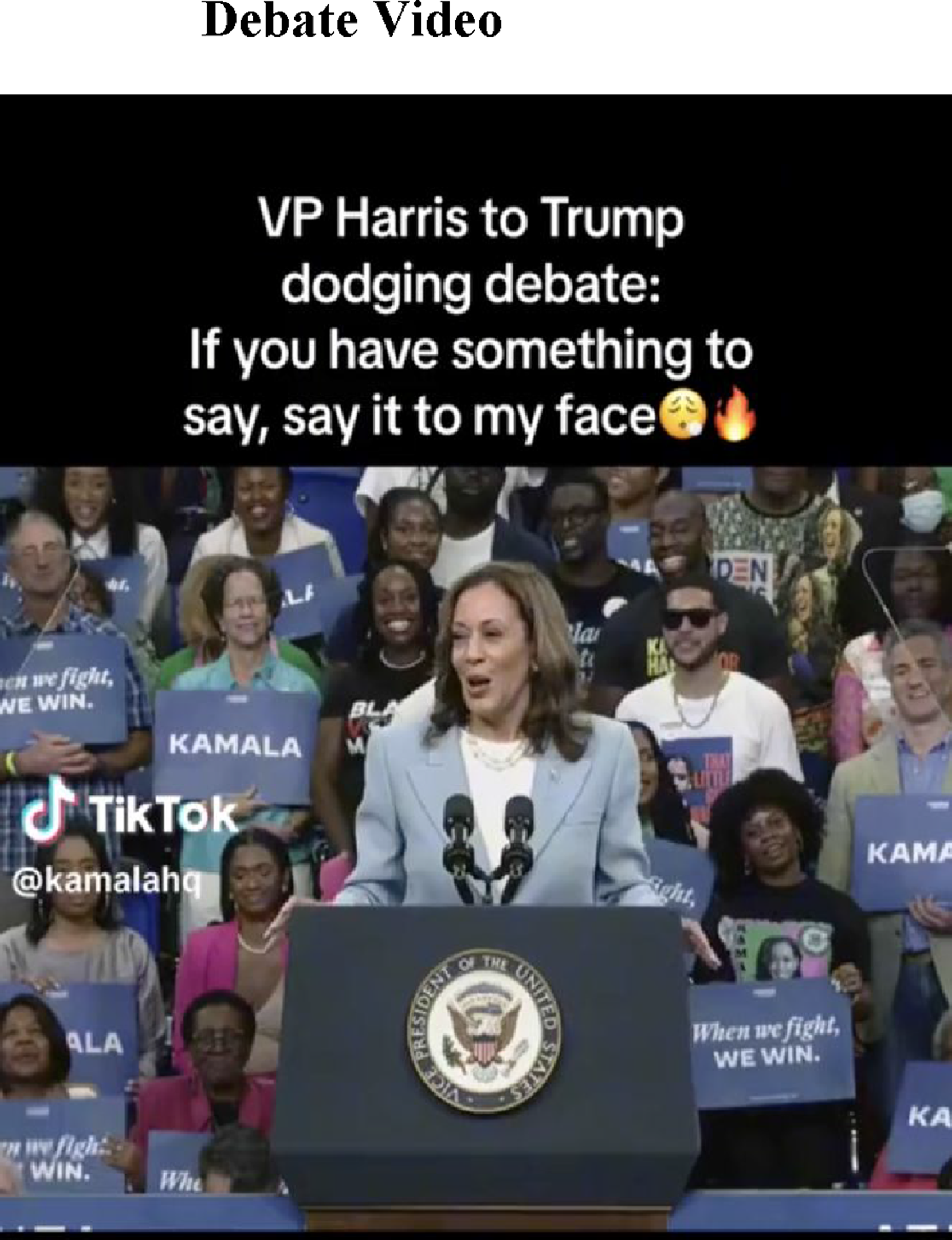
Third, we focus on the impact of polarizing and mud-slinging messages as the incivility frame (Debate Video). The caption on the TikTok reads as follows: “VP Harris to Trump dodging debate: If you have something to say, say it to my face.” In the video which runs 30 seconds long, Kamala Harris is at a campaign rally with her supporters, urging Donald Trump to participate in a debate. We choose this video as it is a clear example of Harris’s use of incivility to express her disdain for Donald Trump. As part of our reasoning for choosing this frame, we look toward previous literature which suggests that candidate usage of “uncivil” framing has important implications for voter support. As we noted earlier, this type of messaging can influence voter perceptions, leading to decreased candidate support under certain circumstances (e.g., Brooks and Geer 2007; Goel and Merkley 2024; Gubitz 2021). We also build upon the literature which finds that historical tropes such as anger and aggression are often directed toward Black women, leading to negative public perceptions towards them (e.g., Carr 2026; Harris-Perry 2011). Given the nature of the video, some voters might also associate Harris with the aforementioned tropes. For these reasons, we expect that participant exposure to this particular video will lead to decreased support for Harris.
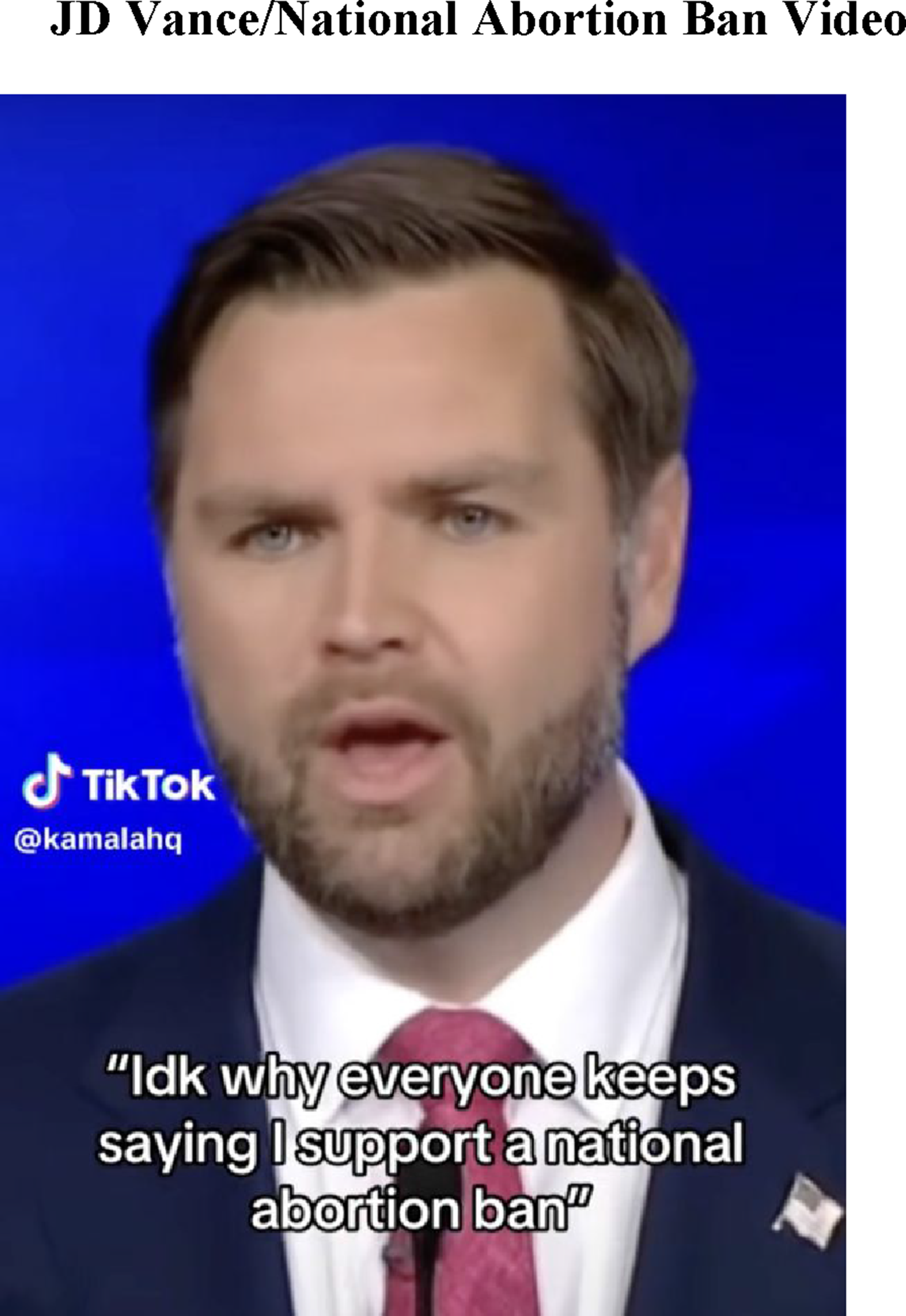
Finally, we examine the negative partisanship frame (JD Vance/National Abortion Ban Video). The caption on the TikTok reads “Idk why everyone keeps saying I support a national abortion ban.” In the video, JD Vance is on the debate stage, a Justin Timberlake song plays in the background, and headlines of JD Vance supporting a national abortion ban are clipped from national news websites. The clip runs 10 seconds long. Negative partisanship, characterized by voters’ aversion to opposing parties (e.g., Bankert 2021; Bankert 2022), often drives the use of attack ads that focus on contentious issues such as reproductive rights. In the 2024 campaign, Democrats targeted Republican vice-presidential nominee J. D. Vance’s stringent anti-abortion stance, highlighting his past comments opposing exceptions for rape and incest, and his comparison of abortion to slavery. We chose this video as our fourth and final frame given its connection to prior literature, which highlights how negative attack advertisements, often directed at candidates of the opposing party, sometimes lead to decreased candidate support (e.g., Banda and Windett 2016). We therefore expect this video to lead to decreased support for Harris, particularly among Republican respondents, given the video’s negative partisan component.
The TikToks were selected due to their focus on general policy, racialized language, incivility, as well as negative partisanship, each of which has been shown to impact candidate support during a campaign. In addition, we leverage TikTok “edits,” which are videos based on viral memes, and repackaged clips, which are reposted on other social media platforms. By exposing participants to different types of videos, our strategy assesses how each type engages viewers and which frames were most impactful to the campaign’s elusive messaging strategy. On the whole, we expect that certain frames (negative partisanship frame and incivility) will lead to decreased support for Harris, while other frames (identity and policy) will lead to increased support for Harris.
Dependent Variables: Harris Support
Our primary dependent variables are measures of support for VP Harris, based on four key items. First, we examine candidate favorability towards Harris. This question reads as follows: “For each of the following people, please indicate whether your overall opinion of them is very favorable, somewhat favorable, somewhat unfavorable, very unfavorable, or if you have no opinion or haven’t heard enough to say.” 7 Our second dependent variable measures participants’ likelihood to share the TikTok video. This question asks respondents how likely they are to share the campaign ad that they viewed with their social media following. The question reads as follows: How likely are you to share the TikTok that you viewed with your social media followers? (Responses range from very likely to very unlikely on a four-point Likert scale). Our third dependent variable measures the perceived effectiveness of social media content at making voters enthusiastic about the 2024 presidential election. This question reads as follows: In your view, how effective do you believe social media content has been in making people more enthusiastic about this presidential election cycle?
(Responses range from very effective to very ineffective on a 4-point Likert scale). Last, our fourth dependent variable measures vote intention in the 2024 presidential election. The question reads as follows “Which presidential candidate do you plan to vote for?”
Respondents are presented with the VP Harris/Walz ticket and the Trump/Vance ticket, among other names that appeared on the ballot in the states we targeted.
Treatment Variables: Kamala Harris TikTok Ads
Below, we’ve also included a screengrab of each of the four primary treatment videos, which participants were exposed to.
We analyze the effect of the TikTok videos on support for VP Harris through reporting t-test results between each of our four treatment conditions and our control group, as well as through OLS regression analysis. Our appendix includes our t-test results for each dependent variable across treatment groups for our entire sample, as well as for Gen Z participants, Democratic participants, and participants who report using TikTok often. We subset our t-test results by these groups of voters, given that these voters would likely be the most susceptible to movement across our treatments. To estimate average treatment effects, we run ordinary least squares (OLS) regression for each outcome question, using the numerical value of the outcome variable and four dichotomous indicators of randomly assigned groups as treatment variables.
Our primary independent variables of interest are: Race (1 = Black), Partisanship (1 = Democrat), Gender (1 = women), Racial Resentment (1 = high on racial resentment), Modern Sexism (1 = high on modern sexism), Age (1 = oldest voters), TikTok as participant’s primary source of social media (1 = most active on TikTok), Previous Knowledge of @Kamala HQ (1 = familiar), Discussed a Candidate or Political Issue on Social Media (1 = discussed a candidate or political issue by posting on social media), and Closely Follow the 2024 election on Social Media (1 = very closely). All variables are scaled to the [0, 1] interval.
In order to analyze our data, we run a series of OLS regression models. Please note that in addition to our OLS models, we also run ordered logit models for our three ordinal dependent variables, as well as a standard binary logistic regression for our binary dependent variable (respondent intention to vote Democrat in the 2024 election) in order to conduct comprehensive robustness checks. These additional results can be found in the appendix. 8 Furthermore, we find that both OLS regression and ordered logit models are suitable approaches for testing the effects of our treatment videos on our core dependent variables.
Results
Before turning to the results of our OLS regression analysis, we first examine t-test results for each treatment group on all four dependent variables in our entire sample, in Figure 1. Once again, tables corresponding to each figure can be found in the appendix.
8
As far as our dependent variable on candidate favorability (Figure 1A), our results indicate that overall favorability toward Kamala Harris in the general population is relatively neutral, with mean ratings hovering around the midpoint of the 1-to-4 scale. The control group, which viewed a generic dance video, had a mean favorability rating of 2.52 (SD = 1.19). Among the experimental conditions, the Campaign Video condition resulted in the highest mean favorability (2.77, SD = 1.19), which was significantly higher than the control group at p < .05. This suggests that exposure to traditional campaign messaging positively influenced perceptions of Harris. Other conditions, including the Debate Video (2.53, SD = 1.24), JD Vance/National Abortion Ban Video (2.67, SD = 1.18), and Black Jobs Video (2.51, SD = 1.24), did not significantly differ from the control group. The overall average favorability across all conditions was 2.60 (SD = 1.21), reflecting a slightly positive tilt but generally mixed opinions. Therefore, we find evidence that specific messages about Kamala Harris are associated with increased favorability, particularly among respondents in the Campaign Video treatment. Mean averages for each DV across each treatment.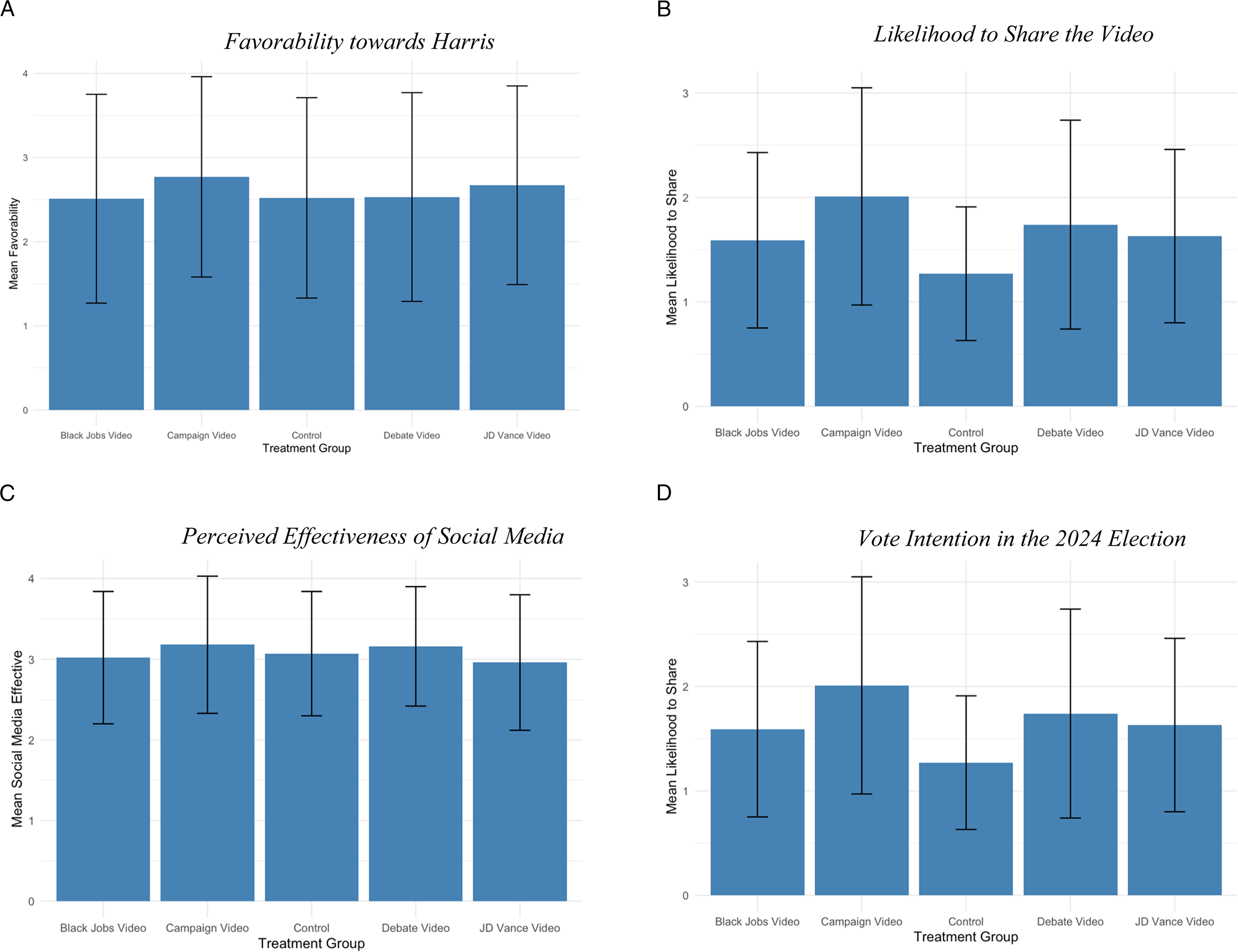
Next, we examine the results for respondents’ likelihood of sharing the video they were exposed to (Figure 1B). The control group, which did not view a TikTok campaign but a dance video, had the lowest mean likelihood of sharing that video (1.27, SD = 0.64). Among the experimental conditions, participants in all four of our treatment conditions have a significant likelihood of sharing the video they were exposed to, relative to the control group (p < .05). This aligns with the earlier finding that the Campaign Video also increased favorability toward Kamala Harris, suggesting that positive campaign messaging not only improves perceptions but also encourages social engagement. The overall average likelihood of sharing across all conditions was 1.65 (SD = 0.91), indicating generally low willingness to share, with notable increases for specific political content. These results reinforce the idea that campaign-driven content, particularly Harris’s own promotional materials, is the most effective in both boosting favorability and driving online engagement.
We also examine t-test results on the perceived effectiveness of social media content in increasing voter enthusiasm for the 2024 presidential cycle. In terms of perceived effectiveness of social media content (Figure 1C), we find that respondents in the Campaign Video treatment showcased the highest likelihood to perceive that social media content was effective in terms of making people excited about the 2024 presidential election with a mean value significantly higher than the control (3.18, SD = 0.85) at p < .01. In addition, we demonstrate that respondents in the Debate Video condition showcased a high likelihood to perceive that social media was effective in terms of making voters excited for the election at a level that is significantly higher than the control (3.16, SD = 0.74), where p < .05. Last, we examine the extent to which respondent exposure towards these videos impacted whether they planned to vote for Harris in the 2024 presidential election (Figure 1D). For this dependent variable, vote intention for Harris in the 2024 election is relatively neutral, with mean averages hovering around the midpoint. We do not find that respondent exposure to the treatments influenced respondent vote intention at levels statistically higher than the mean. We therefore find limited evidence that exposure to the treatments had a significant impact on votes for Harris, at least in terms of mean averages.
Favorability towards Harris across each treatment condition
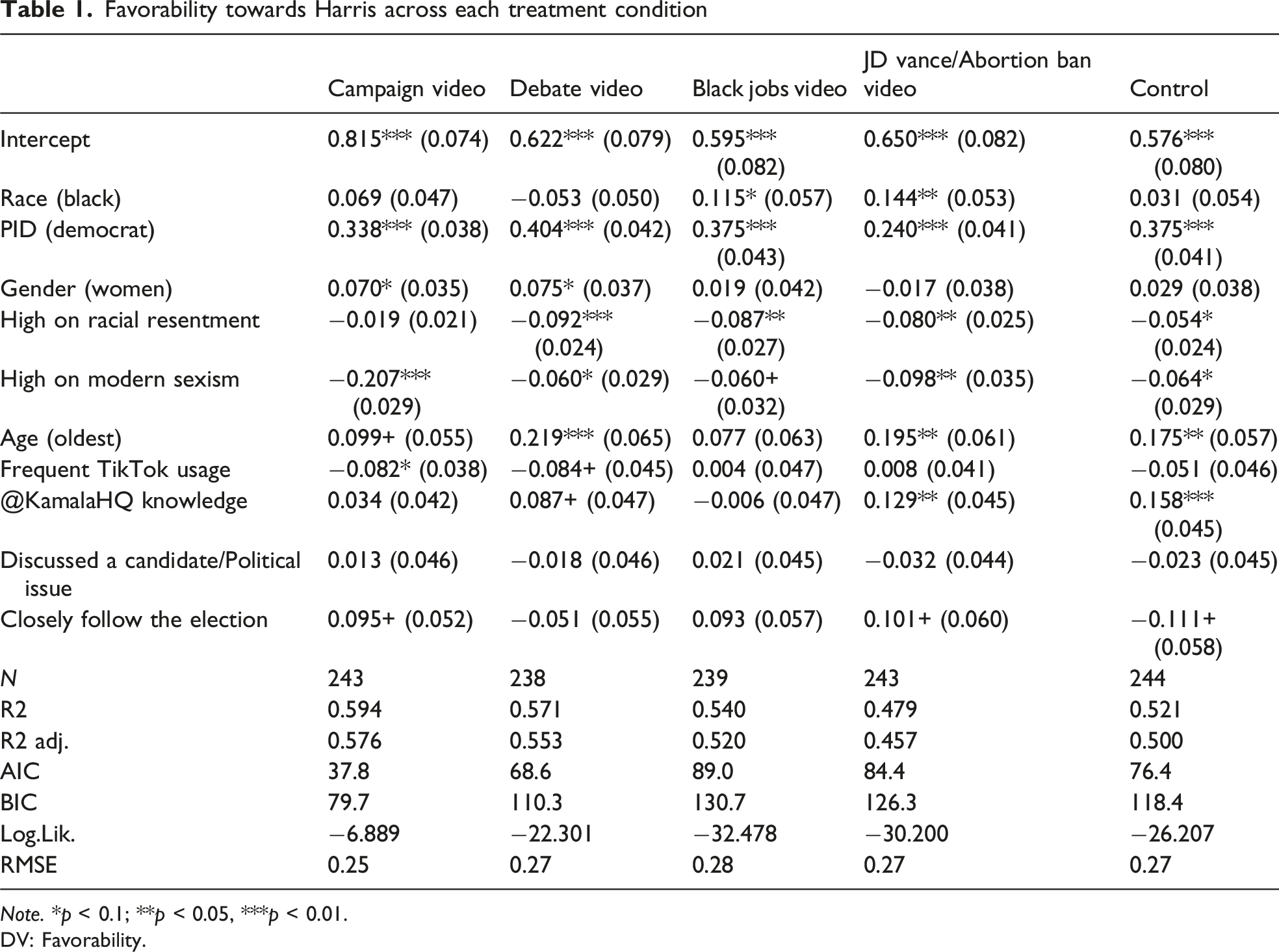
Note. *p < 0.1; **p < 0.05, ***p < 0.01.
DV: Favorability.
Likelihood to share the TikTok across treatment conditions
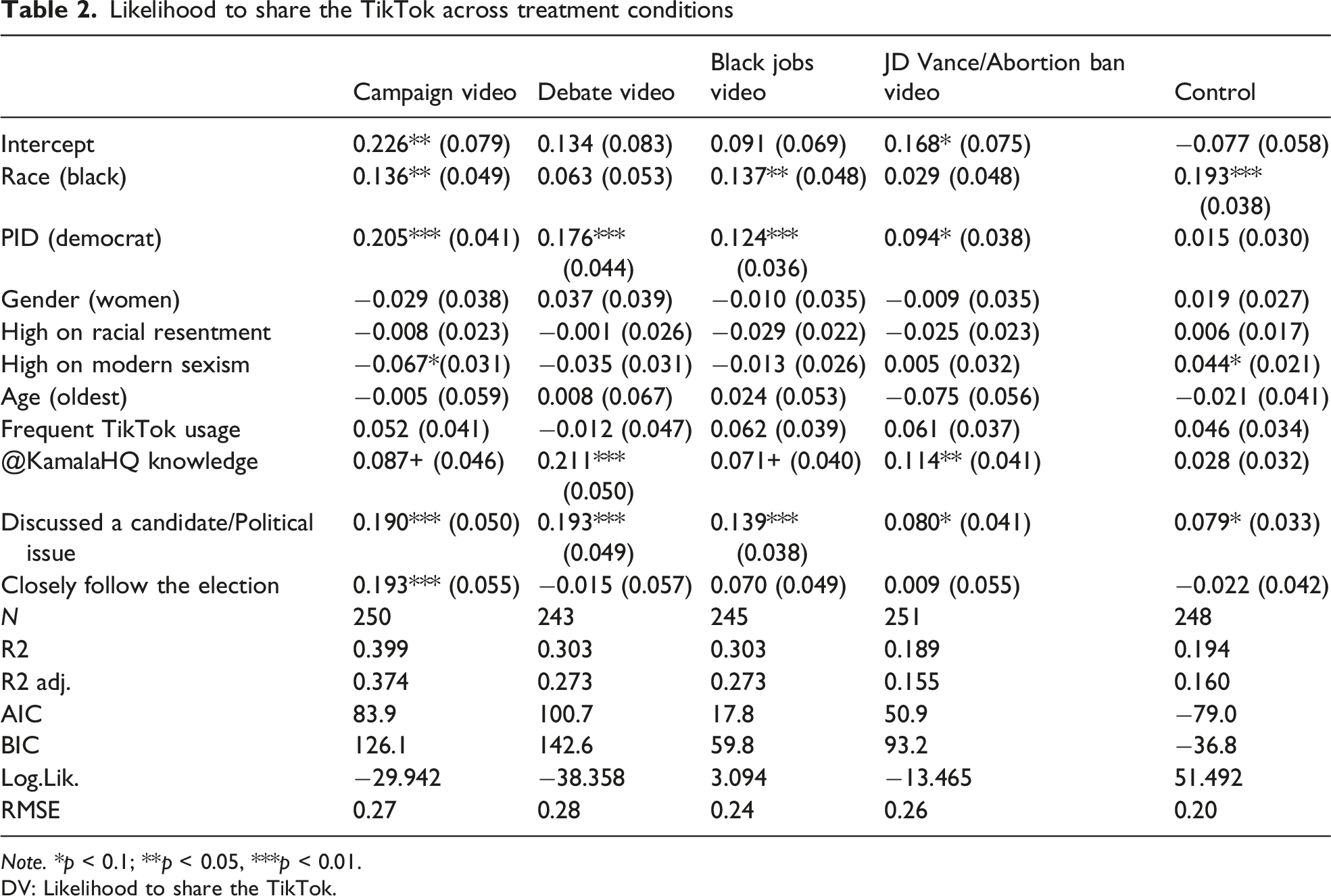
Note. *p < 0.1; **p < 0.05, ***p < 0.01.
DV: Likelihood to share the TikTok.
Perceived effectiveness of social media content at making people enthusiastic for the 2024 election across treatment conditions
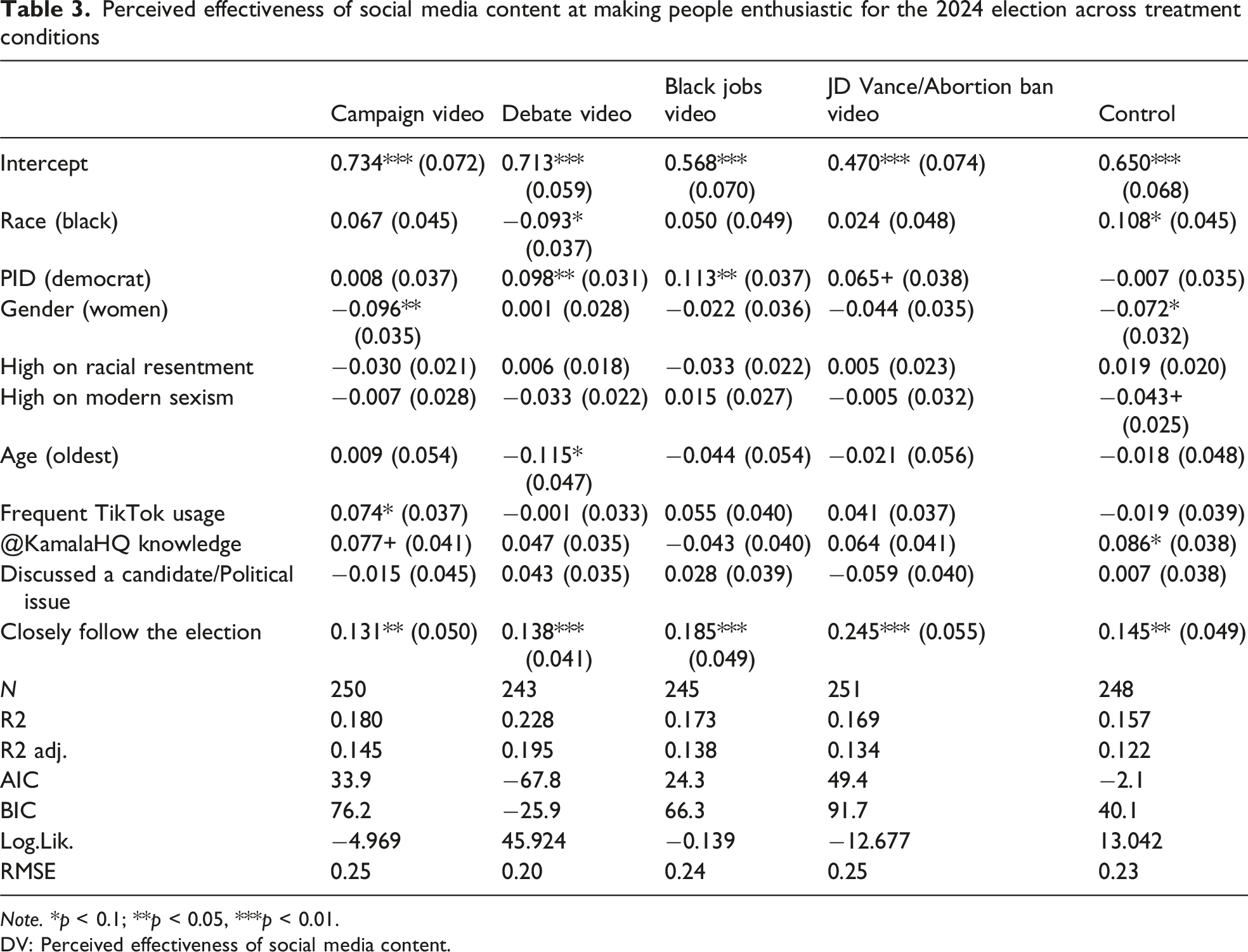
Note. *p < 0.1; **p < 0.05, ***p < 0.01.
DV: Perceived effectiveness of social media content.
Respondent indication to vote democrat in the 2024 presidential election across treatment conditions
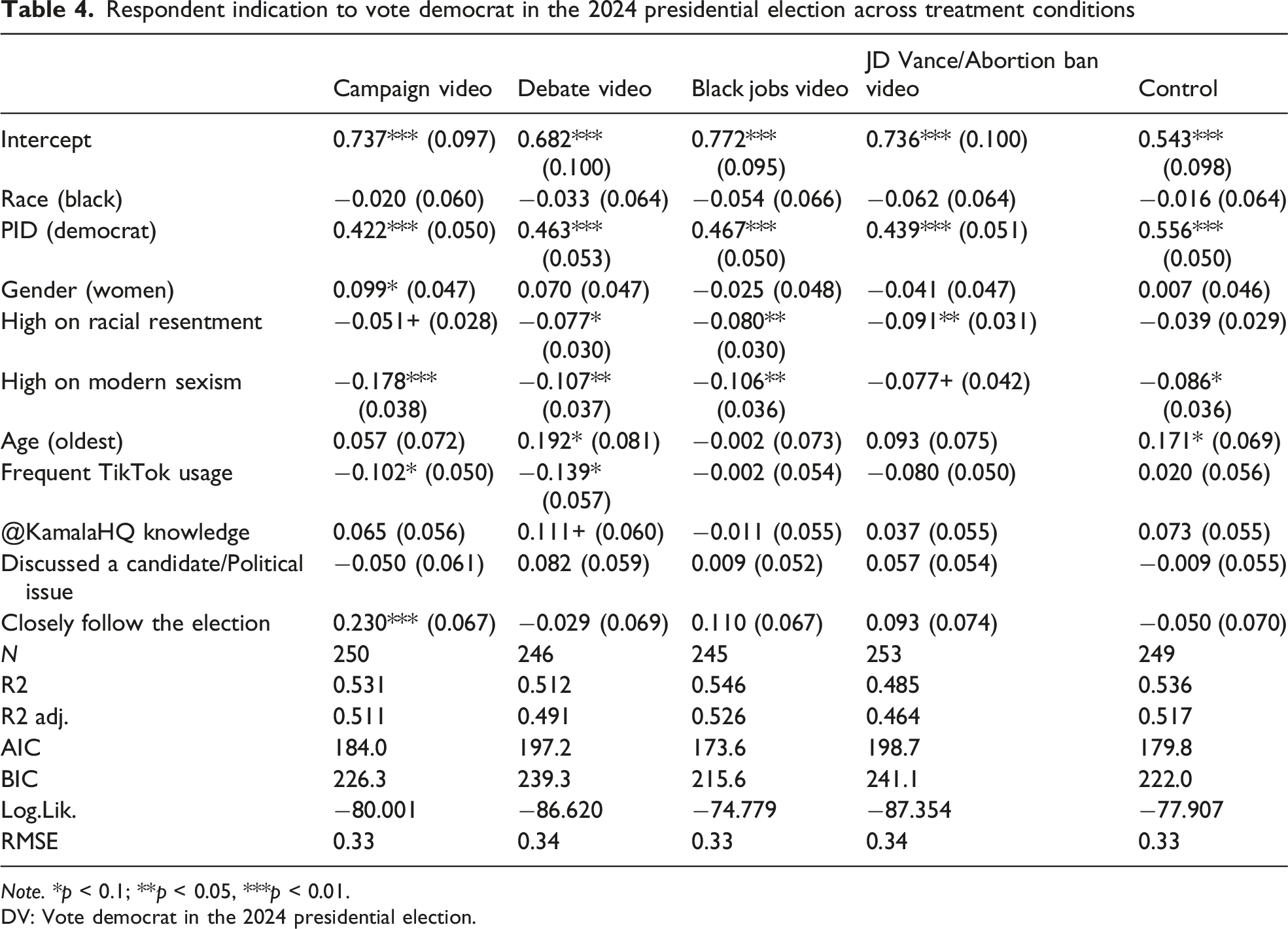
Note. *p < 0.1; **p < 0.05, ***p < 0.01.
DV: Vote democrat in the 2024 presidential election.
Discussion & Conclusion
Political candidates use social media platforms as a central component of their campaign strategy. While traditional campaigning has historically relied on television advertisements, town halls, and storefront organizing, the 2024 election demonstrated the importance of digital spaces for mobilization and messaging. For example, Black women political operatives played a major role in supporting Vice President Harris in weekly Zoom-based meetings. 9 In addition, TikTok became prominent for political discourse through the “Brat Summer” trend that launched the Harris Walz 2024 presidential campaign into Gen Z territory. 10 The explosion of political campaigning on the TikTok platform has not yet been fully understood for its contributions to increasing candidate favorability, political discussion, campaign enthusiasm, and ultimately, vote choice. Our study is among the first to investigate the relationship between short-form micro-campaign ads and political attitudes and behavior, using the 2024 presidential election as our case study.
Within these newer social media contexts, such as TikTok, identity-based backlash persists. The experimental conditions examined four distinct campaign frames: a policy frame represented by the Campaign Video, an identity frame represented by the Black Jobs Video, an incivility frame represented by the Debate Video, and a negative partisanship frame represented by the JD Vance/National Abortion Ban Video. Our study documents the persistence of racial resentment and modern sexism as deterrents to the positive evaluations of Black women political candidates. Harris’s intersectional identity may constrain her campaign’s ability to effectively reach certain segments of the electorate, particularly among voters whose political evaluations are shaped by racialized and gendered attitudes. High levels of racial resentment and modern sexism decreased support for Harris across several outcome measures. Given that Black women candidates often face numerous challenges in the political arena (e.g., Brown, 2014; Riley Emmitt and Peterson, 2023; Wright Austin, 2023), Harris’s South Asian and Black identity may help explain the limited effectiveness of some of the videos included in our experiment for voters higher on racial resentment and modern sexism. Voters who scored higher on these measures expressed significantly lower levels of support for Harris. TikTok videos, regardless of their format, do not overcome pre-existing prejudicial attitudes.
Our study indicates that TikTok campaign videos can shape candidate favorability, though these effects vary across political and demographic contexts. Identity-based appeals also have a mixed effect. With respect to our identity frame hypothesis and the Black jobs ad, Black participants expressed greater support for Vice President Harris relative to non-Black participants, and were more willing to share that content. While TikTok has more Gen Z users, we find the age effects were mixed. In some instances, younger voters expressed greater support, such as perceiving TikTok content in the debate condition as more effective at generating political enthusiasm. However, younger participants reported lower levels of support in other areas, particularly in overall favorability toward Harris. Taken together, these findings suggest that younger voters may engage with short-form political content differently than campaigns anticipate and may not be uniformly persuaded by highly stylized or “catchy” social media messaging.
Ultimately, our study demonstrates that campaign messages shared as TikTok videos have a varied impact on increasing candidate favorability towards Vice President Harris in the 2024 Presidential election. Overall, these short-form videos are not as effective as longer campaign videos on increasing candidate favorability. However, racist and sexist attitudes undermine how 30 seconds to 1 minute of content is effective in establishing candidate support. Our findings raise important questions about whether newer digital media environments mitigate intersectional bias or instead amplify existing racialized and gendered political attitudes in more visible and viral online channels. For Black women candidates in particular, social media platforms may create new opportunities for visibility, mobilization, and direct engagement with voters, while simultaneously exposing them to intensified forms of racialized scrutiny, sexism, and identity-based backlash. As campaigns increasingly rely on digital outreach and platform-based engagement, scholars must continue examining how identity, media environments, and political communication interact to shape candidate evaluation and electoral behavior. In doing so, future research can provide a more comprehensive understanding of how evolving technologies influence political persuasion and the barriers to representation of Black women within American democracy.
Supplemental Material
Supplemental Material—Social Media and Candidate Favorability: TikTok and Support for Harris During the 2024 Presidential Election
Supplemental Material for Social Media and Candidate Favorability: TikTok and Support for Harris During the 2024 Presidential Election by Sydney Carr, Chaya Crowder, Christine Slaughter in Political Research Quarterly.
Footnotes

Funding
The authors received no financial support for the research, authorship, and/or publication of this article.
Declaration of Conflicting Interests
The authors declared no potential conflicts of interest with respect to the research, authorship, and/or publication of this article.
Data Availability Statement
The replication data for the study is located here: https://dataverse.harvard.edu/dataset.xhtml?persistentId=doi:10.7910/DVN/0R4ONS. (Carr et al., 2026).
Supplemental Material
Supplemental material for this article is available online.
Notes
References
Supplementary Material
Please find the following supplemental material available below.
For Open Access articles published under a Creative Commons License, all supplemental material carries the same license as the article it is associated with.
For non-Open Access articles published, all supplemental material carries a non-exclusive license, and permission requests for re-use of supplemental material or any part of supplemental material shall be sent directly to the copyright owner as specified in the copyright notice associated with the article.
