







Abstract
Given the Latino adolescents’ heightened risk of externalizing behaviors and academic disparities experienced by Latino adolescents, this study unifies the mental health and educational perspectives to better understand factors that impact the externalizing behavior among them. Eco-developmental theory was used to conceptualize the link between parenting factors, academic factors, and externalizing behavior. Structural equation modeling was used to analyze the effects of parental support, parental monitoring knowledge, and the adolescent–teacher relationship on externalizing behavior through academic achievement (mediator), in a pool of 508 Latino adolescents from the West Texas area. Findings show that maternal support, the adolescent–teacher relationship, and academic achievement to be negatively related to externalizing behavior. In addition, maternal support and the adolescent–teacher relationship were positively associated with academic achievement. Finally, the results demonstrated academic achievement as a mediating factor in the inverse relationship between adolescent–teacher relationship and externalizing behaviors. Implications are further discussed.
Keywords
Latino adolescents are at an increased risk of externalizing behaviors (Cano et al., 2015), a broad range of behaviors that are characterized as overt and obstreperous, such as refusing to follow directions, acting out aggressively, arguing, and delinquency. For example, studies have found Latino youth to have higher rates of alcohol and drug usage when compared with other ethnic groups (De La Rosa et al., 2005; Telzer et al., 2014). Additionally, the U.S. Latino adolescents are experiencing unprecedented hardships as hate speech and intolerance continue to be promoted, particularly for those Latinos with immigrant parents (Cardoso et al., 2018). Specifically, Parra-Cardona and colleagues (2019) recently indicated that Latino adolescents who are bullied by classmates due to their parents’ undocumented immigration status are beginning to experience suicidal ideation. These newfound hardships faced by Latino youth, given the current sociopolitical climate, not only increase the risk of internalized behavior but could also cause Latinos to act out more in the form of externalizing behavior.
Numerous studies have linked parenting to adolescent externalizing behavior (e.g., Wang et al., 2012; White & Renk, 2012; Yabiku et al., 2010), and scholars are now researching nonfamilial contributing factors in order to examine a more holistic/systemic picture (C. Lopez et al., 2008). For example, studies have noted that school-related factors such as academic achievement and the adolescent–teacher relationship have a significant association with adolescent externalizing behavior (Diego et al., 2003; Hughes et al., 1999). However, a complete model of those factors and an examination of their relationship to externalizing behavior among Latino youth remain absent.
For decades, the separated fields of mental health treatment and education have both sought to understand factors that impact adolescent adjustment (e.g., see Diego et al., 2003; Keyes, 2002), and yet very rarely are these two perspectives utilized to more effectively explain the factors that impact externalizing behaviors among Latino adolescents. The mental health literature emphasizes the interactions of psychosocial symptoms and their effects on subjective wellness (Keyes, 2002), whereas education tends to focus more on the settings and processes of learning (Scribner & Cole, 1973). While these schools of thought possess their respective spheres of influence, eco-developmental theory (Prado & Pantin, 2011) has been useful in describing how these two spheres interact to influence adolescent adjustment. Eco-developmental theory emphasizes social interactions within the adolescent’s ecosystem, while taking into account developmental processes (Pantin et al., 2004).
This study conceptualizes parental support and monitoring knowledge as parenting behaviors that directly impact adolescent externalizing behavior through the adolescent’s ecosystem, specifically their microsystem (Bronfenbrenner, 1979). While parental support can be considered a type of social interaction, the adolescent–teacher relationship is the one that can impact both adolescent academic achievement (Roorda et al., 2011) and externalizing behavior (Wissink et al., 2014). In addition, there is particular value in examining the role that the student–teacher relationship can have on Latino youth, given the findings that less positive relationships often exist between teachers and their students of color (Hill & Torres, 2010). Finally, while there is ample evidence that parenting behaviors (Rodgers & Rose, 2001) and the adolescent–teacher relationship (Rassiger, 2012) influence academic achievement and that academic achievement influences externalizing behavior (Diego et al., 2003), no studies were found that simultaneously analyze these factors in one mediating model among Latino youth. As such, the purpose of this study is to examine direct and indirect associations among parenting behaviors, the adolescent–teacher relationship, and academic achievement in relation to externalizing behaviors among Latino adolescents.
Literature Review
Theoretical Framework
With its roots in ecological systems theory (Bronfenbrenner, 1979), eco-developmental theory involves a number of interacting elements such as social interactions and influences from the child’s own ecosystem (Prado & Pantin, 2011). Specific to this study, social interactions refer to the adolescent–teacher relationship and its influence on academic achievement and externalizing behavior, as well as the impact of parental support on academic achievement and externalizing behavior. As ecosystemic influences, the parental system with which the adolescent directly engages is an aspect of the microsystem, while interactions between larger systems (i.e., school system) and the more proximal family system are conceptualized as mesosystemic in nature. With a strong empirical basis in its application to Latino families (Pantin et al., 2004; Prado & Pantin, 2011), eco-developmental theory will be the guiding framework to analyze these direct and indirect associations among Latino youth.
In accordance with this eco-developmental framework (Pantin et al., 2004), this study also examines academic achievement as a mediator in the relationships between the parental and teacher factors and the outcome of externalizing behavior. Additionally, this study can be considered as being contextualized in relation to the macrosytemic cultural value (Bronfenbrenner, 1979) of “educación.” This term colloquially refers to how well one is “educated” in terms of manners, respect, and moral values (Hill & Torres, 2010; Turcios-Cotto & Milan, 2013). Specifically, it is hypothesized that more positive interactions with parents and teachers will influence Latino youth who grasp this cultural value to excel in their academic performance, further motivating them to avoid engaging in externalizing behavior. The behavioral implications of “educación” provide the rationale for testing academic achievement as a mechanism through which parental support and monitoring knowledge, as well as the adolescent–teacher relationship, continue to impact externalizing behavior among Latino adolescents.
Parental Support
In its simplest form, parental support refers to the amount of acceptance or warmth that a parent conveys to their child (Bean et al., 2006), with an abundance of research linking parental support to positive outcomes in adolescent behavior (Roelofs et al., 2006; White & Renk, 2012). For example, White and Renk (2012) noted that adolescents who reported more positive perceptions of paternal and maternal warmth reported lower levels of externalizing behavior. In addition, Roelofs and colleagues (2006) found an inverse relationship between parental support and externalizing behavior and found that parenting behavior can continue to affect children later on in life.
However, cross-cultural research has been helpful in pointing out important differences in parenting practices and outcomes in adolescent behavior depending on the cultural context (e.g., Broman et al., 2006). For instance, emotional security and acceptance may not be experienced by Latino children through praise as much as it is through high behavioral expectations (Hill et al., 2003). In another study, parental support was found to be a greater protective factor for Latino adolescent externalizing behavior than for European American or African American youth (Broman et al., 2006). While such research among Latino families has generally demonstrated a significant impact of parental support on youth externalizing behavior (e.g., Broman et al., 2006; Hill et al., 2003), other studies (e.g., Pereyra & Bean, 2017) have not found parental support to have a significant impact on substance use in their sample. Given these mixed results among Latino families, it is important to continue investigating how parental support influences externalizing behavior among Latino adolescents.
Parental Monitoring Knowledge
The effects of parenting on adolescent externalizing behaviors have been analyzed across numerous studies, with many utilizing the construct of parental monitoring (Shakib et al., 2003; Smith & Krohn, 1995; Yabiku et al., 2010). More recently, accuracy of the term “monitoring” has been scrutinized and questioned (see Pereyra & Bean, 2017, for more detail), and “monitoring knowledge” has been used as an alternative referring to parental efforts to be aware of children’s activities, relationships, and whereabouts (Lippold et al., 2011). This study will use the term parental “monitoring knowledge,” although there are references to “monitoring” in this literature review when citing studies that utilized this term.
Interestingly, when comparing monitoring cross-culturally, some researchers have found Latino parents to have higher levels of monitoring than their Asian American counterparts (Okagaki & Frensch, 1998; Shakib et al., 2003) and even more so than their European American counterparts (Okagaki & Frensch, 1998). Bulcroft and colleagues (1996) found that children’s intrafamilial behaviors (e.g., amount of TV watched) were less restricted among Latino parents, but in the case of extrafamilial areas such as stricter curfews, Latino parents were more stern than their Anglo counterparts. Furthermore, Latino parents have often been described as being authoritarian and placing higher value/expectations on discipline than Anglo parents and other ethnicities (Julian et al., 1994).
Across varying gender, ethnicity, and socioeconomic groups, lower youth externalizing behaviors have been consistently associated with greater levels of parental monitoring (e.g., Yabiku et al., 2010). Yet studies of parental monitoring and externalizing behavior among Latino youth have produced mixed results. For instance, Yabiku and colleagues (2010) found that parental monitoring was predictive of lower externalizing behavior (i.e., substance use) in their sample, whereas Smith and Krohn (1995) found parental monitoring to be a protective factor against delinquency for Anglo and African American adolescents but not for Latino youth. Moreover, Pereyra and Bean (2017) recently found that maternal monitoring knowledge reduced the risk of Latino adolescent substance use, while paternal monitoring knowledge had no significant impact. A more in-depth analysis of parental monitoring (knowledge) among Latino families is warranted due to the many cultural differences and mixed findings in the literature.
Maternal and Paternal Differences in Parenting Practices Among Latinos
In general, gender differences have been noted in the parenting carried out by mothers and fathers in European American and even Latino families (Baumrind, 1980; Pleck, 1997). For example, mothers are usually seen as the primary caregivers, while fathers are viewed as the economic providers and authority figures in Latino homes (Falicov, 1998). These traditional gender roles are even more pronounced among immigrant parents or those with stronger cultural ties to Mexican heritage (Parra-Cardona et al., 2008). In one study, mothers were found to obtain more knowledge about their children’s day-to-day activities than fathers (Updegraff et al., 2009), while in another study, adolescents reported having more open communication with mothers than fathers (Crockett et al., 2007).
These differences are consistent with Latino cultural gender roles described in the literature as “machismo” and “marianismo” for males and females, respectively. Unfortunately, negative stereotypes have also dominated perceptions of these two gender roles in the literature (see Mirandé, 1991, for example). Other scholars have challenged these assumptions, taking a more strength-based approach to researching Latino gender roles and finding more positive outcomes among Latino families (Saracho & Spodek, 2007). For example, Cruz and colleagues (2011) found that Latino fathers’ “machismo” attitudes were positively associated with children’s reports of positive father involvement for both boys and girls in their study. Research has also suggested that “marianismo” may be associated with a Latina adolescent’s decision to complete high school (Stearns & Glennie, 2006). Interestingly, there are even some studies showing that Latino fathers are involved in many aspects of child-rearing to the same degree and even more so than their Anglo counterparts (Yeung et al., 2001).
In terms of empirical research, differences in parenting practices between mothers and fathers have been noted not only in families of the majority culture (e.g., Pleck, 1997) but among ethnic minorities as well. For example, Bean and colleagues (2006) found that higher paternal support was associated with less antisocial behavior in their European American sample, while maternal support had no significant relationship with antisocial behavior in African American families. Among Latino families, research has also indicated that associations between cultural orientation, parent–adolescent relationship quality, and adolescents’ sexual intentions can differ depending on the parent’s gender (Killoren et al., 2011). In a more recent study, Pereyra and Bean (2017) studied the effects of parental support, monitoring knowledge, and psychological control from each parent (among other variables) on Latino adolescent substance abuse and concluded that mothers’ monitoring knowledge was the only parenting variable associated with less adolescent substance use. In light of the parenting differences documented in the literature between Latino mothers and fathers and their influence on adolescent behavior, this study will not only look at maternal and paternal influences separately but will also expand the eco-developmental perspective to include school-related factors that can affect externalizing behavior among Latino adolescents.
Adolescent–Teacher Relationship
Research has shown the student–teacher relationship to more reliably predict adolescent outcomes than most other school-related factors (e.g., sense of belonging; see Roorda et al., 2011). In their meta-analysis, Roorda and colleagues (2011) found significant associations between student–teacher relationships and academic outcomes. Although studies of the effects of the student–teacher relationship on academic achievement among ethnic minorities are scarce, there is evidence suggesting that adolescent–teacher relationships can impact academic outcomes among at-risk youth. For example, Rassiger (2012) found that a positive adolescent–teacher relationship did improve academic success among at-risk Latino and African American students.
Research in adolescent functioning also demonstrates that teachers’ influence on students can go beyond the academic realm and impact behavior as well (Jennings & Greenberg, 2009). While more attention has historically been given to the ways that negative student behavior is detrimental to the student–teacher relationship (e.g., Fry, 1983), there is also evidence of the reverse. For instance, Hughes and colleagues (1999) found that more positively rated student–teacher relationships tended to predict less childhood hostility over the following year. In another study, a positive adolescent–teacher relationship was found to be associated with less misconduct at school as well as fewer behavioral problems outside of school (Wissink et al., 2014). However, no studies have been found analyzing these factors among Latino adolescents.
Academic Achievement
From an eco-developmental perspective, not only is it important to include the adolescent–teacher relationship as a construct of social interaction when merging the mental health perspective with the educational, but it becomes important to analyze academic achievement and its effect on externalizing behavior since the school system plays such a crucial role in the adolescent’s microsystem (Pantin et al., 2004; Prado & Pantin, 2011). When compared to other ethnicities, Latinos have been identified as a particularly vulnerable student population due to academic underperformance and high dropout rates (M. H. Lopez, 2009; Turcios-Cotto & Milan, 2013). Despite these disparities and what some school systems might believe about Latino values regarding education (Hill & Torres, 2010), Latino parents place great value on education and the academic success of their children (Turcios-Cotto & Milan, 2013).
In terms of findings related to the specific variables studied here, connections have been found between parenting and academic outcomes (Rodgers & Rose, 2001) as well as academic outcomes and externalizing behavior (e.g., Bryant et al., 2003; Zimmermann et al., 2013). For example, parental support has been found to be associated with positive academic outcomes in Latino youth (Alfaro et al., 2009), with increased levels of parental monitoring being associated with lower school dropout rates among Latinos (Martinez et al., 2004). Regarding the connection between academic outcomes and externalizing behavior, students with higher academic achievement may be less at risk to engage in externalizing behavior (Diego et al., 2003). Similarly, academic achievement has been shown to influence externalizing behavior among Latino youth as well (C. Lopez et al., 2008; Vaughn et al., 2011). For instance, C. Lopez and colleagues (2008) found that poor school functioning was associated with more externalizing behavior, while Vaughn and colleagues (2011) found that failing grades contributed to externalizing behavior among Latino adolescents. Given these isolated connections and the theoretical rationale regarding the Latino cultural value of “educación” (Hill & Torres, 2010; Turcios-Cotto & Milan, 2013) and its behavioral implications within an eco-developmental perspective, this study becomes the first to our knowledge to examine the direct and indirect effects of parenting and the adolescent–teacher relationship on externalizing behavior through academic achievement in one inclusive mediating model for Latino youth.
This Study
The purpose of this study is to examine the direct effects of parental support and monitoring knowledge (maternal/paternal) and the adolescent–teacher relationship on externalizing behavior, as well as the mediating effects of academic achievement between those parent and teacher factors and externalizing behavior among Latino adolescents, while controlling for adolescent gender, grade level, and family structure. The following hypotheses were proposed:
Method
Participants and Procedure
Data were obtained from the Youth and Family Project, a school-based, self-reported survey of 9–12th graders from a West Texas area school district. Written parental consent was obtained along with respondent consent prior to surveying. Based on teachers’ willingness to allow surveying in their classrooms, 4,150 students were eligible for participation, and consent forms were sent home to the parents of these students. However, due to student absences and parental consent forms not being returned, 2,292 students were surveyed, resulting in a 55.3% response rate. Due to questionable response integrity (e.g., responses that were entirely loaded to the highest value or lowest), 78 surveys were discarded, leaving a total of 2,214 completed surveys. All students were recruited and surveyed in their designated English course (by grade level). Participants were monitored during the survey by graduate students and high school and university faculty.
The Latino ethnicity portion (self-identified by participants) of the sample included 508 youth from two-parent families, which consisted of 314 boys and 429 girls. Youth from two-parent families were examined, given the desire to examine both maternal and paternal parenting behaviors together. The mean age was 16 years, with a range of 14–18 years old. As for socioeconomic status, it was determined that adolescents would not be able to accurately estimate their family’s income in dollar amounts. Consequently, they were asked to compare their family-level income to other peers; 13 (2.5%) reported being “a lot poorer than most,” 64 (12.6%) reported being “a little poorer than most,” 292 (57.4%) reported being “about the same as most,” 105 (20.7%) reported being “a little richer than most,” 14 (2.8%) of the participants reported being “a lot richer than most,” and 20 (4%) were unaccounted for (missing data). The sample was determined to be moderately to highly acculturated based on (a) participant enrollment in high school–level English courses (where they were surveyed) and (b) a much lower percentage of students with limited English proficiency in the school district (2.6%), compared to the overall state average (16.7%).
Measures
Parental support
Parental support was measured using the 10-item Acceptance subscale from the revised Child Report of Parent Behavior Inventory (Barber, 1996). Parental support was differentiated into mothers’ support (Cronbach’s α = .92) and fathers’ support (Cronbach’s α = .91) as two separate latent variables. Adolescents responded on a 3-point Likert-type scale from 1 = not like her or him to 3 = a lot like her or him as to how well items described their mothers and fathers. A sample item from this scale reads, “cheers me up when I am sad.” While items were not randomly selected to construct the measure, a confirmatory factor analysis was used to identify the items that loaded appropriately onto the scale. All of the items with a factor loading above .68 for the mothers’ support scale and above .75 for the fathers’ support scale were used in the finalized version of the measure.
Parental monitoring knowledge
Monitoring knowledge (Brown et al., 1993; Pereyra & Bean, 2017) was differentiated between mothers’ monitoring knowledge (Cronbach’s α = .82) and fathers’ monitoring knowledge (Cronbach’s α = .88) as well. The scales consisted of 5 items measured on a 3-point Likert-type scale ranging from doesn’t know to knows a lot. Adolescents responded to how much their “parents really know” about items such as “who your friends are.” While items were not randomly selected to construct the measure, a confirmatory factor analysis was used to identify the items that loaded appropriately onto scale. All of the items with a factor loading above .57 for the mothers’ monitoring knowledge scale and above .67 for the fathers’ monitoring knowledge scale were used in the finalized version of the measure.
Adolescent–teacher relationship
The adolescent–teacher relationship (Cronbach’s α = .90; Eccles et al., 1997) was measured by a combination of items describing the adolescent’s perception of their relationship with teachers. The scales consisted of 5 items measured on a 5-point Likert-type scale ranging from none to all. Adolescents responded to questions pertaining to how many of their teachers connected with them in different ways; for example, “how many of your teachers really listen to what you have to say.” While items were not randomly selected to construct the measure, a confirmatory factor analysis was used to identify the items that loaded appropriately onto the scale. All of the items with a factor loading above .67 were used in the finalized version of the measure.
Academic achievement
Adolescent academic achievement (Eccles et al., 1997) was measured by the following question: “In general, how well did you do in school? Would you say your grades were:” Respondents responded on a 5-point Likert-type scale from 1 = well above average to 5 = well below average relative to peers. This item was then reverse-coded to depict a higher score as having a higher level of academic achievement.
Externalizing behavior
Adolescent externalizing behavior (Cronbach’s α = .98) was measured using items from the Delinquency and Aggression scales of the Child Behavior Checklist–Youth Self-Report (Achenbach, 1991). Adolescents responded on a 3-point Likert-type scale from 0 = not true to 2 = very true or often true as which externalizing behaviors they have engaged in. A sample item from this measure reads, “I get in many fights.” While items were not randomly selected to construct the measure, a confirmatory factor analysis was used to identify the items that loaded appropriately unto the scale. All of the items with a factor loading above .51 were used in the finalized version of the measure.
Analysis
Structural equation modeling (Kline, 2010) was used to test direct and indirect effects of maternal/paternal support, maternal/paternal monitoring knowledge, and the adolescent–teacher relationship on externalizing behavior via adolescent academic achievement. The bootstrapping method was chosen not only because it does not rely on the restrictive assumption that the sampling distribution is normally distributed but also because it is now considered to be the most appropriate way to examine indirect effects (Hayes, 2013; Kline, 2010). In the analysis of this study, 2,000 bootstrap samples were used to examine the indirect effects of academic achievement on the relationship between all independent variables (maternal/paternal support, maternal/paternal monitoring knowledge, and the adolescent–teacher relationship) and externalizing behavior, while controlling for adolescent gender, grade level, and family structure. The bootstrapping method also adjusts standard errors so they are appropriate for indirect effects (Kline, 2010).
Results
Direct Effects
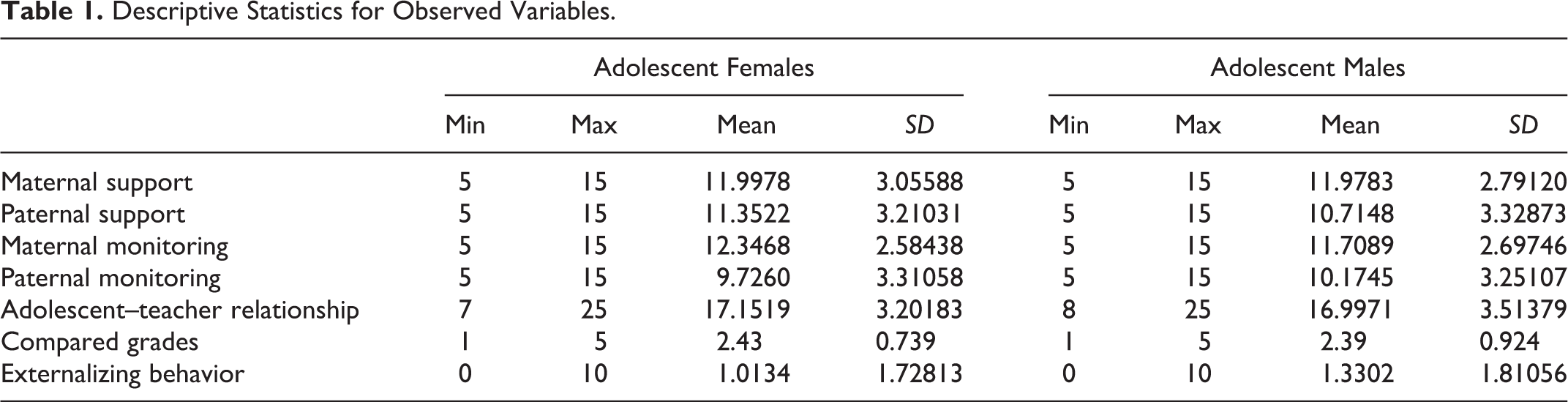
Descriptive statistics for all study variables are presented in Table 1. Bivariate correlations are presented in Table 2, and all correlations were found to be significant and in the expected direction. Model fit statistics revealed a χ2 coefficient of 1,299.238, p < .001, df = 770, with the following fit indices: CFI = .963, TLI = .959, RMSEA = .030, and SRMR = .042. These results indicated that the model was a very good fit for the data, based on recommended fit index standards (i.e., CFI values above .90, TLI values above .95, RMSEA value below .05, SRMR value below .08; Hu & Bentler, 1999). Surprisingly, maternal monitoring knowledge was the only parenting variable to have a significant negative association with adolescent externalizing behavior (β = −.27, p < .001). A positive adolescent–teacher relationship was found to be negatively associated with adolescent externalizing behavior (β = −.10, p < .05), and academic achievement was also found to be negatively associated with adolescent externalizing behavior (β = −.12, p < .01). In terms of academic achievement, maternal support was positively associated with academic achievement (β = .13, p < .05), and a positive adolescent–teacher relationship was positively associated with academic achievement (β = .13, p < .01; see Figure 1 for additional details).
Descriptive Statistics for Observed Variables.
Bivariate Correlations for Study Variables for Latino Adolescent Girls and Boys
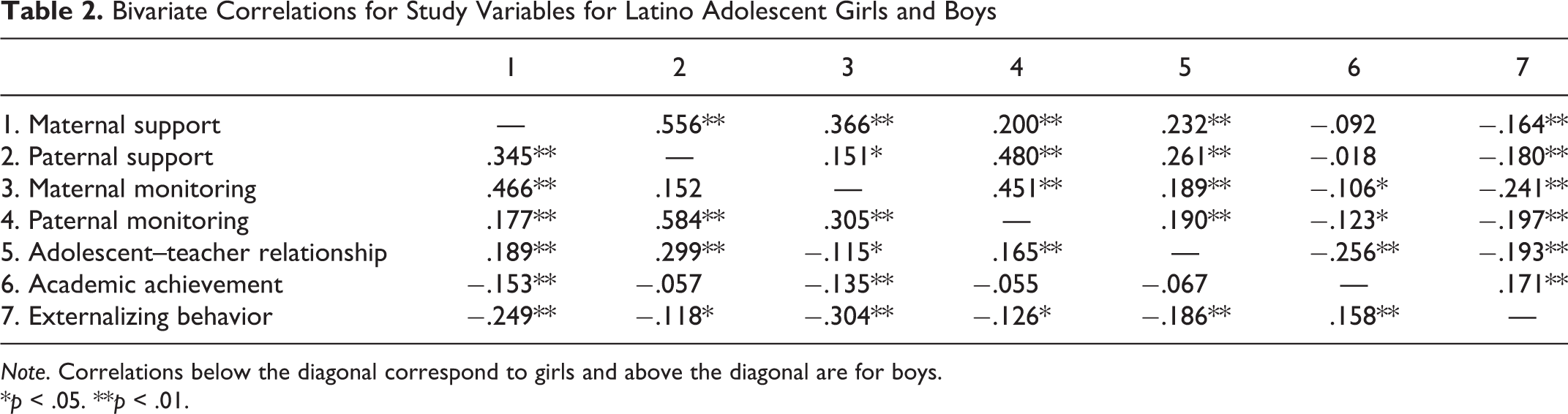
Note. Correlations below the diagonal correspond to girls and above the diagonal are for boys.
*p < .05. **p < .01.
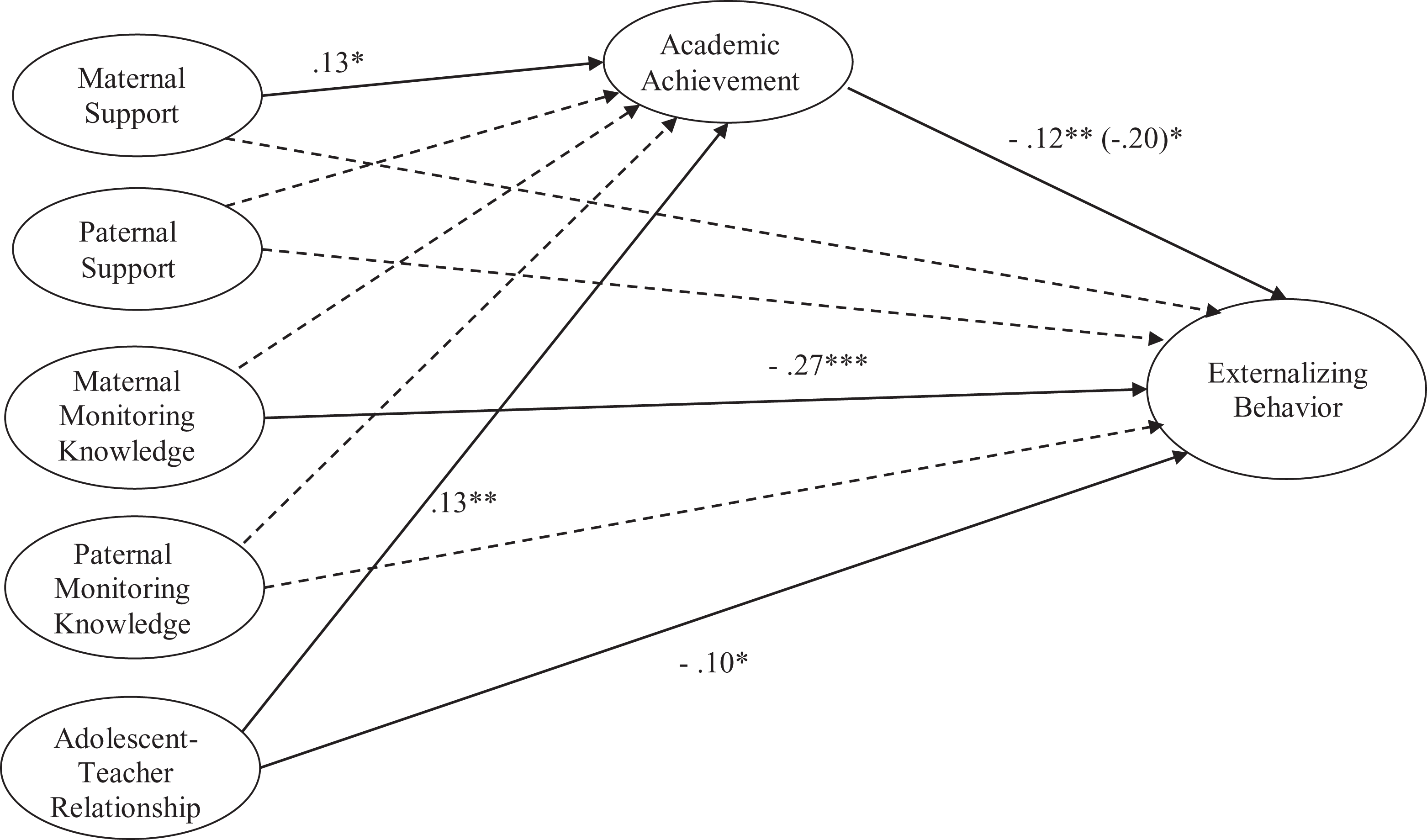
Structural equation model of parenting and school factors in relation to externalized problem behaviors in Latino youth. Note. *p < .05. **p < .01. ***p < .001. Significant direct paths (indirect effects for adolescent-teacher relationship in parentheses), nonsignificant paths are dashed.
In the analysis of indirect paths, 2,000 bootstrap iterations were used, and results indicated only one significant indirect effect between the adolescent–teacher relationship and adolescent externalizing behavior, via academic achievement at the .05 level (p = .047). Grade level was the only control variable found to be significantly associated with adolescent externalizing behavior (p < .05). This model accounted for 17% of the overall variance (R 2) of adolescent externalizing behavior. All other paths (direct and indirect) were nonsignificant.
Discussion
Direct Effects on Latino Adolescent Externalizing Behavior
This study examined the direct and indirect associations between various parenting and school-related factors and academic and behavioral outcomes. While parenting behaviors have generally been found to be strong deterrents for adolescent externalizing behavior (Lippold et al., 2011; Roelofs et al., 2006; White & Renk, 2012), this study only found one parenting variable to reduce the risk of Latino adolescent externalizing behavior. Specifically, perceived maternal monitoring knowledge was associated with less externalizing behavior, thus partially validating the first hypothesis. While it is unclear to the authors why parental support and paternal monitoring knowledge were not found to be significant factors impacting externalizing behavior with the current sample, the finding regarding the influence of maternal monitoring knowledge on externalizing behavior among Latino youth is consistent with other studies showing more impactful monitoring from mothers than fathers in adolescent adjustment (Pereyra & Bean, 2017). Falicov (1998) cites traditional gender roles in parenting among Latinos as a contributing factor toward this particular occurrence, given that mothers tend to invest more direct time with their children than fathers and thus might hold more sway than fathers in curbing externalizing behaviors via monitoring knowledge. From an eco-developmental perspective (Pantin et al., 2004; Prado & Pantin, 2011), maternal monitoring knowledge can be viewed an important microsystemic factor in relation to externalizing behavior problems for Latino adolescents.
The first hypothesis also found support in that adolescent–teacher relationships were negatively associated with externalizing behaviors. This finding coincides with other studies (among non-Latinos) noting an inverse association between the student–teacher relationship and externalizing behavior (Diaz et al., 2017; Hughes et al., 1999; Wissink et al., 2014). However, this is the first to our knowledge to analyze this association among Latino adolescents. Interpreted according to an eco-developmental lens (Pantin et al., 2004), where social interactions are vital in terms of adolescent adjustment, these findings support this theory because there is evidence that a positive adolescent–teacher extends beyond the classroom and can reduce the risk of externalizing behavior among Latino adolescents.
Finally, the first hypothesis also saw support in how academic achievement inversely related to externalizing behavior. While there is ample evidence of this inverse relationship among the general population (Bryant et al., 2003; Diego et al., 2003; Zimmermann et al., 2013), this study’s findings are in line with other Latino-specific studies demonstrating the negative association between academic achievement and externalizing behavior (C. Lopez et al., 2008; Vaughn et al., 2011). From an eco-developmental framework, higher academic functioning in the school system places Latino adolescents in a different eco-systemic sphere (or student environment) which is less prone to externalizing behavior (Pantin et al., 2004; Prado & Pantin, 2011).
Direct Effects on Latino Adolescent Academic Achievement
The second hypothesis was partially supported in that increased perceived maternal warmth coincided with greater academic achievement. Unfortunately, there are many misunderstandings about Latino cultural values of education that can contribute to the disparities found in the literature (M. H. Lopez, 2009; Turcios-Cotto & Milan, 2013). Research has also shown that teachers not only praise Latino students less (even for correct answers) and behave less favorably toward them, but that they are even likely to have minimal expectations for their Latino students (Tenenbaum & Ruck, 2007), thereby contributing to the large academic disparities in Latino youth. Teachers have misconstrued Latino parental school involvement believing that they are less interested in their children’s education, even though parents have indicated attending Parent Teacher Association (PTA) meetings even when they could not understand the content of the meetings because they wanted to prove to their children and their teachers that they do value a quality education (Hill & Torres, 2010). When Latino parents do engage in activities designed by the school system and teachers to foster parental involvement, they often come away feeling confused by the school structure and their implicit expectations (Carreon et al., 2005). Even though Latino parents hold high cultural values of “educación” (Hill & Torres, 2010; Turcios-Cotto & Milan, 2013), they are often disappointed with the schools’ lack of rigor, low standards, and marked inequity in educational quality (Hill & Torres, 2010). The findings of this study confound some of the misconceptions of the interplay between Latino parenting and their children’s academic achievement (Hill & Torres, 2010), while simultaneously coinciding with Alfaro and colleagues’ (2009) study showing that parental support from Latino parents increases the likelihood of their adolescent children performing better in school.
Unsurprisingly, the second hypothesis was partially validated by the positive association between the adolescent–teacher relationship and academic achievement, as demonstrated by previous literature (e.g., Roorda et al., 2011). Although sparse, there exists a budding body of research into how positive adolescent–teacher relationships can factor into the academic success of vulnerable Latino students (e.g., Rassiger, 2012), much akin to the present findings. Eco-developmentally speaking (Pantin et al., 2004; Prado & Pantin, 2011), positive relationships and interactions with teachers are important factors in improving Latino adolescent academic functioning but are most likely heightened given the current academic disparities faced by Latino students (Hill & Torres, 2010; M. H. Lopez, 2009; Tenenbaum & Ruck, 2007; Turcios-Cotto & Milan, 2013).
Mediating Effects of Academic Achievement on Latino Adolescent Externalizing Behavior
As for the final hypothesis, only one significant indirect effect was found—academic achievement was found to mediate the association between the adolescent–teacher relationship and externalizing behavior. While studies analyzing this particular indirect pathway remained elusive, these findings are consistent with research that have found isolated occasions of links between the adolescent–teacher relationship and academic achievement (Rassiger, 2012; Roorda et al., 2011) and between academic achievement and externalizing behavior (C. Lopez et al., 2008; Vaughn et al., 2011). From an eco-developmental perspective (Pantin et al., 2004; Prado & Pantin, 2011), academic achievement becomes the ecosystemic factor (via the macrosystem) through which the adolescent–teacher relationship impacts adolescent externalizing behavior because of the cultural value of “educación” and its behavioral implications (Turcios-Cotto & Milan, 2013). Specifically, the better the relationship is between the Latino adolescent and their teacher, the more they want to perform better in school and thus reduce the risk of externalizing behavior.
Conclusion
While this study has provided some valuable insights regarding eco-developmental factors that impact Latino adolescent externalizing behaviors, it is not without its limitations—particularly within the design. One such constraint is found in the cross-sectional nature of the study. Secondly, acculturation was not measured during the surveying as a participant variable. Third, the data gathered were provided solely from the perspective of the adolescent, without an understanding of parent or teacher perspectives. As such, further investigation could include input from the significant adults in the adolescent’s life. Consistent with an eco-developmental perspective and given the disparities found between Latino parents and the education system (Hill & Torres, 2010), the parent–teacher relationship could be another critical factor to receive future research attention. Plus, given the relatively sparse literature focused on differences in academic achievement and externalizing behaviors between various U.S. Hispanic subgroups (Fomby & Estacion, 2011; Ortiz et al., 2012), the possible effects of ethnic identity and regional residence on these variables should be considered (Vega et al., 2002; Zarate et al., 2005). Prior analysis has revealed the potential for interactions between these variables and educational attainment (Muñoz & Ortega, 1997), thus pointing to the possibility of such an effect on externalizing behaviors. Efforts could thus be made to both compare between these groups and control for said factors. Lastly, while a theoretical inference was made regarding the Latino cultural value of “educación” (Hill & Torres, 2010; Turcios-Cotto & Milan, 2013), it was not directly measured simply because it has not yet been conceptualized as a discrete measure.
As was previously observed and presently hypothesized, the data have shown maternal support, the adolescent–teacher relationship, and academic achievement to be negatively related to externalizing behavior. In addition, maternal support and the adolescent teacher relationship were positively associated with academic achievement. Finally, the results demonstrated academic achievement as a mediating factor in the inverse relationship between the adolescent–teacher relationship and externalizing behaviors. These findings could prove the first of many insights into the myriad of factors that play into the prevalence of externalizing behaviors among Latino adolescents, unifying the mental health and educational perspectives under a single eco-developmental theoretical framework (Pantin et al., 2004; Prado & Pantin, 2011).
Footnotes
Declaration of Conflicting Interests
The author(s) declared no potential conflicts of interest with respect to the research, authorship, and/or publication of this article.
Funding
The author(s) received no financial support for the research, authorship, and/or publication of this article.
