







Abstract
Suicide is one of the leading causes of death, and the rates of suicidal ideation are higher among unwed mothers compared to their counterparts in the Republic of Korea. Adverse childhood experiences (ACEs) have been associated with negative health and behavior outcomes, including suicidal ideation. However, the impact of ACEs on suicidal ideation among Korean unwed mothers remains underexplored. The purpose of this study is to examine the relationships between ACEs and suicidal ideation in adulthood within a sample of 255 Korean unwed mothers. Logistic regression was used to examine the impact of both cumulative and specific ACEs on suicidal ideation in adulthood. The results showed that 34.1% of mothers reported suicidal ideation, 79.8% experienced at least one ACE, and 44.7% reported experiencing four or more ACEs, highlighting a significant level of risk. The number of ACEs was associated with increased odds of having suicidal ideation. Distinct effects of specific types and combinations of ACEs were also identified. Unwed mothers exposed to physical neglect, emotional neglect, or domestic violence were at heightened risk of suicidal ideation. These findings suggest that neglect and domestic violence are critical factors in identifying unwed mothers at risk for suicidal ideation and underscore the necessity of implementing trauma-informed practices to mitigate suicide risk.
Suicide constitutes a critical public health crisis in the Republic of Korea (hereafter Korea), which reports the highest rates among Organization for Economic Cooperation and Development (OECD) countries (OECD, 2023). In Korea, suicide is the first leading cause of death in people aged 10–39, and the second leading cause of death in people aged 40–59 (Ministry of Health and Welfare & Korea Foundation for Suicide Prevention, 2024). Research has shown that the burden of suicide is not equally distributed across various sub-populations (Woo et al., 2018; WHO, 2021). Individuals with adverse childhood experiences (ACEs) are at increased risk of suicide (Angelakis et al., 2019; Hughes et al., 2017), suggesting that ACEs may contribute to disparities in suicide. In the Korean context, where childbirth is predominantly expected to occur within the institution of marriage (OECD, 2019), unwed mothers encounter greater social discrimination compared to other single mothers, such as widows or divorcees (Kim, 2013). Relatedly, unwed mothers in Korea are at a higher risk of suicide, partly due to the additional stress associated with their status (Yi, 2012). Despite this, research specifically addressing suicide among unwed mothers in Korea is scarce, leaving the contributing factors to their heightened suicide risk largely unexplored. This study investigates the relationship between ACEs and suicidal ideation among Korean unwed mothers and examines how different types of ACEs elucidate this relationship. Suicidal ideation is recognized as a critical precursor to suicide attempts and completed suicides (Hubers et al., 2018; Kessler et al., 1999), underscoring the necessity of understanding the factors influencing suicidal ideation to prevent progression to suicide attempts.
ACEs and Suicidal Ideation
ACEs are widespread globally. A systematic review encompassing 112 studies across 96 countries revealed that approximately one billion children experienced ACEs, with 54% of children subjected to violence worldwide (Hillis et al., 2016). A meta-analysis of ACEs from 37 published studies around the world (N = 253,719) demonstrated that 57% of participants reported at least one ACE, while 13% reported experiencing four or more ACEs (Hughes et al., 2017). In Korea, research indicates that between 39% and 89% of adults have been exposed to at least one ACE (Kim & Son, 2020; Min, 2018; Ryu et al., 2017, 2018). Although variations in reported ACE prevalence can be attributed to differing assessment methodologies and diverse populations, the data consistently show that ACEs are common and frequently co-occur. Furthermore, given that ACEs can be transmitted across generations (Southern & Sullivan, 2021), their long-term impact should be considered and addressed through therapeutic interventions.
ACEs are foundational to numerous health and behavioral issues in adulthood (Centers for Disease Control and Prevention [CDC], 2021b), including suicidal behaviors (Angelakis et al., 2019; Liu et al., 2017; Zatti et al., 2017). Using a nationally representative U.S. sample (N = 9,421), Thompson et al. (2019) demonstrated that an accumulation of ACEs significantly increased the risk of suicide in adulthood. The odds of experiencing suicidal ideation and suicide attempts were three times higher for individuals with three or more ACEs compared to those with no ACEs.
Further, the types of ACEs exerted differential impacts on suicidal ideation and suicide attempts. Specifically, physical, sexual, and emotional abuse, parental incarceration, and a family history of suicidality increased the odds of suicidal ideation and suicide attempts by 1.4–2.7 times. In contrast, neglect, parental death, and parental alcoholism did not have a significant effect (Thompson et al., 2019). Another study found that persons who experienced any type of ACEs were 2–5 times more likely to attempt suicide (Dube et al., 2001).
Extant research has predominantly linked cumulative ACEs with adverse health outcomes. However, there has been less focus on specific ACEs or combinations of ACEs that may more precisely identify individuals at risk. Brown et al. (2019) explored specific ACEs and the clustering of ACEs in relation to complex health issues among welfare-involved children. Results indicated that physical abuse and caregiver mental illness, particularly when experienced concurrently, were more strongly associated with health challenges. This information may provide greater clarity in identifying key factors associated with health outcomes, thereby enhancing opportunities for early intervention.
While the relationship between ACEs and suicidal ideation has been extensively documented in Western countries, the impact of ACE exposure on suicidal ideation in non-Western contexts, particularly among Korean populations, remains less understood. Moreover, the limited studies that do examine the relationship between ACEs and suicidal ideation in Korea have primarily focused on the general population (Kim & Kim, 2017; Park, 2021). Research specifically addressing marginalized sub-populations with heightened vulnerability to suicide, such as child-rearing unwed mothers in Korea, is scarce. Unwed mothers constitute a particularly vulnerable sub-population in Korea (Kim et al., 2022), as they encounter significant social discrimination and exclusion (Han et al., 2021; Kim, 2013). Approximately 90% of unwed mothers reported experiencing perceived social prejudice and discrimination due to their single mother status (Kim & Ahn, 2009). Further, with 99.5% of international adoptees and 73.9% of domestic adoptees originating from unwed mothers (Ministry of Health and Welfare, 2022), it is evident that unwed mothers continue to face significant pressure to place their children for adoption. These findings suggest that unwed mothers in Korea face additional stigmatizing stressors, alongside financial burdens and typical parenting challenges, which may elevate their risk of suicidal ideation. Kim and Kim (2012) found that unwed mothers exhibited higher levels of suicidal ideation compared to other single parents (such as widows or divorcees) and the general population in Korea. Given the established predictive relationship between ACEs and suicidal ideation in studies involving general population samples in Western countries, it is imperative to expand this research to examine the impact of ACEs on suicidal ideation among Korean unwed mothers.
Purpose of the Present Study
This study investigates the relationship between ACEs and suicidal ideation among unwed mothers residing in Korea. Firstly, we examined whether higher levels of cumulative ACEs are associated with increased suicidal ideation. We hypothesized that there would be a dose-response relationship between the total number of ACEs and suicidal ideation. Secondly, we disaggregated the total ACEs into individual categories and their combinations to assess the relative impact of different patterns of adversities in predicting suicidal ideation. Given the limited evidence on the distinct consequences of each type of ACE within the Korean population, we did not propose a specific hypothesis regarding their relative predictive strength. By focusing on ACEs, this study aims to enhance the understanding of their impact on suicidal ideation among underserved populations within the unique context of Korea.
Method
Participants
Participants were 255 Korean unwed mothers aged 18 or older, each raising one or more children (M = 30.8 years, SD = 6.51, age range = 18–49 years). Participants were recruited through various online forums dedicated to unwed mothers, as well as organizations and associations supporting unwed mothers, supplemented by word-of-mouth recruitment nationwide. A direct web link to the online survey was posted to their webpages and/or sent to their listserv members. Unwed mothers who wanted to participate in the study completed the online survey between July and September of 2018. Each participant received an electronic gift card valued at USD 7.75 as an incentive. The study was approved by the University of Connecticut's Institutional Review Board, and all participants provided informed consent prior to participation.
Measures
Adverse childhood experiences (ACEs)
ACEs were assessed using an adapted version of the original CDC-Kaiser ACE Study (Dong et al., 2004; Felitti et al., 1998), which evaluates participants’ exposure to ten types of childhood adversities. These adversities include abuse (emotional, physical, or sexual), neglect (emotional or physical), and household challenges (parental separation or divorce, domestic violence, incarceration of a household member, household substance abuse, or household mental illness) prior to age 18 (CDC, 2021a). Each positive endorsement of an item was coded as 1 (yes) to indicate exposure to the specific adversity. The positively endorsed items were then summed to generate a composite score (ranging from 0 to 10) for each participant, representing the total number of childhood adversities experienced before age 18. Additionally, items were categorized into cumulative score groups of 0, 1–3, or 4–10 ACEs (Bhushan et al., 2020) to facilitate the detection of meaningful associations.
Suicidal ideation in the past year
Suicidal ideation within the past year was assessed through the following question: “Have you ever seriously thought about taking your life? If yes, how long ago?” The response options were 1 (no), 2 (within one month), 3 (within the last 12 months), and 4 (over a year ago). Participants who selected “within one month” or “within the last 12 months” were coded as having suicidal ideation during the past year.
Covariates
Previous research has demonstrated that the rates of suicidal behavior vary according to age (WHO, 2021) and socio-economic status (Raschke et al., 2022). Therefore, age (in years), educational attainment (categorized as junior high or less, high school graduate, associate degree, bachelor's degree, and graduate degree), income (measured as monthly household income), and employment status (classified as permanent employee, non-permanent employee, self-employed, unpaid family worker, unemployed, or student) were included as covariates.
Data Analysis
Frequencies and proportions were calculated for each categorical variable. Chi-square tests were employed to compare the prevalence of suicidal ideation across different categories. Logistic regression analysis was conducted to assess the impact of both the number and types of ACEs on suicidal ideation, with age as a control variable. Although education level, income, and employment status were initially considered as covariates, chi-square tests indicated that none of these variables were significantly associated with suicidal ideation; therefore, they were excluded from subsequent analyses. All statistical analyses were performed using SPSS.
Results
The overall prevalence of suicidal ideation among the participants was 34.1%. The prevalence was lower among individuals aged 40–49 years (9.1%) compared to those aged 30–39 years (36.8%) and 18–29 years (36.5%). Table 1 provides the distribution of ACEs and examines the association between ACEs and the prevalence of suicidal ideation. Approximately 79.8% of the participants reported experiencing at least one childhood adversity, with an average of 3.39 ACEs per individual. The most frequently reported ACE was emotional abuse (45.9%), followed by parental separation or divorce (45.1%) and domestic violence (44.9%). The least frequently reported ACE category was having an incarcerated household member (11.4%).
Association Between Adverse Childhood Experiences and Suicidal Ideation Among Korean Unwed Mothers (N = 255).
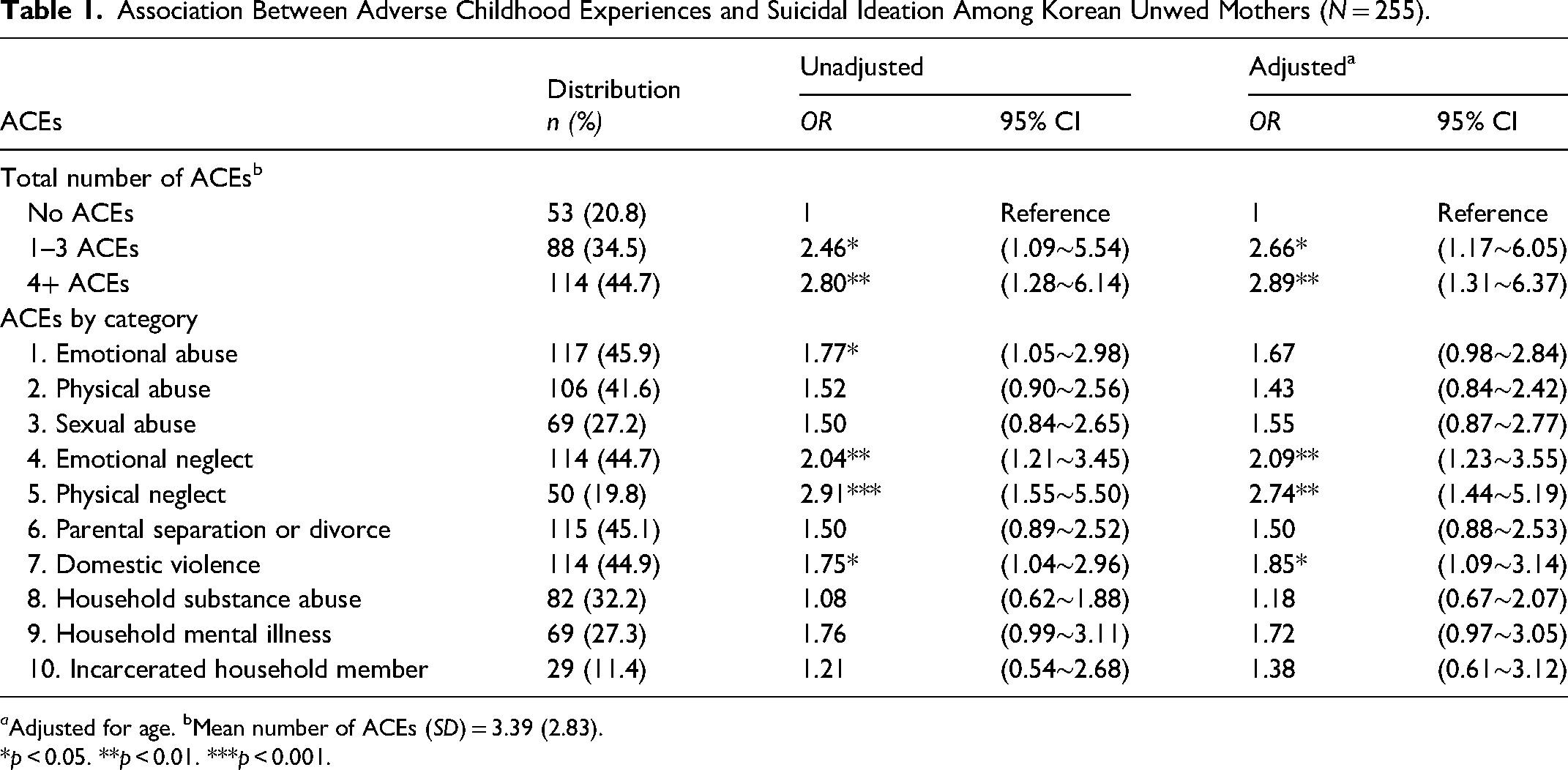
a Adjusted for age. bMean number of ACEs (SD) = 3.39 (2.83).
*p < 0.05. **p < 0.01. ***p < 0.001.
Mother's ACEs were associated with increased odds of having suicidal ideation (OR 1.14, 95% CI [1.04, 1.25]). Compared to individuals with no ACEs, the odds of considering suicide increased 2.89 times among those with four or more ACEs. A detailed analysis of individual ACE items revealed that physical neglect (OR 2.74, 95% CI [1.44, 5.19]), emotional neglect (OR 2.09, 95% CI [1.23, 3.55]), and domestic violence (OR 1.85, 95% CI [1.09, 3.14]) were significantly associated with suicidal ideation, after controlling for age (see Table 1).
We conducted further analysis on the frequencies of suicidal ideation across various combinations of ACE types. Given that physical neglect (PN), emotional neglect (EN), and domestic violence (DV) were positively associated with suicidal ideation (see Table 1), these three variables were selected to form ACE combinations. We explored whether these combinations influenced the prevalence of suicidal ideation beyond the effects of individual ACE categories. As presented in Table 2, mothers experiencing the EN–PN–DV combination exhibited the highest prevalence of suicidal ideation (62.5%), followed by the EN–PN combination (58.5%), the PN-DV combination (55.0%), and the EN–DV combination (45.9%).
Frequency of Suicidal Ideation for ACE Combinations (N = 255).
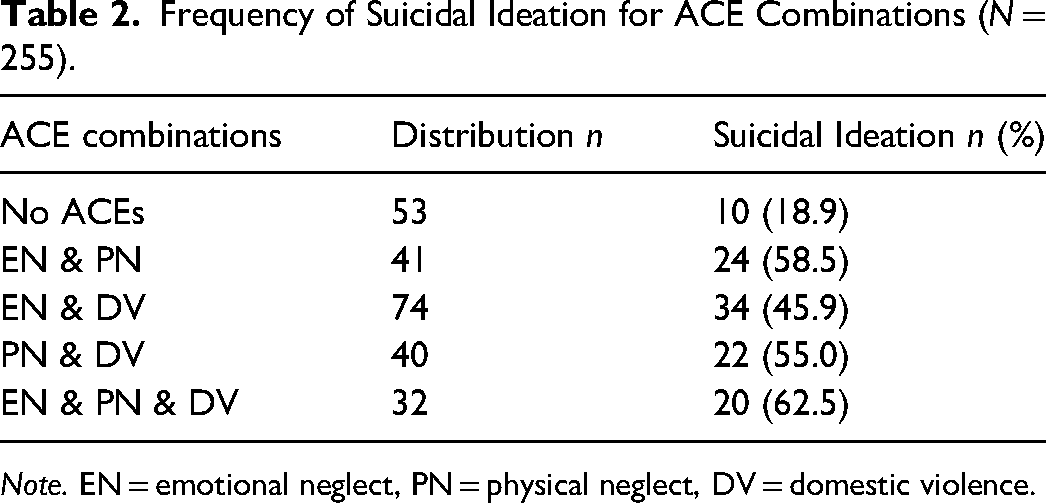
Note. EN = emotional neglect, PN = physical neglect, DV = domestic violence.
Discussion
This study aimed to explore the association between ACEs and suicidal ideation among unwed mothers in Korea. The present study expands upon existing ACE literature by offering distinct patterns of ACE exposure linked to suicidal ideation among underserved populations, particularly in a non-Western context. The findings revealed that Korean unwed mothers were disproportionately at high risk for both ACEs and suicidal ideation compared to the general Korean population. Further, ACEs demonstrated cumulative effects on suicidal ideation in adulthood. Particularly, physical neglect, emotional neglect, and domestic violence predicted a higher level of suicidal ideation, even after adjusting for age. The findings of this study underscore the importance of understanding trauma and highlight the need to train health professionals to effectively identify and support unwed mothers at risk of suicide.
Korean unwed mothers in this study exhibited a higher prevalence of suicidal ideation (34.1%) compared to the Korean general population (4.5%) (Ministry of Health and Welfare & Korea Foundation for Suicide Prevention, 2024), which is consistent with findings of previous studies on marginalized populations. For example, the prevalence of suicidal ideation was reported to be 34.8% among Korean LGB adults (Lee et al., 2019) and 34.4% among North Korean female refugees (Um et al., 2020). These results underscore the urgent need to implement targeted suicide prevention strategies for underserved populations, such as Korean unwed mothers.
We found substantial evidence of high levels of ACEs among the mothers in our study. Of the 255 Korean unwed mothers, 79.2% experienced at least one ACE, and 44.7% reported four or more ACEs. This is in stark contrast to the general Korean population, where 39.3% reported at least one ACE and 7.9% reported four or more ACEs (Kim & Son, 2020). In a separate study of 1,033 Korean adults, 65.7% reported experiencing at least one ACE, and 18.6% reported four or more ACEs (Park, 2021). Current findings underscore the importance of preventing ACEs and prioritizing interventions for Korean unwed mothers.
We also found a dose-response relationship between the number of ACEs and the prevalence of suicidal ideation, indicating that unwed mothers with a greater number of ACEs were more likely to experience suicidal ideation in adulthood. Consistent with previous studies conducted in the United States (Thompson et al., 2019) and Korea (Park, 2021), ACEs were associated with an increased risk of suicidal ideation in adulthood in the current study. This elevated rate of ACEs among Korean unwed mothers may be the underlying mechanism driving the higher prevalence of suicidal ideation.
Moreover, our findings suggest that specific types and combinations of adversities had differential effects on suicidal ideation in adulthood after adjusting for age. Logistic regression analyses indicated that physical neglect, emotional neglect, and domestic violence increased the risk of suicidal ideation by 2.74 times, 2.09 times, and 1.85 times, respectively. This finding is consistent with previous research that highlights the significant association between neglect and suicidal ideation among Korean children (Ryu et al., 2018). Since neglect is associated with the chronicity of child maltreatment (Hindley et al., 2006; White et al., 2015), it is more likely to result in severe and enduring consequences, such as deprivation of basic needs and the rupture of the parent–child relationship. Indeed, the current findings demonstrated that physical neglect was highly concomitant with other ACE categories. Among the 50 participants reporting physical neglect, all had at least one additional ACE, and 94% had an ACE score of 4 or more. These results underscore the need for heightened sensitivity to histories of neglect when screening suicidal ideation and implementing suicide prevention strategies.
Interestingly, while some previous studies have identified both abuse and neglect as being associated with an increased risk for suicidal ideation (e.g., Angelakis et al., 2019), this study found that only neglect, not abuse, was significantly linked to suicidal ideation. Among our study participants, experiences of physical neglect emerged as the most salient factor contributing to suicidal ideation. The unique sociocultural history of Korea, along with Confucian emphasis on family (Park & Cho, 1995) may explain these discrepancies. Throughout periods of colonization, the Korean War, military dictatorships, rapid industrialization, and the 1997–98 financial crisis, the family has served as the only stable and reliable source of support and security in Korea (Chang, 2010; Kim, 2014). The family was regarded as the ultimate source of survival and thus its instrumental roles (e.g., parents’ sacrifices to invest all resources for their children) were emphasized in Korean culture. In this light, experiencing physical neglect may reflect extremely challenging circumstances where participants’ basic needs were not consistently met during childhood. Conversely, physical abuse did not demonstrate significant effects on suicidal ideation in adulthood. This contrast may stem from the fact that physical discipline has been relatively common and considered normative in Korea, where corporal punishment has been referred to as the “cane of love” (Yang, 2009). Even though parental rights to physically discipline their children were removed from Korean civil law in 2021, 64% of Koreans (N = 1,000) still regard appropriate corporal punishment as an effective disciplinary method (Hankook Research, 2021). In the same survey, 70% of respondents indicated that they experienced physical punishment during their childhood.
Childhood exposure to domestic violence was also significantly related to a higher prevalence of suicidal ideation in adulthood. This is in line with previous findings that have documented the association between domestic violence and suicidal ideation (Afifi et al., 2008; Onyskiw, 2003). Additionally, other studies on suicidal attempts reported that witnessing domestic violence increased the risk of attempting suicide (e.g., Dube et al., 2001), indicating that reports of domestic violence may serve as a significant warning sign for suicide risk.
In this study, the experience of sexual abuse was not associated with suicidal ideation, which is inconsistent with findings from previous research (e.g., Thompson et al., 2019). This discrepancy may be attributed to differences in the populations studied (Korean unwed mothers versus the U.S. general population) and variations in item wording between studies. While some studies employed narrower terms, such as parent and caregiver, when defining sexual abusers in their survey (e.g., Thompson et al., 2019), this study used broader terms like adult and person. This broader terminology may have led to inflated response rates for the sexual abuse item, as it could capture not only repetitive or severe sexual abuse by family members but also a one-time, mild incident of sexual harassment from any individual. Given that different types of sexual trauma experiences (e.g., sexual assault versus sexual harassment) are differentially associated with suicidal ideation (Monteith et al., 2016) and that variations in item wording can influence empirical results (Blasberg et al., 2016), future ACE studies need to evaluate the characteristics of sexual abusers, as well as the frequency and intensity of sexual abuse in relation to suicidal ideation. Conducting further research across diverse sociocultural contexts could help elucidate the reasons for these differences and how social and cultural factors influence the link between ACEs and suicide (Kirmayer, 2022).
Further, we found that mothers who reported a combination of physical neglect, emotional neglect, and domestic violence exhibited the highest prevalence of suicidal ideation (62.5%), compared to those with no ACEs (18.5%), those with four or more ACEs (44.7%), or those with other combinations of ACE types (45.9%–58.5%). This aligns with the literature on the differential effects of combined ACEs on adult outcomes, indicating that certain combinations of ACEs are synergistic and significantly elevate overall risk (Briggs et al., 2021). Taken together, our findings suggest that experiences of physical neglect, emotional neglect, and/or domestic violence are key factors associated with suicidal ideation. Thus, a thorough examination of these factors is imperative when assessing a mother's ACEs.
Implications for Clinical Practice and Policy
The study findings offer significant implications for clinical practice and policy. First, the results highlight the necessity for helping professionals to focus on ACEs when identifying mothers at risk for suicidal ideation. It is necessary to consider not only the total number of ACEs but also specific types and combinations of ACEs. This approach provides essential information for understanding the scope of childhood trauma and tailoring interventions to reduce suicide risk. Particularly, careful examination of neglect and domestic violence is crucial when assessing the ACEs of unwed mothers in the Korean context. If there are indications of physical neglect, emotional neglect, and/or domestic violence, it is imperative for helping professionals to evaluate suicidal ideation and intent, and to facilitate referrals to appropriate support services and community resources. When reviewing ACEs, clinicians must exercise caution, as the ACE questionnaire was originally developed for research purposes, not as a screening tool (Anda et al., 2020). Thus, relying solely on the ACE measure to identify mothers at high risk may lead to overestimation or underestimation of risk. Incorporating an assessment of current functioning alongside ACE screening may improve the quality of trauma screening protocols (Raja et al., 2021).
Second, considering the impact of trauma on suicidal ideation, integrating trauma-informed practices in health care settings is essential. Health professionals are uniquely positioned to identify trauma and provide early intervention. Ahmedani et al. (2015) found that among 22,387 individuals who attempted suicide, over 38% had a health care visit within one week prior to their suicide attempt, and nearly 95% had visited within one year. This underscores the healthcare setting as a critical platform for timely intervention, necessitating that health professionals be equipped with the tools to address trauma. As emphasized by Horowitz et al. (2025), in the realm of suicide prevention, the utilization of universal suicide risk assessments and the integration of suicide prevention strategies into primary care are crucial. For unwed mothers, implementing universal trauma screening during routine healthcare or obstetric visits, training pediatricians and obstetricians in brief interventions, embedding mental health and family counselors within primary care clinics, and establishing connections between at-risk mothers and professional counselors can provide effective support to these mothers. There is increasing advocacy for training in trauma-informed practices among health professionals, mental health and family counselors, and other relevant professionals, such as educators and police officers (Chafouleas et al., 2016; Ford, 2017; Goldstein et al., 2018). Collaborating with mothers in a trauma-informed manner may mitigate associated suicide risk through trauma education and linkage to care.
Limitations
Several limitations of the current study must be acknowledged. Firstly, because this study specifically targeted Korean unwed mothers aged 18 or older who are raising one or more children, the findings have limited generalizability. Future research involving other marginalized populations in various countries is needed to enhance external validity. Secondly, the ACE questionnaire used in this study was based on the original 10 items and did not include peer, community, or collective violence, which are components of the Adverse Childhood Experiences International Questionnaire (ACE-IQ; WHO, 2020 ). Notably, witnessing community violence or experiencing bullying is frequently reported among the Korean general population; nearly half of Korean adults have reported witnessing community violence, and about 30% have reported experiencing bullying (Ryu et al., 2018). Such adverse experiences, which were not assessed in this study, may play a critical role in shaping suicidal ideation. Thus, future studies should include bullying, community violence, and collective violence to gain a more comprehensive understanding of the effects of ACEs on suicidal ideation. Thirdly, this study employed a cross-sectional design, which cannot establish causal relationships. Future research should longitudinally track changes in suicidal ideation over time and identify potential mechanisms underlying the association between ACEs and suicidal ideation.
Conclusion
This study enhances the understanding of how ACEs contribute to suicidal ideation among Korean unwed mothers. The findings substantiate the enduring and detrimental effects of ACEs on suicidal ideation and extend ACEs research to include this specific population. To our knowledge, this is the first study to elucidate the relationship between unique types of childhood adversities and suicidal ideation among Korean unwed mothers. The results underscore the importance of risk factors such as physical neglect, emotional neglect, and domestic violence, as well as a high cumulative number of ACEs, highlighting potentially critical targets for suicide prevention and intervention. Incorporating ACE assessments when identifying mothers at risk for suicidal ideation and supporting trauma-informed practices may be essential initial steps to help these mothers thrive despite facing severe hardships.
Supplemental Material
sj-docx-1-tfj-10.1177_10664807251343895 - Supplemental material for Adverse Childhood Experiences and Suicidal Ideation Among Korean Unwed Mothers
Supplemental material, sj-docx-1-tfj-10.1177_10664807251343895 for Adverse Childhood Experiences and Suicidal Ideation Among Korean Unwed Mothers by Hyeseong Kang and Jungeun Olivia Lee in The Family Journal
Footnotes
Author Note
This article is part of a larger mixed-methods research project on the ecosystemic resilience of unwed mothers in Korea. This work was supported by the research grant of the Gyeongsang National University in 2023. We have no known conflicts of interest to disclose.
Declaration of Conflicting Interests
The authors declared no potential conflicts of interest with respect to the research, authorship, and/or publication of this article.
Funding
The authors disclosed receipt of the following financial support for the research, authorship, and/or publication of this article: This work was supported by the Gyeongsang National University (Research Grant in 2023).

Supplemental Material
Supplemental material for this article is available online.
References
Supplementary Material
Please find the following supplemental material available below.
For Open Access articles published under a Creative Commons License, all supplemental material carries the same license as the article it is associated with.
For non-Open Access articles published, all supplemental material carries a non-exclusive license, and permission requests for re-use of supplemental material or any part of supplemental material shall be sent directly to the copyright owner as specified in the copyright notice associated with the article.
