






Abstract
A significant portion of the working population faces economic injustices, precarious work, and exclusion from career development opportunities. Despite the growing scholarly concern for precarious workers, previous studies have pointed out the need for broader conceptualizations of what positive work experiences represent for them because individuals strive for work that provides a sense of worth and dignity in addition to minimal conditions. Building on the Dignity at Work Framework, the present study aimed to investigate dignity at work among paid domestic cleaning (PDC) workers in Switzerland, identify the strategies, resources, and hindrances to secure or enhance favorable conditions, and report participants’ propositions for improving their working conditions. We analyzed four focus groups with 15 PDC workers using Consensual Qualitative Research analysis. Results show a diversity of experiences on a continuum ranging from dignity to indignity at work. Workers employed various strategies, from resignation and demanding adaptation to more resistant responses to dignity threats. Moreover, PDC workers showed critical consciousness at various stages by proposing pragmatic changes, increased contextual support, or more liberatory aspirations and actions. Our findings contribute to bridging precarious work literature with precarity and dignity research and help adapt policies and counseling interventions for precarious workers.
Keywords
Introduction
Work represents a primary source of income and an opportunity to fulfill basic needs for self-determination, social connection, and recognition by others (Blustein et al., 2023). However, favorable forms of work are unequally distributed, and a significant portion of the working population faces economic injustices, precarious work, and exclusion from career development opportunities (Ali et al., 2022; International Labor Organization [ILO], 2024). Within vocational and organizational psychology, a growing concern for such groups of workers has led to the use of constructs such as decent work (Blustein et al., 2016; ILO, 1999) and work precarity (Allan et al., 2021) to investigate the experience of accessing sufficient conditions to attain favorable outcomes such as work well-being. Furthermore, other scholars have highlighted the need for broader conceptualizations of what positive work experiences represent for precarious workers because, irrespective of their objective situation, individuals strive for work that provides a sense of worth and dignity in addition to minimal conditions (Garrison, Her, et al., 2024b; Ribeiro et al., 2019). Previous scholarship emphasized the critical role of workplace dignity, which can be inherently expected as an unconditional recognition of human worth or earned as a reward for differential skills, accomplishments, or efforts (Lucas, 2015). Dignity may also be remediated through others’ actions that recognize one’s worth beyond asymmetrical positions of power or the mere instrumental value of one’s labor (Lucas, 2015; Thomas & Lucas, 2019).
Building on past organizational research on dignity (see Bal, 2017; Gibson et al., 2023; Lucas, 2015), Blustein and Allan (2024) proposed using dignity at work to embrace a more social justice–oriented study of working lives. According to them, dignity at work refers to the experience of being viewed and treated humanely, which derives from decent working conditions and the possibility for autonomy, freedom, and affirmation of one’s actions, social identities, beliefs, and values within human rights principles (Blustein & Allan, 2024). One value of promoting dignity at work stems from the positive outcomes it can provide for workers, such as better mental health, work well-being, job satisfaction, work engagement, and basic needs satisfaction (Thomas & Lucas, 2019). Despite the emerging literature on dignity in the last decade, only a few studies have explored subjective experiences of both dignity and indignity from the workers’ perspective (Gibson et al., 2023; Noronha et al., 2020). Moreover, previous studies have started to describe workers’ responses to dignity threats but have had a more limited focus on workers’ efforts to attain and cultivate dignified conditions, as well as the solutions they envision for a positive change in workplaces marked by precarious and degrading conditions (Ahmed et al., 2023; Baker & Lucas, 2017; Tilton et al., 2024). Because workers in more vulnerable positions are experiencing ongoing challenges in obtaining and maintaining dignified forms of employment owing to labor market trends such as digitization, globalization, or the implementation of neoliberal policies, it is imperative to improve our knowledge of experiences and responses to indignity (Bal, 2017; Blustein et al., 2024).
The present study built on the Dignity at Work Framework (DWF; Blustein & Allan, 2024) to explore the collective experiences of dignity and indignity among paid domestic cleaning (PDC) workers in Switzerland. We applied a Consensual Qualitative Research (CQR; Hill, 2012) approach to analyze four focus groups with 15 PDC workers, investigating the following research questions: (1) What are PDC workers’ experiences of dignity at their workplace? (2) How do PDC workers describe the strategies they adopt and the solutions they envision to preserve or enhance their dignity at work? Investigating these questions is especially relevant among occupational sectors such as PDC, because of important threats to dignity at work stemming from the absence of overarching organizational structures, strong dependence and possible power imbalance vis-à-vis employers, and the involvement of marginalized workers lacking resources to claim their rights (Borges et al., 2024; ILO, 2021; Karunakaran Prasanna et al., 2023). Indeed, PDC has been persistently associated with precarious and exploitative conditions prone to dignity violations (Cruz & Abrantes, 2014; ILO, 2021). In the following sections, we will describe our theoretical framework, provide occupational and contextual specificities of PDC in Switzerland, and present the study aims and contributions.
Dignity at Work as a Relevant Framework to Study Precarious Work Contexts
At its core, human dignity denotes a fundamental sense of equality, respect, worth, and autonomy, with different views on it as being inherently deserved, earned by one’s actions, or shaped through social interactions (Gibson et al., 2023; Hodson, 2001; Lucas, 2015). In recent decades, work psychology scholars have proposed a dignity-oriented approach for investigating work, arguing that, despite the ambiguity and complexity of the concept, it provides a more holistic, humanizing, and inclusive perspective on the multiple issues and rights violations that workers experience (Allan & Blustein, 2022; Gibson et al., 2023). Therefore, the present study builds on the Dignity at Work framework (DWF; Blustein & Allan, 2024), as a relevant framework that synthesizes interdisciplinary literature on the antecedents and outcomes of dignity at work, also describing strategies mobilized by workers to preserve it. The use of the DWF will allow us to investigate the work experiences of PDC workers as well as the strategies they implement, further giving voice to participants to identify possible solutions to improve their working conditions. Macro-level structural antecedents of dignity at work, meso-level interpersonal conditions that reinforce or erode it, and micro-level individual strategies that workers use to uphold it are detailed in the following.
At a macro level and similar to the decent and precarious work frameworks, the DWF outlines structural forces that can either threaten or support the prevalence of dignified working conditions (Allan et al., 2021; Duffy et al., 2016). In fact, political, social, and economic contexts can hinder dignity through deregulation, the weakening of labor unions, or the dismantling of social protections and labor rights, thereby fostering exploitative working conditions and environments (Allan et al., 2021; Blustein & Allan, 2024). Additionally, prevailing systems of power and oppression marginalize workers in unfavorable situations due to discrimination, social inequalities, and limited access to social and economic capital (Cadenas & McWhirter, 2022).
At a more proximal level, the DWF proposes that dignity at work is shaped by the type and quality of working conditions and environments (Blustein & Allan, 2024). Dignity threats are particularly salient in precarious work, characterized by insecure continuity and quantity of work and income, unsafe conditions, limited organizational power and rights, and poor social recognition (Allan et al., 2021; Borges et al., 2024). Indeed, precarious conditions are especially likely to hinder workers’ access to a living wage, sufficient power to resist exploitative practices, and supportive relationships at work (Allan & Blustein, 2022; Allan et al., 2021). In addition, employers can promote management practices that either enhance or undermine employees’ dignity. Practices grounded in respect, fairness, and concern for employees’ well-being contribute to a sense of dignity (Mertz et al., 2024). Dignity also derives from employees’ autonomy and control over their work (e.g., workplace democracy; Bal, 2017) rather than being subjected to coercive and controlling management practices that surveil and humiliate workers. Finally, the availability of resources (e.g., staff, equipment) and clearly defined work roles is critical, as they enable workers to attain dignity by maintaining the quality of the work they perform (Lucas, 2011; Stacey, 2005).
At the interpersonal level, dignity at work also depends on the quality of the relational environment (Blustein & Allan, 2024). Social interactions with employers, managers, clients, or colleagues constitute occasions for workers’ value and worth to be either affirmed or undermined (Gibson et al., 2023). In socially stigmatized occupational sectors, workers often struggle to attain dignity as they face hostile and degrading remarks, invisibility, and a lack of recognition from society, clients, and organizations (Noronha et al., 2020; Rabelo & Mahalingam, 2019). This is particularly salient in cleaning and service sectors, where interactions and relationships with employers or clients are central and where a positive relational environment emerges through reciprocity, gratitude, and mutual respect (Khan et al., 2023; Zhang et al., 2023).
Finally, the DWF also presents the responses workers might adopt toward dignity and indignity experiences. Indeed, workers are not passive actors and respond to dignity threats through actions and strategies aimed at protecting themselves or enhancing their sense of dignity at work (Blustein & Allan, 2024). One category of responses proposed in the DWF involves resistance, which may take the form of collective actions, individual behaviors, or identity and narrative work (Blustein & Allan, 2024). Previous studies have described initiatives such as advocating for organizational change, whereby collectively denouncing mistreatments serves as a source of empowerment and dignity enhancement (Baker & Lucas, 2017; Barua & Haukanes, 2020). Resistance can also take the form of client retaliation behaviors (e.g., gossiping, lower service quality) and identity work, whereby workers construct positive narratives about themselves and their work to preserve a sense of dignity (Lucas, 2011; Tilton et al., 2024). Positive narratives may involve cultivating a sense of pride in one’s work ethic or capacity to cope with adversity (Stacey, 2005). Moreover, workers may derive dignity from feeling useful and providing care to others (Khan et al., 2023). Nevertheless, resistance may not be the only form of response workers can produce against dignity threats, requiring further investigations.
Threats and Opportunities for Dignity at Work Among PDC Workers in Switzerland
Several characteristics make PDC and cleaning work activities particularly susceptible to dignity threats. In fact, paid domestic work often consists of precarious conditions reflected in informal employment arrangements, unstable and discontinuous work opportunities, and limited access to social protections compared to standard forms of employment (Cruz & Abrantes, 2014; ILO, 2021). Working in private households also amplifies the significance of the relational environment, where unequal power dynamics and interpersonal conflicts may give rise to various forms of abuse, humiliation, harassment, or human rights violations (Karunakaran Prasanna et al., 2023). Cleaning work is generally situated at the lowest end of the social recognition ladder as it is widely perceived as degrading and low-status work (Bosmans et al., 2016). Consequently, cleaning activities are subject to social stigmatization, which can foster mistreatment and demeaning behaviors from users, customers, or employers (Murray et al., 2022; Zulfiqar & Prasad, 2022). Finally, PDC is predominantly performed by women with restricted access to resources due to precarious legal status, economic insecurity, and gendered or class-based power asymmetries between employers and employees, factors that further constrain workers’ capacity to preserve or attain more dignity at work (Jokela, 2019).
Switzerland provides a paradoxical context that can both enhance and undermine access to decent and dignified working conditions for PDC workers. Despite recurring crises, such as the 2008 financial crisis or the COVID-19 pandemic, the Swiss economy has demonstrated resilience and competitiveness, sustaining steady labor demand and generating attractive employment opportunities (Murphy & Oesch, 2018; Oesch, 2022). However, in contrast to its strong economic performance, Switzerland’s liberal-oriented labor laws provide only limited protections, thereby exposing precarious and migrant workers to heightened vulnerability (Afonso & Visser, 2014). For instance, research has shown that paid domestic workers were financially vulnerable during the pandemic, due to job and income losses compounded by the country’s high living costs and limited social protections (Bonvin et al., 2021).
In Switzerland, there is no collective agreement regarding specific labor protections for paid domestic work, and the absence of a guaranteed minimum wage further exacerbates this regulatory gap (Oesch & Rieger, 2006; SECO, 2024). At the national level, only a list of recommendations provides a limited and flexible scope of employers’ obligations (SECO, 2024). Such a weak and loosely enforced set of protections often leads to the negotiation of employment conditions on a case-by-case basis, with high risks of abuse or rights violations (e.g., unpaid leaves, harassment; Borges et al., 2024; Carreras, 2008). In the Swiss context, health-related expenses may constitute a source of insecurity for precarious workers. This stems from the semi-public organization of health insurance, which, although mandatory and independent of employment status, imposes costs directly on individuals and can account for a substantial share of household budgets (Masdonati et al., 2019). Although associative organizations and labor unions attempt to mitigate these challenges by offering legal support, their resources remain limited to prevent all risks of dispute or abuse, given the large number of employment relationships in this sector (Unia, 2025).
The Present Study
In the current study, we explore how PDC workers in Switzerland experience and strive for dignity at work. Four focus groups with 15 PDC workers active in Switzerland were used to (a) investigate participants’ experiences of (in)dignity at work in PDC, (b) identify the strategies they adopt to preserve their dignity, and (c) report participants’ solutions for improving working conditions in PDC. Using our participants’ expertise, our study has research, practical, and societal contributions. First, investigating dignity at work in PDC provides initial empirical observations of Blustein and Allan’s (2024) framework. Second, the present study also addresses the need for more research on precarious work from the workers’ perspective (McWha-Hermann et al., 2024), which may allow us to complement theoretical propositions, such as the variety of responses against indignity. Third, focus group settings have been used in previous dignity research (Lucas, 2015), and represent an opportunity to give voice to workers and bring about applicable propositions in a local context (Sultana, 2023; Wilkinson, 1999). Indeed, collective research settings allow participants to share their views, debate ideas, and create social connections that are difficult to develop in isolated work settings such as PDC. Fourth, at the societal level, our study contributes to collective organization and coordination between stakeholders to improve the conditions in paid domestic work (Garrison et al., 2024a).
Method
In the present study, we employed a qualitative design using focus groups and a CQR (Hill, 2012) approach to analysis for addressing our study aims. Qualitative research designs are particularly relevant for accessing workers’ lived experiences, applying novel theoretical propositions, and understanding organizational behavior in a specific context from the workers’ perspective (Wilhelmy & Köhler, 2022). Moreover, qualitative research settings facilitate proximity between participants and researchers, thereby favoring the mutual benefits of participation and contributing to research and social justice purposes (Garrison et al., 2024a). On the researchers’ side, focus groups aid in investigating meanings constructed in interactions with peers (Krueger & Casey, 2015). Collective settings also facilitate investigations among marginalized populations, as they may be less threatening than interviews and reduce the power imbalance between researchers and participants (Wilkinson, 1999). On the participants’ side, group settings gather otherwise socially and professionally isolated workers, representing a step toward mutual support initiatives at the community level (Wilkinson, 1999).
Although CQR has predominantly been applied to data derived from individual interviews, Hill (2012) documented five prior studies that employed CQR for analyzing focus group data. Following Hill’s (2012) mapping of previous CQR applications, subsequent research within the field of career counseling has adopted this analytical approach (see Kanagui-Muñoz et al., 2012; Leigh-Osroosh et al., 2023). The use of CQR for focus groups constitutes a particularly relevant methodological choice, as it combines a discovery-oriented approach that is well-suited for underexplored phenomena, while providing rigorous procedures facilitating the integration of multiple researchers’ perspectives (Kanagui-Muñoz et al., 2012; Leigh-Osroosh et al., 2023).
Participants
Participants’ Demographic Characteristics
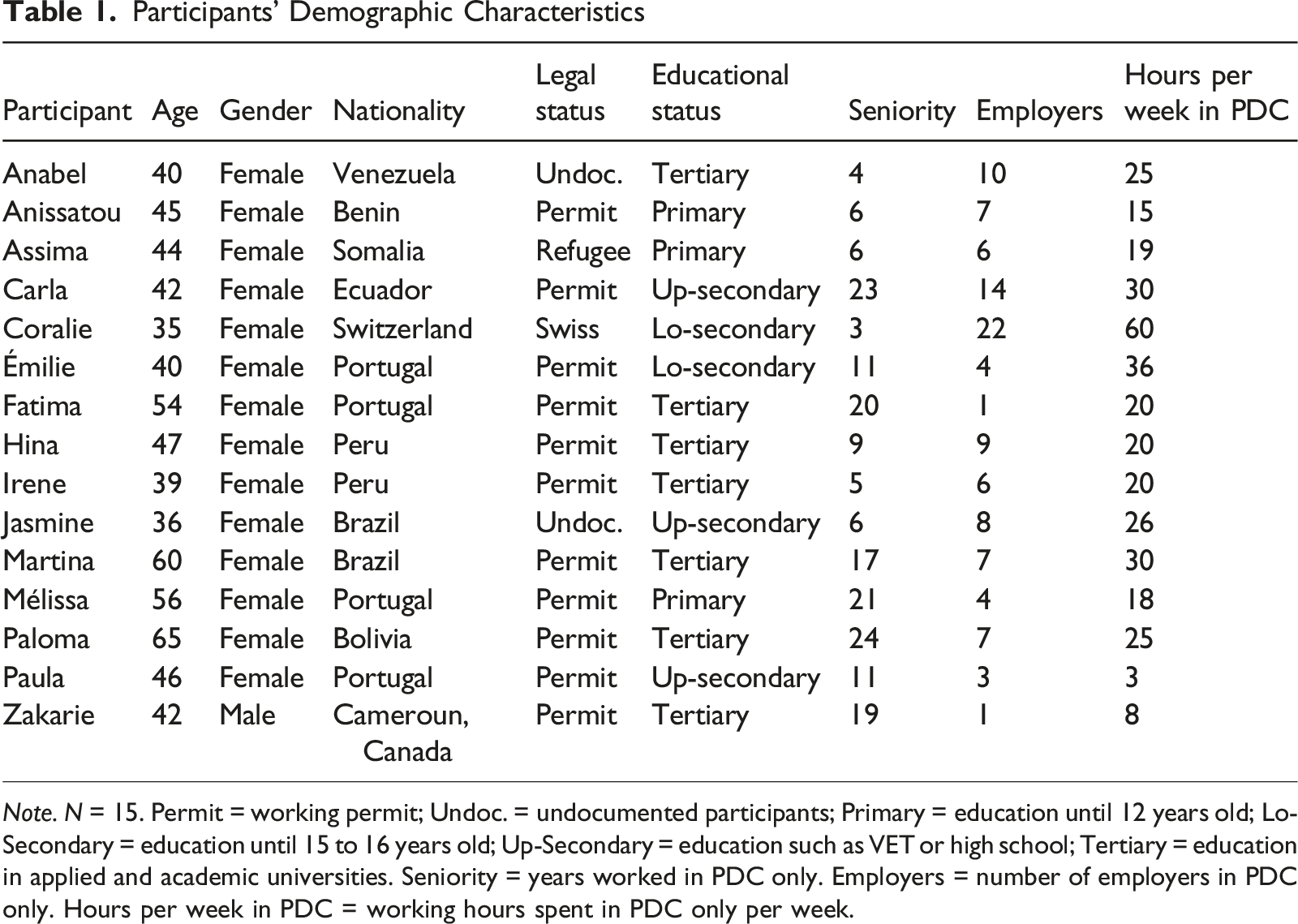
Note. N = 15. Permit = working permit; Undoc. = undocumented participants; Primary = education until 12 years old; Lo-Secondary = education until 15 to 16 years old; Up-Secondary = education such as VET or high school; Tertiary = education in applied and academic universities. Seniority = years worked in PDC only. Employers = number of employers in PDC only. Hours per week in PDC = working hours spent in PDC only per week.
Recruitment Process and Data Collection
After receiving ethical approval from our university’s research ethics committee, participants were recruited with the help of two partner organizations operating a local state platform that manages social security contributions in the paid domestic work sector and provides entry-level training. Collaborating with partner organizations helped build trustful bonds with our participants and improve the transferability of our findings into actionable recommendations (Restubog et al., 2023). The collaboration led to an initial phase of the research project consisting of semi-structured interviews with 24 PDC workers (Borges et al., 2024, 2025). One year later, participants were contacted via email and letter to join a second phase of data collection through focus groups designed to address the research questions of this study. Twelve participants were available and participated in one of the focus groups. The other 12 did not participate for various reasons: Five participants were interested but missed or canceled participation at the last minute, five were not available or interested, one was not contacted due to health issues, and another participant did not respond.
To our knowledge, there are no established guidelines specifying the appropriate sample size for applying CQR to data originating from focus group settings. Hill’s (2012) recommendations ranged from 12 to 15 participants. Although this threshold was not tied to a specific setting, it appears primarily oriented toward individual interview data. Previous CQR studies with focus groups have reported sample sizes ranging from 15 to 97 participants, distributed across two to twelve groups (Hill, 2012; Kanagui-Muñoz et al., 2012; Leigh-Osroosh et al., 2023). Based on previous empirical applications and despite the challenges experienced during data collection, we aimed at 15 participants. This decision allowed us to align with Hill’s recommendations while meeting the lower threshold observed in prior CQR focus group studies.
In line with this aim, we complemented the groups with three additional participants using a waiting list from the initial phase. We also proposed an online setting to overcome the travel constraints of four participants, which followed recommendations from previous studies with hard-to-reach populations (Cortini et al., 2019; Keeling et al., 2019). Furthermore, this target allowed us to have most participants previously interviewed in earlier phases of the research, who were already familiar with the topic and comfortable in sharing their experience in a research setting. The focus groups were also proposed as a form of compensation for previous participants to meet and potentially initiate collective initiatives. Finally, we were mindful not to overload the groups to preserve our mini-group setting, which provides participants more time to contribute to the discussion.
To achieve our study aims, we conducted mini groups (i.e., four to seven participants) because they provide a more intimate setting to free emotions and discourse (Cortini et al., 2019). Five participants were invited to each focus group. The composition of the groups is detailed in Table S1 of the Supplemental Material. Due to last-minute absences, our focus groups gathered three to four participants. One risk of mini groups stems from being potentially anxiety-prone because participants have more time to talk (Cortini et al., 2019). To reduce anxiety, each focus group started with informal discussions in another room where participants could meet, have refreshments, and complete consent forms without being recorded. An informal and unrecorded discussion was also proposed for the online group.
Each group was moderated by the first and second authors in turn, with one serving as the lead and the other taking notes and asking complementary questions (Krueger & Casey, 2015). The focus groups were semi-structured using a guide provided in Table S2 of the Supplemental Material, which was formulated based on the relevant literature. The interview protocol investigated three main topics referring to participants’ (a) perceptions of their working conditions in reference to the concepts of dignity at work and decent work (i.e., To what extent do you consider working conditions in PDC to be decent and dignified?), (b) strategies implemented to secure or enhance dignity at work (i.e., What do you do to make your working conditions more decent? What do you do to preserve your dignity at your work?), and (c) solutions to improve conditions in PDC (i.e., What should be changed to make PDC more decent and dignified?). Before data collection, a pilot focus group with four master’s students in vocational psychology was conducted to coordinate moderators’ styles and note-taking (Krueger & Casey, 2015). The four focus groups lasted 87 to 126 min (M = 107.5). The audio recordings were transcribed in two steps by using a university-provided software with confidentiality safeguards, followed by relistening recordings and performing manual verification and editing.
Methodological Integrity
Methodological integrity and trustworthiness of our data were promoted following the recommendations of Levitt and colleagues (2018) and Morrow (2005). Credibility was achieved by engagement with participants and partner organizations through interviews, meetings, and observation of short training sessions. Credibility was enhanced by conducting debriefing sessions between moderators of the focus groups (Krueger & Casey, 2015), team meetings, research memos, and a CQR approach to analysis (Hill, 2012). Dependability and confirmability were promoted by documenting recruitment, data collection, analytical procedures, and audit steps of analysis. Finally, a fifth focus group was conducted with partner organizations, enhancing the reflexivity and fidelity of data collection with a better understanding of the legal and economic context of participants (Crowhurst, 2013; Restubog et al., 2023).
Our trustworthiness efforts were implemented according to a paradigmatic approach comprising mostly a critical stance to research, with constructivist elements and a contextualist epistemological positioning. From a critical stance, we aimed to increase consciousness by questioning the structural forces reproducing inequality and promoting change by working with participants on collective initiatives (Ponterotto, 2005). Constructivist elements corresponded to grounding participants’ accounts in their context, while remaining reflexive to our own backgrounds (Levitt, 2025; Morrow, 2005). Our contextualist epistemological stance retained a notion of truth “out there” only contextually situated, partial, and dependent on researchers’ perspectives (Madill et al., 2000). Our critical approach aligned with the DWF, emphasizing social criticism and advocacy for dignity at work (Blustein & Allan, 2024). The CQR suited our mixed paradigmatic standpoints by promoting collective reflexivity and analysis reliability through consensus, enhancing the trustworthiness of researchers’ interpretations (Hill, 2012).
The research team was composed of five members: one male doctoral student (i.e., first author), one female master’s student (i.e., second author), two female postdoctoral researchers in vocational and organizational psychology (i.e., third and fourth authors), and one male associate professor in vocational psychology (i.e., fifth author). Regarding the team’s positionality, the five team members were fully or partially embedded in the study context, facilitating rapport with participants and analysis. The first and second authors were fully immersed by moderating the focus groups and maintaining contact with participants and partner organizations. The remaining authors were partially embedded through meetings, converting or restraining reflexive observations in data interpretation derived from the first and second authors’ embeddedness.
The team members had multiple experiences in precarious employment (e.g., cleaning, restaurant) and first- or second-generation immigrant backgrounds. These backgrounds shaped the analysis toward social injustices and a focus on negative aspects of PDC rather than participants’ efforts to find meaning, satisfaction, or other positive aspects at work. Four members had experience in career counseling, and the team had research expertise in well-being and decent work literature. Researchers adopted an advocacy posture by collaborating with partner organizations (Ali et al., 2022). Two researchers had field contacts, and three members only participated in the analysis, thus aiding in the fair description of participants’ experiences.
Analysis
The research team had prior CQR experiences. The first author had led or participated in three CQR studies, and three members had also participated in two studies or more. One member had no experience with CQR and received training, feedback, and readings from the first author. The analysis began with the team discussing biases, and three main conclusions were identified. First, as work psychologists, we may overfocus on the negative aspects of PDC. Thus, the team agreed to consciously apply a nuanced approach in the analysis. Furthermore, a culturally sensitive approach to analysis was encouraged because the team should not rely solely on their backgrounds to comprehend participants’ accounts. Finally, one member pointed out the privileged position we had as researchers, considering the work instability of our participants. This position may under- or overestimate the importance of certain conditions and strategies. Consequently, we identified positive and negative elements with multiple auditing steps.
Following CQR procedures, we analyzed our data in four phases: (a) identifying and coding domains; (b) drafting core ideas; (c) performing cross-analysis; and (d) producing and revising an analysis report (Hill et al., 1997). In the first phase, the coding team started by inductively identifying broad domains, with each coding member reading one focus group transcript and developing a list of domains independently. The coding team agreed on a preliminary list of domains, and each member was assigned a new transcript to code the domains. At this point, a first internal audit was conducted with a pair of coders reading and proposing revisions to each other, leading to a revised domain list and coding (Hill et al., 2005). In the second phase, members were asked to draft core ideas (Hill, 2012). This task was conducted independently on a new transcript. Then, two new pairs of coders provided mutual revisions corresponding to a second internal audit (Hill et al., 2005). The team held meetings to discuss the core ideas and finalize the coding for all focus groups. In parallel, the auditor was occasionally solicited to interpret ambiguous verbatim (Hill et al., 2005). In the cross-analysis phase, the coding team members were asked to create categories for each domain (Hill, 2012). To achieve this task, the coding team held several meetings to discuss, revise, and finalize the categories one domain at a time. The first and second authors coded the transcripts, and the third and fourth gave feedback. In the last phase, the team produced an intermediary analysis report. The external auditor provided written and oral feedback. A final report was produced with revised nomenclature, structure, and frequencies of the domains and categories (Hill, 2012).
Findings
Domains, Categories, and Frequencies
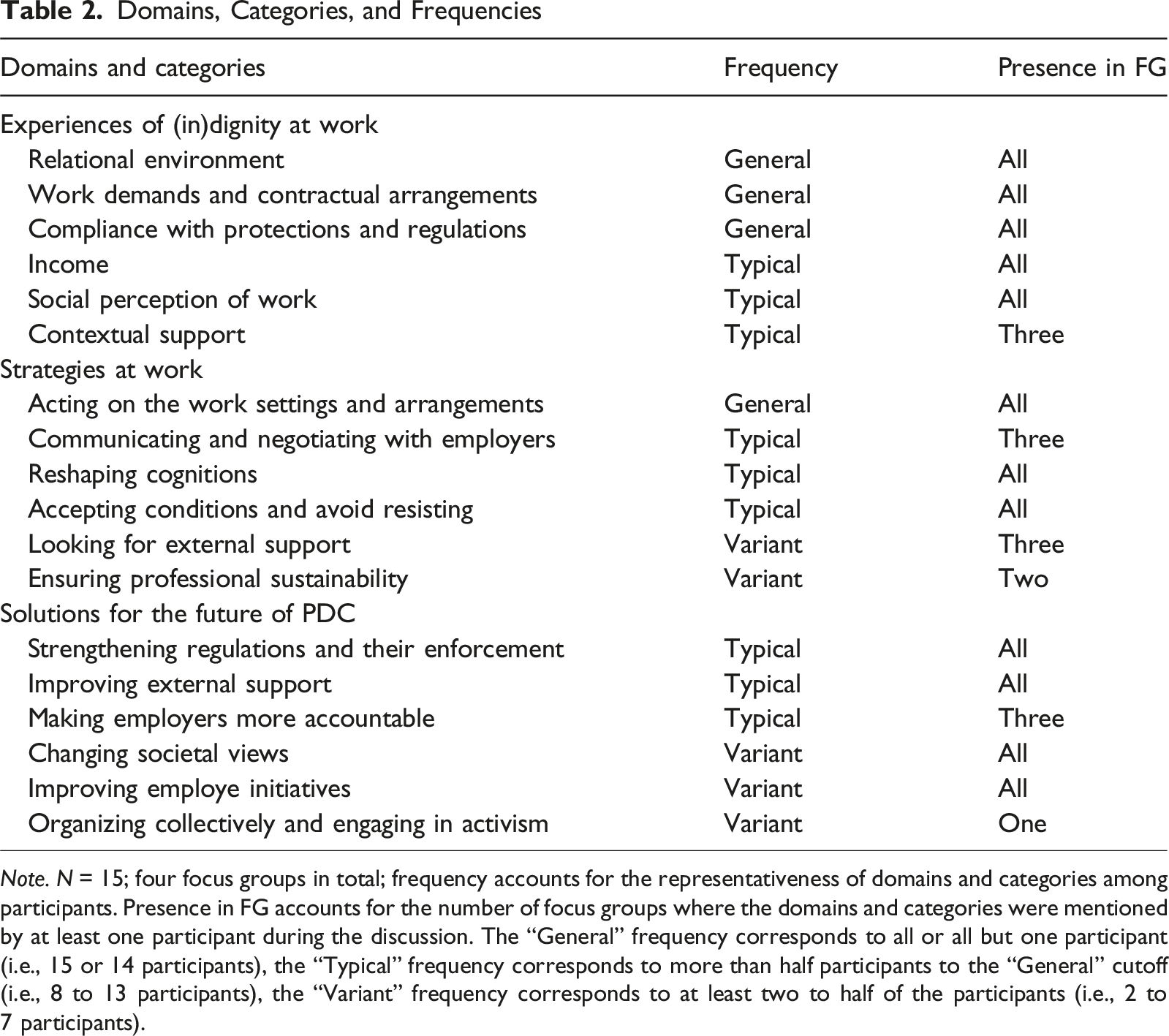
Note. N = 15; four focus groups in total; frequency accounts for the representativeness of domains and categories among participants. Presence in FG accounts for the number of focus groups where the domains and categories were mentioned by at least one participant during the discussion. The “General” frequency corresponds to all or all but one participant (i.e., 15 or 14 participants), the “Typical” frequency corresponds to more than half participants to the “General” cutoff (i.e., 8 to 13 participants), the “Variant” frequency corresponds to at least two to half of the participants (i.e., 2 to 7 participants).
Experiences of (In)Dignity at Work
Participants described a continuum of experiences we associate with the presence or absence of dignity at work. Conditions ranged from precarious and stigmatizing adversities to decent and socially valued work aspects, highlighting how dignity fluctuates within and across participants in terms of the (a) relational environment, (b) work settings and arrangements, (c) the degree of compliance to protections and regulations, (d) income, (e) the perceived social perception of their work, and (f) the access to contextual support. Regarding the relational environment, participants referred to the relationship with employers and the degree of respect and support as a determining aspect of the quality of working conditions. Respectful and supportive environments are characterized by healthy interpersonal communication, recognition, and respect: “I am lucky I had good employers in the sense that they always respect me. […] And if something is not going well, they tell me kindly, ‘can you do this or can you do this differently?” (Jasmine). However, employers can be abusive, misunderstand work roles, and be uncooperative. For example, Assima shared various conflictual interactions with employers over the maintenance of cleaning material or extra hours to be paid despite contractual agreements: “That’s how it’s supposed to be, in our [partner organization] contracts, but she didn’t agree, and she didn’t want to pay me.” Employers could also lack knowledge about existing labor laws, or dignity could be hindered by employers forgetting important benefits such as vacation days: “It means they don’t listen to me, that’s why you forget when I have to be at work, […] but when it’s time to get paid, they’re not there and make excuses and attacks with full texts” (Assima).
Work demands and contractual arrangements contribute to positive or negative experiences in terms of satisfaction and physical or mental health. These specifications stem, for example, from the physical requirements of the job, because “you need to bend over; it really exhausts you” (Anissatou). It also stems from the flexibility it entails, and the commuting constraints one must manage: “It can be detrimental if we really do a lot of kilometers either in public transport or by car; it can become unreasonable. […] Depending on the expected arrival time, rest time and such things are not necessarily respected” (Coralie). Moreover, PDC consists mostly of nonstandard working arrangements marked by the accumulation of multiple employers to make ends meet: “(It’s difficult) to conciliate because it’s precarious work. For example, there are days I work for three distinct families. I start at six and a half and go from one to another” (Martina). Indeed, PDC is distinct from the full-time, fixed contract, single-employer type of employment arrangements. By extension, nonstandard work in PDC makes participants feel insecure because “you don’t have a fixed salary; you worry all the time” (Jasmine).
Another adversity encountered in PDC is compliance with protections and regulations. Some of the difficulties stem, for example, from employers who lack knowledge about the rights and protections in vigor, or the willingness versus unwillingness to provide minimal rights and work benefits (e.g., paid holidays), as Paula declared: “We go on holiday, or we are sick; we are not paid.” The adequacy of income also represents an important issue. For some, working in PDC provided enough economic security. Hina estimated that “it allows us to make a good living so we can do another thing or maybe better things in the future, but at least we can make a living and also give a better future to our children.” Other participants disagreed and highlighted the adverse long-term outcomes of irregular income and limited social contributions throughout the career trajectory that threaten decent living and retirement: “When retirement comes, we can’t live with dignity. Most of us must leave for our countries, but our children are here. We want to stay in Switzerland. We worked and contributed to Switzerland, but we have nothing” (Fatima).
Participants shared mixed views about the social recognition of PDC. On the one hand, workers perceived PDC as more valued and respected in Switzerland than in other countries, as exemplified in the following accounts: “It’s clear that here, I can see that the Swiss value domestic work a lot” (Hina); and “For me, my job is a dignified job” (Mélissa). On the other hand, participants encountered negative stereotypes and representations at work or within their social relationships. However, some employers held stereotypes of workers as poor migrant women, as Assima described: The family said, “Ah, Assima, today she’s different. Look at the shoes; look how she’s done her hair.” It really hurts. […]. It’s clothes, but here, if you come when you’re not badly dressed, it’s not for you. She called the whole family and looked at me, even the little kids, and they looked bad (at me). Mom’s sitting there, and you’re scrubbing the carpet.
Given that PDC occurs independently from overarching organizational structures, several participants identified the presence—or absence—of contextual support as an important factor influencing their experiences of dignity at work. Local associations provided critical help with occasions for career development, such as cheap French classes: “I started taking conversation classes at the [institution’s name]. […] It was an hour, it wasn’t expensive, and it involves classes that make (you) talk. And every evening, I’d go to the classes there, and the people were quite nice” (Mélissa). Nongovernmental institutions also assisted workers in understanding Swiss labor laws or supporting them in their regularization procedures: “There’s somewhere you can go and talk to someone who’s exploiting you, who’s taking away your rights” (Anabel). Disposing of a voucher system organization also facilitated contract clarifications to employers and employees for Coralie: “They act as mediators between you and your employer.” However, other participants perceived a lack of support from them and felt a general absence of institutions that advocate for better conditions on their behalf, as Carla explained: But, in fact, (partner organization), they’re not the employers. It’s the employers who pay the [organization]. And they’re not for us. They’re more for making documents, papers, for employees and employers. And we’re helpless, it’s true. We don’t have anyone to support us. And then, it’s the fact that we are all a bit lost regarding this. It leaves us even less protected from everything.
Protective Strategies to Preserve or Enhance Dignity at Work
Strategies adopted by our participants to deal with their work adversities and strive for dignified conditions in PDC stemmed from (a) acting on the work settings and arrangements, (b) communicating and negotiating with employers, (c) reshaping cognitions, (d) accepting conditions and avoid resisting, (e) looking for external support, and (f) ensuring professional sustainability. The strategy most discussed by the participants consisted of actively setting a preferred set of working conditions for employers, such as salary, cleaning materials, paid leave, tasks, or work schedules. For Émilie, it meant increasing her hourly price when necessary: “I have worked for some ladies for 10 years, since I arrived here. And this year, I said, ‘no, I’m going up for twenty-seven and a half (Swiss francs) because everything’s going up’ […].” Acting strategies also required predefining tasks, expectations, and conditions, as well as making employers respect them. Coralie used contractual agreements: “There’s a 3-month trial period on the contract. I evaluate their situation over the 3-month trial period. If there’s just one hitch, I know that either I or the person has 7 days (to terminate).” Carla estimated the time required for a house, accounting for unexpected difficulties and breaks. Hence, she demanded more than the initial estimation proposed by the employer: “I always allow for a delay of 15 or 20 minutes, even for a quick coffee. Because people take advantage, and if we let ourselves be taken advantage of, that’s the problem.” Importantly, all four groups identified the strategy of selecting respectful employers when feasible to preserve dignity. Selecting respectful employers was a strategy identified in all four groups to ensure dignified working conditions, as Paloma expressed: “I’ve been working for 15 years, so I’ve selected all the people who respect you.” Nevertheless, because participants lack sufficient resources to act on their work settings and arrangements, some necessary strategies can be hurtful in the long term. One strategy consisted of declaring some work hours with social contributions included (e.g., percentage of salary deducted for unemployment or retirement benefits) and having undeclared ones: “I have two undeclared jobs, but the others are all fully declared” (Irene). Another example is Jasmine, who used to take short holidays to avoid losing income and employers: “I take 4 days of vacation a year. I can’t take more than that. […] Because then everyone leaves, and I’m without pay.”
PDC is a relational job with constant communications and negotiations, oral or written. Because participants work for private individuals and families, they must interact with them to define the conditions under which cleaning services will be provided. To guarantee dignified conditions, negotiation and communication started right at the beginning of a new employment relationship. In the case of time estimation for a job, Anabel’s approach was to impose her conditions and then settle every detail with employers before starting: The first day you arrive, you see the whole house, and then you say to the lady, “Here are the conditions; it's like this, I’m going to take a lot of time, 2 or 3 hr more.” And we talk about everything, right away.
Communicating with employers is utilized with the intention of solving disputes, as well as preserving, clarifying, or improving any aspects of their working conditions (e.g., salary, schedules, work role, tasks). There are moments when participants faced employers who did not align with their demands, or they dealt with unjust complaints regarding their work. For Paloma, only communication could be insufficient, so she also asked for proofs to settle disputes: “So, I know my work, I’m not going to let it get to me. So, I say (to employers), “Take a photo, or a video, and we’ll have a look.” Communicating over disagreements was critical as it reinforced or hindered relationships, affecting her self-esteem and the sense of being treated with respect: Sometimes it’s true that you can forget something. I’ve always said that if there’s something I’ve forgotten, you should write to me, but you should write to me with respect. So, I stopped with the rude people. Not everybody, but some people make you feel like a lower (person) in your head.
The third strategy consisted of participants reshaping their cognitions by relativizing difficulties or finding sources of meaning and satisfaction to counteract work adversities such as social stigmatization by others, the dirtiness of cleaning others’ houses, or the physical toll of the job. For Fatima, it meant finding reasons to increase her commitment to the job despite its difficulty: “I said, ‘Right now, I need to earn some money. I know it’s going to be hard. It’s hard. It’s a tough business. How can I get through this?’ I’d go into houses and imagine it was my house.” Zakarie estimated that PDC was a side job outside of his professional identity: I was just doing what I needed to do to get by, […], to be able to pay the bills; sometimes that’s what’s stressing me out too. Doing jobs like that to troubleshoot. But, otherwise, when you get down to it, you say (to yourself), “Well, it’s not your field.”
One risk is that reshaping cognitions may lead to resignation over improving PDC and just accepting conditions as they are due to perceptions regarding a lack of other alternatives, or possibilities to act upon these conditions. Finding reasons to persevere in PDC helps endure harsh conditions and provides a source of pride and dignity from being committed to one’s work despite its health implications, as Paula shared: “But then I said to myself, ‘I’m not going to stop working, even if it’s not good now.’ Otherwise, I’ll be at home all my life. I want to go to work, even with the pain and all. I’m going; I’m trying to take care of myself and all that, but we’re going anyway.”
An alternative, more passive strategy adopted by workers involved accepting their prevailing conditions and avoiding resisting them, largely due to perceived structural and interpersonal barriers that hindered efforts to enhance dignity at work. Responding to Carla, who advocated for not letting employers take advantage of workers, Paloma shared her difficulties in doing that: “We have different characters, too. I’ve never dared to ask for this (raise) […] My daughter-in-law always tells me I should ask, (but) I’m like that.” In other groups, this issue also arose, and some participants, like Hina, shared how workers can be deterred from resisting and demanding better conditions due to fragile legal status and care responsibilities. For example, being undocumented while having children forced her to focus on proximal need fulfillment and take whatever employer was willing to employ her: When you have children to look after, you can’t choose. For example, when I had very young children and we didn’t have a permit here, I worked nonstop. But afterwards, when we had the permit, I stopped working for a while and started doing other things. Because you have more rights, you feel more secure. I think it's also a way of feeling better, because before, you lived from day to day; you didn't think about it.
The last two strategies consisted of looking for external support and ensuring one’s professional sustainability. Participants recalled seeking external support from institutions, close relatives, or fellow workers in PDC to cope with difficulties. When employers did not want to pay her during a sick leave, Coralie turned to a partner organization for help: “I took a picture of my sick leave, […] I took all the contract numbers of the customers I went to, and I wrote an email to [partner organization].” Another strategy to cope with adversities stemmed from sharing them with fellow PDC workers: “I asked everyone; I told them about this conversation (and how) it’s not fair to me” (Émilie). Family and friends could also be useful in distracting one’s mind from work, or sharing the everyday hassles, as for Fatima with her family: “We put the phones on, and we talk to each other. I say, ‘Oh, I want to leave; it’s such a mess.’”
A few participants also focused on their professional sustainability, which we understand as any actions undertaken to maintain one’s capacity to work in PDC or elsewhere until retirement, or to support progress in one’s career trajectory. To preserve herself, Martina devoted a fair amount of time and effort to maintaining a healthy lifestyle by doing preventive health controls in her country of origin, eating well, and participating in regular physical activity: I know, for example, that at my age—I’m already 60—there are a lot of people with whom I work who don't have the same health as I do. [...] The reality of the job goes hand in hand with the conditions, because it's hard work, and very physical, too. And that's why I realized at the beginning that I had to do a lot of sport to strengthen myself.
This strategy also included any measures directed at leaving PDC and working in another field by (a) starting regularization procedures: “I’m starting to apply for a permit, because I’m starting to think that in the future, I want to stop being a cleaning lady all my life” (Irene); or (b) doing continuous education: “For 7 years, I looked after children, and I learned only a little French. So, 9 years ago, I started with [course name] to integrate more quickly” (Hina).
Solutions for the Future of PDC
At the end of our focus group discussions, we asked participants to reflect on solutions that could improve working conditions in PDC in Switzerland. Various propositions were formulated that we grouped into six main solutions: (a) strengthening regulations and their enforcement; (b) improving external support; (c) making employers more accountable; (d) changing societal views; (e) improving employee initiatives; and (f) organizing collectively and engaging in activism. The most prevalent solution addressed the lack of regulations and governmental action to enforce them. Participants highlighted the need for more and clearer labor laws in various aspects, such as income levels or access to social contributions, such as unemployment and retirement benefits: “Cleaning ladies with rights like everyone else, with a second pillar [pension coverage]” (Émilie). Alongside clarity, PDC workers also highlighted the need for stronger enforcement of existing laws: “The law must be properly implemented because we (employers and employees) didn’t know it correctly” (Assima).
All groups also discussed the need for existing nongovernmental institutions to improve their support by sharing information with workers and employers, providing trainings on specific topics (e.g., work-related health, labor laws and policies) or mediating relationships between them, as Fatima illustrated: “It’s kind of up to them to say (to employers), ‘Okay, from now on, you must increase your wages,’ Because if it doesn’t go through them, employers can get around the rules.” In response to Fatima, Zakarie advocated for a better formalization and recognition of professional qualifications. He estimated that qualified professionals would have a better chance of having their rights and wages respected, while remaining competitive against other actors of the cleaning market: “We have to define that because you’ll see that either they’ll (employers) go through an agency, or they’ll go through a recruitment company.”
Eight participants mentioned the need for employers to be held more accountable and provide better conditions, as proposed by Anissatou: “Because, I think that when we are not valued enough, we do really difficult work. If such things can improve, it will be good for us, too.” Employers should respect the mutual agreements in terms of work tasks and comply with labor laws, as Jasmine expressed: “There are employers who understand the law and respect it, and there are others who don’t care.” Holding employers accountable was also associated with changing societal views about PDC. As Martina explained, PDC still suffers from low recognition related to prevalent gender inequalities, particularly in the distribution of care responsibilities in families: “It’s still a rather macho society, and living conditions for families are not ideal. […] To change something, I think we need to change mentalities.”
Nevertheless, responsibility was also put on workers themselves as individuals who should better negotiate with employers to secure favorable conditions: “We have rights; we must assert them” (Paula). Moreover, Mélissa also argued that workers should be accountable for contributing to social security schemes: “At some point, we also have to deduct our share for the compensation fund and the LPP [injury and retirement pensions] for it to work.” Finally, a fraction of participants proposed taking matters into their own hands by organizing collectively to campaign for better rights and conditions: I’ve been considering the idea of creating a cleaning lady association for some time now” (Carla). Supporting Carla’s idea, Fatima shared how fighting collectively would help her attain more dignity in life and in PDC. She also illustrates how collective engagement and action can be hindered by structural (e.g., unsupportive institutions) or personal (e.g., lack of time) barriers: I don’t have the solution, but I want to get involved, to do something. Someone must start somewhere. Switzerland isn’t that big, but it’s already quite complex [...]. I’ve had a pretty complicated life, and I haven’t had the time. But I’m willing to help. I don’t know if everyone feels the same, but these four points, (securing minimum wage, retirement benefits, support, and training), would make our profession dignified. I want to get out of this situation, but I want to do it with dignity, as a person and as a foreigner.
Discussion
The present study aimed to investigate how PDC workers experience and strive for dignity at work. We identified three domains that describe participants’ perceptions of dignity and indignity at work, the strategies they employed depending on the presence of resources, and the solutions envisioned to improve working conditions in PDC. The following section discusses these findings in relation to our theoretical frameworks and prior literature in terms of (a) work experiences, (b) participants’ responses to dignity threats, and (c) solutions to improve the sector.
PDC Brings Various and Hardly Controllable Experiences of Dignity at Work
PDC workers shared diverse experiences at work, with a recurring theme being the variability and limited control they had over experiencing dignity or indignity. Our observations follow Gibson and colleagues’ (2023) proposition that detractors and activators of dignity are found in multilevel sources from societal and organizational levels to interpersonal and individual ones. Detractors and activators will affect individuals’ feelings of being connected to their employers, being respected, and embedded with a sense of community, and not feeling disposable and expendable at work (Gibson et al., 2023). Our findings reveal that experiences of dignity at work are variable, dynamic, and context-dependent, fluctuating not only through workers’ life course and career trajectories, but also across employment settings. Moreover, dignity at work is also shaped by intersecting influences at the macro (e.g., socioeconomic conditions, labor policies), meso (e.g., relationships with employers, institutional or family support), and micro (e.g., workers’ strategies and resources) levels.
However, we identified certain aspects that are omnipresent. PDC workers perceive a lack of regulations, protections, and recognition at the societal level, in addition to limited opportunities for work embeddedness due to working alone, which can be somewhat compensated by a sense of belonging to employers’ families (Di Belgiojoso & Ortensi, 2019). Participants’ accounts stress their powerlessness to influence or overcome the precarious nature of PDC conditions. This limited agency translates into experiences of work precarity hindering dignity at work (Allan et al., 2021). These observations are also congruent with the DWF (Blustein & Allan, 2024), highlighting that workers with intersecting marginalized identities in poorly regulated work will have more difficulties disposing of dignity-prone conditions and relational environments. Although some participants possessed a fragile net of resources that facilitated dignity, threats often accumulated and fostered situations of indignity over which participants had limited control.
Responding to Indignity With Fragile Resistance, Demanding Adaptation, or Resignation
Following the DWF (Blustein & Allan, 2024), our participants partially responded to their work adversities with resistance strategies, aiming to negotiate their wages, select employers, and challenge exploitative behaviors. In such examples, participants demonstrated assertiveness by demanding respect for their person and their work to cope with situations of power imbalances, which was also observed in previous studies (Valenzuela et al., 2023). These findings show how PDC workers demonstrated components of critical consciousness by displaying critical awareness of structural inequalities and unjust situations they encounter, being critically motivated to attain greater respect and recognition, and engaging in critical action to contest exploitative work relationships (Cadenas & McWhirter, 2022). Moving from mere awareness toward action was facilitated for participants reporting agentic internal resources such as work volition (i.e., the freedom to select employers and thus choose better working conditions), or self-confidence (e.g., feeling legitimate to claim their rights), despite the contextual constraints and power differentials. The presence of resistance strategies challenges the view of precarious workers as mere passive actors enduring difficulties and trying to survive them (Tilton et al., 2024). However, resistance occurred primarily at the individual level, with only a few participants seeking external support, echoing the isolated nature of PDC, as well as the general difficulty in engaging in collective resistance (Cadenas & McWhirter, 2022).
Strategies did not exclusively aim at resistance, but we also observed forms of adaptation and resignation. Participants also tried to navigate around difficulties using experience, knowledge, or external advice, which can be linked to adaptation strategies. From a psychology of precarity perspective (Blustein et al., 2024), individuals subjected to precarious conditions may engage in adaptation to reduce the impact of adversity by using relational or cognitive strategies. This is particularly the case of marginalized workers in precarious conditions, lacking sufficient resources to engage in resistance and thus relying on emotional support from peers and relatives (Areguin & Stewart, 2022). Additionally, participants engaged in cognitive job crafting (Wrzesniewski & Dutton, 2001) by reframing their perceptions toward positive aspects of PDC as a temporary and convenient way to earn a living while contributing to others’ well-being. These strategies aim at attaching meaning to work and maintaining a positive self-image, which is consistent with previous findings in precarious work contexts (Tilton et al., 2024).
Adaptation to indignity and precarity represents constant and demanding efforts in response to chronic difficulties (Tilton et al., 2024; Valenzuela et al., 2023). For some of our participants, these strategies were also tied to an understanding of dignity as something earned through hard work rather than inherently deserved, as proposed by Gibson and colleagues (2023). Nevertheless, such strategies primarily aim at surviving in PDC, and our study stresses the fact that such strategies represent a compromise on proximal concerns over long-term detrimental outcomes. For instance, declaring only a portion of revenue, taking limited vacations, or accepting low wages may lead to deteriorated health or precarity during retirement, a fear already shared by participants in a previous study on PDC (Borges et al., 2024).
Furthermore, resistance or adaptation did not prevent workers from experiencing helplessness, blaming themselves for their difficulties, internalizing a sense of inferiority, and avoiding confronting employers, definable as a form of resignation. According to a psychology of precarity perspective, resignation is defined as “the sense of despair that erodes agency and hope” (Blustein et al., 2024, p. 9). Denial of difficulties and refusal to resist may stem from sigma internalization or fear of retaliation for denouncing injustices, which could lead to further precarity (Areguin & Stewart, 2022). In our case, resignation was observed among participants who had lost faith in their ability to change or adapt to certain difficulties, such as requesting a pay increase from employers who had paid them the same wage for decades. However, individuals who are constantly disrespected and excluded may disengage from work as a form of self-protection (Gibson et al., 2023). In line with this interpretation, our study highlights how refraining from resistance may also be seen as a strategy to preserve dignity by mitigating the psychological and emotional fatigue associated with chronic injustices. Congruent with this observation, systemic constraints stemming from exposure to precarity (e.g., single parenthood) and marginalization (e.g., unjust migration policies) throughout the life course further undermine participants’ agentic ability to resist and escape precarious work and potentially pursue dignified career pathways.
An additional contribution of our study stresses how strategies are bound by the availability of resources, which are scarce for precarious workers due to unsupportive work environments and unequal sociopolitical systems. Because of the lack of organizational structures and regulations in PDC, the influence of employers on dignified work environments is central (Hodzi et al., 2021; ILO, 2021). Drawing on Gonzalez-Francese and colleagues (2021), our findings suggest employers may be unwilling or unable to ensure decent and dignified conditions, due to limited legal knowledge, fragile health status, or their own precarious life situation (e.g., students, single parents, elderly employers). In parallel, intersecting vulnerabilities, such as socioeconomic constraints, precarious legal status, and unequal access to institutional support, may undermine marginalized employees’ capacity to negotiate or resist exploitation (Yorke et al., 2022). Participants reported a lack of effective and official mediation structures to seize when employers failed to comply with labor regulations, leaving them with no alternative but to turn to relatives or scattered organizations lacking authority. Furthermore, precarious workers often face administrative barriers in Switzerland and may avoid seeking government assistance. For example, migrants facing precarity may fear that using public services could jeopardize their chances of obtaining Swiss citizenship in the future (Bonvin et al., 2021). While laws and protections are necessary, they are insufficient to reduce foster dignity because of inadequate street-level monitoring (ILO, 2023), employer power imbalances, and the internalization of neoliberal norms documented in cleaning work (Zulfiqar & Prasad, 2022).
Moving Toward Dignity at Work: From Pragmatic Changes to Liberatory Aspirations
Solutions reported by our participants included strengthening regulations and their enforcement (e.g., better retirement coverage), increasing employers’ accountability (e.g., increasing awareness), improving external support (e.g., having strong mediating organizations), changing societal views (e.g., promoting the value of women at work), fostering employees’ initiatives (e.g., being more assertive), and organizing collectively (e.g., creating an association). These solutions were not necessarily proposed by all participants; nevertheless, they reflect a diverse range of alternatives spanning from individual or interpersonal to structural changes.
In this sense, PDC workers collectively demonstrated critical consciousness at various stages. Some participants expressed more cautious perceptions of inequalities, often emphasizing gratitude and describing pragmatic efforts to make work easier, which may correspond to acritical and accommodation responses to oppression (see Watts et al., 1999). However, the focus group setting provided an opportunity to share difficult work experiences and share advice about labor laws and strategies, which allowed for critical aspirations to be expressed toward more rights, respect, and social recognition (Duque et al., 2023). Participants in one focus group also expressed liberatory aspirations by proposing the creation of an association, which was successfully done with three research participants and external PDC workers, demonstrating an evolution into a liberation stage (Duque et al., 2023; Watts et al., 1999). Despite this liberatory outcome, our study illustrates how critical action against indignity is limited for workers in situations of precarity. Collective and individual responses are constrained by the urgency of attending to more proximal needs, the lack of resources, and concerns about the consequences of contesting inequalities, such as losing income or risking exclusion from the country.
Policy and Practical Implications
At the policy level, our study underscores the need for stronger regulations governing PDC in Switzerland and further implication of governmental and nongovernmental actors to monitor employers’ compliance with labor laws and mediate employee–employer conflicts. At the individual level, one potential avenue for addressing indignity in the workplace may involve identifying areas where workers can take action to improve their conditions or communicate their needs. However, such action is often limited by the hardships and structural barriers hindering workers’ latitude and agency. To overcome these limitations, external forms of support provided by collective structures become particularly salient to reduce isolation, foster solidarity, and empower workers. Workers’ initiatives to organize collectively into unions or advocacy groups should thus be better supported.
In this context, career counseling practitioners represent key allies for promoting dignity at work, both at the individual and collective level. Practitioners can assist clients in identifying and prioritizing target areas for improving conditions, or prepare them to engage in constructive dialogue with employers (e.g., role playing, communication and negotiation skills, legal knowledge). Moreover, career counselors can play a catalytic role in the formation of peer support groups to cultivate critical consciousness and initiate collective action. They may also serve as intermediaries, connecting clients with professionals or institutions offering relevant and specialized support. Additionally, career counseling offers a space for clients to reflect on the sustainability of their career trajectory and identify pathways toward more fulfilling and dignified career development. Nevertheless, the supportive potential of career counseling services depends on improving their inclusivity. It is imperative to reduce the structural barriers for clients in precarious situations to access career support, for instance, through extended office hours, financial incentives, or partnerships with other institutions (e.g., social assistance).
Limitations and Future Research Directions
Three main limitations should be considered in the present study. First, our focus was on a particular population within a specific national context. To enhance the transferability of our results, future research should examine workers across a more diverse range of occupational sectors and countries with varying legal protections and contrasting socioeconomic contexts. Along similar lines, the sample consisted predominantly of women, and future research could use more gender-diverse samples to explore a broader range of strategies or specific interpersonal dynamics of power. Second, our study lacked a dynamic perspective to unfold the underlying processes of dignity at work. Future research could therefore investigate which strategies lead to (un)favorable outcomes and which resources are most critical in sustaining workers’ strategies over time. Finally, although investigating dignity at work in groups provided shared and insightful work experiences, this approach should be complemented by more intimate settings (e.g., interviews) to uncover potentially morally reprehensible or disengaging strategies.
Conclusion
The present research investigated dignity at work among PDC workers with a particular focus on work experiences, strategies implemented against indignity, and solutions shared by our participants to improve working conditions in paid domestic occupations. Through focus group discussions, our study allowed us to gain insights into the perspectives of a vulnerable group of workers in their efforts to preserve dignity while dealing with precarious work. Our findings contribute to dignity at work research by illustrating how resistance strategies may be difficult to implement depending on available resources and concerns about falling further into precarity. Policy and practical implications are proposed to support initiatives toward more dignity at work.
Supplemental Material
Supplemental Material - Striving for Dignity Amidst Precarity: A Consensual Qualitative Research on Dignity at Work in Paid Domestic Cleaning in Switzerland
Supplemental Material for Striving for Dignity Amidst Precarity: A Consensual Qualitative Research on Dignity at Work in Paid Domestic Cleaning in Switzerland by André Borges, Luna Longhi, Cecilia Toscanelli, Shagini Udayar, Koorosh Massoudi in Journal of Career Assessment.
Footnotes
Acknowledgments
We thank our partner organizations, Entraide Protestante Suisse (EPER), Camarada, and Centre Social Protestant Vaud (CSP), for contributing to data collection.

Ethical Considerations
Ethical approval was obtained for this study.
Funding
The authors received no financial support for the research, authorship, and/or publication of this article.
Declaration of Conflicting Interests
The authors declared no potential conflicts of interest with respect to the research, authorship, and/or publication of this article.
Supplemental Material
Supplemental material for this article is available online.
References
Supplementary Material
Please find the following supplemental material available below.
For Open Access articles published under a Creative Commons License, all supplemental material carries the same license as the article it is associated with.
For non-Open Access articles published, all supplemental material carries a non-exclusive license, and permission requests for re-use of supplemental material or any part of supplemental material shall be sent directly to the copyright owner as specified in the copyright notice associated with the article.
