






Abstract
This article provides a narrative review of the literature on dignity at work with a focus on social justice perspectives, which informs the development of a conceptual framework to guide future theory, research, practice, and public policies. Dignity at work encompasses earned and inherent dignity; the capacity for autonomous action; the affirmation of diversity; access to decent and humane work conditions; freedom to organize and resist; and opportunities for contribution, meaningfulness, and achievement. The literature review highlighted the diverse disciplinary and conceptual frameworks that inform how dignity at work is defined and understood along with a review of relevant empirical literature exploring the nature, antecedents, and outcomes of dignity at work. We presented a critical conceptual model that includes macro-level, work-based and relational conditions, systems of oppression, and resistance as the context for understanding dignity at work and its outcomes. The paper concluded with directions for future research and implications for practice and public policy.
Every man [human being] is an heir to a legacy of dignity and worth. (Martin Luther King, Jr., 1968)
Dignity at work has long been a major value and concern for working people across contexts and historical eras (e.g., Hodson, 2001; Marx, 1996). In general, dignity refers to “our inherent value and worth” (Hicks, 2018, p. 2). In the work context, dignity is particularly important because people are in positions and roles where their value and worth are framed by complex and/or hierarchical relationships, and institutions that may not prioritize the individual well-being of workers (Bal, 2017; Bolton, 2007; Gibson et al., 2023; Hodson, 2001). Throughout modern history, issues regarding dignity at work have emerged as vital concerns among those who care about the well-being, safety, security, and the overall treatment of working people (Bal, 2017; Pirson, 2017; Thomas & Lucas, 2019). Awareness of the importance of dignity at work became increasingly evident during the COVID-19 crisis as workers who had been invisible for most of their lives—grocery store clerks, delivery drivers, restaurant workers, first responders, and many others who have toiled in obscurity—emerged as central to survival and well-being (Press, 2021). In the increased exposure of essential workers to the broader public, concerns about how these individuals were being treated became prominent, including discussions about their access to dignity at work. The lessons from the pandemic complement the observation that work is a context where people can experience supports or violations to their sense of dignity (Lucas, 2015). As such, we propose that vocational and organizational psychology should embrace the centrality of dignity at work, which lies at the core of many challenges in contemporary society, including racial justice, social justice, equity, and human rights. In this article, we provide a focused narrative review of existing literature on dignity at work, present a conceptual framework informed by social justice perspectives, propose a research agenda, and highlight implications for practice and policy. Our intention is to inspire new research directions, inform systemic changes, and guide interventions to support the people at work.
Experiencing dignity at work is integral to a well-lived life and career (Bolton, 2007; Gibson et al., 2023; Hicks, 2018; Pirson, 2017), yet it has not been consistently explored within work-related specialties in psychology (such as vocational psychology and organizational psychology) and in the broader context of psychology. Violations of dignity, such as bullying, shaming, and microaggressions, are rampant in life and work (Bal, 2017; Hicks, 2018; Hodson, 2001; Mahalingam et al., 2019; Pirson, 2017); moreover, these violations are often rooted in social and racial injustice, thereby placing the issue of dignity at work at the center of the movement to infuse human rights and social justice into the psychological study of working (Blustein et al., 2019; Brewster & Molina, 2021; Duffy et al., 2016). Currently, dignity at work is an emerging line of inquiry in organizational studies, management, communication, sociology, and in political and labor movements (e.g., Bolton, 2007; Gibson et al., 2023; Lucas, 2015; Pirson, 2017). Moreover, in qualitative studies of working, people often discuss the importance of being treated well and feeling that their efforts and presence in the workplace matter (e.g., Blustein, 2019; Hodson, 2001; Jung, 2015).
Taken together, this growing literature supports dignity at work as a central issue that merits concerted attention from scholars, practitioners, and policy advocates. We argue that a critical next step in this line of inquiry is the development of a psychological approach that explicitly embeds an understanding of dignity within an historical and contextual perspective. We view a social justice-informed lens as providing the intellectual and advocacy-based tools to articulate the type of working conditions, policies, and practices that ensure that all workers are valued in our society. Building on recent critiques about the ambiguity of the intended meaning of social justice (e.g., Fraser, 2009), we define social justice in accordance with the perspective offered by Thrift and Sugarman (2019), which is based on “the principle of participatory parity…Thus, all claims of social injustice are evaluated in terms of their effect on a person’s ability to participate socially and politically on equal grounds with their peers” (p. 12). Thrift and Sugarman further argue that “to connect individuals’ experiences to broader structural configurations, psychologists must recognize the significance of history, politics, economics, society, and culture for individual psychological life” (p. 13). In relation to the present discussion about dignity at work, this view of social justice encourages an analysis that centers an understanding of the structural and systemic factors that influence power and privilege throughout the various contexts of life. Furthermore, we suggest that infusing dignity at work into psychological and career interventions as well as organizational and structural change efforts will help to further embed a social justice agenda into ongoing efforts to foreground people as the priority at work and in their broader social and economic lives.
What is Dignity at Work and Why is it Important?
Dignity at work has a rich tradition in discourses that have sought to understand and affirm the human rights and well-being of people at work (Bolton, 2007; Hodson, 2001; Pirson, 2017). The essence of dignity at work is the experience of human dignity, which can be understood as “the feelings of being recognized, acknowledged, included, and respected for who we are or what we know” (Prilleltensky & Prilleltensky, 2021, p. 32). A review of the dignity literature reveals a common theme of acknowledging that dignity should be a baseline consideration in how people are treated as well as an aspiration that all interactions should strive to enhance (Pirson, 2017). Prioritizing dignity at work places the striving for human dignity in a context where people may face significant challenges to their sense of self-worth and respect.
When considering the various definitions and conceptualizations of dignity at work that have been offered by scholars in management (e.g., Gibson et al., 2023; Pirson, 2017), sociology (e.g., Hodson, 2001), psychoanalytic theory (e.g., Levine, 2016), and organizational studies (e.g., Bolton, 2007), several prominent themes emerge. Consistent with Hicks (2018) and Levine (2016), dignity is a mutable construct that reflects both individual psychological experiences shaped by one’s developmental history and the powerful influences of contextual factors. The work context, like other institutions (e.g., schools, social organizations), functions as an in vivo context that can support and/or violate dignity. According to Bolton (2007), dignity at work presents core challenges in that the work entails “selling one’s labor,” which may result in relinquishing “autonomy, freedom, equality and often well-being—the very ingredients of life that have been most commonly associated with human dignity” (p. 7). Bolton further differentiates between dignity at work and dignity in work. In Bolton’s view, dignity at work refers to “our workplace experiences; how we are perceived and valued as a person in the workplace” whereas dignity in work is “linked with the notion of ‘good work’ or meaningful work” (Bolton, 2007, p. x). In Pirson’s (2017) articulation of humanistic management, he proposed that people have unconditional or inherent dignity based on their humanity; he also suggested that people can gain a sense of dignity via their efforts, which is conditional. As Pirson (2017) and Bal (2017) have argued, workplace dignity focuses on the physical work environment and dignity at work has general manifestations beyond the actual workplace. Given the move toward remote and hybrid work and the reality that work is psychological as well as bound to a physical space, we believe that dignity at work is a more inclusive and relevant term in developing a new conceptual framework and research agenda. However, we also include relevant literature on workplace dignity in this article given the strong overlap between these terms.
As reflected in the definitions provided above, several common themes and dialectical dimensions are evident in understanding dignity at work. The distinction between dignity at and in work articulated by Bolton (2007) captures a core feature of differentiating between the psychological experience of dignity (dignity at work) and the degree to which one’s work tasks are decent and satisfying. Relatedly, scholars distinguish inherent dignity and earned dignity, with the former referring to the dignity related to one’s core humanity and the latter referring to dignity that is a function of one’s actions, efforts, and accomplishments (Gibson et al., 2023; Lucas, 2015). Another common theme in many of the definitions is individual autonomy, power, and agency, which reflects the importance of people being able to exercise authentic initiative and engagement in their work tasks and responsibilities (Hodson, 2001). Relational and organizational attributes form another prevalent theme in the definitional literature, underscoring the importance of interpersonal and power-based relationships at work (Blustein, 2011; Gibson et al., 2023). A final theme pertains to how individuals are treated with respect to their social identities, which are often the target of efforts to deny dignity or to provide privilege based on intersecting matrices of domination and oppression (Brewster & Molina, 2021; Byars-Winston, 2012). Given this background, we define dignity at work as encompassing both earned and inherent dignity; the capacity to engage in autonomous action that is consistent with one’s human rights; affirmation of diverse identities, beliefs, and values; being viewed and treated in humane ways; access to decent work conditions; freedom to organize and resist; and opportunities for contribution, meaningfulness, and achievement. Given that the focus of this article is on social justice perspectives, we view dignity at work as an attribute of work that is linked to fundamental human rights and to just and humane treatment at work. Moreover, dignity at work provides an insightful perspective and context for understanding the challenges of participatory parity.
To fully understand dignity at work, distinguishing it from related constructs is important. For example, dignity at work clearly differs from decent work (Duffy et al., 2016), which reflects a baseline set of criteria for work established by the International Labor Organization (ILO; 2008) that does not include individual levels of dignity and self-respect. A recent historical analysis of decent work by Brill (2021) indicated that some constituent groups involved in the development of the ILO’s Decent Work Agenda, which reflected a global movement directed toward defining minimally acceptable standards for work, advocated for the use of dignity at work rather than decent work as the baseline criteria. However, this attempt was ultimately defeated by some employers and governments because dignity at work was viewed as having a more radical agenda in establishing global standards of work. Similarly, dignity at work is different from well-being, which is a broader concept that is often viewed as an outcome of dignity at work (Pirson, 2017). Another relevant construct in understanding dignity at work is meaningful work, which refers to the level of significance and meaning that one experiences about work (Allan et al., 2019). Therefore, while dignity at work and meaningful work may have a close relation (e.g., dignity may provide the foundation for experiencing meaningful work; Hodson, 2001), they are distinct experiences. Taken together, dignity at work is conceptually connected to other constructs but also has a unique meaning, history, and application.
Consistent with a critical approach to research and theory development, we also examine the socio-political contexts of dignity at work. Unlike many other constructs in organizational and vocational psychology, dignity at work has been used to advance various political agendas in ways that are not consistent with the conceptual and ideological attributes of the prevailing formulations in scholarly literature and public policy. Most of the definitions offered by dignity scholars imply or clearly state that dignity is not a given in working contexts; rather, it is shaped by social and political forces, such as access to opportunity, the relational environment, treatment by supervisors and the organization, and the political and social contexts for workers in a given society (e.g., Bal, 2017; Hodson, 2001; Mahalingam et al., 2019). However, a dignity at work theme has been used by more conservative political thought leaders who advocate that work, in of itself, offers dignity, implying (or stating) that accepting government support reflects a lack of dignity (see Hilligoss, 2021, for a critical analysis of this position). Bal (2017) has reviewed the history of dignity at work and has identified the ways in which political theorists and leaders have used the concept of dignity to advocate ideological positions. For example, Marx (1996), who wrote extensively about the adverse impact of dignity violations, viewed strivings for dignity at work as reflecting bourgeois values.
In this article, we endorse a critical and humane perspective of dignity at work that values people and seeks to unpack, identify, and dismantle institutional forces that seek to commodify working people. In a sense, we concur with those activists within the ILO debates about decent work who advocated that dignity at work be established as the baseline criteria for working people across the globe. We believe that a research agenda on dignity at work would serve to combat discourses that insist that all work is of itself inherently dignified. For example, Mahalingam and colleagues (2019) described the work lives of a particular caste in India who were tasked with cleaning up sewage and other debris after a devastating flood, noting that this experience undercut the workers’ sense of dignity. Indeed, the narratives provided by Mahalingam et al. reflect vivid examples of dignity violations at work. We argue that work can be dignified, but it is up to institutions and people inhabiting workplaces to ensure that people are treated with value and worth. Counter to the previous example of dignity violations, the working context can provide supports for dignity, such as receiving positive feedback about one’s efforts and being treated as a valued member of a team or organization based on one’s humanity as well as one's efforts and accomplishments. Given the importance of these experiences at work, we center our contribution in a clearly political and critical space that explores the meaning and impact of scholarship on dignity in a broader context. Our approach clearly places the analysis of dignity at work at the individual level rather than viewing work itself as dignified, a position that has been co-opted by neoliberal and conservative perspectives in their advocacy for work as a source of dignity with little consideration of the actual nature of the work experience (cf. Hilligoss, 2021).
A Critical Conceptual Framework for Dignity at Work
A major objective of this paper is to expand and extend other contemporary reviews (e.g., Bal, 2017; Gibson et al., 2023) by establishing a conceptual framework for dignity at work with an explicit social justice focus, which can facilitate future research, program development, organizational policies, and macro-level institutional and policy reform. As reflected in Figure 1, the first part of this framework is devoted to understanding the antecedents and outcomes of dignity at work. This model identifies the broad sets of factors, supported empirically, that predict access to dignity at work and its outcomes, which includes the ways that people resist the forces that deny or diminish dignity at work. Antecedents and Outcomes of Dignity at Work.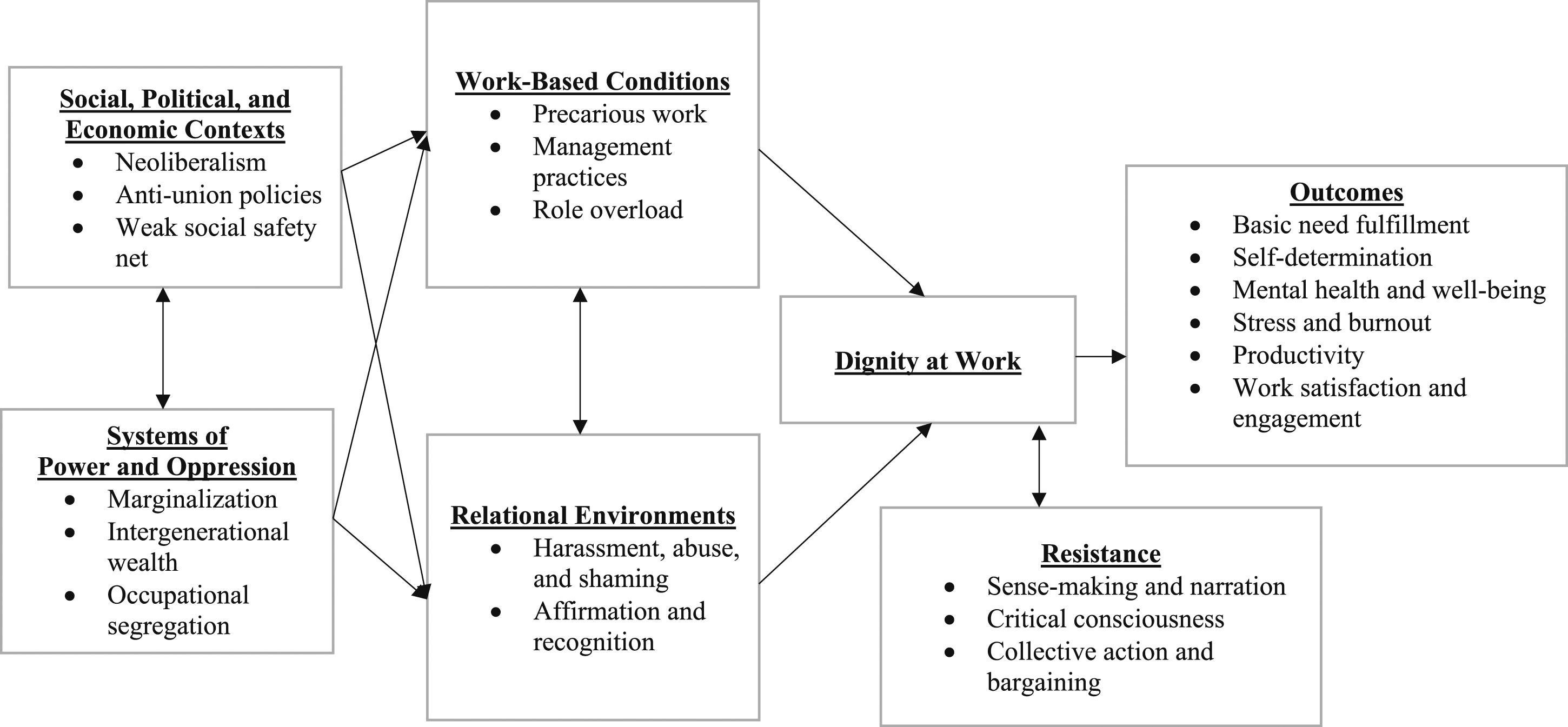
What Do We Know About Dignity at Work?
The knowledge base about dignity at work is transdisciplinary and highly diverse in terms of conceptual ideas, research methodologies, and epistemological frameworks. In the section that follows, we respond to the following questions: (1) what systemic factors support or violate dignity at work; (2) how do these condition shape access to dignity at work; and (3) what are the outcomes of dignity at work? Due to the absence of extensive research and theorizing, we use a narrative approach in this literature review, which Baumeister and Leary (1997) described as a means of linking “together many studies on different topics, either for purposes of reinterpretation or interconnection” (p. 312). A narrative literature review is optimal in cases wherein a topic is “conceptualized differently and studied by various groups of researchers within diverse disciplines and that hinder a full systematic review process” (Snyder, 2019. p. 335). We begin the review with an overview of the theoretical contributions on dignity at work followed by a selective review of the empirical literature to inform our dignity at work model.
Existing Conceptual Frameworks and Theories of Dignity at Work
For the most part, conceptual frameworks and theories about dignity at work have been developed within sociology, management, and organizational studies. Several theories and frameworks have embraced sociologically informed perspectives of dignity at work as a central issue in labor and work-based scholarship. As summarized by Pirson (2017), initial contributions on dignity at work focused on the impact of dignity denial, which is illustrated in the notions of alienation (Marx, 1996) and anomie (Weber, 1947). Building on these classic bodies of work, Hodson (2001) advanced a sociological theory that was framed by an integration of existing formulations of dignity at work along with qualitative and quantitative findings from his own research. The basic premises of Hodson’s contribution are that structural settings at work pose challenges for workers in their aspirations for a dignified work life. These structural challenges include mismanagement and abuse, overwork, compromises to one’s autonomy, and contradictions about employee involvement at work. Hodson then proposed four worker-initiated practices that can safeguard dignity, including resistance, citizenship, creating independent meaning systems, and engaging in social relations at work. The common thread in promoting dignity at work, according to Hodson, is the interaction of the structure of work contexts and individual agency. The strengths of Hodson’s contribution are its empirical foundation and its attention to the complex interactions between individuals and systemic and organizational structures. Moreover, Hodson’s work has stimulated considerable research and conceptual developments within the past two decades.
Two conceptual frameworks have emerged from management studies that seek to create a clear role for dignity at work in research and practice in organizational behavior. Pirson (2017) frames dignity as a central component of humanistic management, which seeks to counter the economistic paradigm that has been the prevailing value system in management. While not advancing a formal theoretical statement, Pirson argues that dignity and well-being are the cornerstones of humanistic management. Pirson proposes that a focus on dignity can serve to shift organizational priorities away from a focus on profits to a clearer objective of foregrounding dignity and aspiring even further to create well-being for workers.
A more elaborate theory of workplace dignity that builds on many of the humanistic ideas of Pirson (2017) as well as broader critiques of management theory and practice has been developed by Bal (2017). Bal’s theory is framed around contributions from Daoist and Kantian perspectives. Daoism, which has emerged from Chinese philosophy and religion, proposes that everything in the world, including non-humans, organizations, and inanimate objects, has dignity and therefore inherent worth (Bal, 2017). The Kantian influence in this theory is manifested in the view that dignity involves both duties and rights. Bal integrated these notions with existing theory and research on workplace dignity to develop a relational model of workplace dignity. For Bal, “while duties capture the way one should behave, rights denote the ways in which one ought to be treated” (2017, p. 79). This theory, therefore, adds to the dignity at work literature by offering the concept of duties, which has not been consistently integrated into existing formulations. Duties provides a clear connection to individuals’ relationships to their workplaces, their motivation to work, their co-workers, and organizations. In addition, the infusion of the Daoist idea of dignity relating to non-humans and inanimate objects casts a wider net, encouraging a more ecological view of dignity at work that places sustainability and humane behavior towards the entire range of objects and beings as a key aspect of leading a dignified life. While Bal’s work has generated considerable interest in theorizing about workplace dignity, it has not generated much empirical research. However, Bal’s work is consistent with the social justice perspective adopted here in its focus on equity and the need for broad, structural perspective of people and their contexts.
New conceptual inroads in understanding dignity at work from a management perspective have been mapped by Lucas and her colleagues (e.g., Lucas, 2015; Lucas et al., 2017; Thomas & Lucas, 2019). Lucas has approached workplace dignity via the lens of social identity theory (Tajfel & Turner, 2004), which frames how the identity of workers is shaped by their membership in social groups, and particularly their social identities (e.g., race, gender, sexual orientation). Lucas notes that these social identities can be a source of dignity or dignity threat. She presents a conceptual framework rather than a theory, which focuses on four intersecting principles. The first principle assumes that workplace dignity is constructed around communication and interactions; in effect, workplace dignity reflects self-perceptions of individuals’ own worth as well as the perceptions of others. The second principle is that workplace dignity is self-constructed and subjective, although also shaped by cultural norms and expectations. The third principle is that workplace dignity is based on inherent dignity and earned dignity, both of which are essential in experiencing dignity at work. The fourth principle is the bivalent nature of workplace dignity, which is manifested by both its presence (dignity) and its absence (indignity). These principles have guided considerable research by Lucas and her colleagues (e.g., Lucas et al., 2017) as well as the development of a workplace dignity scale (Thomas & Lucas, 2019).
Other important conceptual contributions include Hicks’ (2018) discussion of leading with dignity, which places concerns about dignity in the working and management/leadership contexts. Hicks derived ideas about dignity at work from her career in conflict resolution, which revealed the importance of dignity and dignity threats in a wide array of human interactions, including challenging conflictual situations. Hicks argued that focusing on enhancing the dignity of people engaged in conflict provided an important means of helping the parties to move toward negotiation and resolution. Hicks defined ten elements of dignity, which include acceptance of identity; recognition; acknowledgement; inclusion; safety; fairness; independence; understanding; benefit of the doubt; and accountability. Hicks’ (2018) work has provided useful ideas for infusing dignity into organizational consultation, conflict management, and international diplomacy.
In a recent comprehensive review of the dignity at work literature of primarily organizational and management-based research, Gibson and colleagues (2023) constructed a framework that examined the activators (presence of dignity) and detractors (absence of dignity) at societal, organizational, interpersonal, and individual levels. The authors concluded that the dignity at work literature would benefit from an integrative view of both attractors and detractors of dignity along with a more explicitly cultural understanding of how organizations and management can optimize dignified conditions at work. This review also highlighted directions for future research including the need for more empirical work, more attention to dignity from an individual and psychological level, exploration of protective factors that can help people maintain their dignity, and examinations of the impact of technology, artificial intelligence, and surveillance tools on dignity at work. Gibson et al.’s focus on organizations and management and their call for more of a focus on psychological factors provides an important resource that complements our current initiative.
Some of the challenges that are evident in the conceptual literature are ambiguity about definitional parameters of dignity at work coupled with difficulty in defining constructs in ways that would promote research. Moreover, the interdisciplinary nature of scholarship on dignity at work, while a clear asset in creating a wide net for theoretical developments, may serve to inhibit more specified and operational definitions of constructs that would foster both qualitative and quantitative research. These points notwithstanding, the existing literature builds on an intellectually rich body of work from sociology and labor studies that has recently inspired contributions from organizational psychology, management, and communication scholars. In the following section, we review promising empirical studies, which when considered collectively with the theoretical material reviewed herein, provides a foundation for a new conceptual model of dignity and work and a research agenda.
Empirical Research on Dignity at Work
Building on existing literature and recent reviews (e.g., Gibson et al., 2023), we use a social justice perspective to organize a focused portion of the dignity literature, specifically seeking to understand how the experience of dignity at work is shaped by structural forces and discriminatory workplace experiences (Thrift & Sugarman, 2019). Accordingly, Figure 1 provides a social justice informed organizational framework that depicts empirically supported antecedents and outcomes of dignity at work, which are grouped by major themes in the literature. As indicated earlier, the main criteria that we use in selecting studies to review is their pertinence to the major questions that underlie this contribution, which focus on (1) identifying the distal and proximal antecedents of dignity at work and (2) identifying the outcomes of dignity at work. Collectively, exploring these questions provides a foundation for understanding the meaning of dignity at work and its rootedness in social justice values and tenets. However, while the framework may apply to different national contexts, we primarily focus on neoliberal, free market economies, using the United States as an example. Therefore, we do not assume that the model will apply universally, and scholars may adapt the model to different contexts.
Antecedents of Dignity at Work
As seen in Figure 1, four dominant themes arose as antecedents of dignity at work: social, political, and economic conditions; systems of power and oppression; work-based conditions; and relational environments. Although these domains are separate when presented in a more linear model, they are interconnected, which is consistent with our social justice perspective, and lead to dignity at work dynamically and interactively over time (e.g., Allan & Blustein, 2022; Hodson, 2001). This is also true with contextual and systemic conditions that shape the experience of dignity at work, resistance to dignity violations, and dignity at work’s outcomes.
Social, Political, and Economic Context
The dignity at work literature is unique in that it is framed within social, political, and economic contexts. Specifically, threats to dignity at work are becoming more salient because of political and economic systems connected to neoliberal ideologies, such as hyper-individualism and the myth of meritocracy (Allan et al., 2021; Bal & de Jong, 2017; Blustein et al., 2024). For example, neoliberalism – a political and economic system emphasizing free market capitalism, deregulation, and small government – became more prominent beginning in the 1970s and 1980s as globalization and international competitiveness intensified (Kalleberg, 2009). In addition to the emergence of neoliberalism, intense global competitiveness also created incentives for decentralized organizations with fewer permanent workers, less comprehensive benefit packages, and strategic layoffs (Kalleberg, 2009). In sum, these trends led organizations to a shift away from investing in and developing their workforces, which transferred risk from organizations onto individual workers and facilitated the commodification and dehumanization of workers (Bal & de Jong, 2017; Blustein et al., 2024; Davis, 2016; Mahalingam et al., 2019). Consequently, there has been an erosion in stable and permanent employment, which includes steady and meaningful employment relationships, all of which has implications for dignity at work (Allan et al., 2021; Bal & de Jong, 2017).
Concurrent with these major transformations in the labor market has been the gradual restriction of collective bargaining rights and an erosion of the social safety net in many nations (Ali et al., 2022). First, labor unions have historically been a powerful voice advocating for the respect and fair treatment of workers (Lott, 2014). Accordingly, most workplace norms that we take for granted, such as the minimum wage, child labor laws, and safe working environments, are the result of labor union advocacy. For example, regarding safe work environments, labor unions have advocated for workers’ rights to identify hazards at work, participate in making workplaces safe, and refuse to engage in unsafe work, which all reflect support for basic human dignity (Day et al., 2014). However, since the mid-20th century, union membership has declined worldwide (International Labour Organization, 2021). For example, the United States has experienced a long and complex anti-union movement, which has manifested in media representations, anti-labor laws, and company tactics, such as hiring anti-union consultants, firing employees who join unions, and hiring more part-time workers (Lott, 2014). The effect has been a dramatic reduction in the voice and power of workers to advocate for change and preserve dignity (e.g., a decline in workplace democracy; Bal & de Jong, 2017).
Second, the reduced social safety net has also made accessing dignity affirming assistance more difficult (Schott & Finch, 2010), and policies like work requirements create further barriers and disruption to receiving aid (Allan & Kim, 2020). In addition, the minimum wage in the United States has stagnated since the 1970s, with the real adjusted minimum wage steadily declining. Furthermore, the United States is behind peer nations with respect to worker rights, including no access to federally mandated annual and paid family leave or paid sick days (e.g., Sawhill & Guyot, 2020). These are only some examples from the United States, but many countries fail to protect and promote decent and dignifying work, such as having time off for rest and receiving a living wage. Finally, economic downturns and the COVID-19 pandemic have added another layer of precarity and loss that is distributed according to existing inequitable hierarchies (Blustein et al., 2024; ILO, 2021). For example, workers experienced interpersonal isolation, a loss of physical safety at work, and mistreatment and abuse by customers and supervisors. In summary, this complex context provides fertile ground for the violation of dignity at work by shaping work conditions and failing to support the dignity of workers.
Systems of Power and Oppression
These economic shifts have occurred within a deeply inequitable system, with multiple intersecting forms of oppression determining people’s access to work conditions and workplace experiences that promote or violate dignity. For example, systems like classism, sexism, racism, and heterosexism intersect to restrict marginalized people’s vocational freedom and choice, thereby exposing them to structural conditions and workplace experiences that threaten dignity (Brewster & Molina, 2021). While these pathways are complex and interactive, they are deeply rooted in historical context and culminate in ongoing inequity.
For instance, a long history of enslavement, housing segregation, redlining, and workforce discrimination experienced by African Americans in the United States has restricted wealth accumulation and the ability to obtain other forms of capital that can facilitate self-determination, occupational development, and dignity (e.g., Perry & Pickett, 2016). Likewise, public policies in the United States have routinely excluded racialized workers. For example, fights for labor rights in the 20th century were contentious and bloody, but labor policy in the United States made steady progress (MacLaury, 1998). New Deal legislation in the 1930s was especially instrumental in establishing the rights of workers, including the National Labor Relations Act of 1935 (NLR), which provided the right to forms unions, collectively bargain, and strike. However, no measures in the NLR protected racial minorities, and major unions often excluded Black workers or internally relegated Black members to poorer quality jobs (e.g., Cassedy, 1997). Furthermore, the NLR excluded domestic and farm workers who were highly represented by Black workers, which scholars consider a “race-neutral” tactic to prevent Black workers from receiving statutory rights – an exclusion that remains in place today (Perea, 2011). The legacy of these policies and many others continues through workforce discrimination, which affects all aspects of the vocational process, including job searching, hiring and promotions, work well-being, and turnover (Perry & Pickett, 2016).
Different historical legacies of oppression have affected other marginalized groups, which similarly continues. For example, sexism and classism have stratified the labor market in such a way that women and people from lower social classes experience greater abuse, harassment, and coercive control, which threaten autonomy and dignity at work (Crowley, 2013, 2014). Similarly, homophobia, transphobia, and heterosexism create workplace environments where LGBTQ people experience discrimination, lack of safety, social harm, career disruptions, and identity devaluation, directly violating their dignity at work (Baker & Lucas, 2017).
However, systems of power and oppression rarely operate in isolation and, rather, intersect to create unique experiences of marginalization, a process exemplified by the intersection of white supremacy and the patriarchy (Brewster & Molina, 2021). For example, the architect of intersectionality theory, Kimberlé Crenshaw (1989), developed the perspective to describe working-class Black women’s unique experiences of hiring discrimination at General Motors due to the company only hiring Black men or white women. In essence, understanding discrimination in this context required examining race and gender together, rather than racism and sexism as independent axes of oppression. Accordingly, recent vocational research has found that experiences of sexism and racism intersect among women workers of color to predict occupational choice privilege (Autin et al., 2022), and Black women earn the least income compared to other groups (Mandel & Semyonov, 2016).
This is only one example of intersectionality, but research demonstrates that intersecting systems of power shape work-based conditions and experiences within the workplace, which have implications for who has access to workplaces that promote dignity at work (Brewster & Molina, 2021). For example, marginalized populations experience hiring discrimination, occupational segregation, barriers to promotions, and fewer educational opportunities (e.g., Kang et al., 2016; Mandel & Semyonov, 2016; Quintana & Mahgoub, 2016). In summary, systems of power and oppression operate on dignity at work by affecting the types of work available and the workplace environments and experiences of marginalized populations. And, while these examples are derived from the United States, similar processes and barriers are evident in other regions of the world (see, for example, Bal, 2017; Bolton, 2007; Kostera & Pirson, 2017; Mahalingam et al., 2019, for international examples).
Work-Based Conditions
Inequitable systems can shape who experiences work-based conditions that can either promote or threaten dignity at work. In this context, work-based conditions refer to aspects of the work environment, workplace policies and procedures, and the structure and arrangement of jobs (e.g., wages and working hours). Therefore, an important work-based condition is the rise in precarious work, which is defined as risky, temporary, and low wage work where workers have little power and voice (Kalleberg, 2009). Precarious work has been increasing across the globe due to the social and economic factors discussed above, such as neoliberalism and wealth inequality (Kalleberg, 2009), and structural forces have historically shaped precarious work to concentrate it among marginalized populations, such as migrant workers, people with disabilities, women, workers of color, and LGBTQ + workers (see Allan et al., 2021 for examples). Furthermore, precarious work may have both direct and indirect implications for dignity at work. For example, while precarious work might directly violate workplace dignity through unfair pay, differential treatment based on temporary status, and inability to meet basic needs (Allan & Blustein, 2022; Thomas & Lucas, 2019), precarious work also creates the conditions for continued dignity violations by disempowering workers (Allan et al., 2021). For example, migrant farmworkers frequently experience precarious work marked by a lack of autonomy, inconsistent work, poverty wages, surveillance, harassment, and fear of retaliation, all of which relate to less dignity at work (Areguin & Stewart, 2022).
Beyond precarious work, organizations can often violate dignity beginning at the top – namely, how management creates and implements structures that treat workers with respect, worth, and autonomy, or objectify workers as cogs in the machine (Hodson, 2001). Hodson (2001) discussed several ways in which management can disrupt dignity, such as through direct abuse, power hoarding, disorganization, cronyism, and norm setting. These create further conditions that violate dignity. For example, as noted previously, many inequitable and power laden workplace structures create significant challenges for dignity at work, such as restricted autonomy, role overload, and overwork (Crowley, 2013, 2014). Similarly, workplace structures that control workers’ relationships, have rigid policies and practices, or violate privacy are related to less dignity at work (Khademi et al., 2012).
Conversely, organizations can implement workplace conditions, policies, and practices that may promote dignity. For example, this can include workplace democracy, which involves and empowers employees in decision-making (Bal & de Jong, 2017); adequate staffing and resourcing to avoid overload; access to training and work-life balance; ethical leadership; and economic security (Mertz et al., 2023; Thomas & Lucas, 2019). Other factors may include reasonable expectations, appropriate feedback, equitable systems and outcomes, and respectful communication (Hodson, 2001). In summary, many different workplace conditions and structures, shaped by structural factors, can directly relate to experiences of dignity at work.
Relational Environments
While closely linked to workplace conditions and structures, the literature also illustrates that people’s relational environments can promote or threaten dignity at work. Relational environments refer to interpersonal processes (e.g., power dynamics), workplace relationship norms, and exposure to harmful or uplifting social interactions, which operate in nuanced ways to communicate whether a worker is unique and valued or an expendable commodity. These processes, which often derive from economic and oppressive ideologies, and relational environments that violate dignity, can manifest in bullying, abuse, discrimination, exclusion, and harassment (Bal, 2017; Blustein, 2011; Lucas, 2015; Thomas & Lucas, 2019). Moreover, whether these relational acts are perpetrated by coworkers, customers, or supervisors, they often involve a denial of respect and value through the exercise of power (Thomas & Lucas, 2019).
For example, sexual harassment is steeped in social power dynamics, involving a process in which a perpetrator violates another person’s dignity to establish or maintain status (Lopez et al., 2009). Accordingly, scholars have argued that traditional indicators of job appraisals (e.g., job satisfaction) are not appropriate for women because they ignore gendered power dynamics at work – rather, dignity at work might be a more salient outcome because it captures the results of gender discrimination and sexual harassment (Roscigno et al., 2021). Likewise, microaggressions in the workplace – brief but regular insults, slights, or offensive behaviors against marginalized people – directly violate dignity by communicating lower value and status and by creating a broader hostile and unwelcoming climate (Baker & Lucas, 2017; Thomas & Lucas, 2019). Again, as demonstrated in Figure 1, these processes are complex and extend over time. For example, across four studies with different populations, Sainz and colleagues (2023) found that inequity and unfairness predicted less perceived dignity at work via dehumanization and self-objectification.
Many other relational experiences shape workers’ experience of dignity. Specifically, the experience of dignity at work is highly relational and exists within a complex set of relationships, dynamics, and interpersonal feedback loops (Bal, 2017; Blustein, 2011). Generally, workers experience dignity at work when they are in an interpersonal climate that communicates value and respect, such as inclusion in a team that promotes belonging, values differences, respects boundaries, and maintains psychological safety (e.g., Yalden & McCormack, 2010). For example, implementation of workplace democracy that includes all constituents in decision-making may promote dignity at work (Bal & de Jong, 2017). Other positive relational interactions that can promote dignity include positive feedback that communicates the dignity of employees, such as affirmation, recognition, appreciation, gratitude, and inclusion (Lucas, 2015). This can occur in simple ways, such as a supervisor remembering a worker’s name or colleagues treating each other courteously (Lucas, 2015) or customers expressing recognition or gratitude (Wang et al., 2021). Conversely, when these elements are not present, workers will likely experience dignity violations, which can include relational workplace experiences and dynamics like humiliation, dehumanization, and isolation (Khademi et al., 2012). Likewise, dignity violations can occur when people’s coworkers or supervisors deny their abilities and fail to recognize their accomplishments (Khademi et al., 2012). In summary, the sociopolitical context and existing hierarchies shape relational environments at work, such as when marginalized workers experience harassment or microaggressions at work, which threatens dignity. Conversely, many interpersonal dynamics can promote dignity at work, such as having a culture that facilitates respect, recognition, and affirmation.
Resistance
Although the antecedents discussed previously may reduce dignity at work, the dignity at work literature highlights that workers are not passive actors. Rather, when people experience indignity, they may engage in resistance against organizations and institutions that are at the root of their mistreatment. Research has uncovered a range of resistance behaviors, including actively seeking and creating safe spaces, advocating for change in the organization, and avoiding harm (Baker & Lucas, 2017). For example, workers may directly confront their supervisor or vent to colleagues; however, workers might also withdraw their cooperation with the organization through absenteeism, quitting, sabotage, striking, or other tactics (Hodson, 2001).
Another critical resistance process is engaging in discourse and narratives that seek to maintain individual and collective worth (Hamilton et al., 2019; Hodson, 2001). For example, Lucas (2011) argued that all people have a drive to establish a dignified work identity, although this is more difficult for marginalized workers facing coercion and stigma. Specifically, human agency may become contested when it is coerced or controlled, so workers engage in narrative sense-making to maintain their dignity under these conditions (Buzzanell & Lucas, 2013). Hamilton and colleagues (2017) provided a salient example of this process with garbage workers, who experience dignity violations through having a stigmatized job and physical closeness to dirt and grime. In this context, participants internalized a sense of dignity by viewing their work as everyday heroism. Likewise, taking an intersectional perspective, Areguin and Stewart (2022) found that despite facing discrimination and injustices, Latina farmworkers maintained their dignity by recognizing and taking pride in their abilities, finding beauty in their environment, and establishing meaningful relationships. In short, workers use meaning-making and narrative strategies as an important source of resistance to dignity violations.
Despite the importance of narrative strategies, they are often individualized solutions to structural problems. Specifically, dominant self-care and resistance perspectives often reflect individualistic, instrumental, and neoliberal perspectives that place the responsibility of coping with adversity on individual workers, rather than power brokers (Bal et al., 2020). In contrast, workers may also resist dignity violations with solidarity and collective action, such as through developing critical consciousness (Byars-Winston, 2012). Critical consciousness refers to the process of becoming aware of oppressive systems through critical reflection and taking steps to resist those systems through critical action (Cadenas & McWhirter, 2022). With a dignity at work perspective, critical consciousness may involve greater awareness of how economic systems and cultural ideologies, like neoliberalism and hyper-individualism, can dehumanize and commodify workers as well as how systems of marginalization shape who experiences dignity at work (Bal et al., 2020; Byars-Winston, 2012). Critical consciousness can also encourage solidarity and shared purpose to advocate for dignity at work (Hodson, 1996), which includes unionizing to engage in collective action and bargaining.
Joining a union itself reflects a core aspect of human rights and dignity, with the Universal Declaration of Human Rights stating, “Everyone has the right to form and to join trade unions for the protection of [their] interests” (United Nations, 1948). However, as noted previously, unions have also been instrumental in protecting the dignity of workers and promoting self-esteem and respect (Lott, 2014). For example, the United Auto Workers (UAW) union’s constitution states, “Essential to the UAW’s purpose is to afford the opportunity for workers to master their work environment; to achieve not only improvement in their economic status but, of equal importance, to gain from their labors a greater measure of dignity, of self-fulfillment and self-worth.” (UAW, 2022). Therefore, unions represent a key source of collective resistance when dignity at work is threatened. Exemplars of the power of unions in resisting dignity violations are particularly evident in regions outside of the United States that have a culture and political system that supports collective resistance to many of the disparities and oppression of ongoing social injustices.
Outcomes of Dignity at Work
Scholars have examined a range of outcomes associated with dignity at work, which might be promoted through a variety of mechanisms. First, the presence of dignity at work may be a critical condition that provides the security and safety to meet basic psychological needs and experience well-being. Moreover, studies suggest that this may create a positive feedback loop, further enhancing both perceptions of dignity at work and beneficial outcomes. For example, a recent longitudinal study found that greater dignity at work predicted greater autonomy, competence, relatedness, and social contribution need fulfillment over time – variables that are themselves related to a host of well-being outcomes (Allan & Blustein, 2022). Interestingly, greater relatedness need fulfillment also predicted greater dignity at work, suggesting that they were operating in a reciprocal relationship. Likewise, scholars have found dignity at work to predict greater strengths use, adaptability, and empowerment, which in turn predicted greater fulfillment at work (Owens et al., 2022). Therefore, dignity at work may create a foundation for need fulfillment, strengths use, and other beneficial outcomes.
Another thread in the literature concerns how experiencing dignity at work affects performance, productivity, and workplace behaviors. For example, Lucas and colleagues (2017) found that employee voice predicted greater work engagement, while equality of opportunity and respectful social relations predicted fewer counterproductive workplace behaviors. Interestingly, another study found that when customers expressed gratitude to servers (through unexpected tips), this promoted organizational citizenship behaviors through experiences of dignity at work (Wang et al., 2021). Dignity at work might also improve overall organizational functioning. For example, dignity at work is related to greater knowledge sharing among workers via psychological safety (Iqbal et al., 2023) as well as greater organization-based self-esteem, discretionary work effort, and performance, especially when workplace inclusion is high (Ahmed et al., 2022, 2023). Dignity at work is also related to greater organizational commitment, personal self-esteem, and work satisfaction and fewer turnover intensions (Mertz et al., 2023; Sturm & Dellert, 2016). Therefore, while the goal of promoting dignity at work should not primarily be to improve organizational functioning, doing so does not operate against organizational goals.
Finally, scholars have discussed the processes by which dignity violations may lead to negative outcomes. For example, dignity violations might cause chronic stress, which results in poorer mental health and high-risk behaviors that have downstream effects on physical health (Chilton, 2006). This is consistent with studies finding indignity to be related to negative emotional responses, such as anger and frustration, and greater psychological distress and burnout (Lucas, 2015; Owens et al., 2022; Thomas & Lucas, 2019). In short, while dignity at work is related to many positive outcomes, indignity is related to negative outcomes.
In summary, as illustrated in Figure 1, dignity at work may lead to many beneficial outcomes. However, because the experience of dignity at work occurs downstream of existing hierarchies that affect work conditions and relational experiences, its outcomes are likely inequitably distributed. Likewise, the burnout and psychological stress associated with dignity violations likely occur more frequently for marginalized populations, who are exposed to abuses of power and dehumanization.
Future Research Directions
Future directions for research.
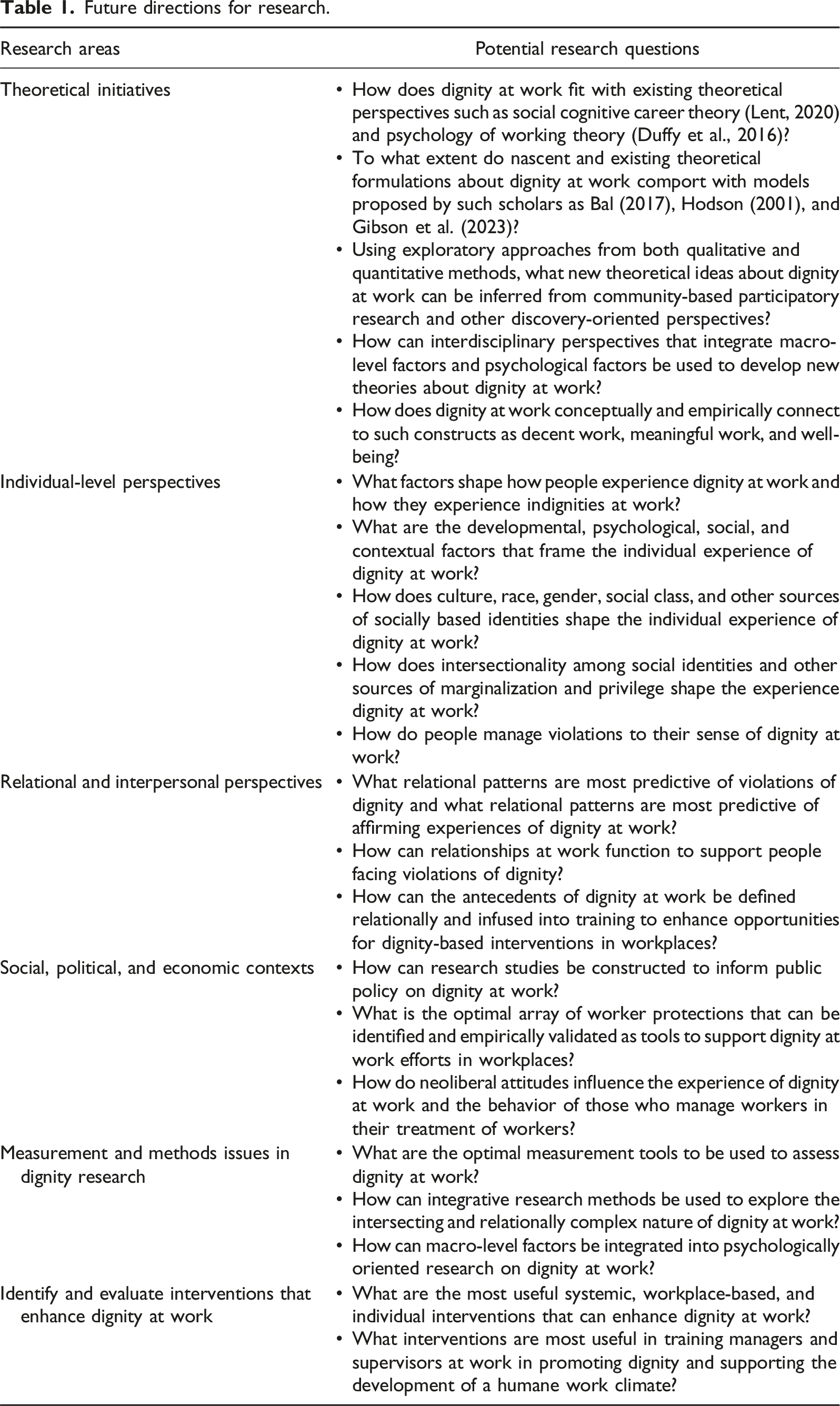
The suggestion to explore how dignity at work may fit into existing and nascent theoretical formulations on work and career provides a potentially informative line of inquiry that can yield multiple notable outcomes. Dignity at work may function as a predictor, mediator, or outcome in such well-established theories as social cognitive career theory (SCCT; Lent, 2020) and psychology of working theory (PWT; Duffy et al., 2016); For example, studies have tested models with dignity at work as a work condition alongside decent work (Allan & Blustein, 2022). However, the model in the current paper differs from PWT in that it highlights the work environment (e.g., relational) as well as resistance to dignity violations. Therefore, dignity at work can form the basis of new theoretical fusions; for example, merging insights from our model and PWT to identify predictors and outcomes of dignity at work.
As suggested by Gibson et al. (2023), considerably more attention is needed in exploring individuals’ experiences with dignity at work. One particularly useful means of exploring individual experience is via qualitative designs that provide participants with opportunities to describe their own experiences via interviews or other forms of self-expression. Developing inferences from the ground-up (e.g., via grounded theory) could be a useful approach in developing an in-depth and dimensional understanding about how dignity is experienced and manifested for people in diverse work contexts. In addition, qualitative research may help explore how dignity at work is relevant outside the workplace, such as during career transitions when the lack of dignified work may be an obstacle (Alacovska et al., 2021). Furthermore, using mixed methods approaches might provide means of examining how such individual constructs as racial identity or social class worldview interact with experiences of dignity and social identities. Expanding out from an individual perspective to a relational framework would be an informative direction; studies that seek to identify relational patterns at work that support dignity and patterns that detract from dignity would be fruitful. These studies may benefit from the use of observations of work interactions, social network analyses, and experimental designs as well as more traditional qualitative and quantitative methods.
Connecting dignity at work to more macro-level factors such as social, political, and economic constraints offer important opportunities to explore how institutional and systemic factors shape and constrain access to dignity at work. Moreover, new theoretical efforts that integrate macro-level factors and the more proximal influences of dignity at work may be useful and may lead scholars to more interdisciplinary theory development. Public policy-based analyses might benefit from quantitative analyses of the relationships between worker protection regulations and the prevalence of individual experiences of dignity. Another approach would be to understand how values such as views of neoliberalism or critical consciousness influence managers and political leaders in their understanding of dignity at work.
Measurement and methodological studies could optimally build on a gap analysis of what tools are needed to fully explore dignity at work. While recent advances in measurement have resulted in viable scales of workplace dignity (e.g., Thomas & Lucas, 2019), additional measures may be needed to fit varied cultural contexts and organizational climates. In addition, the methodological ideas presented earlier in this section point to the need to develop tools that can integrate macro-level factors with psychological factors. One viable approach is the one used by PWT wherein participants are asked to respond to brief measures of their experience of marginalization and economic constraints (Duffy et al., 2016).
Developing effective interventions to foster dignity at work cultures in organizations is also a promising area for new program development and research. Interventions can be constructed for managers and leaders in workplaces to ensure that they are aware of the importance of dignity and cognizant about the ways to optimize their leadership strategies so that they promote and not detract from the experience of dignity. In addition, consistent with the recommendations from Gibson et al. (2023), we encourage researchers to identify protective factors that can be used by individuals to manage and mitigate threats to dignity. Finally, intervention research is needed to provide workers with tools to resist indignities at work.
Implications for Practice and Policy
Despite the nascent level of research on dignity at work, several implications for counseling practice and public policy can be derived from existing literature and our framework. The importance of dignity at work suggests that counselors would benefit from maintaining an intentional awareness of how clients are being treated at work. The dignity at work lens provides a language and broad conceptual context for attending to the ways in which work serves to support or deny experiences of dignity. In addition, discussions of dignity at work might foster critically conscious conversations that could optimally facilitate growth in how people understand matrices of oppression and domination, which shapes work experiences for so many people (Brewster & Molina, 2021). Another viable way for practitioners to intervene in situations where clients’ dignity is compromised is to discuss ways for clients to resist the forces that are violating dignity. In addition, counselors can provide relational support for their clients who are facing indignities while mobilizing their sense of agency in combatting abusive and inappropriate treatment at work.
From a systemic perspective, the existing literature coupled with our conceptual model underscore the importance of developing norms, values, and policies that will create cultures that affirm dignity at work. Based on the explicit intersection between social/racial justice and dignity at work, we propose that efforts to support the humane treatment of all workers should constitute a core element of institutional reforms in the world of work. One way of facilitating this goal is to develop training programs for organizations that link dignity at work values with the full array of goals that guide a given work setting. In addition, linking diversity, equity, and inclusion initiatives with dignity at work programs might provide an optimal integration that could help to operationalize efforts to fully embrace social and racial justice at work. We hope that future research builds a synergistic relationship with practice and policy reforms so that dignity-informed scholarship matters for individuals, organizations, and society at large.
Conclusion
In this contribution, we have sought to provide the conceptual scaffolding to present dignity at work as a core human right for working people. Using a social justice perspective to guide a focused, narrative literature review, we have developed a conceptual framework that optimally can serve as a foundation for further theory construction and advocacy. We concluded with an overview of promising directions for future research to stimulate needed scholarship, program development, and methodological innovations about dignity at work. We hope that this review coupled with the critical conceptual model will serve to build on the call for a world that affirms dignity at work for all, which was central to the vision articulated by Martin Luther King. Jr. over 50 years ago.
Footnotes
Declaration of Conflicting Interests
The author(s) declared no potential conflicts of interest with respect to the research, authorship, and/or publication of this article.
Funding
The author(s) received no financial support for the research, authorship, and/or publication of this article.
