






Abstract
A clear plastic surgical bag which has an incorporated closure string may be used to contain fluid during jet lavage irrigation of foot and ankle wounds. This method may prevent fluid from spraying about, improving barrier precautions for both patient and operating room personnel.
INTRODUCTION
Irrigation of the foot and ankle using jet lavage may be required as part of the surgical management of open fractures and infections. 1 The pressures and pulsations of jet lavage may often cause irrigation fluid and tissue debris to spray about the operating room. This may place the patient at increased risk for nosocomial infection when fluid soaks through the surgical drapes or splashes off operative personnel, non-sterile equipment, or room walls and ceilings onto the surgical field. Furthermore, operative personnel sprayed or splashed with fluid from the surgical site may be at risk for contracting infectious diseases from the patient such as hepatitis and HIV. 2
We describe a simple method of containing irrigation fluid to the operative site.
TECHNIQUE
A sterile clear plastic surgical bag which has an incorporated closure string (Vi-DRAPE® Surgical Drape Isolation Bag, The Clinipad Corporation, Rocky Hill, Connecticut) is used. The foot and ankle is placed in the bag, and the closure string is tied securely to prevent fluid leakage or spraying from the entrance of the bag (Fig. 1). The irrigation jet stick is placed into a small hole cut in the bag near the surgical wound, and the hole is held closed by the non-dominant hand of the surgeon while the dominant hand controls the trigger of the irrigation apparatus. The foot is placed in a surgical basin, and a folded towel is placed along the rim of the basin to prevent indentation and breakdown of the skin of the posterior ankle or leg. A second hole is cut in the bag on the underside of the foot to allow controlled outflow of fluid by gravity into the basin, from which the fluid is suctioned away (Fig. 1).
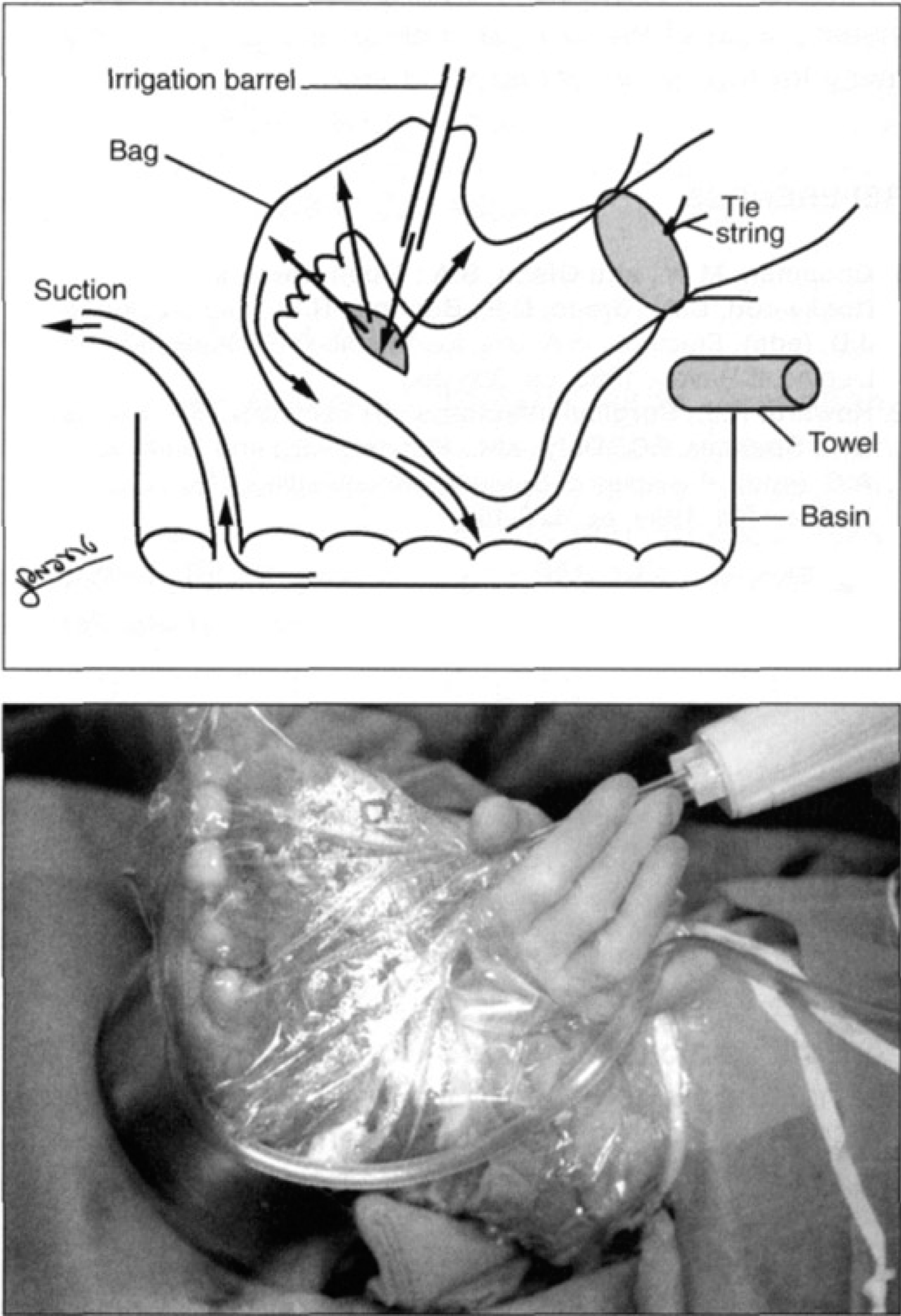
Method using a clear plastic surgical bag for containment of irrigation fluid during jet lavage of the foot and ankle.
COMMENT
The technique enables thorough jet lavage of the surgical wound. The patient and operating staff are protected from contamination which otherwise may result from uncontrolled fluid or aerosolized droplets spraying about. Furthermore, thoroughness of the irrigation may be improved because the clear plastic barrier improves visualization of the wound, without the surgeon shying away for fear of an unexpected splash to the face.