Correction
 Available accessCorrectionFirst published 2026

Select search scope: search across all journals or within the current journal


1-20 of 23 articles
Available accessCorrectionFirst published 2026Available accessResearch articleFirst published 2026Modified Lapidus procedure is well established for severe hallux valgus (HV). Nonetheless, postoperative recurrence remains a clinical concern. Peroneus longus (PL) functions as a dynamic stabilizer of the first ray, and its insertion at the base of the first metatarsal may be partially resected during osteotomy. Notably, PL dysfunction may contribute to recurrence by contributing to postoperative first ray instability. Nevertheless, extent of PL insertion resection during modified Lapidus procedure has not been quantified. This study aimed to evaluate the extent of resected PL insertion during modified Lapidus procedure.
We retrospectively reviewed 80 feet from 74 patients with severe HV. We simulated 2 osteotomy methods: lateral wedge osteotomy at the base of the first metatarsal (M-method) and lateral wedge osteotomy at the distal medial cuneiform (C-method). On radiographs, resected lateral edge length of the first metatarsal (rM1-length) to correct intermetatarsal angle (IMA) to 0° was measured. Based on the rM1-length, 3-dimensional computed tomography models were used to measure whole PL insertion length, resected PL insertion length (rPL-length), and percentage of resected PL insertion (%-rPL). These parameters between the M-method and the C-method were compared. Cutoff value of the IMA for diagnosing feet with %-rPL greater than 50% using the M-method was evaluated.
rM1-length, rPL-length, and %-rPL were significantly greater with the M-method than with the C-method (all
Lateral wedge osteotomy at the first metatarsal may result in substantial PL insertion resection during the modified Lapidus procedure. Lateral wedge osteotomy of the medial cuneiform bone may better preserve PL insertion and potentially have implications for first ray stability.
Available accessResearch articleFirst published 2026Limited dorsiflexion (DF) after total ankle arthroplasty (TAA) is a challenge that has been associated with worse functional outcomes and lower patient-reported satisfaction. The purpose of this study was to identify predictive variables for limited DF following TAA.
A retrospective cohort study was conducted on patients who underwent elective primary TAA between 2013 and 2023 by a single surgeon. Postoperative range of motion (ROM) was assessed using weight-bearing lateral radiographs obtained in maximal DF and plantarflexion (PF). Limited DF was defined as <20° and preoperative DF was based solely on clinical assessment (C-DF). Demographic variables, medical comorbidities, surgical history, and adjunctive procedures, including gastrocnemius recession and tendo-Achilles lengthening (TAL), were collected and compared between patients who achieved full vs limited postoperative DF. Additionally, Foot and Ankle Ability Measure activities of daily living subscale (FAAM-ADL) and visual analog scale (VAS) scores were collected. Multivariable logistic regression was performed to identify independent predictors of final DF.
A total of 175 patients were included in this study, with 111 (63.4%) demonstrating limited postoperative DF and 64 (36.6%) achieving full DF at a mean 3.3 years. Age was significantly greater in the full DF group (65.5 vs 61.5 years,
Preoperative clinical dorsiflexion was the only significant independent predictor of postoperative dorsiflexion following TAA. A thorough preoperative discussion regarding anticipated postoperative motion can help establish appropriate expectations and potentially enhance patient satisfaction following TAA.
Available accessResearch articleFirst published 2026The objective of this study was to assess the types and rates of early complications following elective percutaneous surgery for hallux valgus (HV) in diabetic (DP) vs non-diabetic (NDP) patients.
This retrospective study was conducted at our institution between October 2017 and August 2020. During this period, 874 feet underwent percutaneous surgery for HV correction. All adult diabetic patients with controlled diabetes who underwent percutaneous distal metaphyseal osteotomy and had a minimum follow-up of 6 months were included. For each diabetic patient, 2 age-matched (±1 year) non-diabetic controls were randomly selected. Complications were defined as any deviation from the normal postoperative course and were systematically recorded. This work is a retrospective exploratory analysis of a matched cohort.
A total of 75 patients were analyzed, 25 DP and 50 NDP, with a mean follow-up of 10.8 months (range 6-48) months. There were no significant differences in demographic characteristics between groups, except for body mass index and Charlson Comorbidity Index, both of which were significantly higher in the DP group (
The overall complication rate was 24% (n = 6) in the DP group and 18% (n = 9) in the NDP group (
With the available sample size, no statistically significant differences in the overall complication rate were detected between well-controlled diabetic and non-diabetic patients undergoing minimally invasive hallux valgus surgery. These findings should be interpreted as exploratory and hypothesis-generating, and require confirmation in larger studies.
This is a visual representation of the abstract.
Available accessResearch articleFirst published 2026 , Dietmar Mattausch, Nils Kuehn , [...]
First metatarsophalangeal joint arthrodesis is a reliable treatment for painful end-stage degenerative, inflammatory, and post-traumatic conditions and severe deformities of the first ray. Although long-term functional outcomes are well documented, the incidence and relevance of degenerative changes in adjacent joints of the medial column after first metatarsophalangeal joint (MTP1) fusion remain uncertain.
This exploratory single-center follow-up study included patients who underwent isolated MTP1 arthrodesis between 2012 and 2018. Preoperative and final follow-up weight-bearing radiographs were assessed for osteoarthritis progression in the interphalangeal (IP), tarsometatarsal (TMT1), naviculocuneiform (NC), and talonavicular (TN) joints using the Kellgren-Lawrence classification. Radiographic alignment parameters (hallux valgus angle, intermetatarsal angle, hallux-ground angle, and dorsal extension angle) were recorded. Clinical outcome was evaluated using American Orthopaedic Foot & Ankle Society hallux metatarsophalangeal-interphalangeal score (AOFAS HMI) score, Foot and Ankle Outcome Score (FAOS), Foot Function Index (FFI), and a study-specific questionnaire. Paired statistical tests and Pearson correlation analyses were performed.
Seventy-seven patients (45 female, 32 male) were available for follow-up at a mean of 106.9 ± 25.3 months. Radiographic osteoarthritis progression was significant in all assessed adjacent joints (
MTP1 arthrodesis provides excellent long-term satisfaction and functional outcomes with low revision rates. Although radiographic adjacent-joint degeneration, particularly involving the interphalangeal joint, may occur over time, these changes do not appear to influence clinical outcomes.
This is a visual representation of the abstract.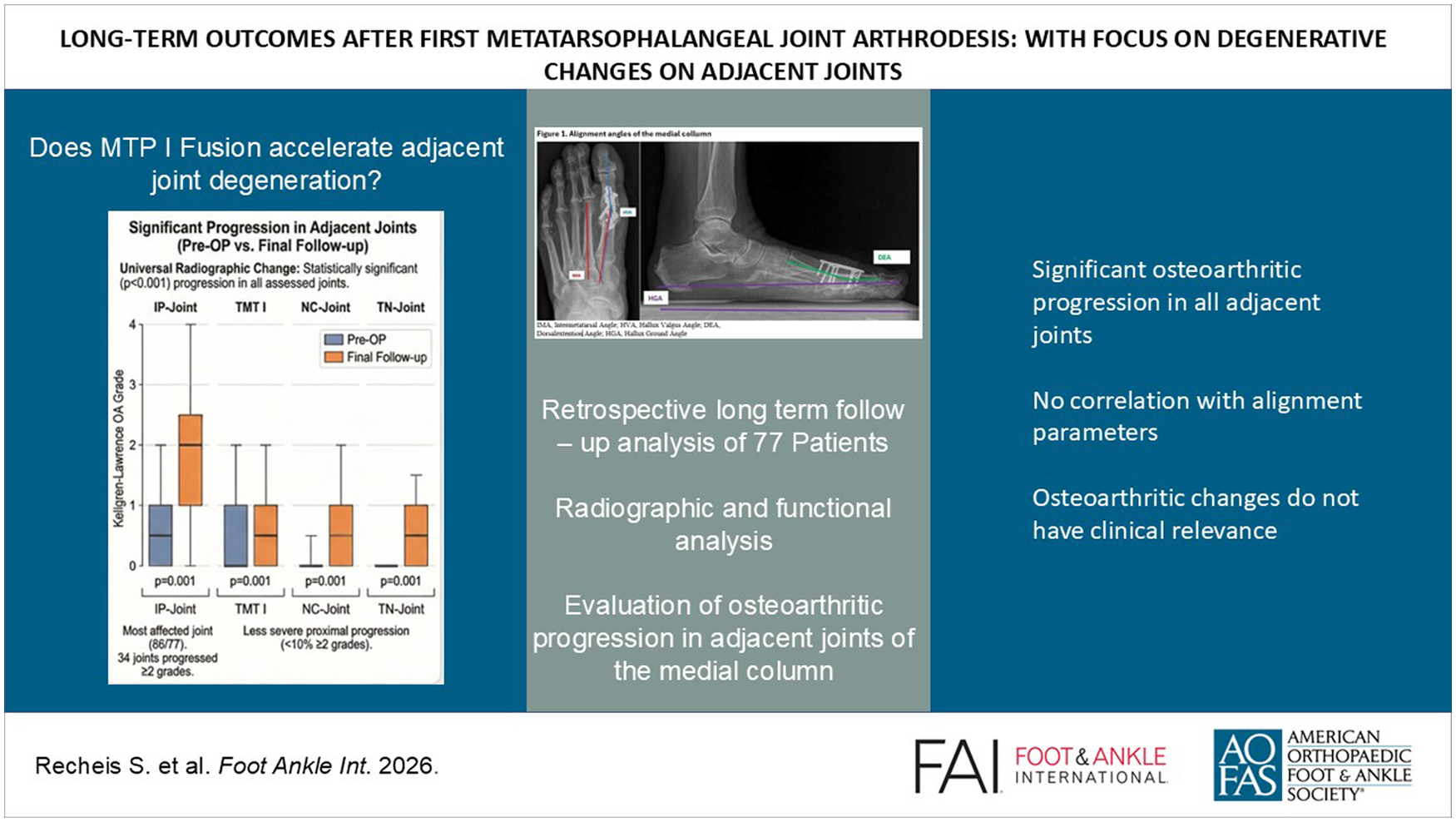
Available accessArticle commentaryFirst published 2026, Paul T. Fortin Available accessResearch articleFirst published 2026
This study aimed to demonstrate long term clinical follow-up and implant survivorship of Salto Talaris–type primary total ankle arthroplasty (TAA) by 1 foot and ankle–trained surgeon at a single institution.
Patients treated with primary Salto Talaris TAA were identified via
A total of 154 patients met inclusion (55.8% female, mean age at surgery 63.3 ± 8.9 years). Mean follow-up was 9.7 years (range, 0.6-17.6 years). Estimated implant survival probability was 100% at 1 year, 97.2% at 3 years (95% CI 94.6-99.9), 94.9% at 5 years (95% CI 91.3-98.7), 91.6% at 10 years (95% CI 86.7-96.9), and 86.9% at both 12 and 15 years (95% CI 79.3-95.3); no component explantation events occurred between 12 and 15 years, with the final explantation recorded at 15.28 years postoperatively. Thirteen patients underwent revision. There was no significant change in dorsiflexion but a reduction in plantarflexion (Δ = –4.3°, 95% CI −6.0 to −2.6;
This cohort suggests that Salto Talaris–type TAA is associated with durable survivorship and patient outcomes at long-term follow-up in this single-surgeon series.
Available accessResearch articleFirst published 2026, Khye Soon Andy Yew, William Yeo , [...]The European Foot & Ankle Society (EFAS) Score is a validated patient-reported outcome measure for the evaluation of postoperative foot and ankle outcomes. Yet, unlike the AOFAS, there is a dearth of literature defining the patient acceptable symptom state (PASS) for EFAS after hallux valgus surgery. This study aimed to determine the PASS for EFAS after hallux valgus surgery.
This was a retrospective cohort study using prospectively collected data of patients who underwent hallux valgus surgery between May 2017 and September 2023 in the authors’ institution. Patients were evaluated preoperatively and at 6 months and 2 years postoperatively, using functional outcomes such as EFAS and American Orthopaedic Foot & Ankle Society (AOFAS) Hallux Metatarsophalangeal-Interphalangeal Rating System. PASS thresholds were determined with the Youden Index on receiver operating characteristic curves, with responses to an anchor question as the external criterion.
A total of 361 patients were followed up for 2 years. This included 324 (89.8%) female and 37 (10.2%) male patients. The mean age and body mass index (BMI) was 56.0 ± 14.0 years and 24.1 ± 4.6, respectively. Patients underwent various procedures including scarf-Akin osteotomy (n = 220, 60.9%), minimally invasive chevron-Akin osteotomy (n = 102, 28.3%), arthrodesis of first metatarsophalangeal joint (n = 15, 4.2%), scarf osteotomy (n = 14, 3.9%), Lapidus procedure (n = 7, 1.9%), and Bosch osteotomy (n = 3, 0.8%). The PASS for EFAS was determined to be 20.5 at 6 months (sensitivity 86.8%, specificity 70.4%) and 23.5 at 2 years (sensitivity 87.2%, specificity 72.0%). However, the PASS for AOFAS was determined to be 84.5 at 6 months (sensitivity 72.6%, specificity 75.0%) and 82.5 at 2 years (sensitivity 90.9%, specificity 63.4%).
The PASS for EFAS established in this study can be used for the clinical interpretation of future hallux valgus studies. A potential ceiling effect of the EFAS was identified, and the revised AOFAS PASS thresholds may warrant consideration.
This is a visual representation of the abstract.
Available accessResearch articleFirst published 2026, Daniel Suter, Benjamin Fritz , [...]Lateral lengthening calcaneal osteotomy (LLOT, Evans and Hintermann) is widely used to treat progressive collapsing foot deformity (PCFD). In the Evans osteotomy, the cut is performed proximal to the calcaneocuboid joint, carrying a risk of violating the anterior or middle subtalar facet. Hintermann proposed a modified technique placing the osteotomy between the middle and posterior facets to reduce risks. Although anatomical studies have shown potential facet involvement, clinical data on the actual incidence and its impact on long-term outcomes remain scarce. This study aimed to determine the incidence of subtalar facet penetration after LLOT and to evaluate its effect on clinical and radiographic results.
All patients aged ≥18 years who underwent LLOT (Evans or Hintermann osteotomy) at our institution between January 1, 2010, and December 31, 2020, were included. Postoperative computed tomography (CT) was performed 6 weeks after surgery to assess possible subtalar facet violation. At a minimum follow-up of 5 years, magnetic resonance imaging (MRI) was obtained to evaluate cartilage and ligament integrity. Clinical outcomes at the time of MRI were assessed using the Foot Function Index (FFI) and the American Orthopaedic Foot & Ankle Society (AOFAS) score. Demographic variables, including type of osteotomy and outcome measures, were compared between patients with and without facet penetration.
Thirty-one patients met inclusion criteria. Subtalar facet penetration was detected in 11 patients (35%) on postoperative CT. No significant differences were observed between groups with respect to demographic variables. MRI analysis revealed no relevant differences in cartilage degeneration. FFI and AOFAS scores were comparable between groups.
Subtalar facet penetration occurred in one-third of patients after LLOT (Evans and Hintermann). With the numbers available, no significant differences in clinical or radiographic outcomes were detected at a minimum 5-year follow-up, suggesting that minor facet violations may have limited clinical relevance.
Level III, retrospective cohort study.
Available accessResearch articleFirst published 2026, Arnd Viehöfer, Carmen Castroviejo , [...]Patients treated with an Ilizarov external fixator often feature risk factors that impair wound healing such as diabetes, peripheral arterial disease, obesity, and renal insufficiency. A 2-staged approach, with initial bony correction (Kirschner wire or hybrid) followed by delayed Ilizarov application by 5 days, is intended to support wound healing by allowing for reduction of soft tissue swelling and enhancing postoperative wound care. We hypothesized that this method is associated with fewer wound complications but increased use of resources.
A retrospective review of 98 cases treated with an Ilizarov fixator (2004-2024) was conducted. Surgical management included 2-stage (n = 53, 54%) and single-stage (n = 45, 46%) procedures. Baseline characteristics and risk factors for compromised wound healing were recorded. Patients were stratified into 3 subgroups to enable comparative analysis: infection-related reconstructions (IRR), Charcot arthropathy (CA) and other applications. Preoperative presence of infection and ulceration was recorded. Primary endpoints were rates of impaired wound healing and wound revisions within 3 months post removal. Secondary endpoints were hospital length of stay after bony fixation, and total hospitalization costs.
Wound revision rates were significantly lower in the 2-stage group (9% vs 36%; OR 5.3, 95% CI 1.8-17.9;
Two-stage Ilizarov ring fixator application in high-risk foot and ankle surgery was associated with lower rates of impaired wound healing and wound revisions, particularly in CA and infection cases, without increasing hospital stay or costs.
Available accessResearch articleFirst published 2026The Progressive Collapsing Foot Deformity (PCFD) classification categorizes deformity patterns into 5 classes (A, hindfoot valgus; B, midfoot/forefoot abduction; C, medial column collapse; D, peritalar subluxation; E, ankle valgus). Currently, the classifying process relies on surgeons' experience and interpretation of clinical and radiographic measurements. The goal of the present study was to establish cut-off threshold values for commonly used PCFD measurements assessing class A to D, using 2 large cohorts of PCFD patients and controls.
This prospective comparative diagnostic study included 154 neutrally aligned or asymptomatic flatfoot volunteers (103 females, mean age 41.7 years, body mass index [BMI] 28.9) and 321 PCFD patients (136 females, mean age 50.7 years, BMI 29.8). Participants underwent weight-bearing computed tomography (WBCT). Measurements were obtained after blinded segmentation and included hindfoot moment arm (HMA, class A), talonavicular coverage angle (TNCA) and talus-first metatarsal angle axial (TFMA-A, class B), talus-first metatarsal angle sagittal (TFMA-S) and forefoot arch angle (FAA, class C), and coverage maps (middle facet [MF], posterior facet [PF], sinus tarsi [ST], class D). Receiver operating characteristic curves, Youden indexes, and areas under the curves (AUCs) identified optimal cut-offs. A partition prediction model refined those values, and a multivariate analysis identified independent predictors of symptomatic PCFD.
Optimal cut-off values (all
This study established robust cut-off values for PCFD measurements across classes A-D using large comparative cohorts, significantly enhancing diagnostic performance (AUC ≥ 80% for most). These thresholds improve the clinical applicability and reliability of the PCFD classification, supporting clinical and surgical decision making and facilitating future comparative research.
Level II, prospective comparative diagnostic study.
Available accessResearch articleFirst published 2026Arthrodesis is regarded as the gold standard for advanced hallux rigidus, providing reliable pain relief but at the cost of first metatarsophalangeal (MTP) joint motion and implant-related complications. Distal oblique osteotomy (DOO) is a joint-preserving alternative that addresses dorsal impingement and altered biomechanics, but direct comparisons with arthrodesis in advanced disease remain limited.
This study retrospectively reviewed prospectively collected registry data from a single tertiary orthopaedic centre. Patients with advanced hallux rigidus who underwent first MTP joint arthrodesis or DOO after failing conservative management were included. Cohorts were matched for age, sex, body mass index, radiographic severity, and hallux valgus angle; however, residual differences remained between cohorts. Clinical outcomes assessed at a minimum of 24 months included patient satisfaction, complications, revision surgery rates, visual analogue scale (VAS) pain, American Orthopaedic Foot & Ankle Society (AOFAS), and range of motion (ROM) scores.
Fifty-nine patients were included (arthrodesis = 28; DOO = 31). Both groups showed improvements in pain and function postoperatively. Patient satisfaction rates (arthrodesis = 25 [89.3%] vs DOO = 28 [90.3%],
DOO may represent a motion-preserving surgical option for selected patients with advanced hallux rigidus. In this study, DOO was associated with comparable patient satisfaction and pain relief to arthrodesis, with preservation of joint motion and lower observed complication rates. These findings suggest that DOO may be considered as an alternative in appropriate patients, although further prospective studies are required.
Level III, retrospective cohort study.
This is a visual representation of the abstract.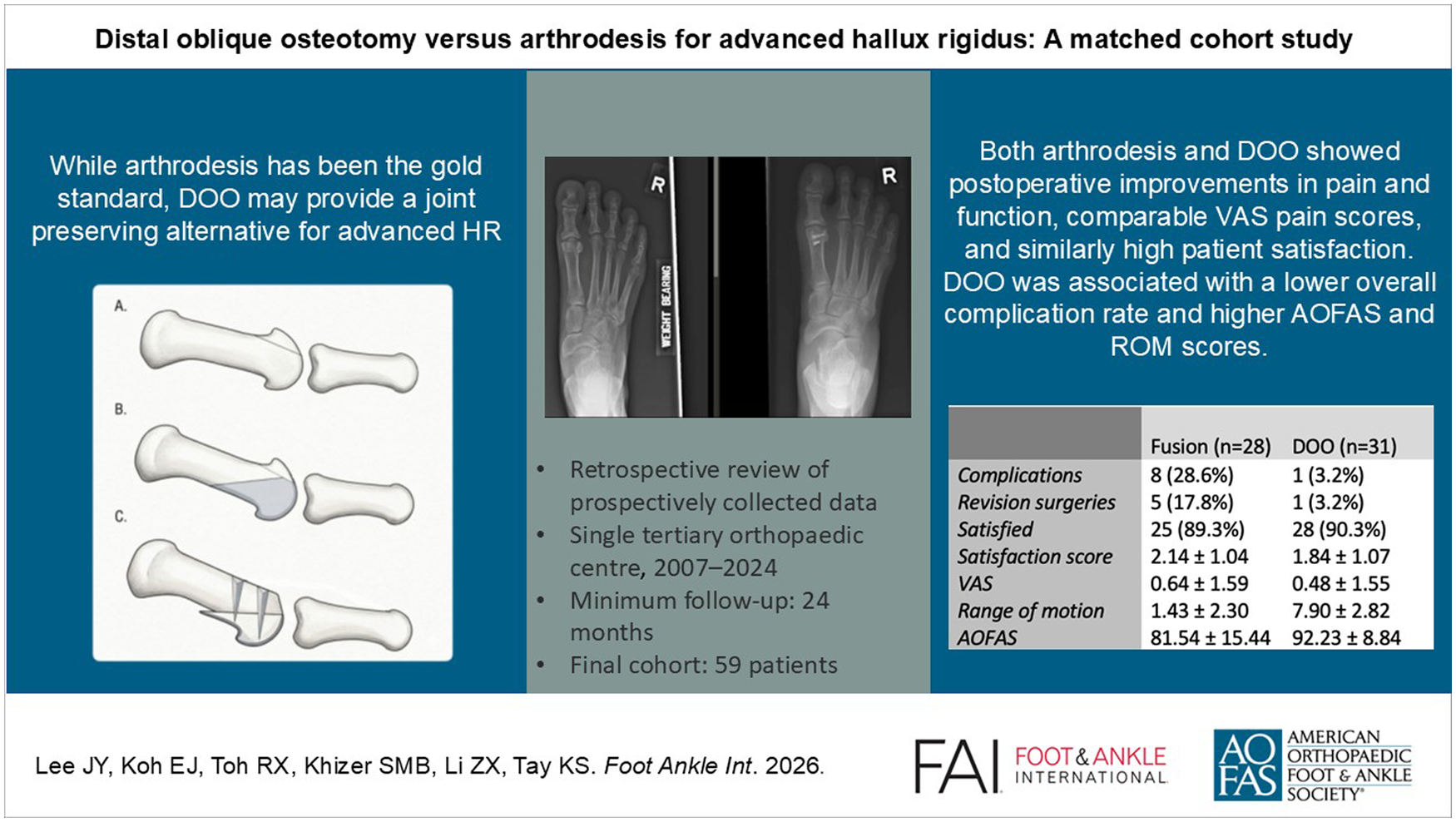
Available accessResearch articleFirst published 2026 , [...]Early results of the fixed-bearing total ankle arthroplasty (TAA) have demonstrated improvement in patient-reported outcome measures (PROMs) for patients with end-stage ankle arthritis. The purpose of this study is to update the previously reported PROMs for the largest cohort of US patients undergoing modern fixed-bearing TAA with the Salto Talaris implant.
A retrospective review was completed of 300 consecutive patients who underwent implantation with 321 modern fixed-bearing TAA by a single surgeon. PROMs were collected prior to surgery, at 3 and 6 months, and yearly thereafter. Collected outcome measures included Veterans RAND 12-Item Health Survey (VR-12), Ankle Osteoarthritis Scale (AOS), and visual analog pain scale (VAS). Presurgical and latest available follow-up (>2 years) PROMs were compared using a mixed effect linear regression with significance level alpha = 0.01 using a Bonferroni-adjusted significance threshold to account for testing across the 5 PROMs.
Of the 321 TAAs, an updated 300 procedures (282 patients) had a minimum 2-year follow-up. The average follow-up was 75.3 (range, 24-193.9) months. The mean physical VR-12 score increased significantly from prior to surgery to latest follow-up, while mental VR-12 scores did not (
At midterm follow-up, fixed-bearing TAA with the Salto Talaris implant was associated with improvement in quality of life, pain, and disability.
Level IV, case series.
This is a visual representation of the abstract.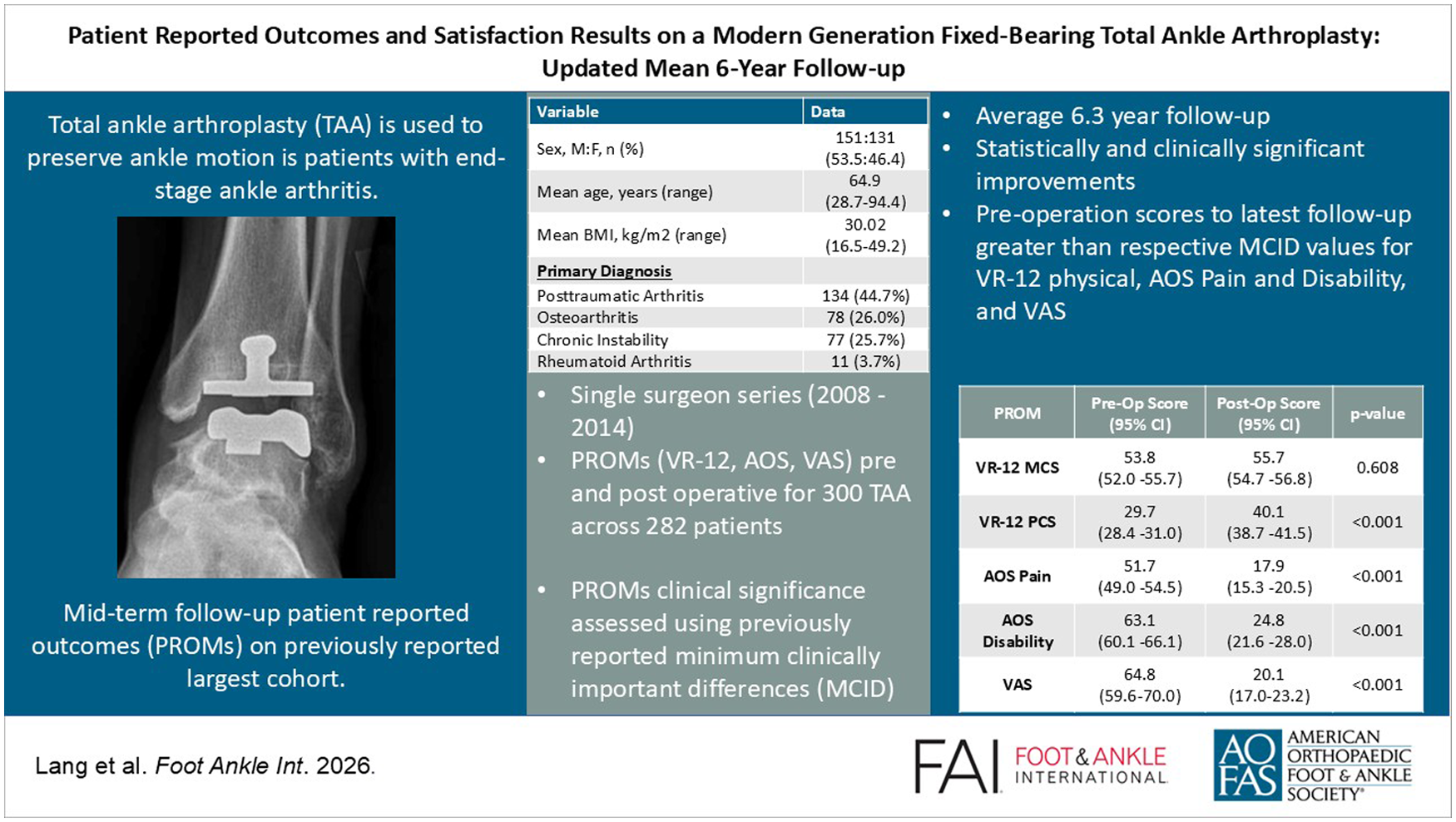
Available accessResearch articleFirst published 2026Nitinol staples (NSs) are increasingly used in foot and ankle surgery; nonetheless, staple breakage incidence and determinants remain incompletely defined. This study examined NS breakage in a large consecutive series, focusing on anatomical site, implant geometry, and fixation strategy.
We retrospectively reviewed 333 patients (379 feet) who underwent foot and ankle surgery with 2-legged NS between 2021 and 2025. Overall, 702 staples were analyzed. Staple breakage was assessed on plain radiographs at a minimum follow-up of 6 months to evaluate implant integrity during the critical phase of bone union. Anatomical location, implant geometry (symmetric vs asymmetric), and fixation type (isolated vs combined) were analyzed. Multivariable logistic regression was performed to explore factors associated with breakage in the hindfoot.
The overall breakage rate was 4.0% (28/702). Breakage rates varied by anatomical site, with higher rates in the calcaneocuboid (22.2%), talonavicular (12.5%), tibiotalar (8.9%), and other joints than in the first ray (0.37%). In the calcaneocuboid joint, isolated staple fixation showed a higher breakage rate (33.3%) than staple fixation with an adjunct screw (6.7%). In second metatarsal shortening osteotomies, asymmetric staples demonstrated a higher breakage rate (35.7%) than symmetric staples (1.0%). Although most breakages were asymptomatic, 2 patients required revision surgery for symptomatic nonunion. In the hindfoot cohort, procedure category (Chopart arthrodesis) showed an association with breakage; however, with the numbers available, no significant association could be detected for body mass index or sex.
The overall breakage rate for 2-legged NS was 4.0%. Breakage was more frequent in several high-demand hindfoot joints, and in second metatarsal osteotomies using asymmetric staples. Hybrid fixation showed a lower breakage rate in the first ray and calcaneocuboid joint. These exploratory findings suggest that anatomical site, staple geometry, and fixation strategy may contribute to the risk of radiographic staple breakage.
 Open accessResearch articleFirst published 2026
A calcaneal osteotomy is a common component of surgical management for various foot and ankle deformities. Open and minimally invasive surgical (MIS) calcaneal osteotomies can be performed. The purpose of this study was to compare complication rates including infection, wound dehiscence, nerve damage, hardware failure, reoperation, and nonunion between these cohorts.
All patients who underwent an open or MIS calcaneal osteotomy between March 2021 and July 2024 at a single institution were identified and retrospectively reviewed. All procedures were performed by one of 2 fellowship-trained orthopaedic foot and ankle surgeons on patients >18 years of age at the time of surgery. These procedures were performed in combination with other procedures to correct planus or cavus feet. Demographic information and postoperative complications were recorded for each patient with a minimum of 12 months follow-up.
Forty-four patients who underwent open calcaneal osteotomy and 26 patients who underwent MIS calcaneal osteotomy met the inclusion criteria for the current study. Patients were followed for a mean 25.3 ± 11.1 months. There was no significant difference in the rate of nonunion (
Data from the current study indicate that open and MIS calcaneal osteotomy are associated with no difference in major complication rates or amount of calcaneal correction. With the numbers available, no significant difference in total or minor complication rates could be detected after FDR adjustment, though fewer minor wound complications were observed in the MIS cohort (3.8% vs 20.5%). Both approaches were associated with significant improvements in patient-reported function and mobility; significant improvement in pain scores was observed in the MIS cohort only after FDR adjustment.
Level IV, retrospective cohort study.
Available accessResearch articleFirst published 2026Managing skeletally mature complex foot deformities (CFDs) remains challenging, and the effectiveness of the Ponseti method (PM) beyond childhood is not established. This study assesses improvements in foot deformity among adolescent and adult patients with idiopathic and acquired CFD treated with serial casting as a presurgical correction strategy.
A retrospective cohort study encompassing 58 skeletally mature patients (78 feet) with idiopathic or acquired CFD treated with a modified PM between 2020 and 2024 was conducted. Patients were categorized by etiology, and deformity severity in cavus, varus, adductus, and equinus was documented at baseline, after casting, and postoperatively. Analysis of variance and Tukey honestly significant difference test assessed changes over time. Postoperative and casting complications, relapses, and Foot and Ankle Outcome Score (FAOS) were reported at final follow-up.
Twenty-eight patients with idiopathic CFD and 30 with acquired CFD were studied. After casting, 95% (55/58) required additional procedures. A plantigrade foot was achieved in 89% (69/78). Seventy-seven percent (60/78) of feet required procedures in addition to Achilles tenotomy. Improvements across all deformity planes were attributable to serial casting (
A modification of the PM, using serial leg casting as a preoperative correction strategy for idiopathic and acquired CFD was associated with reduced need for, or reduced complexity of, major reconstructive foot surgery, with high rates of plantigrade feet and low rates of arthrodesis. This approach could redefine treatment paradigms in resource-constrained settings and for multiplanar correction of foot deformity.
This is a visual representation of the abstract.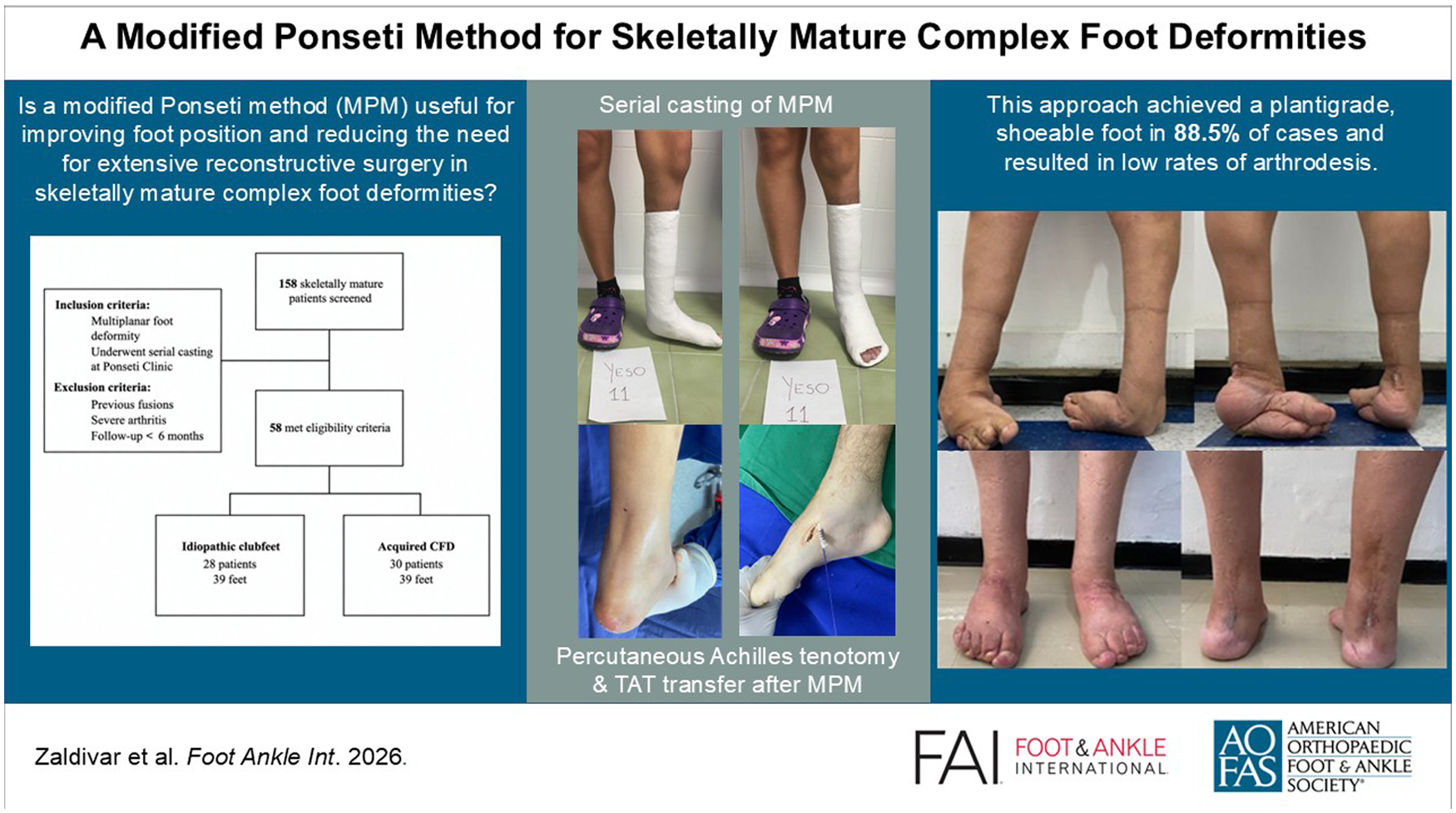
Available accessCorrectionFirst published 2025 Open accessResearch articleFirst published 2024, Eric Jörg Walther
Posttraumatic osteonecrosis (ON) of the lateral distal tibia is a rare but severe complication of malleolar fractures. Treatment options include ankle fusion, arthroplasty, osteotomy, and drilling but clinical data on outcomes are limited to single case reports. The aim of this study was to prospectively evaluate the outcome following joint-preserving reconstruction.
Over a 10-year period, 10 patients (8 females and 2 males, average age 36 years; range, 27-68 years) with posttraumatic ON were treated with intra-articular osteotomy of the distal tibia and bone grafting. All patients initially sustained a closed pronation injury, 7 with initial tibiotalar subluxation. Chronic syndesmotic instability following initial treatment was present in 4 patients and 5 were smokers. All patients were followed for a median of 68 (range, 12-103) months, 7 returned in person for clinical and radiographic follow-up.
No immediate postoperative complications were seen. Secondary ankle fusion was necessary in 1 case (10%) because of progressive osteoarthritis. At the time of follow-up, anterior ankle arthritis leading to impingement and requiring cheilectomy was noted in 4 cases, partial graft necrosis, and secondary syndesmotic instability requiring revision surgery was seen in 1 case each. Compared with the preoperative values, significant improvement in the Olerud-Molander Ankle Score (
In our limited series of patients with posttraumatic ON of the lateral distal tibia, we found that joint-preserving reconstruction using an intra-articular distal tibial osteotomy with autologous bone grafting usually provided significant functional improvement and pain relief. In our cohort secondary fusions by a median 5.5-year follow-up were rare, but secondary, joint-sparing surgeries were common.
Level III, prospective study.
Available accessCorrectionFirst published 2024 Available accessArticle commentaryFirst published 2023