






Abstract
Congenital coalition of the middle and distal phalanges in the fifth toe are common. They have been reported to occur in up to 50% of American and European populations and in up to 73% of people of Japanese descent. Congenital interphalangeal coalition of the other toes is less common. We report two cases of fracture through an interphalangeal coalition following blunt trauma. Diagnosis was delayed in these fractures. One fracture healed only after prolonged immobilization and the other developed a delayed union. Patients with this fracture should be advised of the prolonged convalescence since this may delay their return to preinjury activities.
INTRODUCTION
The frequency of interphalangeal coalition does not differ significantly between fetuses and adults, indicating that this anomaly is not due to bony ankylosis of previously separate phalanges, but is rather a failure of segmentation between the distal and middle phalanges. 3,4 The cause of interphalangeal coalition has been attributed to failure of a middle phalangeal epiphysis to form, which results in a short middle phalanx and at times failure of the middle phalanx to form at all. 5
We report two patients with fracture through a toe interphalangeal coalition. Diagnosis had been delayed. The purpose of this report is to discuss the factors involved in the etiology of this fracture and the difficulty in treating it.
CASE #1
A 35-year-old woman dropped a stack of firewood on her right fifth toe. She had significant pain and swelling in her fifth toe for four weeks after injury and sought care with her family practitioner. Radiographs obtained 4 weeks following her injury were interpreted as not having a fracture. She presented 6 weeks following injury with continued pain and inability to wear a shoe.
Her exam demonstrated normal toe alignment without swelling. The fifth toe was tender to palpation. Bilateral foot radiographs revealed an interphalangeal coalition of the middle and distal phalanges in both fifth toes with a healing fracture through the coalition of the right fifth toe (Fig. 1). She was prescribed buddy taping of the fourth and fifth toes. This, however, increased her pain and she discontinued the taping. She then was prescribed shoes with a wide toe box and a stiff sole and with limited weight bearing. During follow-up examination thirty-two weeks following injury the patient's pain had resolved and the toe became nontender to palpation. Radiographs at time of follow-up documented healing of the fracture at 26 weeks following her injury. The patient returned to her preinjury activities.
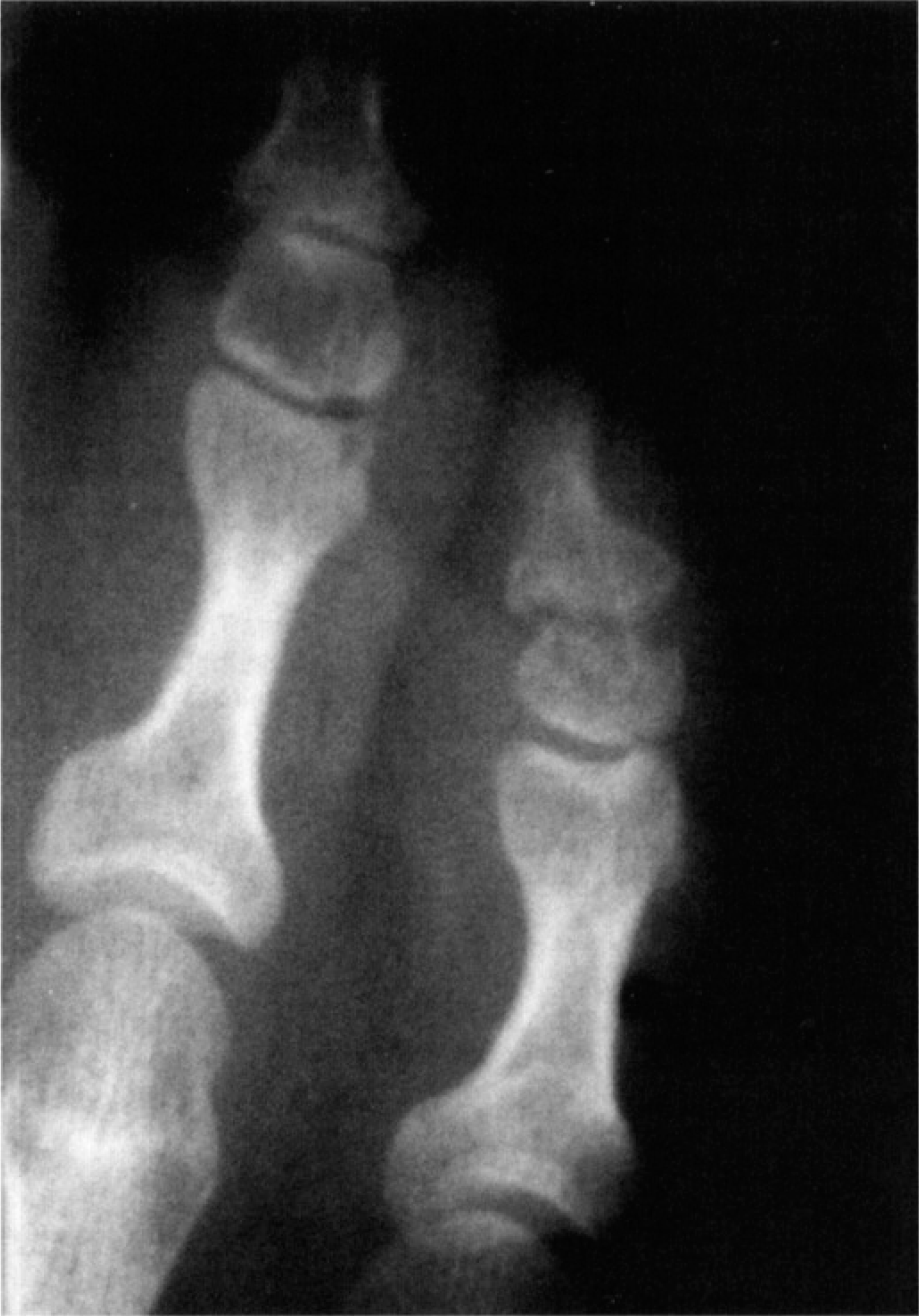
A fractured fifth toe interphalangeal coalition. Note irregular fracture surfaces instead of the normal smooth subchondral bone surfaces expected in a normal distal interphalangeal joint.
CASE #2
A 47-year-old man dropped a steel plate on his left third toe. He saw his family physician three weeks following injury because of continuing pain and swelling of the toe. Radiographs at that time were interpreted as showing no fracture. Because of continuing pain, a bone scan was ordered five weeks post injury, which revealed increased uptake in the third toe.
Examination of the left third toe demonstrated a swollen, erythematous digit. The toe was tender in the region of the middle and distal phalanges. Sensation was decreased to light touch on the dorsal and plantar aspects of the toe. Bilateral foot radiographs revealed bilateral interphalangeal coalitions of the third, fourth, and fifth toes. There was a fracture noted in the left third toe through a congenital coalition of the middle and distal phalanges (Fig. 2). Review of the bone scan confirmed increased uptake in the third toe. The patient was treated with buddy taping of the third to the fourth toe, limited weight bearing and shoes with a wide toe box. Healing was delayed and radiographs six months post injury revealed a nonunion. Clinically, however, his swelling had subsided and his pain decreased considerably. He was satisfied with his clinical result and elected to forego additional treatment including surgery. He has returned to all his preinjury activities.
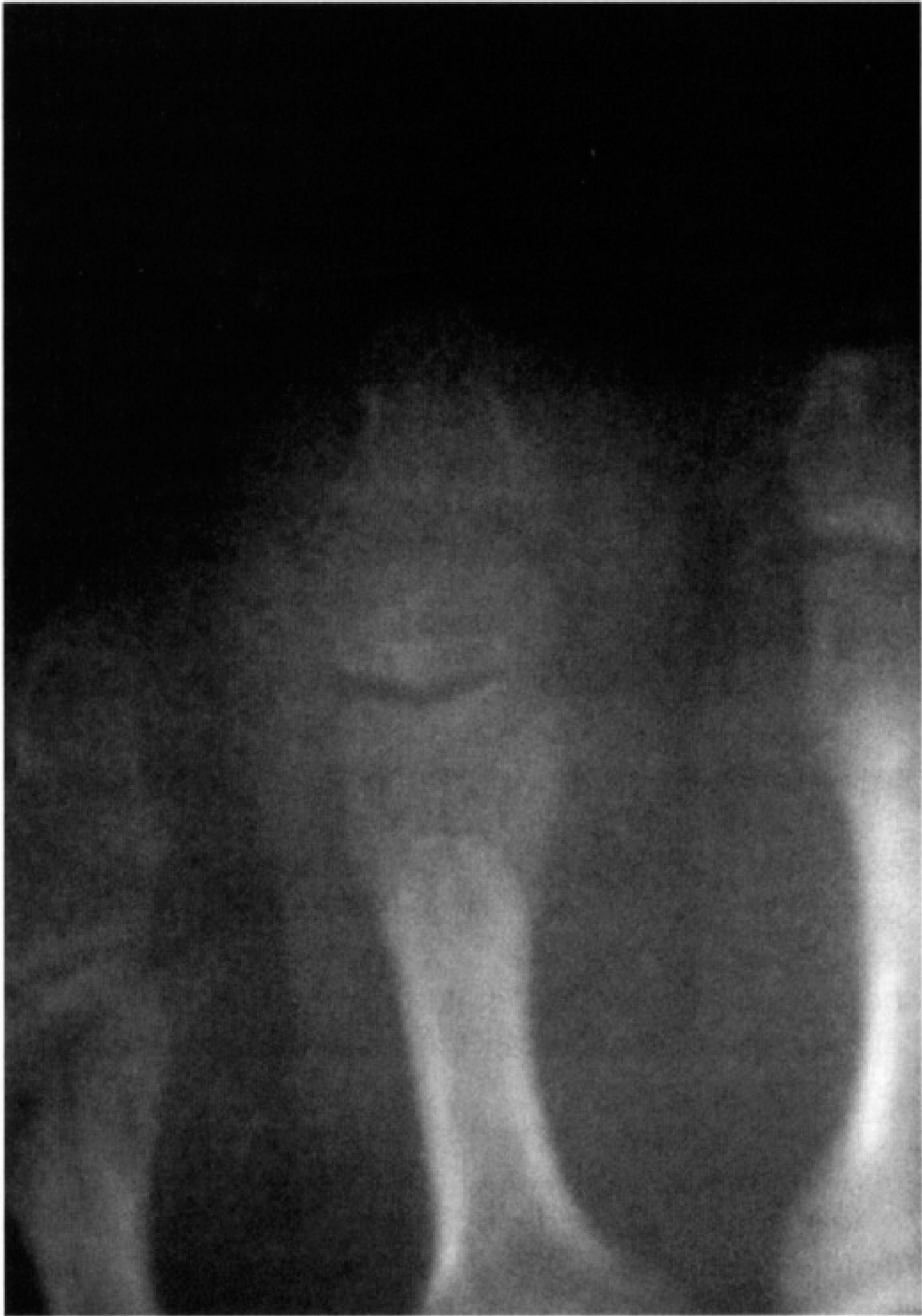
A fractured third toe interphalangeal coalition. This patient had coalitions of his third, fourth, and fifth toes bilaterally.
DISCUSSION
The occurrence of two-phalanged toes is most common in the fifth toe, although any of the lesser toes may be involved. The incidence of interphalangeal coalition of the lateral phalanges has been reported as between 37–40% in populations of European descent and in 73% of populations of Japanese descent. 3 An interphalangeal coalition of a more medial toe seems to occur only if a more lateral adjacent toe is involved. In the general population, the incidence of interphalangeal coalitions of the fourth and fifth toes is 2%, of the third through fifth toes is 0.5%, and of the second through fifth toes is <0.1%. Two-boned toes occur more often in females than males. 5 The incidence of bilaterality of fifth toe interphalangeal coalitions is 88-94% based on a study of 2136 patients. 7
Although this variant was thought to cause no problems clinically, it has been suggested that the unusual shape, length and rigidity of the two-phalanged toe may predispose it to corns and calluses. 6,8 A study of 59 patients by Thompson and Chang found a statistically significant increase in the incidence of hammertoes, clawtoes, soft corns and hard corns in two-boned fifth toes compared to three-boned fifth toes. 9 They suggested that the stiff two-boned toe predisposes it to clinically significant pathology and an increased risk of trauma.
The differential diagnosis of occult toe pain and swelling includes inflammatory arthritis, infection, neoplasm, trauma, and congenital causes. The so called “sausage toe” is pathognomonic for seronegative spondyloarthropathy, such as psoriatic arthropathy or Reiter's syndrome. 10 Neither of our patients showed signs or symptoms of these conditions. A history of direct or indirect trauma makes contusion, dislocation or fracture the most common etiology for toe pain and swelling.
A fracture occurring at an interphalangeal coalition of the middle and distal phalanges may be the result of a stiffened toe with less motion segments and decreased ability to absorb the energy of trauma. A coalition sometimes exhibits a fissure that partially divides the bone into proximal and distal parts. 5 This notch may act as a stress riser, predisposing it to fracture. Finally, the fused phalanx is usually longer than a separate distal or middle phalanx, resulting in a longer lever arm, which may make it susceptible to fracture.
The radiographic appearance of a fracture through a toe coalition can be mistaken for a normal joint, especially if the toe is flexed and a true anteroposterior view of the toe is not obtained. The irregular fracture surface of the fractured coalition should alert the clinician that a fracture is present. A radiograph of the opposite foot is helpful since up to 94% of fifth toe coalitions are bilateral. 7 An MRI or bone scan are not usually necessary as part of the protocol.
The reason for delayed healing of a fractured interphalangeal coalition is unknown. The fracture is difficult to fully immobilize and most patients bear weight immediately. Both the extrinsic and intrinsic muscles of the toe may produce motion at the coalition that prevents or delays healing.
Congenital interphalangeal coalition between the distal and middle phalanges of the fifth toe is common in the general population, and also occurs less commonly in the other lesser toes. A swollen toe following trauma without an obvious fracture of the phalanges should alert the clinician to consider a fracture through an interphalangeal coalition. A prolonged recovery time should be expected and the possibility of delayed union considered.