






Abstract

“Every day you should move enough to get breathless and get unconscious in the middle of the day.”
— Irvin R. Simone, Grinnell College Cross Country Coach
The Olympic Games are about movement and inspiration. Having witnessed the Olympic Games, I am in awe of the physical feats performed by our athletes. In 1956, I followed every event of the Melbourne Olympics and was thrilled when a young American stepped into the ring and hurled the hammer more than 200 feet to defeat the heavily favored Russians. Forty years later, I was privileged to spend an afternoon with Harold Connolly. He still inspires me.
Harold Connolly was coachless when he prepared for the games in 1956. No one knew about burnout. No one knew how much speed and strength training was needed to assure that you would propel a hammer straight forward instead of into the crowd. Connolly figured out if he pushed his body, but also listened to it, he could train successfully. Several times a week he tested his training by leaping to touch the rim of a basketball hoop. At 5′9″, this was no meager task. He could usually leap high enough to dunk the ball. On the days when his legs had lost their spring and he couldn't hit the rim, he would take a day off or cross-train. He was aware that movement must be mixed and balanced and that something was happening to his body. Today, coaches call that “overtraining” or “going stale.”
Dr. Lutter (left) with Harold Connolly, winner of the Gold Medal in the Hammer Throw at the 1956 Melbourne Olympic Games
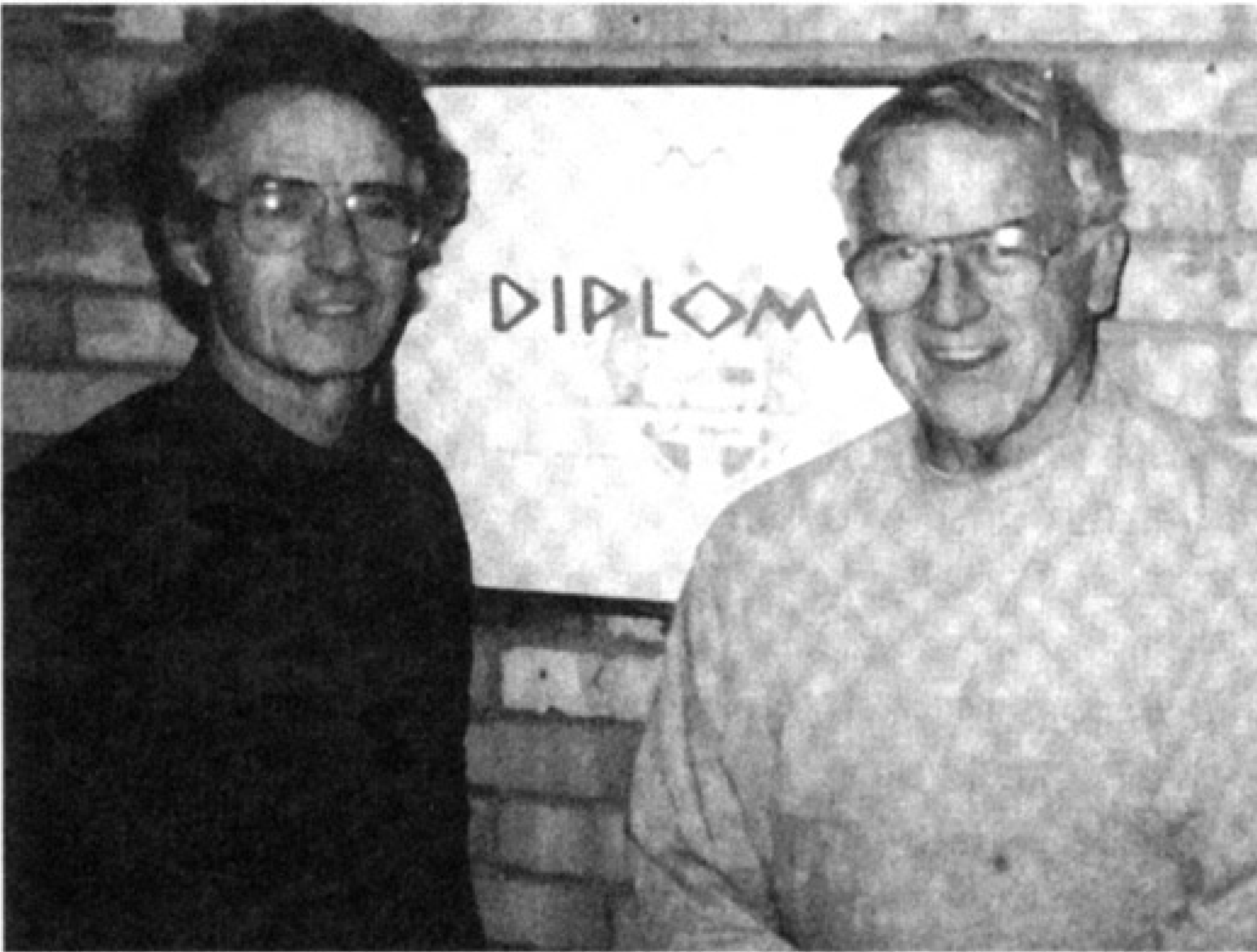
One of the problems that an athlete or surgeon has to deal with as he or she grows older is decreasing physical and mental quickness. Connolly told me he realized that he would never attain that same pinnacle of physical perfection, yet movement, motion, and physical activity remained parts of his lifestyle. To deny this and become sedentary would negate what he felt he stood for. Connolly realized that every day should include some physical movement to supplement his daily mental gymnastics. I like George Sheehan's reflection that we are in “constant competition with previous selves.”
Many of my medical friends remain in competition with their previous selves, but have forgotten the importance of movement and rest (“unconsciousness at midday,” i.e., naps are good!). The best thing that most of us could do to improve our practice would be to skip the breakfast meeting, the HMO contract negotiations, or the seminar on managed care and take a 4-mile walk. The brain is not made to function without a body that moves. Ralph Waldo Emerson knew this. It was Thoreau's religion. The ancient Greeks practiced it, and the modern Olympians live it.
Chatting with Harold Connolly as he pumped away on his excercycle, recovering from total knee arthroplasty, made me realize that the Olympics have a lesson for all of us. What you do in your daily lives is Olympic in nature. To protect your ability to do that, you must seek the balance the Greeks look for with the mind-body-spirit trilogy. “All of us are Olympians,” says Sheehan, “and each day brings with it success and failure that is visible only to ourselves.” A lifelong commitment to some type of inspired motion is imperative if we are to handle the mental gymnastics that the daily practice of providing care requires. While watching a 70-year-old Olympic gold medal champion pumping iron and moving his exercycle, I was inspired and comforted to know that if he can keep moving like that, so can I!
