







Abstract

INTRODUCTION
A below-knee cast often is indicated after an injury or an operation on the lower limb. It provides immobilization of the leg and allows for weightbearing when permissible. The cast can be split into anterior and posterior halves that can be taken apart temporarily to allow intermittent range-of-motion exercises, inspection of the leg, change of dressings and for bathing purpose. The cast can be reassembled to continue with immobilization. Use of fracture braces also can serve such a purpose but are expensive.
The split in a below-knee cast traditionally is made along the sides vertically down the leg and along either side of the foot with a 90-degree angle at the level of the ankle. This split in the cast can, however, weaken its construct. Moreover the 90-degree cut at the level of the ankle can result in a stress riser that weakens the cast and leads to its breakdown at that level. The stress riser can be overcome if the split is curvilinear rather than at 90 degrees. This has been described to give more stability to the split cast. 1 A modification in the technique of splitting the cast is described. Introducing a notch in the split provides further stability to the cast. This technique can be used in short-leg and total-contact casts. The following description shows its application in a short-leg cast.
TECHNIQUE
The patient is positioned on a cast table with the foot and ankle held in the desired position. The entire lower extremity from the toes to the knee is covered with a stockinette and then wrapped with 4-inch cast padding. Synthetic cast material is rolled onto the extremity to complete a short-leg cast incorporating the stockinette at the toes and the knee. The cast is allowed to dry for 10 minutes.
A marker pen is used to delineate the line of the cut on either side of the cast. The line essentially runs vertically down the middle of both the sides of the leg and gently curves forward at the level of the ankle along both sides of the foot. A ‘∠’ shaped notch (Figure 1) is marked out on the lines drawn, at the level midway between ankle and knee joints. A plaster saw is used to cut along the marked lines on either side to split the cast into anterior and posterior shells. The edges are protected with tape. Velcro adhesive straps are applied circumferentially to hold the two halves (Figure 2). The patient is educated on application and removal of the split cast.
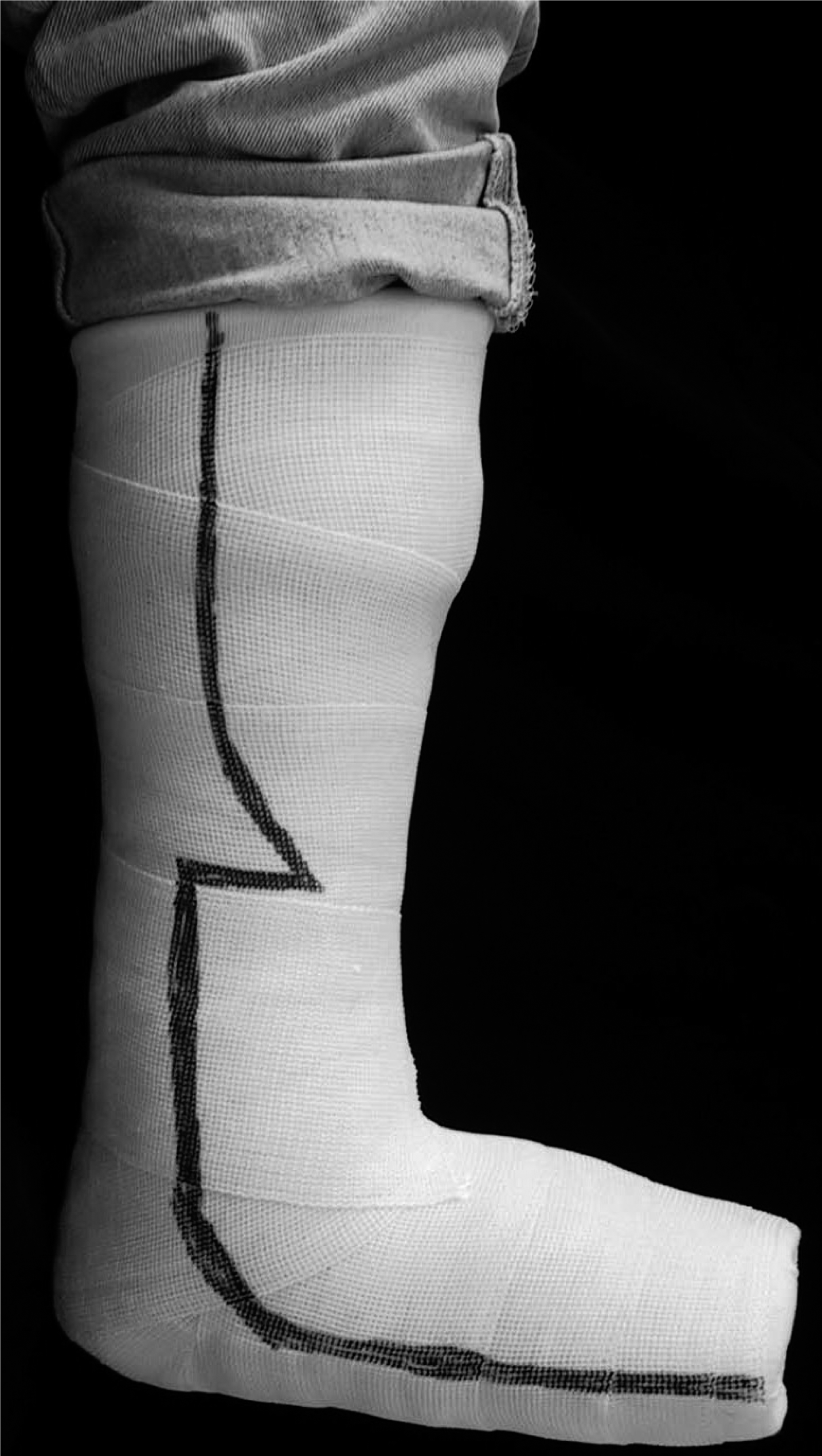
Below-knee cast with outline of the cut incorporating the ‘∠’ shaped notch marked out.
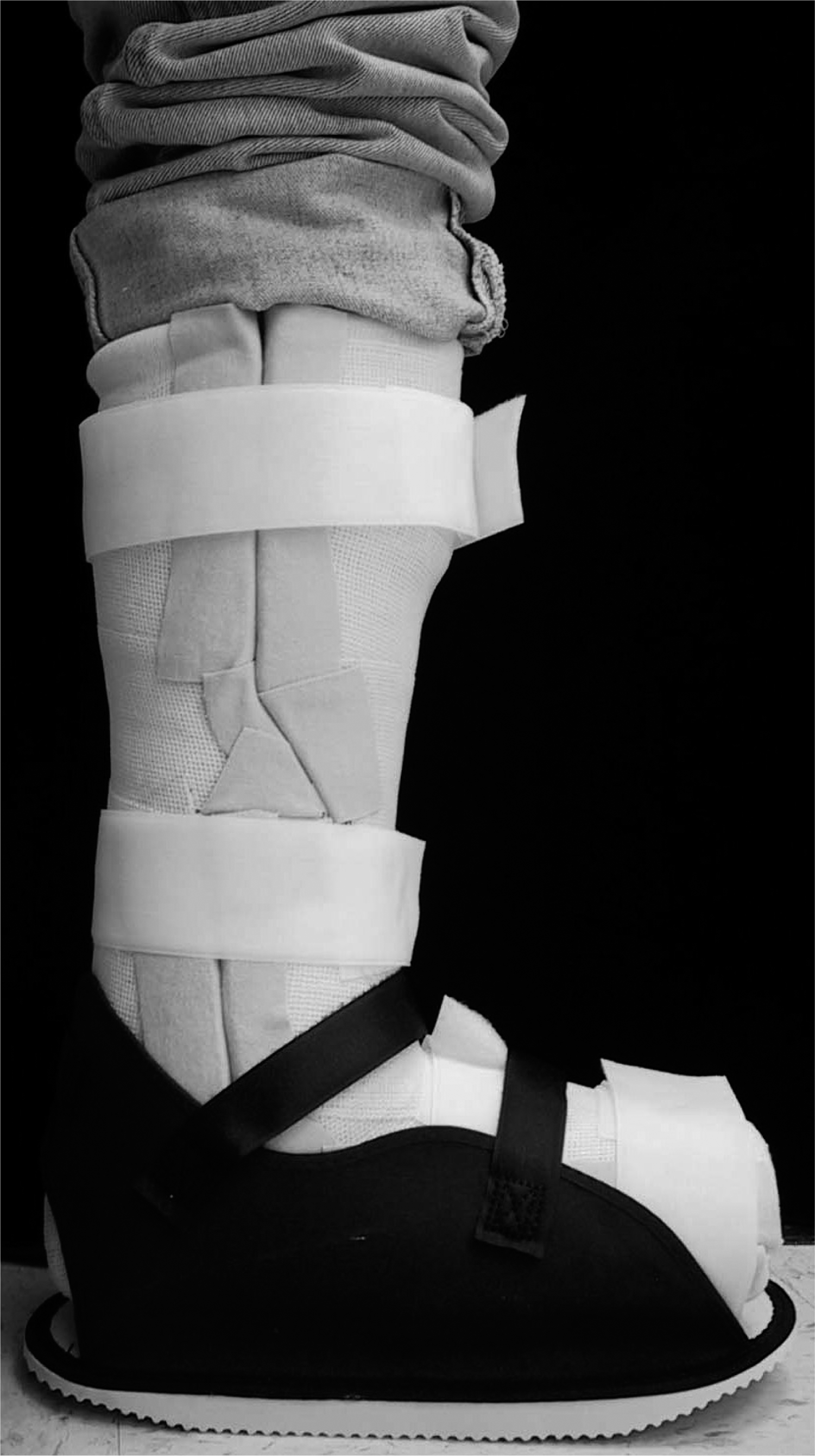
Weightbearing in the finished below knee cast with a stable notch in the split.