






Abstract
Introduction:
Jones fracture and proximal diaphyseal stress fracture of the fifth metatarsal have been associated with prolonged healing times and nonunions. We hypothesized that the Jones fracture and proximal diaphyseal stress fracture have a high incidence in elite collegiate football players and that they lead to a decrease in participation in the NFL. Also, we hypothesized that these fractures are associated with a cavovarus foot alignment.
Materials and Methods:
The database collected by a single NFL team during the 2004 to 2009 NFL Combines was reviewed to identify players with Jones and proximal diaphyseal fifth metatarsal fractures. A total of 74 fifth metatarsal fractures were identified in 68 players. Subsequent participation data also were collected through the NFL.com website and included games played and years played. Digital plain radiographs and additional imaging studies also were reviewed to determine the extent of healing, types of fixation utilized, and foot alignment.
Results:
The locations of fractures in the proximal fifth metatarsal were 45 (61%) in the Jones area, 15 (20%) in the proximal diaphyseal area, and 14 (19%) of indeterminate location. The number of patients treated with intramedullary fixation was 55/74 (74%). Of 74 proximal fifth metatarsal fractures, 9 (12.2%) were nonunions at the time of the NFL Combine medical examinations. With the numbers available, the average number of games played in the NFL was not significantly different in the fifth metatarsal fracture group, 16.9, compared to the control group, 24.9 (P > .05). The average number of games started was 7.4 in the fracture group versus 12.1 in the control group (P > .05). No significant differences were noted in the number of years played in the NFL. Except for talonavicular angle measurements, all measurements of coronal plane alignment demonstrated significant differences across groups, but no differences were noted in sagittal plane alignment.
Conclusion:
No statistically significant difference was noted in participation in the NFL following Jones fractures and proximal diaphyseal stress fractures of the fifth metatarsal, although a trend toward decreased participation was noted. Radiographic abnormalities were noted in the coronal plane with varus alignment, but not in the sagittal plane.
Level of Evidence:
Level III, retrospective cohort study.
Fractures of the proximal fifth metatarsal have been classified into 3 anatomic subgroups: tuberosity avulsion fractures in zone 1, fractures at the metaphyseal/diaphyseal junction (Jones fracture) in zone 2, and proximal diaphyseal stress fractures in zone 3.3,9 Of these fractures, metaphyseal-diaphyseal junction (Jones fractures) and proximal diaphysis have been identified as fractures at risk for refracture, nonunion, and delayed union, particularly in more active individuals.4,8-10,12,18,20,24,25 The difficulties in healing of these fractures have been explained by a watershed in blood supply. 22 Failure rates of healing of these fractures have varied widely from 0 to 40%,2,4,8,17,18,24,25 and the reported time lost from sport has been as high as 66 months. 25
Approximately 45% to 70% of all metatarsal fractures involve the fifth metatarsal.6,14,15,23 A national study of the incidence of foot fractures presenting to emergency rooms demonstrated the incidence of Jones fractures to be 0.7% to 1.9% of all foot fractures. 8 However, the prevalence is higher in the elite football player with 17.8% incidence of all foot fractures in the NFL injury surveillance system from 1996 to 2001. 11
Various treatment options have been reported for the treatment of Jones fractures and proximal diaphyseal stress fractures of the fifth metatarsal. Nonoperative treatment with cast immobilization and prolonged non-weight-bearing, as well as surgical treatment with screw fixation, onlay bone grafting, or cerclage wiring have been described, with and without bone grafting. 26 Advantages associated with operative treatment have included reduced time to union, an increased union rate, and earlier return to sports, particularly in athletes.2,4,10,17,18,24 Factors associated with nonunions have included failure of immobilization, early weight-bearing, the presence of intramedullary sclerosis, and use of screw fixation smaller than 4.5 mm diameter.4,26 Concern for refracture has been noted more in the elite athlete both with and without operative fixation.
The purpose of this study was to determine the incidence, effect on NFL participation, and radiographic parameters of foot alignment associated with Jones fractures and proximal diaphyseal stress fractures in elite collegiate football players. We hypothesized that the Jones fracture and proximal diaphyseal stress fracture lead to a decrease in participation in the NFL and are associated with a cavovarus foot alignment.
Methods
Between 2004 and 2009, 1987 elite college athletes were medically examined at the NFL Combines. All participants were asked to report current and past injuries, as well as previous surgeries. Players were routinely questioned regarding initial treatment and the results of treatment. Standard radiographs of the involved areas were routinely obtained prior to examination. The information detailing injuries was made available to all team physicians during the Combines. Scouting reports were also incorporated into player evaluations when available. Clinical exams and radiographic findings were recorded yearly at the time of the Combines, and these reports were reviewed retrospectively. All imaging studies, including CT scans, magnetic resonance imaging, and bone scans, were available digitally, and their interpretation by experienced musculoskeletal radiologists was available for review.
In this study to determine bone union and extent of healing in the athletes, plain radiographs were routinely reviewed, and additional imaging studies were obtained when necessary, including CT scan in 10, MRI in 4, and bone scans in 2. Player positions were collected to determine differences in injury patterns and outcomes across positions and were divided into offensive linemen, defensive linemen, tight ends, running backs, linebackers, wide receivers, quarterbacks, punters, and defensive secondary.
The NFL.com website was reviewed to determine the round in which the player was drafted, the number of games started, and the number of games played in a season. Radiographic parameters were measured using PACS software. Following calibration, measurements made to determine foot alignment included Meary’s Angle (normal range of −4 to 4 degrees) with cavus alignment being greater than 4 degrees and flatfoot alignment being less than −4 degrees, 5 calcaneal pitch (normal range of 20-25 degrees) with cavus alignment being greater than 30 degrees and flatfoot less than 15 degrees, talar first metatarsal angle (normal 0-20 degrees of valgus), and talonavicular coverage angle (normal approaches 0 degrees). We also examined the talar fifth metatarsal angle and the talar second metatarsal angle, which have not been validated or previously reported to the best of our knowledge.
A control group consisting of various foot injuries was identified for comparison and was matched based on the medical grade, player position, body mass index (BMI), and whether the player was drafted. The injuries that composed the control group consisted of 10 foot contusions, 8 traumatic first through fourth metatarsal fractures, 7 toe fractures, 3 ankle sprains, 2 Achilles insertional pain, 1 soft corn, 1 Haglund deformity, 1 flexor hallucis tendonitis, 1 gunshot wound, 1 midfoot arthritis, and 1 Morton’s neuroma.
Statistical analysis was performed using IBM SPSS Statistics, version 19, and survival analysis was performed using Cox regression. A number of variables related to fracture union were examined for statistical significance including operative versus nonoperative treatment, BMI, radiographic parameters in the coronal and sagittal planes, screw diameter, percentage of screw diameter to inner cortical diameter, percentage of screw length to metatarsal length, and cannulated versus solid screw.
Results
The incidence of proximal fifth metatarsal fractures at the NFL Combines between 2004 and 2009 was 3.42%. There were 74 proximal fifth metatarsal fractures in 68 athletes, with 6 players having bilateral injuries. The location of fracture based on radiographic review was Jones in 61%, proximal diaphyseal in 20%, and indeterminate in 19%.
The number of injuries by player position included offensive line 21 (28%), defensive line 11 (15 %), defensive backfield 10 (14%), linebackers 8 (11%), wide receivers 7 (10%), running backs 6 (8%), quarterbacks 4 (5%), tight ends 4 (5%), and punters 3 (4%).
When comparing the fracture group versus the control group, no significant difference was noted, 71% versus 72%, with regard to being drafted in the NFL. Medical orthopedic grading was not statistically significant in the fracture group 2.14 versus the control group 2.31 (P = .594). BMI was 32 in both the fifth metatarsal fracture group and control group.
A total of 56 (76%) fractures were treated with surgical fixation and 18 (24%) were treated nonoperatively. The average screw width was 4.0 mm (SD = 0.75), and the average screw length was 40 mm. The screw diameter was not statistically significant between groups with 4.0 mm for the union group and 4.3 mm for the nonunion group. All 55 fractures were treated with intramedullary fixation except 1 who was treated successfully with only bone grafting and immobilization. The type of screw was cannulated in 59%, solid in 30%, and tapered in 11%. All of the cannulated screws were partially threaded except 1, and all of the solid screws were partially threaded except 2. The overall nonunion rate was 12.2% (9/74), with 10.7% (6/56) for the surgical fixation group and 16.7% (3/18) for the nonoperative group. The percentage of screw fill, measured using the width of the screw threads divided by the narrowest medullary width (isthmus) within which the screw threads were engaged, was not statistically significant between the 2 groups, with an average of 68.6% for the union group and 71.8% for the nonunion group (P = .42).
Logistic regression analysis was performed to see the effect of BMI and the fractured area (Jones vs proximal diaphysis) on union rates. BMI (r = .270, P = .052) and the fractured area were not correlated with union rates, and no correlation was noted between the fractured area and union rates (P = .177). No correlations were found between the width of the screw, the percentage of screw fill, the length of the screw, the length of the metatarsal, and the percentage of screw length versus metatarsal length.
At the time of the NFL Combines, 6 athletes had revision surgeries for nonunions. The locations of the nonunions were 4 Jones fractures, 1 proximal diaphyseal fracture, and 1 indeterminate fracture. Of the athletes, 2 subsequently healed and 2 failed revision surgery with a solid screw, with 1 never playing in the NFL and 1 playing 1 game in the NFL. An athlete failed 3 surgeries, with the most recent surgery including solid fixation, and he never played in the NFL. Another had an asymptomatic nonunion and played in the NFL for 3 years and started in 5 games.
The number of players who played fewer than 10 games in the NFL was significantly higher in the fracture group (32/68, 47%) compared to the control group (11/31, 35%; P = .042). Comparison between the fracture and control groups demonstrated no significant difference in the total number of games played in the NFL, although a trend was noted; fracture group 16.9 games (SD = 20.7) versus control group 24.9 games (SD = 28.2; P = .115). The average number of games started was higher in the control group, 12.1 games (SD = 24.1), than the fracture group, 7.4 games (SD = 13.6), but not statistically different (P = .31).
An assessment of the effect of a proximal fifth metatarsal fracture on NFL career length was completed with a survival analysis using Cox regression. The survival analysis (Figure 1) reflected a trend toward decreased NFL career length in players with a previous proximal fifth metatarsal fracture, but was not statistically significant (P = .073).
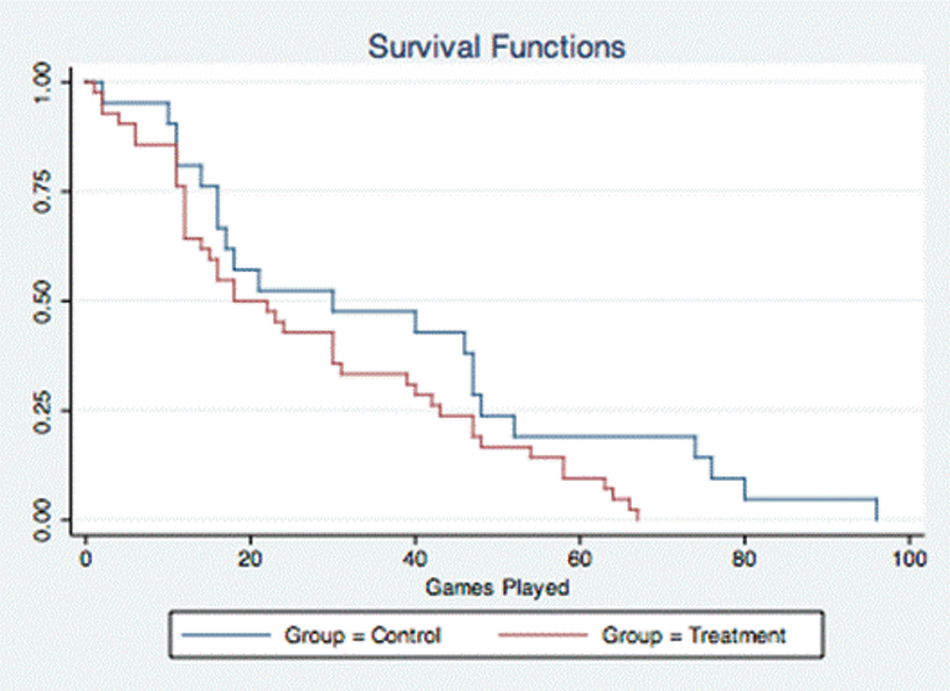
Survival analysis. Treatment, fifth metatarsal fracture.
On AP views of the foot, the average talar first metatarsal angle was 1.9 degrees versus 6.5 degrees (P = .015), talar second metatarsal angle was 8.0 degrees versus 14.6 degrees (P = .001), the talar fifth metatarsal angle was 21.4 degrees versus 29.6 degrees (P = .001), and the talonavicular angle was −7.6 degrees versus −9.1 degrees (P > .05). On lateral views of the foot, the average Meary’s angle was 2.0 degrees versus 3.1 degrees (P > .05) and the average calcaneal pitch angle was 17.5 degrees versus 17.7 degrees (P > .05). Statistically significant differences were not noted in sagittal plane foot alignment. Coronal plane foot alignment demonstrated statistically significant differences across the fracture group and control group for all measures except the talonavicular angle (Table 1).
Radiographic Parameter Comparison
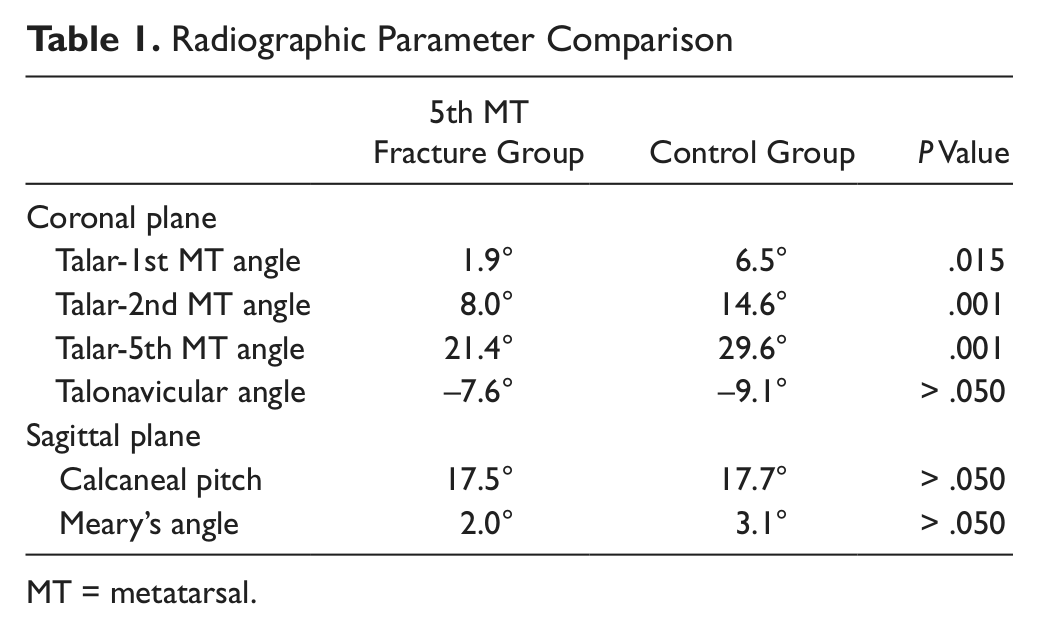
MT = metatarsal.
In addition to complications related to bone healing, complications of surgical treatment included 1 screw backing out and 5 painful hardware. Five patients underwent hardware removal, 2 of which had associated nonunions.
Discussion
Treatment of proximal fifth metatarsal fractures has been recommended based on the location of fracture and activity level. Based on the Torg classification, type I fractures may be treated in a cast with non-weight-bearing for 3 to 12 weeks. For type II (Jones fracture) and type III (proximal diaphyseal) fractures in the active individual, most authors have recommended ORIF to avoid prolonged immobilization and to decrease delayed unions or nonunions. Difficulty in distinguishing between the type II and type III has been recognized because of their close proximity, and a recent study determined that differentiation between these fracture types is not necessary because the treatment and outcomes were not significantly different between the 2 locations. 2 Our results also did not demonstrate any significant differences between type II and type III fractures with respect to treatment and outcomes.
Results of treatment of Jones fractures have varied widely in the literature. Porter et al reported a 100% union rate using immediate screw fixation in 22 patients. 17 Quill reported that 1 in 3 conservatively treated fractures refractured and therefore recommended early surgical treatment. 18 A recent study by Mologne et al 13 randomized patients with Jones fractures to 8 weeks non-weight-bearing cast treatment or early intramedullary screw fixation. Operative treatment reduced time to union and return to sport in nearly 50%. Nunley et al reported a return to full function to be prolonged by an average of 5.5 months for nonoperative treatment as compared to operative treatment. 2 Our results demonstrate the difficulties in treatment of this athletic population, with a union rate of 89% in operatively treated fractures and of 83% in nonoperatively treated fractures. The small screw size (average 4.0 mm) and high BMI (average 32) were not correlated with the nonunion rate, although a larger sample size may have demonstrated significance.
In the management of Jones and proximal diaphyseal fifth metatarsal fractures, the type and size of screw fixation remains controversial. Biomechanical data comparing cannulated versus solid 4.5 mm screw fixation have not demonstrated differences in simulated fifth metatarsal fractures in regard to initial stiffness and the force to final displacement. 16 Furthermore, Shah et al examined the size of screw fixation, and found no differences between 5.5 mm versus 4.5 mm screws in initial fixation strength or ultimate load to failure. 21 However, these studies did not look at cyclic loads to failure. Glasgow et al discouraged the use of cannulated screw fixation after noting failure in 1 patient. 4 Reese et al recommended the use of the largest screw possible and recommended caution with the use of screws less than 4 mm in diameter. 19 Porter et al reported very high union rates with both 4.5 mm and 5.5 mm screws in 2 separate studies. 17 Horst et al found resistance of torsional forces to have no difference between 5.0 mm and 6.5 mm screws. 7 In our study, the frequent use of solid screws was noted, particularly in the revision setting, and no significant differences were noted with respect to screw type or size and healing rates.
Offensive linemen were the most frequently injured position group in our study, at 28% of injuries across all positions. BMI did not correlate significantly with the incidence or healing of the fractures. A significant difference was noted in the number of players playing in fewer than 10 games between the fracture and control groups. However, no significant differences were noted between the fracture and control groups with respect to total games played, years played, or games started, although trends were noted to reflect decreased play. A recent study of survivorship of NFL Combine players with a history of shoulder stabilization did show a significant decrease in survival in the NFL. 1 In our study, survival analysis demonstrated a shorter career length in athletes with a history of proximal fifth metatarsal fractures, but was not of statistical significance.
To our knowledge, this is the first study to isolate radiographic factors associated with proximal fifth metatarsal fractures. Coronal plane alignment, as measured by talar first metatarsal angle, talar second metatarsal angle, and talar fifth metatarsal angle, did show significant differences between the fracture and control groups, with an associated increased fracture occurrence in varus foot alignment. Alignment in the sagittal plane, as measured by Meary’s angle and the calcaneal pitch, did not differ between the fracture and control groups.
In comparison to a previous study of players at the NFL Combines from 1998 to 2002, 11 a trend toward increased operative fixation was observed, with our study noting 76% surgical treatment versus the previous study noting 53% surgical treatment. Other trends noted include an increased incidence of proximal fifth metatarsal fractures from 1.8% in the previous study to 3.4% in our study. There was no significant change in union rates with surgical treatment with 89% in a previous study versus 89% in our study.
The main weaknesses of the study are related to this being a retrospective review of the data collected at the time of the NFL Combines. The duration of treatment, including type and duration of immobilization with and without surgical treatment, and the timing with respect to sports participation were not routinely collected. Larson et al have reported that return to full activity before complete radiological union was predictive of failure, 10 and this information was not available in our study. The use of bone graft, type of bone graft material (allograft or autograft), timing from diagnosis to surgery, and presence of sclerosis, all of which have been noted to be significant factors related to union rates, were not routinely collected.4,10,12,20
Another weakness of the study was the use of a control group composed of players with a history of foot injury. Because radiographs of players are obtained only in the setting of a report of past injury, the control group may have been limited by these injuries with regard to participation in the NFL. We reduced this bias by selecting a control group that consisted of injuries that are not associated with malalignment (cavovarus or pes planovalgus) and that are considered acute injuries. However, a control group consisting of players who had never had a foot injury may have resulted in a statistically significant difference in participation in the NFL.
Conclusion
Jones fractures and proximal diaphyseal fifth metatarsal fractures in the elite collegiate American football population have high nonunion rates. Varus alignment of the foot is significantly associated with these fractures, but cavus alignment did not show significance. Differentiation of these fractures by location did not affect treatment or outcomes, and we agree with the recommendations of Chuckpaiwong et al for distinguishing the location of these fractures. A trend toward decreased participation in the NFL was noted, although only participation in fewer than 10 games was found to be statistically significant.
Footnotes
Declaration of Conflicting Interests
The author(s) declared no potential conflicts of interest with respect to the research, authorship, and/or publication of this article.
Funding
The author(s) received no financial support for the research, authorship, and/or publication of this article.